A practical guide to the “third option” between outsourcing your outbound and hiring a full-time team in a new Asian market
You need outreach in a new Asian market.
You are not ready for a full-time hire.
You do not want to hand everything to an agency.
So what is left?
For many B2B teams, the answer is a fractional SDR: a sales development representative who works part of their time on your account, inside your process, instead of joining as a full-time employee. (SDR: the person who runs first outreach, qualifies prospects, and books meetings.)
A fractional SDR can give you:
- local-language outreach without a full hire;
- faster start than recruiting;
- flexibility to scale up or down;
- a way to learn the market before committing headcount.
Most teams ask:
“Should we outsource outbound or hire our own SDR?”
But for B2B companies entering a new Asian market, the better question is:
“How much of a person do we need, for how long, and who will manage them?”
Because the right model depends on how proven your market is—not on which option sounds cheaper.
This guide builds on our pillar, Breaking Into Asia: 5 Critical Asia Expansion Mistakes, and our guide on when to hire a local sales team in Asia. For full outsourcing comparisons, see Outsourced vs In-House Sales Teams: Which Works Better in Southeast Asia?.
- TL;DR — Key Takeaways (our view)
- A fractional SDR is part of a person’s time, working inside your process.
- It sits between outsourced SDR services and an in-house hire.
- It fits best when demand is promising but not yet proven.
- You still need a manager and a closer on your side.
- Agree hours, reporting, and handover rules upfront.
- Move to full-time when the pipeline justifies it.
If you only do one thing: name the person on your side who will manage the fractional SDR and take the meetings they book.
Who This Guide Is For—and Who It Is Not For
This Guide Is For
- founders opening a first Asian market;
- sales leaders who need local-language outreach without a full hire;
- companies testing several Asian markets with limited budget;
- teams that want more control than a fully managed service;
- companies considering sales staff augmentation (adding outside people to your own team).
This guide is especially useful if your team is asking:
- What exactly is a fractional SDR?
- How is it different from outsourcing?
- When should we hire full-time instead?
- How do we manage a part-time SDR well?
This Guide Is Not For
- you already have proven pipeline that needs full-time capacity;
- you want a hands-off, fully managed program;
- you need senior account executives who close deals, not SDRs;
- you have nobody internally to manage the work.
Practical fit check: if you can name who will take the meetings, and you are not sure the market justifies a full-time hire yet, read on.
What a Fractional SDR Means
A fractional SDR is a sales development representative who works part of their time on your account, often a set number of hours per week, rather than as a full-time employee. They run first outreach, qualify prospects, and book meetings, and usually work inside your tools and processes as an extension of your team.
Fractional vs. Outsourced vs. In-House SDR (Our Comparison)
| Factor | Fractional SDR | Outsourced SDR Service | In-House SDR |
|---|---|---|---|
| Time commitment | Part of a week | Program-based | Full-time |
| Works in your tools | Usually | Sometimes | Yes |
| Who manages day to day | Shared; you set direction | Provider | You |
| Speed to start | Fast | Fast | Slow (recruiting) |
| Market knowledge | Depends on person | Depends on provider | Builds over time |
| Flexibility | High | Medium | Low |
| Best stage | Testing and early pipeline | Testing or scaling | Proven demand |
The terms overlap in the market, and many providers offer more than one model. What matters is who manages, whose process is used, and how much time you get.
For the difference between SDR and BDR roles (BDR: business development representative, often focused on outbound new business), read SDRs vs BDRs in Asian Marketing Expansion.
Practical Rule (our take)
Buy the time you need for the stage you are in.
Why Companies Consider Fractional SDRs in Asia
Reason 1 — Full-Time Hires Have Fixed Costs
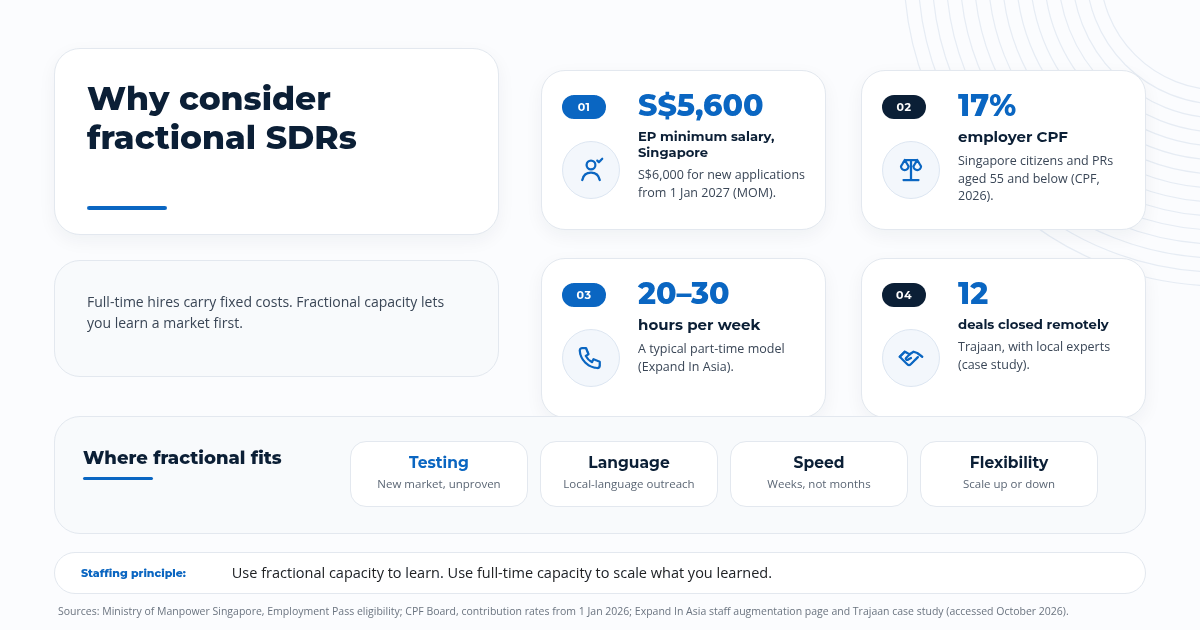
In Singapore, for example, a foreign hire on an Employment Pass must meet a minimum qualifying salary of S$5,600 a month, rising to S$6,000 for new applications from 1 January 2027 (higher in financial services and for older candidates).1 For Singapore citizens and permanent residents aged 55 and below, employers also contribute 17% CPF (Singapore’s mandatory retirement savings scheme) on ordinary wages up to S$8,000 a month, as of 2026.2 These are floors and fixed costs, before recruiting, benefits, and management time.
Reason 2 — Demand Is Often Not Proven Yet
In our experience, many companies enter Asia with interest, not evidence. A fractional SDR lets you build evidence before committing headcount. See How to Validate Product-Market Fit in a New Asian Market.
Reason 3 — Speed Matters
Recruiting a good SDR in a new country takes time. Expand In Asia’s staff augmentation page, for example, lists a typical setup time of one to two weeks for fractional professionals.3
Reason 4 — Local Language and Context
A fractional SDR based in or from the market can run outreach in the local language and understand local business etiquette, which a headquarters team usually cannot.
Practical Rule (our take)
Use fractional capacity to learn. Use full-time capacity to scale what you learned.
When a Fractional SDR Makes Sense—and When It Doesn’t
| Situation | Fractional SDR? (Our View) |
|---|---|
| Testing a new Asian market | Often a good fit |
| Need local-language outreach in two or three markets | Good fit, one per market or language |
| Proven pipeline, need daily volume | Consider full-time |
| No internal manager or closer | Not yet; fix that first |
| Complex enterprise sale needing deep account work | Possible, paired with a senior seller |
| Want a fully hands-off program | Consider a managed outsourced service |
Relatable Example
A software company selling to manufacturers wants to test Vietnam and Thailand. It is not sure either market will work. One fractional SDR per market, for part of the week, gives it local outreach and real feedback without two full hires.
Costs: How to Compare Models Fairly
We do not publish typical fractional SDR rates here because they vary widely by provider, market, language, and seniority. Instead, compare full costs.
| Cost Item | Fractional | Outsourced Service | In-House |
|---|---|---|---|
| Salary or fee | Part-time fee | Program fee | Full salary |
| Statutory costs (e.g., CPF in Singapore) | Usually handled by provider | Handled by provider | You pay |
| Recruiting | Minimal | None | Yes |
| Tools and data | Sometimes included | Often included | You pay |
| Management time | Yours, partly | Lower | Yours, fully |
| Exit cost if market fails | Low | Low to medium | Higher |
Our View
The cheapest monthly fee is not the cheapest model if nobody manages the work and meetings are wasted.
How to Set Up a Fractional SDR Engagement
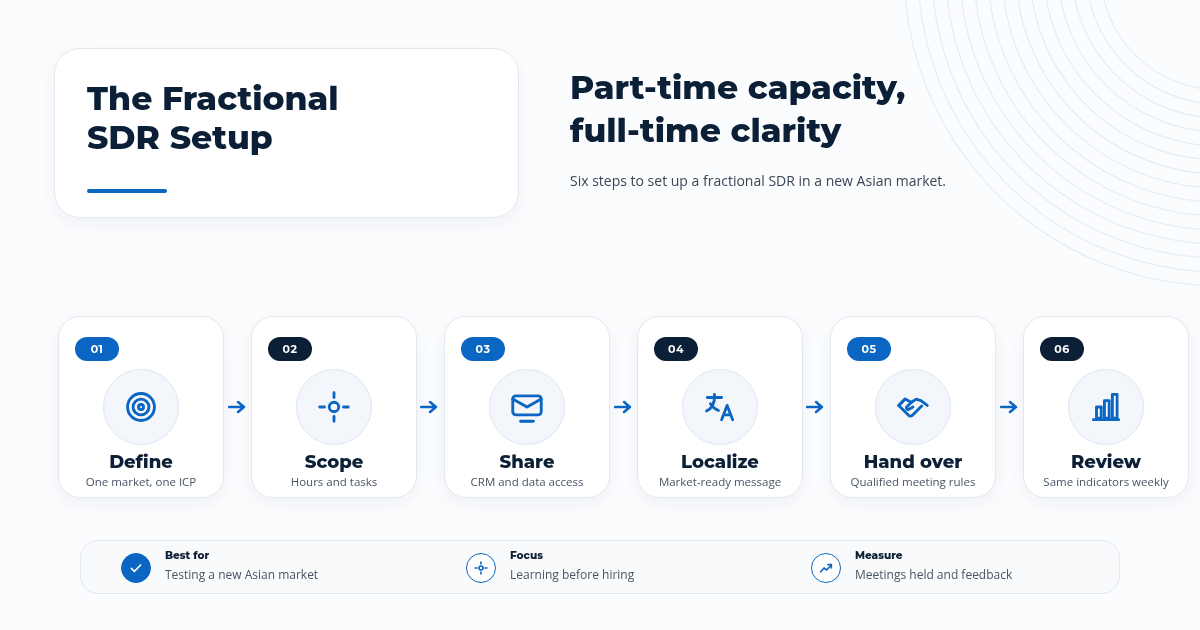
Our framework, the Fractional SDR Setup, has six steps.
Step 1 — Define the Market and ICP
Choose one market and one buyer profile first (ICP: ideal customer profile, the type of company and role you want).
Step 2 — Set Hours and Scope
Agree how many hours per week and what the SDR will do: research, outreach, follow-up, and booking.
Step 3 — Share Tools and Data
Give access to your CRM (customer relationship management system) so activity and meetings are visible in one place.
Step 4 — Localize the Message
Adapt your message to the market’s language and buyer norms. See Why Your Home-Market Sales Playbook Stalls in Asia—and What to Localize First.
Step 5 — Agree Handover Rules
Define what a qualified meeting is, who takes it, and how fast follow-up happens.
Step 6 — Review Weekly
Review the same indicators every week: reach, response, meetings held, and feedback. See Leading Indicators That Prove Your Asia Expansion Is Working.
Practical Rule (our take)
A fractional SDR needs full-time clarity.
How to Manage a Fractional SDR Well
Our Recommendations
- Name one manager on your side who meets the SDR weekly.
- Fix the hours and the days they will work on your account.
- Share context: product, proof points, and common objections.
- Log feedback: what buyers say, in their words.
- Protect the handover: meetings booked must be taken quickly.
- Keep the CRM clean: one source of truth.
Expand In Asia’s readiness tool notes that a new SDR team without close management usually creates activity faster than learning.4 That applies even more to part-time capacity.
What a Fractional SDR Should Not Do
Clear limits protect both sides.
- Close deals that need senior negotiation, pricing authority, or contract decisions.
- Make promises about product, price, or delivery that your team has not approved.
- Use contact data in ways that break local data protection rules. Check each market’s requirements with your advisers.
- Work without a brief. A part-time SDR cannot guess your positioning.
Mini Case: Remote Market Testing With Local Experts
Trajaan, a Paris-based startup, worked with Expand In Asia to test the market and build pipeline remotely with local experts. Its co-founder and CEO, Matthieu Danielou, says in the published case study: “We closed 12 deals without flying even once to Asia.”5
What This Shows (Our View)
You do not always need a full local team on day one. Local capacity, managed well, can build real pipeline before you commit to hiring.
Need Help Adding Sales Development Capacity in Asia?
Expand In Asia helps B2B companies add flexible sales development capacity across Asian markets through:
- fractional and full-time SDRs;
- part-time, project-based, and full-time engagement models;
- ICP definition and target lists;
- localized buyer messaging;
- LinkedIn, email, and phone outreach;
- appointment setting with decision-makers;
- weekly reporting and feedback logs;
- scaling up or down as pipeline grows.
Fractional SDRs Across Several Asian Markets
Asia is not one market. Languages, channels, and buyer habits differ by country. For a multi-country test, a fractional model can be split by market or language.
Common Setups (Our View)
| Setup | How It Works | Watch For |
|---|---|---|
| One SDR, one market | Part-time focus on a single country | Slow learning if hours are very low |
| One SDR per language | Each SDR covers the markets that share a language | Different buying norms within one language |
| Regional SDR plus local support | One SDR in English, local support for specific markets | Gaps where English outreach underperforms |
Relatable Example
An English-language SDR may work well for Singapore and parts of the Philippines, but Vietnam, Thailand, Japan, and Indonesia often need local-language outreach and follow-up.
For how to sequence markets, read our guide to building a multi-country expansion strategy for Asia.
Fractional SDR vs. Freelance SDR
The two are sometimes confused.
- Freelance SDR: an independent person you find and manage yourself. You handle vetting, onboarding, and quality.
- Fractional SDR through a provider: a part-time professional supplied and supported by a company, which usually handles recruiting, replacement, and quality checks.
Our View
Freelancers can work if you have strong management and market knowledge in-house. In a new country, provider support often reduces the risk of a bad match.
What a Good Weekly Report Should Include
A fractional SDR works part of the week, so the report must make every hour visible.
- hours worked on your account;
- accounts and contacts reached;
- replies and real conversations;
- meetings booked and meetings held;
- objections and buyer quotes;
- what will change next week.
Practical Rule (our take)
If you cannot see the work, you cannot manage it.
Questions to Ask a Fractional SDR Provider
Before you sign, ask:
- How many hours per week will the SDR work on our account?
- How many other clients does the SDR support?
- Which languages and markets do they cover?
- Will they work in our CRM?
- How do you define a qualified meeting?
- What do weekly reports include?
- Who manages the SDR on your side?
- How quickly can we scale up, down, or stop?
For warning signs, read 7 Red Flags When Hiring a B2B Sales Outsourcing Company.
When to Move From Fractional to Full-Time
Signals to Consider More Capacity (Our View)
- meetings consistently turn into second meetings and proposals;
- the SDR’s hours are fully used and good accounts are waiting;
- you have repeatable messaging per market;
- you have a closer who can handle more meetings;
- leadership has agreed a budget based on pipeline evidence.
Relatable Example
If your fractional SDR in Thailand is booking more qualified meetings than your team can follow up, the next step is more closing capacity, not just more outreach.
Common Fractional SDR Mistakes
Mistake 1 — No Internal Owner
Nobody manages the work or takes the meetings.
Mistake 2 — Vague Hours
Part-time becomes “whenever.”
Mistake 3 — No CRM Access
Activity disappears into spreadsheets.
Mistake 4 — Generic Messaging
Local-language outreach still needs a local message.
Mistake 5 — Judging Too Early
Give the test enough time to show leading indicators.
Mistake 6 — Scaling Before the Handover Works
More meetings will not help if follow-up is slow.
Fractional SDR Readiness Scorecard
Score each area from 1 to 5. This is our own simplified framework, not an industry benchmark. For a broader check, take the free Asia Expansion Readiness Assessment Tool.
| Area | 1 — Weak | 3 — Developing | 5 — Strong |
|---|---|---|---|
| Market and ICP | Unclear | Broad | One market, one profile |
| Internal owner | None | Part-time interest | Named, weekly meetings |
| Closer | None | Founder, sometimes | Ready to take meetings |
| Messaging | Headquarters only | Partly localized | Localized and tested |
| CRM | None | Spreadsheet | Shared CRM |
| Handover rules | Undefined | Informal | Written and agreed |
| Reporting | None | Monthly | Weekly, same indicators |
| Scale-up rule | None | Vague | Pipeline-based trigger |
Score Interpretation (Our Guidance)
| Total Score | What It Means |
|---|---|
| 34–40 | Ready. A fractional SDR can start quickly. |
| 27–33 | Good base. Fix handover and reporting first. |
| 20–26 | Partly ready. Name an owner and a closer. |
| Below 20 | Not ready. Define the market and ICP first. |
Need Flexible Sales Development Capacity?
Next Steps With Expand In Asia
- Pick one market and one ICP.
- Name your internal owner and closer.
- Agree hours, reporting, and handover.
- Set a pipeline-based rule for moving to full-time.
To go deeper:
Ready to Implement These Strategies?
Book a free 30-minute strategy session where we’ll audit your current growth approach and identify your highest-leverage opportunities in Asian markets.
Frequently Asked Questions
1. What is a fractional SDR?
A fractional SDR is a sales development representative who works part of their time on your account, often a set number of hours per week, rather than as a full-time employee. They run first outreach, qualify prospects, and book meetings, and usually work inside your tools and processes as an extension of your team.
2. What is the difference between a fractional SDR and an outsourced SDR?
In our view, the main difference is integration. A fractional SDR usually works inside your team, tools, and process for part of the week. An outsourced SDR service usually runs outreach as a managed service with the provider’s own process and reporting. Many providers offer both models.
3. When does a fractional SDR make sense in Asia?
Our view: a fractional SDR makes sense when you need local-language outreach in a new Asian market, have not yet proven enough demand to justify a full-time hire, and have someone internally who can manage the work and close the meetings booked.
4. How many hours does a fractional SDR work?
It depends on the provider and agreement. Expand In Asia’s staff augmentation page, for example, lists a part-time model of 20 to 30 hours per week alongside project-based and full-time options.
5. Is a fractional SDR cheaper than hiring in-house?
Often, because you pay for part of a person’s time and avoid recruitment, but compare full costs. In Singapore, for example, an in-house hire on an Employment Pass must meet a minimum qualifying salary set by the Ministry of Manpower, and local employees attract employer CPF contributions.
6. What are the risks of a fractional SDR?
In our experience, the main risks are split attention across clients, weak handover to your closers, and thin market knowledge. Reduce them with clear hours, weekly reporting, shared CRM access, and a named manager on your side.
7. Does Expand In Asia offer fractional SDRs?
Yes. Expand In Asia is a Singapore-based B2B outbound and market-entry partner. Its staff augmentation service provides fractional and full-time sales development professionals, with part-time, project-based, and full-time engagement models.
Have you tried a fractional SDR in Asia? Share what worked in the comments, or pass this guide to whoever is planning your next market.
About the author: Joel Berou is Asia Expansion & Revenue Growth Advisor at Expand In Asia, a Singapore-based B2B outbound and market-entry partner that helps companies build pipeline across Asian markets. Last updated: October 16, 2026.
Sources
-
Ministry of Manpower Singapore. Employment Pass: Eligibility (accessed 16 October 2026). https://www.mom.gov.sg/passes-and-permits/employment-pass/eligibility ↩
-
CPF Board. How much CPF contributions to pay and CPF contribution rates from 1 January 2026 (accessed 16 October 2026). https://www.cpf.gov.sg/employer/employer-obligations/how-much-cpf-contributions-to-pay ↩
-
Expand In Asia. Staff Augmentation (accessed 16 October 2026). https://expandin.asia/services/staff-augmentation/ ↩
-
Expand In Asia. Asia Expansion Readiness Assessment Tool (accessed 16 October 2026). https://tools.expandin.asia/ ↩
-
Expand In Asia. Case Studies: Trajaan (client testimonial by Matthieu Danielou, Co-Founder & CEO). https://expandin.asia/case-studies/ ↩