
A practical guide for B2B leaders under pressure to “put someone in Asia”
You just came back from a big industry event in Singapore.
The energy was incredible.
Everyone agreed: Asia is the next big opportunity.
Someone suggests a press release. Then a job post. Then a regional office.
It feels like momentum.
In our experience, this is exactly the moment to slow down and ask when to hire a local sales team in Asia—not whether. Hiring before you have validated the market is one of the most common and expensive expansion mistakes we see.
Before your first hire, you can:
- start conversations with real target buyers;
- build relationships with a few key accounts;
- test messaging, channels, and objections;
- build an early pipeline remotely;
- work with a local partner on first contacts.
Most leadership teams ask:
“How fast can we get a team on the ground?”
But for B2B companies entering Asia, the better question is:
“What will our first local hire inherit on day one?”
Because a new hire with a blank page has two jobs at once.
Discover the market.
And deliver results.
That is hard in any country. It is harder in a market where trust takes time.
This guide expands on Mistake 5 from our masterclass, Breaking Into Asia: 5 Critical Asia Expansion Mistakes.
- TL;DR — Key Takeaways (our view)
- Hiring is not validation. A local team looks like progress but does not prove demand.
- Do the groundwork remotely first. Conversations, relationships, early pipeline, market insight.
- Use a local partner for first contacts. It is often faster and cheaper than learning through a hire.
- You do need someone on the ground eventually. The question is when.
- Hire on evidence. Six signs show the market is ready.
- Send the right person—prepared. Your first hire should inherit pipeline and relationships.
If you only do one thing: before approving a local hire, list the accounts, relationships, and insights that person will start with. If the list is empty, do the groundwork first.
Who This Guide Is For—and Who It Is Not For
This Guide Is For
- founders and CEOs deciding whether to hire in Asia this year;
- CROs and sales leaders asked to “build the Asia team”;
- international expansion leads planning a regional office;
- B2B companies with strong traction at home and interest from Asia;
- boards and investors reviewing an Asia hiring plan;
- teams that already hired once in Asia and it did not work.
This guide is especially useful if your team is asking:
- Should we hire now or wait?
- Can we build pipeline before we have people in Asia?
- What evidence should we have before hiring?
- What should our first hire start with?
This Guide Is Not For
- you need a detailed cost comparison of in-house vs. outsourced teams (read The Cost of Building a Sales Team in Singapore vs. Outsourcing);
- you already have a validated pipeline and need to scale it;
- you need hiring for non-sales functions only;
- you expect a fixed rule that fits every company.
Practical fit check: if your Asia hiring plan started right after an industry event, this guide is for you.
What “Hiring Before Validating the Market” Means
Hiring before validating the market means putting sales headcount in a new Asian country before you have confirmed real demand there: conversations with target buyers, an early pipeline, a few key relationships, and evidence of what messaging and channels work. In our experience, it is one of the most expensive ways to learn about a market.
Validation here means market evidence, not a perfect pipeline. You do not need a pipeline full of advanced opportunities. You need enough real conversations to know where the opportunity is.
Hire-First vs. Groundwork-First (Our Comparison)
| Area | Hire First | Groundwork First |
|---|---|---|
| Day-one pipeline | Empty | Early opportunities and conversations |
| Relationships | None | A few key accounts already engaged |
| Market insight | Based on reports and estimates | Based on real buyer conversations |
| Pressure on the hire | Discover and deliver at once | Develop and deepen what exists |
| Cost of a wrong market | High | Lower |
| Speed once hired | Slower ramp | Faster ramp |
Practical Rule (our take)
A hire is a way to scale demand.
It is not a way to discover it.
Why Hiring Too Early Is a Costly Mistake
Nicolas Levitte, Founder & CEO of Expand In Asia, calls this mistake “sneaky” because it happens at a moment that feels like momentum.
Reason 1 — It Looks Like Progress
In his account at our masterclass, a company attends an event, feels it must move fast, hires locally, and announces it with a press release. Expectations go up immediately. The market has not been tested.
Reason 2 — “Fail Fast” Gets Expensive
Some leaders see an early hire as a way to fail fast and learn fast. In our view, that can be very costly in Asia, where trust and relationships take time to build and a slow start can look like failure.
Reason 3 — Costs Are Real and Rising
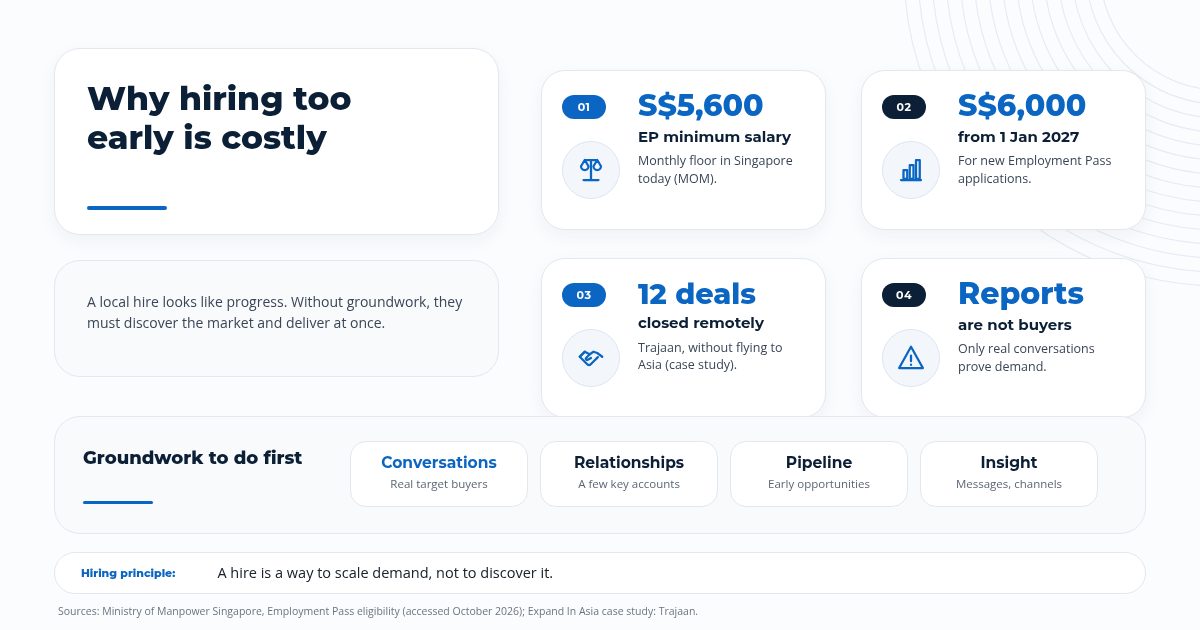
Even before salary, hiring has fixed costs. For example, if you hire a foreign salesperson in Singapore on an Employment Pass, the Ministry of Manpower sets a minimum qualifying salary of S$5,600 a month, rising to S$6,000 for new applications from 1 January 2027 (S$6,200 and S$6,600 in financial services, and higher for older candidates).1 That is a floor, not a typical sales salary.
For a full comparison, read The Cost of Building a Sales Team in Singapore vs. Outsourcing.
Reason 4 — Reports Are Not Buyers
Market-size estimates and consulting reports can tell you a market is attractive. In our experience, only conversations with real buyers tell you whether they will buy from you.
Practical Rule (our take)
Excitement can start the conversation.
Evidence should approve the hire.
The Groundwork-First Hiring Model
Our framework, the Groundwork-First Hiring Model, has three stages. It is based on the approach Nicolas described at our masterclass and on our work with clients.
Stage 1 — Start Conversations Remotely
What to Do
Reach target buyers in your priority market from where you are, with a local partner making first contacts.
What You Learn
- which segments respond;
- which messages land;
- which channels work;
- which objections come up.
Relatable Example
Instead of hiring a country manager in Jakarta to “see what’s out there,” book 20 conversations with Indonesian target accounts first. You will learn more in a month of real meetings than in a quarter of desk research.
Stage 2 — Build Early Pipeline and Key Relationships
What to Do
Turn the best conversations into an early pipeline and a few relationships you can deepen.
What “Enough” Looks Like (Our View)
Not a pipeline full of advanced deals. Real opportunities from target buyers, and a few relationships that are progressing.
For a step-by-step method, read Building a B2B Sales Pipeline from Zero in a New Asian Market.
Stage 3 — Hire Someone Who Inherits the Groundwork
What to Do
Hire locally to develop and deepen what already exists.
What the Hire Should Receive
- the early pipeline;
- contact history and notes for key accounts;
- what messaging, proof, and channels worked;
- known objections and how they were handled;
- a clear target segment.
Practical Rule (our take)
Send the right person.
But send them prepared.
6 Signs You Are Ready to Hire a Local Sales Team in Asia
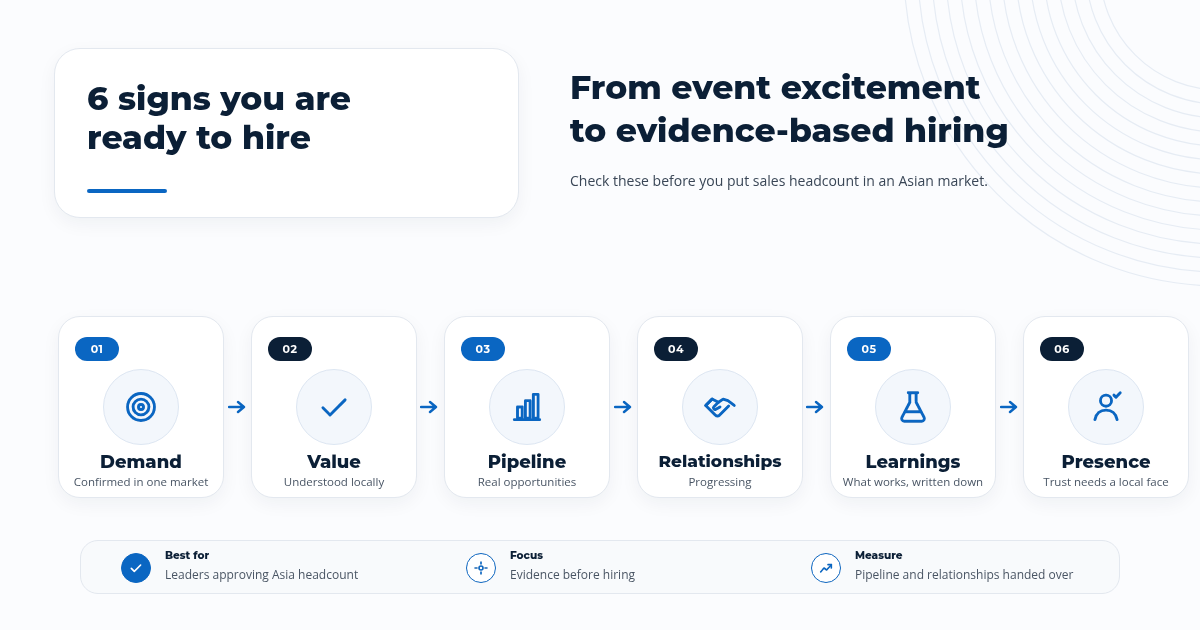
These signs are Expand In Asia’s view, built on the groundwork-first approach. They are not an industry standard.
Sign 1 — Demand Is Confirmed in One Specific Market
You have had real conversations with target buyers in that country, not just interest at an event.
Sign 2 — Your Value Is Understood Locally
Buyers understand why your product matters to them, and you know whether your proposition needs adapting (see our guide on how to localize your sales playbook for Asia).
Sign 3 — An Early Pipeline Exists
Early conversations have turned into real opportunities. As Nicolas put it, you do not need a pipeline full of advanced opportunities at this stage.
Sign 4 — Key Relationships Are Progressing
Contacts are sharing priorities, making introductions, or agreeing to next steps (see relationship selling in Asia).
Sign 5 — You Know What Works
You can document the messaging, channels, and proof that get replies in that market.
Sign 6 — Trust Now Needs Local Presence
Accounts are at the point where meeting in person, more often, would help move them forward.
Readiness Check (Our Framework)
| Sign | In Place? | If Not |
|---|---|---|
| Demand confirmed in one market | Yes / No | Run more remote buyer conversations |
| Value understood locally | Yes / No | Test and adapt messaging |
| Early pipeline | Yes / No | Keep building remotely with a partner |
| Key relationships progressing | Yes / No | Multi-thread target accounts |
| Documented learnings | Yes / No | Write the playbook before hiring |
| Trust needs local presence | Yes / No | Plan visits before a full hire |
Mini Case Studies: Groundwork Before Headcount
Case 1 — Trajaan
Situation
Trajaan, a 10-person, Paris-based search-intelligence startup, saw Asia as a promising market but wanted to avoid constant travel.
Solution
According to its published case study, Trajaan worked with Expand In Asia’s local experts to test the market and build pipeline remotely, while the founder stayed focused on product strategy.2
Results (Client’s Account)
In the words of co-founder and CEO Matthieu Danielou: “We closed 12 deals without flying even once to Asia.” He also credits that international traction with helping the company’s acquisition by Cision.2
Case 2 — A Subsidiary Launch in 2011
These details come from Nicolas Levitte’s first-hand account at our masterclass.
Situation
A US media-technology company sent him to Asia to set up a subsidiary.
Solution
Before he moved, the company worked with a local consultant—a Canadian citizen originally from Singapore—who opened the first doors in Southeast Asia.
Results (Speaker’s Account)
He arrived with an early pipeline and key relationships to develop, which made the move much more productive. The remote conversations gave a sense of real opportunities, not just market-size estimates or a consulting report.
Our Take
In both cases, local presence came after evidence, not instead of it.
Need Help Building Groundwork Before You Hire?
Expand In Asia helps B2B companies validate Asian markets and build early pipeline remotely through:
- market prioritization;
- ICP definition (ICP: your ideal customer profile);
- localized buyer messaging;
- LinkedIn, email, and phone outreach;
- SDR execution (the people who run first outreach and book meetings);
- appointment setting with decision-makers;
- market feedback reports;
- handover of pipeline and notes to your future local hire.
Questions to Ask Before Approving an Asia Sales Hire
If you are the CEO, board member, or investor signing off on the hire, these questions help separate momentum from evidence. They are our recommendation, not a formal standard.
Market Questions
- Which single country is this hire for, and why that one first?
- How many real conversations have we had with target buyers there?
- What did buyers say they need, in their own words?
Pipeline Questions
- Which accounts are already engaged, and with whom?
- Which relationships are moving, and what was the last next step agreed?
Playbook Questions
- Which messages, proof, and channels have worked so far?
- Which objections keep coming up, and how do we answer them?
Handover Questions
- What will the new hire receive on day one?
- Who supports them while they build local relationships?
Relatable Example
If a board member asks “Who will this person call in week one?” and the answer is “they will figure it out,” the groundwork is not done yet.
An Important Disclaimer: You Do Need Someone on the Ground
This is not an argument against local teams.
As Nicolas stressed at our masterclass, at some point you do need someone on the ground in Asia. Relationships and trust matter a lot here. A local presence helps build that trust and shows you are committed.
The point is timing.
Our View
The goal is not to wait until everything is perfect, because that moment never comes. The goal is to do enough groundwork before you set up locally.
For the in-house vs. partner question once you are ready, read Outsourced vs. In-House Sales Teams: Which Works Better in Southeast Asia?.
Common Hiring-Timing Mistakes
Mistake 1 — Hiring After an Event High
Excitement is not evidence.
Mistake 2 — Announcing Before Testing
A press release raises expectations before you know the market.
Mistake 3 — Hiring a Country Manager to Do Research
In our experience, senior hires are expensive researchers.
Mistake 4 — Giving the Hire a Blank Page
No pipeline, no relationships, no learnings.
Mistake 5 — Waiting for Perfect
Groundwork should be enough, not complete.
Mistake 6 — Hiring for Several Countries at Once
Validate one market before staffing the next. See our guide to a multi-country expansion strategy for Asia.
Local Hiring Readiness Scorecard
Score each area from 1 to 5. This is our own simplified framework, not an industry benchmark. For a broader view, take the free Asia Expansion Readiness Assessment Tool.
| Area | 1 — Weak | 3 — Developing | 5 — Strong |
|---|---|---|---|
| Buyer conversations | None | A few | Many, in one target market |
| Demand evidence | Reports only | Some interest | Confirmed need from target buyers |
| Early pipeline | Empty | A few leads | Real opportunities in one market |
| Key relationships | None | One or two | Several, progressing |
| Documented learnings | None | Notes | Messaging, channels, objections written down |
| Local partner support | None | Ad hoc | Ongoing first-contact support |
| Hiring rationale | Event excitement or announcement | Mixed | Documented market evidence |
| Handover plan | None | Informal | Pipeline and notes ready for the hire |
Score Interpretation (Our Guidance)
| Total Score | What It Means |
|---|---|
| 34–40 | Ready to hire. Send the right person, prepared. |
| 27–33 | Close. Fill the weakest gaps before hiring. |
| 20–26 | Keep building groundwork remotely. |
| Below 20 | Hiring now is high risk. Start with buyer conversations. |
Need Help Building a Local Team When You Are Ready?
Expand In Asia can add trained sales talent to your team in Asia without a full local setup.
Next Steps With Expand In Asia
- Do not hire on excitement.
- Build groundwork remotely: conversations, relationships, pipeline, insight.
- Check the six signs.
- Send the right person, prepared.
To go deeper:
- read the pillar guide, Breaking Into Asia: 5 Critical Asia Expansion Mistakes;
- see our Product-Market Fit Validation services;
- read Building a B2B Sales Pipeline from Zero in a New Asian Market.
Ready to Implement These Strategies?
Book a free 30-minute strategy session where we’ll audit your current growth approach and identify your highest-leverage opportunities in Asian markets.
Frequently Asked Questions
1. When should a company hire a local sales team in Asia?
In our view, hire a local sales team in Asia after you have confirmed demand in a specific market: real conversations with target buyers, an early pipeline, a few key relationships, and clear insight into messaging, channels, and objections. Hiring before that groundwork can be costly and time-consuming.
2. Why is hiring locally before validating the market a mistake?
In our experience, an early hire looks like progress and creates high expectations, but without validated demand, the new person has to discover the market and deliver results at the same time. That is expensive and slow, and a poor start can set back the whole market.
3. Can you build pipeline in Asia before setting up locally?
Yes. You can start conversations, build relationships, test assumptions, and start building pipeline remotely, often with a local partner making first contacts. Expand In Asia’s client Trajaan says it closed 12 deals without flying to Asia, according to its published case study.
4. Do you eventually need someone on the ground in Asia?
Yes. Relationships and trust matter a lot in many Asian markets, and having someone local helps build that trust and shows you are serious. Our view is that the question is when, not whether: do enough groundwork first, then send the right person, prepared.
5. What should a first local sales hire in Asia inherit?
In our recommendation, a first local hire should inherit an early pipeline, a list of key relationships, notes on what messaging and channels worked, known objections, and a clear target segment. They should not start from a blank page.
6. What does it cost to hire a foreign salesperson in Singapore?
Costs vary by role and seniority. One fixed reference point: from 1 January 2027, Singapore’s Ministry of Manpower raises the minimum qualifying salary for new Employment Pass applications from S$5,600 to S$6,000 a month (higher in financial services and for older candidates). See our separate cost guide for a full comparison.
7. How can Expand In Asia help before we hire locally?
Expand In Asia is a Singapore-based B2B outbound and market-entry partner. It opens first conversations with target buyers across Asian markets, builds early pipeline remotely, and shares market feedback, so your future local hire starts with relationships and insight, not a blank page.
Did your first hire in Asia start with a pipeline or a blank page? Share your experience in the comments or pass this guide to whoever is approving your Asia headcount.
About the author: Joel Berou is Asia Expansion & Revenue Growth Advisor at Expand In Asia, a Singapore-based B2B outbound and market-entry partner that helps companies build pipeline across Asian markets. This article draws on the October 2026 masterclass presented by Nicolas Levitte, Founder & CEO of Expand In Asia. Last updated: October 16, 2026.
Sources
-
Ministry of Manpower Singapore. Employment Pass: Eligibility (accessed 16 October 2026). https://www.mom.gov.sg/passes-and-permits/employment-pass/eligibility ↩
-
Expand In Asia. Case Studies: Trajaan (client testimonial by Matthieu Danielou, Co-Founder & CEO). https://expandin.asia/case-studies/ — also shared on Expand In Asia’s LinkedIn page, 4 September 2026: https://www.linkedin.com/posts/expand-in-asia_asiaexpansion-gotomarket-b2bsales-activity-7501567431212011521-helz ↩↩