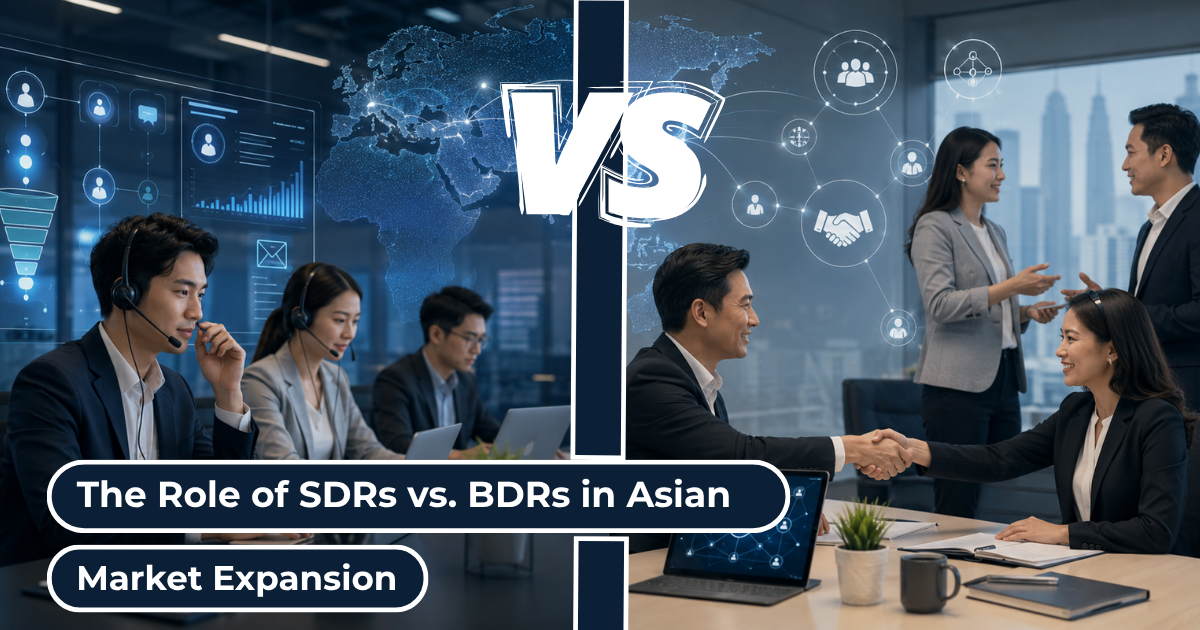
SDRs vs. BDRs in Asian Market Expansion
How to structure sales development roles when entering Singapore, ASEAN, and wider Asia
When companies expand into Asia, one of the first sales questions is usually:
“Do we need SDRs, BDRs, local sales reps, or an outsourced team?”
The answer depends on what kind of pipeline problem you are trying to solve.
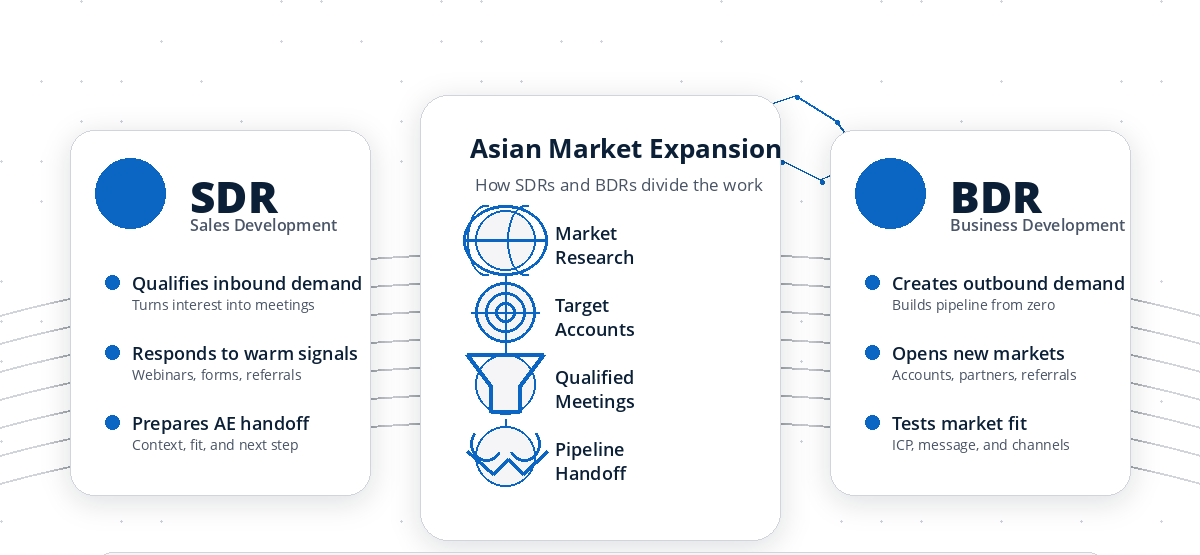
If your company already has inbound interest, event leads, webinar signups, referrals, or product trial users, you may need SDR support to qualify and convert those signals into real sales meetings.
If your company is entering a new Asian market with no brand awareness, no active demand, and no local pipeline, you may need BDR support to create new opportunities through outbound prospecting, account research, and market development.
Both roles matter.
But they are not the same.
Salesforce defines SDRs as sales professionals who manage top-of-the-funnel activities such as gathering prospect data, educating prospects, qualifying leads, and booking meetings. Salesforce also describes BDRs as responsible for generating new business opportunities, including prospecting, lead qualification, lead nurturing, and booking meetings for account executives. HubSpot’s guidance draws a practical distinction: BDRs typically handle cold outbound prospecting, while SDRs often focus on nurturing warmer inbound leads.
In Asian market expansion, that distinction becomes important because new markets often require both:
- BDRs to create demand where none exists yet;
- SDRs to qualify and convert the demand that starts to appear.
This guide explains how the roles differ, when each role matters, and how to structure SDR and BDR support for Asian expansion.
- TL;DR — Key Takeaways
- SDRs and BDRs both support pipeline, but they usually enter the process differently.
- SDRs are often strongest when demand already exists. They qualify inbound leads, webinar attendees, referrals, event contacts, product signups, and warm prospects.
- BDRs are often strongest when demand must be created. They research accounts, identify buyers, run outbound, create first conversations, and open new markets.
- Asian expansion often needs BDRs first. If your brand is unknown in the market, someone must create initial awareness and conversations.
- SDRs become more important as signals increase. Once campaigns generate replies, events, referrals, and inbound leads, SDRs help qualify and route them.
- The strongest model is often hybrid. BDRs create market access, SDRs qualify demand, and account executives handle discovery, proposals, and closing.
- Do not define roles by job title alone. Define them by lead source, market maturity, buyer journey stage, and handoff responsibility.
If you only do one thing: map the stakeholders, decision criteria, and approval process in the first serious sales conversation—not after the proposal.
Who This Comparison Is For (and Not For)
This Guide Is For
- B2B companies entering a new Asian market.
- Founders deciding whether to hire SDRs, BDRs, or outsource sales development.
- CROs and sales leaders building regional pipeline coverage.
- Country managers responsible for early market traction.
- SDR and BDR managers structuring outbound and qualification teams.
- RevOps leaders defining lead routing, handoff, and CRM stages.
- SaaS, cybersecurity, cloud, fintech, HR tech, healthtech, managed services, data, AI, and professional-services companies expanding across Asia.
This guide is especially useful if your team is asking:
- Should we hire an SDR or BDR first?
- Who should handle outbound into new Asian accounts?
- Who should qualify webinar, event, and referral leads?
- How do we avoid confusing SDR, BDR, and AE responsibilities?
- Should we outsource the first sales development role?
- How do SDRs and BDRs work together in a new market?
This Guide Is Not For
This guide may be less useful if:
- your sales process is fully self-serve;
- your product is low-ticket and purely transactional;
- your company has no defined ICP;
- your team wants to launch across all Asian markets at once;
- you expect SDRs or BDRs to close complex enterprise deals alone;
- you have no CRM, qualification standard, or sales handoff process;
- you only need consumer lead generation rather than B2B pipeline.
Practical fit check: This guide is for companies building qualified B2B pipeline in Asia—not simply adding junior sales headcount.
SDR vs. BDR: The Practical Difference
The terms SDR and BDR are sometimes used interchangeably.
That is part of the problem.
In one company, an SDR may handle outbound. In another company, a BDR may handle inbound. In some organisations, the difference is based on seniority, territory, segment, or career path.
For expansion planning, use a practical definition:
| Role | Practical Focus |
|---|---|
| SDR | Qualifies and develops existing demand or warmer sales signals |
| BDR | Creates new demand through outbound prospecting and market development |
SDR in Simple Terms
An SDR helps turn interest into qualified sales conversations.
They may work with:
- inbound leads;
- webinar attendees;
- event contacts;
- referrals;
- marketing-qualified leads;
- product signups;
- warm LinkedIn conversations;
- reactivated CRM contacts.
BDR in Simple Terms
A BDR helps create conversations where demand does not yet exist.
They may work with:
- cold target accounts;
- new market lists;
- outbound email;
- LinkedIn prospecting;
- cold calling;
- account-based campaigns;
- partner prospecting;
- event target-account outreach.
Neither role is “better.”
They solve different pipeline problems.
Why the Distinction Matters in Asian Expansion
Asian market expansion usually begins with uncertainty.
You may not know:
- which country should be prioritised;
- which buyer persona responds;
- whether the category is understood;
- whether your global proof is relevant;
- how much localisation is needed;
- which channels work;
- whether buyers prefer email, LinkedIn, phone, referrals, or events;
- how many stakeholders influence the decision.
In this environment, role clarity matters.
A BDR is useful when your company needs to create access.
An SDR is useful when your company needs to qualify signals.
Example
A cybersecurity SaaS company enters Singapore.
At the beginning, there are no inbound leads and no local references. The company needs target-account research, outbound messaging, LinkedIn engagement, and meetings with IT and security leaders.
That is a BDR-led motion.
After three months, the company runs webinars, gets referrals, receives demo requests, and builds a small content audience. Now it needs fast follow-up, qualification, routing, and meeting preparation.
That is where SDR support becomes more important.
What SDRs Do in a Market-Entry Motion
SDRs are valuable when there is already some level of interest or signal.
They help prevent leads from becoming wasted demand.
SDR Responsibilities
- respond to inbound leads;
- qualify marketing-qualified leads;
- follow up with webinar attendees;
- qualify event leads;
- route product signups;
- handle warm LinkedIn replies;
- validate fit before AE meetings;
- collect discovery context;
- prepare handoff notes;
- nurture leads not ready for sales.
SDR Qualification Areas
An SDR should confirm:
- company fit;
- buyer role;
- problem relevance;
- timing;
- budget potential;
- decision involvement;
- next step;
- disqualification reason if not a fit.
SDR Value in Asia
In Asian market expansion, SDRs help because they:
- respond quickly to market signals;
- prevent warm interest from going cold;
- filter poor-fit leads before they reach AEs;
- capture local buyer feedback;
- improve CRM hygiene;
- help marketing understand lead quality by channel.
Best Use Cases for SDRs
| Use Case | Why SDRs Help |
|---|---|
| Webinar follow-up | Separate attendees from sales-ready buyers |
| Event leads | Qualify conversations after conferences |
| Inbound forms | Respond fast and validate fit |
| Product trials | Identify high-fit accounts and usage signals |
| Referrals | Convert warm intros into structured meetings |
| Content downloads | Nurture or route based on intent |
What BDRs Do in a Market-Entry Motion
BDRs are valuable when the market is not yet producing enough demand.
They help create pipeline from zero.
BDR Responsibilities
- research target accounts;
- build account lists;
- identify decision-makers;
- map buying committees;
- run outbound email;
- use LinkedIn prospecting;
- conduct cold calls;
- test messaging;
- create first conversations;
- identify partner paths;
- open doors into strategic accounts.
BDR Value in Asia
In a new Asian market, BDRs help because they:
- test whether the ICP exists locally;
- discover which titles own the problem;
- identify regional versus local decision-makers;
- learn objections from the market;
- create early meetings before inbound demand exists;
- support account-based market validation.
Best Use Cases for BDRs
| Use Case | Why BDRs Help |
|---|---|
| New country entry | Create conversations before brand awareness exists |
| Strategic accounts | Map and approach multiple stakeholders |
| Outbound campaigns | Test ICP, messaging, and channel fit |
| Partner discovery | Identify resellers, ecosystem players, and referral paths |
| Market validation | Learn whether buyers care about the problem |
| Expansion from Singapore to ASEAN | Adapt outbound by country and segment |
SDR vs. BDR Responsibilities Side by Side
| Responsibility | SDR | BDR |
|---|---|---|
| Qualify inbound leads | ✓ | |
| Follow up with webinar attendees | ✓ | |
| Nurture warm leads | ✓ | |
| Route product signups | ✓ | |
| Research cold accounts | ✓ | |
| Identify new decision-makers | ✓ | |
| Run outbound prospecting | Sometimes | ✓ |
| Create demand in new markets | ✓ | |
| Test ICP and messaging | Shared | ✓ |
| Book qualified AE meetings | ✓ | ✓ |
| Maintain CRM notes | ✓ | ✓ |
| Capture market feedback | ✓ | ✓ |
| Close deals |
Neither role should be expected to own complex closing.
That should usually remain with the AE, founder, country manager, or senior commercial lead.
Which Role Should Come First in a New Asian Market?
The answer depends on your starting point.
Choose a BDR First If:
- no local pipeline exists;
- brand awareness is low;
- the market is unvalidated;
- you need to test ICP and messaging;
- you have a target-account strategy;
- you need outbound into cold accounts;
- you need to create meetings before inbound demand exists.
Choose an SDR First If:
- you already have inbound interest;
- you are running webinars or events;
- marketing is generating leads;
- product trials are coming in;
- referrals exist but are not followed up;
- AEs are wasting time qualifying poor-fit leads;
- lead response time is slow.
Choose Both If:
- you are entering a priority market with enough budget;
- you need outbound market creation and inbound qualification;
- your AEs are already stretched;
- you are running campaigns across several lead sources;
- you need full funnel coverage from first touch to qualified meeting.
Practical Rule
| Market Condition | Recommended Role |
|---|---|
| No demand yet | BDR |
| Warm leads but poor qualification | SDR |
| Many signals from several channels | SDR + BDR |
| Strategic enterprise accounts | BDR + senior AE |
| Event-heavy market entry | SDR for follow-up, BDR for target-account outreach |
| Partner-led market | BDR for ecosystem mapping, SDR for referral follow-up |
How SDRs and BDRs Work With Account Executives
SDRs and BDRs should not operate separately from account executives.
They should feed a clear sales process.
Recommended Handoff
| Step | Owner |
|---|---|
| Account selection | Sales leader / BDR / Marketing |
| Contact research | BDR |
| Outbound engagement | BDR |
| Inbound qualification | SDR |
| Meeting qualification | SDR or BDR |
| Discovery call | AE / Founder / Country Manager |
| Proposal | AE |
| Negotiation | AE |
| Closing | AE |
| Feedback loop | Shared |
Handoff Notes Should Include
- account context;
- buyer role;
- source of interest;
- outreach history;
- stated pain;
- trigger event;
- objections raised;
- stakeholders mentioned;
- meeting purpose;
- recommended discovery questions.
A weak handoff causes the buyer to repeat themselves.
That slows the deal and damages trust.
How the Model Changes by Market Maturity
The SDR/BDR model should change as the market matures.
Stage 1 — Market Unknown
You do not yet know whether the ICP responds.
Primary need:
- research;
- account mapping;
- outbound testing;
- message validation.
Best role:
- BDR-led.
Stage 2 — Early Signals
You are getting replies, event interest, referrals, or webinar registrations.
Primary need:
- qualification;
- follow-up;
- CRM discipline;
- meeting conversion.
Best role:
- BDR + SDR support.
Stage 3 — Repeatable Pipeline
You know which segments respond and which meetings convert.
Primary need:
- scale;
- specialisation;
- better handoff;
- pipeline reporting.
Best role:
- SDR + BDR + AE model.
Stage 4 — Regional Expansion
You are expanding from one Asian market into another.
Primary need:
- localisation;
- new account research;
- channel testing;
- market-specific qualification.
Best role:
- BDR for new market creation;
- SDR for campaign response and qualification.
How the Model Changes by Lead Source
Not all leads should be handled the same way.
Lead Source Routing
| Lead Source | Best Owner | Reason |
|---|---|---|
| Cold target account | BDR | Needs outbound creation |
| Webinar attendee | SDR | Needs qualification and follow-up |
| Product signup | SDR | Needs usage and fit validation |
| Event target-account list | BDR | Needs pre-event outreach |
| Event booth conversation | SDR | Needs post-event qualification |
| Referral | SDR or AE | Warmer signal, needs context |
| Strategic named account | BDR + AE | Needs mapping and senior engagement |
| Partner-sourced lead | SDR | Needs fit and next-step validation |
| Content download | SDR | Needs intent qualification |
| New market account list | BDR | Needs ICP and channel testing |
This routing prevents the wrong role from handling the wrong lead type.
How the Model Changes by Buyer Seniority
Buyer seniority affects role design.
Junior or Functional Buyers
SDRs can often qualify:
- interest;
- use case;
- fit;
- basic pain;
- next steps.
Department Heads
SDRs or BDRs can engage, but the handoff must be strong.
The AE should enter once there is clear pain, urgency, or project relevance.
Founders and C-Suite
BDRs may open the door, but senior involvement matters.
For high-value deals, the founder, AE, or regional sales leader may need to participate earlier.
LinkedIn and Edelman’s 2025 research also highlights the importance of hidden buyers, including internal stakeholders outside the obvious user group. Hidden buyers consume and evaluate thought leadership similarly to target buyers, and 56% of target buyers and 55% of hidden buyers use thought leadership during vendor evaluation.
That matters because SDRs and BDRs should not only chase one visible buyer. They should help map the broader decision ecosystem.
Common Mistakes When Structuring SDR and BDR Roles
Mistake 1 — Using the Titles Interchangeably
If the role is unclear, the process becomes unclear.
Define whether the person creates demand, qualifies demand, or both.
Mistake 2 — Hiring an SDR When the Market Needs a BDR
If there is no inbound demand, an SDR may spend most of their time waiting for leads.
A new market often needs outbound creation first.
Mistake 3 — Hiring a BDR Without a Clear ICP
Outbound without a clear ICP produces activity, not pipeline.
Mistake 4 — Expecting SDRs or BDRs to Close Deals
They should create and qualify opportunities.
Complex closing usually belongs to AEs or senior sellers.
Mistake 5 — No Written Handoff Criteria
Without handoff criteria, AEs may reject meetings and SDRs/BDRs may not know why.
Mistake 6 — No Market Feedback Loop
BDRs and SDRs hear objections first.
If that feedback does not reach leadership, the market-entry strategy cannot improve.
Mistake 7 — Treating Asia as One Territory
A BDR motion in Singapore may not work the same way in Indonesia, Vietnam, Japan, Korea, or Thailand.
Mistake 8 — Overloading One Role
One person cannot effectively own research, outreach, inbound qualification, CRM hygiene, event follow-up, partner development, and AE support at scale.
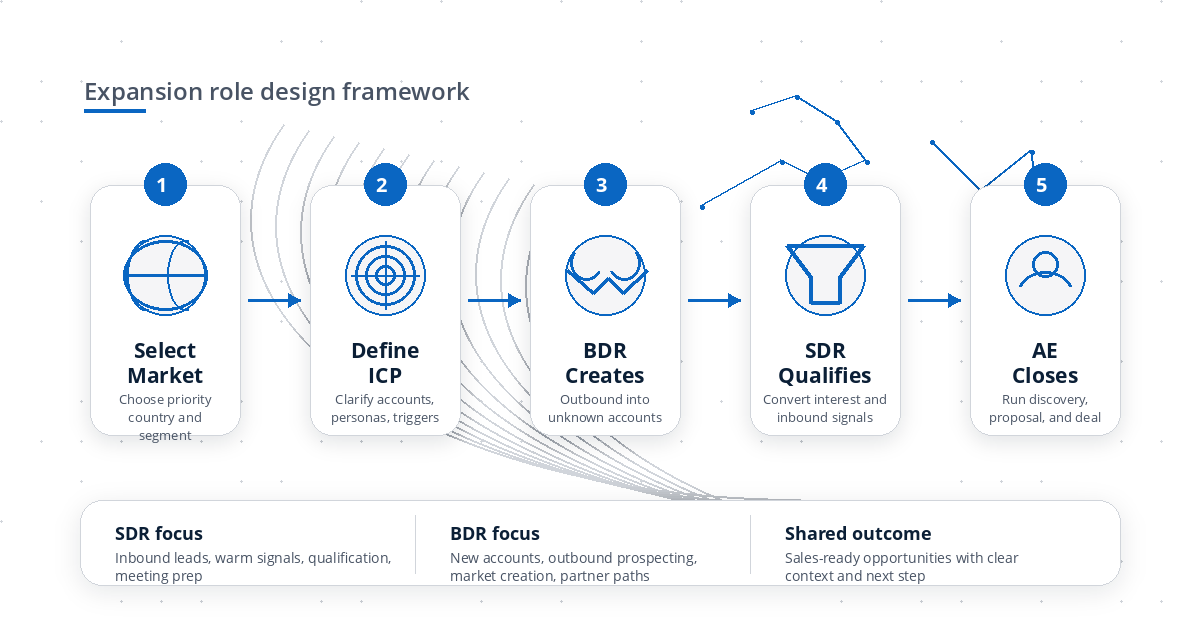
SDR/BDR Operating Model for Asian Expansion
Layer 1 — Strategy
Owned by:
- founder;
- CRO;
- regional sales leader;
- country manager.
Responsibilities:
- select market;
- define ICP;
- set revenue goals;
- approve messaging;
- decide sales motion.
Layer 2 — BDR Market Creation
Owned by:
- BDR;
- outsourced sales development team;
- market research support.
Responsibilities:
- build target-account lists;
- map decision-makers;
- run outbound;
- test messaging;
- identify partner and referral paths;
- create first meetings.
Layer 3 — SDR Qualification
Owned by:
- SDR;
- lead qualification team;
- RevOps support.
Responsibilities:
- qualify inbound and campaign-generated leads;
- follow up with webinar and event leads;
- validate fit and timing;
- prepare AE handoff;
- update CRM.
Layer 4 — AE Conversion
Owned by:
- AE;
- founder;
- country manager;
- senior seller.
Responsibilities:
- run discovery;
- build business case;
- manage proposal;
- negotiate;
- close;
- feed back qualification quality.
Common Mistakes That Slow Deals Down
Mistake 1 — Talking to Only One Person
Your champion may not control the decision.
Mistake 2 — Sending Proposals Too Early
A proposal sent before pain, process, and stakeholders are clear often stalls.
Mistake 3 — No Local Proof
Buyers may hesitate if all examples are from unrelated markets.
Mistake 4 — Weak Discovery
If you do not understand the real business issue, the proposal becomes generic.
Mistake 5 — No Clear Next Step
Every vague next step increases the chance of delay.
Mistake 6 — Ignoring Procurement
Procurement friction often appears late because sales did not ask early.
Mistake 7 — Over-Relying on Discounts
Discounts rarely fix unclear value or weak urgency.
Mistake 8 — Poor Handoff From SDR to AE
If the AE lacks context, discovery restarts and the buyer loses confidence.
Mistake 9 — No Internal Business Case
Your champion may want to move forward but lack the materials to persuade others.
Mistake 10 — Treating SEA as One Market
A process that works in Singapore may need adaptation in Malaysia, Indonesia, Vietnam, Thailand, or the Philippines.
Role-Design Scorecard
Score each category from 1 to 5.
| Area | 1 — Weak | 3 — Developing | 5 — Strong |
|---|---|---|---|
| Market clarity | Broad Asia target | Country selected | Priority country and ICP defined |
| Role clarity | SDR/BDR used interchangeably | Basic division | Clear demand creation vs. demand qualification |
| Lead source routing | No routing | Some manual routing | Lead source mapped to SDR/BDR/AE |
| ICP definition | Generic audience | Partial segmentation | Clear accounts, personas, triggers, exclusions |
| Handoff process | Informal | Basic notes | Written criteria and CRM fields |
| Feedback loop | No review | Occasional feedback | Weekly review of quality, objections, and conversion |
| Market localisation | Generic script | Some local changes | Market, persona, and channel-specific approach |
| AE alignment | Late involvement | Some shared calls | Clear AE ownership and discovery standards |
| Reporting | Activity only | Meetings tracked | Pipeline, acceptance, and conversion tracked |
| Scalability | One person owns everything | Some specialisation | Repeatable role model by market stage |
Score Interpretation
| Total Score | Recommendation |
|---|---|
| 42–50 | Strong role design; ready to scale carefully |
| 34–41 | Good foundation; clarify weak handoff or routing areas |
| 25–33 | Role confusion may slow pipeline creation |
| Below 25 | Rebuild SDR/BDR model before expanding |
Build Internally, Outsource, or Use a Hybrid Model?
Asian expansion does not always require immediate internal hiring.
The right model depends on market maturity, budget, complexity, and urgency.
Internal SDR/BDR Team
Best when:
- the market is strategic;
- pipeline is already validated;
- you need deep company knowledge;
- long-term local presence matters;
- managers can coach the team properly.
Outsourced SDR/BDR Support
Best when:
- you need speed;
- the market is still being tested;
- you lack local research capacity;
- you want to reduce hiring risk;
- you need meetings before committing to full local headcount.
Hybrid Model
Best when:
- internal team owns strategy and closing;
- external team handles research, outreach, and early qualification;
- both teams share CRM and reporting;
- market feedback is reviewed weekly.
Operating Model Comparison
| Model | Best For | Risk |
|---|---|---|
| Internal SDR | Warm demand and long-term qualification | Expensive if demand is not validated |
| Internal BDR | Strategic outbound and named accounts | Slow hiring and ramp time |
| Outsourced SDR | Inbound qualification and campaign follow-up | Needs clear criteria and oversight |
| Outsourced BDR | New market prospecting and pipeline creation | Needs strong ICP and messaging |
| Hybrid | Controlled expansion with flexible capacity | Requires good management rhythm |
Need SDR or BDR Support for Asian Expansion?
Expand In Asia helps B2B companies build qualified pipeline across Asia through:
- ICP definition;
- target-account research;
- BDR-led outbound prospecting;
- SDR-style lead qualification;
- LinkedIn and email outreach;
- appointment setting;
- CRM handoff;
- market feedback.
Talk to Expand In Asia about structuring your sales development model in Asia →
15. Next Steps With Expand In Asia
SDRs and BDRs both play important roles in Asian market expansion.
But they solve different problems.
Use BDRs when you need to create demand in a new market.
Use SDRs when you need to qualify and convert existing demand.
Use both when your market-entry motion includes outbound, inbound, events, webinars, referrals, and product or content signals.
For broader market-entry planning, read:
Go-to-Market (GTM) Strategies for Asia
For more pipeline-generation tactics, read:
10 Best B2B Qualified Lead Generation Strategies for 2026
Schedule a consultation with Expand In Asia →
Ready to Implement These Strategies?
Book a free 30-minute strategy session where we’ll audit your current growth approach and identify your highest-leverage opportunities in Asian markets.
Frequently Asked Questions
1. What is the difference between an SDR and a BDR?
The distinction varies by company, but a practical difference is that SDRs often qualify warmer demand such as inbound leads, webinar attendees, referrals, and product signups, while BDRs often create new demand through outbound prospecting and account development. HubSpot describes BDRs as typically handling cold outbound prospecting while SDRs nurture warmer inbound leads.
2.Which role is better for Asian market expansion?
BDRs are often more useful at the beginning of a new Asian market entry because they create conversations where demand does not yet exist.
SDRs become more useful once the company starts generating signals from campaigns, webinars, events, referrals, content, or product usage.
3. Should we hire an SDR or BDR first?
Hire or outsource BDR capacity first if you need outbound pipeline from zero.
Hire or outsource SDR capacity first if you already have inbound leads or warm signals that need faster qualification.
4. Can one person do both roles?
Yes, especially in an early-stage team.
However, as volume grows, the roles should become clearer. Demand creation and demand qualification require different rhythms, skill sets, and performance metrics.
5. Do SDRs and BDRs close deals?
Usually no.
They qualify and create opportunities. Account executives, founders, country managers, or senior sellers usually manage discovery, proposal, negotiation, and closing.
6. How should SDRs and BDRs work with AEs?
They should use a written handoff process that includes account fit, buyer role, source, pain, trigger, objections, meeting purpose, and recommended discovery questions.
7. What metrics should we use?
Track:
- target accounts researched;
- contacts mapped;
- positive replies;
- meetings booked;
- meetings held;
- sales acceptance;
- opportunity creation;
- pipeline value;
- disqualification reasons;
- conversion by market and role.
8. Should SDR or BDR roles be outsourced?
They can be.
Outsourcing is often useful when the market is still being validated, when speed matters, or when the internal team lacks local research and prospecting capacity. The internal team should still own strategy, positioning, pricing, and closing.