
A practical guide for B2B teams whose pitch opens doors in Asia but does not close deals
Your playbook worked at home.
It may have worked in two or three other countries too.
Then you bring it to Asia.
Meetings get booked. Buyers are polite. Interest seems real.
And deals stall.
In our experience, this is one of the most common patterns for companies that have already expanded internationally. The fix is rarely a new product. It is learning how to localize your sales playbook for Asia: which parts to change, in what order, and which parts to leave alone.
A sales playbook is the documented way your team sells: who you target, what you say, what proof you show, how you run meetings, and how deals move to a close. Localizing it can mean adjusting:
- the language and format of outreach;
- the case studies and references you lead with;
- how you frame the value (risk reduction vs. being first);
- who you engage first in the buyer’s company;
- commercial terms such as pricing and contracts.
Most sales leaders ask:
“Why isn’t our proven pitch working here?”
But for B2B teams expanding across Asia, the better question is:
“Which parts of our playbook are proven only for buyers who think like our home market?”
Because buyers weigh risk differently.
A message that excites a US buyer can worry a buyer in Jakarta.
A champion who drives a deal in Berlin may wait for their boss in Tokyo.
This guide expands on Mistake 2 from our masterclass, Breaking Into Asia: 5 Critical Asia Expansion Mistakes. In Expand In Asia’s pre-webinar survey, this was the topic that resonated most.
- TL;DR — Key Takeaways (our view)
- Most of your playbook can stay. Product, qualification, and reporting usually transfer; pitch, proof, and sales approach often do not.
- Lead with local proof, not “be the first.” In our experience, many Asian buyers see being first as a risk.
- Engage senior people earlier. Champion-only selling is harder in hierarchical organizations.
- Localize in order. Language, then proof, then framing, then sales approach, then terms.
- Rebuild only on evidence. Change the core proposition only when buyers reject the value itself.
- Watch the stall signals. Many first meetings and few second meetings usually point to the playbook, not the market.
If you only do one thing: replace your home-market case studies with references from the same or a similar Asian market before your next round of outreach.
Who This Guide Is For—and Who It Is Not For
This Guide Is For
- sales leaders at companies already selling in Europe, North America, or Australia;
- CROs and founders whose Asia pipeline moves slower than at home;
- sales enablement teams adapting decks, scripts, and case studies;
- regional managers asked by headquarters to “just use the global playbook”;
- B2B SaaS, technology, and services companies selling to mid-sized and large organizations;
- teams in Singapore preparing to sell into other Asian markets.
This guide is especially useful if your team is asking:
- Why do we get first meetings but few second meetings?
- Should we change our pitch for Asian buyers?
- Do we need local case studies before we can close?
- Why does our internal champion go quiet?
This Guide Is Not For
- you have not yet chosen which Asian markets to enter (start with our guide to multi-country expansion strategy for Asia);
- you need content translation guidance only;
- you sell only to consumers;
- you expect one universal “Asia pitch.”
Practical fit check: if your Asia deck is your home-market deck with a new cover slide, this guide is for you.
What It Means to Localize a Sales Playbook for Asia
Localizing a sales playbook for Asia means adapting how your team targets, pitches, proves value, and closes deals so it fits how buyers in each Asian country actually buy. In our experience, it usually changes language, proof, message framing, and who you engage first, while the product and core value proposition (the main reason customers buy) stay the same.
It is different from translation.
Translated Playbook vs. Localized Playbook
| Area | Translated Playbook | Localized Playbook |
|---|---|---|
| Language | Same deck in another language | Language and tone suited to the buyer |
| Proof | Home-market logos and ROI stories | References from the same or a similar market |
| Framing | “Be first, get ahead” | “Peers are already seeing results” |
| Who you engage | One champion, bottom-up | Senior leaders early, plus users |
| Meeting style | Fast demo, fast close | More stakeholders, more time for trust |
| Terms | Home-market pricing and contracts | Adjusted where local procurement requires |
Practical Rule (our take)
Translation changes the words.
Localization changes what convinces the buyer.
For content-level localization, read Why Localization Fails: Common Mistakes B2B Companies Make in Asia.
Why Home-Market Playbooks Stall in Asia
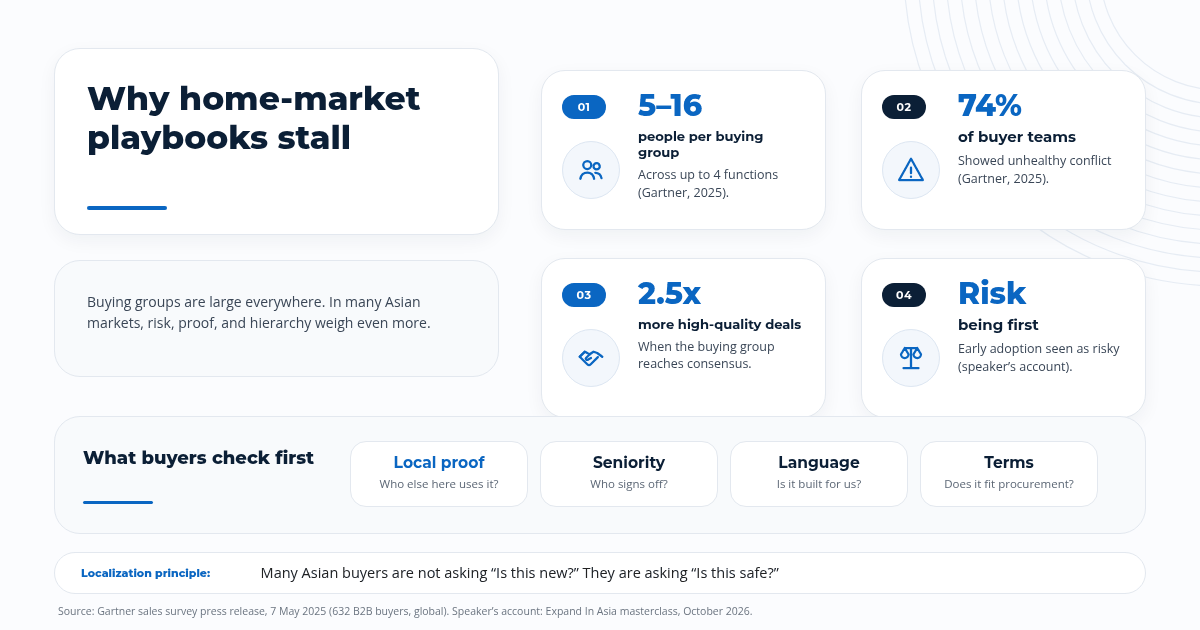
Three things change when you cross into many Asian markets.
Reason 1 — Buyers Weigh Risk Differently
As Nicolas Levitte, Founder & CEO of Expand In Asia, tells it: in 2014 he joined LinkedIn on the team launching Sales Navigator, a sales prospecting tool, in Asia. It had launched successfully in the US and Australia. The new Singapore team relied on US messaging: be an early adopter and gain a competitive advantage through social selling (using LinkedIn networks and content to find and approach buyers).
Doors opened. Closing was slower than expected.
The reason, in his account: for many prospects, being first was a risk, not an advantage. If no one local used it, maybe it only worked in the US.
Reason 2 — Decisions Involve More People and More Seniority
Large B2B purchases involve many people everywhere. Gartner’s May 2025 survey of 632 B2B buyers, a global study, found buying groups ranging from five to 16 people across as many as four functions, and reported that 74% of buyer teams showed “unhealthy conflict” during the decision.1 It also found that buying groups that reach consensus are 2.5 times more likely to report a high-quality deal.
In our experience, hierarchy adds another layer in many Asian organizations. A user who loves your product may hesitate to recommend it without their manager’s support.
Reason 3 — Proof Does Not Travel Well
In our experience, a case study from Germany or California often means little to a buyer in Manila or Jakarta. Buyers want to know whether it worked for a company like theirs, in a market like theirs.
Practical Rule (our take)
Many Asian buyers are not asking “Is this new?”
They are asking “Is this safe?”
The Stall Signals: How to Tell Your Playbook Is the Problem
Before changing anything, check whether the playbook is really the issue.
Signals and What They Usually Mean (Our Experience)
| Signal | What It Often Points To |
|---|---|
| Many first meetings, few second meetings | Pitch or proof is not landing |
| Buyers ask “Who else in this market uses it?” | Missing local references |
| Champion goes quiet after a positive demo | Needs senior support you have not secured |
| “Let’s wait and see” after strong interest | Being first feels risky |
| Procurement raises unexpected requirements | Commercial terms not adapted |
| Buyers say the problem is not a priority | The proposition itself may not fit |
Why This Matters
The first five signals usually call for localization. Only the last one may call for a rebuild.
The Playbook Localization Ladder: What to Change First
Our framework, the Playbook Localization Ladder, puts changes in order. Start at the bottom. Climb only when the lower rung is done and the stall signals remain.
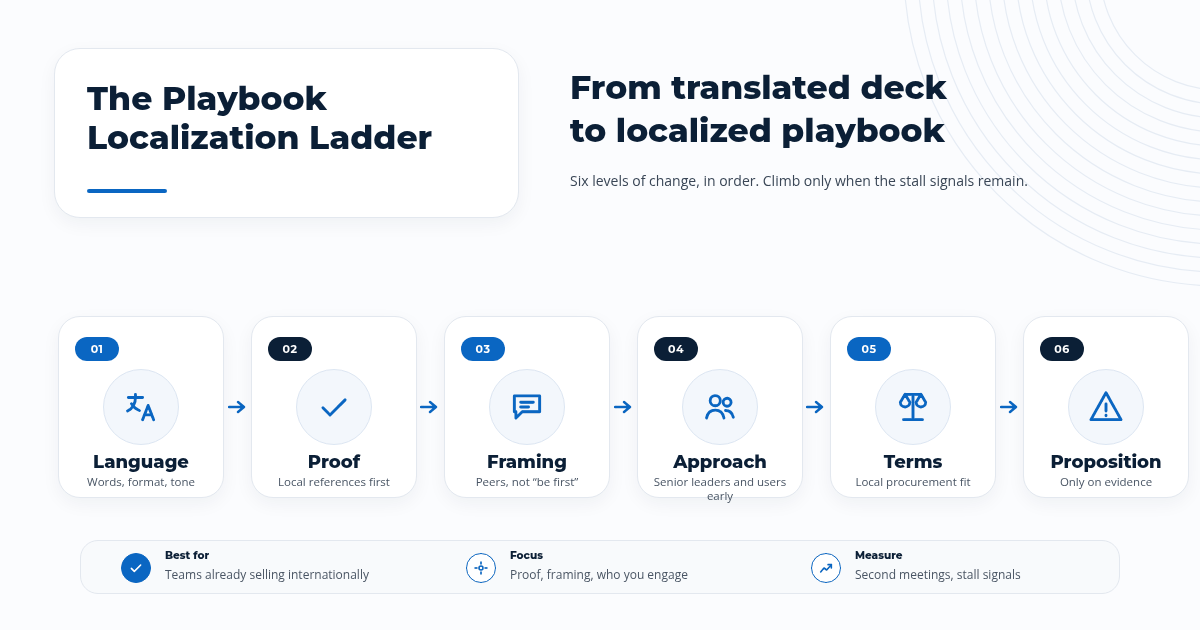
Level 1 — Language and Format
What to Change
Outreach language, deck language, meeting materials, and tone.
What to Keep
Your structure and core message.
Asia-Specific Reminder
In our experience, English is enough for first contact in some markets and not in others. In Japan, for example, Nicolas worked with a translator because many meeting participants were not fluent in English.
Level 2 — Proof
What to Change
Lead with references from the same country or a similar market. Start with smaller accounts if needed.
Why It Works (Our Experience)
After the slow start with Sales Navigator, the team focused on winning smaller companies first, then returned to larger accounts with local success stories.
How to Implement
- list every reference you have in Asia, however small;
- ask early customers for permission to be named or quoted;
- build one short local case study per priority market;
- use regional proof until country proof exists.
Level 3 — Message Framing
What to Change
Shift from “be the first” to “your peers are already seeing results.”
Example Messages
Home-market framing: “Be one of the first in your industry to gain this advantage.”
Localized framing: “Two companies in your sector in this region are already evaluating this, and one is already using it.”
Practical Rule (our take)
Sell the fear of being left behind, not the excitement of being ahead.
Level 4 — Sales Approach and Who You Engage
What to Change
Move from a single-champion, bottom-up approach to multi-level engagement.
Bottom-Up vs. Multi-Level Engagement
| Approach | How It Works | Fit in Hierarchical Organizations (Our View) |
|---|---|---|
| Bottom-up champion | One power user proves value and sells upward | Often slower; the champion may wait for approval |
| Top-down only | Senior leader decides alone | Can stall when users are not on board |
| Multi-level | Engage senior leaders early and build user support in parallel | Usually the strongest fit |
How to Implement
- map decision-makers and influencers in each target account;
- request a senior-level meeting early, not after the demo;
- keep building relationships with future users in parallel;
- expect more people in meetings, and plan for them.
For a structured way to work several stakeholders in one account, read Account-Based Selling (ABS) for B2B Companies in Asia: A Practical Guide. To build trust with each of those stakeholders, see Relationship Selling in Asia: How to Build Trust That Actually Moves B2B Deals Forward.
Level 5 — Commercial Terms
What to Change
Price levels, currency, payment terms, contract format, and procurement documentation where local buyers require it.
What to Keep
Your pricing logic and discount rules, so country deals stay comparable.
Level 6 — The Core Proposition (Only on Evidence)
When to Rebuild
In our view, only when buyers consistently say the problem you solve is not a priority, or when regulation or market structure removes the value.
Example
In Nicolas’s account, regulation at the time in India limited how his media-technology solution could create value there. No amount of pitch localization would have fixed that.
Practical Rule (our take)
Localize the buying experience first.
Rebuild the core proposition only when the market evidence says the proposition itself is wrong.
What Not to Localize: Keep These Global
Localizing too much is also a mistake.
When every country team rewrites everything, headquarters loses the ability to compare markets, and good ideas stop spreading.
Keep These Consistent Across Markets (Our View)
- Qualification criteria: the rules for what counts as a real opportunity;
- Deal stages and CRM fields: so pipeline means the same thing everywhere (CRM: the system where your team tracks contacts and deals);
- Pricing logic and discount limits: local price points can change, the rules should not;
- Brand promise: the one-line reason customers choose you;
- Reporting: the same weekly metrics in every market.
Relatable Example
Think of it like a restaurant chain. The menu can change by country. The kitchen standards and the accounting do not.
Practical Rule (our take)
Localize what the buyer sees.
Standardize what management measures.
Localize or Rebuild? A Quick Decision Table
| If Buyers Say… | Our Recommendation |
|---|---|
| “Interesting, but who else here uses it?” | Localize proof |
| “We need to check with management.” | Localize the sales approach |
| “Can you work with our procurement process?” | Localize terms |
| “We like it, but the timing is not right.” | Localize framing and keep the relationship |
| “This is not a problem for us.” | Test with other segments before rebuilding |
| “Regulation does not allow this here.” | Rebuild or deprioritize the market |
Mini Case Study: Relaunching a Global Pitch in Asia
These details come from Nicolas Levitte’s first-hand account at our masterclass.
Situation
A global sales platform launched in Asia from Singapore after successful launches in the US and Australia.
Trigger
The new team reused US decks, messaging, and ROI stories.
Barrier
Doors opened, but closing was slow. Prospects saw early adoption as a risk.
Solution
The team shifted to a fear-of-missing-out approach, won smaller companies first, and returned to larger accounts with local success stories.
Results (Speaker’s Account)
The message changed from “be first” to “others in your market are already seeing results,” which he says resonated far better with prospects.
Our Take
Even large international companies can fall into this trap. The playbook was not wrong. It was written for a different buyer.
Need Help Testing a Localized Playbook?
Expand In Asia helps B2B companies adapt and test their sales approach across Asian markets through:
- market prioritization;
- ICP and account research (ICP: your ideal customer profile);
- localized buyer messaging;
- LinkedIn and email outreach;
- cold calling and appointment setting;
- SDR execution (the people who run first outreach and book meetings);
- lead qualification;
- market feedback loops that show what buyers actually say.
Talk to Expand In Asia about localizing your sales playbook →
Sales Playbook Localization Scorecard
Score each area from 1 to 5. This is our own simplified framework, not an industry benchmark. For a broader view of your team’s readiness, take the free Asia Expansion Readiness Assessment Tool.
| Area | 1 — Weak | 3 — Developing | 5 — Strong |
|---|---|---|---|
| Language and format | Home-market only | Partly adapted | Adapted per market |
| Local proof | None | Regional proof | Country or similar-market references |
| Message framing | “Be first” | Mixed | Peer adoption and risk reduction |
| Senior engagement | After the demo, if at all | Sometimes early | Planned from first meeting |
| Multi-level relationships | One champion | Two contacts | Leaders and users in parallel |
| Commercial terms | Home-market terms only | Ad hoc changes | Documented local options |
| Stall-signal tracking | Not tracked | Informal | Logged per market and reviewed |
| Feedback loop | None | Occasional | Regular review of buyer feedback |
Score Interpretation (Our Guidance)
| Total Score | What It Means |
|---|---|
| 34–40 | Playbook is well adapted. Focus on scaling what works. |
| 27–33 | Good base. Fix proof and engagement gaps first. |
| 20–26 | The playbook is still mostly home-market. Start at Level 1–2 of the ladder. |
| Below 20 | High risk of stalled deals. Rework proof and framing before more outreach. |
Need Help Getting Local Feedback Fast?
Expand In Asia runs outreach to real buyers in your target markets and reports back what they say.
Next Steps With Expand In Asia
- Keep the core: product, value proposition, qualification, reporting.
- Localize what buyers see: language, proof, framing.
- Change who you engage: senior leaders early, users in parallel.
- Rebuild only on evidence.
To go deeper:
Ready to Implement These Strategies?
Book a free 30-minute strategy session where we’ll audit your current growth approach and identify your highest-leverage opportunities in Asian markets.
Frequently Asked Questions
1. What does it mean to localize a sales playbook for Asia?
Localizing a sales playbook for Asia means adapting how your team targets, pitches, proves value, and closes deals so it fits how buyers in each Asian country actually buy. In our experience, it usually changes language, proof, message framing, and who you engage first, while the product and core value proposition stay the same.
2. Will a US or European sales playbook work in Asia?
In our experience, parts of it will. The product, qualification logic, and reporting often transfer well. The pitch, proof, and sales approach often need changes, because many Asian buyers weigh risk, references, and seniority differently from buyers in the US or Europe.
3. Why does early-adopter messaging often fail with Asian buyers?
In the experience Nicolas Levitte shared at our masterclass, being first was often seen as a risk, not an advantage: if nobody local uses a product, buyers wonder whether it only works elsewhere. Messages built on local proof and peer adoption tended to land better.
4. Should we sell top-down or bottom-up in Asia?
Our view: in many hierarchical Asian organizations, combine both. Engage senior decision-makers earlier than you would at home, while still building support among the people who will use the product. Relying only on a single internal champion is often harder in these organizations.
5. Which parts of the sales playbook should we localize first?
Our recommendation is to start with what buyers see first: language and format, then proof from the same or a similar market, then message framing, then the sales approach and who you engage. Change commercial terms next, and rebuild the core proposition only if evidence says buyers reject the value itself.
6. How do we know whether to localize or rebuild our value proposition?
In our view, localize when buyers like the outcome but hesitate about risk, proof, or process. Rebuild when buyers consistently say the problem you solve is not a priority, or regulation or market structure makes the value irrelevant, as Nicolas experienced with media regulation in some markets.
7. How can Expand In Asia help us adapt our sales playbook?
Expand In Asia is a Singapore-based B2B outbound and market-entry partner. It runs localized outreach and books meetings with decision-makers across Asian markets, and feeds back what buyers say, so you can see which parts of your playbook land and which need to change.
Which part of your playbook needed the biggest change in Asia? Share it in the comments or pass this guide to your sales enablement lead.
About the author: Joel Berou is Asia Expansion & Revenue Growth Advisor at Expand In Asia, a Singapore-based B2B outbound and market-entry partner that helps companies build pipeline across Asian markets. This article draws on the October 2026 masterclass presented by Nicolas Levitte, Founder & CEO of Expand In Asia. Last updated: October 16, 2026.
Sources
-
Gartner, Inc. “Gartner Sales Survey Finds 74% of B2B Buyer Teams Demonstrate ‘Unhealthy Conflict’ During the Decision Process” (press release, 7 May 2025; survey of 632 B2B buyers, August–September 2024). https://www.gartner.com/en/newsroom/press-releases/2025-05-07-gartner-sales-survey-finds-74-percent-of-b2b-buyer-teams-demonstrate-unhealthy-conflict-during-the-decision-process ↩