A practical guide for B2B leaders who want an honest answer before they commit budget to Asia
Your board wants an Asia plan.
Your product works.
Your funding is in place.
But one question is harder to answer than the others:
Is your team actually ready to create pipeline in a market it does not know yet?
That is what an Asia expansion readiness assessment is for. It scores your commercial foundations before you commit to fixed costs like hires, offices, or long contracts. In plain terms: it tells you whether to go alone, get targeted help, or test the market with a partner first.
A good readiness check looks at:
- why you are entering Asia, in business terms;
- which markets you have prioritized;
- how much real buyer evidence you have;
- who will manage sales development every week;
- whether your tools and leadership can support a learning period.
Most leadership teams ask:
“Are we ready for Asia?”
But for B2B companies entering a new Asian market, the better question is:
“Which parts of our growth engine are ready—and which ones will break first?”
Because readiness is not one thing.
A company can have a great product and no one to manage outreach.
A company can have budget and no evidence of demand.
This guide explains how to assess your readiness and how to use Expand In Asia’s free Asia Expansion Readiness Assessment Tool. It builds on our pillar guide, Breaking Into Asia: 5 Critical Asia Expansion Mistakes.
- TL;DR — Key Takeaways (our view)
- Readiness is commercial, not just product. Strategy, evidence, people, tools, and leadership all matter.
- The free tool takes about seven minutes. It rates 14 statements across five pillars.
- Your score points to an operating model. Go independently, use targeted support, or validate with a partner.
- A low score is not a “no.” It tells you what to fix or who to work with.
- Evidence of demand changes everything. The stronger it is, the safer fixed commitments become.
- Leadership patience is a readiness factor. Asia should not be judged on first-month revenue.
If you only do one thing: take the Asia Expansion Readiness Assessment Tool with your sales lead and your CEO separately, then compare answers.
Who This Guide Is For—and Who It Is Not For
This Guide Is For
- founders and CEOs preparing an Asia expansion plan;
- CROs and sales leaders asked to build pipeline in a new region;
- expansion leads comparing “build in-house” vs. “work with a partner”;
- B2B SaaS, technology, and services companies selling to other businesses;
- companies already in one Asian market planning the next;
- boards and investors reviewing an Asia budget.
This guide is especially useful if your team is asking:
- Are we ready to enter Asia on our own?
- What should we fix before hiring?
- Should we start with one market or several?
- How do we explain our readiness to the board?
This Guide Is Not For
- you sell only to consumers;
- you need a legal or tax checklist for setting up an entity;
- you want a country ranking (read our guide to a multi-country expansion strategy for Asia);
- you have already scaled a proven sales engine in the market.
Practical fit check: if your Asia plan has a revenue target but no named person managing outreach, this guide is for you.
What an Asia Expansion Readiness Assessment Means
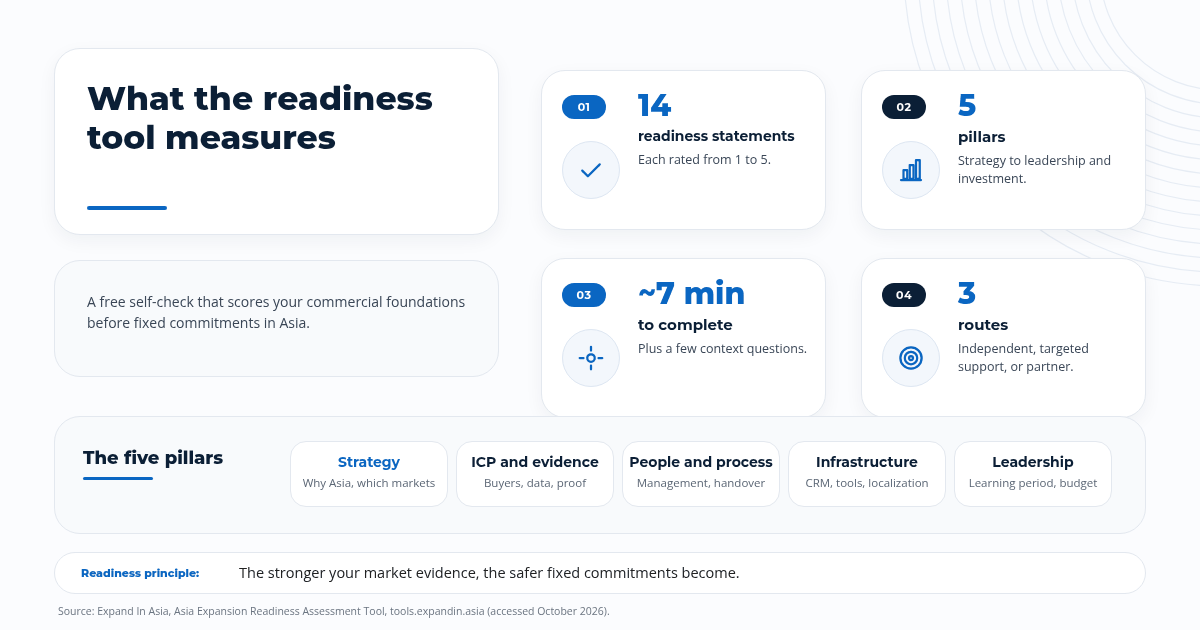
An Asia expansion readiness assessment is a structured self-check that scores whether a company’s commercial foundations are strong enough to enter an Asian market. Expand In Asia’s free tool rates 14 statements across five pillars: Strategy, ICP and Market Evidence, People and Process, Infrastructure, and Leadership and Investment.
Two terms you will see:
- ICP (ideal customer profile): the type of company most likely to buy from you;
- SDR (sales development representative): the person who finds prospects, runs first outreach, and books meetings.
Readiness Assessment vs. Market Research
| Area | Market Research | Readiness Assessment |
|---|---|---|
| Question it answers | Is the market attractive? | Can we win in it, now? |
| Focus | Market size, competitors, trends | Your strategy, evidence, team, tools, leadership |
| Who it is about | The market | Your company |
| Typical output | A report | A score and a recommended operating model |
| Time needed | Weeks | About seven minutes for the tool |
| Main risk it reduces | Entering the wrong market | Entering the right market the wrong way |
Practical Rule (our take)
Market research tells you where to go.
A readiness assessment tells you how ready you are to get there.
Why an Asia Expansion Readiness Assessment Matters
At our October 2026 masterclass, Nicolas Levitte, Founder & CEO of Expand In Asia, walked through five common Asia expansion mistakes: treating Asia as one market, copying the home-market playbook, underestimating relationships, using the wrong channels, and hiring before validating the market.
In our view, they share one root cause.
Companies check whether the product is ready and whether the funding is ready. They rarely check whether the engine that creates new business—outbound sales development—is ready for a new market.
Reason 1 — It Prevents Expensive Fixed Commitments Too Early
The tool’s own guidance is direct: the stronger your market evidence, the safer it is to make fixed hiring commitments. In our experience, the reverse is also true. Without evidence, a hire or an office is a bet.
Reason 2 — It Shows Where the Engine Will Break
According to the tool, a new SDR team without close management usually creates activity faster than learning. In plain terms: lots of emails and calls, very little insight. The assessment finds that gap before it costs you a quarter.
Reason 3 — It Aligns Leadership
The tool asks whether leadership is aligned on the expected learning period and will not judge Asia only by first-month revenue. In our experience, this one question explains many “failed” market entries that were actually stopped too early.
Reason 4 — It Points to an Operating Model, Not Just a Score
The tool translates your answers into one of three routes. That makes the result useful for a board discussion, not just a self-check.
Practical Rule (our take)
Do not ask “Are we ready?”
Ask “Ready for what: learning, pipeline, or scaling?”
The Five Pillars of Asia Expansion Readiness
These are the five pillars used in the Asia Expansion Readiness Assessment Tool. The descriptions below summarize the tool’s statements in plain language.
Pillar 1 — Strategy
What It Checks
- a clear commercial reason for Asia, beyond “Asia is a growth market”;
- specific priority markets, instead of “Asia” as one market;
- a clear list of what you need to learn or prove first, such as ICP fit, meeting conversion, objections, pricing, or sales cycle.
Relatable Example
“Asia is growing” is not a strategy. “We will test demand from mid-sized logistics companies in Vietnam and the Philippines first” is.
Pillar 2 — ICP and Market Evidence
What It Checks
- an Asia ICP and buyer personas defined with local evidence, not copied from the US or Europe;
- access to accurate, compliant prospect data for your priority markets;
- meaningful evidence such as customers, active opportunities, partner feedback, or repeated buyer conversations.
Pillar 3 — People and Process
What It Checks
- someone who can actively manage SDR performance, coaching, and market learning every week;
- clear rules for qualifying leads and handing meetings to closers;
- a sales process that can handle longer cycles and relationship-building.
For a deeper look at roles, read SDRs vs. BDRs in Asian Marketing Expansion.
Pillar 4 — Infrastructure
What It Checks
- a CRM (the system where your team tracks contacts and deals), sequencing, calling, and reporting tools that can measure Asia activity;
- the ability to localize messaging, email domains, calling workflows, time zones, and compliance by market.
For tools, see Sales Enablement Tools Every B2B Team Expanding into Asia Should Use.
Pillar 5 — Leadership and Investment
What It Checks
- leadership alignment on the learning period;
- budget and management capacity for at least two rounds of changes to ICP, messaging, or market focus;
- willingness to invest in local or regional capability long term if the approach works.
Practical Rule (our take)
If you can only afford one attempt, you cannot afford to learn.
How the Tool Turns Your Score Into a Route
The tool starts with context questions: your current base, your Asia footprint, your evidence of demand, who can manage SDR execution, your main objective for the next 6–12 months, and how many markets you plan to start with.
Then you rate the 14 statements from 1 (not in place) to 5 (strong and repeatable). The tool combines your score with your context to recommend one of three routes:
| Route | What the Tool Says It Means | When It Usually Fits (Our View) |
|---|---|---|
| Go independently | Repeatable evidence and local management are already in place | You have traction and a leader in the market |
| Use targeted support | The engine is strong, but specific gaps remain | Strong team, missing data, language, or channel skills |
| Validate with a partner | The market thesis still needs proof before fixed commitments | Little buyer evidence, no local management yet |
One important note from the tool itself: a high score does not automatically mean “do everything yourself,” and a lower score does not automatically mean “outsource.”
How to Run the Assessment: Six Steps
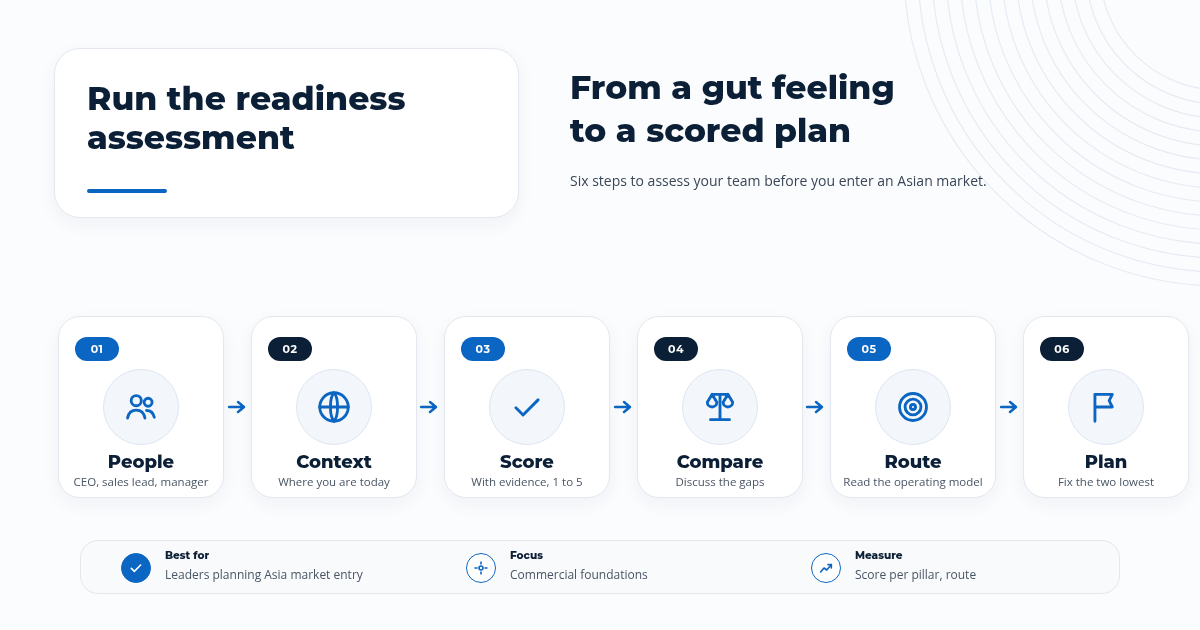
This is how we recommend running the assessment inside your company.
Step 1 — Pick the Right People
Who Should Take It
Your CEO or founder, your sales leader, and the person who will manage Asia outreach.
Why It Matters
In our experience, different roles see different gaps. The CEO may rate strategy high; the sales lead may rate data access low.
Step 2 — Set the Context Honestly
What to Do
Answer the context questions for where you are today, not where you plan to be.
Step 3 — Score Each Statement With Evidence
How to Score
For each statement, ask: “What proof do we have?” If the answer is “we believe so,” score it 2 or 3, not 5.
Step 4 — Compare and Discuss
What to Do
Put the answers side by side. Discuss every statement where scores differ by two points or more.
Step 5 — Read the Route, Not Just the Score
What to Do
Look at the recommended operating model and ask whether it matches your objective: learning, pipeline, or scaling.
Step 6 — Turn Gaps Into a Plan
What to Do
Pick the two lowest-scoring statements. Assign an owner and a deadline to each. Retake the assessment after you act.
Practical Rule (our take)
A readiness score is a starting point for a conversation, not a verdict.
Example Scenarios (Illustrative, Not Real Clients)
These scenarios are examples we created to show how scores translate into routes. They are not client cases.
Scenario A — The Strong Engine Without Evidence
A European SaaS company has a strong sales team, good tools, and leadership support, but no Asian buyer conversations yet. Infrastructure and people score well; market evidence scores low. A likely route: validate with a partner before hiring.
Scenario B — The Proven Market, Missing Skills
A US company already has customers in Singapore and wants to enter Indonesia. Evidence and leadership are strong; local-language outreach and data access are weak. A likely route: targeted support.
Scenario C — The Ready Team
A company has repeatable pipeline in one Asian market and a regional sales leader in place. A likely route: go independently, with support only where needed.
How to Present Your Results to the Board
Boards rarely want a score on its own. They want to know what it means for money and risk.
A Simple One-Page Summary (Our Template)
- the market you assessed and why;
- your score per pillar, with the two lowest highlighted;
- the recommended route and why it fits your objective;
- the two actions you will take, with owners and dates;
- what evidence would justify the next fixed commitment, such as a hire.
Relatable Example
“We scored low on market evidence, so we will run buyer conversations in one market before hiring” is a much easier decision for a board than “We need budget for an Asia team now.”
Need Help Turning Your Score Into a Plan?
Expand In Asia helps B2B companies close readiness gaps and test Asian markets through:
- market prioritization;
- ICP definition and account research;
- compliant prospect data;
- localized buyer messaging;
- LinkedIn, email, and phone outreach;
- SDR execution and management;
- appointment setting with decision-makers;
- market feedback that strengthens your evidence.
Common Readiness Assessment Mistakes
Mistake 1 — Scoring Intentions, Not Evidence
“We plan to” is not a 5.
Mistake 2 — Only the CEO Takes It
In our experience, the person closest to execution sees the real gaps.
Mistake 3 — Treating the Score as Pass or Fail
The score points to a route. Every route can work.
Mistake 4 — Ignoring the Leadership Pillar
A strong team stopped after one month has not failed. It was not given time to learn.
Mistake 5 — Assessing “Asia,” Not a Market
Score your readiness for one specific market at a time.
Mistake 6 — Never Retaking It
Readiness changes. Retake the assessment after each major change.
Quick Readiness Self-Check Scorecard
Use this quick version before taking the full tool. It is our simplified summary, not a replacement for the Asia Expansion Readiness Assessment Tool.
| Pillar | 1 — Not in Place | 3 — Partly in Place | 5 — Strong and Repeatable |
|---|---|---|---|
| Strategy | “Asia is growing” | Markets named, goals vague | Clear business case and priority markets |
| ICP and evidence | Copied from home market | Some local conversations | Customers, opportunities, repeated feedback |
| Prospect data | Unknown | Partial coverage | Accurate, compliant, by market |
| People | No one manages SDRs | Part-time oversight | Weekly management and coaching |
| Process | No handover rules | Informal | Clear qualification and handover |
| Infrastructure | Home-market tools only | Partly adapted | Measures Asia activity reliably |
| Leadership | Expects revenue in month one | Mixed | Aligned on a learning period |
| Investment | One attempt only | Some flexibility | Budget for several iterations |
Score Interpretation (Our Guidance)
| Total Score | What It Usually Suggests |
|---|---|
| 34–40 | Strong foundations. Check whether going independently fits your objective. |
| 27–33 | Solid base with gaps. Targeted support often fits. |
| 20–26 | Several gaps. Validate the market before fixed commitments. |
| Below 20 | Start with evidence and leadership alignment first. |
Need the Full Picture?
Take the free tool for a recommended operating model based on your full context.
Next Steps With Expand In Asia
- Pick one market to assess.
- Take the tool with two or three people.
- Discuss the gaps where scores differ.
- Act on the two lowest scores first.
To go deeper:
- read the pillar guide, Breaking Into Asia: 5 Critical Asia Expansion Mistakes;
- read When Should You Hire a Local Sales Team in Asia?;
- read Building High-Performance B2B Sales Teams.
Ready to Implement These Strategies?
Book a free 30-minute strategy session where we’ll audit your current growth approach and identify your highest-leverage opportunities in Asian markets.
Frequently Asked Questions
1. What is an Asia expansion readiness assessment?
An Asia expansion readiness assessment is a structured self-check that scores whether a company’s commercial foundations are strong enough to enter an Asian market. Expand In Asia’s free tool rates 14 statements across five pillars: Strategy, ICP and Market Evidence, People and Process, Infrastructure, and Leadership and Investment.
2. How do you know if your company is ready to expand into Asia?
In our view, you are ready when you have a clear commercial reason for Asia, specific priority markets, real buyer evidence, someone who can manage sales development every week, tools that can measure Asia activity, and leadership willing to fund a learning period. A readiness assessment shows which of these are missing.
3. What should an Asia expansion readiness assessment measure?
It should measure commercial foundations, not just product or funding: the business case, market prioritization, ICP and evidence of demand, data access, sales management capacity, handover rules, CRM and localization setup, and leadership alignment on timelines and investment.
4. How long does the Asia Expansion Readiness Assessment Tool take?
According to the tool page at tools.expandin.asia, it takes approximately seven minutes. You answer a few context questions, rate 14 readiness statements from 1 to 5, and receive a readiness score and a recommended operating model.
5. Does a low score mean we should outsource?
No. The tool itself states that a high score does not automatically mean doing everything yourself, and a lower score does not automatically mean outsourcing. The right model depends on your evidence of demand, who can manage execution, how many markets you enter, and whether your priority is learning, pipeline, or scaling.
6. What is SDR readiness?
SDR readiness is whether your company can run sales development in a new market: SDRs (sales development representatives) who find prospects and book meetings, someone to manage and coach them weekly, clear handover rules to closers, accurate prospect data, and tools to track results.
7. How can Expand In Asia help after the assessment?
Expand In Asia is a Singapore-based B2B outbound and market-entry partner. After you complete the free assessment, you can open a discussion to pressure-test your market thesis, ICP, outreach approach, and resourcing model before committing to fixed costs.
Which readiness pillar scored lowest for your team? Share it in the comments or send the tool to your sales lead and compare scores.
About the author: Joel Berou is Asia Expansion & Revenue Growth Advisor at Expand In Asia, a Singapore-based B2B outbound and market-entry partner that helps companies build pipeline across Asian markets. This article draws on the October 2026 masterclass presented by Nicolas Levitte, Founder & CEO of Expand In Asia. Last updated: October 16, 2026.
Sources
-
Expand In Asia. Asia Expansion Readiness Assessment Tool (accessed 16 October 2026). https://tools.expandin.asia/ ↩