Why This Decision Is Harder in Southeast Asia
Most B2B companies approaching the outsourced vs. in-house question have frameworks built for the US or European market. Southeast Asia changes the calculation significantly — and the factors that make it different are not always visible until you are mid-execution.
Southeast Asia is not a single market. Singapore, Indonesia, Vietnam, the Philippines, Malaysia, and Thailand each carry distinct buyer behaviors, relationship norms, language requirements, regulatory environments, and price sensitivities. A sales hire who is effective in Singapore may need substantial recalibration to sell into Jakarta or Ho Chi Minh City. The e-Conomy SEA 2024 report (Google, Temasek, Bain) positions Southeast Asia’s digital economy approaching $300 billion in gross merchandise value in 2025 — but this growth is distributed unevenly across markets with very different commercial infrastructure.
The talent market adds another layer. Singapore’s hiring environment is competitive and expensive. According to the Randstad Singapore 2025 Job Market Outlook and Salary Guide, professionals with strong sales track records can command salary increments of 15–30% when switching roles. Recruitment timelines extend further when specialist knowledge of a specific regional market is required.
For companies that have not yet validated product-market fit in the region, committing to a full in-house build before there is pipeline evidence carries real financial and operational risk.
- TL;DR — Key Takeaways
- Building a 3-person in-house sales team in Singapore carries a fully-loaded annual cost of approximately $323,000–$340,000 USD (including salary, CPF/benefits, recruitment, tools, training, and overhead) based on 2025 Singapore salary market data
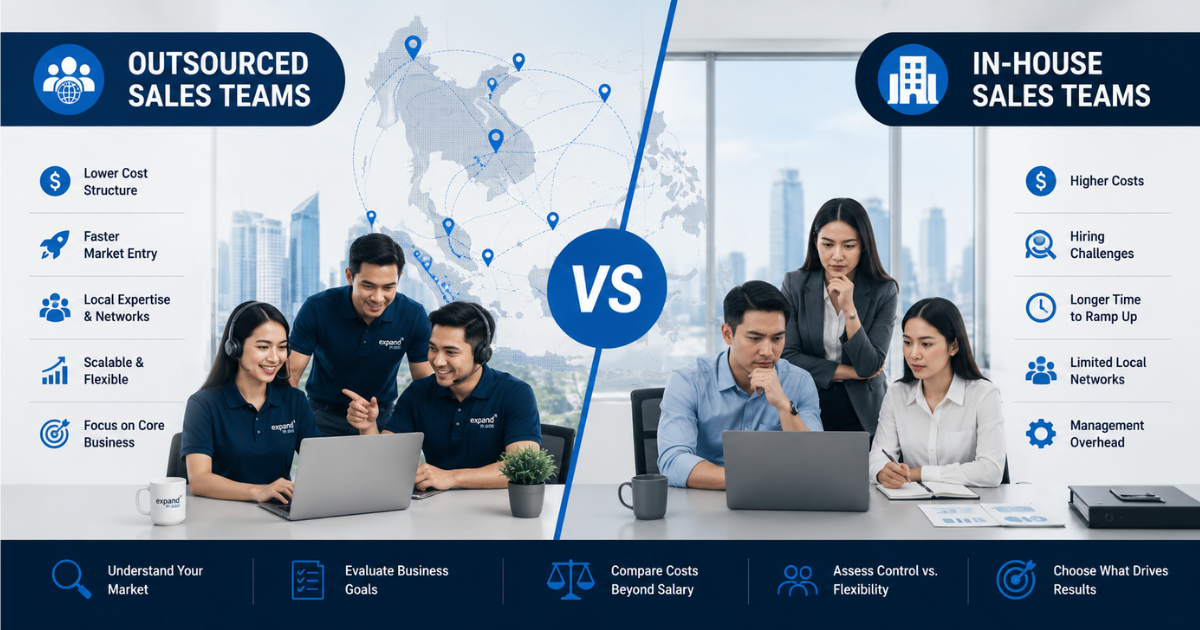
- Outsourcing an equivalent scope typically costs 50–70% less than building internally, with faster deployment and built-in market knowledge
- McKinsey research documents that hybrid selling — combining outsourced execution with internal strategic oversight — drives up to 50% more revenue than traditional in-house-only models
- Speed to market is the most decisive variable for companies entering Southeast Asia: an outsourced team can begin outreach in weeks; internal hiring and ramp in Singapore typically takes 4–9 months
- Neither model is universally superior. The right choice depends on your growth stage, target country, ICP complexity, and how much institutional knowledge you need to retain internally
If you only do one thing: If you only do one thing: Map your timeline and budget against the true total cost of each model before any hiring or outsourcing decision. The gap is larger than most teams expect.
Who This Comparison Is For (and Not For)
This framework is for you if:
-
Your company is entering one or more Southeast Asian markets and has not yet established a local sales team
-
You have a defined ICP but are unsure which operational model will get you to first revenue faster and more cost-effectively
-
You are already running an in-house team in SEA and are evaluating whether augmenting it with outsourced resources makes sense
-
You are a revenue leader or founder who needs a structured, data-grounded way to present this decision internally
This comparison is not the right fit if:
-
You have not yet validated your product or offer in the target SEA market — both models will struggle without a tested value proposition tailored for this region (see GTM Strategies for Asia)
-
Your buyer segment requires a deeply technical enterprise sales process with multi-year relationship cycles that necessitate full-time internal ownership from day one
-
You are looking for a one-size-fits-all answer; the right model is genuinely context-dependent
Model Overview: What Each Approach Actually Involves
Before comparing the two, it is worth defining what each model means in practice — because both terms are used loosely.
What “In-House Sales Team” Means in Southeast Asia
An in-house team is a directly employed group of sales professionals who work exclusively for your organization, typically hired locally in your target market. In Southeast Asia, this usually means:
-
Hiring a Country Manager or Regional Sales Lead, plus SDRs or BDRs based in the target market
-
Building or licensing your own sales technology stack (CRM, sequencing, data tools)
-
Running your own onboarding, training, and performance management
-
Full payroll, CPF contributions (in Singapore), and employment law compliance
What “Outsourced Sales Team” Means in Southeast Asia
An outsourced model engages a third-party sales execution partner who provides trained sales professionals, tools, and process as a managed service. In Southeast Asia, this typically means:
-
A dedicated or shared team of SDRs/BDRs aligned to your ICP and messaging
-
The partner handles recruitment, training, tools, payroll, and compliance
-
You receive structured reporting on pipeline activity and qualified meeting outcomes
-
Engagements commonly run on retainer, performance, or hybrid pricing structures
🔗 For a full breakdown of what to look for when selecting an outsourced partner, see our related post: How to Evaluate a B2B Sales Outsourcing Partner: A Scorecard for Asian Markets
Cost Comparison
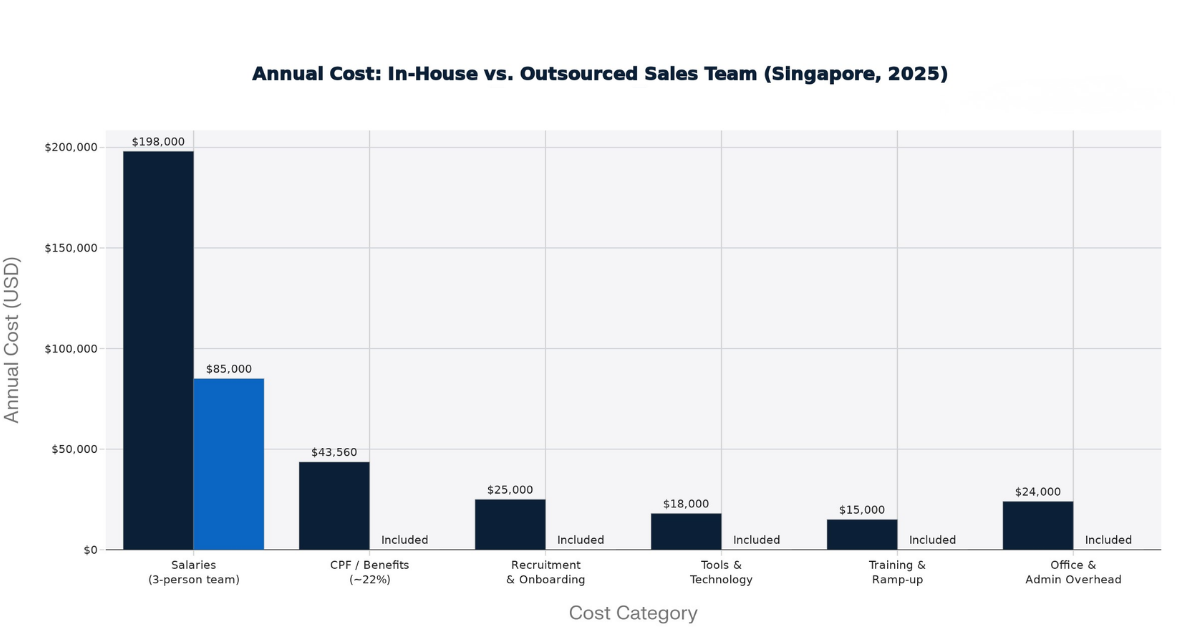
One of the most consistent errors companies make is comparing the quoted price of an outsourced partner directly against the base salary of a single in-house hire. This comparison is structurally misleading.
A realistic in-house team requires more than salaries. For a minimum viable 3-person B2B sales team in Singapore (1 Sales Manager + 2 SDRs), the fully-loaded annual cost based on available 2025 market data includes:
| Cost Component | In-House (USD/yr est.) | Outsourced Partner |
|---|---|---|
| Salaries (Sales Manager + 2 SDRs) | ~$198,000 | — |
| CPF / Employer Benefits (~22%) | ~$43,560 | — |
| Recruitment & Headhunting Fees | ~$25,000 | — |
| Sales Tools & Technology (CRM, sequencing, data) | ~$18,000 | Included |
| Onboarding & Training | ~$15,000 | Included |
| Office & Admin Overhead | ~$24,000 | Included |
| Total Annual Estimated Cost | ~$323,560 | ~$85,000–$130,000 |
Notes: Salary benchmarks derived from Glassdoor Singapore (Sales Manager avg. SGD 78k/yr), Randstad Singapore 2025 Guide (SDR/BDR range SGD 48k–60k/yr), converted at approximate USD exchange rates. CPF employer contribution rate of approximately 17% applied. Outsourced retainer range based on Aexus (2025) market benchmarks for managed B2B sales services. Figures are illustrative estimates and will vary by engagement scope and provider.
The cost differential is not the only consideration — but it is often the most underestimated one in internal business cases. Aexus documents that outsourcing costs 50–70% less than building internally, with faster time to first pipeline activity.
Decision Matrix: 8 Criteria That Matter in SEA
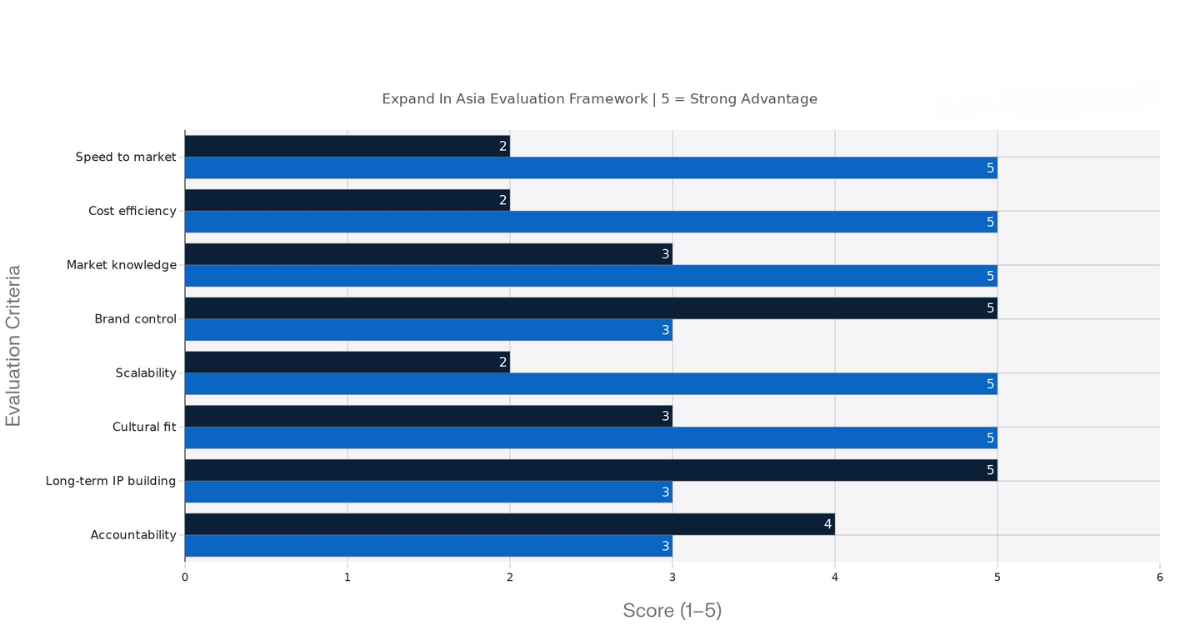
This matrix scores each model on dimensions that are specifically relevant to Southeast Asian market conditions. Scores are indicative frameworks, not absolute rankings — your context will shift these.
| Criteria | In-House | Outsourced | Why It Matters in SEA |
|---|---|---|---|
| Speed to market | ⭐⭐ | ⭐⭐⭐⭐⭐ | Hiring, onboarding, and ramp in Singapore takes 4–9 months; outsourced teams typically begin in weeks silverbellgroup |
| Cost efficiency | ⭐⭐ | ⭐⭐⭐⭐⭐ | Fully-loaded in-house cost is significantly higher, especially in Singapore randstad |
| Market knowledge | ⭐⭐⭐ | ⭐⭐⭐⭐⭐ | Established partners bring pre-built knowledge of buyer behaviors, decision hierarchies, and local norms callboxinc |
| Brand control | ⭐⭐⭐⭐⭐ | ⭐⭐⭐ | In-house teams fully represent your brand in every interaction; outsourced requires tighter briefing and oversight |
| Scalability | ⭐⭐ | ⭐⭐⭐⭐⭐ | Scaling an outsourced team is faster and does not require additional headcount approvals silverbellgroup |
| Cultural fit | ⭐⭐⭐ | ⭐⭐⭐⭐⭐ | Experienced SEA partners have native-language SDRs and culturally calibrated messaging per country callboxinc |
| Long-term IP building | ⭐⭐⭐⭐⭐ | ⭐⭐⭐ | In-house teams accumulate institutional knowledge of your market and buyers over time |
| Accountability | ⭐⭐⭐⭐ | ⭐⭐⭐ | Internal hires are more directly manageable; outsourced accountability depends on contract SLAs |
When Outsourced Wins in Southeast Asia
Outsourcing delivers a clearer advantage in specific, well-defined situations. These are not arguments for outsourcing in every case — they are the conditions under which the evidence consistently favors it.
1. You are in market validation mode (first 6–12 months)
Before your ICP, messaging, and pipeline economics are validated in the target SEA market, committing to a permanent in-house team is premature. An outsourced model lets you test and iterate without the fixed overhead of full-time employees who must be managed through a pivot.
2. Speed to pipeline is a competitive priority
If your company needs qualified meetings in Singapore, Jakarta, or Manila within 60–90 days, an outsourced team with pre-built local infrastructure is the only practical option. In-house hiring, onboarding, and ramp typically require 4–9 months before a new SDR generates consistent output.
3. You are entering multiple ASEAN markets simultaneously
Scaling a separate in-house team for each target country is capital-intensive and organizationally complex. Outsourced partners with existing multi-market capabilities — covering Singapore, Indonesia, the Philippines, Malaysia, and Vietnam — eliminate the need to build country-specific hiring pipelines in parallel.
4. You need native-language and culturally calibrated outreach
Gartner research notes that by 2025, 80% of B2B sales interactions occur in digital channels. Getting the right message to the right buyer in the right language is non-negotiable. A partner with native Bahasa Indonesia, Filipino, or Vietnamese-speaking SDRs has an immediate structural advantage over an English-only in-house team attempting to cover those markets.
5. Your team does not yet have regional sales management experience
If your internal leadership has not built or managed a sales team in Southeast Asia before, the learning curve — combined with regional hiring, compliance, and cultural complexity — represents a meaningful execution risk. An outsourced partner absorbs much of this operational burden while your team learns the market.
💬 “Test an outsourced SDR partner if you don’t have internal capacity. Pick one region or segment, build a hybrid motion, and instrument it well. Once you see what channel mix and messaging work, roll that model out more broadly.” — SalesHive, Future Trends in B2B Sales, 2025
When In-House Wins
An in-house team is not the wrong answer — it is the right answer in specific, well-defined conditions.
1. You have validated pipeline and are scaling a proven motion
Once your ICP, messaging, and conversion economics are proven in the target market, an in-house team that owns and deepens that playbook creates more durable competitive advantage than a continued outsourced model.
2. Your deal complexity requires deep product knowledge
Enterprise B2B sales processes involving complex technical solutions, multi-stakeholder buying committees, or long evaluation cycles (12+ months) benefit from dedicated sales professionals with deep product knowledge and continuity of relationship. Outsourced models are generally more effective for top-of-funnel and mid-funnel pipeline generation, not for closing complex enterprise deals.
3. You are building for a long-term market presence
Companies committed to Southeast Asia as a core strategic market — not just a testing ground — need to build institutional knowledge, hire local talent, and develop internal capability over time. An in-house team is a prerequisite for this. According to Expand In Asia’s market trend analysis, companies with locally embedded teams consistently build stronger buyer relationships and brand recognition in ASEAN markets over a 2–3 year horizon.
4. Your buyer relationships require high continuity
Certain ASEAN markets — particularly Japan, South Korea (adjacent to SEA), and segments within Singapore’s enterprise space — place significant weight on relationship continuity. Buyer trust is built over time with consistent relationship owners, not rotating external SDRs.
The Hybrid Model: A Practical Middle Path
For many B2B companies entering Southeast Asia, neither a pure in-house nor a pure outsourced model is the optimal structure. A hybrid approach — where an outsourced partner handles top-of-funnel pipeline generation while an internal team manages qualified opportunities and customer relationships — has become increasingly common and well-documented.
McKinsey research identifies hybrid as the default operating model in modern B2B sales, representing 70% of sales roles. The same McKinsey analysis documents that hybrid selling drives up to 50% more revenue than traditional models by enabling broader market coverage and access to a more diverse talent pool.
In the Southeast Asian context, a practical hybrid structure looks like this:
| Sales Function | Who Owns It | Why |
|---|---|---|
| ICP definition & messaging | Internal team | Requires intimate knowledge of your product and strategic positioning |
| Prospecting & outbound sequencing | Outsourced partner | Leverages local market knowledge, language capability, and existing infrastructure |
| Qualified meeting facilitation | Outsourced partner | First-meeting conversion benefits from local credibility |
| Opportunity management & negotiation | Internal or senior hire | Complex deal progression requires product depth and brand representation |
| Customer onboarding & success | Internal team | Relationship continuity is critical for retention |
This structure gives companies speed-to-market without sacrificing strategic control — and allows the internal team to focus on activities that compound over time while the outsourced partner handles high-volume execution.
Evaluating whether to outsource, hire, or use a hybrid model for your SEA market entry?
Speak with the Expand In Asia team — we’ll map the right model for your stage and markets →
Real-World Scenario: Choosing the Right Model
Situation: A B2B SaaS company headquartered in Australia with an established product targeting HR and operations leaders in mid-market companies (200–1,000 employees) decides to enter Singapore and Malaysia.
Trigger: Inbound interest from two Singapore-based prospects, combined with a board mandate to generate $500,000 USD in new ARR from Asia within 18 months.
Barrier: The company has no in-house Asia sales capability. Building an internal team from scratch — a Singapore-based Country Manager plus two SDRs — would require 6–9 months of hiring and ramp before meaningful pipeline exists. The 18-month board timeline makes this approach high-risk.
Solution applied: A hybrid model — engaging an outsourced B2B sales partner in Singapore to run top-of-funnel pipeline generation (prospecting, outreach, meeting qualification) while a senior internal hire (a part-time VP of Asia Sales based remotely) manages qualified opportunities and the commercial relationship.
Snapshot:
Company type: B2B SaaS (HR tech)
Target segment: Mid-market (200–1,000 employees), Singapore and Malaysia
Time to first qualified meetings: 6 weeks post-engagement
Time to first closed deal: Month 4
Pipeline at Month 12: 14 qualified opportunities, 3 closed-won
Total outsourced engagement cost at Month 12: approximately $110,000 USD
Estimated cost of equivalent in-house build over same period: approximately $280,000+ USD (before first hire is fully productive)
Results: The company reached its first $500k ARR milestone in Month 16 — within the board timeline. At month 18, they used validated pipeline data and conversion benchmarks to justify hiring their first full-time Singapore-based Sales Director to manage and scale the motion internally.
How to Make the Final Call
Use this decision guide to determine which model fits your current situation:
Choose Outsourced if:
-
✅ You have not yet validated your ICP and messaging in the target SEA market
-
✅ You need qualified pipeline within 60–90 days
-
✅ Your budget does not support a fully-loaded in-house team for 12+ months
-
✅ You are entering more than one SEA market simultaneously
-
✅ You need native-language outreach capability your internal team cannot currently provide
Choose In-House if:
-
✅ You have validated pipeline economics in the market and are scaling a proven motion
-
✅ Your deal complexity requires deep, continuous product knowledge and long relationship cycles
-
✅ You are committing to a long-term (3+ year) market presence and need institutional knowledge to accumulate internally
-
✅ Your buyer segment requires high relationship continuity with consistent contact
Choose Hybrid if:
-
✅ You want speed-to-market without sacrificing strategic control
-
✅ Your product requires internal expertise at the opportunity and negotiation stage but benefits from outsourced top-of-funnel execution
-
✅ You are in a 12–24 month window between market validation and full internal team build-out
🔗 For a curated list of evaluated outsourced sales partners operating in Asia, see: 25 Best B2B Sales Outsourcing Companies Worth Hiring in 2026
🟦 Talk to Our Team
Book a 30-minute consultation to discuss your target markets, your timeline, and which sales model best fits your current stage.
Schedule a Call with Expand In Asia →
📋 Evaluate Your Options
Use our structured partner evaluation framework to shortlist and score outsourced sales providers for Asian markets.
Read: How to Evaluate a B2B Sales Outsourcing Partner →
🗺️ Understand the Market Landscape
Read our analysis of the key trends shaping B2B expansion and sales across Asia in 2025 and beyond.
Read: Top Market Trends Reshaping Asian Expansion →
Ready to Implement These Strategies?
Book a free 30-minute strategy session where we’ll audit your current growth approach and identify your highest-leverage opportunities in Asian markets.
Frequently Asked Questions
1. How long should a B2B sales outsourcing partner evaluation take?
From job posting to a fully productive SDR generating consistent qualified meetings, most companies building in Singapore should budget 6–9 months. This accounts for recruitment (typically 6–12 weeks for specialist sales roles), onboarding (4–6 weeks), and ramp time (2–4 months before conversion metrics stabilize). The Randstad Singapore 2025 Salary Guide notes that hiring focus has shifted toward selective replacement rather than expansion, making competitive candidates harder to secure. If your timeline is shorter than 6 months, an outsourced or hybrid model is a more practical near-term option.
2. What is the typical contract structure for outsourced B2B sales in Southeast Asia?
Most established B2B sales outsourcing engagements in Southeast Asia use a retainer-based or hybrid (retainer + performance) structure. Pure performance-only models are less common for new client relationships because they create misaligned incentives around lead quality. Typical minimum engagement periods range from 3–6 months, which allows enough time to complete onboarding, ICP alignment, and at least two full outreach cycles before performance conclusions are drawn. Always define “qualified meeting” in writing as part of the contract.
3. Can an outsourced sales team represent our brand credibly in Southeast Asian markets?
Yes — when properly onboarded and managed. The critical factors are: a detailed brand and messaging brief at the start of engagement, a defined ICP that the outsourced team internalizes, regular call listening and coaching sessions, and a clear escalation path for prospect questions that require internal product expertise. Companies that treat outsourced SDRs as fully integrated extensions of their revenue team — rather than external vendors given a script — consistently report stronger brand representation outcomes.
4. How do cultural differences across SEA countries affect which sales model works?
Cultural dynamics vary significantly across Southeast Asia and affect both the sales model choice and the execution approach within each model. In Singapore, a predominantly English-language, relationship-oriented business culture with high digital adoption often makes outsourced models with experienced local SDRs immediately effective. In Indonesia, relationship-building timelines are longer, Bahasa Indonesia fluency is a significant advantage, and trust is harder to establish through purely digital outreach. In Vietnam and the Philippines, different norms again apply. An outsourced partner with genuine multi-market capability — not just geographic presence — is better positioned to navigate these differences than a generalist.
5. At what stage should a company transition from outsourced to in-house sales in SEA?
A practical transition trigger is the combination of: (1) validated pipeline economics — you know your qualified opportunity rate, show rate, and conversion rate well enough to project CAC reliably; (2) sufficient deal volume to justify full-time internal headcount; and (3) a long-term market commitment that makes institutional knowledge accumulation strategically valuable. Most companies using an outsourced model well use Month 12–18 data to make the build-out case to the board. The hybrid model described in this article is often the bridge between those two stages.
6. Does Expand In Asia provide outsourced sales execution for multiple SEA countries simultaneously?
Yes. Expand In Asia works with B2B companies across multiple Southeast Asian markets, including Singapore, Indonesia, the Philippines, Malaysia, Vietnam, and Thailand. Engagements are structured based on your specific target markets, ICP, and growth stage. To discuss your multi-market requirements, book a consultation with the team here.
💬 Which model are you currently evaluating — and what’s the biggest factor driving your decision? Drop your situation in the comments below. We read every response and often address recurring questions in follow-up content.
📤 Was this comparison useful? Share it with a colleague or partner navigating the same decision, or bookmark the decision matrix for your next strategy review.