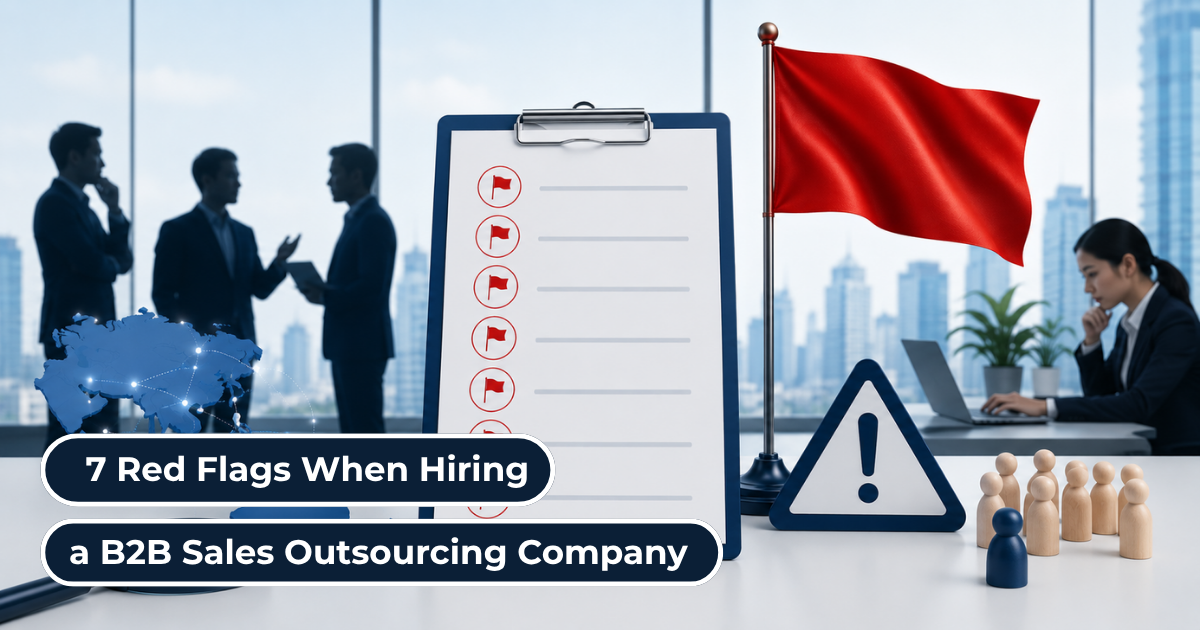
7 Red Flags When Hiring a B2B Sales Outsourcing Company
A practical due diligence checklist for B2B companies evaluating outsourced sales partners — especially when entering or expanding across Asian markets.
A good outsourced sales partner can help you validate a new market, create pipeline faster, and reduce the cost of building a full local team too early.
The wrong partner can do the opposite.
They can burn your target account list, damage your brand with generic outreach, report activity without pipeline quality, and leave you with little more than “meetings booked” that never convert.
This matters even more in Asia. Markets such as Singapore, Indonesia, Vietnam, the Philippines, Malaysia, Japan, and South Korea require different buyer expectations, business etiquette, languages, and follow-up norms. A vendor that treats “Asia” as one generic market is already starting from the wrong assumption.
This guide gives you a simple checklist: seven red flags to look for before signing with a B2B sales outsourcing company.
- TL;DR — Key Takeaways
- Do not hire a vendor based only on activity promises. More emails, more calls, or more meetings do not automatically mean qualified pipeline.
- Ask for proof before process. A credible partner should show relevant case studies, reporting examples, client references, and a clear methodology.
- Reporting transparency is non-negotiable. Clutch’s guidance says a reliable outsourcing partner should provide clear KPIs, regular reporting, and pipeline visibility.
- Data handling matters. Singapore’s PDPC provides guidance for organisations outsourcing data processing activities to data intermediaries.
- Avoid any provider that cannot define a “qualified lead” or “qualified meeting” in writing. This is where most expectation gaps begin.
If you only do one thing: ask every shortlisted vendor to show a sample report, a written qualified-meeting definition, and one relevant client reference before you review pricing.
Who This Comparison Is For (and Not For)
This checklist is designed for B2B companies that are:
- evaluating B2B sales outsourcing companies for the first time;
- entering a new Asian market and need local pipeline support;
- comparing outsourced SDR, appointment-setting, or lead generation providers;
- replacing a previous vendor that underperformed;
- building a shortlist from directories, referrals, or review platforms;
- trying to avoid paying for “activity” that does not turn into qualified pipeline.
It is especially relevant for companies selling SaaS, cybersecurity, fintech, HR tech, cloud services, professional services, data platforms, or complex B2B solutions where buyer qualification matters.
This checklist is not for companies looking for a fully transactional call center model where the only metric is volume. For strategic B2B sales, the standard must be higher.
Why Red Flags Matter in Outsourced B2B Sales
Outsourced sales is not just a vendor decision. It is a market-facing decision.
The people you hire externally will represent your brand in front of prospects. They will write to your target accounts, speak to your buyers, handle objections, qualify interest, and create the first impression of your company.
That means the risk is not limited to cost. The bigger risks are:
- poor brand representation;
- low-quality meetings;
- weak qualification standards;
- non-compliant data handling;
- market learning that never gets captured;
- internal teams losing trust in outbound as a channel.
The market is also crowded. Clutch listed 5,539 companies under sales outsourcing as of June 11, 2026, and positions its platform around verified reviews, project outcomes, and pricing insights. More choice is useful, but it also means buyers need a sharper filter.
7 Red Flags At-A-Glance
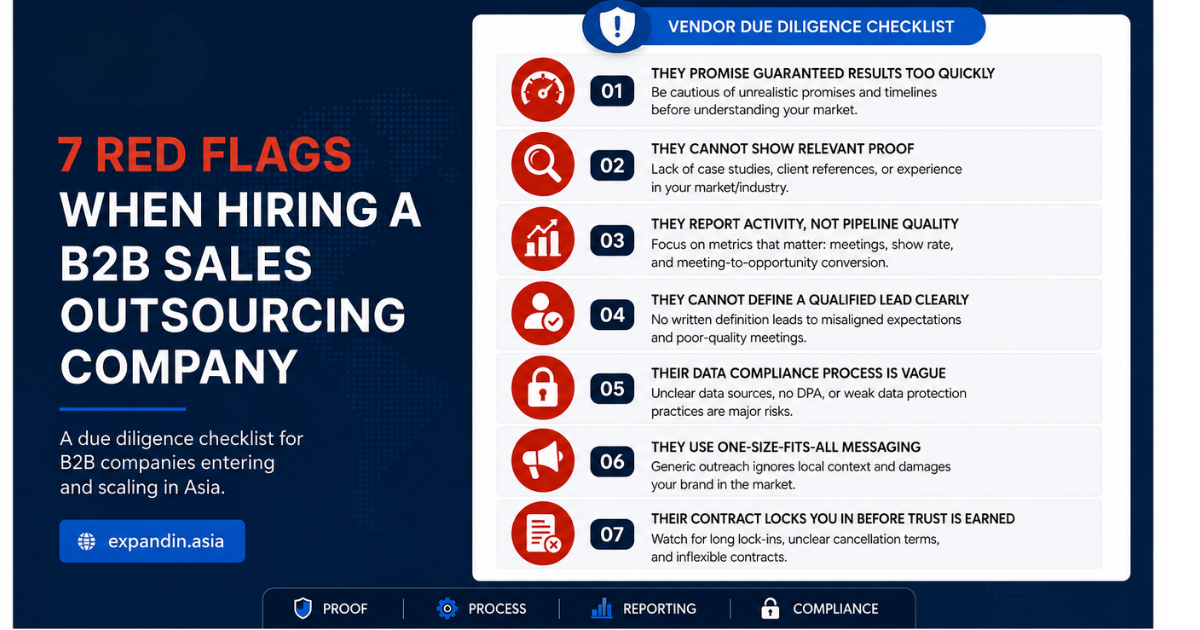
Red Flag #1 : They Promise Guaranteed Results Too Quickly
The first red flag is a vendor that makes confident promises before understanding your market.
Examples:
- “We guarantee 30 qualified meetings in the first month.”
- “We already know your market.”
- “This campaign will work immediately.”
- “Our system works for every industry.”
- “You do not need much onboarding.”
In B2B sales, especially in new markets, results depend on several variables: ICP clarity, offer maturity, average contract value, buyer urgency, channel fit, data quality, messaging, competitive landscape, and sales cycle length.
A vendor can confidently explain a process. They should be careful about guaranteeing outcomes too early.
Aexus lists unrealistic promises about timelines or results as a red flag when evaluating B2B sales outsourcing providers. That does not mean vendors cannot be ambitious. It means they should distinguish between what they control and what the market must validate.
What to Ask Instead
Ask:
- “What assumptions need to be true for that result to happen?”
- “What would you expect to learn in the first 30 days?”
- “Which leading indicators do you track before meetings start converting?”
- “What results have you seen for companies similar to ours?”
- “What would make this campaign underperform?”
Green Flag Version
A stronger partner will say something like:
“In the first 30 days, we expect to validate list quality, messaging, positive reply patterns, and early meeting conversion. We can estimate targets, but we will not treat them as guaranteed until we validate the segment.”
That answer is less flashy, but much more useful.
Red Flag #2 : They Cannot Show Relevant Market or Industry Proof
A vendor may have experience. The question is whether it is relevant to your situation.
For example, if you sell enterprise cybersecurity into Singapore financial services, a case study about booking meetings for a US-based SMB SaaS company may not be enough. If you are expanding into Indonesia, a vendor with only English-speaking Singapore campaigns may not have the right market depth.
Aexus recommends assessing industry expertise, market presence, track record with similar companies and deal sizes, cultural fit, communication process, CRM capability, and reporting capability when selecting a B2B sales outsourcing partner.
Common Warning Signs
Be cautious if the vendor:
- only shares generic logos, not relevant case studies;
- cannot explain the buyer journey in your target market;
- has no experience in your segment or deal size;
- cannot provide client references;
- only shows activity numbers, not conversion outcomes;
- claims “APAC experience” but cannot name specific markets, roles, or buyer types.
What to Ask Instead
Ask:
- “Which markets in Asia have you actively sold into?”
- “Which industries have you supported?”
- “Can you show a campaign that had a similar buyer persona?”
- “What was the meeting-to-opportunity conversion rate?”
- “Can we speak with a current or former client?”
Green Flag Version
A credible partner will be able to explain:
- the exact market they worked in;
- the target persona;
- the outreach channels used;
- the qualification criteria;
- the reporting cadence;
- what worked;
- what did not work;
- what changed after the first campaign cycle.
This is especially important when selling across Asia, where Singapore, Indonesia, Vietnam, the Philippines, Japan, and South Korea require different commercial approaches.
Red Flag #3 : They Report Activity, Not Pipeline Quality
Activity is easy to report.
Pipeline quality is harder.
A weak vendor will show you:
- number of emails sent;
- number of calls made;
- number of LinkedIn invites sent;
- number of follow-ups completed;
- number of meetings booked.
Those numbers matter, but they are not enough.
A serious B2B sales outsourcing company should report metrics that connect activity to business outcomes. Clutch’s sales outsourcing buyer guidance says a reliable outsourcing partner should provide clear KPIs, regular reporting, CRM or pipeline tracking access, and alignment around lead quality, conversion rates, and timeline expectations.
Metrics That Matter More
Ask for reporting on:
| Metric | Why It Matters |
|---|---|
| Account coverage | Shows whether the right companies are being reached |
| Persona coverage | Shows whether the right decision-makers are being targeted |
| Positive reply rate | Shows message-market resonance |
| Meeting booked rate | Shows conversion from interest to action |
| Show rate | Shows whether meetings are real and well-qualified |
| Meeting-to-opportunity rate | Shows whether sales accepts the meetings as valuable |
| Disqualification reasons | Shows where ICP, messaging, or offer may be weak |
| Market feedback themes | Turns outbound into market intelligence |
What to Ask Instead
Ask:
- “Can we see a sample weekly report?”
- “Do we get CRM visibility?”
- “How do you report meeting quality?”
- “Do you track meeting-to-opportunity conversion?”
- “How do you document market feedback?”
Martal’s outsourcing guidance specifically warns that vague reporting is a red flag and recommends asking for a sample report or dashboard before signing.
Green Flag Version
A strong vendor does not hide behind volume. They show you what the market is saying and how the campaign is improving.
Red Flag #4 — They Cannot Define a Qualified Lead Clearly
This is one of the most common reasons outsourced sales partnerships fail.
The vendor says they delivered leads.
The client says the leads were not qualified.
Both sides are frustrated.
The root cause is usually simple: “qualified” was never defined properly.
A Weak Definition
A weak definition sounds like:
“A qualified lead is anyone interested in learning more.”
That is too loose for B2B sales.
A Strong Definition
A stronger definition includes:
| Qualification Area | Example Requirement |
|---|---|
| Company fit | Industry, size, geography, revenue, market |
| Persona fit | Job title, seniority, buying influence |
| Problem fit | Prospect has a relevant pain, trigger, or initiative |
| Timing | Prospect has a current or near-term reason to evaluate |
| Authority / influence | Prospect can influence or refer the decision |
| Exclusion rules | Not a student, vendor, consultant, competitor, or irrelevant contact |
| Meeting standard | Prospect agreed to a business conversation, not just accepted a calendar invite |
For Expand In Asia-style engagements, this definition should be written before the campaign begins.
What to Ask Instead
Ask:
- “How do you define a qualified meeting?”
- “Will this definition be included in the agreement?”
- “What disqualifies a meeting?”
- “Who verifies meeting quality?”
- “What happens if a meeting does not meet the agreed definition?”
Green Flag Version
A strong partner will welcome a written definition. It protects both sides.
Red Flag #5 : Their Data Compliance Process Is Vague
B2B sales outsourcing often involves prospect data: names, titles, business emails, LinkedIn profiles, phone numbers, CRM notes, outreach history, and meeting records.
That creates data handling responsibilities.
For Singapore, the Personal Data Protection Commission provides a guide for organisations managing data intermediaries when outsourcing data processing activities. DLA Piper’s Singapore data protection overview notes that business contact information used solely for business purposes is excluded from certain PDPA obligations, but organisations still need to pay attention when personal data is collected, used, disclosed, retained, protected, or transferred.
DLA Piper also notes that data intermediaries processing personal data on behalf of another organisation under a written contract are directly liable for obligations relating to retention and protection of personal data, and that organisations are required to enter written agreements with data intermediaries to whom they transfer personal data.
Common Warning Signs
Be cautious if the vendor cannot explain:
- where prospect data comes from;
- whether data is verified;
- how opt-outs are handled;
- who owns the data after the engagement;
- how data is stored;
- how data is deleted after termination;
- whether subcontractors are used;
- whether data may be transferred outside the target market;
- how CRM access is controlled.
What to Ask Instead
Ask:
- “What data sources do you use?”
- “How do you manage opt-outs and suppression lists?”
- “Do you sign a data processing agreement?”
- “Where is prospect data stored?”
- “What happens to our data when the engagement ends?”
- “Do you use subcontractors or offshore teams?”
- “How do you handle Singapore PDPA, GDPR, or other market-specific privacy requirements?”
Green Flag Version
A serious partner will have a documented data handling process, clear access controls, and a written exit process.
They may not be your legal adviser, but they should understand that data compliance is not optional.
Red Flag #6 : They Use One-Size-Fits-All Messaging
Generic messaging is one of the fastest ways to damage a market.
A vendor that sends the same sequence to every persona, country, industry, and seniority level is not doing strategic sales development. They are doing volume outreach.
This is a major issue in Asia.
A message that works for a Singapore-based COO may not work for a Japanese enterprise buyer, an Indonesian founder, a Vietnamese country manager, or a Philippine shared-services leader. Decision-making structures, response norms, levels of directness, hierarchy, and preferred channels vary by market.
Common Warning Signs
Watch out if the vendor:
- uses the same sequence for all countries;
- does not ask about buyer pains;
- does not ask for customer proof points;
- skips persona-specific messaging;
- avoids localization;
- cannot explain channel strategy;
- treats LinkedIn, email, and calling as interchangeable;
- does not test message variants.
What to Ask Instead
Ask:
- “How would you adapt messaging between Singapore and Indonesia?”
- “How do you write differently for CEOs, sales leaders, and operations leaders?”
- “Can we review sample messaging before launch?”
- “How many message variants do you test?”
- “How do you incorporate market feedback?”
Green Flag Version
A strong vendor will build messaging around:
- market;
- persona;
- pain point;
- trigger event;
- maturity stage;
- local context;
- proof;
- CTA friction level.
They will also be comfortable with review cycles, because your brand is the asset at risk.
Red Flag #7 : Their Contract Locks You In Before Trust Is Earned
Outsourced sales needs enough time to work. A one-week test is not realistic.
But a long lock-in before the vendor has proven communication quality, reporting discipline, and execution fit is risky.
Martal’s guidance recommends reviewing contract terms around commitment length and scalability, and notes that buyers should avoid being locked into a long contract if performance is lacking.
Common Warning Signs
Be cautious if:
- the minimum term is long with no pilot option;
- cancellation terms are unclear;
- pricing is hard to understand;
- onboarding fees are not explained;
- performance definitions are vague;
- the vendor owns all campaign data;
- there is no service review checkpoint;
- there is no clear process for underperformance.
What to Ask Instead
Ask:
- “What is the minimum initial engagement?”
- “Is there a pilot or phased rollout?”
- “What are the termination terms?”
- “What happens if meeting quality is poor?”
- “Can we scale up or down?”
- “Who owns the data and campaign assets?”
- “What are the review checkpoints?”
Green Flag Version
A strong partner will offer a structure that balances both sides:
- enough time to produce meaningful data;
- enough flexibility to adjust;
- clear underperformance rules;
- transparent pricing;
- defined ownership of campaign assets;
- agreed review points.
Vendor Red Flag Scorecard
Use this checklist during vendor evaluation calls.
| Red Flag | What to Look For | Risk Level | Pass / Fail |
|---|---|---|---|
| Unrealistic promises | Guarantees before discovery | High | |
| No relevant proof | No comparable market, industry, or persona examples | High | |
| Activity-only reporting | Reports dials/emails but not conversion or quality | High | |
| No qualified-lead definition | “Interested” is treated as qualified | High | |
| Vague data process | No DPA, unclear sources, no deletion process | High | |
| Generic messaging | Same sequence across personas and markets | Medium–High | |
| Rigid contract | Long lock-in, unclear cancellation, weak performance terms | Medium–High |
Recommended Scoring
| Total Failed Items | Recommendation |
|---|---|
| 0–1 | Proceed to reference checks and commercial review |
| 2–3 | Proceed only if gaps are addressed in writing |
| 4+ | High risk — reconsider shortlist |
| Any compliance failure | Do not proceed without legal / data protection review |
Real-World Scenario
Situation
A European SaaS company wants to enter Singapore and Malaysia. The team is considering three B2B sales outsourcing companies.
Trigger
The company has a 12-month Asia expansion target but does not yet have local SDRs, a Singapore office, or validated outbound messaging.
Barrier
All three vendors claim they can generate meetings quickly. The proposals look similar, but the evaluation team is unsure how to compare them.
Evaluation Using the Red Flag Checklist
| Criteria | Vendor A | Vendor B | Vendor C |
|---|---|---|---|
| Relevant Asia case studies | Weak | Strong | Moderate |
| Sample reporting | Activity-only | Pipeline-focused | No sample |
| Qualified meeting definition | Vague | Written | Vague |
| Data process | Basic | Documented | Unclear |
| Messaging approach | Generic | Persona + market-specific | Generic |
| Contract flexibility | 12-month lock-in | 3-month pilot | 6-month minimum |
| Client references | Not available | Available | Available |
Decision
Vendor B is not necessarily the cheapest, but it is the lowest risk. It provides relevant proof, written qualification criteria, clear reporting, and a reasonable pilot structure.
The company proceeds with Vendor B for a 90-day Singapore pilot before expanding to Malaysia.
Lesson
When vendors sound similar, the best choice is usually the one that gives you the clearest operating evidence — not the biggest promise.
What a Strong Partner Looks Like Instead
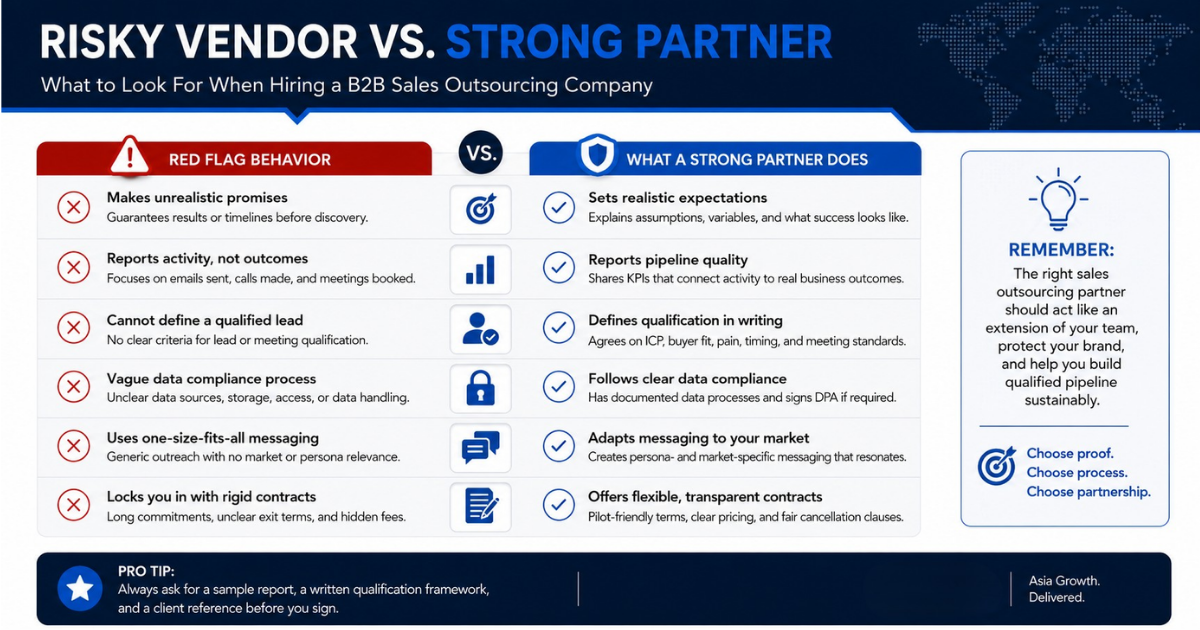
A strong B2B sales outsourcing company should be able to show you:
| Area | What Good Looks Like |
|---|---|
| Discovery | Asks about ICP, sales cycle, ACV, market assumptions, and disqualification criteria |
| Market experience | Has proof in your region, industry, or buyer segment |
| Messaging | Builds persona-specific and market-specific outreach |
| Reporting | Shares weekly dashboards and conversion metrics |
| Qualification | Defines qualified meetings in writing |
| Compliance | Explains data sourcing, opt-outs, access, retention, and deletion |
| Communication | Provides a dedicated point of contact and clear review cadence |
| Contracting | Offers clear scope, pricing, ownership, and exit terms |
| Learning loop | Turns outreach feedback into GTM insight |
This is the difference between a vendor and a partner.
A vendor executes tasks.
A partner helps you learn the market and improve the motion.
Evaluating a B2B Sales Outsourcing Company for Asia?
Before you sign, pressure-test the vendor against your market, ICP, messaging, data process, and reporting expectations.
Expand In Asia helps B2B companies enter and scale across Asian markets with structured outbound sales execution, qualified lead generation, and region-specific GTM support.
Talk to Expand In Asia about your vendor shortlist →
How to Run a Better Evaluation Process
Do not rely on one discovery call.
Use a structured process:
Step 1 — Define Your Success Criteria
Before speaking to vendors, document:
- target market;
- target industries;
- target personas;
- qualified meeting definition;
- disqualification criteria;
- expected reporting cadence;
- acceptable tools and CRM process;
- budget range;
- pilot timeline.
Step 2 — Shortlist 3–5 Vendors
Use review platforms, referrals, and curated guides. Clutch recommends comparing companies based on verified client reviews, case studies, reputation, responsiveness, and delivered results.
For a curated starting point, read: 25 Best B2B Sales Outsourcing Companies Worth Hiring in 2026.
Step 3 — Ask for Evidence
Request:
- sample reports;
- anonymized case studies;
- outreach samples;
- client references;
- qualification criteria;
- data process documentation;
- campaign timeline.
Step 4 — Score Vendors Side by Side
Avoid evaluating vendors based on memory. Use a scorecard.
| Evaluation Area | Weight |
|---|---|
| Market / industry proof | 20% |
| Reporting transparency | 20% |
| Qualification discipline | 15% |
| Messaging quality | 15% |
| Data compliance | 15% |
| Contract flexibility | 10% |
| Cultural fit | 5% |
Step 5 — Start With a Controlled Pilot
A 90-day pilot is often enough to test:
- account list quality;
- message-market fit;
- reply quality;
- meeting conversion;
- reporting discipline;
- collaboration style;
- early opportunity quality.
The goal is not to prove full revenue impact in 90 days. The goal is to validate whether the partner can create qualified pipeline and market learning in a disciplined way.
Build Pipeline Without Guesswork
Hiring a B2B sales outsourcing company should not feel like a gamble.
The right partner should give you clarity before you sign: what they will do, how they will report, how they define quality, how they protect your data, and how they will adapt to your target market.
Expand In Asia works with B2B companies entering and scaling across Asian markets through structured outbound sales execution, qualified lead generation, and GTM support.
Three practical next steps:
1. Talk to Our Team
Book a consultation to discuss your target market, ICP, timeline, and whether outsourced sales is the right model for your current stage.
Schedule a call with Expand In Asia →
2. Compare Providers
Read: 25 Best B2B Sales Outsourcing Companies Worth Hiring in 2026
3. Strengthen Your Lead Generation Strategy
Read: 10 Best B2B Qualified Lead Generation Strategies for 2026
Ready to Implement These Strategies?
Book a free 30-minute strategy session where we’ll audit your current growth approach and identify your highest-leverage opportunities in Asian markets.
Frequently Asked Questions
1. What is the biggest red flag when hiring a B2B sales outsourcing company?
The biggest red flag is a vendor that cannot define a qualified lead or qualified meeting in writing. Without that definition, the vendor may optimize for booked meetings while your sales team expects real opportunities. This creates friction within the first month of the engagement.
2. How many vendors should we compare before choosing one?
For most B2B companies, three to five vendors is enough. Fewer than three gives you limited comparison. More than five often slows the process without improving the decision. The key is to compare vendors using the same scorecard, not just their pitch decks.
3. Should we choose the cheapest sales outsourcing provider?
Not automatically. A cheaper provider may be appropriate for simple appointment-setting, but complex B2B sales requires good data, messaging, reporting, and qualification. A low-cost vendor that generates poor-fit meetings can waste more money than it saves.
4. How long should a B2B sales outsourcing pilot run?
A practical pilot usually runs around 90 days. This gives enough time to complete onboarding, build lists, test messaging, launch outreach, review early conversion data, and assess meeting quality. Shorter tests may only measure setup speed, not actual market response.
5. What should be included in outsourced sales reporting?
At minimum, reporting should include account coverage, persona coverage, outreach volume, positive replies, meetings booked, show rate, meeting quality, disqualification reasons, and market feedback themes. For mature programs, meeting-to-opportunity conversion should also be tracked.
6. Is outsourced sales safe from a data compliance standpoint?
It can be, but only if the vendor has proper data handling practices. For Singapore, companies should pay attention to PDPA-related obligations, data intermediary arrangements, data retention, data protection, and written agreements when prospect data is processed by a third party.
7. Can outsourced SDRs represent our brand properly?
Yes, but only with the right onboarding, messaging review, call coaching, and escalation process. A strong outsourced team should operate like an extension of your commercial team, not a disconnected call center.
💬 Which model are you currently evaluating — and what’s the biggest factor driving your decision? Drop your situation in the comments below. We read every response and often address recurring questions in follow-up content.
📤 Was this comparison useful? Share it with a colleague or partner navigating the same decision, or bookmark the decision matrix for your next strategy review.