Scaling Your Revenue with Outbound Sales Outsourcing in ASEAN
A practical playbook for building qualified pipeline across Southeast Asia without hiring a separate sales team in every market
ASEAN offers a sizeable growth opportunity for B2B companies.
The region recorded a population of approximately 684.1 million in 2024, alongside US$3.84 trillion in trade in goods, US$1.29 trillion in trade in services, and US$230.8 billion in foreign direct investment.
Its digital economy was also expected to exceed US$300 billion in gross merchandise value in 2025.
But those numbers do not mean companies can approach ASEAN as one sales territory.
Singapore, Malaysia, Indonesia, Vietnam, Thailand, and the Philippines differ in language, commercial maturity, buyer accessibility, decision-making structures, regulation, pricing expectations, and relationship norms.
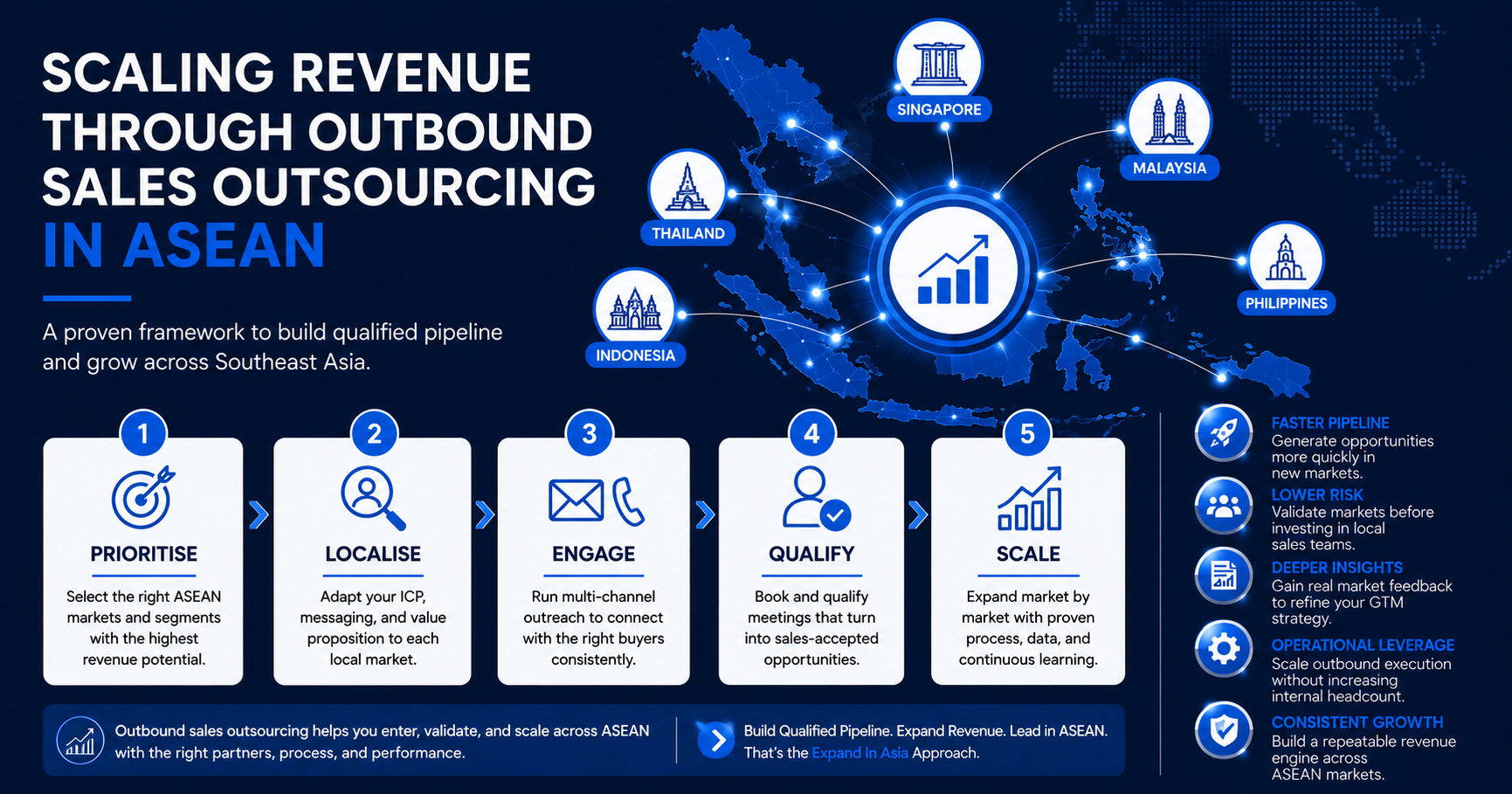
Outbound sales outsourcing can help companies enter these markets faster and with less fixed hiring risk. However, it only scales revenue when the engagement is built around:
- market prioritisation;
- localised ICPs and messaging;
- coordinated multichannel outreach;
- written qualification criteria;
- disciplined handoff;
- pipeline reporting;
- market-by-market expansion.
This guide explains how to build that model.
- TL;DR — Key Takeaways
- Do not launch across every ASEAN country at once. Begin with one priority market and a tightly defined customer segment.
- Localise the entire sales motion—not only the language. Adapt your ICP, commercial problem, proof, target roles, channels, CTA, and follow-up style.
- Measure accepted pipeline rather than activity alone. Emails sent and calls made matter less than meetings held, sales-accepted opportunities, pipeline value, and market intelligence.
- Scale only after the first motion is repeatable. Document what worked before adding another industry, persona, or country.
If you only do one thing: select one ASEAN market-and-segment combination and validate it before expanding the programme regionally.
Who This Comparison Is For (and Not For)
This playbook is designed for companies that:
- already have a proven B2B product or service;
- are entering Southeast Asia for the first time;
- have a broad ICP but need to test its relevance in ASEAN;
- need outbound pipeline before hiring multiple local salespeople;
- want to validate one market before expanding regionally;
- already have internal account executives or founders who can close;
- need both qualified meetings and market feedback.
It is particularly relevant for:
- B2B SaaS companies;
- cybersecurity providers;
- cloud and managed service providers;
- HR technology companies;
- fintech firms;
- professional-services companies;
- data and AI platforms;
- healthtech businesses;
- enterprise software providers.
This model may not be suitable when:
- your product has not achieved product-market fit anywhere;
- your deal value cannot support structured outbound investment;
- your internal team cannot follow up on meetings;
- you expect the outsourcing partner to define your complete business strategy;
- every sales conversation requires a deeply technical specialist from the first touch.
Why ASEAN Needs a Different Outbound Model
ASEAN is commercially connected, but it is not commercially uniform.
The region combines:
- globally connected business hubs;
- large domestic consumer and enterprise markets;
- manufacturing centres;
- fast-growing digital economies;
- mature multinational buyers;
- family-owned local groups;
- markets with different legal and regulatory frameworks.
A campaign that works with English-speaking regional executives in Singapore may not translate directly to Indonesian founders, Vietnamese manufacturing leaders, Philippine shared-services executives, or Malaysian mid-market companies.
The differences affect:
- which accounts should be targeted;
- which job titles hold influence;
- how direct the opening message should be;
- which proof points build credibility;
- whether email, LinkedIn, phone, events, or referrals work best;
- how quickly a buyer is willing to engage;
- who needs to approve a purchase;
- how opportunities should be followed up.
A scalable ASEAN outbound model therefore needs both regional consistency and local flexibility.
Regional consistency comes from:
- one revenue strategy;
- one CRM and reporting structure;
- shared qualification definitions;
- common brand standards;
- central performance management.
Local flexibility comes from:
- country-specific account selection;
- localised buyer personas;
- adapted messaging;
- market-relevant proof;
- appropriate channels;
- culturally suitable follow-up.
Outbound sales outsourcing is valuable because it provides execution capacity without requiring you to recruit, onboard, and manage a separate team in every market.
Define the Revenue Outcome
Do not begin with an activity target such as:
“We need 10,000 emails sent every month.”
Begin with the commercial outcome.
Examples include:
- validate Singapore demand among regional SaaS companies;
- create 20 sales-accepted opportunities in Malaysia;
- build a qualified pipeline among Indonesian logistics companies;
- generate the first US$500,000 in regional pipeline;
- identify which ASEAN market should receive the first internal sales hire.
Reverse-Engineer the Funnel
A practical planning model begins with the revenue target and works backwards.
| Funnel Stage | Illustrative Assumption |
| Revenue target | US$500,000 |
| Average contract value | US$50,000 |
| Closed-won deals required | 10 |
| Opportunity-to-close rate | 25% |
| Qualified opportunities required | 40 |
| Meeting-to-opportunity rate | 40% |
| Qualified meetings required | 100 |
These are examples, not guaranteed conversion benchmarks.
Use your existing figures wherever possible. If you do not have regional data yet, state the assumptions clearly and review them after each campaign cycle.
Questions to Answer Before Launch
- What revenue or pipeline outcome are we pursuing?
- Which product or service is in scope?
- What is the typical contract value?
- How long is the sales cycle?
- Which team owns discovery, proposals, and closing?
- What qualifies an opportunity?
- What pipeline level would justify continued investment?
- What would cause us to stop, change segment, or change market?
A strong outsourced partner should help translate these answers into operating metrics.
Prioritize the Right ASEAN Market
Launching across six countries simultaneously creates fragmented data and weak learning.
Instead, rank your potential markets using a scorecard.
ASEAN Market-Priority Scorecard
| Evaluation Factor | Suggested Weight | Questions to Ask |
| Existing demand signals | 20% | Do we already receive enquiries, referrals, traffic, or partner interest? |
| ICP concentration | 20% | Are enough target companies present? |
| Buyer accessibility | 15% | Can the right decision-makers be reached through available channels? |
| Product relevance | 15% | Does the solution address a recognised local problem? |
| Commercial viability | 15% | Can the market support our price point and deal economics? |
| Internal capability | 10% | Can our team support meetings, proposals, and closing? |
| Regulatory complexity | 5% | Are there major licensing, procurement, privacy, or contracting barriers? |
Score each factor from 1 to 5.
The highest-priority market should offer the strongest combination of:
- buyer concentration;
- commercial need;
- accessible decision-makers;
- suitable pricing;
- relevant proof;
- manageable regulatory complexity;
- internal closing capacity.
Do Not Assume Singapore Must Always Be First
Singapore is often a practical entry point because it is a regional headquarters market with widespread business English usage and strong multinational representation.
However, it may not always provide:
- the greatest number of target accounts;
- the fastest sales cycle;
- the strongest buyer urgency;
- the best pricing fit;
- the lowest competitive intensity.
For some companies, Malaysia, Indonesia, the Philippines, Thailand, or Vietnam may rank higher.
The decision should come from evidence, not habit.
Localize Your ICP and Buyer Map
A global ICP is only the starting point.
For each target country, define:
- priority industries;
- company size;
- local versus regional headquarters;
- ownership structure;
- revenue or employee bands;
- technology maturity;
- trigger events;
- decision-makers;
- influencers;
- procurement requirements;
- disqualifiers.
Example: Broad ICP vs. Localised ICP
| Dimension | Broad Regional ICP | Singapore Version | Indonesia Version |
| Company type | Mid-market B2B company | Regional HQ, funded scale-up, or multinational subsidiary | Large local group, enterprise, or established scale-up |
| Target role | Head of Sales | Regional VP Sales, APAC Director, Country Manager | Founder, Commercial Director, Business Unit Head |
| Main problem | Insufficient pipeline | Difficulty building pipeline across Asia | Need for local access, trust, and market education |
| Proof required | Global case study | Regional or Singapore reference | Local, regional, or closely comparable sector proof |
| Initial CTA | Book a demo | Compare regional GTM assumptions | Explore relevance and establish fit |
Localisation Is More Than Translation
Changing the country name in an email is not localisation.
A properly localised campaign adapts:
- the buyer problem;
- target seniority;
- commercial language;
- credibility markers;
- examples;
- channel mix;
- meeting request;
- follow-up cadence;
- objection handling.
For example, a Singapore buyer may respond to a concise, commercially direct message supported by regional proof.
A buyer in another market may require:
- stronger relationship context;
- a local referral;
- a more educational opening;
- greater seniority from the seller;
- longer trust-building before a meeting.
Design the Outsourced Operating Model
The outsourced provider should operate as an extension of your commercial team.
It should not function as a disconnected appointment-setting supplier.
Recommended Ownership Structure
| Sales Function | Internal Team | Outsourced Partner | Shared |
| Revenue strategy | ✓ | ||
| Market prioritisation | ✓ | ||
| ICP definition | ✓ | ||
| Local research | ✓ | ✓ | |
| Account and contact data | ✓ | ✓ | |
| Messaging development | ✓ | ||
| Email and LinkedIn outreach | ✓ | ||
| Calling and follow-up | ✓ | ||
| Early qualification | ✓ | ✓ | |
| Opportunity management | ✓ | ||
| Proposal and negotiation | ✓ | ||
| Reporting and optimisation | ✓ | ||
| Customer onboarding | ✓ |
Minimum Outsourced Team Structure
A structured ASEAN outbound programme may include:
- an account or programme lead;
- one or more SDRs or BDRs;
- a data and research resource;
- campaign and messaging support;
- a reporting owner;
- one internal commercial decision-maker.
The exact team depends on the number of markets, target-account volume, language requirements, and sales complexity.
Weekly Operating Rhythm
Weekly campaign meeting
Review:
- accounts researched;
- personas identified;
- contacts reached;
- positive replies;
- meetings booked;
- meetings held;
- no-shows;
- disqualification reasons;
- objections;
- message performance;
- market observations.
Monthly commercial review
Review:
- sales-accepted opportunities;
- meeting-to-opportunity conversion;
- pipeline value;
- opportunity stage progression;
- strongest segments;
- weakest segments;
- channel performance;
- market comparison;
- campaign changes;
- expansion decisions.
This rhythm prevents the engagement from becoming a volume-reporting exercise.
Build a Market-Specific Outbound System
A scalable system coordinates several channels around one coherent buyer narrative.
Recommended Channel Mix
| Channel | Best Used For | Limitation |
| Research, credibility, connections, senior-role access | Crowded inboxes and platform limits | |
| Structured value communication and follow-up | Deliverability and data quality must be managed | |
| Phone | Rapid qualification and objection discovery | Requires accurate data and appropriate timing |
| Referrals | Trust and access to senior buyers | Harder to scale without a process |
| Webinars and events | Education and credibility | Longer preparation cycle |
| Partnerships | Ecosystem access and local introductions | Requires clear mutual value |
Do not depend entirely on one channel.
Example Multichannel Sequence
- Research the company and buyer.
- Engage with relevant LinkedIn activity.
- Send a short connection request.
- Send an email tied to a relevant business trigger.
- Make a phone attempt where appropriate.
- Follow up with a proof point or market observation.
- Ask a low-friction commercial question.
- Request a referral to the correct person if needed.
- Close the sequence with a useful resource or observation.
Build Each Message Around Five Elements
Relevance
Why this account and buyer?
Problem
What commercial issue are you qualified to discuss?
Proof
What evidence lowers perceived risk?
Perspective
What useful observation can you add?
Low-friction next step
What is easy for the buyer to agree to?
A practical CTA might be:
“Would comparing your current ASEAN pipeline assumptions with what we are seeing across the region be useful?”
This can create less friction than asking for a product demonstration immediately.
Define Qualification and Handoff
Revenue does not scale when the outsourced team and internal sales team use different definitions of a qualified meeting.
Define qualification in writing before launch.
Qualified Meeting Framework
| Qualification Area | Example Standard |
| Account fit | Matches the agreed industry, size, geography, and commercial profile |
| Persona fit | Decision-maker, influencer, evaluator, or credible internal referrer |
| Problem relevance | Relevant challenge, initiative, or trigger is present |
| Interest | Prospect agrees to discuss the issue or potential solution |
| Timing | There is a current or foreseeable reason to continue |
| Exclusions | Not a vendor, competitor, student, job seeker, or irrelevant consultant |
| Meeting confirmation | Prospect understands and accepts the meeting purpose |
Meeting Handoff Checklist
The outsourced SDR should record:
- company background;
- contact title and influence;
- reason for engagement;
- stated challenge or initiative;
- relevant trigger;
- objections raised;
- previous interaction history;
- meeting objective;
- recommended discovery questions;
- follow-up commitments.
Establish a Feedback SLA
Internal sales should provide feedback within 24–48 hours.
Use consistent categories:
- qualified opportunity;
- nurture;
- wrong persona;
- wrong company;
- no active problem;
- insufficient authority;
- timing issue;
- no-show;
- duplicate account;
- existing opportunity.
Without fast feedback, the outsourced team cannot improve its targeting or qualification.
Measure Pipeline and Market Learning
Outbound outsourcing should create two outputs:
- qualified pipeline;
- commercial intelligence.
Core Metrics
Market coverage
- target accounts researched;
- buying personas mapped;
- ICP coverage;
- contact-data accuracy.
Engagement
- connection-acceptance rate;
- email-delivery rate;
- positive-reply rate;
- live-conversation rate;
- referral rate.
Meetings
- meetings booked;
- meetings held;
- show rate;
- qualification pass rate;
- meeting source.
Pipeline
- sales-accepted opportunities;
- meeting-to-opportunity conversion;
- pipeline value;
- opportunity stage progression;
- closed-won revenue.
Market intelligence
- common objections;
- competitor mentions;
- pricing resistance;
- buying triggers;
- target-title patterns;
- preferred channels;
- recurring product questions;
- local terminology.
ASEAN Market Dashboard
| Metric | Singapore | Malaysia | Indonesia | Philippines |
| Accounts researched | ||||
| Positive replies | ||||
| Meetings held | ||||
| Sales-accepted opportunities | ||||
| Pipeline value | ||||
| Best persona | ||||
| Main objection | ||||
| Strongest channel |
Do not judge markets only by meeting count.
One country may produce fewer meetings but larger opportunity values, faster procurement, or stronger win potential.
Scale Market by Market
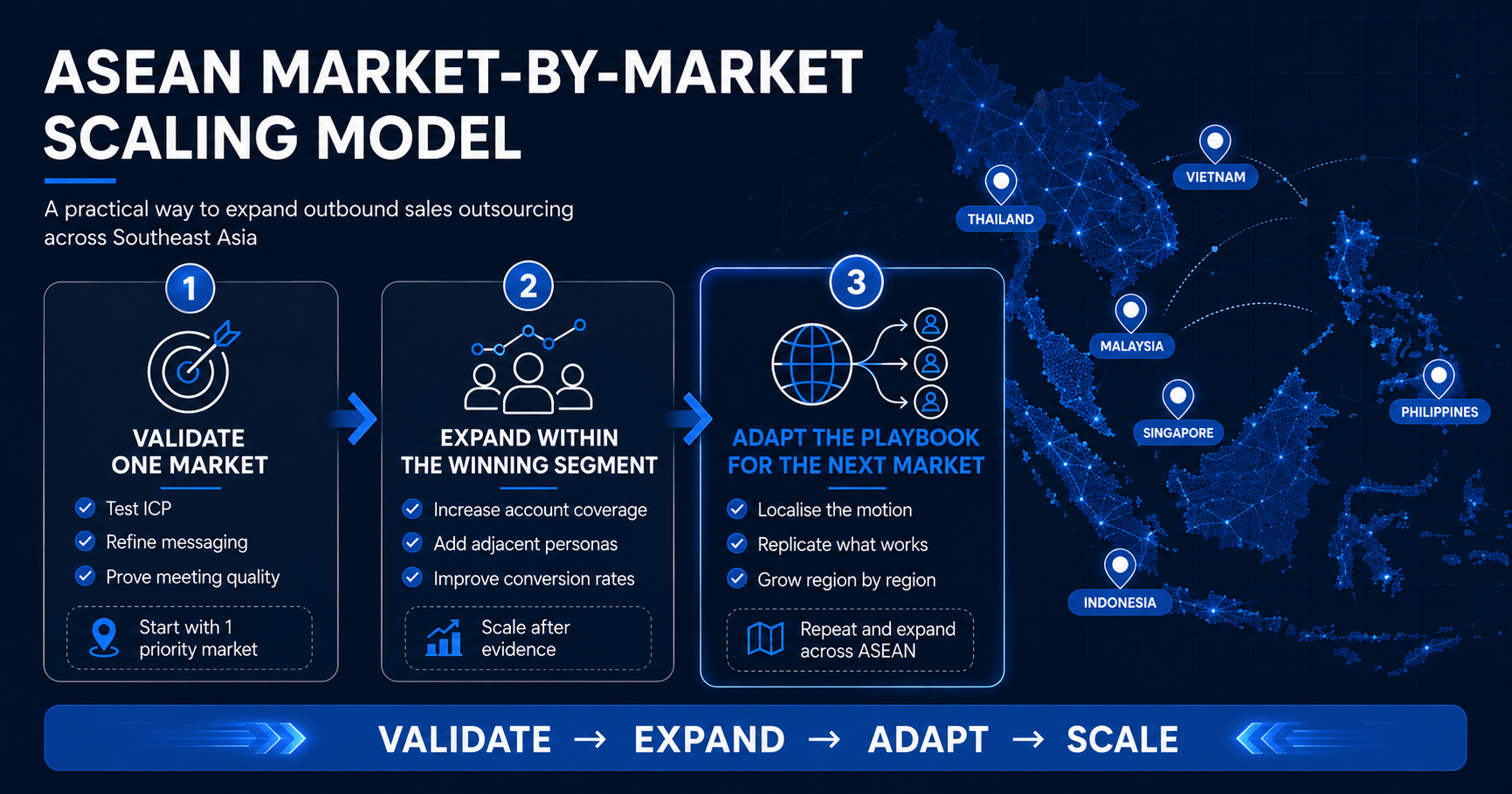
Add another country only after the first market has produced a documented and repeatable motion.
Market-Readiness Gate
Before expansion, confirm that you have:
- a clear ICP;
- validated personas;
- reliable account and contact data;
- at least one message that creates repeatable engagement;
- agreed qualification criteria;
- an effective meeting handoff;
- early opportunity evidence;
- internal closing capacity;
- documented objections;
- market-specific compliance review.
Three Ways to Scale
1. Scale horizontally
Add more accounts within the same country and segment.
Example: Increase Singapore coverage from 200 to 600 technology companies.
2. Scale vertically
Add an adjacent industry, product, or buyer persona.
Example: Move from Singapore SaaS companies into fintech and professional services.
3. Scale geographically
Adapt the proven motion to another ASEAN country.
Example: Localise a successful Singapore programme for Malaysia before moving into a market requiring deeper language adaptation.
Do Not Copy the Campaign Blindly
For every new market, reassess:
- ICP density;
- buyer roles;
- commercial pain;
- proof;
- message tone;
- language;
- channel mix;
- follow-up timing;
- data quality;
- qualification;
- regulatory obligations.
A repeatable playbook is a foundation—not a script that should be copied unchanged.
Illustrative ASEAN Expansion Scenario
Editorial note: The following scenario is illustrative. It demonstrates how the framework may be applied and is not presented as a published client case study.
Situation
A European cybersecurity SaaS company has existing customers in Europe and Australia but no repeatable pipeline in ASEAN.
Objective
Generate US$1 million in qualified regional pipeline over 12 months.
Market Assessment
The company evaluates Singapore, Malaysia, Indonesia, Vietnam, Thailand, and the Philippines.
Singapore scores highest because:
- the company has regionally relevant customer references;
- its target buyers are accessible;
- its pricing aligns with mid-market and enterprise budgets;
- its internal account executives can support discovery calls;
- regional headquarters are part of the ICP.
Phase 1 — Validate Singapore
The outsourced team targets:
- financial-services companies;
- professional-services firms;
- technology companies;
- CISOs;
- IT directors;
- security leaders.
The first 90 days test:
- account quality;
- buyer titles;
- message resonance;
- objections;
- meeting quality;
- early opportunity conversion.
Phase 2 — Expand Within the Winning Segment
Once the strongest vertical and persona are identified, the team:
- increases account coverage;
- adds adjacent roles;
- builds new proof-based messages;
- improves objection handling;
- tightens qualification.
Phase 3 — Adapt for Malaysia
The programme is then localised for Malaysia.
Changes may include:
- different account-size thresholds;
- adjusted commercial messaging;
- local and regional proof;
- revised job-title targeting;
- stronger phone follow-up;
- different pricing conversations.
Phase 4 — Assess Indonesia
Indonesia is not launched automatically.
The company first evaluates:
- language requirements;
- data availability;
- local relationship expectations;
- partner opportunities;
- contracting requirements;
- price suitability;
- internal follow-up capacity.
Resulting Operating Model
The company creates a structured market-by-market expansion process rather than running one broad “ASEAN campaign.”

Seven Mistakes That Slow Revenue Growth
Mistake 1 — Launching in Too Many Countries
Running simultaneous campaigns across multiple countries produces fragmented insight.
Better approach: Start with one priority country and one controlled secondary test.
Mistake 2 — Using One Regional Message
A generic “grow in Asia” message is unlikely to create urgency.
Better approach: Tie the outreach to a specific buyer, trigger, market, and commercial problem.
Mistake 3 — Measuring Activity Instead of Pipeline
Large outreach volumes can hide poor targeting.
Better approach: Prioritise meetings held, accepted opportunities, pipeline value, and market learning.
Mistake 4 — Weak Internal Follow-Up
Qualified meetings lose value when internal sellers respond slowly.
Better approach: Set preparation, follow-up, and CRM feedback SLAs.
Mistake 5 — Outsourcing All Strategic Thinking
An outsourced provider cannot permanently compensate for unclear positioning or weak proof.
Better approach: Retain strategy, product expertise, pricing, and closing ownership internally.
Mistake 6 — Expanding Before Validation
A weak programme does not become stronger when copied into more countries.
Better approach: Identify whether the problem is ICP, data, messaging, channel, proof, qualification, or follow-up.
Mistake 7 — Ignoring Data Governance
Regional outbound can involve cross-border storage, processing, and transfer of prospect information.
Better approach: Document data sourcing, access, suppression, retention, transfer, and deletion procedures.
Evaluating a B2B Sales Outsourcing Company for Asia?
Before you sign, pressure-test the vendor against your market, ICP, messaging, data process, and reporting expectations.
Expand In Asia helps B2B companies enter and scale across Asian markets with structured outbound sales execution, qualified lead generation, and region-specific GTM support.
Talk to Expand In Asia about your vendor shortlist →
ASEAN Outbound Operating Scorecard
Score each category from 1 to 5.
| Category | 1 — Weak | 3 — Developing | 5 — Scalable |
| Market prioritisation | Broad ASEAN launch | Basic country ranking | Evidence-based sequence |
| ICP localisation | Global ICP only | Some country adaptation | Country-specific ICP and exclusions |
| Messaging | One generic sequence | Persona variations | Market, persona, trigger, and proof variations |
| Channel strategy | Single channel | Two channels | Coordinated multichannel model |
| Qualification | Meeting booked equals qualified | Basic filters | Written sales-accepted criteria |
| Reporting | Activity only | Replies and meetings | Pipeline, conversion, and market intelligence |
| Internal handoff | Informal | Defined owner | Documented SLA and feedback loop |
| Data governance | Unclear | Basic controls | Documented sourcing, access, retention, and transfer |
| Scaling discipline | Add countries quickly | Review after launch | Readiness gate before expansion |
Score Interpretation
| Total Score | Interpretation |
| 36–45 | Strong foundation for controlled regional scaling |
| 27–35 | Viable, but strengthen weak areas before adding countries |
| 18–26 | Keep the programme narrow and fix execution gaps |
| Below 18 | Rebuild the outbound foundation before expanding |
What to Look for in an Outsourcing Partner
A strong ASEAN outbound partner should demonstrate:
- direct experience in relevant Asian markets;
- market-specific research capability;
- persona-level messaging;
- culturally appropriate execution;
- multilingual capability where required;
- transparent reporting;
- written qualification standards;
- CRM integration;
- documented data handling;
- a dedicated account lead;
- structured handoff and feedback;
- capacity to scale country by country.
Avoid providers that:
- treat ASEAN as one homogeneous market;
- promise guaranteed results before discovery;
- report activity without pipeline quality;
- use generic outreach across every country;
- cannot explain their data sources;
- do not define a qualified meeting;
- offer no structured feedback loop.
For a broader comparison, review:
25 Best B2B Sales Outsourcing Companies Worth Hiring in 2026
For additional pipeline-development tactics, read:
10 Best B2B Qualified Lead Generation Strategies for 2026
Next Steps with Expand In Asia
Scaling outbound revenue across ASEAN requires more than adding offshore SDR capacity.
It requires a system that combines:
- market selection;
- buyer research;
- localised messaging;
- multichannel outreach;
- written qualification;
- fast internal handoff;
- shared reporting;
- controlled regional scaling.
Expand In Asia supports B2B companies entering and expanding across Asian markets through outsourced sales execution, qualified lead generation, market validation, and GTM support.
Talk to Our Team
Discuss your:
- priority ASEAN countries;
- ICP;
- pipeline target;
- internal sales capacity;
- sales cycle;
- market-entry timeline.
Schedule a consultation with Expand In Asia →
Compare Providers
Read: 25 Best B2B Sales Outsourcing Companies Worth Hiring in 2026
Strengthen Your Lead-Generation Strategy
Read: 10 Best B2B Qualified Lead Generation Strategies for 2026
Ready to Implement These Strategies?
Book a free 30-minute strategy session where we’ll audit your current growth approach and identify your highest-leverage opportunities in Asian markets.
Frequently Asked Questions
1. What is outbound sales outsourcing?
Outbound sales outsourcing is the use of an external team to manage some or all prospecting activities.
These may include:
- account research;
- contact identification;
- email outreach;
- LinkedIn engagement;
- calling;
- follow-up;
- meeting booking;
- initial qualification.
The internal company normally retains ownership of opportunity management, proposals, negotiation, and closing.
2. Is outbound sales outsourcing suitable for every ASEAN country?
It can support most ASEAN markets, but the execution model must be adapted.
Language, data availability, buyer accessibility, relationship expectations, regulation, and channel preferences should be assessed country by country.
3. Which ASEAN market should a B2B company enter first?
There is no universal answer.
Select the market with the strongest combination of:
- ICP density;
- buyer accessibility;
- commercial need;
- relevant proof;
- acceptable pricing;
- manageable regulation;
- internal closing capability.
Singapore is a common entry point, but it should still be tested against your specific business model.
4.How long does an outsourced outbound program take to produce results?
Initial engagement signals may appear within several weeks.
However, meaningful conclusions normally require multiple campaign cycles. Early indicators include:
- data accuracy;
- response quality;
- positive replies;
- buyer objections;
- meetings booked.
Later-stage indicators include:
- meetings held;
- sales-accepted opportunities;
- pipeline value;
- opportunity progression;
- revenue.
Should one outsourced team cover all ASEAN countries?
A central team can manage regional strategy, data standards, reporting, and campaign coordination.
However, execution should still be localised by country. The same sequence should not be used unchanged across every market.
5. What metrics should we use?
Track:
- account coverage;
- contact-data accuracy;
- positive replies;
- meetings held;
- show rate;
- sales-accepted opportunities;
- meeting-to-opportunity conversion;
- pipeline value;
- opportunity progression;
- market feedback.
Do not evaluate the programme solely through email, call, or connection volume.
6.When should we enter a second market?
Expand after the first market has:
- a validated ICP;
- reliable account data;
- proven messaging;
- clear qualification;
- a working handoff;
- early opportunity evidence;
- enough internal capacity to manage more pipeline.
7. Can an outsourced team eventually be replaced by an internal team?
Yes.
Many companies use outsourcing to validate a market before hiring a local or regional team.
A hybrid structure can also continue long term, with the outsourced partner managing pipeline generation while internal sellers manage opportunities and strategic accounts.
How should data compliance be handled across ASEAN?
Document:
- data sources;
- lawful processing considerations;
- access permissions;
- opt-out and suppression processes;
- retention;
- deletion;
- cross-border transfers;
- vendor and subcontractor controls.
ASEAN provides regional data-management and model contractual-clause frameworks, but national legal requirements still need to be reviewed for each market.
💬 Which model are you currently evaluating — and what’s the biggest factor driving your decision? Drop your situation in the comments below. We read every response and often address recurring questions in follow-up content.
📤 Was this comparison useful? Share it with a colleague or partner navigating the same decision, or bookmark the decision matrix for your next strategy review.