A practical playbook for foreign B2B companies that want to build pipeline in Malaysia
Malaysia often looks like the easy next market.
English is widely spoken. It sits next to Singapore. Investment is at record levels.
So the plan says: “Add Malaysia next quarter. Same team, same deck.”
But a nearby market is still a different market.
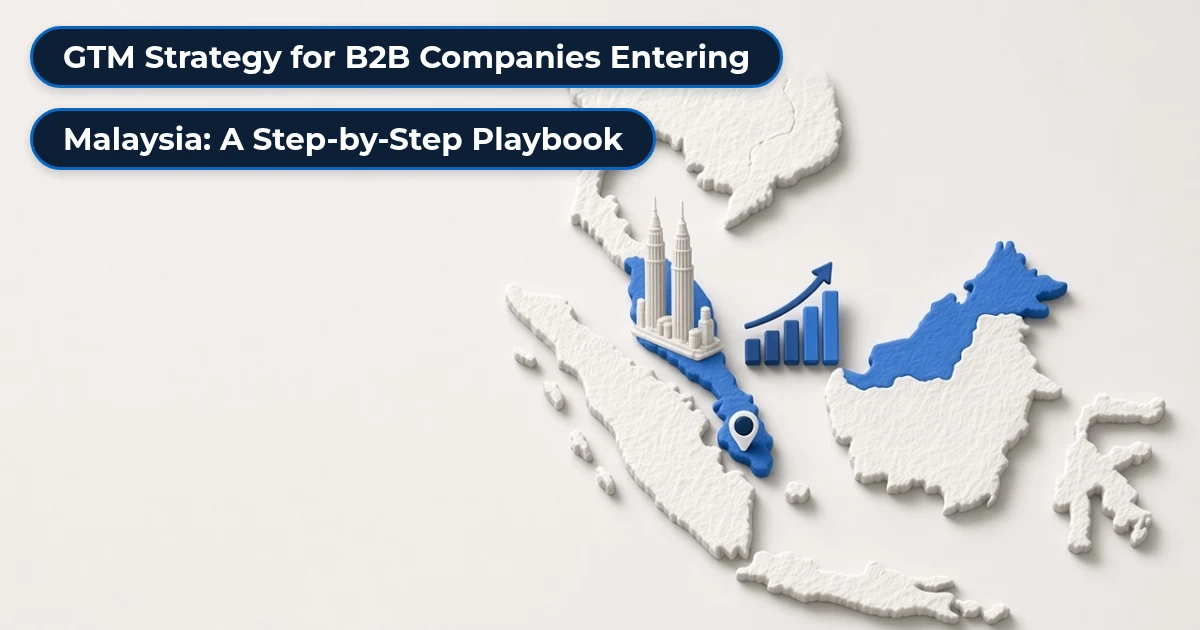
A B2B GTM strategy for Malaysia turns that intention into a sequence of decisions: who to sell to, in which region, with what message and proof, through which channels, and how to know it is working. GTM (go-to-market) simply means your plan for reaching and winning customers in a market.
A Malaysia GTM plan usually covers:
- the segments and regions you will target first;
- how you will adapt your message, and when to use Malay or Chinese;
- which outreach channels you will use;
- what local proof you will show;
- how you will price and contract in ringgit;
- how you will measure early progress.
Most expansion teams ask:
“Can we just cover Malaysia from Singapore?”
But for B2B companies entering Malaysia, the better question is:
“Which Malaysian buyers will buy from us first—and what will convince them we are here for them?”
Because being close to a market does not make you relevant in it.
A semiconductor supplier in Penang may want a meeting next week.
A government-linked company in Kuala Lumpur may need a year of relationship-building and a formal procurement process first.
This playbook extends our series of country GTM guides, including GTM Strategy for B2B Companies Entering Vietnam, GTM Strategy for B2B SaaS Entering the Philippine Market, and How to Build a GTM Playbook for Entering the Indonesian B2B Market. It builds on our pillar, Breaking Into Asia: 5 Critical Asia Expansion Mistakes. If you are still deciding whether Malaysia belongs on your list, start with our Top 5 Emerging B2B Markets in Asia-Pacific to Watch in 2026–2027.
- TL;DR — Key Takeaways
- Malaysia is growing steadily. GDP grew 5.2% in 2025, and an advance estimate puts Q3 2026 at 5.3% (DOSM).
- Start with one segment and one region. The Klang Valley, Penang, and Johor often behave like different markets (our view).
- English opens doors; local language builds trust. Malaysia ranks first in Asia for English proficiency, but some buyers still prefer Malay or Chinese (our experience).
- LinkedIn helps, but is not enough. About 27.7% of the population were members in late 2025.
- Local proof beats Singapore proof. Win one Malaysian reference early (our view).
- Validate before you build. Pipeline first; entity and hires later (our view).
If you only do one thing: pick one segment in one region and book ten discovery meetings before writing the rest of your Malaysia plan.
Who This Guide Is For—and Who It Is Not For
This Guide Is For
- foreign B2B SaaS, technology, and services companies considering Malaysia;
- companies already in Singapore adding Malaysia as a second market;
- sales leaders asked to build Malaysia pipeline from abroad;
- suppliers to manufacturing, electronics, logistics, and digital infrastructure;
- founders comparing Malaysia with Vietnam, Indonesia, or the Philippines;
- regional teams building a multi-country plan.
This guide is especially useful if your team is asking:
- Where should we start in Malaysia?
- Is English enough?
- Which channels reach Malaysian decision-makers?
- Can our Singapore team cover Malaysia?
This Guide Is Not For
- you need step-by-step legal guidance on licensing, tax, or company setup;
- you sell only to consumers;
- you want a ranking of Asian markets (see our multi-country expansion strategy for Asia);
- you are deciding where to put a regional headquarters (see Singapore as a regional hub for Asia expansion).
Practical fit check: if Malaysia is a line item under “Singapore + nearby,” this guide is for you.
What a B2B GTM Strategy for Malaysia Means
A B2B GTM strategy for Malaysia is a plan for how a foreign company will find, reach, and win business customers in Malaysia: which segments and regions to target, how to adapt the message, which channels to use, what local proof to show, how to price, and how to measure early progress.
“Covered From Singapore” vs. Malaysia-Specific GTM
| Area | Covered From Singapore | Malaysia-Specific GTM |
|---|---|---|
| Target | “Malaysia” as one market | One segment in one region |
| Language | English only | English, with Malay or Chinese where buyers need it |
| Channels | LinkedIn and email | LinkedIn, email, phone, introductions, events |
| Proof | Singapore logos | Malaysian or similar-market references |
| Pricing | SGD or USD price list | Ringgit pricing and local terms |
| Success metric | Revenue in year one | Meetings, pipeline, and learning first |
Practical Rule (our take)
Malaysia is not an extension of Singapore.
Plan it as its own market.
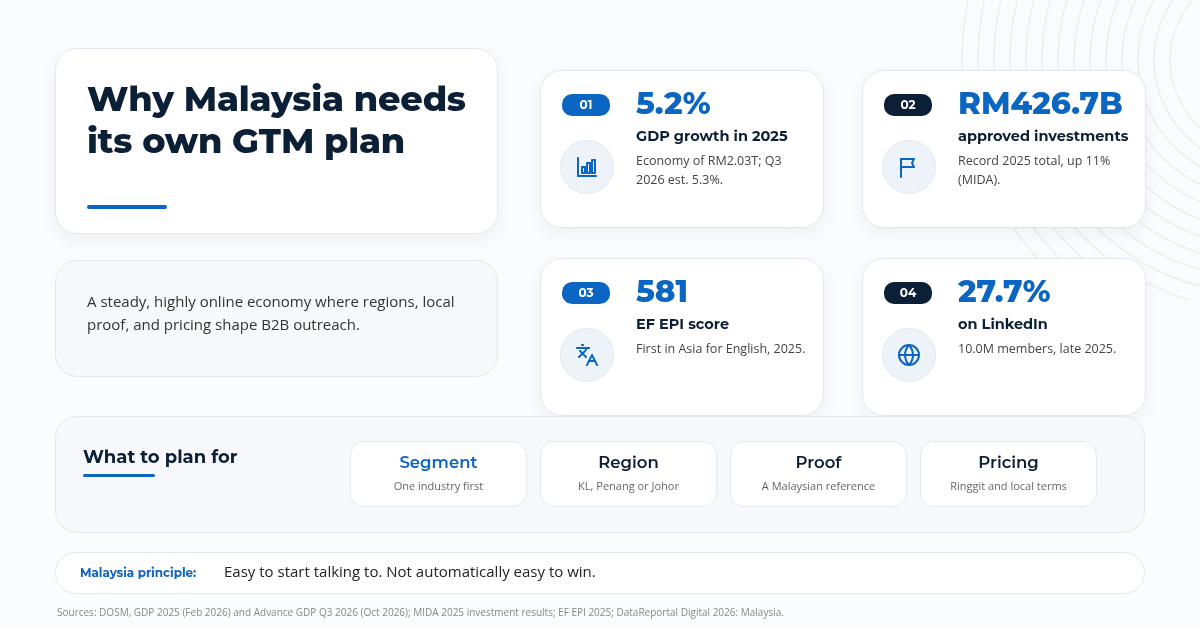
Why Malaysia Deserves Its Own GTM Plan
Reason 1 — Steady Growth in a Mid-Sized Economy
According to the Department of Statistics Malaysia (DOSM), GDP grew 5.2% in 2025 to RM2.03 trillion at current prices, and gross national income per capita rose to RM57,200. Services and manufacturing made up 82.5% of GDP.1 DOSM’s advance estimate puts growth at 5.3% in the third quarter of 2026, and about 5.5% for the first nine months of the year.2 Advance estimates can be revised; the full Q3 release is due on 18 November 2026.
Reason 2 — Record Investment, Led by Digital
The Malaysian Investment Development Authority (MIDA) reports a record RM426.7 billion in approved investments in 2025, up 11%, across 8,390 projects. Services took 65.9%, and the information and communication sub-sector alone took RM152.9 billion, driven by AI, big data, data centres, and cloud computing.3 In plain terms: new facilities, new projects, and new teams that need suppliers.
Reason 3 — A Large Base of Smaller Businesses
DOSM reports that micro, small, and medium enterprises (MSMEs) generated RM689.8 billion in 2025, or 39.7% of GDP, growing 5.7%.4 For many B2B sellers, the realistic first customers are not the largest groups but established mid-sized companies.
Reason 4 — High English Proficiency, but Several Business Languages
Malaysia scored 581 in the EF English Proficiency Index 2025, first in Asia.5 In our experience, English works for most first conversations in the Klang Valley and Penang. Malay, Mandarin, and other Chinese languages still matter in some family-owned firms, government-linked companies, and traditional sectors.
Reason 5 — Highly Online, With Better LinkedIn Coverage Than Most of the Region
DataReportal’s Digital 2026 Malaysia report counts 35.4 million internet users in late 2025, or 98.0% of the population, and 10.0 million LinkedIn members, about 27.7%.6 That is far higher than Vietnam (9.8%), but it still leaves many decision-makers who are rarely active there. Members are not the same as active business users, so treat these as signals, not targets.
Practical Rule (our take)
Malaysia is easy to start talking to.
It is not automatically easy to win.
Choosing Your First Segment and Region
Segment
In our experience, foreign B2B companies often find early traction in segments that are already international or investing, such as:
- electronics, electrical, and semiconductor supply chains;
- data centres, cloud, and digital infrastructure;
- logistics, warehousing, and cross-border trade;
- financial services and fintech;
- professional and technology services for growing mid-sized firms.
These are examples, not a ranking. Validate your own segment.
Region
DOSM’s 2026 estimates put Malaysia’s population at 34.4 million, with about 7.5 million in Selangor, 4.2 million in Johor, 2.1 million in Kuala Lumpur, and 1.8 million in Penang.7
| Region | Often Fits (Our Experience) | Keep in Mind |
|---|---|---|
| Klang Valley (Kuala Lumpur and Selangor) | Headquarters, financial services, tech, government-linked companies | Most competitive; buyers see many vendors |
| Penang (and the northern corridor) | Electronics, semiconductors, manufacturing, engineering | Technical buyers; proof and site visits matter |
| Johor | Manufacturing, logistics, data centres; close links with Singapore | Fast-changing; check who decides locally vs. in Singapore |
| East Malaysia (Sabah and Sarawak) | Energy, resources, regional projects | Different business networks; usually a later phase |
Practical Rule (our take)
Start where your best-fit buyers are concentrated, not where the drive from Singapore is shortest.
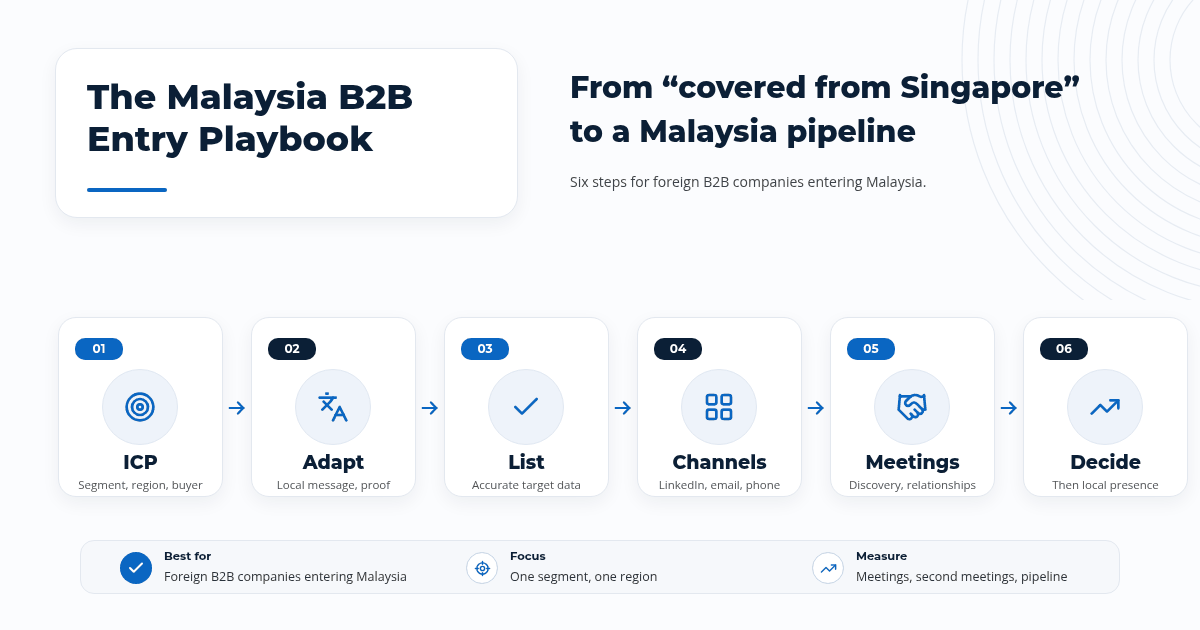
The Malaysia B2B Entry Playbook
Our framework, the Malaysia B2B Entry Playbook, follows six steps. It mirrors the structure we use in our Vietnam, Philippines, and Indonesia guides, adapted for Malaysia.
Step 1 — Define Your ICP for Malaysia
What to Do
Define your ICP (ideal customer profile: the type of company most likely to buy) for Malaysia specifically: industry, size, region, ownership type, and buyer role.
Why It Matters
In our experience, a multinational’s Penang plant, a family-owned local manufacturer, and a government-linked company can all sit in the same industry and buy in completely different ways.
Step 2 — Adapt Message and Proof
What to Change
- examples that reflect Malaysian business realities, not Singapore ones;
- references from Malaysia or similar Southeast Asian markets;
- pricing shown in ringgit;
- Malay or Chinese-language support where the buyer needs it.
Example First Message
“Hi Ms. Tan, I’m reaching out from [Company]. We help electronics manufacturers in Penang cut unplanned machine downtime. Two plants in the northern corridor already use our system. Would a 20-minute call next week be useful to see whether it fits your line?”
Why It Works (Our View)
It is short, names the buyer’s industry and region, uses nearby proof, and asks for a small next step. It does not lead with “we’re based in Singapore.”
For the sales side, see how to localize your sales playbook for Asia.
Step 3 — Build an Accurate Target List
What to Do
Build a list of target companies and decision-makers from reliable sources. Malaysia updated its Personal Data Protection Act in 2024, with changes in force during 2025,8 so check how you collect, store, and use contact data with a qualified adviser. This is not legal advice.
Step 4 — Choose a Channel Mix
Channels to Combine (Our Experience)
- LinkedIn for tech, multinationals, and senior professionals;
- email with short, clear messages;
- phone, especially for mid-sized and family-owned firms;
- introductions through partners, chambers, industry associations, and existing clients;
- industry events and trade shows, where many Malaysian buyers still meet new suppliers.
For the buyers LinkedIn misses, read How to Reach Decision-Makers Who Aren’t on LinkedIn in Asia.
Practical Rule (our take)
Pick channels by buyer type, not by what worked in Singapore.
Step 5 — Run Discovery Meetings and Build Relationships
What to Do
Book discovery meetings with target buyers. Follow up consistently. Multi-thread: build relationships with several people in each account.
Why It Matters
In our experience, Malaysian buyers often say yes to a first call quickly. Trust, and a second meeting, take longer. Read relationship selling in Asia for how to measure progress.
Step 6 — Measure, Then Decide on Local Presence
What to Measure
Meetings held, second meetings, stakeholders engaged, objections, and early opportunities. Our guide to leading indicators for new market sales covers which signals matter before revenue.
When to Add Local Presence (Our View)
Once real opportunities exist and buyers ask who will support them in Malaysia. See When Should You Hire a Local Sales Team in Asia?.
How Malaysia Compares With Vietnam and the Philippines
If Malaysia is one option in a wider Southeast Asia plan, these published figures help frame the differences. They describe whole populations, not B2B buyers.
| Indicator | Malaysia | Vietnam | Philippines |
|---|---|---|---|
| LinkedIn members as % of population (late 2025) | 27.7% | 9.8% | 18.8% |
| EF English Proficiency Index 2025 score | 581 | 500 | 569 |
| Population | ~34.4M (2026, DOSM) | ~102.3M (2025 average, NSO) | ~115.8M (2024, UN) |
Sources: DOSM;7 DataReportal Digital 2026 country reports;6 EF EPI 2025;5 National Statistics Office of Viet Nam;9 UN World Population Prospects 2024.10
What This Means in Practice (Our View)
Compared with Vietnam, Malaysia usually needs less translation and offers better LinkedIn coverage. Compared with the Philippines, it is smaller, but its buyers are spread across several strong regional hubs rather than one capital.
Malaysia and Singapore: Hub, Neighbor, or Both?
Many companies sell into Malaysia from Singapore. The links are getting closer: Singapore and Malaysia exchanged the Johor-Singapore Special Economic Zone (JS-SEZ) agreement on 7 January 2025, aiming to improve cross-border movement of goods and people.11
Our View
Use Singapore for what it does well—regional leadership, contracts, and coordination. But give Malaysia its own targets, proof, and pricing. Buyers in Kuala Lumpur rarely want to feel like an add-on to a Singapore account.
What to Expect From Malaysian B2B Buyers (Our Experience)
- First meetings come easier than in many markets. Shared language helps.
- Second meetings are the real test. Polite interest is common; commitment takes proof.
- Relationships and introductions matter. A warm introduction often beats ten cold emails.
- Ownership shapes the process. Multinationals, family-owned firms, and government-linked companies decide differently.
- Price sensitivity is real. Buyers compare you with regional and local alternatives.
- Local support is expected. Who will help them, in their time zone and language, after the sale?
Relatable Example
An operations director at a family-owned logistics firm in Selangor may take your call in English, then ask to meet the founder in person before introducing you to the owner.
Working With Local Partners in Malaysia
In our experience, a local partner can shorten the learning curve by:
- building accurate target lists;
- running calls and emails in the right language for each buyer;
- arranging meetings and introductions;
- explaining local buying practices.
What to Check (Our Recommendation)
Ask any partner for examples in your segment, how they handle prospect data under Malaysia’s rules, and how they will report what buyers say.
Pricing and Commercial Terms in Malaysia
What to Consider (Our Experience)
- buyers usually expect pricing in Malaysian ringgit;
- price expectations are often lower than in Singapore;
- larger and government-linked buyers may have formal procurement and vendor registration steps;
- payment terms may be longer than you are used to.
Our View
Keep your pricing logic consistent across markets. Adjust levels and terms where Malaysian buyers require it. Get local tax and legal advice before finalizing contracts, and agree payment terms in writing before work starts.
Mini Example: Testing Malaysia From Singapore (Illustrative)
This is an illustrative example, not a client case.
Situation
A Singapore-based maintenance software company has ten Singapore customers and wants to test Malaysia.
Approach
It targets mid-sized electronics manufacturers in Penang, rewrites its one-page overview around Malaysian examples with ringgit pricing, and runs LinkedIn, email, and phone outreach with a local partner.
What It Learns
Buyers respond to downtime and labor-cost problems, ask for a Malaysian reference, and want to know who will visit the plant.
Next Decision
It wins one pilot in Penang before expanding to Johor.
Our Take
The first wave of meetings is not about revenue. It is about learning what Malaysian buyers actually need.
Need Help Building a Malaysia GTM Strategy?
Expand In Asia helps foreign B2B companies enter Malaysia through:
- market and segment prioritization;
- ICP definition for Malaysia;
- target account and contact research;
- localized buyer messaging;
- LinkedIn, email, and phone outreach;
- SDR execution (the people who run first outreach and book meetings);
- appointment setting with decision-makers;
- market feedback reports.
Common Malaysia GTM Mistakes
Mistake 1 — Treating Malaysia as an Extension of Singapore
Same language does not mean same buyers, budgets, or proof.
Mistake 2 — Treating Malaysia as One Market
The Klang Valley, Penang, Johor, and East Malaysia can differ.
Mistake 3 — Relying on LinkedIn Alone
Coverage is better than in most of the region, but still partial. Mix channels.
Mistake 4 — Pricing Only in Singapore Dollars
A foreign-currency price list signals that you are not really here.
Mistake 5 — Setting Up Before Testing
An entity and office before pipeline is an expensive bet.
Mistake 6 — Using Global References Only
Local proof matters. Win one Malaysian reference early.
Malaysia GTM Readiness Scorecard
Score each area from 1 to 5. This is our own simplified framework, not an industry benchmark. For a broader check, take the free Asia Expansion Readiness Assessment Tool.
| Area | 1 — Weak | 3 — Developing | 5 — Strong |
|---|---|---|---|
| Segment and region | “Malaysia” | One segment, several regions | One segment, one region |
| ICP for Malaysia | Copied from Singapore | Partly adapted | Defined with local evidence |
| Message and language | Singapore deck | Some local examples | Local examples and language support |
| Target list | None | Partial | Accurate and data-checked |
| Channel mix | LinkedIn only | Two channels | Mixed by buyer type |
| Local proof | None | Regional | Malaysian references |
| Pricing | SGD or USD only | Ringgit on request | Ringgit pricing and local terms |
| Progress metrics | Revenue only | Some activity metrics | Meetings, stakeholders, opportunities |
Score Interpretation (Our Guidance)
| Total Score | What It Means |
|---|---|
| 34–40 | Ready to scale outreach in Malaysia. |
| 27–33 | Good base. Fix local proof and pricing. |
| 20–26 | Still a “covered from Singapore” plan. Focus on segment and region. |
| Below 20 | Start with validation. See How to Validate Product-Market Fit in Asia. |
Need Pipeline in Malaysia?
Expand In Asia runs localized B2B outreach and appointment setting in Malaysia.
Next Steps With Expand In Asia
- Pick one segment and one region.
- Adapt message, proof, and pricing.
- Mix channels by buyer.
- Test, then decide on local presence.
To go deeper:
Ready to Implement These Strategies?
Book a free 30-minute strategy session where we’ll audit your current growth approach and identify your highest-leverage opportunities in Asian markets.
Frequently Asked Questions
1. What is a B2B GTM strategy for Malaysia?
A B2B GTM strategy for Malaysia is a plan for how a foreign company will find, reach, and win business customers in Malaysia: which segments and regions to target, how to adapt the message, which channels to use, what local proof to show, how to price, and how to measure early progress.
2. How do foreign B2B companies enter Malaysia?
In our experience, most start by testing demand remotely or with a local partner: choosing one segment, running outreach in English with Malay or Chinese support where buyers need it, and holding discovery meetings in the Klang Valley, Penang, or Johor. Entity, hiring, and office decisions usually come after early pipeline exists.
3. How big is Malaysia's economy?
According to the Department of Statistics Malaysia (DOSM), GDP grew 5.2% in 2025 to RM2.03 trillion at current prices. The advance estimate for the third quarter of 2026 shows growth of 5.3%, and 5.5% for the first nine months of 2026.
4. Is English enough to sell B2B in Malaysia?
Often, yes, especially in the Klang Valley and Penang. Malaysia scored 581 in the EF English Proficiency Index 2025, first in Asia. In our experience, Malay or Chinese-language support still helps with some family-owned firms, government-linked buyers, and traditional sectors.
5. Which channels work for B2B outreach in Malaysia?
In our experience, a mix of LinkedIn, email, phone, introductions, and events works best. DataReportal’s Digital 2026 Malaysia report shows 10.0 million LinkedIn members in late 2025, about 27.7% of the population, so LinkedIn is useful but will still miss many buyers.
6. Should we enter Malaysia from Singapore?
Many companies do, because the two markets are close and connected, and the Johor-Singapore Special Economic Zone agreement was exchanged in January 2025. In our view, treat Malaysia as its own market with its own buyers, proof, and pricing, even if your team sits in Singapore.
7. How can Expand In Asia help with a Malaysia GTM strategy?
Expand In Asia is a Singapore-based B2B outbound and market-entry partner. It helps foreign companies prioritize Malaysian segments, build target lists, run localized outreach, book meetings with decision-makers, and report market feedback before larger commitments.
Are you planning to enter Malaysia in the next year? Share your biggest question in the comments or pass this playbook to your expansion team.
About the author: Joel Berou is Asia Expansion & Revenue Growth Advisor at Expand In Asia, a Singapore-based B2B outbound and market-entry partner that helps companies build pipeline across Asian markets. Last updated: October 26, 2026.
Sources
-
Department of Statistics Malaysia (DOSM). Gross Domestic Product 2025 (February 2026). https://www.dosm.gov.my/portal-main/release-content/gross-domestic-product-2025 ↩
-
DOSM. Advance Gross Domestic Product (GDP) Estimates, Third Quarter 2026 (16 October 2026). https://www.dosm.gov.my/portal-main/release-content/advance-gross-domestic-product-gdp-estimates-q32026 ↩
-
Malaysian Investment Development Authority (MIDA). Malaysia Breaks Investment Record with RM426.7 Billion in 2025, Up 11% Year-on-Year. https://www.mida.gov.my/media-release/malaysia-breaks-investment-record-with-rm426-7-billion-in-2025-up-11-year-on-year-creating-over-240000-new-jobs/ ↩
-
DOSM. Micro, Small & Medium Enterprises (MSMEs) Performance 2025 (July 2026). https://www.dosm.gov.my/portal-main/release-content/micro-small–medium-enterprises-msmes-performance-2025 ↩
-
EF Education First. EF English Proficiency Index 2025: Malaysia. https://www.ef.com/wwen/epi/regions/asia/malaysia/ ↩↩
-
DataReportal (Kepios, Meltwater, We Are Social). Digital 2026: Malaysia (data as of October 2025). https://datareportal.com/reports/digital-2026-malaysia ↩↩
-
DOSM. Current Population Estimates, Malaysia, 2026 (31 July 2026). https://www.dosm.gov.my/portal-main/release-content/current-population-estimates-2026 ↩↩
-
Personal Data Protection Commissioner Malaysia. Commencement dates of the Personal Data Protection (Amendment) Act 2024 (December 2024). https://www.pdp.gov.my/ppdpv1/wp-content/uploads/2024/12/PENETAPAN-TARIKH-PERMULAAN-KUAT-KUASA.pdf ↩
-
National Statistics Office of Viet Nam. Socio-economic situation in the fourth quarter and 2025 (January 2026). https://www.nso.gov.vn/en/data-and-statistics/2026/01/socio-economic-situation-in-the-fourth-quarter-and-2025/ ↩
-
United Nations, Department of Economic and Social Affairs, Population Division. World Population Prospects 2024. https://population.un.org/wpp/ ↩
-
Singapore Economic Development Board / Ministry of Trade and Industry. Agreement between Singapore and Malaysia and the Johor–Singapore Special Economic Zone (8 January 2025). https://www.edb.gov.sg/en/corporate-news/agreement-between-singapore-and-malaysia-and-the-johor-singapore-special-economic-zone ↩