GTM Strategy for B2B SaaS Entering the Philippine Market
A practical guide for validating demand, building trust, and creating qualified SaaS pipeline in the Philippines
The Philippines can be an attractive market for B2B SaaS companies.
It has a large English-speaking business environment, a strong services economy, a young and digital population, an active startup ecosystem, and growing demand for tools that improve productivity, customer experience, finance, HR, operations, sales, and digital transformation.
The Philippine digital economy reached ₱2.74 trillion in gross value added in 2025, equivalent to 9.8% of GDP, according to the Philippine Statistics Authority. The World Bank also describes digitalization as a force that can support productivity-led growth and improve services such as healthcare, education, financial inclusion, agriculture, social protection, and disaster resilience in the Philippines.
But entering the Philippines is not as simple as running an English-language SaaS campaign and waiting for demos.
The market may look accessible, but B2B SaaS buyers still need:
- clear local relevance;
- trust before commitment;
- pricing that matches local budget realities;
- practical proof;
- internal stakeholder alignment;
- fast follow-up;
- strong support expectations;
- patient relationship-building.
A strong go-to-market strategy should help your team answer:
- Which Philippine segment should we target first?
- Who owns the problem locally?
- Should we sell direct, through partners, or both?
- What proof will buyers believe?
- Which channels create real conversations?
- How should we price or package the offer?
- What should we validate before hiring locally?
This guide explains how B2B SaaS companies can build a practical GTM strategy for entering the Philippine market.
- TL;DR — Key Takeaways
- The Philippines is digitally active, but B2B SaaS still needs clear business justification. High digital usage does not automatically mean fast SaaS adoption.
- Start narrow. Choose one segment, one buyer problem, and one priority account list before scaling.
- English helps, but localization still matters. Local examples, pricing context, support expectations, and business relevance matter more than language alone.
- Trust and relationships are important. Referrals, partner credibility, founder involvement, local proof, and responsive follow-up can improve conversion.
- Budget sensitivity should shape packaging. SaaS companies may need pilot offers, phased rollout, local pricing logic, or clear ROI materials.
- Do not hire a local team too early. Validate ICP, messaging, channel fit, meeting quality, and opportunity creation first.
- Measure pipeline quality, not only activity. Track meetings held, sales acceptance, qualified opportunities, objection patterns, and conversion by segment.
If you only do one thing: validate one repeatable Philippine SaaS segment before scaling sales headcount, marketing spend, or partner commitments.
Who This Comparison Is For (and Not For)
This Guide Is For
- B2B SaaS companies entering the Philippines for the first time.
- SaaS founders validating whether the Philippines should become a priority market.
- CROs and sales leaders building early pipeline before local hiring.
- Marketing leaders adapting regional or global campaigns for Philippine buyers.
- SDR and BDR teams running outbound campaigns into the Philippines.
- RevOps teams building CRM fields, lead scoring, and reporting by market.
- SaaS companies selling into finance, HR, customer support, sales, marketing, cybersecurity, operations, logistics, education, healthcare, cloud, data, and AI.
This guide is especially useful if your team is asking:
- Is the Philippines a good market for our SaaS product?
- Should we start with direct sales or partners?
- Which buyers should we target first?
- Does English content need localization?
- How do we handle budget sensitivity?
- What should our first 90-day pilot look like?
- When should we hire a local sales rep?
This Guide Is Not For
This guide may be less useful if:
- your SaaS product is fully consumer-focused;
- your product has no clear B2B use case;
- your company wants instant nationwide coverage;
- your pricing cannot flex for pilot or phased adoption;
- your sales team is unwilling to do local market research;
- your company expects high-volume demos without trust-building;
- you do not have CRM, qualification, or sales follow-up discipline.
Practical fit check: This guide is for B2B SaaS teams that want qualified Philippine pipeline—not just surface-level market interest.
Why the Philippines Needs Its Own SaaS GTM Strategy
Indonesia is not a single, simple market.
It is large, diverse, relationship-driven, and regionally complex. A buyer in Jakarta may behave differently from a buyer in Surabaya, Bandung, Medan, or Bali. A large enterprise may require a different sales motion from a fast-growing tech company or mid-market services firm.
A generic “Asia” or “Southeast Asia” campaign often fails because it does not account for:
- language;
- trust;
- hierarchy;
- procurement process;
- regional differences;
- partner influence;
- local proof requirements;
- buyer education needs;
- slower relationship development.
A strong GTM playbook gives your team a shared operating model.
It answers:
- who are we targeting first?
- why does this segment matter?
- what problem are we solving?
- what proof do we have?
- what channels will we use?
- how will we qualify interest?
- what will sales do after the meeting?
- how will we know whether the market is working?
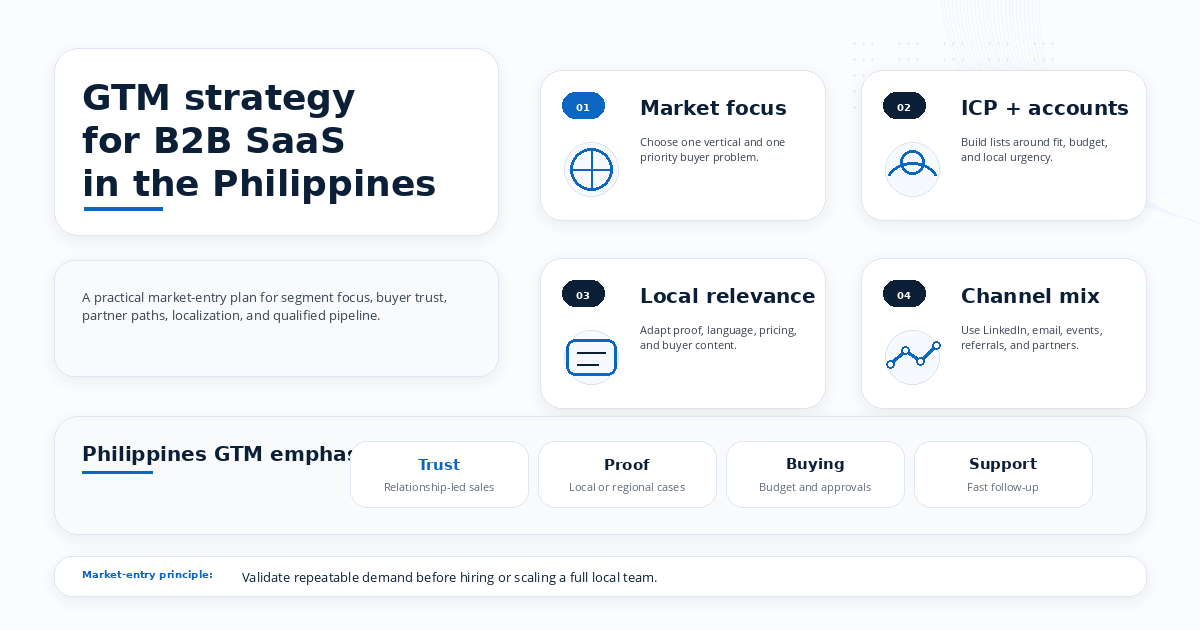
Step 1 — Choose Your First Philippine Segment
The Philippines is not one uniform SaaS market.
Your first GTM motion should focus on one clear segment.
Segment Options
| Segment Type | Examples |
|---|---|
| Industry | fintech, BPO, logistics, education, healthcare, retail, real estate, SaaS, professional services |
| Company size | startups, SMEs, mid-market, enterprise, conglomerates |
| Business function | sales, HR, finance, customer support, IT, operations, marketing |
| Location | Metro Manila, Cebu, Davao, Clark, regional hubs |
| Buyer problem | productivity, compliance, customer experience, revenue growth, automation |
| Technology maturity | cloud-ready teams, spreadsheet-heavy teams, digitally mature enterprises |
| Urgency trigger | hiring growth, expansion, compliance changes, funding, new branches, cost pressure |
Recommended Starting Point
For many B2B SaaS companies, start with:
- one industry;
- one buyer persona;
- one business problem;
- one clear SaaS use case;
- one defined account list;
- one sales motion.
Example
Instead of targeting:
“All Philippine SMEs”
Start with:
“Metro Manila and Cebu-based BPO and professional-services companies with 100–1,000 employees that need better sales, HR, or customer support workflow visibility.”
That is easier to research, message, and validate.
Step 2 — Define Your Philippine SaaS ICP
Your global ICP may not be specific enough.
A Philippine SaaS ICP should account for fit, urgency, budget, and operational reality.
ICP Criteria
| ICP Area | Questions to Answer |
|---|---|
| Industry fit | Which Philippine sectors feel the problem most strongly? |
| Company size | Which companies have enough budget and process complexity? |
| Buyer role | Who owns the problem locally? |
| Budget reality | Can the company afford the subscription? |
| Tech readiness | Is the team ready to adopt SaaS tools? |
| Data sensitivity | Will data privacy, security, or compliance matter? |
| Support expectations | Will onboarding or local support be needed? |
| Trigger event | What creates urgency now? |
| Disqualifier | Which accounts should not be pursued? |
Example ICP
Philippine mid-market companies in BPO, logistics, and professional services with 100–1,000 employees, growing teams, spreadsheet-heavy workflows, and department heads responsible for improving visibility, productivity, or customer response times.
Disqualification Criteria
Exclude accounts that:
- are too small for the subscription;
- have no clear owner for the problem;
- lack digital readiness;
- have no urgent business pain;
- cannot support implementation;
- are outside the priority segment;
- only want free tools or one-time services.
Step 3 — Understand the Local Buying Committee
A SaaS buyer in the Philippines may not make the decision alone.
Even in mid-market companies, the decision may involve:
- department head;
- finance;
- IT;
- operations;
- business owner;
- procurement;
- legal;
- data privacy officer;
- executive sponsor;
- end users.
Buying Committee Map
| Role | What They Care About |
|---|---|
| Business owner | Productivity, revenue, service quality, operational pain |
| Finance | Cost, ROI, payment terms, budget timing |
| IT | Security, integration, access, support |
| Data privacy officer | Personal data handling and compliance |
| Department head | Adoption, workflow impact, team productivity |
| End users | Ease of use and daily workflow |
| Procurement | Vendor process and commercial terms |
| Executive sponsor | Strategic priority and business case |
Questions to Ask Early
- Who owns the problem?
- Who controls the budget?
- Who will use the software daily?
- Who needs to approve data or security requirements?
- What tools are currently being used?
- What would make implementation difficult?
- What does success need to look like in 90 days?
Why This Matters
If the SaaS product affects data, workflows, customer communication, finance, HR, or IT, expect more stakeholders.
Your content and sales process should prepare for that.
Step 4 — Localize Positioning, Proof, and Pricing
English-language content may be understandable in the Philippines.
But understanding is not the same as buying confidence.
Localization should adapt the business case.
What to Localize
| Area | What to Adapt |
|---|---|
| Positioning | Connect the product to a specific Philippine buyer problem |
| Proof | Use local, regional, or highly comparable case studies |
| Pricing | Explain ROI, phased rollout, pilot options, or team-based value |
| Content | Use practical one-pagers, FAQs, decks, and implementation guides |
| CTA | Match buyer readiness: assessment, consultation, pilot, demo |
| Support | Clarify onboarding, training, and response expectations |
| Compliance | Address data privacy and security where relevant |
Weak Message
“Scale your operations with an AI-powered SaaS platform.”
Stronger Philippine SaaS Message
“Help your customer support team reduce manual follow-up, improve response visibility, and give managers a clearer view of unresolved cases without adding more spreadsheets.”
The second message is more practical.
It speaks to a business issue.
Step 5 — Build Trust Signals Before Pushing Conversion
Indonesia often rewards patience and credibility.
A prospect may need to see that your company is serious about the market before agreeing to a commercial conversation.
Trust Signals That Help
- local or regional case studies;
- Bahasa Indonesia content;
- credible local partners;
- referrals;
- event participation;
- founder or senior leader involvement;
- practical market insights;
- clear implementation process;
- strong professional presence on LinkedIn;
- consistent follow-up.
Trust-Building Touchpoints
| Touchpoint | Purpose |
|---|---|
| LinkedIn content | Builds familiarity |
| Partner webinar | Adds credibility |
| Localised guide | Shows market understanding |
| Referral request | Creates warmer access |
| Follow-up note | Maintains relationship momentum |
| Case study | Reduces risk |
| Executive message | Signals commitment |
Practical Rule
Do not push conversion before trust exists.
Create a reason for the buyer to believe the conversation is worth their time.
Step 5 — Decide Between Direct Sales, Partners, or Hybrid GTM
B2B SaaS companies usually have three options.
Direct Sales
Best when:
- the product is easy to explain;
- buyers are reachable;
- deal size justifies direct outreach;
- implementation is simple;
- the company can manage onboarding remotely.
Partner-Led GTM
Best when:
- trust barriers are high;
- implementation support is needed;
- local relationships matter;
- the product requires integration;
- industry-specific access is important.
Hybrid GTM
Best when:
- the vendor owns strategy and closing;
- partners support implementation or referrals;
- SDR/BDR teams create pipeline;
- local specialists support trust and adoption.
Comparison
| GTM Model | Best For | Risk |
|---|---|---|
| Direct sales | Faster validation and control | Harder if trust or support is weak |
| Partner-led | Credibility and local access | Slower if partner incentives are unclear |
| Hybrid | Balanced market entry | Requires strong coordination |
For many SaaS companies entering the Philippines, a hybrid model is often practical: direct outreach for validation, partner support for credibility or delivery, and careful local-market feedback.
Step 6 — Choose the Right Acquisition Channels
Do not rely on one channel.
A Philippine B2B SaaS GTM motion should often combine outbound, content, referrals, events, and partner paths.
Channel Mix
Useful for:
- finding executives and department heads;
- mapping accounts;
- warming up prospects;
- sharing thought leadership;
- building credibility.
Useful for:
- structured outreach;
- follow-up;
- sharing one-pagers;
- booking discovery calls;
- running nurture sequences.
Phone
Useful for:
- confirming the right contact;
- qualifying interest;
- following up on events;
-
reaching operational buyers.
Webinars
Useful for:
- education;
- product category explanation;
- lead capture;
- stakeholder engagement;
- local proof-building.
Events
Useful for:
- trust-building;
- partner development;
- industry visibility;
- founder-led conversations.
Referrals
Useful for:
- reducing trust barriers;
- accessing senior buyers;
- improving meeting quality.
Partners
Useful for:
- implementation;
- local access;
- credibility;
- ongoing support.
Recommended First Motion
- Build a focused account list.
- Map 3–5 stakeholders per account.
- Engage on LinkedIn.
- Send practical email outreach.
- Invite prospects to a webinar, consultation, or assessment.
- Follow up quickly.
- Qualify meetings carefully.
- Capture objections and market feedback.
Step 7 — Build a 90-Day Pilot Campaign
Do not scale too early.
Run a 90-day pilot first.
Days 1–30 — Foundation
- select segment;
- define ICP;
- build account list;
- map buyers;
- localize messaging;
- prepare sales assets;
- set CRM fields;
- define qualification criteria.
Days 31–60 — Activation
- launch LinkedIn and email outreach;
- test one webinar or content angle;
- follow up by phone;
- track replies;
- document objections;
- book qualified meetings.
Days 61–90 — Review
- compare segments;
- review meetings held;
- evaluate sales acceptance;
- analyze objections;
- assess pricing resistance;
- identify partner needs;
- decide whether to scale, adjust, or pause.
Pilot Metrics
| Metric | What It Shows |
|---|---|
| Positive replies | Message relevance |
| Meetings booked | Initial interest |
| Meetings held | Buyer commitment |
| Sales acceptance | Lead quality |
| Opportunity creation | Commercial potential |
| Objections | Market readiness |
| Pricing feedback | Packaging fit |
| Partner signals | Local trust or delivery needs |
Step 8 — Create Buyer Enablement Assets
SaaS buyers need more than a demo.
They often need materials that help them explain the product internally.
Useful Assets
- one-page overview;
- ROI calculator;
- pricing explainer;
- implementation plan;
- onboarding checklist;
- security FAQ;
- data privacy FAQ;
- case study;
- buyer comparison guide;
- internal business-case template.
Asset by Stakeholder
| Stakeholder | Useful Asset |
|---|---|
| CEO / founder | Strategic value summary |
| CFO / finance | ROI and cost comparison |
| IT | Security and integration overview |
| Department head | Use-case workflow guide |
| End users | Simple product walkthrough |
| Procurement | Vendor and commercial summary |
| Data privacy officer | Data handling and privacy FAQ |
Buyer enablement is especially important when a champion needs to justify the decision internally.
Step 9 — Build the Sales Handoff and Qualification Process
The first SaaS GTM pilot will only work if sales handles qualified interest properly.
Handoff Notes Should Include
- company context;
- buyer role;
- current tools;
- pain discussed;
- urgency;
- budget signal;
- data/privacy concerns;
- stakeholders mentioned;
- objections raised;
- recommended next step.
Qualification Criteria
A qualified meeting should include:
- account fit;
- relevant buyer;
- clear pain;
- realistic use case;
- practical next step;
- no obvious disqualifier.
Why This Matters
Poor handoff wastes good market interest.
Strong handoff turns early conversations into learning, opportunities, and repeatable strategy.
Measure Market Feedback and Pipeline Quality
Activity alone is not enough.
You need to know whether the market is producing qualified demand.
What to Track
| Category | Metrics |
|---|---|
| Activity | accounts researched, contacts mapped, emails sent, calls made |
| Engagement | replies, positive replies, LinkedIn responses, webinar attendance |
| Quality | meetings held, sales acceptance, disqualification reasons |
| Pipeline | opportunities created, pipeline value, stage movement |
| Market learning | objections, pricing feedback, stakeholder patterns, partner needs |
| Adoption concerns | onboarding issues, support needs, data/privacy concerns |
The goal is to understand whether the Philippine market is worth scaling—and where.
Step 11 — Decide When to Scale or Hire Locally
After the pilot, choose the next move based on evidence.
Scale If:
- the ICP is clear;
- buyers respond;
- meetings are held;
- sales accepts the meetings;
- opportunities are forming;
- objections are manageable;
- pricing is not a consistent blocker;
- the channel mix is repeatable.
Partner If:
- local trust is needed;
- implementation support matters;
- buyers ask for local presence;
- industry access is relationship-led;
- after-sales support is a major concern.
Hire Locally If:
- the Philippines is a strategic priority;
- pipeline has been validated;
- the sales cycle requires local presence;
- customer success and onboarding need local support;
- leadership wants long-term market ownership.
Adjust or Pause If:
- buyers show weak urgency;
- meetings do not convert;
- pricing consistently fails;
- the product requires major localization;
- the segment is too broad;
- the market needs education before sales.
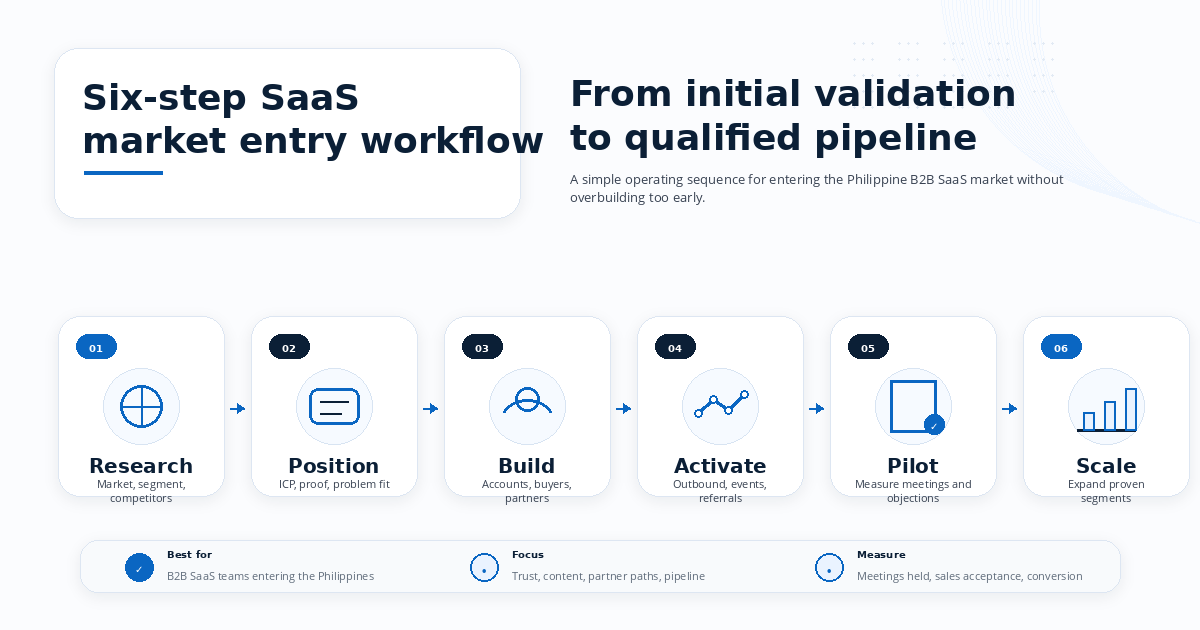
Philippine B2B SaaS GTM Framework
Use this six-step framework.
Step 1 — Research
Understand market size, category maturity, competitors, buyer roles, local business habits, pricing expectations, and compliance needs.
Step 2 — Position
Adapt ICP, value proposition, proof, pricing logic, and CTA for Philippine buyers.
Step 3 — Build
Create account lists, buyer maps, localized assets, CRM fields, and partner/referral paths.
Step 4 — Activate
Launch LinkedIn, email, calls, webinars, events, referrals, and partner outreach.
Step 5 — Pilot
Measure meetings held, sales acceptance, objections, pricing feedback, privacy concerns, and opportunity creation.
Step 6 — Scale
Expand only when a segment, message, channel mix, and sales process show evidence of working.
Common Mistakes to Avoid
Mistake 1 — Assuming English Means No Localization
English helps, but local business relevance still matters.
Mistake 2 — Targeting Too Broadly
“All Philippine businesses” is not an ICP.
Mistake 3 — Ignoring Budget Sensitivity
Pricing and packaging must match buyer readiness.
Mistake 4 — Selling Features Instead of Business Outcomes
Focus on workflow improvement, productivity, visibility, compliance, customer experience, or revenue impact.
Mistake 5 — Skipping Trust-Building
Referrals, local proof, partners, and fast follow-up can matter.
Mistake 6 — No Data Privacy Preparation
SaaS companies handling personal data should prepare data privacy, security, and processing answers. The National Privacy Commission provides DPA guidance and identifies obligations for Personal Information Controllers and Personal Information Processors.
Mistake 7 — Hiring Before Validation
Validate the market first.
Mistake 8 — Measuring Only Meetings Booked
Track meetings held, sales acceptance, opportunity creation, objections, and conversion.
Philippine SaaS GTM Scorecard
Score each area from 1 to 5.
| Area | 1 — Weak | 3 — Developing | 5 — Strong |
|---|---|---|---|
| Market focus | Broad Philippines target | Basic segment focus | Clear priority segment and buyer problem |
| ICP | Generic SaaS audience | Some buyer definition | Philippines-specific ICP and disqualifiers |
| Positioning | Global copy only | Some local references | Practical local problem framing |
| Proof | Global claims only | Regional proof | Local, regional, or highly comparable proof |
| Pricing | Standard global package | Some flexibility | Clear pilot, ROI, or phased adoption logic |
| Channels | One channel | Two-channel test | LinkedIn, email, calls, events, referrals, partners |
| Buyer enablement | Demo only | Basic one-pager | ROI, FAQ, implementation, and privacy materials |
| Qualification | Any meeting counts | Basic filters | Written qualified meeting criteria |
| CRM | Scattered notes | Basic tracking | Market, source, persona, objections, and stage tracking |
| Scaling decision | Based on optimism | Based on activity | Based on sales acceptance and opportunity evidence |
Score Interpretation
| Total Score | Recommendation |
|---|---|
| 42–50 | Strong Philippine SaaS GTM foundation; prepare for controlled scaling |
| 34–41 | Good foundation; improve proof, pricing, or qualification areas |
| 25–33 | Continue validation before scaling investment |
| Below 25 | Rebuild GTM strategy before entering or expanding in the Philippines |
Need Help Entering the Philippine B2B SaaS Market?
Expand In Asia helps B2B SaaS companies enter the Philippines through:
- ICP definition;
- account research;
- localized messaging;
- LinkedIn and email outreach;
- appointment setting;
- lead qualification;
- CRM reporting;
- market feedback.
Talk to Expand In Asia about building your Philippine SaaS GTM strategy →
Next Steps With Expand In Asia
The Philippines can be a strong market for B2B SaaS companies, but success depends on focus.
A practical GTM strategy should help your team:
- choose the right first segment;
- define a realistic ICP;
- localize business messaging;
- prepare proof and buyer enablement;
- build trust;
- test the right channels;
- qualify meetings properly;
- decide when to scale.
For broader market-entry planning, read:
Go-to-Market (GTM) Strategies for Asia
For pipeline tactics, read:
10 Best B2B Qualified Lead Generation Strategies for 2026
Schedule a consultation with Expand In Asia →
Ready to Implement These Strategies?
Book a free 30-minute strategy session where we’ll audit your current growth approach and identify your highest-leverage opportunities in Asian markets.
Frequently Asked Questions
1. Is the Philippines a good market for B2B SaaS?
It can be. The Philippines has a growing digital economy and strong digital adoption, but B2B SaaS success depends on segment focus, pricing fit, buyer trust, clear ROI, and strong follow-up. The Philippine digital economy reached 9.8% of GDP in 2025, according to the Philippine Statistics Authority.
2. Do B2B SaaS companies need to localize for the Philippines?
Yes. English may work well for many business audiences, but localization should still adapt the message, proof, pricing, support expectations, and buyer enablement materials.
3. Should SaaS companies sell direct or through partners?
It depends on the product. Direct sales works well for validation and simpler SaaS products. Partners may help when trust, implementation, integrations, or local support are important. A hybrid model is often practical.
4. What channels work for B2B SaaS in the Philippines?
Common channels include LinkedIn, email, phone, webinars, events, referrals, and partner-led introductions. The best mix depends on the ICP, buyer persona, price point, and sales cycle.
5. Should companies hire locally immediately?
Not always. Many companies should validate ICP, messaging, channel fit, meeting quality, and opportunity creation before hiring full-time local headcount.
6. What should a 90-day pilot measure?
Measure positive replies, meetings booked, meetings held, sales acceptance, opportunities created, pricing feedback, objections, privacy concerns, and partner signals.
7. What compliance issues should SaaS companies consider?
SaaS companies handling personal data should prepare answers around data privacy, security, access control, processing roles, and customer data handling. The Philippines’ National Privacy Commission provides guidance on the Data Privacy Act of 2012 and obligations for Personal Information Controllers and Processors.