A practical market watchlist for B2B companies planning APAC expansion
Asia Pacific is not one market.
That is the first mistake many B2B companies make.
They say:
“We want to expand into Asia.”
But Asia Pacific includes very different economies, buyer behaviors, maturity levels, languages, procurement processes, and business cultures.
Selling into Singapore is not the same as selling into India.
Selling into Vietnam is not the same as selling into Malaysia.
Selling into Indonesia is not the same as selling into the Philippines.
Some markets are better for enterprise SaaS.
Some are better for manufacturing technology.
Some are better for fintech, cloud, cybersecurity, HR tech, AI, logistics, or professional services.
Some are large but complex.
Some are smaller but easier to use as a regional entry point.
For 2026–2027, the opportunity is not just “Asia is growing.”
The real question is:
Which APAC markets are becoming more attractive for B2B companies, and how should teams prioritize them?
The Asian Development Bank expects developing Asia and the Pacific to keep growing, with its April 2026 outlook projecting regional growth of 5.1% in both 2026 and 2027 under an early stabilization scenario.
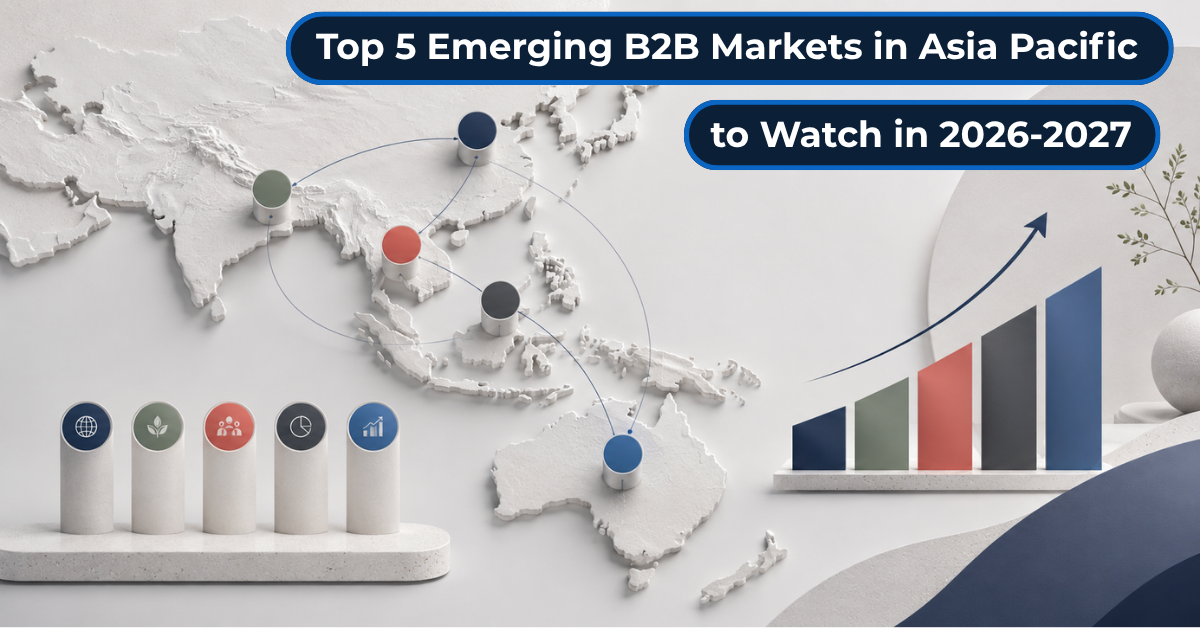
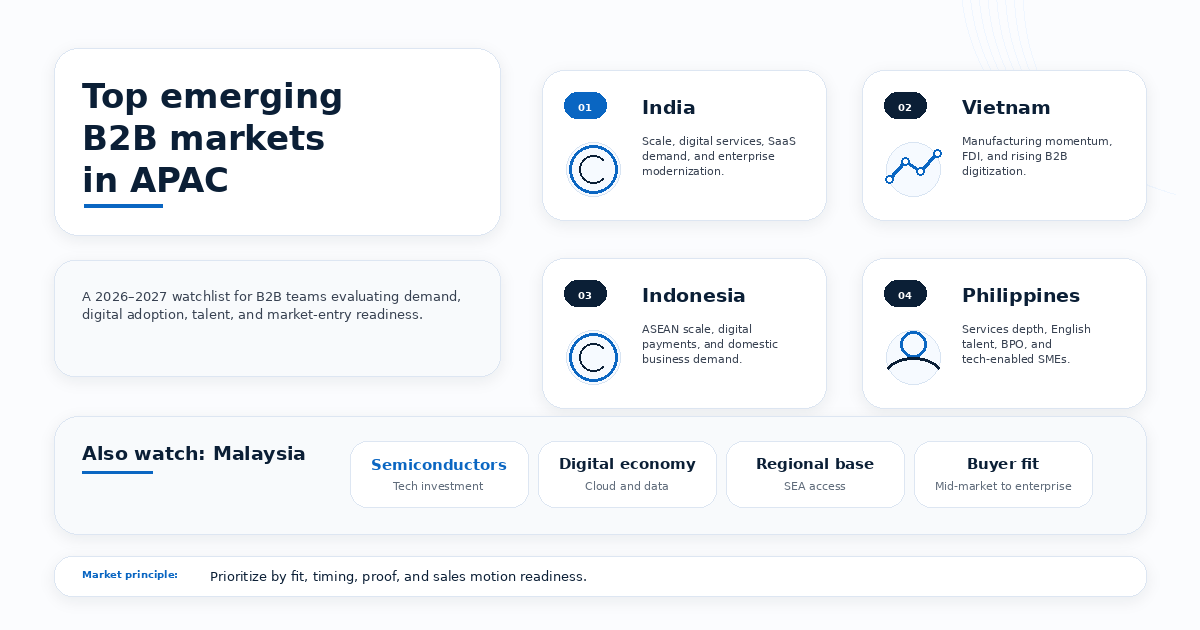
This guide highlights five emerging B2B markets in Asia Pacific to watch in 2026–2027:
- India
- Vietnam
- Indonesia
- Philippines
- Malaysia
This is not a one-size-fits-all ranking. It is a practical B2B watchlist based on market scale, digital adoption, business modernization, talent, investment momentum, and go-to-market relevance.
- TL;DR — Key Takeaways
- APAC is not one market. B2B teams should prioritize by ICP fit, buyer maturity, sales access, and local proof requirements.
- India offers unmatched scale. It is attractive for SaaS, AI, fintech, cloud, cybersecurity, data, and enterprise services, but competition and segmentation complexity are high.
- Vietnam is becoming more compelling. Strong growth, manufacturing momentum, FDI, and digital modernization make it a serious B2B market to watch.
- Indonesia remains a major ASEAN opportunity. Its size, digital economy, and domestic demand make it attractive, but execution requires localization and patience.
- The Philippines is strong for services-led B2B. English-speaking talent, BPO depth, digital services, and a young workforce create opportunities for SaaS, HR tech, fintech, and customer operations.
- Malaysia is a strong regional technology and mid-market entry option. Semiconductors, digital investment, and stable business infrastructure make it attractive for selected B2B sectors.
- Singapore still matters. It may not be “emerging,” but it remains a critical regional HQ, validation, and decision-making hub.
- Do not expand everywhere at once. Validate pipeline, objections, conversion, and sales acceptance before committing local hiring or large budgets.
If you only do one thing: choose your first APAC market based on where your ICP is easiest to reach, educate, qualify, and convert—not just where the GDP chart looks attractive.
Who This Guide Is For—and Who It Is Not For
This Guide Is For
- B2B companies planning APAC expansion in 2026–2027.
- SaaS, cybersecurity, cloud, fintech, HR tech, AI, data, logistics tech, managed services, and professional-services companies.
- Founders and CEOs deciding which Asian market to enter first.
- CROs and sales leaders building regional pipeline strategies.
- CMOs and demand generation teams planning market-specific campaigns.
- SDR, BDR, and RevOps teams building target-account lists.
- GTM teams comparing India, Southeast Asia, and wider APAC.
This guide is especially useful if your team is asking:
- Which APAC market should we prioritize first?
- Is India too broad to enter without segmentation?
- Is Vietnam ready for B2B SaaS?
- How should we think about Indonesia versus the Philippines?
- Is Malaysia a good regional B2B market?
- Should Singapore be the first market or the regional hub?
- How do we validate demand before hiring locally?
This Guide Is Not For
This guide may be less useful if:
- you want a consumer-market ranking;
- your product is not B2B;
- your team has no defined ICP;
- you are looking for a guaranteed “best country” answer;
- you plan to enter multiple countries without market testing;
- you are not ready to adapt messaging, pricing, and proof by market.
Practical fit check: The best APAC market is not always the biggest market. It is the market where your buyer problem, proof, access, and timing match.
How We Define an Emerging B2B Market
An emerging B2B market is not simply a country with high GDP growth.
For B2B companies, a market becomes attractive when several things come together:
- businesses are modernizing;
- digital adoption is increasing;
- buyers have budget or urgency;
- companies are investing in technology;
- sales channels are reachable;
- local proof is becoming more valuable;
- procurement is maturing;
- talent is available;
- regional or global vendors are entering;
- customer problems are clear enough to sell against.
B2B Market Attractiveness Is Different From Consumer Market Attractiveness
| Consumer Market Question | B2B Market Question |
|---|---|
| How many consumers are online? | How many target companies match our ICP? |
| Is consumer spending rising? | Are businesses investing in solutions like ours? |
| Is the population young? | Are decision-makers reachable and budget-aware? |
| Is the digital economy growing? | Are companies buying software, services, or outsourced expertise? |
| Is the market large? | Can we build qualified pipeline at a reasonable cost? |
The best B2B market is not always the largest economy.
It is the market where your company can create repeatable, qualified sales conversations.
Market Selection Criteria for 2026–2027
For this watchlist, the five markets were selected based on practical B2B expansion factors.
Criteria Used
| Criteria | Why It Matters |
|---|---|
| Economic momentum | Shows overall business confidence and investment potential |
| Digital adoption | Indicates readiness for SaaS, cloud, automation, AI, and data solutions |
| B2B buyer maturity | Shows whether companies understand the business problem |
| Talent base | Affects implementation, support, hiring, and customer success |
| Market size | Determines long-term revenue potential |
| Sales access | Shows whether target buyers can be reached through outbound, partners, events, or referrals |
| Localization needs | Affects sales complexity and GTM adaptation |
| Regional relevance | Shows whether the market can support broader APAC expansion |
Important Note
This is not a recommendation to enter all five markets at once.
Most B2B companies should start with one or two priority markets, validate demand, then scale.
For a broader market-entry framework, read Go-to-Market (GTM) Strategies for Asia. Expand In Asia’s live GTM guide focuses on building market-entry frameworks for B2B companies expanding into Asia.
Market 1 — India
Why India Is on the Watchlist
India is difficult to ignore.
It offers:
- massive market scale;
- a large digital economy;
- deep technology talent;
- strong startup and enterprise ecosystems;
- growing SaaS and AI adoption;
- major domestic and global business services demand;
- sophisticated buyers in selected sectors.
ADB’s July 2026 update lowered India’s FY2026 forecast compared with April due to energy-price pressures, while the FY2027 forecast remained supported by improved global conditions and export competitiveness.
India is not “easy,” but it can be highly attractive when the ICP is narrow.
Best-Fit B2B Categories
India can be strong for:
- SaaS;
- AI tools;
- cybersecurity;
- cloud infrastructure;
- fintech;
- data and analytics;
- developer tools;
- HR tech;
- sales and marketing technology;
- enterprise services;
- managed services.
What Makes India Attractive
| Strength | B2B Relevance |
|---|---|
| Market scale | Large number of potential accounts |
| Tech talent | Strong buyer understanding of software and services |
| Startup ecosystem | Demand for growth, automation, and efficiency tools |
| Enterprise modernization | Large companies investing in digital systems |
| Global services base | Strong B2B services and outsourcing depth |
What Makes India Challenging
India is not one market.
It is many markets inside one country.
Challenges include:
- intense competition;
- pricing pressure;
- long enterprise cycles;
- regional variation;
- crowded vendor landscape;
- need for strong segmentation;
- difficulty selling with generic messaging.
GTM Recommendation
Do not enter India broadly.
Choose a narrow segment.
Examples:
- B2B SaaS companies in Bengaluru;
- fintech teams in Mumbai;
- cybersecurity buyers in enterprise IT;
- funded startups expanding internationally;
- global capability centers with automation needs.
Practical Rule
India rewards focus.
Broad targeting wastes time.
Market 2 — Vietnam
Why Vietnam Is on the Watchlist
Vietnam has become one of the most interesting B2B markets in Southeast Asia.
It combines:
- strong growth;
- manufacturing momentum;
- FDI inflows;
- rising digital adoption;
- young talent;
- growing business modernization;
- increasing international attention.
The World Bank’s latest Vietnam update projects growth of 6.8% in 2026 after an 8% expansion in 2025, describing the forecast as still robust.
World Bank reporting also notes that Vietnam’s 2025 growth was supported by strong exports, higher public investment, rising FDI inflows, and high-tech and electronics shipments.
Best-Fit B2B Categories
Vietnam can be attractive for:
- manufacturing technology;
- supply-chain software;
- logistics tech;
- HR tech;
- cloud and cybersecurity;
- fintech infrastructure;
- ERP and workflow automation;
- industrial automation;
- data and reporting tools;
- sales and customer operations software.
What Makes Vietnam Attractive
| Strength | B2B Relevance |
|---|---|
| Manufacturing growth | Demand for operational systems and automation |
| FDI activity | International companies need local enablement |
| Young workforce | Strong digital adoption potential |
| Export economy | Need for compliance, logistics, quality, and supply-chain tools |
| Digital modernization | Increasing openness to SaaS and platforms |
What Makes Vietnam Challenging
Challenges include:
- relationship-building requirements;
- practical implementation expectations;
- localization needs;
- price sensitivity in some segments;
- need for clear use-case education;
- limited patience for abstract messaging.
GTM Recommendation
Lead with practical business outcomes.
Vietnam buyers often respond better to:
- implementation clarity;
- operational value;
- case examples;
- step-by-step explanations;
- proof from similar companies;
- clear support model.
Practical Rule
In Vietnam, do not oversell the vision before explaining the practical path.
Market 3 — Indonesia
Why Indonesia Is on the Watchlist
Indonesia is one of the most important long-term B2B markets in Southeast Asia.
It offers:
- large population and business base;
- strong domestic demand;
- growing digital economy;
- increasing use of digital payments;
- a large SME and enterprise landscape;
- major opportunities in fintech, logistics, retail, HR, and business services.
S&P maintained Indonesia’s BBB/A-2 rating in July 2026, citing robust growth prospects, modest government and external debt, and expectations of recovering government revenue, while also noting fiscal and policy risks.
Best-Fit B2B Categories
Indonesia can be attractive for:
- fintech;
- payments infrastructure;
- logistics technology;
- HR tech;
- retail technology;
- B2B marketplaces;
- cybersecurity;
- cloud services;
- sales outsourcing;
- customer operations;
- compliance and workflow tools.
What Makes Indonesia Attractive
| Strength | B2B Relevance |
|---|---|
| Market size | Large long-term revenue opportunity |
| Digital payments growth | Opens fintech and commerce infrastructure opportunities |
| Domestic demand | Strong need for productivity and business tools |
| SME base | Broad market for workflow and operational platforms |
| Regional importance | Key ASEAN market for long-term expansion |
What Makes Indonesia Challenging
Indonesia requires patience.
Challenges include:
- localization;
- Bahasa Indonesia support;
- relationship-driven selling;
- complex stakeholder paths;
- regional diversity;
- pricing sensitivity;
- need for local credibility or partners.
GTM Recommendation
Do not treat Indonesia as a quick outbound-only market.
Build trust through:
- local proof;
- partner support;
- Bahasa-ready materials;
- market-specific messaging;
- warm introductions;
- practical education.
Practical Rule
Indonesia rewards companies that invest in relationship infrastructure.
Market 4 — Philippines
Why the Philippines Is on the Watchlist
The Philippines is an attractive B2B market for companies that sell into services-led sectors, customer operations, workforce technology, fintech, education, healthcare, and business process transformation.
The World Bank describes the Philippines as being supported by increasing urbanization, a large and youthful population, strong consumer demand, remittances, and a rapidly expanding services sector that includes business process outsourcing, wholesale and retail trade, and tourism.
The OECD’s 2026 Philippines survey also notes that business process outsourcing is a pillar of the economy, while highlighting AI-related challenges and the need for reskilling and upskilling.
Best-Fit B2B Categories
The Philippines can be attractive for:
- HR tech;
- customer support software;
- contact-center technology;
- AI tools for operations;
- fintech;
- edtech;
- healthcare technology;
- sales and marketing tools;
- workflow automation;
- cybersecurity;
- training and enablement platforms.
What Makes the Philippines Attractive
| Strength | B2B Relevance |
|---|---|
| English proficiency | Easier sales, support, and onboarding |
| BPO depth | Strong buyer relevance for operations and automation |
| Young workforce | Strong digital adoption potential |
| Services economy | Large base for HR, customer experience, and productivity tools |
| Relationship-oriented business culture | Good fit for referral-led and consultative selling |
What Makes the Philippines Challenging
Challenges include:
- budget sensitivity;
- procurement timelines;
- need for clear ROI;
- support expectations;
- champion dependency;
- varying maturity between enterprise and SMB buyers.
GTM Recommendation
Lead with:
- clear business case;
- practical ROI;
- fast support;
- relatable use cases;
- role-based training;
- strong follow-up.
Practical Rule
In the Philippines, enthusiasm is useful—but adoption and ROI still need to be proven.
Market 5 — Malaysia
Why Malaysia Is on the Watchlist
Malaysia is often underrated.
It may not have India’s scale or Indonesia’s population, but it has strong B2B qualities:
- stable business environment;
- regional accessibility;
- strong English usage in business;
- technology-intensive investment;
- semiconductor and electronics strength;
- growing digital economy;
- useful base for selected Southeast Asian expansion.
The OECD projects Malaysia’s GDP growth at 4.2% in 2026 and 4.8% in 2027, with investment buoyed by technology-intensive sectors including semiconductors.
Malaysia’s digital economy has also seen strong investment signals; Tech for Good Institute reported that Malaysia Digital investments reached RM42.6 billion by mid-2025, a 125% quarter-on-quarter growth.
Best-Fit B2B Categories
Malaysia can be attractive for:
- semiconductor ecosystem services;
- cloud and data infrastructure;
- cybersecurity;
- fintech;
- HR tech;
- managed services;
- industrial technology;
- professional services;
- regional operations tools;
- AI and automation for business workflows.
What Makes Malaysia Attractive
| Strength | B2B Relevance |
|---|---|
| Business stability | Easier planning and market testing |
| English business usage | Easier sales and support communication |
| Semiconductor and E&E base | Strong technology and manufacturing relevance |
| Digital investment | Growing demand for cloud, data, and automation |
| Regional location | Useful Southeast Asia operating base |
What Makes Malaysia Challenging
Challenges include:
- smaller market size than India or Indonesia;
- sector-specific opportunity concentration;
- need to differentiate against established vendors;
- procurement and partner dynamics;
- competition from Singapore as regional HQ.
GTM Recommendation
Malaysia can work well as a focused B2B market when your offer matches:
- technology-intensive industries;
- regional operations;
- mid-market modernization;
- cybersecurity or managed services;
- manufacturing and supply-chain workflows.
Practical Rule
Malaysia is a strong “fit-driven” market.
It works best when your ICP is clearly aligned with the market’s business strengths.
Where Singapore Fits in the APAC Expansion Strategy
Singapore is not on this “emerging market” list because it is already a mature regional business hub.
But it still matters.
A lot.
Singapore often serves as:
- APAC headquarters;
- regional buying center;
- investor hub;
- partner hub;
- proof market;
- sales leadership base;
- enterprise decision-making center.
For many B2B companies, Singapore is where the regional decision starts—even if users, implementation, or expansion happen elsewhere in Southeast Asia.
Singapore’s Role
| Role | Why It Matters |
|---|---|
| Regional HQ | Many APAC decision-makers sit there |
| Validation market | Good place to test positioning and proof |
| Partner hub | Easier access to regional partnerships |
| Enterprise buyer base | Strong fit for SaaS, cybersecurity, fintech, and cloud |
| Market-entry gateway | Useful before entering Indonesia, Vietnam, Malaysia, or the Philippines |
For sales-cycle ideas in Singapore and Southeast Asia, read How to Shorten Your B2B Sales Cycle in Singapore and SEA.
How to Prioritize Your First Market
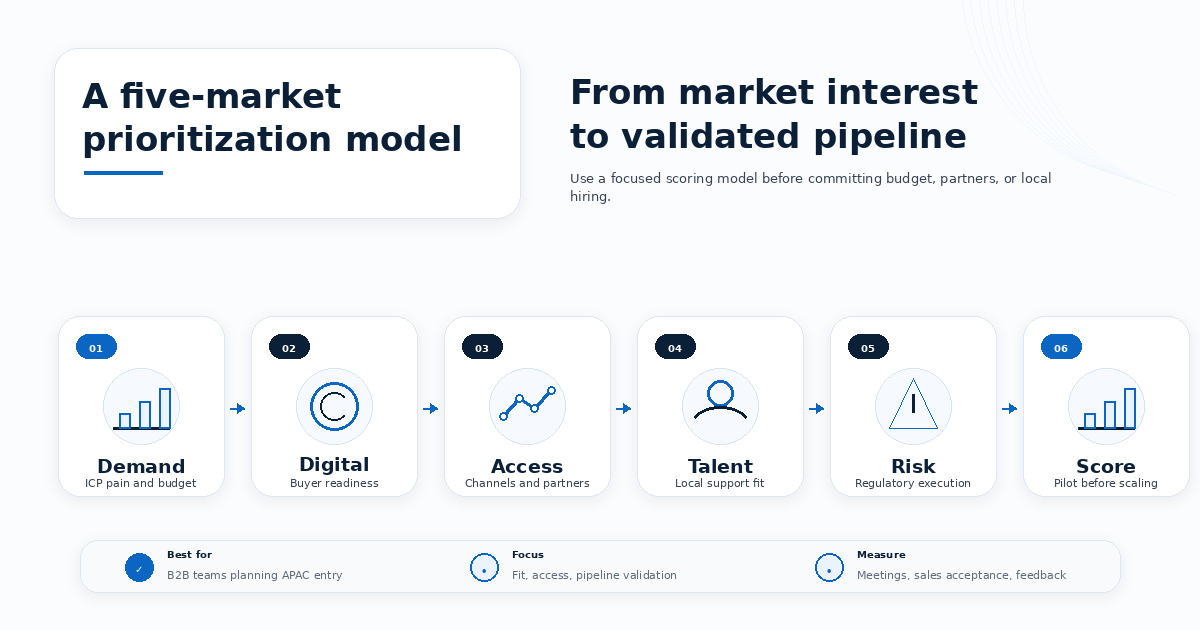
Do not choose your first APAC market based only on macroeconomic headlines.
Use a practical B2B scorecard.
Market Prioritization Criteria
| Criteria | Question |
|---|---|
| ICP fit | Are there enough companies that match your target profile? |
| Buyer pain | Is the problem urgent and understood? |
| Budget | Can the market pay at your target price point? |
| Access | Can you reach decision-makers through outbound, partners, events, or referrals? |
| Proof | Do you have relevant case studies or localizable proof? |
| Sales cycle | Can your team handle the expected timeline? |
| Localization | What language, cultural, or content adaptation is needed? |
| Competition | Is the market crowded, under-served, or misunderstood? |
| Support | Can you onboard and support customers properly? |
| Expansion path | Can the market lead to other APAC opportunities? |
Suggested Starting Approach
- Select two candidate markets.
- Define narrow ICPs for each.
- Build target-account lists.
- Test messaging.
- Run controlled outbound.
- Track positive replies and objections.
- Qualify meetings carefully.
- Compare sales acceptance.
- Decide where to scale.
For a practical pipeline validation framework, read Building a B2B Sales Pipeline from Zero in a New Asian Market.
Common Mistakes When Choosing APAC Markets
Mistake 1 — Choosing the Biggest Market First
Big does not mean easiest.
India and Indonesia offer huge potential, but they require strong segmentation.
Mistake 2 — Treating Southeast Asia as One Market
Singapore, Indonesia, Vietnam, Malaysia, Thailand, and the Philippines have different buyer behaviors.
Mistake 3 — Ignoring Local Proof
Global case studies may not be enough.
Mistake 4 — Expanding Before Validating Pipeline
Hiring locally before testing demand can be expensive.
Mistake 5 — Using One Message Across All Markets
Localization is not only translation.
It includes pain points, proof, CTA, timing, and tone.
For positioning guidance, read Positioning a Global Brand for Local Buyers.
Mistake 6 — Ignoring Post-Sale Readiness
If you cannot onboard, support, and retain customers in the market, acquisition success can turn into churn.
APAC B2B Market Prioritization Scorecard
Score each area from 1 to 5.
| Area | 1 — Weak | 3 — Developing | 5 — Strong |
|---|---|---|---|
| ICP density | Few matching accounts | Some target accounts | Strong concentration of ideal customers |
| Buyer pain | Problem unclear | Pain exists but needs education | Clear, urgent, budget-linked problem |
| Digital readiness | Low adoption | Mixed maturity | Strong openness to software, services, or automation |
| Sales access | Hard to reach buyers | Some channels available | Clear outbound, partner, event, or referral access |
| Local proof | No relevant proof | Some regional proof | Strong market, sector, or similar-customer proof |
| Localization need | High adaptation required | Manageable adaptation | Clear messaging and support path |
| Competition | Crowded and undifferentiated | Competitive but addressable | Clear positioning gap |
| Sales-cycle fit | Too long or unclear | Manageable with qualification | Fits current sales capacity |
| Support readiness | Cannot support market | Basic support available | Strong onboarding and customer success fit |
| Expansion potential | One-off market | Possible regional bridge | Strong path to wider APAC growth |
Score Interpretation
| Total Score | Recommendation |
|---|---|
| 42–50 | Strong candidate for focused market validation |
| 34–41 | Good candidate; improve proof, access, or localization |
| 25–33 | Interesting but risky; test narrowly before scaling |
| Below 25 | Not ready for serious GTM investment yet |
Need Help Choosing the Right APAC Market?
Expand In Asia helps B2B companies validate and build pipeline across Asian markets through:
- ICP and account research;
- market prioritization;
- localized buyer messaging;
- LinkedIn and email outreach;
- appointment setting;
- sales qualification;
- pipeline reporting;
- market feedback loops.
Talk to Expand In Asia about identifying your best-fit APAC market before scaling →
Next Steps With Expand In Asia
The top emerging B2B markets in APAC for 2026–2027 are not identical opportunities.
India gives you scale.
Vietnam gives you growth momentum.
Indonesia gives you long-term ASEAN depth.
The Philippines gives you services, English talent, and operations-led opportunity.
Malaysia gives you stable, tech-linked B2B potential.
But the right market depends on your ICP.
Before investing in local hiring, partnerships, or large campaigns, validate:
- who the buyer is;
- whether the pain is urgent;
- what proof is needed;
- which channels work;
- what objections appear;
- whether meetings become qualified opportunities.
For broader expansion planning, read Go-to-Market (GTM) Strategies for Asia.
For pipeline validation, read Building a B2B Sales Pipeline from Zero in a New Asian Market.
For improving local buyer relevance, read Positioning a Global Brand for Local Buyers.
Schedule a consultation with Expand In Asia →
Ready to Implement These Strategies?
Book a free 30-minute strategy session where we’ll audit your current growth approach and identify your highest-leverage opportunities in Asian markets.
Frequently Asked Questions
1. What are the top emerging B2B markets in Asia Pacific for 2026–2027?
The five markets highlighted in this guide are India, Vietnam, Indonesia, the Philippines, and Malaysia. They each offer different B2B opportunities based on scale, digital adoption, business modernization, talent, and regional relevance.
2. Is Singapore an emerging B2B market?
Singapore is not usually considered an emerging market, but it remains one of the most important APAC hubs for regional headquarters, enterprise buying, investor networks, partners, and market validation.
3. Which APAC market should a B2B SaaS company enter first?
It depends on the ICP. India offers scale, Singapore offers regional decision access, Vietnam offers growth momentum, Indonesia offers long-term ASEAN depth, the Philippines offers services-led opportunity, and Malaysia offers a stable tech-linked base.
4. Should B2B companies enter multiple APAC markets at once?
Usually not. Most companies should validate one or two markets first, compare pipeline quality, then scale after seeing evidence.
5. What is the biggest mistake companies make when entering APAC?
The biggest mistake is treating APAC as one market. Each country requires different messaging, proof, sales cycle expectations, buyer education, and localization.
6. How should B2B teams validate a new APAC market?
Start with ICP definition, account research, narrow target lists, localized messaging, controlled outbound, qualified meetings, sales acceptance tracking, and market feedback.