A practical guide to entering several Asian countries in the right order, without building a separate business in each one
Asia is not one market.
It is a region made of very different markets.
Most B2B teams know that. Many still build one “Asia plan” anyway.
A multi-country expansion strategy for Asia fixes that. It decides:
- which countries you enter first;
- in what order the next ones follow;
- what stays the same everywhere;
- what changes in each country;
- what evidence you need before adding the next market.
Most leadership teams start by asking:
“Which Asian countries should we launch in?”
But for B2B teams expanding across Asia, the better question is:
“How do we run several Asian countries without building a new business in each one?”
Because the differences are not small.
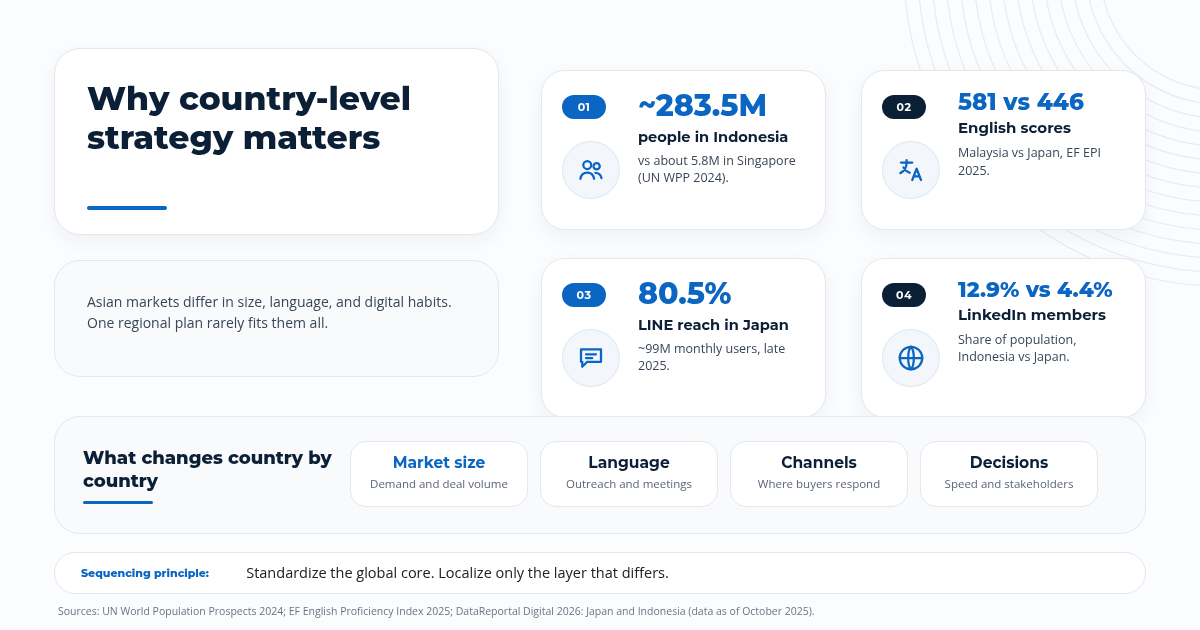
Singapore has about 5.8 million people. Indonesia has about 283 million.
Japan buys by consensus. Many Southeast Asian deals move through personal networks.
This guide expands on Mistake 1 from our masterclass, Breaking Into Asia: 5 Critical Asia Expansion Mistakes. It focuses on one question: how to sequence and run a multi-country expansion so that each country gets the attention it needs.
It is not a ranking of the best countries. For that, see our APAC market watchlist.
- TL;DR — Key Takeaways (our view)
- Start with one to three markets. More countries at once usually means less learning per country.
- Separate your global core from your local layer. Keep the product and core message; adapt language, proof, channels, and sales approach.
- Choose markets for reachable demand, not headline size. A smaller market you can reach beats a large one you cannot.
- Give each first-wave market a role. One may be your learning market, another your revenue market.
- Use evidence gates. Add the next country only when the current one shows repeatable results.
- Treat Singapore as a base, not a proxy. What works there may not work elsewhere in Asia.
If you only do one thing: write down what will stay global and what will change per country before you launch your second market.
Who This Guide Is For—and Who It Is Not For
This Guide Is For
- founders and CEOs planning to sell in more than one Asian country;
- revenue and sales leaders with a regional Asia target;
- strategy and business development teams building a phased entry plan;
- companies already in Singapore deciding where to go next;
- B2B SaaS, technology, industrial, and professional services firms;
- regional leaders who need to explain country priorities to headquarters.
This guide is especially useful if your team is asking:
- Should we launch in several Asian countries at once?
- Which parts of our plan can stay the same across Asia?
- How do we decide when to add the next country?
- Why is one country working while another is not?
This Guide Is Not For
- you want a ranked list of the best Asian countries for B2B (see our market watchlist);
- you need country-specific legal, tax, or incorporation advice;
- you plan to sell in only one Asian country for the foreseeable future;
- you expect one regional campaign to work everywhere.
Practical fit check: if your Asia plan has one budget line, one message, and one target list for the whole region, this guide is for you.
What a Multi-Country Expansion Strategy for Asia Means
A multi-country expansion strategy for Asia is a plan for entering several Asian countries in a deliberate order. It defines what stays the same everywhere, such as the product and core value proposition (the main reason customers buy from you), and what changes in each country, such as language, proof, sales channels, and sometimes pricing.
It sits between two extremes.
One Regional Plan vs. a Multi-Country Strategy
| Area | One Regional “Asia” Plan | Multi-Country Strategy |
|---|---|---|
| Market choice | Many countries at once | One to three first, then waves |
| Messaging | One message for the region | Core message plus local proof and language |
| Channels | Same outreach everywhere | Channels matched to each country’s buyers |
| Targets | One list, one persona | Country-specific target accounts and roles |
| Budget | Spread evenly | Concentrated where evidence is strongest |
| Decision to expand | Based on the plan | Based on evidence from each market |
Practical Rule (our take)
One Asia plan is easy to approve.
It is hard to execute.
Why Country-Level Strategy Matters in Asia
The numbers alone show how different these markets are.
Selected Asian Markets at a Glance
| Market | Population (UN, 2024) | EF English Proficiency Index score (2025) |
|---|---|---|
| Indonesia | ~283.5 million | 471 |
| Philippines | ~115.8 million | 569 |
| Vietnam | ~101.0 million | 500 |
| Thailand | ~71.7 million | 402 |
| Malaysia | ~35.6 million | 581 |
| Japan | ~123.8 million | 446 |
| Singapore | ~5.8 million | Not ranked in 2025 index |
Population figures come from the United Nations’ World Population Prospects 2024, the latest edition.1 English scores come from the EF English Proficiency Index 2025, the most recent edition, where a higher score means stronger adult English skills among test takers.2 EF notes that its index is based on people who chose to take its test, so treat it as a directional signal, not a census.
Digital habits also differ. According to DataReportal’s Digital 2026 reports (data as of October 2025), LINE had about 99 million monthly active users in Japan, equal to 80.5% of the population, while LinkedIn had about 5.4 million registered members there, or 4.4% of the population.3 In Indonesia, LinkedIn had about 37 million registered members, or 12.9% of the population.4
In plain terms: the same LinkedIn-and-email campaign will reach a very different share of buyers in Jakarta than in Tokyo.
And the human side differs too. In his first Asia role, Nicolas Levitte, Founder & CEO of Expand In Asia, found early traction in Singapore and Malaysia. In Japan, by his account, he needed a translator and an advisor experienced in Japanese business, because decisions were made by consensus in large meetings. In Indonesia, polite interest often meant learning, not buying.
The Global Core vs. the Local Layer
The goal is not to rebuild your business in every country.
In our view, the goal is to keep a stable global core and adapt a thin local layer.
What to Standardize vs. What to Localize (Our Framework)
| Keep Global (Core) | Adapt per Country (Local Layer) |
|---|---|
| Product and roadmap | Language of outreach and materials |
| Brand and positioning | Proof points and case studies from the same or similar markets |
| Core value proposition | Which pain points you lead with |
| Pricing logic | Price levels, currency, and contract terms where needed |
| CRM and data structure | Target accounts, buyer roles, and titles |
| Qualification criteria | Outreach channels and cadence |
| Reporting and KPIs | Sales approach (for example, more senior engagement in hierarchical companies) |
What This Prevents
Building a separate company, message, and process in every country.
What It Still Requires
Someone who understands each market well enough to adapt the local layer.
Asia-Specific Reminder
In our experience, proof travels poorly. A case study from Germany may mean little to a buyer in Jakarta. A case study from Singapore or Malaysia often means more.
Practical Rule (our take)
Standardize what customers do not see.
Localize what they do.
For how content and language should change by market, read Country-Specific Content Localization: Singapore vs. Indonesia vs. Vietnam.
The Asia Market Wave Model: How to Sequence Your Markets
Our framework for sequencing is the Asia Market Wave Model. You enter in waves, and each wave must pass an evidence gate before the next one starts.
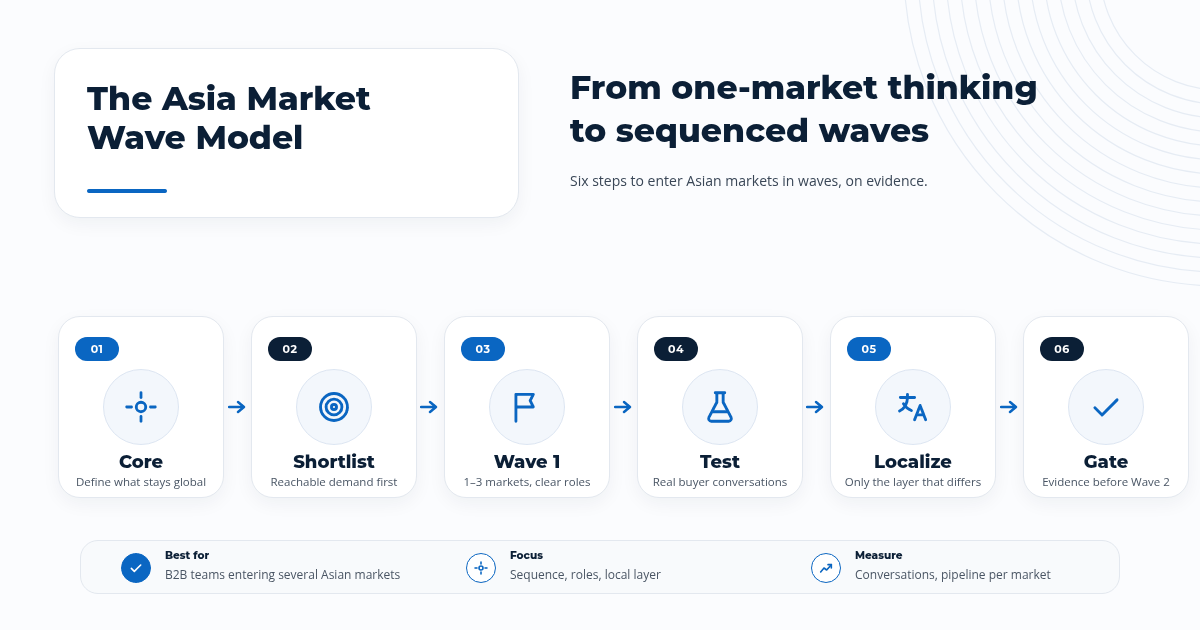
Step 1 — Define Your Global Core
What to Do
Write down what will not change: product, positioning, core value proposition, pricing logic, qualification criteria, and reporting.
Why It Matters
Without this, every country team reinvents the basics, and headquarters cannot compare results.
How to Implement
- agree on one core value proposition in one sentence;
- define the ideal customer profile (ICP: the type of company and buyer most likely to buy) at a global level;
- set the same qualification criteria for every market;
- use one CRM structure and one set of pipeline stages.
Step 2 — Shortlist on Reachable Demand
What to Do
Score candidate countries on how many target companies they have, how reachable the decision-makers are, competition, ease of entry, and strategic importance.
Why It Matters
As our masterclass takeaway put it: for an initial test, prioritize evidence of reachable demand and speed of learning over headline market size.
How to Implement
- count real target accounts per country, not just GDP or population;
- check whether you can find and contact the right roles;
- note language needs and whether you have the skills to meet them;
- flag regulatory limits for your product early.
Step 3 — Pick Wave 1 and Give Each Market a Role
What to Do
Choose one to three countries. Give each a clear role.
Why It Matters
Different markets teach different lessons. A clear role keeps expectations realistic.
Example Roles (Our Framework)
| Role | Purpose | Typical Expectation |
|---|---|---|
| Anchor market | Base of operations and early references | Fastest learning, often English-friendly |
| Revenue market | Large pool of target accounts | Slower start, bigger upside |
| Learning market | Test a hypothesis (new segment or channel) | Insight first, revenue later |
Step 4 — Test Each Market With Real Conversations
What to Do
Run outreach to real target buyers in each wave-1 country. Track messaging, channels, objections, and buyer roles separately per country.
Why It Matters
In our experience, early conversations reveal more than any market report: who decides, what they compare you to, and what proof they need.
How to Implement
- keep one outreach plan per country, not one for the region;
- log every objection by country;
- record which channels produce replies in each market (if key buyers are hard to find online, see how to reach B2B decision-makers in Asia who aren’t on LinkedIn);
- review country results side by side every month.
For a step-by-step approach to the first conversations, read How to Build a Market Entry Strategy for Emerging Asian Economies.
Step 5 — Localize the Layer That Differs
What to Do
Use what the conversations taught you to adjust only the local layer: language, proof, channels, roles, and sometimes price. Our guide on how to localize your sales playbook for Asia shows what to change first.
Why It Matters
This keeps the core stable while each country gets what its buyers need.
Asia-Specific Reminder
In hierarchical organizations, which in our experience are common in many Asian markets, you may need to engage senior decision-makers earlier than you would at home.
Step 6 — Pass the Evidence Gate Before Wave 2
What to Do
Decide for each market: expand, hold, or exit. Add the next wave only when a market shows repeatable evidence.
Evidence Gate (Our Guidance)
| Signal | What “Ready” Looks Like |
|---|---|
| Meetings | Regular meetings with the right buyer roles |
| Objections | Main objections known and answered |
| Proof | At least one local or similar-market reference |
| Opportunities | Deals moving to later stages |
| Channels | A repeatable outreach mix for that country |
Practical Rule (our take)
Expanding before the gate copies your unsolved problems into a new country.
Passing the gate is also the signal to think about people on the ground. For that decision, read When Should You Hire a Local Sales Team in Asia? Signs You’ve Validated the Market.
Two Market Contrasts That Show Why Sequencing Matters
These contrasts come from the masterclass and our client work. They are patterns, not rules.
Contrast 1 — Singapore vs. Indonesia
What We See
Singapore is small, highly international, and relatively easy to navigate in English. Indonesia is far larger and more spread out geographically, with different regulation and, in our experience, stronger needs for localization and local relationships.
What It Means for Sequencing
Singapore can be a sensible anchor market. Success there does not tell you how Indonesia will respond. Plan Indonesia as its own test.
For a deeper country playbook, read How to Build a GTM Playbook for Entering the Indonesian B2B Market.
Contrast 2 — Japan vs. Southeast Asia
What We See
Japan is highly mature and sophisticated. In our experience it often requires deeper localization, more credibility, and more patience. Some Southeast Asian markets can move faster commercially but may depend more on networks and local partners.
What It Means for Sequencing
Japan is rarely a quick learning market. If it is strategic for you, give it more time, language support, and senior attention, and do not judge it by Southeast Asian timelines.
Mini Case Study: Testing Several Asian Markets Without Moving There
Situation
Trajaan, a 10-person, Paris-based search-intelligence startup, wanted to become a global brand.
Trigger
Asia looked promising, but the team was small and based in Europe.
Barrier
According to the published case study, the challenge was navigating fragmented Asian markets and different business codes, for example in Japan and South Korea, without constant travel.5
Solution
Trajaan worked with Expand In Asia’s local experts as a cultural bridge, so the founder could test the market and build pipeline remotely while staying focused on product strategy.
Results
In the words of co-founder and CEO Matthieu Danielou: “We closed 12 deals without flying even once to Asia.” He also credits that international traction with helping the company’s acquisition by Cision.5
| Snapshot | Detail |
|---|---|
| Company type | B2B search-intelligence platform (MarTech) |
| Home base | Paris, about 10 people |
| Markets | Several Asian markets, including Japan and South Korea |
| Approach | Remote market testing and pipeline building with local experts |
| Outcome (client’s account) | 12 deals closed without travel to Asia |
Our Take
Multi-country does not have to mean multi-office. Testing several markets remotely, with people who know each one, is often the cheapest way to learn where to commit.
Common Multi-Country Expansion Mistakes
Risk 1 — Too many countries in wave 1. Budget and attention get spread too thin to learn anything.
Risk 2 — One message for the region. Buyers in each country hear something that was not written for them.
Risk 3 — Choosing markets by headline size. Large markets you cannot reach produce little early learning.
Risk 4 — Using Singapore as a proxy. Early wins there create false confidence about the rest of the region.
Risk 5 — No evidence gate. Wave 2 starts because the calendar says so, not because wave 1 works.
Risk 6 — Rebuilding the core in every country. Each market drifts, and results cannot be compared.
Need Help Sequencing Your Asian Markets?
Expand In Asia helps B2B companies plan and test multi-country entry across Asia through:
- market prioritization;
- ICP and account research per country;
- localized buyer messaging;
- LinkedIn and email outreach;
- cold calling and appointment setting;
- SDR execution (the people who run first outreach and book meetings);
- product-market fit validation (testing whether real buyers want your product);
- country-by-country pipeline reporting.
Talk to Expand In Asia about sequencing your Asia expansion →
Multi-Country Sequencing Scorecard
Score each area from 1 to 5. This is our own simplified framework, not an industry benchmark. For a fuller view of your team’s readiness, take the free Asia Expansion Readiness Assessment Tool.
| Area | 1 — Weak | 3 — Developing | 5 — Strong |
|---|---|---|---|
| Wave 1 focus | Many countries at once | 4–5 countries | 1–3 countries with clear roles |
| Market criteria | Population or GDP only | Some reachability data | Target accounts and reachability counted |
| Global core | Undefined | Partly written | Written and agreed |
| Local layer | None, or rebuilt per country | Some adjustments | Deliberate adjustments per country |
| Local proof | Home-market case studies only | Regional proof | Local or similar-market proof per country |
| Channel mix | Same everywhere | Partly adapted | Matched to each country |
| Country reporting | Regional totals only | Some country split | Side-by-side country results |
| Evidence gate | None | Informal | Defined signals before each new wave |
Score Interpretation (Our Guidance)
| Total Score | What It Means |
|---|---|
| 34–40 | Ready to plan wave 2 in a disciplined way. |
| 27–33 | Solid base. Fix your weakest areas before adding countries. |
| 20–26 | Wave 1 is not yet producing clear evidence. Narrow your focus. |
| Below 20 | High risk of spreading too thin. Restart with one to three markets. |
Need Help Testing Demand Country by Country?
Expand In Asia helps B2B companies test demand with real buyers before committing headcount.
Next Steps With Expand In Asia
- Start narrow: one to three markets, each with a role.
- Protect the core: one product, one value proposition, one data structure.
- Adapt the layer buyers see: language, proof, channels, roles.
- Expand on evidence: pass the gate before wave 2.
To go deeper:
- read the pillar guide, Breaking Into Asia: 5 Critical Asia Expansion Mistakes;
- compare markets in Top 5 Emerging B2B Markets in Asia Pacific to Watch in 2026–2027;
- score your team with the Asia Expansion Readiness Assessment Tool.
Ready to Implement These Strategies?
Book a free 30-minute strategy session where we’ll audit your current growth approach and identify your highest-leverage opportunities in Asian markets.
Frequently Asked Questions
1. What is a multi-country expansion strategy for Asia?
A multi-country expansion strategy for Asia is a plan for entering several Asian countries in a deliberate order. It defines what stays the same everywhere, such as the product and core value proposition, and what changes in each country, such as language, proof, sales channels, and sometimes pricing.
2. Should a B2B company enter several Asian markets at once?
In our view, usually not. Most B2B companies learn faster and spend less by starting with one to three markets, proving demand there, and then adding the next wave. Entering many countries at once spreads budget, attention, and local relationships too thin.
3. How many Asian markets should we enter first?
Our recommendation is one to three. Choose them based on how many of your ideal customers are there, how easily you can reach them, competition, ease of entry, and strategic importance. Favor markets where you can learn quickly over markets that only look large on paper.
4. What should we standardize across Asian markets, and what should we localize?
In our experience, standardize the product, brand, core value proposition, pricing logic, and data and CRM structure. Localize the language, proof points and case studies, outreach channels, sales approach, buyer roles you target, and sometimes price levels and contract terms.
5. Is Singapore a good test market for the rest of Asia?
Singapore is often a practical base because English is widely used and company setup is straightforward. In our experience, it is a weak predictor of how other Asian markets will respond, because buyer behavior, language, and decision-making differ sharply in markets such as Indonesia or Japan.
6. When should we add the next Asian market?
Our view: add the next market when the current one shows repeatable evidence, such as regular meetings with the right buyers, documented objections, and opportunities moving forward. Expanding before that usually copies unsolved problems into a new country.
7. How does Expand In Asia help with multi-country expansion?
Expand In Asia is a Singapore-based B2B outbound and market-entry partner. It helps companies prioritize markets, research target accounts, run localized outreach, and book meetings with decision-makers across Asian markets, so they can test demand in each country before committing headcount.
Which Asian market surprised your team the most? Share it in the comments or pass this guide to the colleague planning your next market.
About the author: Joel Berou is Asia Expansion & Revenue Growth Advisor at Expand In Asia, a Singapore-based B2B outbound and market-entry partner that helps companies build pipeline across Asian markets. This article draws on the October 2026 masterclass presented by Nicolas Levitte, Founder & CEO of Expand In Asia. Last updated: October 16, 2026.
Sources
-
United Nations, Department of Economic and Social Affairs, Population Division. World Population Prospects 2024 (latest revision). https://population.un.org/wpp/ ↩
-
EF Education First. EF English Proficiency Index 2025. https://www.ef.com/wwen/epi/ — report PDF: https://www.ef.com/assetscdn/WIBIwq6RdJvcD9bc8RMd/cefcom-epi-site/reports/2025/ef-epi-2025-english.pdf ↩
-
DataReportal (Kepios, Meltwater, We Are Social). Digital 2026: Japan (data as of October 2025). https://datareportal.com/reports/digital-2026-japan ↩
-
DataReportal (Kepios, Meltwater, We Are Social). Digital 2026: Indonesia (data as of October 2025). https://datareportal.com/reports/digital-2026-indonesia ↩
-
Expand In Asia. Case Studies: Trajaan (client testimonial by Matthieu Danielou, Co-Founder & CEO). https://expandin.asia/case-studies/ ↩↩