
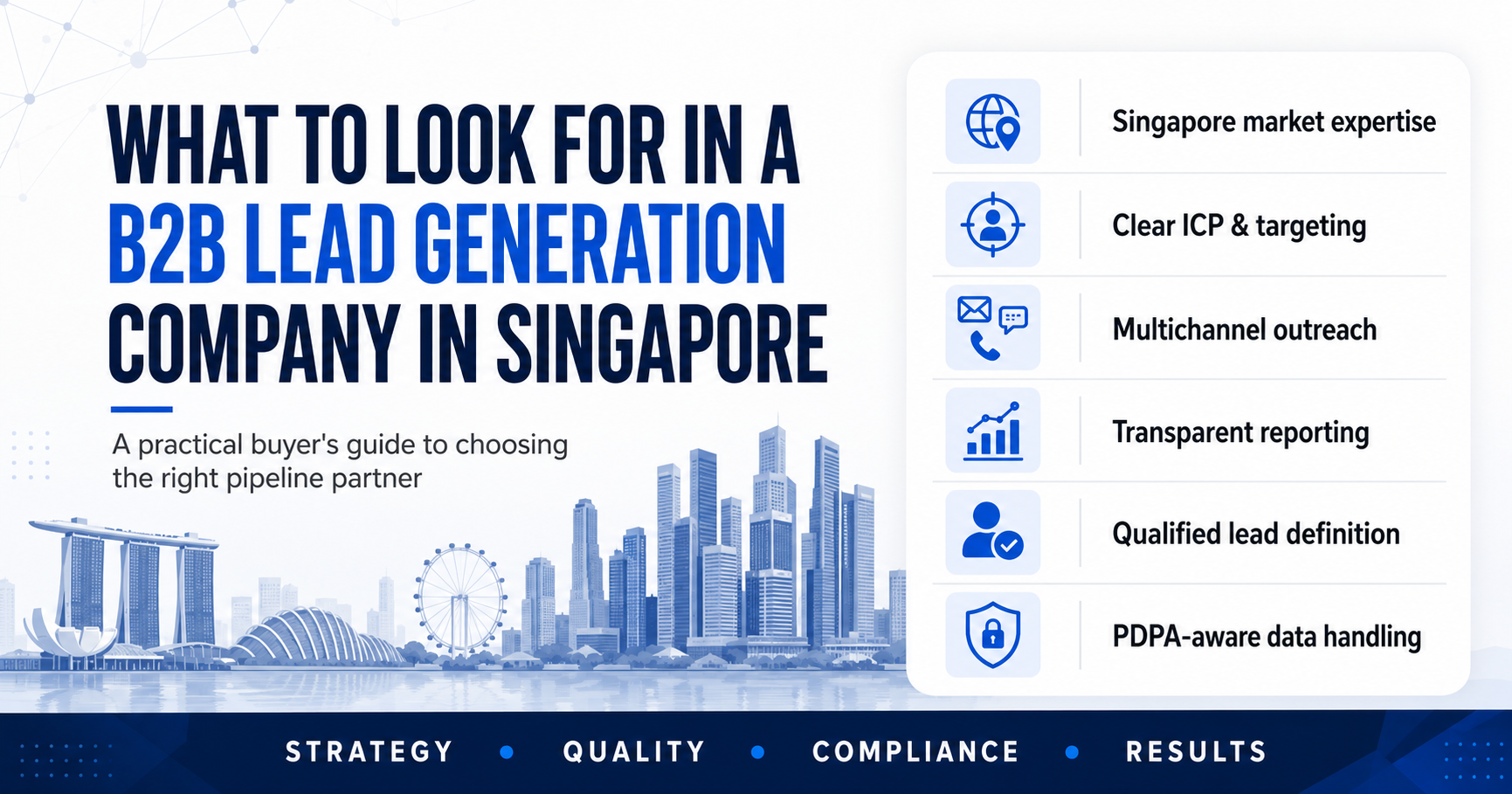
What to Look for in a B2B Lead Generation Company in Singapore
A practical buyer’s guide to choosing a partner that produces qualified pipeline—not just contact lists and booked meetings
Singapore is an attractive base for regional B2B growth, but it is also a competitive and digitally mature market.
As of May 2026, Singapore had more than 630,000 registered business entities, according to ACRA’s current business registry statistics. That creates a broad prospect universe—but it does not mean every company or contact belongs in your target market.
Singapore’s digital economy contributed S$128.1 billion, or 18.6% of GDP, in 2024, according to IMDA. Buyers operate in a sophisticated environment where generic outreach, weak targeting, and low-quality data are easier to recognise and ignore.
The right B2B lead generation company should therefore do more than build lists or send messages.
It should help you:
- identify the right accounts;
- reach relevant decision-makers;
- localise your value proposition;
- create qualified conversations;
- report transparently;
- protect your data and brand;
- turn campaign feedback into better commercial decisions.
This guide provides a structured way to compare providers before committing budget, data, and brand reputation.
- TL;DR — Key Takeaways
- Prioritise Singapore and APAC market experience. A provider should understand local buyer behaviour, regional headquarters structures, and how Singapore fits into broader Asia expansion.
- Demand a written lead definition. “Interested contact” and “qualified opportunity” are not the same.
- Ask for sample reports. Good providers connect outreach activity to meetings held, sales acceptance, opportunity creation, and market feedback.
- Verify data handling. Singapore’s PDPC provides specific guidance for organisations managing outsourced data-processing relationships.
- Start with a controlled pilot. Validate fit, communication, data quality, and meeting quality before scaling.
If you only do one thing: ask every shortlisted provider to show a sample report, a written qualified-lead definition, and a relevant case study before discussing long-term pricing.
Who This Buyer’s Guide Is For
This guide is for companies that are:
- entering Singapore for the first time;
- expanding an existing APAC footprint;
- replacing an underperforming lead-generation agency;
- comparing appointment-setting providers;
- deciding whether to outsource SDR execution;
- launching a new B2B product or market segment;
- trying to build pipeline before hiring a full local team.
It is particularly relevant for:
- B2B SaaS companies;
- cybersecurity providers;
- cloud and managed service providers;
- fintech firms;
- HR technology companies;
- professional-services firms;
- enterprise software vendors;
- data and AI platforms;
- healthtech companies.
This guide is less suitable if your objective is purely consumer lead generation or high-volume transactional telemarketing.
Why Provider Selection Matters in Singapore
Lead generation companies represent your brand before your internal sales team ever speaks with the prospect.
They influence:
- which accounts hear from you;
- which people are contacted;
- what message is delivered;
- how your company is positioned;
- whether outreach feels relevant or generic;
- what information is recorded;
- whether the resulting meetings are worth your sales team’s time.
In a market with more than 630,000 registered entities, the challenge is not finding companies. It is identifying the right companies, the right roles, and the right commercial triggers.
A weak provider may produce:
- large but inaccurate databases;
- generic email sequences;
- meetings with junior or irrelevant contacts;
- inflated activity reports;
- inconsistent CRM notes;
- poor data-governance practices;
- little useful market feedback.
A strong provider should reduce uncertainty—not create more of it.
Criterion 1 — Singapore Market Expertise
A provider does not need to be Singapore-owned to be effective in Singapore.
It does need to understand how the market works.
What Strong Market Expertise Looks Like
The company should be able to explain:
- which industries are most relevant to your offer;
- whether your buyers are local or regional decision-makers;
- how Singapore headquarters influence wider APAC buying;
- which job titles typically own the problem;
- how local companies differ from multinational subsidiaries;
- which channels are suitable for your target audience;
- how Singapore campaigns may support expansion into ASEAN.
Questions to Ask
- Which Singapore-based campaigns have you managed?
- Which industries and personas did you target?
- How did Singapore buyer behaviour differ from other markets?
- Can you show a relevant case study?
- How do you distinguish local accounts from regional headquarters?
- How do you adapt the campaign for Singapore-based APAC leaders?
Warning Sign
Be cautious if the provider claims broad “Asia experience” but cannot explain specific Singapore campaigns, target roles, buyer objections, or conversion lessons.
Criterion 2 — Clear ICP and Targeting Methodology
A credible lead generation company should challenge and refine your ICP—not simply accept a broad brief and begin scraping contacts.
A Strong ICP Should Cover
| Area | Example |
|---|---|
| Geography | Singapore-based entity or regional HQ |
| Industry | SaaS, financial services, logistics, professional services |
| Company size | 100–1,000 employees |
| Revenue or maturity | Established mid-market or funded scale-up |
| Buyer role | VP Sales, COO, Country Manager, CIO |
| Commercial trigger | Expansion, new funding, hiring, transformation initiative |
| Disqualifiers | Agencies, students, consultants, competitors, micro-businesses |
What to Ask
- How do you validate our ICP before launch?
- What happens if the initial segment does not respond?
- How do you identify trigger events?
- How do you prioritise accounts?
- Will we approve the account criteria before outreach?
- How do you prevent duplicates and existing customers from entering the campaign?
Why This Matters
A campaign aimed at the wrong accounts can still produce high activity.
That activity will not create useful pipeline.
Criterion 3 — Data Quality and Account Research
Poor data creates:
- bounced emails;
- calls to wrong numbers;
- messages to former employees;
- duplicate records;
- irrelevant meetings;
- reputational risk.
ACRA’s Bizfile search tools allow users to search entities, industries, people, and reserved names, while official business profiles provide access to core entity information. A capable provider should combine authoritative company sources with reputable business databases and manual verification.
Ask How Data Is Built
A provider should explain:
- data sources;
- verification process;
- refresh frequency;
- role validation;
- email-verification methods;
- phone-number validation;
- duplicate prevention;
- CRM matching;
- suppression-list handling.
Data Quality Checklist
| Check | Required? |
|---|---|
| Company still active | ✓ |
| Correct Singapore entity | ✓ |
| Contact currently employed | ✓ |
| Role matches buyer map | ✓ |
| Business email verified | ✓ |
| Existing CRM record checked | ✓ |
| Opt-out status checked | ✓ |
| Source recorded | ✓ |
Warning Sign
Avoid providers that refuse to explain where their data comes from or imply that database access alone guarantees accuracy.
Criterion 4 — Multichannel Outreach Capability
A reliable B2B lead generation company should not depend on one channel.
Different buyers respond through different routes.
Relevant Channels
| Channel | Primary Use |
|---|---|
| Research, visibility, connections, social engagement | |
| Structured value communication and follow-up | |
| Phone | Direct qualification and objection discovery |
| Webinars | Education and credibility |
| Events | Relationship-building and account engagement |
| Referrals | Trust and senior access |
| Partnerships | Ecosystem-led introductions |
What Good Multichannel Execution Looks Like
The provider should coordinate channels rather than run disconnected activities.
For example:
- research the account;
- view and engage with the buyer’s LinkedIn activity;
- send a relevant connection request;
- send a short email tied to a business trigger;
- follow up by phone;
- share a relevant insight;
- ask for the appropriate internal contact if needed.
What to Ask
- Which channels are included?
- Who owns copy and message approval?
- How do you avoid over-contacting prospects?
- How do you coordinate LinkedIn, email, and phone?
- Can we review sequences before launch?
- How are replies escalated?
Warning Sign
A provider that promises performance from a single generic email sequence is unlikely to be building a durable pipeline system.
Criterion 5 — Written Lead Qualification Standards
This is one of the most important evaluation criteria.
The definition of a lead should be written before the campaign begins.
Levels of Lead Quality
| Lead Type | Definition |
|---|---|
| Contact | A person matching basic role criteria |
| Engaged contact | A contact who replied or interacted |
| Marketing-qualified lead | Fits the ICP and shows interest |
| Sales-qualified lead | Fits the ICP and has a relevant commercial reason to engage |
| Qualified meeting | Confirmed meeting with an appropriate person and agreed business context |
| Opportunity | Accepted by sales and entered into pipeline |
A booked calendar invite is not automatically a qualified lead.
Written Qualification Framework
The agreement should cover:
- account fit;
- role and seniority;
- buying influence;
- relevant pain or initiative;
- timing;
- interest level;
- disqualifiers;
- meeting confirmation;
- replacement or review process.
What to Ask
- How do you define a qualified lead?
- What disqualifies a meeting?
- Who verifies qualification?
- What information is recorded before handoff?
- How do you handle no-shows?
- What happens when sales rejects a lead?
Warning Sign
If the provider avoids putting qualification criteria in writing, expectations are likely to diverge after launch.
Criterion 6 — Transparent Reporting and CRM Integration
Good reporting should answer more than:
“How many messages did you send?”
G2’s buyer guidance for lead generation services highlights targeting, CRM integration, lead scoring, analytics, and customisable nurturing workflows as important evaluation areas.
Minimum Reporting Metrics
Activity
- accounts researched;
- contacts added;
- emails delivered;
- calls completed;
- LinkedIn touches.
Engagement
- replies;
- positive replies;
- live conversations;
- referrals;
- meetings booked.
Quality
- meetings held;
- show rate;
- qualification pass rate;
- sales acceptance;
- disqualification reasons.
Pipeline
- opportunities created;
- meeting-to-opportunity conversion;
- pipeline value;
- opportunity stage;
- closed-won revenue where available.
Market Intelligence
- recurring objections;
- competitor mentions;
- price resistance;
- trigger events;
- content requests;
- product questions.
What to Ask
- Can we see a sample report?
- How often will reports be delivered?
- Will data be entered into our CRM?
- Can we access campaign data directly?
- Do you report sales-accepted opportunities?
- How do you capture market feedback?
- Who owns the data after the engagement ends?
Warning Sign
A dashboard full of activity numbers can still hide poor lead quality.
Criterion 7 — PDPA-Aware Data Handling
A lead generation provider may process:
- names;
- work emails;
- mobile numbers;
- LinkedIn profiles;
- CRM records;
- call notes;
- meeting information.
Singapore’s PDPC publishes guidance for organisations managing data intermediaries when outsourcing data-processing activities. The guidance focuses on governance, contractual controls, access, protection, retention, and accountability.
What to Ask
- What prospect data do you collect?
- Where does the data come from?
- Where is it stored?
- Who can access it?
- Do you use subcontractors?
- How are opt-outs handled?
- How long is data retained?
- What is deleted after termination?
- Do you sign a data-processing agreement where required?
- How are data incidents escalated?
Important Qualification
A lead generation provider is not a substitute for legal advice.
Your organisation should still assess its own obligations under Singapore’s PDPA and any other laws that apply to the campaign.
Warning Sign
“B2B data is exempt from everything” is not a sufficient compliance answer.
Criterion 8 — Relevant Proof and Client References
Do not evaluate a provider only through logos and testimonials.
Ask for evidence that is relevant to your:
- industry;
- target market;
- buyer seniority;
- deal size;
- sales cycle;
- channel mix.
What a Useful Case Study Includes
| Element | What to Look For |
|---|---|
| Client context | Industry, size, target market |
| Target audience | Roles and account types |
| Challenge | Why pipeline was difficult |
| Approach | Data, channels, messaging, cadence |
| Qualification | Definition used |
| Outcome | Meetings held, opportunities, pipeline |
| Learning | What changed during the campaign |
Client Reference Questions
- Did the provider understand your ICP?
- Was communication consistent?
- Were meetings genuinely qualified?
- How transparent was reporting?
- How quickly did the team respond to feedback?
- Did the provider protect the brand?
- Would you hire them again?
Warning Sign
A provider that cannot supply a relevant case study, anonymised reporting sample, or reference should not automatically be rejected—but the absence should increase your due diligence.
Criterion 9 — Commercial Model and Contract Flexibility
Pricing should be evaluated against scope and expected value—not simply monthly cost.
Common Commercial Models
| Model | Advantages | Risks |
|---|---|---|
| Monthly retainer | Predictable; supports full service | Requires clear accountability |
| Pay per meeting | Easy to understand | Can encourage low-quality volume |
| Retainer + performance | Balances capacity and outcomes | Performance definitions must be precise |
| Project or pilot | Useful for validation | May not show full-cycle results |
| Dedicated SDR | Greater focus and continuity | Higher cost and management need |
Contract Questions
- What is included in the fee?
- Are data and tools included?
- Is onboarding charged separately?
- What is the minimum term?
- Can the engagement be expanded or reduced?
- What are the exit conditions?
- Who owns campaign assets?
- Are there replacement provisions for unqualified meetings?
- What happens if the ICP changes?
- Are any subcontractors involved?
Warning Sign
Avoid proposals where the price is clear but the scope, qualification rules, ownership, and cancellation terms are not.
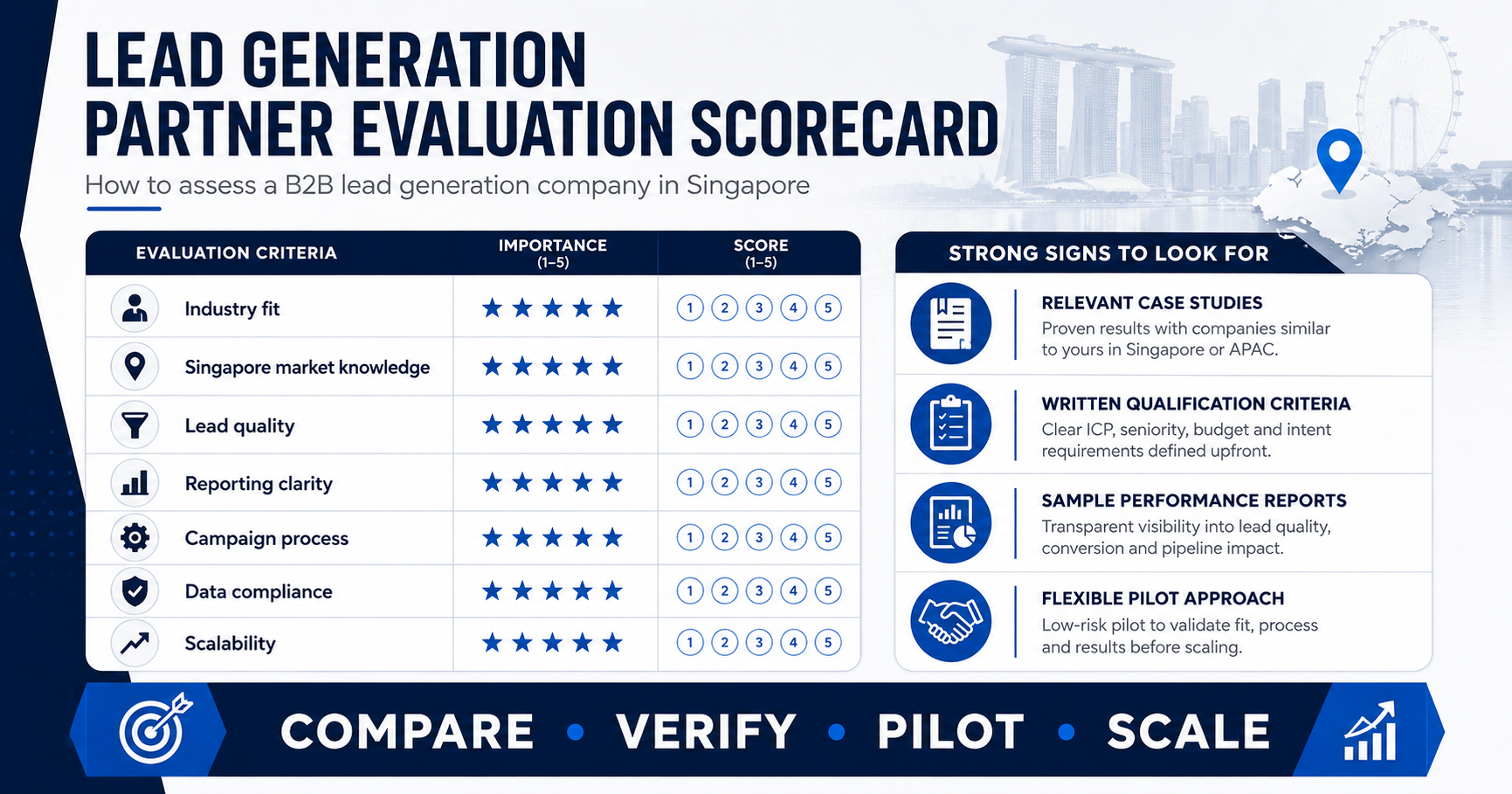
Lead Generation Partner Evaluation Scorecard
Score each provider from 1 to 5.
| Evaluation Criterion | Weight | Vendor A | Vendor B | Vendor C |
|---|---|---|---|---|
| Singapore market expertise | 15% | |||
| Industry and ICP fit | 15% | |||
| Data quality and research | 15% | |||
| Multichannel capability | 10% | |||
| Qualification standards | 15% | |||
| Reporting and CRM integration | 10% | |||
| PDPA-aware data handling | 10% | |||
| Case studies and references | 5% | |||
| Commercial flexibility | 5% | |||
| Weighted Total | 100% |
Score Interpretation
| Score | Recommendation |
|---|---|
| 4.2–5.0 | Strong candidate; proceed to references and contract review |
| 3.4–4.1 | Viable; address identified gaps in writing |
| 2.6–3.3 | Conditional; consider a limited pilot only |
| Below 2.6 | High execution risk |
Do not let one exceptional presentation compensate for weaknesses in qualification, compliance, or reporting.
Questions to Ask During Vendor Interviews
Use the same questions for every shortlisted provider.
Market and Experience
- Which Singapore campaigns have you run?
- Which industries and buyer roles were involved?
- What did you learn from those campaigns?
- Can you provide a relevant case study or reference?
Targeting and Data
- How do you validate our ICP?
- What data sources do you use?
- How do you verify contacts?
- How do you prevent duplicate or existing accounts?
Messaging and Channels
- Who writes the messaging?
- How is copy approved?
- Which channels are included?
- How do you localise outreach?
Qualification
- What is your definition of a qualified lead?
- What information is required before handoff?
- How do you handle rejected leads and no-shows?
Reporting
- Can we see a sample report?
- What CRM integration is available?
- Do you track sales-accepted opportunities and pipeline?
Data and Compliance
- How do you handle consent, opt-outs, retention, and deletion?
- Do you sign a data-processing agreement where appropriate?
Commercial Terms
- What is included in the fee?
- What is the minimum engagement?
- Who owns the data and campaign assets?
- What are the termination terms?
Red Flags to Avoid
1. Guaranteed Meeting Volumes Before Discovery
Targets can be estimated. Results should not be guaranteed before the provider understands your market, offer, and buyer.
2. No Written Qualification Definition
This commonly produces disputes over lead quality.
3. Activity-Only Reporting
Emails and calls do not prove pipeline quality.
4. Generic Singapore Messaging
Adding “Singapore” to a global template is not localisation.
5. Unclear Data Sources
The provider should explain where information comes from and how it is verified.
6. No Relevant Proof
Broad global experience is not the same as Singapore or APAC relevance.
7. Long Lock-In With No Review Point
The provider should have enough time to execute, but the engagement should include clear review and exit terms.
8. No Feedback Loop
A campaign cannot improve if rejected leads and buyer objections are not reviewed.
How to Structure a 90-Day Pilot
Days 1–30 — Foundation
Focus on:
- ICP alignment;
- target-account approval;
- data quality;
- messaging;
- CRM setup;
- qualification rules;
- reporting format.
Pilot Gate
Do not launch until the account criteria, messages, and handoff process are approved.
Days 31–60 — Market Engagement
Measure:
- deliverability;
- connection acceptance;
- positive replies;
- live conversations;
- buyer objections;
- meetings booked;
- data issues.
Days 61–90 — Lead Quality
Measure:
- meetings held;
- show rate;
- sales acceptance;
- meeting-to-opportunity conversion;
- market feedback;
- response to coaching;
- reporting consistency.
Pilot Success Criteria
A successful pilot should demonstrate:
- accurate targeting;
- consistent communication;
- relevant messaging;
- reliable data;
- clear reporting;
- acceptable meeting quality;
- evidence of commercial learning.
Do not evaluate the programme only on closed revenue if your normal sales cycle is longer than the pilot.
What a Strong Partner Looks Like
| Area | Strong Partner Behaviour |
|---|---|
| Discovery | Asks detailed questions before proposing volume |
| Market knowledge | Understands Singapore and regional buyer structures |
| ICP | Helps refine targeting and exclusions |
| Data | Documents sourcing and verification |
| Messaging | Builds persona- and market-specific outreach |
| Channels | Coordinates LinkedIn, email, phone, and other touchpoints |
| Qualification | Defines accepted leads in writing |
| Reporting | Links activity to quality and pipeline |
| Compliance | Explains access, retention, opt-outs, and deletion |
| Collaboration | Responds to sales feedback quickly |
| Commercial terms | Provides clear scope, ownership, and exit conditions |
| Learning | Converts buyer feedback into GTM improvements |
The objective is not merely to outsource activity.
It is to build a pipeline system that your internal team trusts.
Next Steps with Expand In Asia
Choosing a B2B lead generation company should be a structured commercial decision.
The right provider should demonstrate:
- relevant Singapore experience;
- accurate targeting;
- localised messaging;
- disciplined qualification;
- transparent reporting;
- responsible data handling;
- flexible commercial terms.
Compare Providers
Review:
Top 11 B2B Lead Generation Companies in Singapore in 2026
Strengthen Your Internal Framework
Read:
10 Best B2B Qualified Lead Generation Strategies for 2026
Discuss Your Pipeline Requirements
Speak with Expand In Asia about your target market, ICP, sales cycle, current pipeline, and preferred engagement model.
Schedule a consultation with Expand In Asia →
Ready to Implement These Strategies?
Book a free 30-minute strategy session where we’ll audit your current growth approach and identify your highest-leverage opportunities in Asian markets.
Frequently Asked Questions
1. What does a B2B lead generation company do?
A B2B lead generation company identifies target accounts and decision-makers, conducts outreach, qualifies interest, and transfers suitable conversations to the client’s sales team.
Depending on the provider, services may include data research, LinkedIn engagement, email outreach, calling, appointment setting, webinars, reporting, and CRM updates.
2. How much does B2B lead generation cost in Singapore?
Pricing varies based on target complexity, channels, languages, data requirements, SDR capacity, and qualification depth.
Compare providers using scope and expected commercial value—not only monthly price. Ask whether data, tools, onboarding, reporting, and replacement policies are included.
3. Should we pay per lead or use a monthly retainer?
A retainer often supports deeper research, messaging, multichannel execution, and continuous optimisation.
Pay-per-lead can work for simpler offers, but it may incentivise volume unless qualification rules are tightly defined. A hybrid structure can balance execution capacity with performance accountability.
4. How long should a lead generation pilot run?
Around 90 days is often a practical starting point.
That period allows time for onboarding, data preparation, message testing, outreach, early meetings, and an initial assessment of lead quality. The appropriate duration depends on your market and sales cycle.
5. What is a qualified B2B lead?
A qualified lead should match agreed account and persona criteria and have a relevant reason to engage.
The definition should cover company fit, role, seniority, pain or initiative, interest, timing, and disqualifiers. It should be documented before outreach begins.
6. Can a lead generation company guarantee meetings?
A provider may propose targets based on prior experience, but guarantees made before discovery should be treated cautiously.
Results depend on the offer, ICP, market, data quality, proof, competition, channel fit, and sales cycle.
7. How important is Singapore market experience?
It is important when your success depends on local buyer access, regional headquarters, Singapore-specific proof, or APAC commercial structures.
A provider with only general global experience may require a longer learning period.
8. How should PDPA considerations be handled?
The provider should document its data sources, access controls, retention, deletion, opt-out process, and subcontractors.
Singapore’s PDPC provides guidance on managing data intermediaries, but your company should obtain appropriate legal advice for its specific campaign and data practices.