LinkedIn Lead Generation in Singapore: Tactics That Work in 2026
A practical playbook for turning LinkedIn activity into qualified B2B conversations and pipeline
Singapore is one of Asia’s most attractive B2B markets.
It combines a dense business ecosystem, a large concentration of regional headquarters, digitally mature buyers, and strong access to founders, directors, country managers, and regional decision-makers.
That makes LinkedIn a natural prospecting channel.
But it also makes the platform competitive.
Most senior buyers in Singapore have already received:
- generic connection requests;
- automated follow-ups;
- copied-and-pasted pitches;
- AI-written messages with fake personalisation;
- immediate meeting requests from people they do not know.
The result is not that LinkedIn has stopped working.
The result is that low-effort LinkedIn prospecting has become easier to ignore.
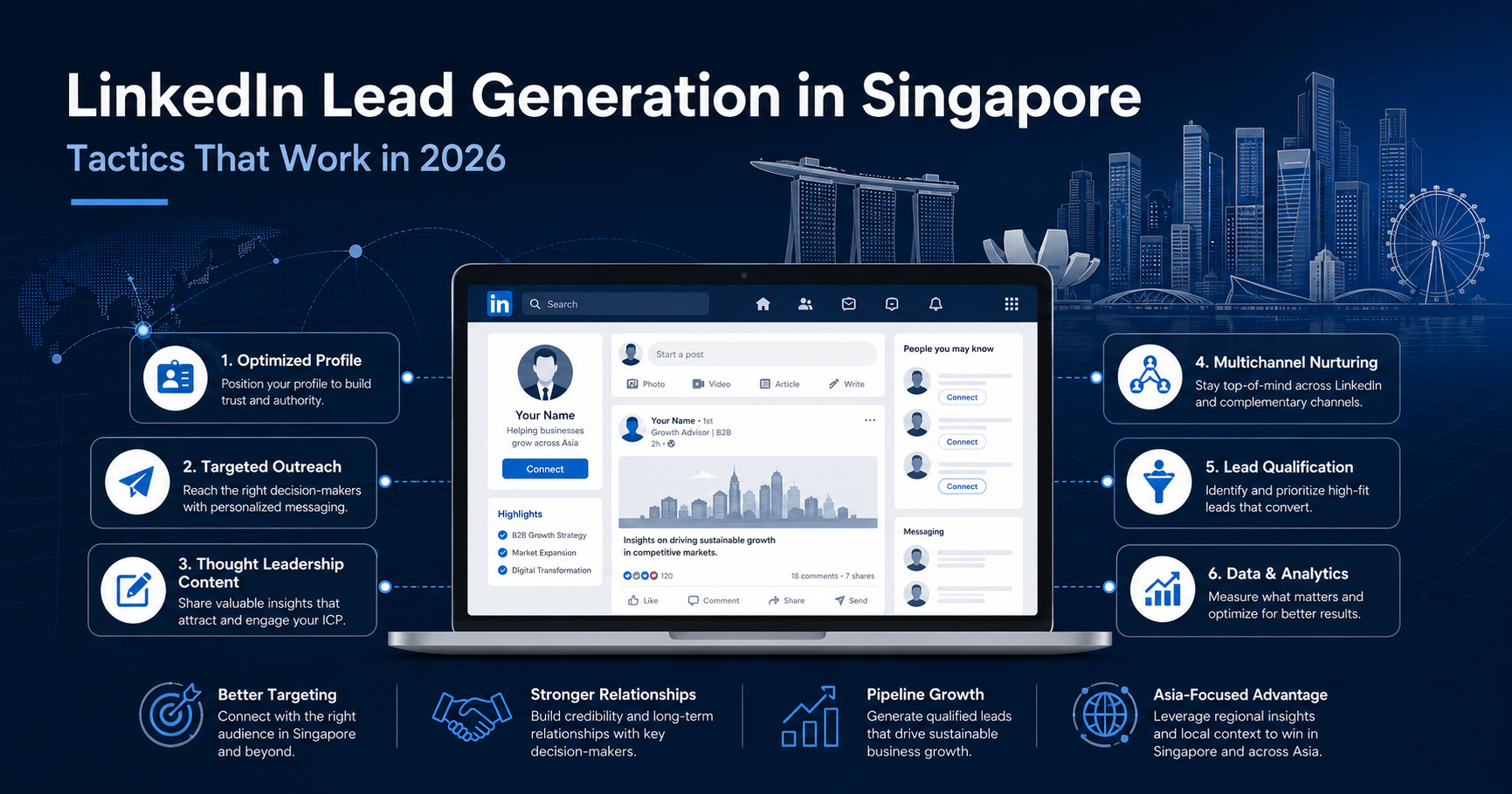
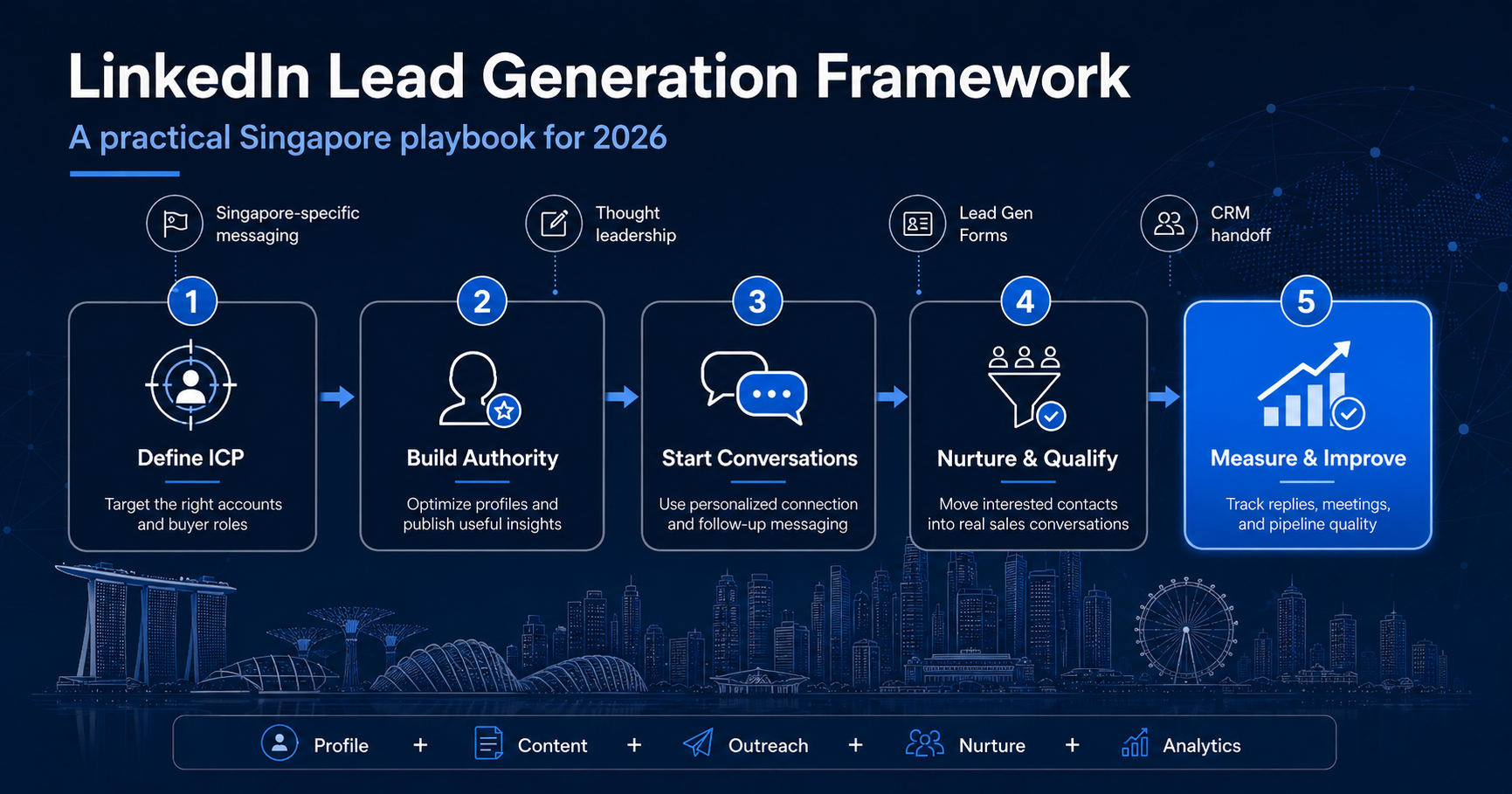
In 2026, successful LinkedIn lead generation in Singapore is less about sending more messages and more about creating a connected commercial system involving:
- clear targeting;
- credible profiles;
- useful content;
- thoughtful engagement;
- personalised outreach;
- multichannel follow-up;
- written qualification criteria;
- CRM visibility.
TL;DR — Key Takeaways
- LinkedIn still works for B2B lead generation in Singapore, but generic connection-and-pitch sequences are becoming less effective.
- Targeting quality matters more than outreach volume. Define the right accounts, personas, triggers, and disqualifiers before sending messages.
- Your profile is part of the sales process. Prospects often review it before deciding whether to accept or reply.
- Thought leadership supports outbound prospecting. Useful market insights can build familiarity with both visible buyers and hidden members of the buying committee.
- Personalised outreach should create a conversation, not force a demonstration.
- Comment-led and trigger-based engagement can warm up accounts before direct outreach.
- Organic activity and paid formats can work together. Thought Leader Ads, Document Ads, and Lead Gen Forms can extend strong content and capture demand.
- Measure qualified conversations and pipeline—not just connections, impressions, or message volume.
If you only do one thing: stop treating LinkedIn as a standalone messaging tool. Combine profile positioning, useful content, targeted outreach, nurturing, and lead qualification.
Who This Guide Is For—and Who It Is Not For
This Guide Is For
- B2B companies selling into Singapore.
- Founders and sales leaders building an outbound pipeline.
- SDR and business development teams trying to improve reply and meeting quality.
- Marketing teams supporting sales through thought leadership and paid LinkedIn campaigns.
- Regional expansion teams using Singapore as an entry point into Asia.
- SaaS, cybersecurity, cloud, fintech, HR technology, professional-services, healthtech, data, and enterprise-software companies.
- Companies that need high-trust conversations with senior decision-makers.
This guide is particularly useful when your company:
- has a defined product or service;
- knows its broad ICP;
- can support qualified discovery meetings;
- wants a repeatable prospecting process;
- needs to build credibility in Singapore;
is prepared to use more than one channel.
This Guide Is Not For
This guide may be less suitable if:
- you want to send thousands of fully automated connection requests;
- your product is low-ticket and consumer-focused;
- you expect LinkedIn to replace email, phone, events, and referrals;
- your team is unwilling to improve its profiles or publish useful content;
- nobody can follow up on qualified conversations;
- success is measured only through impressions, likes, or follower growth.
Practical fit check: This guide is designed for companies that want qualified B2B conversations and pipeline—not simply more LinkedIn activity.
Table of Contents
- Why LinkedIn remains relevant in Singapore
- What changed in 2026
- Tactic 1 — Define a Singapore-ready ICP
- Tactic 2 — Build a credible profile
- Tactic 3 — Use thought leadership to create familiarity
- Tactic 4 — Engage before sending a message
- Tactic 5 — Write connection requests that earn acceptance
- Tactic 6 — Build a human follow-up sequence
- Tactic 7 — Use commercial triggers
- Tactic 8 — Combine LinkedIn with email, phone, and events
- Tactic 9 — Use paid LinkedIn formats selectively
- Tactic 10 — Qualify and hand off leads properly
- Metrics that matter
- Common mistakes
- A practical 30-day execution plan
- Next steps with Expand In Asia
- Frequently asked questions
1. Why LinkedIn Remains Relevant in Singapore
LinkedIn is useful in Singapore because many target B2B buyers are professionally visible on the platform.
Depending on your ICP, you can research and reach:
- founders;
- CEOs;
- country managers;
- regional directors;
- functional heads;
- sales and marketing leaders;
- technology executives;
- operational buyers;
- buying influencers.
LinkedIn also gives you more context than a basic contact database.
You can often see:
- role changes;
- new appointments;
- company announcements;
- content interests;
- professional networks;
- event activity;
- hiring signals;
- market-expansion references.
That context can make outreach more relevant.
But access is not the same as attention.
The buyer still needs a credible reason to:
- accept your connection;
- read your message;
- continue the conversation;
- agree to a meeting.
A successful LinkedIn strategy therefore needs to combine relevance, credibility, and timing.
2. What Changed in 2026
The platform has become noisier.
AI and automation tools allow teams to create more messages, posts, comments, and prospect lists in less time. That increases output, but it also increases the amount of generic content buyers receive.
Several practical changes have followed.
Buyers Recognise Templates Faster
Messages that begin with exaggerated praise or irrelevant personalisation often feel automated.
Examples include:
- “I was impressed by your exceptional career journey.”
- “Your leadership at Company X is truly inspiring.”
- “I noticed your company is doing amazing things.”
These statements create little value unless they connect to a genuine commercial reason.
Profiles Matter More
When a buyer receives a message, they often review the sender’s:
- headline;
- current role;
- About section;
- activity;
- content;
- mutual connections;
- company credibility.
A weak profile can reduce acceptance and reply rates even when the message is good.
Thought Leadership Supports Prospecting
Only a small percentage of potential buyers are actively in-market at a given time.
Most prospects are:
- not ready;
- researching;
- unaware of the problem;
- comparing options;
- influenced by people who are not part of the visible buying process.
Useful content helps your company become familiar before the buyer is ready for a conversation.
Buying Committees Are Broader Than Target Lists
Your target decision-maker may not be the only person who matters.
Hidden buyers can include:
- finance;
- legal;
- procurement;
- operations;
- technology;
- regional leadership.
They may never reply to outreach, but they can still influence whether a supplier progresses.
3. Tactic 1 — Define a Singapore-Ready ICP
Do not begin with the message.
Begin with the market.
A weak targeting brief sounds like:
“Target B2B companies in Singapore.”
That definition is too broad to produce relevant outreach.
A Strong ICP Should Include
| Dimension | Questions to Answer |
| Location | Singapore entity, local headquarters, or Singapore-based regional team? |
| Industry | Which sectors have the strongest need for the offer? |
| Company size | Employee count, revenue, funding, or operational scale? |
| Buyer role | Who owns the problem? Who influences it? |
| Trigger | What creates a reason to engage now? |
| Problem | Which measurable commercial issue can you address? |
| Proof requirement | What evidence will create credibility? |
| Disqualifiers | Which companies and contacts should be excluded? |
Example ICP
A focused ICP might be:
Singapore-based regional SaaS and technology companies with 50–500 employees, targeting founders, CROs, country managers, and heads of sales who need to create pipeline across Southeast Asia.
That is more actionable than “technology companies in Singapore.”
Build a Buyer Map
Do not stop with one title.
Map:
- economic buyer;
- operational owner;
- technical evaluator;
- internal champion;
- procurement influencer;
- potential referrer.
This improves both targeting and referral-based follow-up.
4. Tactic 2 — Build a Credible Profile
Your profile is part of the campaign.
A prospect may review it before they:
- accept;
- reply;
- book;
- refer you internally.
Headline
A headline should communicate relevance.
Weak
Account Executive at Company X
Better
Helping B2B companies build qualified pipeline in Singapore and across Asia
The second version makes the commercial context clearer.
Banner
Use the banner to reinforce:
- the market you serve;
- the problem you solve;
- the outcome you support.
Keep it clean and readable.
About Section
Write for the buyer—not as a résumé.
A useful structure is:
- who you help;
- what problem you solve;
- what approach you use;
- why your experience is relevant;
- a low-friction next step.
Featured Section
Use it to show evidence.
Examples:
- case study;
- guide;
- webinar;
- checklist;
- market report;
- relevant article;
- booking page.
Recent Activity
A credible profile should show some evidence of expertise.
That does not require daily posting.
It does require enough relevant activity to confirm that you understand the buyer’s market and commercial issues.
5. Tactic 3 — Use Thought Leadership to Create Familiarity
LinkedIn lead generation is stronger when prospects know something about you before the first direct message.
Thought leadership can help by:
- establishing relevance;
- demonstrating expertise;
- shaping buyer understanding;
- reaching hidden influencers;
- giving salespeople a reason to follow up.
Useful Content Themes
Market Observations
Examples:
- what foreign B2B companies misunderstand about Singapore;
- how regional HQ buying differs from local buying;
- why one APAC campaign rarely works in every market.
Practical Frameworks
Examples:
- a five-step market-entry checklist;
- a lead qualification scorecard;
- an outsourced-versus-in-house comparison.
Commercial Lessons
Examples:
- why meetings fail to become opportunities;
- why large prospect lists can produce weak pipeline;
- how slow internal follow-up damages outbound results.
Case-Based Insights
Share the situation, challenge, approach, and lesson without exposing confidential information.
A Simple Post Structure
Use:
Observation → Tension → Insight → Practical implication
Example:
More companies are using Singapore as their regional base.
The mistake is assuming a Singapore campaign can simply be copied into Indonesia, Vietnam, and Japan.
The buyer roles, trust signals, and path to a meeting can be very different.
Regional strategy should stay consistent. Outreach execution should be localised.
Avoid Generic Content
Content is unlikely to support lead generation when it contains:
- obvious statements;
- recycled motivational advice;
- unsupported claims;
- no point of view;
- no relevance to the ICP.
6. Tactic 4 — Engage Before Sending a Message
The first interaction does not always need to be a connection request.
Before reaching out, you can:
- follow the buyer;
- review their recent posts;
- engage with company updates;
- leave a relevant comment;
- attend an event they are involved in;
- respond to a shared industry topic.
What a Useful Comment Looks Like
Avoid:
Great post. Thanks for sharing.
Use a comment that adds something.
Example:
Strong point on regional expansion. We often see teams validate Singapore first, but the outreach motion usually needs to change before entering Indonesia or Vietnam.
This creates familiarity and demonstrates relevant expertise.
Do Not Manufacture Engagement
Do not comment just to create the appearance of personalisation.
Engage only when you can add a useful perspective.
7. Tactic 5 — Write Connection Requests That Earn Acceptance
A connection request should not try to explain the entire offer.
Its job is to make connecting feel reasonable.
A Practical Structure
- relevant observation;
- credible reason to connect;
- no hard pitch.
Example 1 — Role Relevance
Hi Sarah, noticed you’re leading regional sales from Singapore. We work with B2B teams building pipeline across Asia, so I thought it made sense to connect.
Example 2 — Expansion Trigger
Hi Daniel, saw that your team is expanding across Southeast Asia. I work closely with B2B companies validating regional pipeline, so I thought it would be useful to connect.
Example 3 — Content-Based
Hi Mei, enjoyed your point on enterprise adoption in Singapore. We see similar patterns in regional GTM projects, so I wanted to connect and follow your insights.
Keep It Short
Connection requests should be easy to process.
Avoid:
- long paragraphs;
- full product descriptions;
- meeting links;
- exaggerated compliments;
- artificial familiarity.
8. Tactic 6 — Build a Human Follow-Up Sequence
The prospect accepted your request.
That is not permission to send a large sales pitch immediately.
Message 1 — Acknowledge and Open
Thanks for connecting, Sarah. We’ve been seeing more B2B teams use Singapore as a base for regional pipeline, but the outreach model often changes considerably by market. Is Asia expansion currently part of your remit?
Message 2 — Add Context
One pattern we keep seeing: teams often have a strong regional target list but struggle to generate enough qualified conversations outside referrals. Is outbound something your team currently manages internally?
Message 3 — Share Useful Value
We recently mapped the main differences between building an internal SDR function and outsourcing initial market validation in Singapore. Happy to share the framework if relevant.
Message 4 — Low-Friction CTA
Based on what you shared, it may be useful to compare your current Singapore pipeline assumptions with what we are seeing across similar B2B teams. Open to a short conversation?
Why This Sequence Works
It:
- starts with context;
- asks questions;
- creates space for qualification;
- offers value before requesting time;
- avoids assuming the buyer has a problem.
9. Tactic 7 — Use Commercial Triggers
Trigger-based outreach gives the message a real reason to exist.
Useful Triggers
- funding announcement;
- Singapore office launch;
- regional expansion;
- senior appointment;
- sales hiring;
- partnership announcement;
- product launch;
- acquisition;
- event participation;
- public discussion of a relevant commercial problem.
Example
Hi Andrew, noticed your new Singapore appointment and the wider APAC expansion plan. We support B2B teams validating pipeline before building local headcount, so I thought the timing made sense to connect.
Use Triggers Carefully
Do not mention a trigger unless it is genuinely relevant.
A funding announcement does not automatically mean the company needs your service.
Use the trigger to open a question—not make an assumption.
10. Tactic 8 — Combine LinkedIn With Email, Phone, and Events
LinkedIn is stronger when it works as part of a coordinated sequence.
Example Multichannel Flow
- Identify the target account.
- Research the buyer on LinkedIn.
- Engage with relevant content.
- Send a connection request.
- Send a short email tied to the same commercial context.
- Follow up on LinkedIn.
- Make a phone attempt where appropriate.
- Invite the buyer to a webinar or relevant event.
- Record the outcome in CRM.
Why Multichannel Works
Different people respond through different channels.
One buyer may ignore LinkedIn but reply to email.
Another may see your content several times before accepting.
Another may only engage after an event or referral.
The message should stay consistent, but the channel should remain flexible.
11. Tactic 9 — Use Paid LinkedIn Formats Selectively
Paid campaigns can strengthen organic and outbound execution.
They should not compensate for weak targeting or weak content.
Thought Leader Ads
Thought Leader Ads allow companies to amplify posts from executives, employees, experts, customers, or other credible voices.
They are useful for:
- founder insights;
- executive commentary;
- market observations;
- category education;
- event takeaways;
- strong-performing organic content.
The main advantage is that the creative appears through a person rather than only through the company page.
Lead Gen Forms
Lead Gen Forms reduce friction by using pre-filled professional information.
They are useful for:
- report downloads;
- webinar registrations;
- consultation requests;
- event signups;
- checklists;
- market-entry guides.
Document Ads
Document Ads let buyers read educational content inside the LinkedIn feed.
They can be used for:
- awareness;
- engagement;
- lead generation;
- gated guides;
- reports;
- practical frameworks.
A Good Paid Sequence
- Publish useful executive content organically.
- Identify the strongest post.
- Amplify it to the right audience.
- Retarget engaged buyers with a guide or webinar.
- Capture interest through a Lead Gen Form.
- route qualified responses to sales.
Paid activity works best when it extends existing relevance.
12. Tactic 10 — Qualify and Hand Off Leads Properly
A connection is not a lead.
A reply is not necessarily an opportunity.
Define stages clearly.
| Stage | Definition |
| Connection | Buyer accepted the request |
| Engaged contact | Buyer replied or interacted meaningfully |
| Conversation | A relevant commercial discussion began |
| Qualified lead | Account, persona, and problem fit agreed criteria |
| Qualified meeting | Buyer accepted a meeting with clear context |
| Opportunity | Internal sales accepted the lead into pipeline |
Qualification Areas
Capture:
- account fit;
- buyer role;
- business problem;
- current initiative;
- timing;
- influence;
- agreed next step.
CRM Handoff
Every qualified lead should include:
- LinkedIn profile;
- company details;
- conversation history;
- trigger;
- problem discussed;
- qualification notes;
- meeting objective;
- recommended next questions.
Without this information, internal sales begins the meeting with less context than the outsourced or prospecting team had.
13. Metrics That Matter
Avoid judging performance only through impressions and connections.
Activity Metrics
- profile views;
- connection requests;
- connections accepted;
- messages sent;
- comments and engagements.
Engagement Metrics
- acceptance rate;
- reply rate;
- positive-reply rate;
- conversations started;
- referral rate.
Meeting Metrics
- meetings booked;
- meetings held;
- show rate;
- qualification rate.
Pipeline Metrics
- sales-accepted leads;
- opportunities created;
- meeting-to-opportunity conversion;
- pipeline value;
- revenue.
Content Metrics
- engagement from target personas;
- profile visits from target accounts;
- saves;
- meaningful comments;
- direct conversations attributed to content.
A post with fewer impressions but several relevant buyer conversations may be more valuable than a viral post seen by the wrong audience.
14. Common Mistakes
Mistake 1 — Using the Same Message for Everyone
A CEO, country manager, sales leader, and operations director do not have the same priorities.
Mistake 2 — Pitching Immediately
A connection acceptance is not a buying signal.
Mistake 3 — Fake Personalisation
Mentioning a prospect’s university, hometown, or unrelated post does not create commercial relevance.
Mistake 4 — Ignoring the Profile
A weak profile makes a strong message less credible.
Mistake 5 — Publishing Content With No Clear Audience
Content should help your ICP think, decide, or act differently.
Mistake 6 — Over-Automating
Automation should support execution—not remove judgement.
Mistake 7 — Ignoring Hidden Buyers
The contact you target may not be the only person who influences the decision.
Mistake 8 — Treating Singapore as the Whole of Asia
A campaign validated in Singapore should be adapted before being used elsewhere.
Mistake 9 — Measuring Vanity Metrics
Connections and impressions do not equal qualified pipeline.
Mistake 10 — Slow Follow-Up
Qualified interest loses momentum quickly when internal sales does not respond.
15. A Practical 30-Day Execution Plan
Week 1 — Build the Foundation
- define the ICP;
- identify buying roles;
- document triggers and disqualifiers;
- update profiles;
- prepare proof and content assets;
- build the first target-account list.
Week 2 — Create Familiarity
- follow priority buyers;
- engage with relevant posts;
- publish two useful insights;
- prepare connection-request variants;
- finalise CRM stages.
Week 3 — Start Outreach
- send personalised connection requests;
- begin follow-up conversations;
- use relevant email support;
- track replies and objections;
- qualify interested contacts.
Week 4 — Review and Improve
- compare acceptance by persona;
- review positive-reply patterns;
- identify strong content themes;
- analyse meeting quality;
- refine ICP and messaging;
- decide whether paid amplification is justified.
LinkedIn Lead Generation Scorecard
Score your current programme from 1 to 5.
| Area | 1 — Weak | 3 — Developing | 5 — Strong |
| ICP | Broad Singapore targeting | Some role and industry focus | Precise account, persona, trigger, and exclusion criteria |
| Profiles | CV-style profiles | Basic value proposition | Buyer-focused positioning and proof |
| Content | Generic posts | Occasional useful insights | Consistent market and problem-led thought leadership |
| Outreach | Automated pitch | Some personalisation | Relevant, role-specific conversations |
| Multichannel | LinkedIn only | LinkedIn plus email | Coordinated LinkedIn, email, phone, events, and referrals |
| Qualification | Reply equals lead | Basic filters | Written sales-accepted criteria |
| CRM | Manual notes | Partial tracking | Complete source, conversation, meeting, and pipeline visibility |
| Measurement | Connections and impressions | Replies and meetings | Qualified pipeline and revenue contribution |
Score Interpretation
| Total | Recommendation |
| 33–40 | Strong foundation; focus on optimisation and controlled scaling |
| 25–32 | Viable, but several parts of the system need improvement |
| 17–24 | Activity exists, but commercial integration is weak |
| Below 17 | Rebuild the foundation before increasing outreach volume |
Need Help Building Qualified LinkedIn Pipeline in Singapore?
Expand In Asia supports B2B companies with:
- ICP and account definition;
- LinkedIn prospecting;
- messaging;
- content-supported outreach;
- appointment setting;
- qualification;
- CRM reporting;
- Asia-focused GTM execution.
Talk to Expand In Asia about your LinkedIn lead generation strategy →
Next Steps With Expand In Asia
LinkedIn can be a strong lead generation channel in Singapore.
But it works best as part of a wider commercial system.
The most effective programmes combine:
- focused targeting;
- credible profiles;
- thought leadership;
- relevant engagement;
- human outreach;
- multichannel follow-up;
- qualification;
- pipeline reporting.
For a broader comparison of providers, read:
Top 11 B2B Lead Generation Companies in Singapore in 2026
For additional pipeline tactics, read:
10 Best B2B Qualified Lead Generation Strategies for 2026
Schedule a consultation with Expand In Asia →
Ready to Implement These Strategies?
Book a free 30-minute strategy session where we’ll audit your current growth approach and identify your highest-leverage opportunities in Asian markets.
Frequently Asked Questions
1. Does LinkedIn lead generation still work in Singapore in 2026?
Yes.
However, response quality depends heavily on targeting, profile credibility, message relevance, content, and follow-up. Generic high-volume automation is less likely to generate strong results.
2. How many connection requests should we send?
There is no universal number.
Begin with a controlled volume that allows the team to research accounts, personalise appropriately, respond quickly, and maintain quality. Follow LinkedIn’s current platform limits and policies.
3. Should the company page or personal profile lead the strategy?
Both can contribute.
Company pages support brand credibility and paid campaigns. Personal profiles often generate stronger organic trust and direct conversations.
4. What should we post?
Publish content relevant to the problems, decisions, and market conditions your ICP faces.
Useful formats include:
- practical frameworks;
- market observations;
- case-based lessons;
- decision checklists;
- event takeaways;
- original research;
- buyer mistakes.
5. How long should a LinkedIn outreach message be?
Keep early messages short enough to scan quickly.
The goal of the first message is to start a conversation—not explain the entire offer.
6. Should we use automation?
Automation can support research, reminders, CRM updates, and administrative work.
It should not replace human review, commercial judgement, or meaningful personalisation
7. Are Thought Leader Ads useful?
They can be effective for amplifying strong content from founders, executives, experts, or employees to a defined target audience.
They work best when the original content already demonstrates relevance.
8. Are Lead Gen Forms suitable for B2B campaigns?
Yes.
They can reduce conversion friction for guides, webinars, reports, events, and consultation offers. The leads still need to be qualified before being treated as sales opportunities.
9. Should LinkedIn replace email prospecting?
Usually not.
LinkedIn and email often work better together, supported by phone, events, content, referrals, or partner engagement where appropriate.
10. What is the most important metric?
Qualified pipeline.
Acceptance rates, replies, and meetings are useful leading indicators, but the programme should ultimately contribute to sales-accepted opportunities and revenue.