Cold Email vs. LinkedIn Outreach: Which Converts Better in Asia?
A practical comparison for B2B companies deciding where to focus outbound sales effort across Asian markets
Cold email and LinkedIn outreach are often treated as competing channels.
One team says email is better because it scales.
Another says LinkedIn is better because it builds trust.
A third team uses both but cannot tell which one actually creates qualified pipeline.
In Asia, the answer is rarely simple.
A cold email campaign that works in Singapore may perform differently in Japan, Indonesia, Vietnam, India, or the Philippines. A LinkedIn sequence that gets replies from regional SaaS leaders may struggle with traditional enterprise buyers who rely more on referrals, events, or local networks.
So the better question is not:
“Which channel converts better?”
The better question is:
“Which channel converts better for this buyer, in this market, at this stage of the sales motion?”
This guide compares cold email and LinkedIn outreach across Asia, explains where each channel performs best, and gives you a practical framework for using both together.
- TL;DR — Key Takeaways
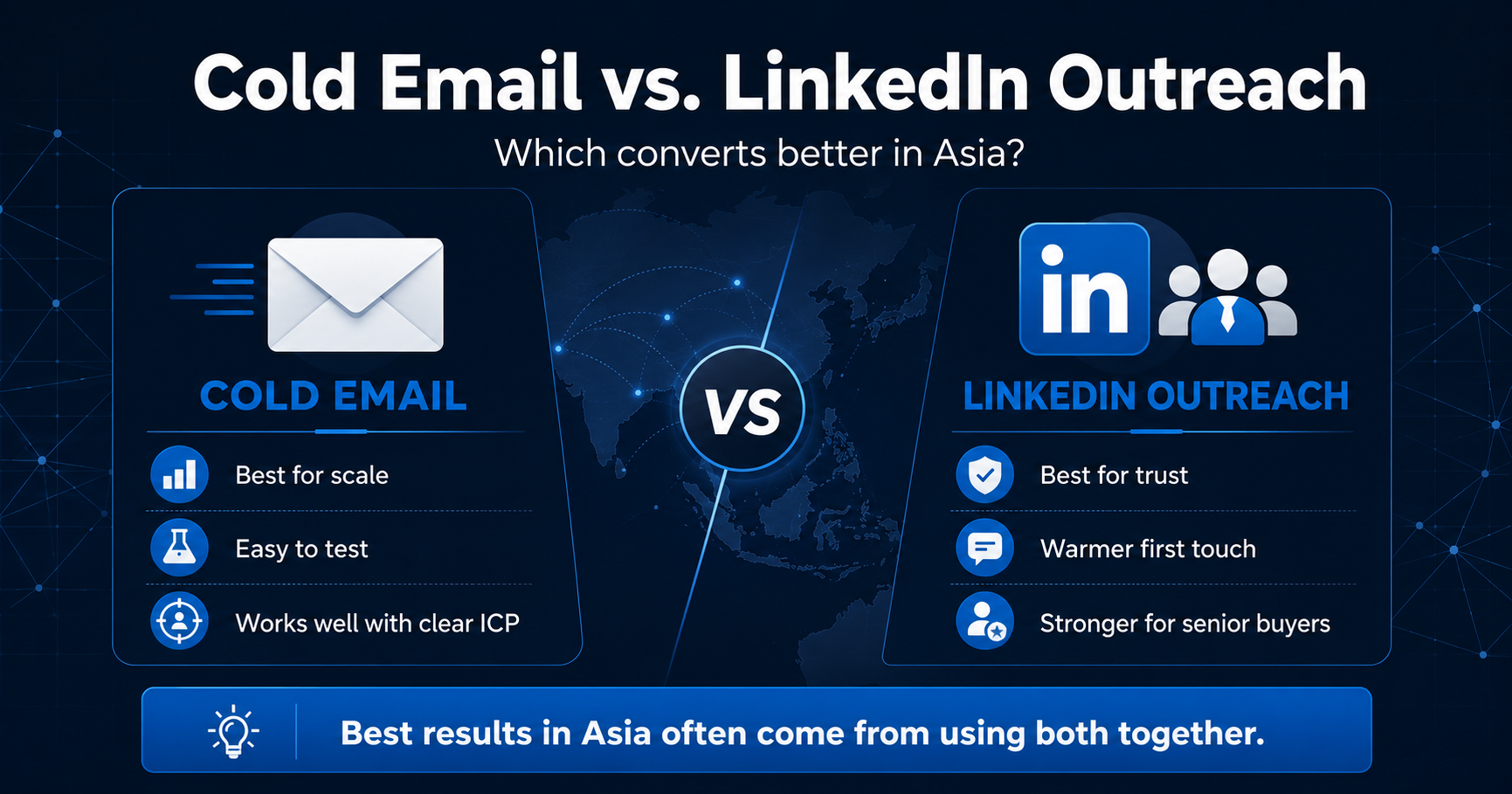
- Cold email is usually better for scale. It is easier to test segments, contact multiple stakeholders, and run structured sequences across large account lists.
- LinkedIn outreach is usually better for trust. It gives prospects profile context, social proof, mutual connections, and content before the first direct conversation.
- Asia is not one outbound market. Channel performance varies by country, industry, buyer seniority, language, and relationship norms.
- The strongest programmes often use both. Email creates reach and structure; LinkedIn creates visibility, credibility, and warmer entry points.
- Conversion should not be measured only by reply rate. The real metric is qualified pipeline: meetings held, sales-accepted opportunities, opportunity value, and market feedback.
- Thought leadership matters. LinkedIn and Edelman’s 2025 research found that 56% of target buyers and 55% of hidden buyers use thought leadership during vendor evaluation.
- Email benchmarks are useful, but not enough. Mailchimp states that its campaign benchmarking is based on hundreds of millions of emails, but your cold outbound performance will depend heavily on list quality, relevance, deliverability, and offer fit.
If you only do one thing: do not choose cold email or LinkedIn based on preference. Choose based on your ICP, market, buyer role, message, and required sales motion.
Who This Comparison Is For (and Not For)
This Guide Is For
- B2B companies expanding into Asia and deciding how to run outbound prospecting.
- Sales leaders comparing cold email, LinkedIn, and multichannel outreach.
- SDR teams trying to improve reply quality and meeting conversion.
- Founders selling into Singapore, ASEAN, India, Japan, Korea, or wider APAC.
- Marketing teams supporting outbound with content, webinars, or paid LinkedIn campaigns.
- Companies that need qualified pipeline from specific Asian markets, not just more contacts.
This guide is especially useful for companies selling:
- B2B SaaS;
- cybersecurity;
- fintech;
- cloud and managed services;
- HR technology;
- professional services;
- healthtech;
- data and AI platforms;
- enterprise software;
- market-entry or regional expansion services.
This Guide Is Not For
This guide may be less useful if:
- you are running consumer marketing rather than B2B prospecting;
- you are looking for mass spam tactics;
- your product is low-ticket and purely transactional;
- you do not have a defined ICP;
- your team cannot follow up quickly on replies;
- your only metric is email open rate or LinkedIn connection acceptance;
- you want one generic campaign for all Asian markets.
Practical fit check: This guide is designed for companies asking how to create qualified conversations across Asia—not how to send the highest possible number of messages.
Why the Comparison Is Different in Asia
Asia is not one outbound environment.
The region includes:
- highly digital regional hubs such as Singapore;
- relationship-led enterprise markets;
- fast-growing founder-led ecosystems;
- markets where English works well;
- markets where local language or local credibility matters more;
- countries where LinkedIn usage is strong among business leaders;
- countries where email, phone, referrals, events, and local partners still carry more weight.
That means the same channel can perform differently depending on:
| Factor | Why It Matters |
|---|---|
| Country | Singapore, Japan, India, Indonesia, Vietnam, and the Philippines have different business communication norms. |
| Buyer seniority | Senior buyers may respond better to trusted social proof or warm introductions. |
| Industry | Technology buyers may be more reachable on LinkedIn; traditional sectors may require email, phone, or events. |
| Deal size | Larger deals usually require more trust-building and multiple stakeholders. |
| Language | English-only outreach may work in some segments and fail in others. |
| Brand awareness | Unknown vendors often need more credibility-building before asking for a meeting. |
| Sales motion | A transactional offer may work through email; a strategic offer may need LinkedIn and referrals. |
So the question is not simply which channel converts better.
The question is which channel best matches the buyer’s trust path.
What Cold Email Does Best
Cold email remains valuable because it gives sales teams reach, control, and structure.
Cold Email Is Strong For Scale
Email allows teams to:
- reach multiple buyers in the same account;
- test different segments quickly;
- run structured sequences;
- attach or link to useful resources;
- coordinate outreach across a CRM;
- measure delivery, replies, clicks, and conversions.
This makes email useful when you need a controlled outbound experiment.
Cold Email Is Strong For Account Coverage
In Asia, buying committees may include:
- country managers;
- regional directors;
- founders;
- finance leaders;
- operations leaders;
- IT or security heads;
- procurement;
- functional owners.
Cold email makes it easier to contact multiple relevant stakeholders within one target account.
Cold Email Is Strong For Testing
You can test:
- ICP segments;
- subject lines;
- pain points;
- proof points;
- CTAs;
- follow-up timing;
- market-specific messaging.
Mailchimp notes that benchmark data is built from hundreds of millions of emails and can compare open, click, and unsubscribe rates by industry and audience characteristics. That reinforces the value of structured email measurement, even though cold outbound results should be interpreted differently from opted-in marketing campaigns.
Best Cold Email Use Cases
Cold email works well when:
- you have a verified target list;
- the buyer problem is specific;
- the message is concise;
- the CTA is low-friction;
- your domain and deliverability are managed;
- your team can follow up quickly;
- the campaign is tracked in CRM.
Where Cold Email Breaks Down
Cold email breaks down when teams treat it as a volume game.
Deliverability Risk
Poor sending practices can damage performance.
Common problems include:
- unverified emails;
- high bounce rates;
- weak domain setup;
- too much volume too quickly;
- spam-like wording;
- irrelevant targeting;
- poor unsubscribe handling.
Trust Gap
Cold email often provides less context than LinkedIn.
A buyer receiving an email may not immediately know:
- who you are;
- whether you are credible;
- whether your company is real;
- whether you understand their market;
- whether the message is automated.
That is especially important for foreign companies entering Asia.
Generic AI Outreach
AI can help draft messages. It can also make every message sound the same.
Signs of weak AI-assisted email include:
- vague compliments;
- over-personalisation based on irrelevant details;
- generic pain points;
- long paragraphs;
- unnatural tone;
- no clear reason for the outreach.
Lower Relationship Context
In relationship-sensitive markets, email may need support from:
- LinkedIn profile visibility;
- mutual connections;
- event participation;
- referral strategy;
- partner introductions;
- market-specific proof.
Email alone may open the door. It rarely carries the entire trust burden.
What LinkedIn Outreach Does Best
LinkedIn outreach is valuable because it combines identity, context, and conversation.
LinkedIn Builds Trust Before the Ask
A prospect can review:
- your profile;
- your company;
- mutual connections;
- recent content;
- comments;
- role history;
- featured resources.
That gives LinkedIn a trust advantage over a cold email from an unknown sender.
LinkedIn states that Thought Leader Ads help build credibility through trusted voices, including employees, experts, customers, and creators. It also says these formats help position a company as an industry authority.
LinkedIn Is Strong For Senior Buyers
Senior buyers often want context before replying.
LinkedIn supports this through:
- professional identity;
- shared networks;
- company pages;
- thought leadership;
- event visibility;
- public conversations.
LinkedIn Supports Thought Leadership
LinkedIn and Edelman’s 2025 research found that 64% of target buyers and 63% of hidden buyers spend more than an hour per week consuming thought leadership, while 56% of target buyers and 55% of hidden buyers use thought leadership in vendor evaluation.
This matters because many Asian deals are influenced by people beyond the obvious target contact.
LinkedIn Is Strong For Warm-Up
Before direct outreach, you can:
- follow the prospect;
- engage with their content;
- comment thoughtfully;
- invite them to an event;
- share a relevant post;
- use content to establish familiarity.
This makes the first direct message less cold.
Where LinkedIn Outreach Breaks Down
LinkedIn has limits.
Lower Volume
LinkedIn outreach is generally harder to scale than email.
It requires:
- profile quality;
- manual review;
- connection acceptance;
- message timing;
- content support;
- more careful personalisation.
Crowded Inboxes
Senior buyers receive many LinkedIn messages.
Common weak messages include:
- instant pitch after connection;
- fake praise;
- irrelevant personalisation;
- long product descriptions;
- meeting link too early;
- no commercial context.
Platform Dependency
LinkedIn activity depends on platform rules, profile health, connection limits, and account behaviour.
Over-automation can create risk.
Visibility Does Not Equal Intent
A view, like, or connection does not necessarily mean buying interest.
LinkedIn must still connect to qualification and CRM tracking.
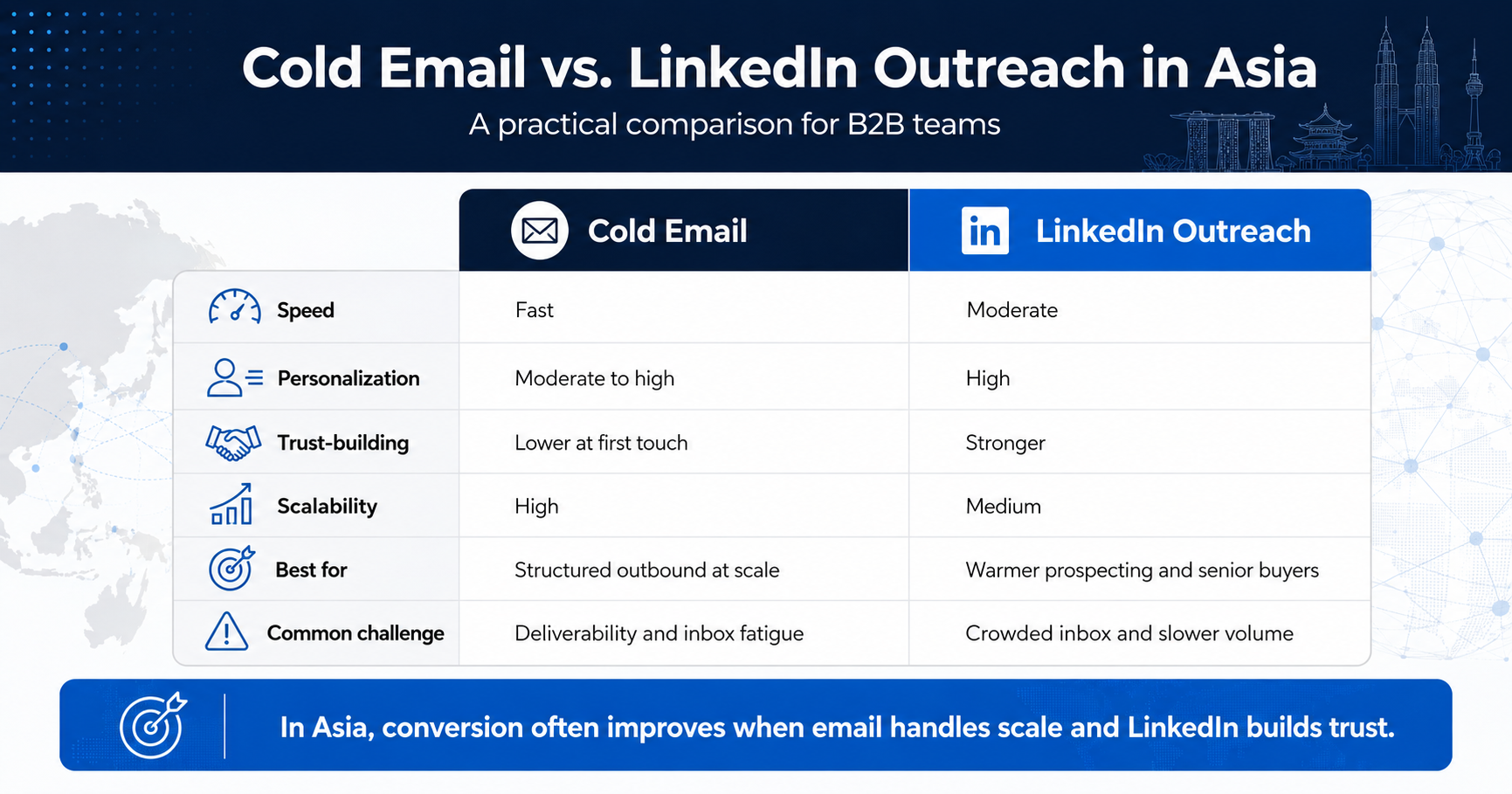
Cold Email vs. LinkedIn Outreach: Side-by-Side Comparison
| Criteria | Cold Email | LinkedIn Outreach |
|---|
| Best For | Scale and structured outbound testing | Trust-building and relationship-led conversations |
| Speed | Faster to launch at volume | Slower due to profile and connection steps |
| Personalisation | Can be strong, but often template-driven | Easier to personalise with visible context |
| Trust | Lower at first touch | Higher if profile and content are credible |
| Data Needed | Verified emails, company data, roles | LinkedIn profiles, role relevance, activity context |
| Measurement | Delivery, opens, clicks, replies, meetings | Connections, replies, profile views, content engagement, meetings |
| Risk | Deliverability and spam perception | Over-automation and crowded inboxes |
| Best Buyer Type | Operational or functional buyers with clear pain | Senior buyers, founders, regional leaders, relationship-led prospects |
| Best CTA | Short question or resource offer | Conversation, insight, referral, event, or low-friction question |
| Main Weakness | Can feel impersonal | Harder to scale quickly |
| Best Use in Asia | Coverage and testing | Credibility and trust-building |
Which Channel Works Better by Market Type
Regional Hubs
Examples: Singapore, Hong Kong, selected APAC HQ environments.
Likely stronger approach: multichannel.
Cold email helps cover target accounts. LinkedIn helps build credibility with senior and regional buyers.
Relationship-Led Enterprise Markets
Examples: certain enterprise segments in Japan, Korea, Indonesia, and large local conglomerates.
Likely stronger approach: LinkedIn plus referrals, events, and partner-led introductions.
Cold email may still support the process, but it may not be enough to create trust.
Founder-Led Growth Markets
Examples: start-up and scale-up ecosystems in India, Singapore, Indonesia, Vietnam, and the Philippines.
Likely stronger approach: LinkedIn for warm-up and founder-level conversations; email for structured follow-up.
Technical or IT Buyer Markets
Likely stronger approach: email plus LinkedIn.
Email can deliver technical context and resources. LinkedIn can validate identity and support thought leadership.
Traditional Local Sectors
Likely stronger approach: email, phone, events, and referral-led outreach, supported by LinkedIn where buyers are active.
LinkedIn may not always be the first-touch channel.
Which Channel Works Better by Buyer Persona
| Buyer Persona | Better First Channel | Why |
|---|---|---|
| Founder / CEO | Trust, identity, and context matter | |
| Country Manager | LinkedIn + email | Role is visible; follow-up needs structure |
| Head of Sales / CRO | LinkedIn + email | Often active on LinkedIn but needs commercial relevance |
| Marketing Leader | Content and thought leadership can warm the conversation | |
| IT / Security Leader | Email + LinkedIn | Email supports detail; LinkedIn supports credibility |
| Operations Leader | Practical pain points can be communicated directly | |
| Procurement | Process-driven communication is often clearer | |
| Regional Director | LinkedIn + referral | Trust and relevance are critical |
| Finance Leader | Email + internal referral | Usually needs business case and context |
This is directional. The right answer depends on the account and market.
Why Multichannel Usually Wins
The best Asian outbound programmes rarely depend on one channel.
A prospect might:
- see your LinkedIn post;
- receive your email;
- notice your profile view;
- accept your connection;
- attend your webinar;
- reply to the second email;
- ask a colleague about your company;
- then agree to a meeting.
Attribution may show one channel. Influence may involve several.
HubSpot’s 2025 State of Sales coverage reported that 42% of surveyed sales professionals said social media delivered the highest cold-outreach response rate, compared with 26% for email and 23% for phone. This does not mean social always wins in Asia, but it supports the idea that social channels have become a major outbound driver.
LinkedIn Lead Gen Forms can also support the paid side of the funnel: LinkedIn states that its forms use pre-filled profile data and provide campaign reporting for cost per lead, form-fill rate, and audience segments.
The Role of Each Channel
| Channel | Role |
|---|---|
| Cold email | Scale, structure, follow-up, account coverage |
| Trust, context, visibility, senior access | |
| Phone | Fast qualification and objection discovery |
| Events | Relationship-building and warm context |
| Referrals | Credibility and senior access |
| Content | Education and hidden-buyer influence |
How to Build a Combined Cold Email + LinkedIn Sequence
Step 1 — Define the Account List
Segment by:
- country;
- industry;
- company size;
- buyer role;
- expansion signal;
- technology stack;
- hiring signal;
- funding or market trigger.
Step 2 — Map Multiple Contacts
For each account, identify:
- primary decision-maker;
- functional owner;
- influencer;
- technical evaluator;
- possible referrer.
Step 3 — Warm With LinkedIn
Before email, consider:
- viewing the profile;
- following the buyer;
- engaging with relevant content;
- sending a connection request;
- sharing a useful insight.
Step 4 — Send a Short Cold Email
Use email for a clear commercial message.
Example:
Subject: Singapore pipeline question
Hi [Name], noticed [Company] is expanding its regional presence.
We help B2B teams validate and build qualified pipeline across Asia before they commit to full local headcount.
Curious if Singapore or ASEAN pipeline creation is currently a priority for your team?
Step 5 — Follow Up on LinkedIn
If connected:
I sent a short note by email as well. The reason I reached out is we often see B2B teams get referrals into Asia, but struggle to turn that into a repeatable pipeline motion. Curious if that is relevant on your side.
Step 6 — Add Proof
Share:
- case study;
- market insight;
- event invite;
- checklist;
- comparison framework.
Step 7 — Ask for the Right Path
If the person is not responsible:
Is this something you would normally own, or would someone else on the regional commercial team be closer to it?
Step 8 — Qualify Before Booking
Confirm:
- account fit;
- buyer role;
- problem relevance;
- timing;
- next step;
- meeting purpose.
What to Measure
Do not compare cold email and LinkedIn only by top-of-funnel numbers.
Cold Email Metrics
- delivery rate;
- bounce rate;
- open rate;
- click rate;
- reply rate;
- positive reply rate;
- meetings booked;
- meetings held;
- sales acceptance.
LinkedIn Metrics
- profile views from target accounts;
- connection acceptance rate;
- message reply rate;
- content engagement from target personas;
- conversations started;
- meetings booked;
- meetings held;
- sales acceptance.
Shared Pipeline Metrics
- qualified meetings;
- no-show rate;
- opportunity creation;
- meeting-to-opportunity conversion;
- pipeline value;
- sales-cycle movement;
- closed-won revenue.
Market Learning Metrics
- common objections;
- best-performing persona;
- strongest country;
- strongest industry;
- message themes that resonate;
- referral patterns;
- channel preference by segment.
Common Mistakes
Mistake 1 — Declaring a Winner Too Early
One campaign does not prove that email or LinkedIn is better.
It may only prove that the list, message, or offer was stronger in one channel.
Mistake 2 — Comparing Volume Instead of Quality
Email may create more replies. LinkedIn may create fewer but higher-trust conversations.
Compare meetings held and accepted opportunities.
Mistake 3 — Treating Asia as One Market
A channel that works in Singapore may not work the same way in Japan, India, Vietnam, Korea, or Indonesia.
Mistake 4 — Using the Same Message in Both Channels
Email and LinkedIn require different formats.
Email can carry a bit more structure. LinkedIn should usually feel shorter and more conversational.
Mistake 5 — Over-Automating LinkedIn
Automation can damage credibility and create platform risk.
Mistake 6 — Ignoring Deliverability
Cold email requires technical setup, list quality, warm-up discipline, and careful sending practices.
Mistake 7 — Pitching Before Trust Exists
This is especially costly when targeting senior buyers.
Mistake 8 — Not Tracking CRM Outcomes
Without CRM tracking, you may know which channel created replies but not which created revenue.
A Practical Channel-Decision Scorecard
Score each item from 1 to 5.
| Decision Factor | Cold Email Stronger If… | LinkedIn Stronger If… |
|---|---|---|
| Target list size | Large, verified list | Smaller strategic account list |
| Buyer seniority | Mid-level or functional | Senior, founder, regional executive |
| Need for trust | Moderate | High |
| Message complexity | Simple and direct | Needs context and credibility |
| Market familiarity | You are already known | You need to build awareness |
| Sales cycle | Shorter | Longer or relationship-led |
| Content support | Limited content available | Strong insights or thought leadership |
| Language/localisation | English email works | Social proof or local context needed |
| Follow-up capacity | Automated and structured | Human and relationship-led |
| Primary goal | Segment testing and coverage | Relationship entry and senior access |
Interpretation
| Result | Recommended Approach |
|---|---|
| Cold email scores higher | Use email as the primary channel and LinkedIn as support |
| LinkedIn scores higher | Use LinkedIn as the trust-building channel and email for structure |
| Scores are similar | Use a coordinated multichannel sequence |
| Neither scores well | Revisit ICP, offer, proof, or market selection before launching |
Not Sure Which Channel Will Work Best in Asia?
Expand In Asia helps B2B companies test and scale outbound across Asian markets using:
- ICP definition;
- account research;
- LinkedIn engagement;
- cold email;
- appointment setting;
- lead qualification;
- CRM reporting;
- market feedback.
Talk to Expand In Asia about your outbound channel strategy →
Next Steps With Expand In Asia
Cold email and LinkedIn outreach both work in Asia when they are used correctly.
The stronger approach is usually not choosing one channel forever.
It is building a system where:
- email creates reach;
- LinkedIn builds trust;
- content supports credibility;
- calls and events add context;
- referrals open harder doors;
- CRM shows which channel creates real pipeline.
For more on lead-generation strategy, read:
10 Best B2B Qualified Lead Generation Strategies for 2026
For Singapore provider comparisons, read:
Top 11 B2B Lead Generation Companies in Singapore in 2026
Schedule a consultation with Expand In Asia →
Ready to Implement These Strategies?
Book a free 30-minute strategy session where we’ll audit your current growth approach and identify your highest-leverage opportunities in Asian markets.
Frequently Asked Questions
1.Which converts better in Asia: cold email or LinkedIn outreach?
Neither channel wins universally.
Cold email is usually stronger for scale, account coverage, and structured testing. LinkedIn is usually stronger for trust, senior-buyer access, and relationship-led engagement. In many Asian B2B markets, the best results come from using both together.
2. Is cold email still effective in Asia?
Yes, but only when targeting, relevance, deliverability, and follow-up are strong.
Cold email becomes weak when teams rely on large unverified lists, generic messaging, poor domain setup, and no qualification process.
3. Is LinkedIn outreach better for senior buyers?
Often, yes.
Senior buyers may want profile context, social proof, mutual connections, and thought leadership before they respond. LinkedIn can provide that trust layer better than email alone
4. Should we send the same message on email and LinkedIn?
No.
The commercial idea can be consistent, but the format should change. Email can be slightly more structured. LinkedIn should usually be shorter, more conversational, and less formal.
5. What is the best sequence?
A practical sequence might include:
- LinkedIn profile review;
- light engagement;
- cold email;
- LinkedIn connection request;
- email follow-up;
- LinkedIn follow-up;
- proof-based message;
- qualification question.
The exact sequence should depend on the buyer and market.
6. How should we measure channel performance?
Measure:
- positive replies;
- meetings held;
- show rate;
- qualified meetings;
- sales-accepted opportunities;
- pipeline value;
- opportunity conversion.
Do not rely only on open rates, connection acceptance, impressions, or reply volume.
7. Does LinkedIn work in every Asian market?
LinkedIn is useful in many Asian B2B segments, especially with regional, technology, professional-services, and senior commercial buyers. But activity levels and response patterns vary by country, industry, and role.
8. What if our target buyers are not active on LinkedIn?
Use LinkedIn for research and credibility where possible, but rely more on email, phone, referrals, events, associations, partners, and local networks.
9. How does thought leadership affect conversion?
Thought leadership can make buyers more receptive before direct outreach. LinkedIn and Edelman’s 2025 research found that target buyers and hidden buyers use thought leadership during vendor evaluation, which makes content especially useful for complex B2B buying groups.
💬 Which model are you currently evaluating — and what’s the biggest factor driving your decision? Drop your situation in the comments below. We read every response and often address recurring questions in follow-up content.
📤 Was this comparison useful? Share it with a colleague or partner navigating the same decision, or bookmark the decision matrix for your next strategy review.