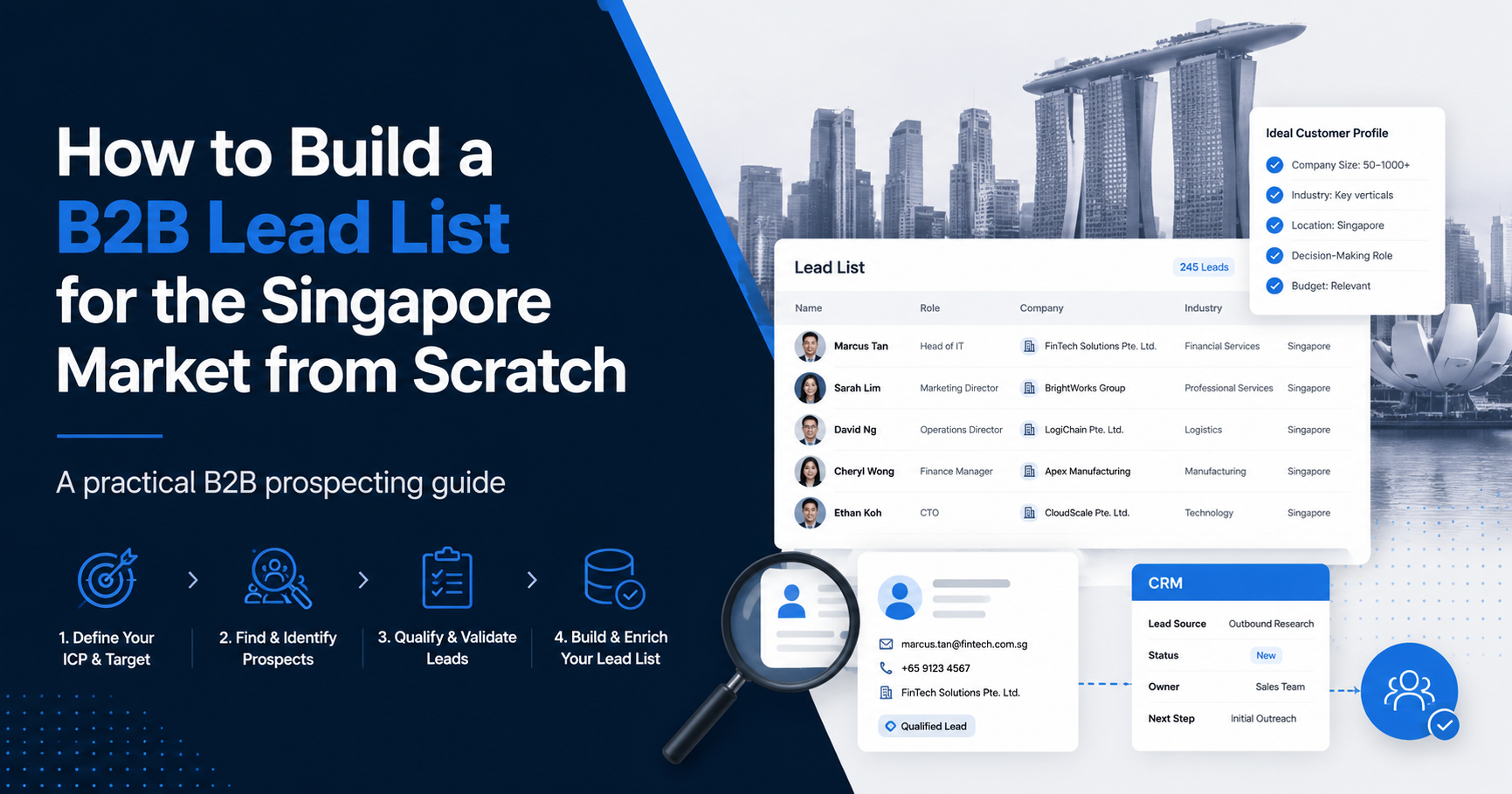
How to Build a B2B Lead List for the Singapore Market from Scratch
A practical guide to building accurate, relevant, and outreach-ready B2B prospect lists for Singapore
A strong outbound campaign does not start with messaging.
It starts with the list.
If the lead list is too broad, outdated, poorly segmented, or filled with irrelevant contacts, even the best outreach sequence will struggle. You may send more emails, make more calls, and launch more LinkedIn messages—but the campaign will still underperform because the wrong people were targeted from the beginning.
This is especially important in Singapore.
Singapore has a dense and sophisticated business environment. ACRA reported 630,446 registered business entities in May 2026, based on its monthly business registry statistics. That creates a large prospect universe, but it also creates a filtering problem: not every company is relevant, active, reachable, or commercially suitable for your offer.
Building a B2B lead list for Singapore from scratch requires more than exporting contacts from a database.
It requires a structured process:
- define the ideal customer profile;
- identify the right target accounts;
- verify that companies are active and relevant;
- map decision-makers and influencers;
- validate contact data;
- enrich the list with commercial context;
- score and segment leads;
- prepare the data for CRM and outreach;
- maintain compliance and data hygiene.
This guide explains how to do that step by step.
- TL;DR — Key Takeaways
- Do not start with a database export. Start with a clear ICP, target account criteria, and disqualification rules.
- Use official and commercial sources together. ACRA and Bizfile can help validate entity information, while commercial databases, LinkedIn, websites, and manual research help identify decision-makers and triggers.
- Verify before outreach. Check company status, contact role, email validity, phone numbers, duplicates, and CRM conflicts before launching a campaign.
- Build account-level and contact-level data. B2B selling often requires multiple stakeholders per company.
- Segment the list before messaging. Industry, company size, buyer role, trigger, and pain point should influence outreach.
- Keep data governance in mind. PDPC guidance highlights considerations for organisations outsourcing data-processing activities to data intermediaries, including governance, policies, service management, and exit management.
If you only do one thing: define what a “qualified Singapore lead” means before collecting a single contact.
Who This Comparison Is For (and Not For)
This Guide Is For
- B2B companies entering Singapore for the first time.
- Sales and marketing teams preparing outbound campaigns.
- Founders building their first Singapore prospect list.
- SDR managers who need cleaner data for outreach.
- GTM teams validating Singapore before hiring locally.
- Companies expanding from Singapore into wider ASEAN.
- Businesses comparing outsourced versus internal lead generation.
This guide is especially relevant for companies selling:
- B2B SaaS;
- cybersecurity;
- fintech;
- cloud and managed services;
- HR technology;
- professional services;
- healthtech;
- logistics technology;
- data and AI platforms;
- enterprise software.
This Guide Is Not For
This guide may be less useful if:
- you are looking for consumer lead lists;
- you want to scrape as many emails as possible without qualification;
- your product has no defined target customer;
- your team cannot follow up on leads;
- you are not prepared to verify or maintain data;
- you need only broad market research, not an outreach-ready list;
- your campaign depends entirely on paid ads rather than outbound prospecting.
Practical fit check: this guide is designed for companies that want a clean, qualified, and commercially useful B2B lead list—not just a spreadsheet of names.
Why Lead-List Quality Matters in Singapore
Singapore is a high-opportunity market, but it is also a high-signal market.
Buyers are used to receiving business outreach. Many senior decision-makers are already exposed to:
- LinkedIn messages;
- cold emails;
- event invitations;
- partner introductions;
- sales calls;
- webinar follow-ups;
- vendor newsletters.
That means poor targeting stands out quickly.
A weak lead list creates problems such as:
- contacting companies that are too small or too large;
- targeting regional HQs with local-only messaging;
- messaging junior staff who cannot influence the decision;
- reaching inactive or irrelevant entities;
- using outdated titles;
- duplicating existing CRM records;
- contacting competitors, students, recruiters, or consultants;
- wasting SDR time on low-fit accounts.
A strong list does the opposite.
It gives your sales team:
- clear account prioritisation;
- relevant buyer roles;
- better message personalisation;
- cleaner CRM data;
- more meaningful reply analysis;
- better campaign learning;
- higher confidence in outreach results.
In B2B prospecting, list quality is not admin work. It is commercial strategy.
Step 1 — Define Your Singapore ICP
The first step is to define your ideal customer profile.
A weak ICP sounds like:
“We want companies in Singapore.”
That is not enough.
A stronger ICP sounds like:
“We target Singapore-based technology and professional-services companies with 50–500 employees, regional growth responsibility, and a need to build qualified outbound pipeline across Southeast Asia.”
ICP Criteria to Define
| ICP Area | Questions to Answer |
|---|---|
| Geography | Is the company Singapore-based, Singapore-registered, or Singapore-led regionally? |
| Industry | Which sectors are most relevant? |
| Company size | Employee count, revenue range, funding stage, or office footprint? |
| Business model | SaaS, services, platform, enterprise, mid-market, channel-led? |
| Buyer pain | What problem should the company reasonably have? |
| Trigger | What makes this account timely now? |
| Budget fit | Can the company realistically afford the offer? |
| Decision structure | Local buyer, regional buyer, founder-led, or HQ-led? |
| Disqualifiers | Which accounts should be excluded? |
Singapore-Specific ICP Considerations
Singapore often plays several commercial roles:
- local domestic market;
- regional headquarters location;
- ASEAN launchpad;
- Asia-Pacific commercial hub;
- financial-services centre;
- technology and innovation hub;
- procurement or decision-making base for wider regional teams.
So your list must clarify whether you are targeting:
- companies selling only in Singapore;
- Singapore-based companies expanding regionally;
- foreign companies with Singapore offices;
- regional leaders based in Singapore;
- local subsidiaries of multinational companies.
Each group may require different messaging and buyer mapping.
Step 2 — Build Target-Account Criteria
After defining the ICP, translate it into target-account filters.
Example Account Criteria
| Filter | Example |
|---|---|
| Country | Singapore |
| Entity status | Active / live business |
| Industry | SaaS, fintech, logistics, professional services |
| Employee count | 50–500 |
| Revenue band | Mid-market or enterprise |
| Regional relevance | Singapore HQ or APAC office |
| Buyer problem | Pipeline growth, market entry, lead quality |
| Trigger | Hiring, funding, expansion, new leadership |
| Exclusions | Agencies, micro-businesses, students, competitors |
Build “Must-Have” and “Nice-to-Have” Criteria
Must-have
These are non-negotiable.
Examples:
- Singapore presence;
- relevant industry;
- correct company size;
- active business status;
- buyer role exists.
Nice-to-have
These improve prioritisation.
Examples:
- recent funding;
- hiring sales roles;
- regional expansion;
- relevant technology stack;
- event participation;
- recent executive appointment.
This prevents your list from becoming too narrow too early.
Choose Reliable Data Sources
No single source will give you a perfect Singapore B2B lead list.
Use a combination.
Official Sources
ACRA maintains Singapore’s national register of business entities and updates statistics monthly. Bizfile provides search functions that can help users find information through entity, industry, people, and reserved-name searches.
Useful official-source checks include:
- entity name;
- UEN;
- registration status;
- registered address;
- entity type;
- industry classification;
- business profile information where available.
Commercial Databases
Commercial sources may help identify:
- employee count;
- job titles;
- email addresses;
- phone numbers;
- technology stack;
- funding information;
- company growth signals;
- recent hiring.
Examples include tools such as:
- Apollo;
- ZoomInfo;
- Lusha;
- Sales Navigator;
- Crunchbase;
- Similarweb;
- BuiltWith;
- company websites;
- LinkedIn company pages.
Manual Research Sources
Manual checks often improve quality.
Use:
- company websites;
- leadership pages;
- LinkedIn profiles;
- press releases;
- event speaker pages;
- webinar registrations;
- annual reports;
- association directories;
- partner ecosystems;
- job postings.
Recommended Source Mix
| Data Need | Best Source Type |
|---|---|
| Company existence | ACRA / Bizfile |
| Industry and status | ACRA / website / LinkedIn |
| Company size | LinkedIn / commercial database / website |
| Decision-makers | LinkedIn / company website / events |
| Emails | Commercial database / manual verification |
| Phone numbers | Database / switchboard / website |
| Triggers | News, LinkedIn, hiring, funding, events |
| Technology stack | Website analysis / commercial tools |
| Regional relevance | Website, LinkedIn, press releases |
Validate Company Information
Before adding a company to the lead list, check whether it is worth targeting.
Company Validation Checklist
| Check | Why It Matters |
|---|---|
| Active business status | Avoid inactive or irrelevant entities |
| Correct entity | Many companies have similar names |
| Singapore relevance | Confirm Singapore presence or regional role |
| Industry fit | Avoid wasting outreach on wrong sectors |
| Company size | Ensure commercial suitability |
| Website quality | Confirms credibility and business activity |
| Recent activity | Shows whether the company is operating and growing |
| Buyer roles present | Confirms target contacts likely exist |
| No competitor conflict | Prevents awkward outreach |
| No existing CRM conflict | Avoids duplicating customers or live opportunities |
Entity vs. Operating Brand
In Singapore, the registered entity name may differ from the brand name used publicly.
For example:
- legal entity name may include “Pte. Ltd.”;
- website may use a shorter brand name;
- regional HQ may operate under a group brand;
- local subsidiary may have a different registered entity.
Your lead list should capture both:
- Legal / registered entity name
- Operating brand name
This reduces CRM confusion.
Step 5 — Map Decision-Makers and Influencers
A B2B lead list is not just a company list.
It should include the people who influence or own the buying conversation.
Typical Buyer Roles by Use Case
| Use Case | Possible Buyers |
|---|---|
| Sales outsourcing | CEO, Founder, CRO, VP Sales, Country Manager |
| Marketing services | CMO, Head of Marketing, Demand Gen Lead |
| Cybersecurity | CISO, CIO, IT Director, Security Manager |
| HR technology | CHRO, HR Director, Talent Lead, People Operations |
| Cloud services | CIO, CTO, Head of Infrastructure, IT Manager |
| Finance solution | CFO, Finance Director, Operations Director |
| Logistics tech | COO, Supply Chain Director, Operations Manager |
Map More Than One Contact
For each priority account, identify:
- economic buyer;
- business owner;
- technical evaluator;
- day-to-day user;
- influencer;
- possible internal referrer.
Suggested Contact Count Per Account
| Account Tier | Contacts to Map |
|---|---|
| Tier 1 strategic accounts | 4–8 contacts |
| Tier 2 target accounts | 2–4 contacts |
| Tier 3 broad-fit accounts | 1–2 contacts |
This is especially important when targeting Singapore-based regional teams, where the decision-maker may sit in Singapore but technical or operational stakeholders may sit elsewhere.
Step 6 — Verify Contact Data
Contact verification is where many lead lists fail.
A person may have the right title, but if the email is wrong, the phone number is outdated, or they left the company, the lead is not outreach-ready.
Contact Verification Checklist
| Data Point | Verification Method |
|---|---|
| Current role | LinkedIn profile, company website, recent posts |
| Company match | LinkedIn profile and website |
| Email format | Verification tool and domain pattern |
| Email deliverability | Email validation tool |
| Phone number | Website, switchboard, database, manual check |
| Seniority | Title and reporting line |
| Location | Singapore or relevant regional office |
| Duplicate status | CRM and spreadsheet check |
| Opt-out status | CRM suppression list |
Common Problems to Remove
- former employees;
- generic inboxes only;
- role mismatch;
- student or job seeker profiles;
- consultants not employed by the company;
- duplicate records;
- personal email addresses;
- invalid emails;
- contacts already marked as “do not contact.”
Verification slows down the build process, but it improves campaign performance.
Step 7 — Enrich Leads With Commercial Context
A basic lead record includes name, company, title, email, and phone.
A useful B2B lead record includes context.
Enrichment Fields to Add
| Field | Why It Helps |
|---|---|
| Company website | Confirms identity and supports research |
| LinkedIn company URL | Useful for social prospecting |
| Contact LinkedIn URL | Supports profile review and outreach |
| Industry | Enables segmentation |
| Company size | Indicates fit and budget potential |
| HQ / office location | Clarifies Singapore relevance |
| Regional presence | Supports APAC messaging |
| Trigger event | Creates reason for outreach |
| Pain hypothesis | Connects account to message |
| Technology stack | Supports relevance for tech vendors |
| Funding or growth signal | Indicates possible expansion |
| Existing competitors | Supports positioning |
| Notes | Captures manual research insights |
Example Enriched Lead
| Field | Example |
|---|---|
| Company | CloudScale Pte. Ltd. |
| Industry | B2B SaaS |
| Location | Singapore |
| Contact | Ethan Koh |
| Role | CTO |
| Trigger | Hiring regional sales roles |
| Pain Hypothesis | Scaling pipeline across ASEAN |
| LinkedIn URL | Added |
| Verified | |
| Segment | Tier 1 |
| Suggested Message Angle | Regional GTM validation |
The more strategic the sale, the more valuable enrichment becomes.
Step 8 — Score and Segment the List
Not every lead deserves the same level of effort.
Score the list before outreach.
Account Scoring Criteria
| Criteria | Score 1 | Score 3 | Score 5 |
|---|---|---|---|
| Industry fit | Poor | Adjacent | Strong |
| Company size | Too small / large | Acceptable | Ideal |
| Singapore relevance | Unclear | Local presence | Singapore HQ / regional HQ |
| Buyer availability | No clear buyer | One possible buyer | Multiple relevant buyers |
| Trigger | None | Weak signal | Strong timely trigger |
| Budget fit | Low | Moderate | Strong |
| Strategic value | Low | Medium | High |
Suggested Segments
Tier 1 — Strategic Accounts
High-fit companies with strong triggers and relevant buyers.
Use:
- deeper research;
- personalised messaging;
- LinkedIn warm-up;
- multi-contact outreach;
- senior seller involvement.
Tier 2 — Good-Fit Accounts
Relevant companies but with fewer signals.
Use:
- standard personalisation;
- email + LinkedIn sequence;
- moderate research depth.
Tier 3 — Broad-Fit Accounts
Potentially relevant but lower priority.
Use:
- lighter research;
- broader message testing;
- lower-touch sequence.
Segmentation helps your team avoid treating all leads the same.
Step 9 — Prepare the List for CRM and Outreach
A lead list is not ready until it can be used properly.
CRM-Ready Fields
At minimum, prepare:
- company name;
- legal entity name;
- website;
- industry;
- company size;
- Singapore relevance;
- contact first name;
- contact last name;
- job title;
- department;
- seniority;
- email;
- phone;
- LinkedIn URL;
- lead source;
- account tier;
- ICP segment;
- trigger;
- message angle;
- owner;
- status;
- next step;
- opt-out status.
Standardise Before Import
Clean:
- capitalisation;
- country names;
- industry labels;
- job titles;
- phone-number formatting;
- company suffixes;
- duplicate account names;
- invalid characters;
- blank fields.
Create Campaign Segments
Examples:
- Singapore SaaS founders;
- Singapore-based APAC sales leaders;
- fintech operations directors;
- HR technology buyers;
- cybersecurity decision-makers;
- logistics companies expanding regionally.
Segmentation should guide messaging.
Step 10 — Maintain Data Hygiene and Compliance
Lead lists decay.
People change roles. Companies close. Emails bounce. Job titles change. Prospects opt out.
Ongoing Data Hygiene
Set a regular process for:
- bounce removal;
- duplicate cleanup;
- contact refresh;
- job-change checks;
- CRM conflict review;
- opt-out suppression;
- invalid phone removal;
- status updates;
- campaign outcome logging.
Compliance Considerations
Singapore’s PDPC states that the PDPA excludes business contact information such as an individual’s name, position or title, business telephone number, business address, business email, business fax number, and similar information.
However, that does not mean data governance can be ignored.
If your organisation outsources data processing or lead-list building, PDPC guidance on managing data intermediaries highlights key considerations around governance, risk assessment, policies, service management, and exit management.
Practical Data Governance Checklist
- Record data sources.
- Avoid unnecessary personal data.
- Maintain suppression lists.
- Respect opt-outs.
- Limit access to campaign users.
- Define data retention periods.
- Delete or return data at the end of vendor engagements.
- Document responsibilities when using outsourced providers.
- Review applicable laws for any cross-border campaign.
This is especially important when Singapore is used as a base for wider Asia outreach.
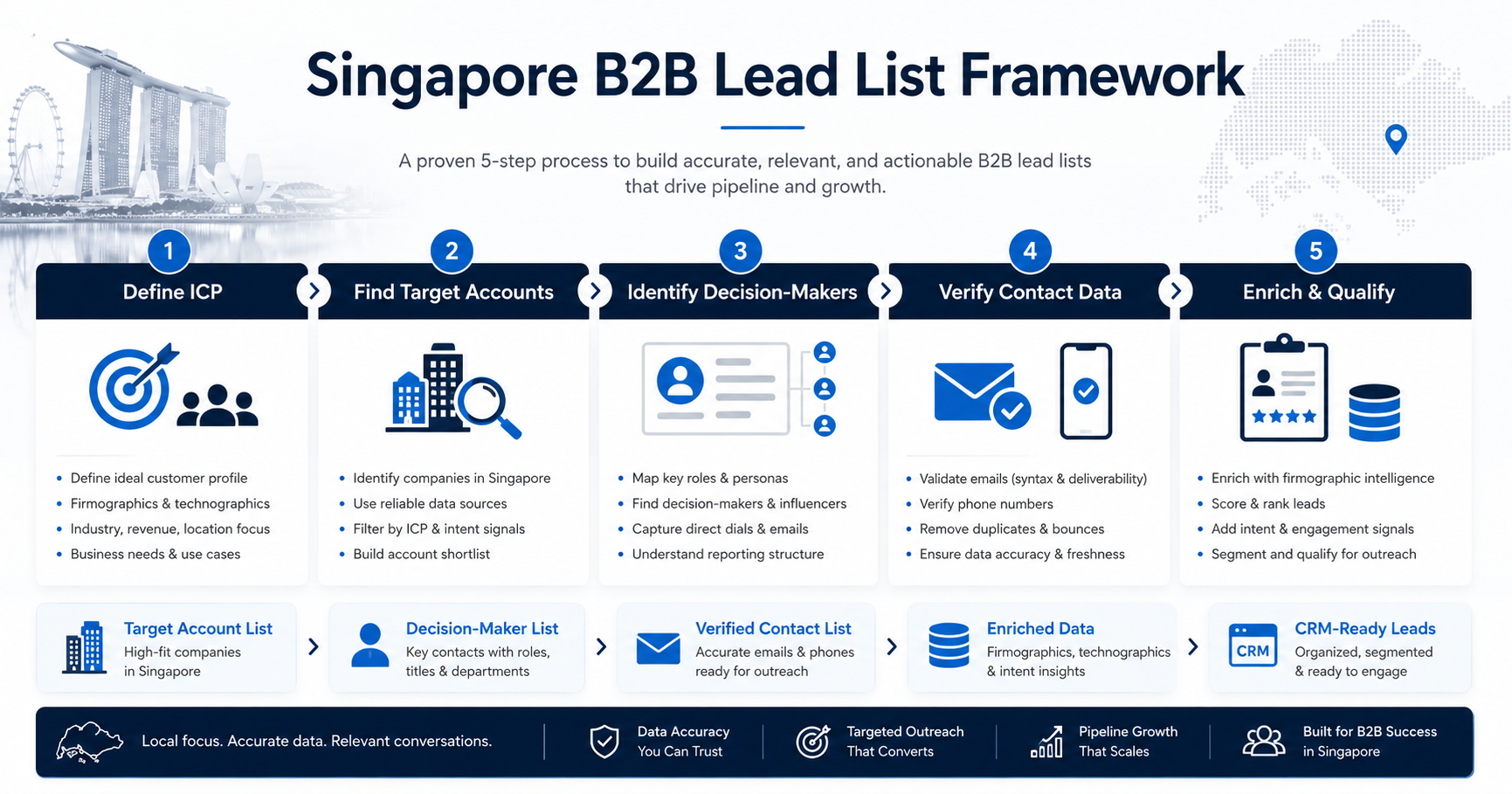
Singapore B2B Lead-List Framework
Use this five-step process:
| Step | Output |
|---|---|
| 1. Define ICP | Clear qualification and exclusion criteria |
| 2. Find Target Accounts | Shortlist of companies matching the ICP |
| 3. Identify Decision-Makers | Contact map for each priority account |
| 4. Verify Contact Data | Validated emails, phones, roles, and CRM status |
| 5. Enrich and Qualify | Segmented, scored, outreach-ready lead list |
What “Ready” Looks Like
A Singapore B2B lead list is ready when:
- companies match the ICP;
- accounts are segmented by priority;
- contacts are current and relevant;
- emails are verified;
- duplicates are removed;
- CRM conflicts are checked;
- opt-outs are respected;
- triggers and message angles are recorded;
- owners and next steps are assigned.
Common Mistakes to Avoid
Mistake 1 — Buying a Generic List
A generic list may look efficient, but it often includes poor-fit companies, outdated contacts, and weak segmentation.
Mistake 2 — Targeting Only One Contact Per Account
B2B buying decisions usually involve more than one person.
Mistake 3 — Ignoring Singapore’s Regional Role
A Singapore-based leader may be responsible for ASEAN or APAC, not only Singapore.
Mistake 4 — Using Job Titles Too Literally
Titles vary by company.
A “Head of Growth” in one company may own pipeline, while in another company the same responsibility may sit with the founder or country manager.
Mistake 5 — Skipping Verification
Invalid data damages deliverability, productivity, and trust.
Mistake 6 — No Disqualification Rules
Without exclusions, lists become bloated with irrelevant contacts.
Mistake 7 — No CRM Preparation
A spreadsheet that cannot be imported cleanly will slow down the campaign.
Mistake 8 — No Data Maintenance
A list is not a one-time asset. It needs refreshes and feedback from campaign results.
Sample Lead-List Columns
Use these columns as a starting point.
| Category | Columns |
|---|---|
| Company Data | Company Name, Legal Entity Name, Website, UEN, Industry, Company Size, HQ, Singapore Presence |
| Contact Data | First Name, Last Name, Title, Department, Seniority, Email, Phone, LinkedIn URL |
| Fit Data | ICP Segment, Account Tier, Buyer Persona, Pain Hypothesis, Trigger |
| Verification Data | Email Status, Role Verified, Company Status, Duplicate Check, CRM Match |
| Campaign Data | Lead Source, Message Angle, Owner, Outreach Status, Last Touch, Next Step |
| Compliance Data | Opt-Out Status, Source Notes, Consent Basis Where Applicable, Retention Notes |
| Outcome Data | Reply Status, Meeting Status, Disqualification Reason, Opportunity Status |
Recommended Required Fields
For outbound campaigns, do not launch without:
- company name;
- website;
- contact name;
- title;
- email or LinkedIn URL;
- industry;
- account tier;
- lead source;
- verification status;
- outreach owner;
- opt-out status.
Build Internally or Outsource?
You can build a Singapore lead list internally, outsource it, or use a hybrid model.
Internal Build
Best when:
- your team knows the market well;
- list size is manageable;
- you have research capacity;
- CRM standards are already clear;
- the campaign is highly strategic.
Outsourced Build
Best when:
- your team lacks time;
- you need market coverage quickly;
- the list requires manual verification;
- multiple personas must be mapped;
- you want a partner to support outreach as well.
Hybrid Build
Best when:
- your internal team defines ICP and strategy;
- an external partner builds and verifies data;
- both teams review and refine targeting;
- internal sellers own qualified opportunities.
Ownership Model
| Activity | Internal | Outsourced | Shared |
|---|---|---|---|
| ICP definition | ✓ | ✓ | |
| Account sourcing | ✓ | ✓ | |
| Contact mapping | ✓ | ||
| Data verification | ✓ | ||
| Qualification rules | ✓ | ✓ | |
| CRM import | ✓ | ✓ | |
| Message strategy | ✓ | ✓ | |
| Outreach execution | ✓ | ✓ | |
| Opportunity follow-up | ✓ |
Need a Clean Singapore B2B Lead List Before Launching Outreach?
Expand In Asia helps B2B companies define their ICP, identify target accounts, map decision-makers, verify contact data, and prepare outreach-ready lead lists for Singapore and wider Asia.
Talk to Expand In Asia about building your Singapore prospect list →
Next Steps With Expand In Asia
A good lead list is not just a spreadsheet.
It is the foundation of your outbound sales motion.
The right Singapore B2B lead list should help your team:
- focus on the right companies;
- reach the right decision-makers;
- personalise messaging;
- reduce wasted outreach;
- improve reply quality;
- qualify opportunities faster;
- learn from the market.
For more support on Singapore lead generation, read:
Top 11 B2B Lead Generation Companies in Singapore in 2026
For wider market-entry planning, read:
Go-to-Market (GTM) Strategies for Asia
Schedule a consultation with Expand In Asia →
Ready to Implement These Strategies?
Book a free 30-minute strategy session where we’ll audit your current growth approach and identify your highest-leverage opportunities in Asian markets.
Frequently Asked Questions
1.What is a B2B lead list?
A B2B lead list is a structured database of target companies and contacts that match a defined customer profile.
A good lead list includes company data, buyer roles, verified contact details, segmentation, qualification notes, lead source, and outreach status.
2. How do you build a B2B lead list for Singapore?
Start by defining your ICP, then build target-account criteria, source companies from official and commercial data sources, validate company information, map decision-makers, verify contact details, enrich with commercial context, score the list, and prepare it for CRM.
3.What sources should be used?
Use a combination of:
- ACRA and Bizfile;
- LinkedIn;
- company websites;
- commercial databases;
- event pages;
- press releases;
- funding databases;
- job postings;
- industry directories.
No single source is enough.
4. How many leads should we start with?
Start with enough records to test meaningfully without sacrificing quality.
For a focused Singapore campaign, many teams begin with 100–300 target accounts and 2–4 contacts per priority account, depending on ICP and resources.
5. Should we target companies or contacts first?
Start with companies.
Account quality determines whether the opportunity is worth pursuing. After selecting target accounts, map the right contacts within each company.
6. What makes a lead qualified?
A qualified lead should match the account profile, buyer persona, problem fit, timing, and outreach criteria agreed before the campaign.
A verified email alone does not make someone qualified.
7. How often should a lead list be refreshed?
Refresh active campaign lists continuously.
At minimum, review bounces, role changes, duplicates, opt-outs, and CRM conflicts after every campaign cycle. Strategic account lists should be reviewed regularly before new outreach.
8. Is it better to buy or build a lead list?
Buying a generic list is rarely enough.
A better approach is to build or enrich a list based on your ICP, then manually verify and segment it before outreach.
9. Can Expand In Asia help build Singapore lead lists?
Yes. Expand In Asia can help define ICP, identify Singapore target accounts, map decision-makers, verify contact data, and prepare lead lists for outbound sales campaigns.
💬 Which model are you currently evaluating — and what’s the biggest factor driving your decision? Drop your situation in the comments below. We read every response and often address recurring questions in follow-up content.
📤 Was this comparison useful? Share it with a colleague or partner navigating the same decision, or bookmark the decision matrix for your next strategy review.