A practical guide to planning trade shows and industry events in Asia so they produce meetings and pipeline—not just a bag of business cards
You fly to a big trade show in Asia.
The booth is busy.
You scan 300 badges.
Three months later, two of them have turned into real conversations.
What happened?
Usually, the event was treated as the plan instead of one step in it. Trade show lead generation in Asia works when you book meetings before the event, qualify conversations on-site, and follow up fast in the buyer’s language and channel.
Strong event programs:
- pick events their target buyers actually attend;
- book meetings before anyone flies;
- qualify conversations, not just scan badges;
- follow up within days, with a clear next step;
- measure pipeline, not footfall.
Most teams ask:
“Which trade show should we exhibit at?”
But for B2B companies entering Asian markets, the better question is:
“Which buyers do we need to meet, and how will the event help us meet them?”
Because an event is a place to meet buyers. It is not a strategy on its own.
This guide builds on our pillar, Breaking Into Asia: 5 Critical Asia Expansion Mistakes, and on our guide to when to hire a local sales team in Asia, which warns against hiring on event excitement.
- TL;DR — Key Takeaways (our view)
- Events start conversations. Follow-up creates pipeline.
- Book meetings before you fly. Do not rely on walk-ups.
- Qualify on-site with three or four simple questions.
- Follow up within days, in the buyer’s language and preferred channel.
- Measure meetings and pipeline, not badge scans.
- Excitement is not evidence. Validate before you hire.
If you only do one thing: start outreach to your target accounts several weeks before the event and aim to arrive with meetings already in the calendar.
Who This Guide Is For—and Who It Is Not For
This Guide Is For
- marketing leaders planning trade show budgets in Asia;
- sales leaders who attend events to open new markets;
- founders exhibiting at their first Asian trade show;
- companies combining events with outbound outreach;
- teams that want to prove event ROI (return on investment).
This guide is especially useful if your team is asking:
- Which events should we attend?
- How do we book meetings in advance?
- What should we do at the booth?
- How do we follow up and measure results?
This Guide Is Not For
- you organize events rather than attend or exhibit;
- you sell mainly to consumers;
- you are focused on online events (read How to Use Webinars for B2B Lead Generation in Southeast Asia);
- you only want brand awareness, not pipeline.
Practical fit check: if your last event produced a spreadsheet of contacts that nobody followed up, this guide is for you.
What Trade Show Lead Generation in Asia Means
Trade show lead generation in Asia is the process of using trade shows, exhibitions, and industry events in Asian markets to meet target buyers and turn those meetings into qualified sales opportunities. It covers pre-event outreach, on-site conversations and qualification, and post-event follow-up, measured by meetings and pipeline created.
Event Activity vs. Event Pipeline
| Activity Measure | Pipeline Measure |
|---|---|
| Booth visitors | Meetings held with target accounts |
| Badges scanned | Qualified conversations |
| Brochures handed out | Next steps agreed |
| Social media posts | Opportunities created |
| “Great show!” | Pipeline value after three to six months |
For the difference between generating interest and capturing leads, read Demand Generation vs Lead Generation: What B2B Teams in Asia Need to Know.
Practical Rule (our take)
Count conversations that lead somewhere, not people who walked past.
Why Trade Shows Still Matter in Asia
Reason 1 — The Industry Is Active
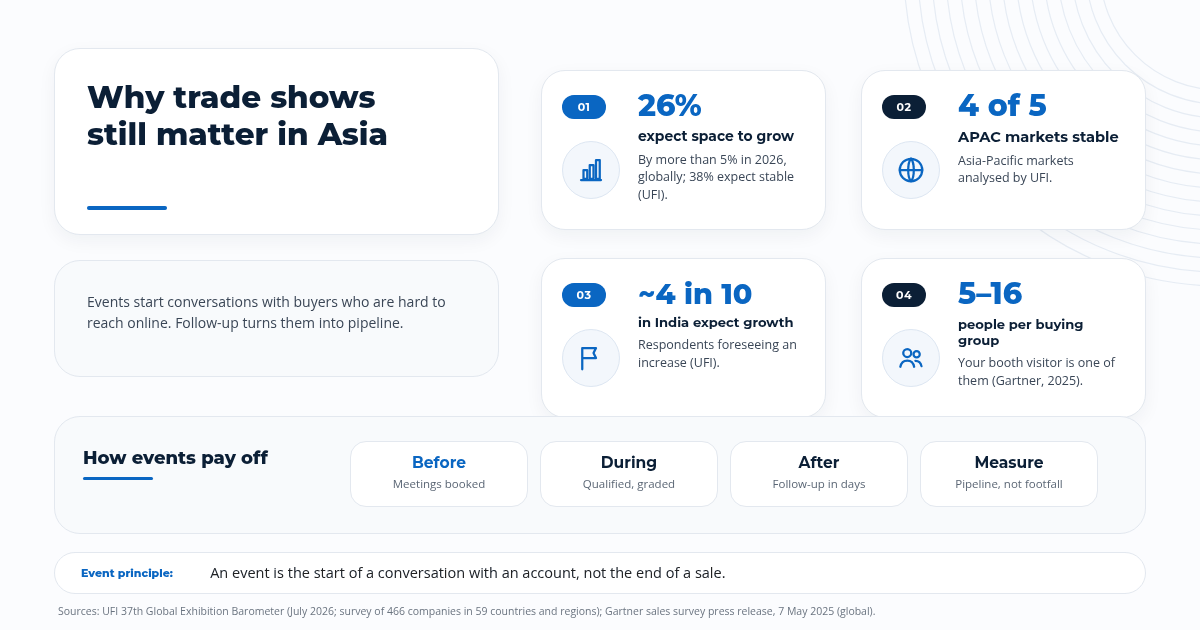
UFI’s 37th Global Exhibition Barometer, based on a survey of 466 companies in 59 countries and regions concluded in June 2026, found that 26% of respondents globally expected rented exhibition space in their home market to grow by more than 5% in 2026, and 38% expected it to stay stable.1 In Asia-Pacific, respondents in four of the five markets analysed expected stable activity, while in India nearly four in ten expected an increase.1
Reason 2 — Face-to-Face Builds Trust
In our experience, many Asian buyers prefer to meet in person before trusting a new supplier. An event lets you meet several prospects in a few days. See Relationship Selling in Asia.
Reason 3 — Some Buyers Are Hard to Reach Online
Buyers in traditional industries and some regions are less active on LinkedIn. Events can reach them in person. See How to Reach B2B Decision-Makers in Asia Who Aren’t on LinkedIn.
Reason 4 — One Visitor Is Rarely the Whole Buying Group
Gartner’s May 2025 global survey found B2B buying groups of five to 16 people across up to four functions.2 The person at your booth is usually one of several people who will decide.
Practical Rule (our take)
An event is the start of a conversation with an account, not the end of a sale.
The Event-to-Pipeline Plan
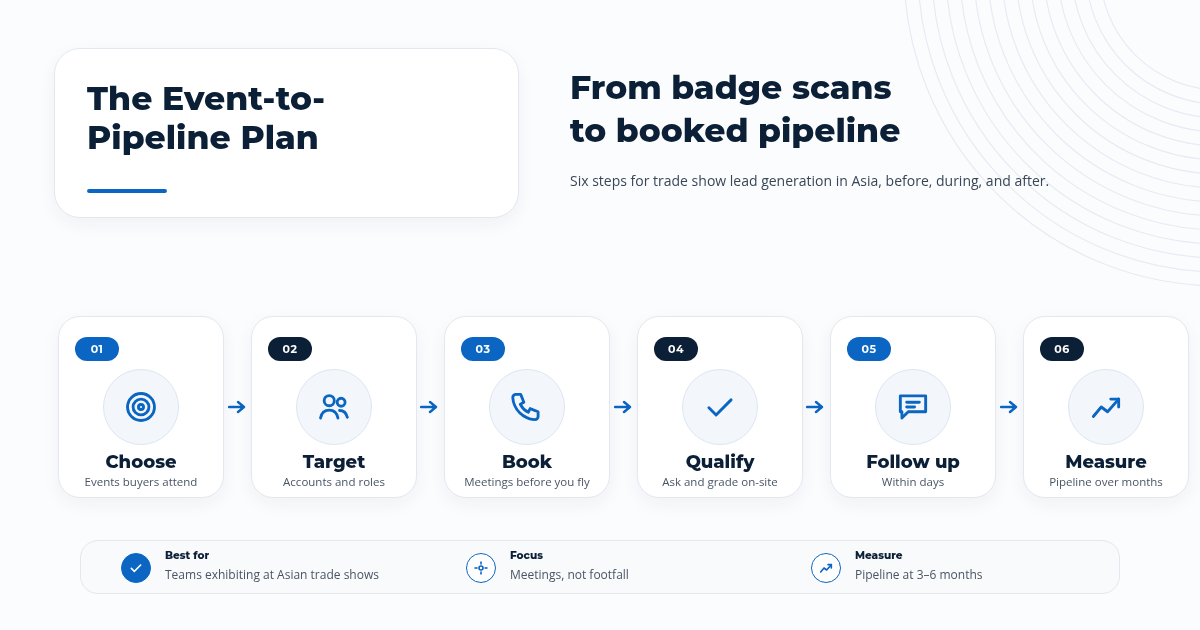
Our framework, the Event-to-Pipeline Plan, has six steps across before, during, and after the event.
Step 1 — Choose the Right Event
What to Check
- Do your target buyers attend, or mainly competitors and suppliers?
- Is it regional or local?
- What did past exhibitors in your category get from it?
Relatable Example
A big regional show may draw more people, but a smaller national industry event may bring more of your actual buyers.
Step 2 — Target Attendees
Build a list of target accounts and the roles you want to meet. Research who is likely to attend, speak, or exhibit.
Step 3 — Book Meetings Before You Fly
Start outreach several weeks before the event by email, LinkedIn, and phone. Offer a specific reason to meet, such as a short demo or a conversation about a known industry problem.
Step 4 — Qualify On-Site
Use three or four questions to separate real prospects from browsers (see the qualification section below). Record answers immediately.
Step 5 — Follow Up Fast
Send a personal follow-up within days, referencing the conversation and proposing a dated next step. Use the buyer’s language and preferred channel.
Step 6 — Measure Pipeline
Track meetings held, opportunities created, and pipeline value over the following months. Compare with the full cost of the event.
Practical Rule (our take)
Plan the follow-up before you plan the booth.
Exhibit, Attend, or Walk the Floor?
You do not always need a booth. Choose the format that fits your goal and stage.
| Option | Best For (Our View) | Watch For |
|---|---|---|
| Exhibit with a booth | Visibility in a market you have committed to | High cost; staff tied to the booth |
| Attend as a visitor | Meeting target accounts and exhibitors | Fewer walk-up conversations |
| Speak or sponsor a session | Credibility with a specific audience | Long lead times; cost |
| Host a side meeting or dinner | Deeper conversations with a few accounts | Invitations must be booked early |
Relatable Example
If you are testing a new market, attending with ten pre-booked meetings may teach you more than a booth that mostly attracts suppliers.
Who Does What at the Booth
Small teams get overwhelmed fast. Agree roles before the event.
- Meeting lead: runs booked meetings and decides next steps.
- Booth host: greets visitors, asks the first qualifying question, and introduces the right person.
- Note taker or lead capturer: records grades and notes right after each conversation.
- Follow-up owner: sends follow-ups after the event and keeps the CRM updated (CRM: customer relationship management system).
Our View
One person can hold two roles. Nobody should hold all four.
Events in Different Asian Markets
Events work differently from market to market. These are patterns from our experience, not rules.
- Language: materials and staff who speak the local language often help, especially in Japan, Vietnam, Thailand, and Indonesia.
- Business cards: still widely exchanged in many Asian markets; bring plenty and record them the same day.
- Follow-up channel: some buyers reply to email; others respond better to a phone call or an introduction.
- Hierarchy: the senior decision-maker may not visit the booth. Ask who else should be involved.
For Japan-specific norms, read How to Sell B2B in Japan as a Foreign Company.
Before the Event: A Pre-Event Checklist
| When (Our Guidance) | What to Do |
|---|---|
| Several weeks before | Confirm target accounts and roles; start outreach |
| Two to three weeks before | Book meetings; confirm booth logistics |
| One week before | Confirm meetings; brief the team; prepare follow-up templates |
| Day before | Reconfirm key meetings; check lead capture tools |
Our View
Arriving with booked meetings changes the event. Walk-ups become a bonus, not the plan.
Localize your invitations where needed. In markets such as Japan, Vietnam, Thailand, and Indonesia, local-language outreach and materials often help. See Why Your Home-Market Sales Playbook Stalls in Asia—and What to Localize First.
During the Event: How to Qualify Conversations
Four Questions to Ask (Our Recommendation)
- What is your role in decisions like this?
- What problem are you working on this year?
- Who else would be involved?
- Would a follow-up meeting in the next few weeks be useful?
Simple Lead Grades
| Grade | Meaning | Follow-Up |
|---|---|---|
| A | Target account, clear need, agreed next step | Meeting proposal within days |
| B | Target account, interest, no next step yet | Personal follow-up with useful content |
| C | Not a target or no clear need | Light nurture or no follow-up |
Relatable Example
A procurement manager says, “We review suppliers in Q1, and our operations director decides.” That is a B lead with a clear next step: ask for an introduction to the operations director before Q1.
After the Event: The Follow-Up Sequence
Our Recommended Sequence
- Within a few days: personal message referencing the conversation, with a proposed next step.
- About a week later: a second message adding something useful, such as a case study or answer to a question they raised.
- Two to three weeks later: a phone call or LinkedIn message for those who have not replied.
- Ongoing: move B and C leads into a longer nurture program.
Our View
In our experience, speed and relevance matter more than volume. A short, specific note beats a generic “nice to meet you” email sent to everyone.
Keep data protection rules in mind when you import event contacts and send follow-ups, and check how they apply in each market with a qualified adviser. This is not legal advice.
Mini Case: The Event That Felt Like Success (Speaker’s Account)
At our October 2026 masterclass, Expand In Asia’s founder described a pattern he has seen: a company attends an event, feels it must move fast, hires locally, and announces it before the market has been tested.3 Expectations go up immediately, and the evidence is not there yet.
What This Shows (Our View)
An event can create real conversations. Only follow-up meetings and pipeline show whether there is a market. Track the leading indicators after an event before making hiring decisions. See Leading Indicators That Prove Your Asia Expansion Is Working.
Need Help Turning Events Into Pipeline?
Expand In Asia helps B2B companies get more from events in Asia through:
- target account research;
- attendee targeting;
- pre-event outreach by email, LinkedIn, and phone;
- meeting booking before the event;
- localized invitations and messaging;
- booth traffic and lead capture support;
- tailored post-event follow-up;
- reporting on meetings and pipeline.
Combining Events With Outbound
Events work best as part of a wider outreach plan, not as a one-off.
How They Fit Together (Our View)
- Before: outbound outreach books the meetings and warms up target accounts.
- During: the event gives you face-to-face time that builds trust faster.
- After: outbound follow-up keeps the conversation going and reaches the other people in the buying group.
- Between events: steady outreach keeps your pipeline moving, so you are not waiting for the next show.
Relatable Example
A company that meets a plant manager at a manufacturing show can use follow-up calls and emails to reach the finance and procurement contacts who were never at the event.
How to Measure Event ROI
| Metric | What It Shows | When to Measure |
|---|---|---|
| Meetings booked before the event | Pre-event outreach quality | Before the event |
| Meetings held at the event | Real buyer access | During the event |
| A-grade leads | Qualified interest | Right after the event |
| Follow-up meetings | Whether interest is real | Weeks after |
| Opportunities created | Pipeline from the event | One to three months after |
| Pipeline value vs. full cost | Return on the event | Three to six months after |
Full Event Cost Includes
- booth or ticket fees;
- travel and accommodation;
- staff time;
- materials and shipping;
- pre-event and follow-up outreach.
Practical Rule (our take)
Judge an event at three to six months, not on the last day.
Common Trade Show Mistakes
Mistake 1 — No Meetings Booked in Advance
You depend on luck.
Mistake 2 — Scanning Without Qualifying
Badges are not leads.
Mistake 3 — Slow Follow-Up
Interest fades fast after an event.
Mistake 4 — Generic Follow-Up Emails
“Nice to meet you” is not a next step.
Mistake 5 — Measuring Footfall
Visitors are activity, not pipeline.
Mistake 6 — Hiring on Event Excitement
Validate demand before you commit headcount.
Event Readiness Scorecard
Score each area from 1 to 5. This is our own simplified framework, not an industry benchmark. For a broader check, take the free Asia Expansion Readiness Assessment Tool.
| Area | 1 — Weak | 3 — Developing | 5 — Strong |
|---|---|---|---|
| Event choice | Popularity | Some buyer evidence | Target buyers confirmed |
| Target list | None | Broad | Accounts and roles listed |
| Pre-event outreach | None | Last-minute | Weeks ahead, multi-channel |
| Meetings booked | None | A few | Calendar mostly planned |
| On-site qualification | Badge scans | Notes | Questions and grades |
| Follow-up | Generic, slow | Within weeks | Personal, within days |
| Localization | English only | Some materials | Language and channel by market |
| Measurement | Footfall | Leads | Meetings and pipeline |
Score Interpretation (Our Guidance)
| Total Score | What It Means |
|---|---|
| 34–40 | Event-ready. Focus on follow-up speed. |
| 27–33 | Good base. Book more meetings in advance. |
| 20–26 | Activity-focused. Add qualification and measurement. |
| Below 20 | Not ready. Build target lists and outreach first. |
Need More Qualified Meetings at Your Next Event?
Next Steps With Expand In Asia
- Choose events by buyer, not by size.
- Book meetings before you fly.
- Qualify and grade on-site.
- Follow up within days and measure pipeline.
To go deeper:
Ready to Implement These Strategies?
Book a free 30-minute strategy session where we’ll audit your current growth approach and identify your highest-leverage opportunities in Asian markets.
Frequently Asked Questions
1. How do you generate B2B leads from trade shows in Asia?
Our recommendation: choose events your target buyers actually attend, book meetings with them before the event, qualify conversations on-site with a few simple questions, and follow up within days in the buyer’s preferred channel and language. Measure meetings and pipeline, not badge scans.
2. What should you do before a trade show?
Before a trade show, define your target accounts, research which of them will attend, and start outreach a few weeks ahead to book meetings at the event. Prepare your team, materials, and follow-up messages in advance, including local-language versions where needed.
3. What should you do after a trade show?
After a trade show, sort contacts by how qualified they are, follow up quickly with a message that references your conversation, and propose a specific next step. Log every contact and outcome in your CRM so you can measure what the event produced.
4. How do you measure trade show ROI in Asia?
In our view, measure meetings held, qualified opportunities created, and pipeline value from the event over the following months, compared with the full cost of attending. Badge scans and booth visitors are useful activity measures, but they are not pipeline.
5. Is the trade show industry in Asia growing in 2026?
According to UFI’s 37th Global Exhibition Barometer (survey concluded June 2026), respondents in four of the five Asia-Pacific markets analysed expected stable activity in 2026, while in India nearly four in ten expected an increase.
6. Should we hire a local team after a successful event?
Not on event excitement alone. In our view, use the event to start conversations, then validate demand through follow-up meetings and pipeline before you commit to hiring.
7. How can Expand In Asia help with events?
Expand In Asia is a Singapore-based B2B outbound and market-entry partner. Its Event Traffic Engine service supports pre-event marketing, attendee targeting, multi-channel outreach, booth traffic, lead capture, and tailored follow-up for events in Asia.
What is the best event your team has attended in Asia, and why did it work? Share it in the comments, or pass this guide to whoever plans your event calendar.
About the author: Joel Berou is Asia Expansion & Revenue Growth Advisor at Expand In Asia, a Singapore-based B2B outbound and market-entry partner that helps companies build pipeline across Asian markets. This article draws on the October 2026 masterclass presented by Nicolas Levitte, Founder & CEO of Expand In Asia. Last updated: October 16, 2026.
Sources
-
UFI, The Global Association of the Exhibition Industry. 37th Global Exhibition Barometer (July 2026; survey concluded June 2026). https://www.ufi.org/app/uploads/2026/07/UFI-Barometer-37th-Edition.pdf ↩↩
-
Gartner, Inc. “Gartner Sales Survey Finds 74% of B2B Buyer Teams Demonstrate ‘Unhealthy Conflict’ During the Decision Process” (press release, 7 May 2025). https://www.gartner.com/en/newsroom/press-releases/2025-05-07-gartner-sales-survey-finds-74-percent-of-b2b-buyer-teams-demonstrate-unhealthy-conflict-during-the-decision-process ↩
-
Expand In Asia. Breaking Into Asia masterclass (October 2026). https://expandin.asia/events-webinars/ ↩