Demand Generation vs. Lead Generation: What B2B Teams in Asia Need to Know
How to create market interest, capture buyer intent, and turn both into qualified pipeline
Many B2B companies expanding into Asia ask the same question:
“Should we focus on demand generation or lead generation?”
The better question is:
“Where is the buyer right now?”
If the market does not know your brand, does not understand your category, or does not feel urgency around the problem, lead generation alone will struggle.
If the market already understands the problem and buyers are actively looking for solutions, demand generation without a lead capture and qualification process will waste interest.
That is the difference.
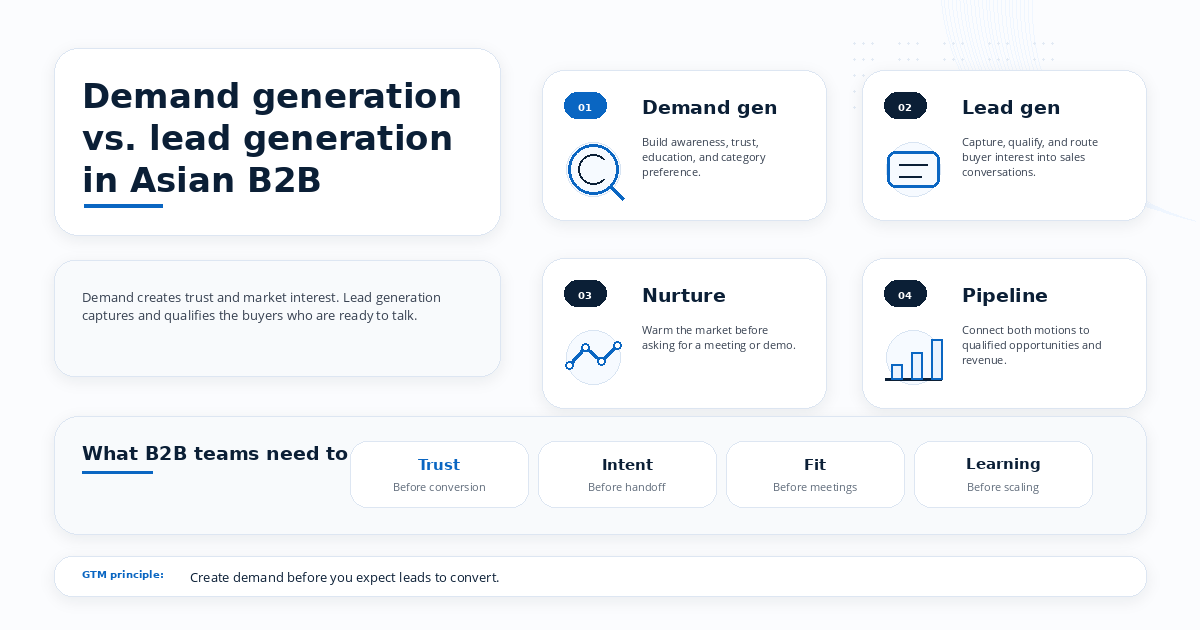
Demand generation creates awareness, trust, education, and interest before the buyer is ready to talk.
Lead generation captures and qualifies buyers who show enough interest to enter a sales process.
Both matter.
But in Asia, the balance between the two can vary significantly by market, buyer maturity, category awareness, trust level, and sales cycle complexity.
Gartner describes B2B buying as nonlinear, with buyers moving through buying tasks such as problem identification, solution exploration, requirements building, and supplier selection across digital and human interactions. That means B2B teams cannot assume every buyer is ready for a sales meeting just because they clicked an ad, downloaded a guide, or accepted a LinkedIn connection.
Forrester also reported that 86% of B2B purchases stall during the buying process, reinforcing why companies need to support buyers before, during, and after lead capture.
This guide explains the difference between demand generation and lead generation, why both matter in Asian markets, and how B2B teams should combine them to create qualified pipeline.
- TL;DR — Key Takeaways
- Demand generation creates market interest. It educates buyers, builds trust, shapes the problem, and makes your company easier to consider.
- Lead generation captures buyer interest. It turns intent signals into contacts, conversations, meetings, and sales-qualified opportunities.
- Lead generation struggles when demand is weak. If buyers do not understand the problem or trust the vendor, they are less likely to respond.
- Demand generation struggles without lead capture. If interest is not tracked, qualified, and followed up, pipeline gets lost.
- Asian markets often require more trust-building before conversion. This is especially true when the brand is unknown, the category is new, or local proof is limited.
- The strongest GTM motion combines both. Demand generation warms the market; lead generation identifies and qualifies buyers who are ready to engage.
- Measure both separately. Demand generation should not be judged only by leads. Lead generation should not be judged only by meetings booked.
If you only do one thing: stop treating demand generation and lead generation as competing strategies. Use demand generation to create readiness and lead generation to convert readiness into pipeline.
Who This Comparison Is For (and Not For)
This Guide Is For
- B2B companies expanding into Asia.
- SaaS, cybersecurity, cloud, fintech, HR tech, healthtech, AI, data, logistics tech, managed services, and professional-services companies.
- Founders deciding whether to invest in content, webinars, events, outbound, or appointment setting.
- CROs and sales leaders building pipeline in new Asian markets.
- CMOs and demand generation teams supporting regional growth.
- SDR and BDR teams running LinkedIn, email, and phone outreach.
- RevOps teams measuring lead quality, campaign attribution, and pipeline contribution.
This guide is especially useful if your team is asking:
- Why are we generating leads but not enough opportunities?
- Should we run awareness campaigns or outbound campaigns first?
- Why do webinar attendees not convert?
- Why are SDRs struggling to book qualified meetings?
- How do we build trust before asking for a demo?
- How should demand generation and lead generation work together?
This Guide Is Not For
This guide may be less useful if:
- your product is fully self-serve;
- your buyers already have strong purchase intent;
- your company only needs transactional form fills;
- your team has no defined ICP;
- your sales team does not follow up properly;
- your company wants instant conversion without market education;
- your team measures marketing only by volume, not quality.
Practical fit check: If your company sells a considered B2B product in Asia, you likely need both demand generation and lead generation.
What Demand Generation Means
Demand generation is the process of creating awareness, interest, trust, and preference in the market before a buyer is ready to speak with sales.
It is not just “brand awareness.”
It is not just content marketing.
It is the work of helping buyers understand:
- the problem;
- the cost of doing nothing;
- available solution options;
- why the issue matters now;
- what good looks like;
- why your company is credible;
- what next step makes sense.
Demand Generation Activities
Demand generation may include:
- thought leadership;
- educational content;
- webinars;
- market reports;
- industry guides;
- LinkedIn content;
- event participation;
- founder-led content;
- partner content;
- buyer education campaigns;
- ungated resources;
- account-based marketing;
- category education.
Simple Example
A B2B SaaS company entering Singapore may publish a guide on:
“How regional sales teams can validate ASEAN pipeline before hiring local reps.”
That guide may not immediately generate demo requests.
But it can make the buyer more aware of the problem, more familiar with the company, and more open to future outreach.
That is demand generation.
What Lead Generation Means
Lead generation is the process of identifying, capturing, and qualifying potential buyers.
It is closer to sales conversion.
Lead generation asks:
- who showed interest?
- who fits our ICP?
- who is worth following up with?
- who is ready for a sales conversation?
- who should be nurtured instead?
- who should be disqualified?
Lead Generation Activities
Lead generation may include:
- gated content;
- demo forms;
- consultation forms;
- webinar registration;
- LinkedIn outreach;
- cold email;
- appointment setting;
- outbound calling;
- event lead capture;
- referral follow-up;
- landing pages;
- paid campaigns;
- SDR/BDR qualification.
Simple Example
A B2B company runs LinkedIn and email outreach to 500 target accounts in the Philippines.
Prospects who respond positively are qualified based on company fit, buyer role, problem relevance, urgency, and next step.
That is lead generation.
Demand Generation vs. Lead Generation: Side-by-Side Comparison
| Area | Demand Generation | Lead Generation |
|---|---|---|
| Primary goal | Create market interest and trust | Capture and qualify buyer interest |
| Buyer stage | Earlier stage | Later stage |
| Main question | “Why should buyers care?” | “Who is ready to talk?” |
| Typical activities | Content, webinars, events, thought leadership | Forms, outbound, SDR follow-up, qualification |
| Output | Awareness, engagement, education, preference | Leads, meetings, qualified opportunities |
| Best metric | Engagement quality and pipeline influence | Sales-accepted meetings and opportunities |
| Risk if overused | Interest without conversion | Leads without readiness |
| Asia relevance | Builds trust and market familiarity | Converts active interest into pipeline |
Simple Difference
Demand generation warms the market.
Lead generation captures the market.
You need both if you want qualified pipeline.
Why the Distinction Matters in Asia
Asia is not one market.
A buyer in Singapore may already understand your category.
A buyer in Indonesia may need trust-building and local proof.
A buyer in Vietnam may need practical education.
A buyer in Japan may need credibility and precision.
A buyer in the Philippines may need a clear business case and fast follow-up.
If your team treats every market as sales-ready, lead generation may underperform.
If your team only educates the market but never captures interest, demand generation may not produce pipeline.
Why Asia Often Requires Both
Many Asian market-entry motions involve:
- low brand awareness;
- limited local proof;
- multi-stakeholder buying;
- relationship-led decision-making;
- language or localization needs;
- market education;
- channel testing;
- slower trust-building;
- different levels of category maturity.
LinkedIn and Edelman’s 2025 B2B thought leadership report highlights the importance of “hidden buyers,” or internal stakeholders who influence purchases even when they are not the obvious target contact. That matters because demand generation often reaches people who are not yet visible as leads but may still influence the decision.
When Demand Generation Should Come First
Demand generation should come first when the market is not ready for direct conversion.
Prioritize Demand Generation If:
- your brand is unknown in the market;
- buyers do not understand your category;
- your product requires education;
- trust is low;
- local proof is limited;
- outbound response is weak;
- buyers are not actively searching;
- the purchase involves multiple stakeholders;
- your offer is complex or strategic.
Example
A cybersecurity platform entering Vietnam may need educational content before expecting demo requests.
A market-entry guide, webinar, buyer checklist, or practical explainer may perform better than asking for a demo immediately.
Useful Demand Generation Assets
| Buyer Need | Useful Asset |
|---|---|
| Understand the problem | Explainer article |
| Understand market relevance | Country-specific guide |
| Compare approaches | Framework or checklist |
| Trust the vendor | Case study or partner content |
| Influence internal stakeholders | Executive summary |
| Reduce uncertainty | FAQ or implementation guide |
When Lead Generation Should Come First
Lead generation should come first when there is already enough buyer readiness.
Prioritize Lead Generation If:
- the market understands the problem;
- buyers are actively looking;
- your category is familiar;
- your ICP is well defined;
- your offer is easy to explain;
- you have strong proof;
- the buyer has urgent pain;
- your sales team can follow up quickly;
- you can qualify leads properly.
Example
A B2B SaaS company with a proven product entering Singapore may already have clear buyer demand.
In that case, LinkedIn outreach, email sequences, webinar follow-up, and appointment setting can work well if the targeting and messaging are strong.
Useful Lead Generation Assets
| Lead Source | Follow-Up Asset |
|---|---|
| Outbound reply | Discovery call agenda |
| Webinar attendee | Practical next-step email |
| Demo form | Qualification checklist |
| Event lead | Meeting recap and use case |
| Referral | Contextual intro deck |
| Content download | Related case study or guide |
How Demand Generation and Lead Generation Work Together
The strongest B2B pipeline strategy connects both motions.
A Simple Flow
- Demand generation educates and builds trust.
- Buyers engage with content, events, or conversations.
- Lead generation captures intent signals.
- SDRs or BDRs qualify the buyer.
- Sales accepts the meeting.
- Pipeline is created.
- Market feedback improves future demand generation.
Example Workflow
A company entering Indonesia might:
- publish a Bahasa-ready market guide;
- run a partner webinar;
- share LinkedIn content;
- engage target accounts;
- invite relevant buyers to a practical session;
- follow up with attendees;
- qualify interested accounts;
- book meetings with sales-ready buyers;
- nurture non-ready buyers.
Demand generation creates familiarity.
Lead generation turns familiarity into structured sales conversations.
Content, Webinars, and Thought Leadership in Demand Generation
Demand generation depends heavily on useful content.
But useful does not mean generic.
In Asia, content should often be localized by:
- market;
- buyer role;
- business maturity;
- pain point;
- industry;
- sales stage;
- proof requirement.
Useful Demand Generation Content
- market-entry guides;
- buyer education articles;
- webinars;
- event panels;
- comparison guides;
- ROI frameworks;
- executive briefs;
- LinkedIn posts;
- case studies;
- checklists;
- industry explainers.
Thought Leadership and Hidden Buyers
Thought leadership can help influence stakeholders who may not fill out a form or reply to sales outreach.
LinkedIn and Edelman’s 2025 report notes that B2B buying decisions are shaped by broader internal influencers, not only the obvious buyer. This makes thought leadership especially useful for complex Asian B2B buying groups.
Practical Rule
Do not create content only for the person who downloads it.
Create content for the people they need to convince internally.
LinkedIn, Email, and Appointment Setting in Lead Generation
Lead generation depends on execution.
In Asia, that usually means combining:
- LinkedIn outreach;
- email outreach;
- calling;
- event follow-up;
- webinar follow-up;
- referral paths;
- SDR or BDR qualification.
What Good Lead Generation Should Do
Good lead generation should:
- target the right accounts;
- reach the right buyer roles;
- use relevant messaging;
- identify real interest;
- qualify fit and timing;
- avoid wasting AE time;
- capture objections;
- create clean CRM data;
- route good meetings to sales.
What Bad Lead Generation Looks Like
Bad lead generation focuses on:
- contact volume;
- generic messaging;
- unqualified meetings;
- weak account research;
- poor follow-up;
- unclear handoff;
- no market feedback.
The result is activity without pipeline.
Why Leads Fail to Convert Into Pipeline
Many companies think they have a lead generation problem.
Often, they have a demand readiness problem.
Common Reasons Leads Do Not Convert
| Problem | What It Means |
|---|---|
| Weak fit | The lead is not the right account or persona |
| Low trust | The buyer does not know the brand well enough |
| Poor timing | The buyer is interested but not ready |
| Weak proof | The case study does not reduce risk |
| Wrong CTA | The ask is too early or too aggressive |
| No buying committee | Only one contact is engaged |
| Poor handoff | Sales lacks context |
| No nurture | Non-ready leads are abandoned |
Forrester reported that B2B purchases often stall during the buying process, which is a reminder that buyer interest does not automatically become revenue.
What to Do Instead
Separate leads into:
- sales-ready;
- nurture-ready;
- education-ready;
- poor-fit;
- partner-fit;
- future-market-fit.
Not every lead should become a sales meeting.
Metrics to Track for Demand Generation
Demand generation should not be judged only by lead volume.
Demand Generation Metrics
| Metric | What It Shows |
|---|---|
| Target-account engagement | Whether the right companies are paying attention |
| Content engagement | Which topics resonate |
| Webinar attendance | Market education and interest |
| LinkedIn engagement | Brand familiarity and senior visibility |
| Return visits | Growing interest |
| Content-assisted meetings | Whether content supports conversion |
| Pipeline influence | Whether demand contributes to revenue |
| Objection reduction | Whether content helps buyers progress |
Practical Rule
Demand generation should be measured by market readiness and pipeline influence—not just impressions.
Metrics to Track for Lead Generation
Lead generation should not be judged only by meetings booked.
Lead Generation Metrics
| Metric | What It Shows |
|---|---|
| Positive reply rate | Message relevance |
| Lead-to-meeting conversion | Initial interest quality |
| Meeting held rate | Buyer commitment |
| Sales acceptance rate | Qualification quality |
| Opportunity creation | Commercial relevance |
| Disqualification reasons | Targeting accuracy |
| Pipeline value | Business impact |
| Time to follow-up | Execution discipline |
Practical Rule
A smaller number of high-quality meetings is better than a large number of poor-fit meetings.
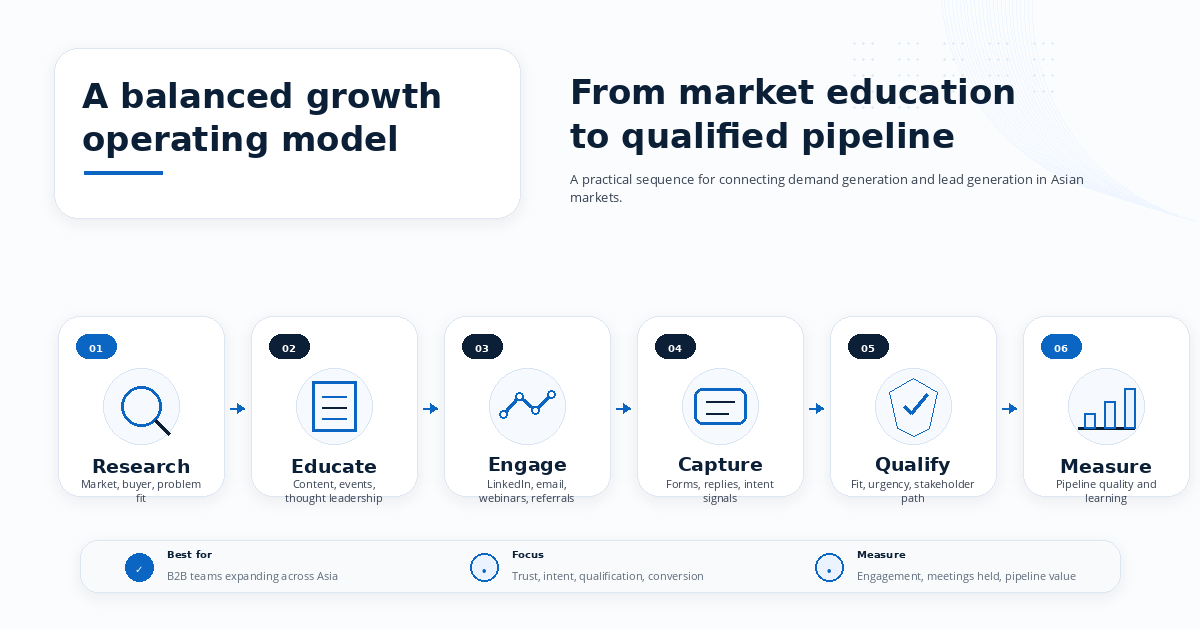
A Balanced B2B Growth Model for Asia
Use this six-step model.
Step 1 — Research
Understand the market, buyer maturity, category awareness, ICP, and proof gaps.
Step 2 — Educate
Create content, webinars, LinkedIn insights, and buyer enablement that build trust.
Step 3 — Engage
Use LinkedIn, email, events, webinars, referrals, and partners to create interaction.
Step 4 — Capture
Turn signals into leads through replies, forms, event follow-ups, and intent indicators.
Step 5 — Qualify
Confirm account fit, buyer role, urgency, pain, stakeholder path, and next step.
Step 6 — Measure
Track both demand health and lead quality.
Common Mistakes to Avoid
Mistake 1 — Expecting Lead Generation to Create Demand Alone
Outbound can open conversations, but it cannot fully replace trust, market education, and proof.
Mistake 2 — Running Demand Generation Without Capture
Awareness without follow-up creates hidden waste.
Mistake 3 — Measuring Demand Generation Only by Leads
Demand generation may influence buyers before they convert.
Mistake 4 — Measuring Lead Generation Only by Meetings
Meetings that do not convert are not enough.
Mistake 5 — Using the Same Motion Across Asia
Singapore, Indonesia, Vietnam, Japan, Korea, Thailand, the Philippines, and India may require different levels of education and trust-building.
Mistake 6 — No Nurture Path
Not-ready buyers should not be discarded.
Mistake 7 — Weak Sales Handoff
Sales needs context, not just a calendar booking.
Mistake 8 — Ignoring Hidden Buyers
Internal influencers may shape the deal without ever becoming a visible lead.
Demand and Lead Generation Scorecard
Score each area from 1 to 5.
| Area | 1 — Weak | 3 — Developing | 5 — Strong |
|---|---|---|---|
| Market understanding | Broad Asia assumptions | Some country research | Clear market, ICP, and maturity view |
| Demand generation | Little education | Some content | Strong market education and trust-building |
| Lead generation | Generic outreach | Basic campaigns | Targeted, qualified, account-aware lead capture |
| Content quality | Product-focused | Some buyer value | Localized, role-specific buyer enablement |
| Channel mix | One channel | Two-channel motion | LinkedIn, email, events, webinars, referrals |
| Qualification | Any reply counts | Basic fit check | Written fit, pain, urgency, and next-step criteria |
| Nurture | No follow-up | Basic sequences | Clear path by buyer readiness |
| Sales handoff | Calendar booking only | Some notes | Context-rich CRM and meeting handoff |
| Measurement | Activity only | Leads and meetings | Pipeline quality, sales acceptance, market learning |
| Feedback loop | No review | Occasional updates | Continuous improvement by market and persona |
Score Interpretation
| Total Score | Recommendation |
|---|---|
| 42–50 | Strong demand and lead generation system; optimize by market |
| 34–41 | Good foundation; improve nurture, handoff, or measurement |
| 25–33 | Activity exists, but pipeline quality may be inconsistent |
| Below 25 | Rebuild strategy before scaling campaigns |
Need Help Building Qualified Pipeline in Asia?
Expand In Asia helps B2B companies combine demand creation and lead generation through:
- ICP definition;
- target-account research;
- localized outreach;
- LinkedIn and email engagement;
- appointment setting;
- lead qualification;
- CRM reporting;
- market feedback.
Talk to Expand In Asia about building qualified pipeline in Asia →
Next Steps With Expand In Asia
Demand generation and lead generation should not compete.
They should work together.
Demand generation helps buyers understand, trust, and remember you.
Lead generation identifies which buyers are ready for a real sales conversation.
For B2B teams expanding across Asia, the right balance depends on market maturity, buyer awareness, local trust, proof, channel fit, and sales readiness.
For more pipeline tactics, read:
10 Best B2B Qualified Lead Generation Strategies for 2026
For broader market-entry planning, read:
Go-to-Market (GTM) Strategies for Asia
Schedule a consultation with Expand In Asia →
Ready to Implement These Strategies?
Book a free 30-minute strategy session where we’ll audit your current growth approach and identify your highest-leverage opportunities in Asian markets.
Frequently Asked Questions
1. What is the difference between demand generation and lead generation?
Demand generation creates awareness, trust, and buyer interest. Lead generation captures and qualifies that interest into leads, meetings, and opportunities.
2. Which comes first: demand generation or lead generation?
It depends on buyer readiness. If the market is unfamiliar with your brand or category, demand generation should usually come first. If buyers already understand the problem and are actively looking, lead generation can start earlier.
3. Why does lead generation fail in Asia?
Lead generation often fails when buyers are not ready, targeting is too broad, messaging is generic, proof is weak, or sales follow-up is poor.
4. Why is demand generation important in Asia?
Demand generation helps build trust, educate buyers, and influence internal stakeholders across complex markets and buying groups.
5. Can outbound be part of demand generation?
Yes. Outbound can support demand generation when it shares useful insight, educates the buyer, and builds familiarity—not only asks for meetings.
6. What should B2B teams measure?
Measure demand health, engagement, positive replies, meetings held, sales acceptance, opportunity creation, pipeline value, objections, and market learning.