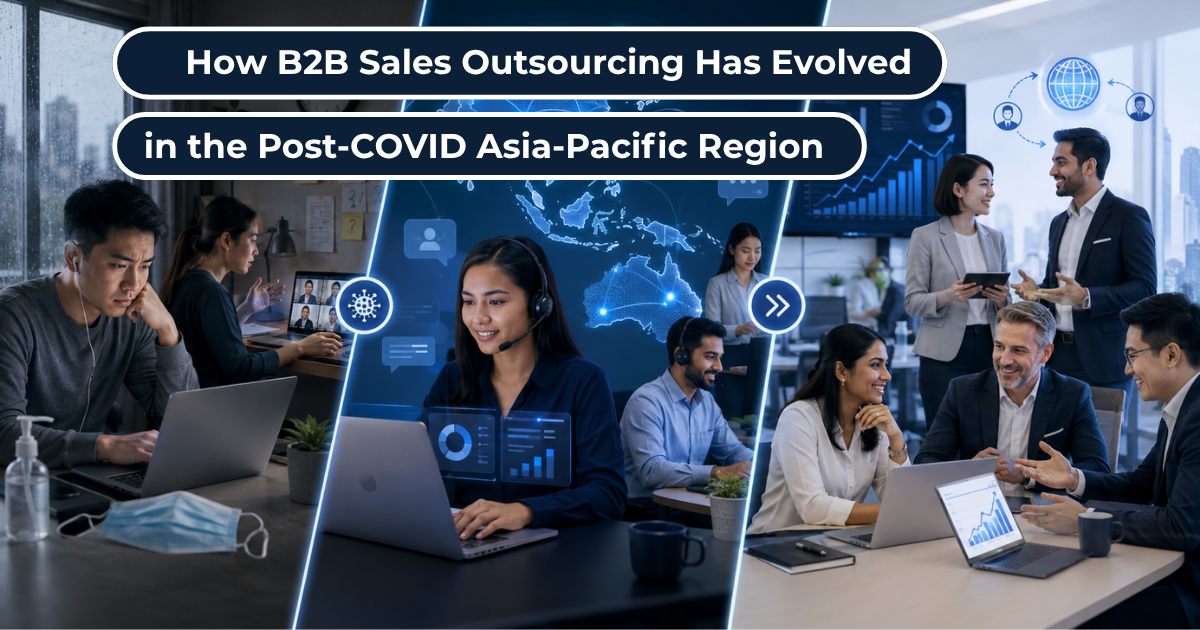
How B2B Sales Outsourcing Has Evolved in the Post-COVID Asia-Pacific Region
From low-cost execution to a more strategic, localised, and measurable growth model
Before COVID-19, B2B sales outsourcing was often evaluated through a relatively narrow lens:
- How many SDRs can the provider supply?
- How many calls or emails can they complete?
- How much cheaper is the outsourced team than hiring locally?
- How quickly can appointments be booked?
Those questions still matter. But they no longer define the category.
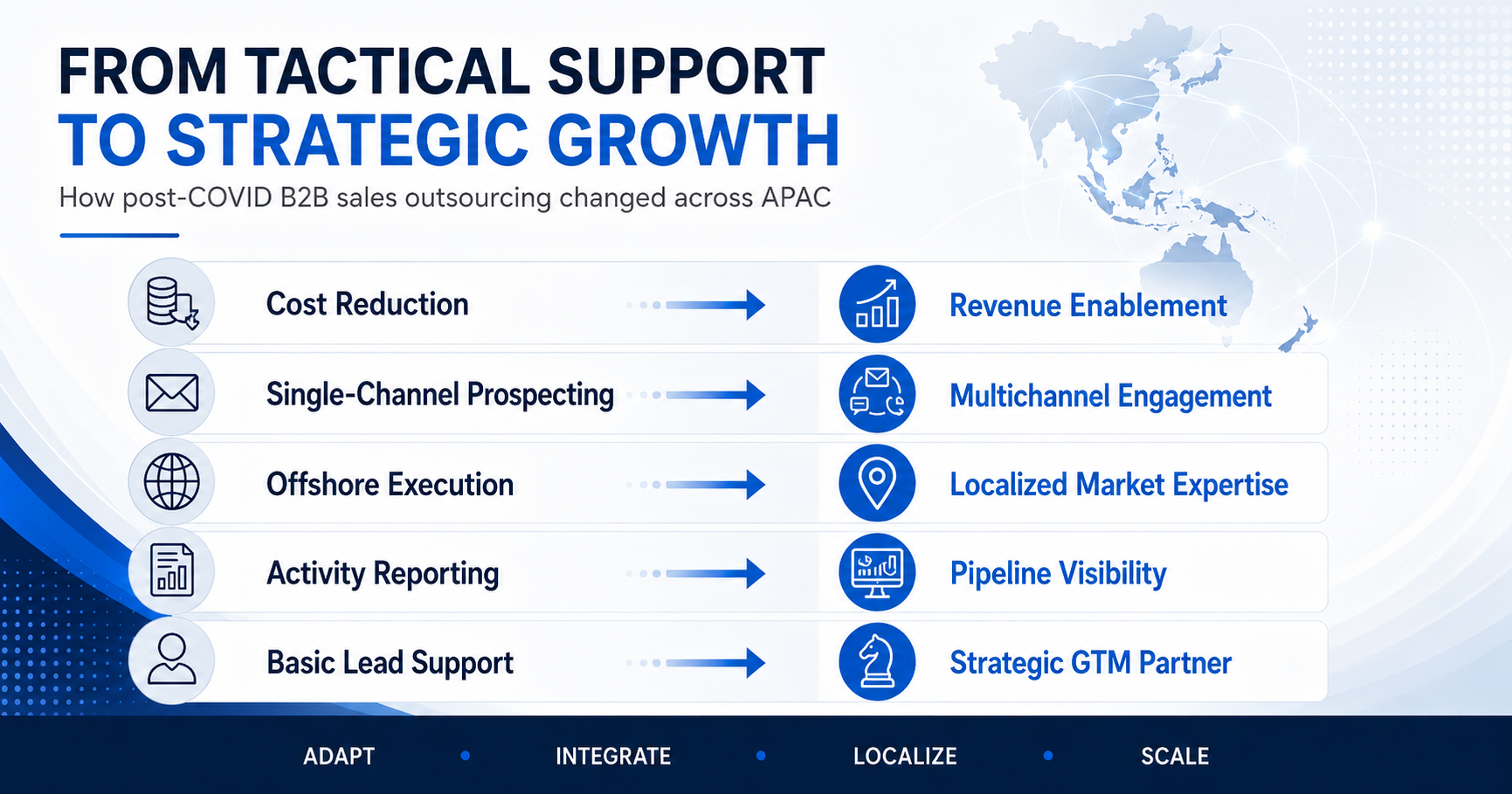
Across Asia-Pacific, the post-COVID model has moved toward hybrid engagement, distributed sales teams, multichannel prospecting, local market expertise, technology-enabled reporting, and closer integration between outsourced and internal revenue teams.
The shift is part of a broader change in B2B buying. McKinsey’s research found that customers increasingly expect a mix of in-person meetings, remote human interaction, and digital self-service rather than a single sales channel.
Outsourcing itself has also become more strategic. Deloitte’s 2024 Global Outsourcing Survey reported that 80% of surveyed executives planned to maintain or increase third-party outsourcing investment, while 50% were already using outsourced providers for front-office capabilities such as sales, marketing, and research and development.
The post-COVID question is therefore no longer simply:
“Should we outsource sales?”
It is:
“Which sales capabilities should remain internal, which should be outsourced, and how should the two operate together across highly different APAC markets?”
- TL;DR — Key Takeaways
- Outsourcing has moved beyond cost reduction. Companies increasingly use external partners to access market expertise, specialist talent, technology, and operating flexibility.
- Remote selling became permanent, but not exclusive. Post-COVID B2B selling is hybrid, combining digital research, remote meetings, self-service, phone, social channels, events, and in-person engagement.
- Activity reporting is being replaced by pipeline visibility. Modern programmes are expected to track meetings held, sales acceptance, opportunities, conversion, and market feedback.
- AI has increased execution capacity but also raised the bar for relevance. Gartner found that 73% of surveyed B2B buyers actively avoid suppliers that send irrelevant outreach.
- The strongest model is often hybrid. Internal teams retain strategy, product expertise, negotiation, and closing while outsourced teams support research, prospecting, outreach, qualification, and market validation.
- Generic APAC coverage is less credible. Companies now expect country-specific knowledge, localised messaging, relevant languages, and awareness of different buyer structures.
If you only do one thing: stop evaluating outsourced sales providers solely on cost and appointment volume. Evaluate how well they integrate with your GTM strategy and convert market activity into accepted pipeline.
Who This Blog Is For—and Who It Is Not For
This guide is for B2B companies trying to understand how sales outsourcing across Asia-Pacific has changed since COVID—and what those changes mean for their current or future go-to-market model.
This Guide Is For
- CEOs and founders entering Asia-Pacific who are deciding whether to build a local sales team, outsource prospecting, or use a hybrid model.
- CROs and sales leaders reviewing whether their current outsourcing provider still fits modern buyer expectations and sales processes.
- Regional and country managers responsible for creating pipeline across several APAC markets without hiring a separate SDR team in every country.
- GTM and revenue operations leaders who need outsourced teams to integrate with internal CRM, reporting, qualification, and opportunity-management processes.
- B2B companies replacing an activity-based vendor with a partner that can support market validation, localisation, and qualified pipeline generation.
- Organisations evaluating AI-assisted sales execution but concerned about generic outreach, weak relevance, and damage to their brand.
- Companies selling complex B2B solutions such as SaaS, cybersecurity, cloud services, fintech, professional services, HR technology, healthtech, data, and enterprise software.
This guide is particularly relevant when your company:
- has a proven product or service in another region;
- has identified APAC as a strategic growth area;
- needs pipeline before committing to permanent local headcount;
- already has internal sellers who can manage qualified opportunities;
- requires market-specific insight rather than broad regional activity;
- wants to understand which sales functions should remain internal and which can be outsourced.
This Guide Is Not For
This guide may be less relevant if:
- You are looking only for the cheapest offshore calling team. The post-COVID model discussed here focuses on capability, integration, localisation, and pipeline quality—not labour arbitrage alone.
- Your product has not achieved product-market fit in any region. Outsourcing can test market response, but it cannot fix a fundamentally unvalidated offer.
- Your company sells a highly transactional, low-value product where success depends almost entirely on very high call volume and short sales cycles.
- You expect an outsourcing provider to own your entire commercial strategy. Internal leadership should still own positioning, pricing, product expertise, opportunity management, and major sales decisions.
- Your internal team cannot follow up on qualified meetings. Even a strong outsourced programme will underperform when leads are not handled quickly and consistently.
- Every buyer conversation requires a senior technical specialist from the first touch. In that case, a traditional outsourced SDR model may need to be replaced by a more specialised or hybrid team.
- You want one generic campaign for the whole Asia-Pacific region. The modern model requires market prioritisation and localisation rather than treating APAC as one uniform territory.
Practical fit check: This guide is most useful if you are not simply asking whether outsourcing is cheaper. It is designed for companies asking how outsourced sales should work now—and how to build a model that creates qualified pipeline, market insight, and scalable regional growth.
The Pre-COVID Outsourcing Model
Before the pandemic, many sales-outsourcing engagements were designed around operational efficiency.
The typical model looked like this:
- Build a prospect list.
- Assign offshore callers or SDRs.
- Run email or telephone outreach.
- Book appointments.
- Report activity to the client.
The commercial case was often centred on:
- labour-cost reduction;
- rapid headcount expansion;
- call volume;
- list production;
- appointment volume;
- reduced internal recruitment.
This model could work for straightforward campaigns. Its limitations became clearer when companies attempted to sell complex B2B solutions across Asia-Pacific.
The region is not one homogeneous territory. Buyers in Singapore, Indonesia, Japan, Australia, India, Vietnam, the Philippines, Malaysia, and South Korea can differ significantly in:
- decision-making hierarchy;
- preferred communication style;
- language;
- procurement;
- relationship expectations;
- digital maturity;
- average deal size;
- tolerance for unsolicited outreach.
A centrally produced script and a broadly defined “APAC list” were rarely enough.
What COVID Changed Permanently
The pandemic forced sales organisations to operate without many of the mechanisms they had previously relied on:
- conferences;
- trade shows;
- office visits;
- in-person discovery;
- customer dinners;
- face-to-face partner meetings;
- physical market-entry teams.
Remote selling changed from an optional channel into a core commercial capability.
McKinsey subsequently found that B2B customers wanted the right mix of remote human engagement, digital self-service, and in-person interaction throughout the buying journey.
This changed the role of outsourced teams.
An outsourced SDR was no longer simply a caller working from a remote location. The outsourced team increasingly needed to operate across:
- video meetings;
- CRM workflows;
- LinkedIn;
- email;
- telephone;
- online events;
- digital content;
- partner channels;
- intent and account data.
The pandemic accelerated this transition, but buyer expectations have kept it in place.
Evolution 1 — From Office-Based to Remote-First Execution
Before
Sales outsourcing was often managed through central delivery centres with tightly controlled office operations.
After
Distributed and remote teams became commercially acceptable and technically workable.
The modern outsourced team may include:
- an account lead in Singapore;
- SDRs elsewhere in Southeast Asia;
- research support in the Philippines or India;
- local-language specialists in individual markets;
- internal account executives in Europe, Australia, or North America.
This gives companies more flexibility in assembling the right mix of talent.
What Improved
Remote-first execution made it easier to:
- access talent outside expensive commercial hubs;
- deploy specialists market by market;
- extend campaign coverage across time zones;
- combine regional and local resources;
- scale without establishing a new physical office immediately.
What Became Harder
Distributed execution also increased the need for:
- better documentation;
- stronger CRM discipline;
- clear ownership;
- secure data access;
- consistent messaging;
- recorded handoffs;
- regular campaign reviews.
Remote working did not remove the need for management. It made operating discipline more important.
Evolution 2 — From Single-Channel to Hybrid Engagement
A cold-email-only or telephone-only campaign is increasingly insufficient for complex B2B markets.
McKinsey’s B2B Pulse research describes hybrid selling as a response to buyers wanting multiple channels and more flexibility. Its research also found that 65% of customers preferred remote human interaction or digital self-service in the buying journey.
More recent McKinsey research continues to describe omnichannel selling as a defining characteristic of B2B growth leaders.
The Modern Channel Mix
| Channel | Role in the Sales Motion |
|---|---|
| Research, visibility, connection-building, persona access | |
| Structured messaging, proof, follow-up | |
| Phone | Direct qualification and objection discovery |
| Video meetings | Remote discovery and stakeholder alignment |
| Webinars | Education and multi-account engagement |
| Events | Trust-building and in-person relationship development |
| Partners and referrals | Credibility and market access |
| Digital content | Buyer education and self-directed research |
Why This Matters in APAC
Not every channel performs equally in every market.
For example:
- LinkedIn may provide strong access to regional executives in Singapore.
- Phone and referral-led engagement may play a larger role in relationship-driven segments.
- Local-language email may be necessary in some markets.
- Events may remain particularly important for high-value enterprise relationships.
The outsourced provider’s role has therefore expanded from executing a campaign to coordinating a broader engagement system.
Evolution 3 — From Generic APAC Coverage to Market Localisation
One of the most significant post-COVID changes is the decline of the generic “one team covers all of Asia” proposition.
Companies are more aware that APAC contains distinct commercial environments.
Earlier Model
- One English sequence
- One account list
- One ICP
- One CTA
- One reporting dashboard
- One regional campaign
Current Model
- Country-specific market priorities
- Local account definitions
- Market-appropriate buyer roles
- Persona-specific outreach
- Relevant proof and use cases
- Adapted channels and timing
- Market-level reporting
Localisation Now Covers More Than Language
A properly localised sales motion considers:
- who owns the problem;
- how authority is distributed;
- how direct a message should be;
- which customer examples create trust;
- whether the buyer expects education before a meeting;
- how referrals influence credibility;
- whether the opportunity should be handled locally or regionally.
This is one reason outsourced partners with genuine market experience can provide more value than providers offering only lower-cost headcount.
Evolution 4 — From Headcount Supply to Specialist Capability
Traditional outsourcing was often sold as an alternative labour pool.
The emerging model is capability-led.
Deloitte’s outsourcing research shows that organisations increasingly use external partners not only for efficiency but also to address talent and capability gaps. Its 2024 survey found that half of executives identified talent acquisition as a leading challenge affecting strategic priorities.
Capabilities Companies Now Expect
A modern provider may be expected to supply:
- market researchers;
- data specialists;
- SDRs;
- local-language prospectors;
- campaign strategists;
- copywriters;
- sales-operations support;
- account-based outreach;
- webinar support;
- CRM reporting;
- call coaching;
- market intelligence.
The Commercial Difference
The old question was:
“How many SDRs do we get?”
The better question is:
“Which capabilities do we need to validate and scale this market?”
This shift is particularly relevant in APAC because the execution requirement can change from one country to another.
Evolution 5 — From Activity Reporting to Pipeline Accountability
Before COVID, many outsourced programmes relied heavily on volume metrics.
Examples:
- calls completed;
- emails sent;
- contacts added;
- meetings booked;
- LinkedIn requests sent.
These metrics remain useful for diagnosing execution. They are not sufficient for evaluating commercial value.
Modern Performance Layers
Activity
- Accounts researched
- Contacts verified
- Calls made
- Emails delivered
- Social touches
Engagement
- Positive replies
- Live conversations
- Referrals
- Meetings booked
Quality
- Meetings held
- Show rate
- Sales acceptance
- Disqualification reasons
Pipeline
- Opportunities created
- Meeting-to-opportunity conversion
- Pipeline value
- Stage progression
- Revenue
Intelligence
- Buyer objections
- Competitor mentions
- Pricing feedback
- Market triggers
- Product questions
Gartner’s 2025 buyer research reinforces why relevance matters: 73% of surveyed buyers said they actively avoid suppliers sending irrelevant outreach.
That makes quality and learning more important than raw volume.
Evolution 6 — From Disconnected Vendors to Integrated GTM Partners
The earlier vendor relationship was often transactional:
- the client supplied a script;
- the provider supplied labour;
- leads were handed over;
- the client managed everything else.
The post-COVID model is increasingly integrated.
A Modern Shared Operating Model
| Function | Internal Team | Outsourced Partner | Shared |
|---|---|---|---|
| Revenue strategy | ✓ | ||
| Market selection | ✓ | ||
| ICP design | ✓ | ||
| Account research | ✓ | ||
| Messaging | ✓ | ||
| Outbound execution | ✓ | ||
| Early qualification | ✓ | ✓ | |
| Opportunity management | ✓ | ||
| Negotiation and closing | ✓ | ||
| Reporting | ✓ | ||
| Market learning | ✓ |
This structure gives the client strategic control while allowing the outsourced team to bring specialised execution capacity.
Why Integration Matters
Without integration:
- SDR feedback does not reach the GTM team;
- rejected leads are not analysed;
- messaging remains unchanged;
- CRM information becomes incomplete;
- market learning is lost;
- internal sellers lose confidence in the channel.
A strong partnership should improve the client’s understanding of the market—not merely generate appointments.
Evolution 7 — From Manual Prospecting to AI-Assisted Execution
AI has changed how outsourced teams work.
It can support:
- account research;
- contact enrichment;
- message drafting;
- call summaries;
- CRM data entry;
- meeting preparation;
- intent interpretation;
- reporting;
- sequence optimisation.
This creates greater execution capacity.
It also creates a new risk: more generic outreach sent more quickly.
Gartner reported in 2026 that B2B buying journeys are becoming more self-directed and digitally mediated, with 45% of surveyed buyers saying they had used AI during a recent purchase.
At the same time, buyers continue to value human involvement at critical moments. Gartner separately reported that 69% of surveyed B2B buyers turned to sales representatives to validate AI-generated insights.
What This Means for Outsourcing
The winning model is not “AI instead of SDRs.”
It is:
- AI for research and administration;
- humans for relevance and judgement;
- AI for preparation;
- humans for conversation;
- AI for pattern detection;
- humans for qualification and trust.
Providers that simply use AI to multiply message volume may create more activity while reducing brand credibility.
What Has Not Changed
The post-COVID model is different, but several fundamentals remain constant.
Clear ICP
No channel or technology can compensate for targeting the wrong companies.
Relevant Value Proposition
Buyers still need a credible reason to engage.
Trust
Remote communication has not removed the importance of relationships.
McKinsey found that in-person engagement remained meaningful even as digital and remote channels expanded; 76% of surveyed buyers described face-to-face visits as a sign that a supplier valued the relationship.
Product Expertise
Complex opportunities still need internal expertise during discovery, evaluation, and negotiation.
Follow-Up Discipline
Qualified meetings produce little value when internal sellers respond slowly.
Management
Outsourced teams still require:
- objectives;
- coaching;
- feedback;
- governance;
- performance review;
- strategic direction.
The Modern APAC Outsourcing Operating Model
A practical post-COVID structure has four layers.
Layer 1 — Central Strategy
The internal team defines:
- revenue target;
- market priorities;
- product positioning;
- commercial boundaries;
- opportunity ownership.
Layer 2 — Localised Execution
The outsourced partner supports:
- market research;
- account mapping;
- contact identification;
- messaging adaptation;
- multichannel outreach;
- early qualification.
Layer 3 — Shared Pipeline Operations
Both teams manage:
- CRM standards;
- meeting handoff;
- qualification;
- feedback;
- campaign optimisation;
- reporting.
Layer 4 — Internal Conversion
The internal team owns:
- deeper discovery;
- solution design;
- proposals;
- negotiation;
- closing;
- customer onboarding.
This model is not appropriate for every business, but it provides a practical balance between speed and control.
Is Your Current Outsourcing Model Outdated?
Use this checklist.
| Question | Outdated Signal | Modern Signal |
|---|---|---|
| How is the provider selected? | Lowest monthly cost | Capability and market fit |
| How is APAC treated? | One region, one campaign | Country-level priorities |
| How is outreach run? | One main channel | Coordinated multichannel |
| How is messaging built? | Generic script | Market and persona adaptation |
| What is reported? | Activity | Quality, pipeline, learning |
| How is data handled? | Separate spreadsheets | Integrated CRM workflow |
| How is feedback shared? | Informal | Structured weekly review |
| What is the provider’s role? | Appointment supplier | GTM execution partner |
| How is technology used? | Basic automation | AI-assisted, human-reviewed |
| How does scaling happen? | Add more headcount | Replicate a validated motion |
Interpretation
If most of your answers fall in the outdated column, the issue may not be outsourcing itself.
The issue may be the design of the engagement.
Illustrative Before-and-After Scenario
Editorial note: This scenario is illustrative and should not be presented as a published client case study.
Before
A North American SaaS company hires an outsourced provider to target “APAC.”
The provider:
- builds one regional list;
- sends one English email sequence;
- reports emails and meetings;
- hands all appointments to one internal account executive.
After three months:
- meetings are spread across unrelated markets;
- many contacts are too junior;
- internal sales rejects most meetings;
- no clear market insight is produced.
After Redesign
The company restructures the programme.
Phase 1 — Prioritise
It selects Singapore and Australia based on:
- existing customer proof;
- accessible buyers;
- pricing fit;
- internal closing capacity.
Phase 2 — Localise
Separate ICPs and messaging are built for each market.
Phase 3 — Integrate
The outsourced partner is added to the CRM, meeting feedback is required within 48 hours, and qualification is written into the operating process.
Phase 4 — Report
The dashboard tracks:
- meetings held;
- sales acceptance;
- opportunity creation;
- pipeline;
- buyer feedback.
The result is not simply more activity. It is a clearer understanding of where the company should invest.
What the Next Phase May Look Like
The next phase of sales outsourcing in APAC is likely to combine three forces.
1. More AI-Assisted Execution
Administrative work, research, summarisation, and reporting will continue to become more automated.
2. Greater Demand for Human Relevance
As AI-generated outreach increases, buyers may place more value on relevant human interaction.
Gartner’s 2025 research predicted that by 2030, 75% of B2B buyers would prefer sales experiences prioritising human interaction over AI.
3. More Modular Sales Teams
Companies may increasingly assemble teams around capabilities rather than employment status:
- internal sales leader;
- outsourced SDR team;
- local market adviser;
- technical specialist;
- channel partner;
- customer-success owner.
4. Stronger Data Governance
Distributed teams and AI-assisted workflows increase the importance of:
- access control;
- data lineage;
- suppression lists;
- retention policies;
- cross-border transfer review;
- clear vendor governance.
5. More Outcome-Based Commercial Models
Providers may face greater pressure to link pricing and performance to:
- sales-accepted meetings;
- opportunities;
- pipeline;
- market milestones.
However, outcome-based models will still require precise written definitions to avoid incentivising volume over quality.
Is Your APAC Sales-Outsourcing Model Still Built for the Pre-COVID Era?
Expand In Asia helps B2B companies redesign outsourced sales around:
- priority Asian markets;
- localised ICPs;
- multichannel prospecting;
- qualified meetings;
- CRM-integrated reporting;
- structured market feedback;
- controlled regional scaling.
Talk to Expand In Asia about your current APAC sales model →
Next Steps with Expand In Asia
B2B sales outsourcing in Asia-Pacific has become more sophisticated.
The strongest programmes now combine:
- internal strategic ownership;
- outsourced execution;
- market localisation;
- hybrid engagement;
- modern technology;
- disciplined reporting;
- shared learning.
Expand In Asia supports B2B companies entering and scaling across Asian markets through outsourced sales execution, lead generation, market validation, and GTM support.
Compare Sales-Outsourcing Providers
Read:
25 Best B2B Sales Outsourcing Companies Worth Hiring in 2026
Understand the Wider Market
Read:
Top Market Trends Reshaping Asian Expansion in 2025
Review Your Current Model
Discuss your:
- priority countries;
- ICP;
- sales cycle;
- internal capacity;
- channel mix;
- reporting;
- expansion timeline.
Schedule a consultation with Expand In Asia →
Ready to Implement These Strategies?
Book a free 30-minute strategy session where we’ll audit your current growth approach and identify your highest-leverage opportunities in Asian markets.
Frequently Asked Questions
1. How did COVID change B2B sales outsourcing?
COVID accelerated remote selling, digital collaboration, distributed sales teams, video-based discovery, and reliance on CRM and digital outreach.
The longer-term change is that these practices became permanent components of hybrid B2B sales rather than temporary substitutes for in-person engagement.
2. Is sales outsourcing now more strategic than before?
In many organisations, yes.
Deloitte’s outsourcing survey found that companies were using external providers for front-office capabilities, including sales and marketing, and that most surveyed executives planned to maintain or increase outsourcing investment.
3. Does remote selling work across every APAC market?
Remote selling is useful across the region, but the right channel mix varies.
Some markets and buyer segments may respond well to digital-first engagement, while others require referrals, local-language communication, events, or in-person relationship-building.
4. Has in-person selling become less important?
It has become one part of a broader hybrid model.
McKinsey’s research indicates that buyers value flexibility across digital, remote, and face-to-face channels.
5. What should an outsourced provider report?
At minimum:
- account coverage;
- positive replies;
- meetings booked;
- meetings held;
- show rate;
- sales acceptance;
- opportunity creation;
- pipeline value;
- disqualification reasons;
- market feedback.
6. How is AI changing outsourced sales?
AI can improve research, drafting, CRM administration, summarisation, and reporting.
However, excessive automation can create generic outreach. Human review remains essential for relevance, qualification, judgement, and trust.
7. Should outsourced teams close deals?
That depends on the sales cycle.
Outsourced teams can support qualification and early discovery, but complex enterprise opportunities often benefit from internal product specialists and senior commercial owners during evaluation, negotiation, and closing.
8. What is the best outsourcing model for a company entering APAC?
For many companies, a hybrid structure works well:
- internal team owns strategy and closing;
- outsourced team manages research, prospecting, outreach, and early qualification;
- both teams share reporting and market learning.