A plain-language map of B2B cold outreach data privacy laws in Asia: the data protection and anti-spam rules across eight markets, last verified 11 November 2026
Important: this is general information, not legal advice.
This article is general information, last verified 11 November 2026 (Asia/Manila). It is not a legal opinion and does not create a lawyer-client relationship. Laws and regulator guidance change, and how they apply depends on your facts. Expand In Asia is not a law firm. Confirm your outreach plans with a qualified adviser in each market before you start.
You have a prospect list for five Asian markets.
Your team is ready to email and call.
Then someone asks whether the outreach is allowed under the rules that apply.
Nobody is sure.
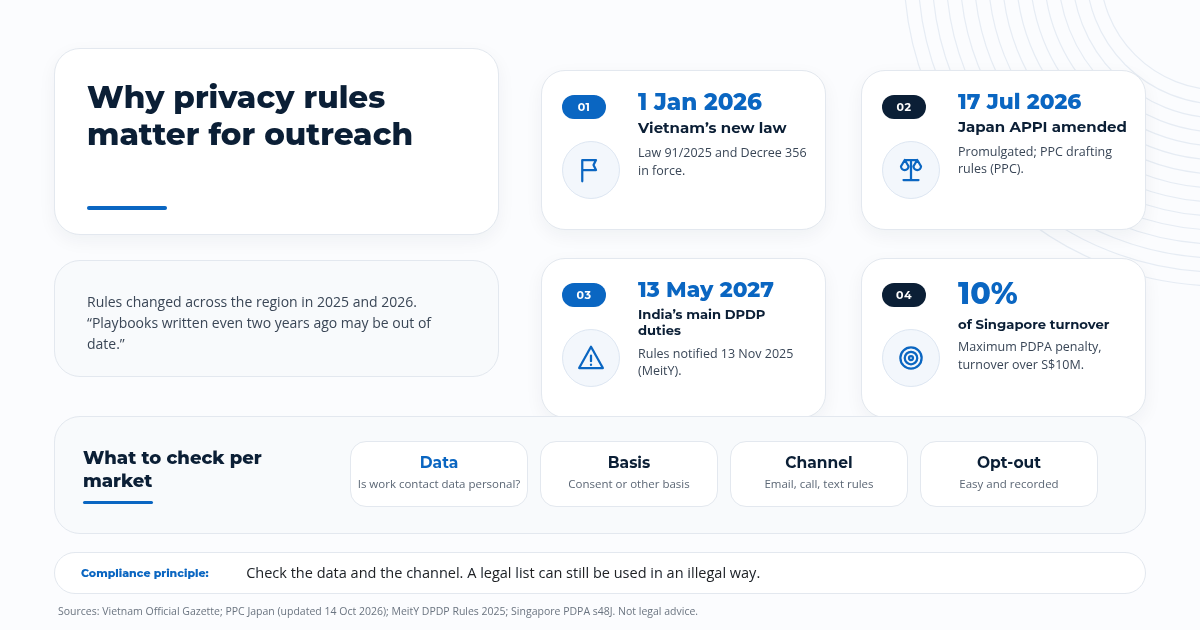
Those rules matter more in 2026 than they did a few years ago. B2B cold outreach data privacy laws in Asia changed fast: Vietnam brought in a new law in January 2026, Japan promulgated an APPI amendment in July 2026 (commencement still to be specified), Malaysia’s amendments took effect in phases in 2025, and India’s rules started phasing in from November 2025. Indonesia’s 2022 law is in force after its 2024 transition; confirm any 2026 implementing regulation with counsel.
In plain terms, before you reach out, you need to know:
- whether a work email or phone number counts as personal data;
- whether you need consent or another legal basis;
- which anti-spam or telemarketing rules apply;
- who enforces the law, and what is changing next.
Most sales teams ask:
“Can we cold email in Asia?”
But for B2B companies entering several Asian markets, the better question is:
“What does each market’s law require for the data we hold and the channel we use?”
Because there is no single Asian rule. A practice that is fine in Singapore may need a different approach in Vietnam.
This guide builds on our pillar, Breaking Into Asia: 5 Critical Asia Expansion Mistakes, and on our guide to reaching B2B decision-makers who aren’t on LinkedIn.
- TL;DR — Key Takeaways
- All eight markets covered here have national data protection laws.
- Several changed in 2025–2026: Malaysia, Vietnam, Japan, Indonesia, and India.
- Singapore generally excludes B2B messages from its Do Not Call rules, but other PDPA and anti-spam duties can apply.
- Vietnam’s new law requires consent and opt-out for advertising using personal data.
- Japan’s anti-spam law allows business emails to publicly disclosed business addresses, unless the recipient refuses.
- India’s main DPDP obligations apply from 13 May 2027.
- Our view: keep a record of where each contact came from and an easy opt-out in every channel.
If you only do one thing: before launching outreach in a new market, ask local counsel two questions: which legal basis applies to our prospect data, and which channel rules apply.
Who This Guide Is For—and Who It Is Not For
This Guide Is For
- sales and marketing leaders running outreach into Asia;
- founders building prospect lists for new markets;
- operations and RevOps teams (RevOps: revenue operations, who manage sales tools and data);
- companies working with outbound partners in several countries;
- anyone who needs a starting map before speaking to counsel.
This guide is especially useful if your team is asking:
- Which laws apply in each market?
- Who are the regulators?
- What changed recently?
- What should we ask our lawyers?
This Guide Is Not For
- you need a legal opinion (speak to counsel);
- you process sensitive data such as health or financial records;
- you sell only to consumers (B2C rules are often stricter);
- you need guidance on cross-border data transfers in detail.
Practical fit check: if you are about to email or call prospects in an Asian market for the first time, use this guide to prepare questions for your lawyer.
What B2B Cold Outreach Data Privacy Laws in Asia Mean
B2B cold outreach data privacy laws in Asia are the national data protection, anti-spam, and telemarketing rules that govern how companies collect, store, and use people’s contact details to email, call, or message prospects at other businesses. They differ by country in how they treat work contact details, consent, opt-outs, and penalties.
Three Types of Rules to Check
| Rule Type | What It Covers | Example |
|---|---|---|
| Data protection law | Collecting and using personal data | Singapore PDPA, Japan APPI, India DPDP Act |
| Anti-spam rules | Commercial emails and messages | Singapore Spam Control Act, Japan anti-spam law |
| Telemarketing rules | Marketing calls and texts | Singapore DNC provisions, Vietnam Decree 91/2020 |
Practical Rule (our take)
Check the data and the channel. How a list is used matters as much as where it came from.
Why Data Privacy Matters for B2B Outreach in Asia
Reason 1 — The Rules Changed Recently
Reason 2 — Penalties Are Real
Singapore’s PDPA allows financial penalties of up to 10% of an organization’s annual Singapore turnover if that turnover exceeds S$10 million, or up to S$1 million otherwise.2 Thailand’s PDPA, fully in force since 1 June 2022, provides for administrative fines, and the regulator has published official criteria for imposing them.5
Reason 3 — Work Contact Details Are Treated Differently
Singapore’s PDPA generally excludes business contact information from most of its data protection rules.1 Many other laws in the region do not have the same broad exclusion, so a named person’s work email can still count as personal data.
Reason 4 — Trust Is Part of Selling
In our experience, outreach that respects local rules and makes opting out easy also protects your reputation in markets where buyers talk to each other.
Practical Rule (our take)
Compliance is not only legal protection. It is part of earning trust.
Country-by-Country Overview (Status as of 11 November 2026)
| Country | Main Law | Regulator | Status (Oct 2026) |
|---|---|---|---|
| Singapore | Personal Data Protection Act 2012 (PDPA); Spam Control Act 2007 | Personal Data Protection Commission (PDPC) | In force; 2020 amendments fully in force since Oct 2022 |
| Malaysia | Personal Data Protection Act 2010, as amended in 2024 | Personal Data Protection Commissioner / Department (JPDP) | Amendments in force in phases during 2025 |
| Thailand | Personal Data Protection Act B.E. 2562 (2019) | Personal Data Protection Committee (PDPC Thailand) | Fully in force since 1 June 2022; fines issued since 2024 |
| Philippines | Data Privacy Act of 2012 (Republic Act 10173) | National Privacy Commission (NPC) | In force; no 2026 amendment identified |
| Indonesia | Law No. 27 of 2022 on Personal Data Protection | Confirm the supervising body with counsel; a dedicated PDP agency is provided for in the law | In force since the 2024 end of the statutory transition; confirm any 2026 implementing regulation with counsel |
| Vietnam | Law on Personal Data Protection No. 91/2025/QH15; Decree 356/2025/ND-CP | Ministry of Public Security | In force since 1 Jan 2026 |
| Japan | Act on the Protection of Personal Information (APPI); anti-spam law | Personal Information Protection Commission (PPC) | 2026 amendment promulgated 17 Jul 2026; commencement date not yet specified (within two years, by cabinet order) |
| India | Digital Personal Data Protection Act 2023; DPDP Rules 2025 | Data Protection Board of India; MeitY | Phased: main obligations from 13 May 2027 |
Singapore: PDPA, Do Not Call, and the Spam Control Act
Main Law and Regulator
The Personal Data Protection Act 2012, enforced by the Personal Data Protection Commission (PDPC).
What It Means for B2B Outreach
- Business contact information (such as name, job title, work phone, and work email provided for business purposes) is generally excluded from most of the PDPA’s data protection provisions.1
- Do Not Call (DNC) provisions generally do not apply to marketing messages sent to an organization for its business purposes, according to PDPC guidelines.1 A message offering something for personal use is different.
- Spam Control Act: unsolicited commercial emails or texts sent in bulk must include an unsubscribe facility and an “
” label, and unsubscribe requests must be honored within 10 business days.3 - Penalties: up to 10% of annual Singapore turnover for organizations with turnover above S$10 million, or up to S$1 million.2
For list building, see How to Build a B2B Lead List for the Singapore Market From Scratch.
Malaysia: PDPA 2010 and the 2024 Amendments
Main Law and Regulator
The Personal Data Protection Act 2010, administered by the Personal Data Protection Commissioner and the Personal Data Protection Department (JPDP).
What Changed
The Personal Data Protection (Amendment) Act 2024 came into force in phases in 2025, according to the official Federal Gazette commencement notice (P.U. (B) 522): some sections on 1 January 2025, others on 1 April 2025, and sections 6 and 9 on 1 June 2025.4 Official JPDP guidelines issued in 2025 address appointment of a data protection officer and notification of qualifying data breaches to the Commissioner within 72 hours. Confirm how those guidelines apply to your organisation with counsel.
What It Means for B2B Outreach
The PDPA applies to personal data processed in commercial transactions, and it gives individuals a right to ask you to stop processing their data for direct marketing. Check your legal basis and opt-out process with counsel.
Thailand: PDPA B.E. 2562
Main Law and Regulator
The Personal Data Protection Act B.E. 2562 (2019), fully in force since 1 June 2022, overseen by the Personal Data Protection Committee.
Enforcement
The Act has been fully in force since 1 June 2022. It provides for administrative fines, and the Personal Data Protection Committee has published official criteria for imposing them (2022, amended 2024).5 We do not repeat unofficial reports of individual fine amounts here. Confirm current enforcement practice with counsel.
What It Means for B2B Outreach
The Act requires a legal basis for processing, such as consent or legitimate interest, and gives individuals a right to object to direct marketing. Ask a qualified adviser which basis fits your outreach.
The Philippines: Data Privacy Act of 2012
Main Law and Regulator
The Data Privacy Act of 2012 (Republic Act 10173), enforced by the National Privacy Commission (NPC). The NPC sets administrative fines under its 2022 circular.6
What It Means for B2B Outreach
The law requires a lawful basis, transparency about how data is used, and respect for data subjects’ rights, including objecting to processing. Some organizations must also register with the NPC. Check whether this applies to you.
Indonesia: Law No. 27 of 2022 (PDP Law)
Main Law and Regulator
Law No. 27 of 2022 on Personal Data Protection, fully applicable since October 2024.
Status as of 11 November 2026
The statute was enacted on 17 October 2022. Its transitional provision gave organisations two years to adjust, a period that ended in October 2024.7
An implementing government regulation has been widely described in unofficial copies and law-firm notes as Government Regulation No. 33 of 2026, enacted 16 July 2026 and taking effect 16 January 2027. As of 11 November 2026 we could not independently retrieve that instrument from the official Indonesian regulation databases (peraturan.go.id and peraturan.bpk.go.id). A lawyer should confirm the official text, number, and commencement date before you rely on them. The same applies to which body currently supervises the law day to day.
What It Means for B2B Outreach
The 2022 law already applies. Confirm with counsel whether an implementing regulation has commenced, and review your legal basis, notices, and data handling now rather than later.
Vietnam: The 2025 Personal Data Protection Law
Main Law and Regulator
The Law on Personal Data Protection (Law No. 91/2025/QH15) and its guiding Decree 356/2025/ND-CP, in force since 1 January 2026, replacing Decree 13/2023.8 The Ministry of Public Security leads enforcement.
What It Means for B2B Outreach
- The law sets specific rules for advertising: customers must consent, be informed about how they will be contacted, and be able to refuse and stop receiving ads.8
- Decree 91/2020/ND-CP on spam messages, emails, and calls remains in the official gazette. Article 13 of that decree says advertising telephone calls may be made only from 8:00 a.m. to 5:00 p.m., unless otherwise agreed with the user.8 Confirm current penalty rules with a qualified adviser. We do not cite unofficial fine amounts.
For more on entering Vietnam, read GTM Strategy for B2B Companies Entering Vietnam.
Japan: APPI and the Anti-Spam Law
Main Law and Regulator
The Act on the Protection of Personal Information (APPI), enforced by the Personal Information Protection Commission (PPC).
Status as of 11 November 2026
An amendment bill was submitted on 7 April 2026, passed on 10 July 2026, and promulgated on 17 July 2026.9 The official PPC notice states that, except for some provisions, the amendment takes effect within two years of promulgation on a date specified by cabinet order. As of 11 November 2026, the PPC’s amendment page still said that cabinet orders, rules, and guidelines were being prepared; its latest published discussion materials on that page were dated 14 October 2026. Many details and start dates are not yet final. Do not treat later updates to existing-law Q&A as the amendment’s commencement date.
Advertising Email
Japan’s anti-spam law (the Act on Regulation of Transmission of Specified Electronic Mail) generally allows advertising email without prior opt-in to organizations or business people who publicly disclose their email address, unless they state that they refuse such email.10
India: DPDP Act 2023 and the 2025 Rules
Main Law and Regulator
The Digital Personal Data Protection Act 2023, with the Data Protection Board of India and the Ministry of Electronics and Information Technology (MeitY).
Status as of 11 November 2026
The DPDP Rules, 2025 were notified in the Gazette of India on 13 November 2025 (G.S.R. 846(E)). Under rule 1, Rule 4 (registration and obligations of Consent Managers) comes into force one year after publication — 13 November 2026, two days after this verification. Rules 3, 5 to 16, 22 and 23 — including notice, consent, security, and breach notification — come into force eighteen months after publication, on 13 May 2027. Rules 1, 2 and 17 to 21 came into force on publication. MeitY has also published a corrigendum (16 December 2025); read the official rules and corrigendum together with counsel.11
What It Means for B2B Outreach
Use the time before May 2027 to map what prospect data you hold, why, and how people can withdraw consent. India also has separate telecom rules for marketing calls and texts; check them before phone outreach.
The Compliant Outreach Check
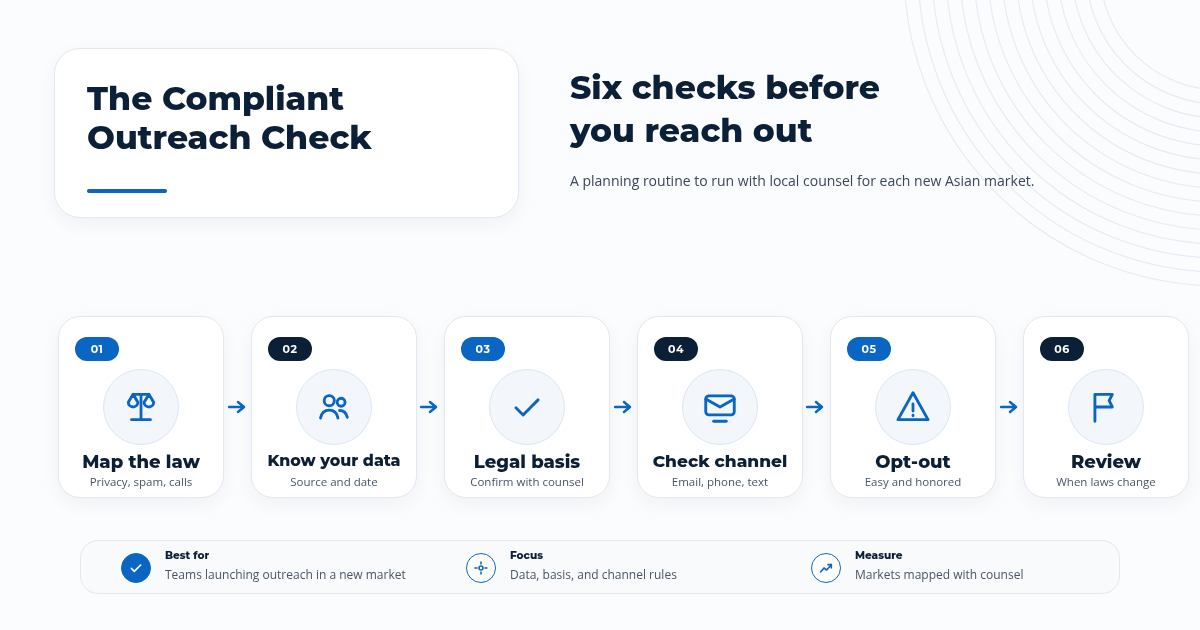
Our framework, the Compliant Outreach Check, is a six-step routine to run with counsel before outreach in each new market. It is a planning aid, not a legal process.
Step 1 — Map the Law
Identify the data protection, anti-spam, and telemarketing rules for the market.
Step 2 — Know Your Data
List what contact data you hold, where it came from, and when.
Step 3 — Confirm the Legal Basis
Ask counsel which basis applies: business contact exclusion, consent, legitimate interest, or another.
Step 4 — Check the Channel
Email, calls, texts, and LinkedIn messages can fall under different rules.
Step 5 — Build the Opt-Out
Make it easy to stop contact in every channel, and record requests.
Step 6 — Review and Record
Review rules when laws change and keep records of what you did and why.
Practical Rule (our take)
If you cannot explain where a contact came from, do not contact them.
Practical Habits That Help in Every Market
These are our recommended habits, not legal requirements.
- Record the source of every contact.
- Keep messages relevant to the person’s business role.
- Identify yourself clearly in every email and call.
- Offer an easy opt-out and honor it quickly.
- Avoid personal numbers and addresses for B2B outreach where you can.
- Store data securely and limit who can export lists.
- Review vendors’ data sources before buying lists.
For channel choices, read Cold Email vs LinkedIn Outreach: Which Converts Better in Asia? and Telemarketing Appointment Setting.
Need Help Running Outreach the Right Way in Asia?
Expand In Asia helps B2B companies run outreach across Asian markets through:
- market prioritization;
- ICP definition (ICP: your ideal customer profile);
- targeted prospect lists with recorded sources;
- localized buyer messaging;
- LinkedIn, email, and phone outreach;
- opt-out handling and contact records;
- appointment setting with decision-makers;
- weekly reporting by market.
Expand In Asia is not a law firm. We work alongside your legal advisers.
Common Mistakes
Mistake 1 — Assuming One Rule for All of Asia
Every market differs.
Mistake 2 — Treating Work Emails as Always Exempt
Singapore’s business contact exclusion is not universal.
Mistake 3 — Using Old Playbooks
Vietnam, Japan, Indonesia, Malaysia, and India have all changed rules since 2024.
Mistake 4 — Buying Lists Without Checking Sources
You may inherit someone else’s problem.
Mistake 5 — No Opt-Out Process
Opt-outs must be easy and honored.
Mistake 6 — Skipping Local Counsel
General guides, including this one, are not legal advice.
Outreach Compliance Readiness Scorecard
Score each area from 1 to 5. This is our own simplified framework, not a legal assessment. For a broader check, take the free Asia Expansion Readiness Assessment Tool.
| Area | 1 — Weak | 3 — Developing | 5 — Strong |
|---|---|---|---|
| Law mapping | None | Some markets | Every target market |
| Data sources | Unknown | Partly recorded | Recorded per contact |
| Legal basis | Not considered | Assumed | Confirmed with counsel |
| Channel rules | Not checked | Email only | Email, calls, texts checked |
| Opt-out | None | Email only | Every channel, recorded |
| Security | Open exports | Some limits | Access controlled |
| Vendors | Not reviewed | Informal | Data sources checked |
| Review cycle | Never | Ad hoc | When laws change |
Score Interpretation (Our Guidance)
| Total Score | What It Means |
|---|---|
| 34–40 | Strong habits. Keep reviewing as laws change. |
| 27–33 | Good base. Confirm legal bases with counsel. |
| 20–26 | Gaps. Record data sources and build opt-outs. |
| Below 20 | High risk. Pause new markets until mapped. |
Need Help With Targeted Prospecting?
Next Steps With Expand In Asia
- Map the rules for each target market.
- Record where every contact came from.
- Confirm legal bases with local counsel.
- Build opt-outs into every channel.
To go deeper:
Ready to Implement These Strategies?
Book a free 30-minute strategy session where we’ll audit your current growth approach and identify your highest-leverage opportunities in Asian markets.
Frequently Asked Questions
1. Do Singapore's Do Not Call rules apply to B2B marketing calls?
According to PDPC guidelines, the Do Not Call provisions generally do not apply to marketing messages sent to an organization for its business purposes. Other PDPA obligations and the Spam Control Act may still apply. The law does not give a blanket answer for every call. Confirm your case with a qualified adviser. This is general information, not legal advice.
2. Which Asian countries have data protection laws that affect B2B outreach?
Singapore, Malaysia, Thailand, the Philippines, Indonesia, Vietnam, Japan, and India all have national data protection laws. Several changed recently: Malaysia’s amendments in 2025, Vietnam’s new law in January 2026, Japan’s amendment promulgated in July 2026, and India’s DPDP Rules in November 2025. Confirm Indonesia’s implementing-regulation status with counsel.
3. Is a business email address personal data?
It depends on the country. Singapore’s PDPA generally excludes business contact information from most of its data protection rules. In many other Asian laws, a named person’s work email can still be personal data. Check each market’s law with local counsel.
4. Do I need consent to send B2B cold emails in Asia?
It varies by country. Japan’s anti-spam law allows advertising emails without prior opt-in to addresses publicly disclosed for business. Vietnam’s new law requires consent for marketing using personal data. Other markets allow other legal bases. Confirm with local counsel; this is not legal advice.
5. What is the current status of India's DPDP Act?
India notified the Digital Personal Data Protection Rules on 13 November 2025. The Data Protection Board was established then, consent manager provisions take effect on 13 November 2026, and most compliance obligations take effect on 13 May 2027.
6. What changed in Vietnam's data protection rules in 2026?
Vietnam’s Law on Personal Data Protection (Law No. 91/2025/QH15) and its guiding Decree 356/2025/ND-CP took effect on 1 January 2026, replacing Decree 13/2023. The law includes specific consent and opt-out rules for advertising.
7. Is this article legal advice?
No. This article is general information, last verified 11 November 2026. It is not legal advice. Laws and regulator guidance change, and how they apply depends on your facts. Speak to a qualified adviser in each market before running outreach.
Which market’s rules have been hardest for your team to work through? Share it in the comments, or pass this guide to whoever owns outreach compliance.
Not legal advice. This article is general information, last verified 11 November 2026 (Asia/Manila). It does not create a lawyer-client relationship. Confirm how these laws apply to your business with a qualified adviser in each market.
About the author: Joel Berou is Asia Expansion & Revenue Growth Advisor at Expand In Asia, a Singapore-based B2B outbound and market-entry partner that helps companies build pipeline across Asian markets. Last verified: 11 November 2026.
Sources
-
Personal Data Protection Commission Singapore. Advisory Guidelines on the Do Not Call Provisions (revised 1 February 2021); Personal Data Protection Act 2012, Eighth Schedule. https://www.pdpc.gov.sg/-/media/Files/PDPC/PDF-Files/Advisory-Guidelines/Advisory-Guidelines-on-the-DNC-Provisions-1-Feb-2021.pdf ↩↩↩
-
Singapore Statutes Online. Personal Data Protection Act 2012, section 48J (as amended). https://sso.agc.gov.sg/Act/PDPA2012 ↩↩
-
Singapore Statutes Online. Spam Control Act 2007, Second Schedule. https://sso.agc.gov.sg/Act/SCA2007 ↩
-
Federal Government Gazette Malaysia, P.U. (B) 522, Appointment of Date of Coming into Operation of the Personal Data Protection (Amendment) Act 2024 (19 December 2024; published 24 December 2024): sections 6 and 9 in operation from 1 June 2025. https://www.pdp.gov.my/wp-content/uploads/2024/12/PENETAPAN-TARIKH-PERMULAAN-KUAT-KUASA.pdf. Personal Data Protection Department, Guideline on Data Breach Notification (2025) and Guideline on data protection officers (2025). https://www.pdp.gov.my/wp-content/uploads/2025/08/GP_DBN_ENG.pdf; https://www.pdp.gov.my/wp-content/uploads/2025/08/GP_DPO_ENG.pdf ↩
-
Office of the Personal Data Protection Committee (Thailand). Personal Data Protection Act, B.E. 2562 (2019) (in force 1 June 2022); Notification on Criteria for Rendering an Order Imposing an Administrative Fine by the Expert Committee, B.E. 2565 (2022), as amended 8 May B.E. 2567 (2024). https://www.pdpc.or.th/wp-content/uploads/2023/12/2_Personal-Data-Protection-Act-2019.pdf; https://www.pdpc.or.th/en/22849/ ↩↩
-
National Privacy Commission (Philippines). NPC Circular No. 2022-01: Guidelines on Administrative Fines (8 August 2022). https://www.privacy.gov.ph/wp-content/uploads/2022/08/NPC-CIRCULAR-NO.-2022-01-GUIDELINES-ON-ADMINISTRATIVE-FINES-dated-08-AUGUST-2022-w-SGD.pdf ↩
-
Government of Indonesia. Undang-Undang Nomor 27 Tahun 2022 tentang Pelindungan Data Pribadi, enacted 17 October 2022, including the two-year transitional provision (Article 74). Official text: https://www.peraturan.go.id/id/uu-no-27-tahun-2022; official copy: https://jdih.setkab.go.id/PUUdoc/176837/Salinan_UU_Nomor_27_Tahun_2022.pdf. An implementing regulation widely described as PP 33/2026 was not independently retrieved from peraturan.go.id or peraturan.bpk.go.id as of 11 November 2026. ↩↩
-
Official Gazette of Vietnam. Law No. 91/2025/QH15 on Personal Data Protection; Decree 356/2025/ND-CP. https://congbao.chinhphu.vn/van-ban/luat-so-91-2025-qh15-45578/57730.htm. Decree 91/2020/ND-CP on spam messages, emails, and calls (official gazette entry and gazette PDF), including Article 13 on advertising call hours. https://congbao.chinhphu.vn/van-ban/nghi-dinh-so-91-2020-nd-cp-31908.htm; https://congbaocdn.chinhphu.vn/CongBaoCP/VanBan/2020/8/31908/32282-1-2020837-83891-2020-nd-cp.pdf ↩↩↩↩
-
Personal Information Protection Commission Japan. 令和8年 改正個人情報保護法について (2026 APPI amendment page, re-checked 11 November 2026; discussion materials on that page through 14 October 2026). https://www.ppc.go.jp/personalinfo/legal/r8kaiseihogohou/. Official notice of promulgation, 17 July 2026 (commencement within two years of promulgation, on a date specified by cabinet order, except some provisions): https://www.ppc.go.jp/news/press/2026/260717/ ↩↩
-
e-Gov Japan. Act on Regulation of Transmission of Specified Electronic Mail. https://laws.e-gov.go.jp/law/414AC0100000026 ↩
-
Ministry of Electronics and Information Technology, India. Digital Personal Data Protection Rules, 2025, G.S.R. 846(E) (notified 13 November 2025), rule 1 (commencement) and rule 4 (Consent Manager). Official MeitY copy of the Gazette and the ministry’s rules page (also lists a corrigendum dated 16 December 2025 and the enforcement-timeline document): https://www.meity.gov.in/static/uploads/2025/11/53450e6e5dc0bfa85ebd78686cadad39.pdf; https://www.meity.gov.in/documents/act-and-policies/digital-personal-data-protection-rules-2025-gDOxUjMtQWa ↩