
A practical year-end playbook for B2B leaders who need to lock a 2027 Asia plan before January
2027 is seven weeks away.
Many Asia plans are still a slide.
A country name. A hopeful revenue line. No first market. No budget ceiling. No one named as owner.
That is not a plan. It is an intention.
An Asia expansion plan 2027 is the set of decisions you lock before January: which market you will enter or deepen first, what you will spend, how you will staff the work, what evidence will count as progress, and how you will use the first quarter — including the weeks around Chinese New Year.
Most teams ask:
“Which Asian market should we enter next year?”
That question matters. It is not the only one.
For B2B leaders closing the year, the better question is:
“What do we need to decide now so Q1 is a test, not a scramble?”
Because January will not give you extra time.
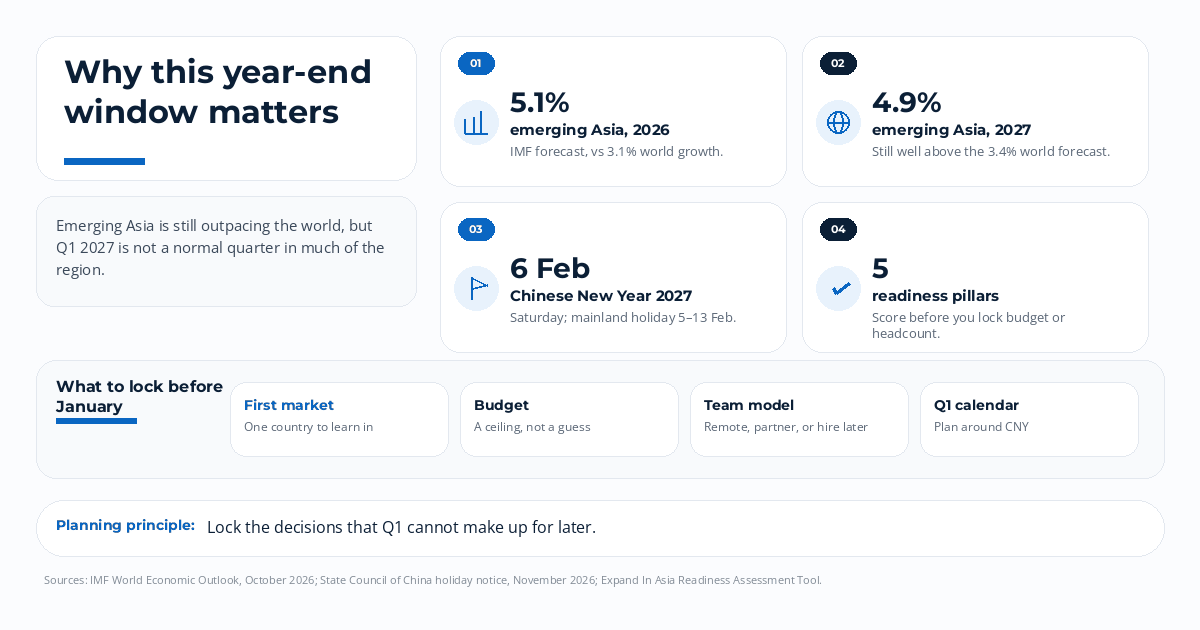
The IMF’s October 2026 World Economic Outlook still has emerging and developing Asia growing faster than the world: 5.1% in 2026 and 4.9% in 2027, against world growth of 3.1% and 3.4%.12 India is forecast at 7.0% in both years. The ASEAN-5 (Indonesia, Malaysia, the Philippines, Singapore, and Thailand) was raised to 4.4% for 2026.2
Those figures are a reason to stay serious about Asia. They are not a reason to enter five countries in January.
And Q1 2027 is not a normal quarter in much of the region. Chinese New Year falls on Saturday 6 February 2027. Mainland China’s official holiday runs from 5 to 13 February.3 In our experience, buying also slows in late January through mid-February in Singapore, Malaysia, and many regional headquarters.
This playbook is the year-end planning hub for that work. It sits beside our earlier pillar, Breaking Into Asia: 5 Critical Asia Expansion Mistakes. That guide is about the mistakes to avoid. This one is about the plan to take into 2027.
If you are still choosing a first market, start with Top 5 Emerging B2B Markets in Asia Pacific to Watch in 2026–2027 and Asia Is Not One Market: A Multi-Country Expansion Strategy. If you need a scored picture of your team, use the free Asia Expansion Readiness Assessment Tool.
- TL;DR — Key Takeaways
- Lock four things before January: a first market, a budget envelope, a team model, and a Q1 learning calendar (our view).
- Asia is still outpacing the world, but growth figures are not a GTM plan (IMF, October 2026).
- Do not enter five markets on 2 January. Learn in one to three, usually one first (multi-country expansion strategy).
- Score your readiness across five pillars before you lock budget or headcount (readiness assessment).
- Plan Q1 around Chinese New Year 2027 (6 February; mainland holiday 5–13 February).
If you only do one thing: write a one-page 2027 plan that names one first market and a budget ceiling, and share it with the people who control the money.
Who This Guide Is For—and Who It Is Not For
This Guide Is For
- founders, CEOs, and CROs locking a 2027 Asia budget;
- sales and expansion leaders asked to “get Asia moving” in Q1;
- companies already in Singapore adding a second market;
- teams that have a country on a slide but no operating plan;
- regional managers who need a plan headquarters will fund.
This guide is especially useful if your team is asking:
- What should we decide before January?
- How big should the first-year budget be?
- Do we hire, partner, or test remotely?
- How does Chinese New Year affect Q1?
This Guide Is Not For
- you want a ranking of Asian markets (see our Top 5 Emerging B2B Markets guide);
- you need a country-by-country GTM playbook (start with Vietnam, Malaysia, Indonesia, or the Philippines);
- you need legal, tax, or entity-setup advice;
- you sell only to consumers.
Practical fit check: if your 2027 Asia plan is still a slide, this guide is for you.
What an Asia Expansion Plan for 2027 Means
An Asia expansion plan 2027 is a short, dated set of decisions for how a B2B company will enter or deepen one or more Asian markets in the coming year: the first market, the budget envelope, the team model, the evidence that will count, and the calendar for the first quarter.
It is not a 40-page strategy deck. It is not a market-ranking list. It is the document that lets January start with work, not with another debate.
A Slide vs. a 2027 Plan
| Area | A slide | A 2027 plan |
|---|---|---|
| Market | “Asia” or a long list | One first market, with a reason |
| Budget | A revenue target only | A spending ceiling by category |
| Team | “Hire locally in Q1” | Remote, partner, or hire later, with a trigger |
| Success | Revenue in month three | Meetings, stakeholders, and pipeline quality |
| Timing | “Start in January” | A Q1 calendar that includes Chinese New Year |
| Owner | Unclear | A named internal owner |
Practical Rule (our take)
If your plan cannot be explained on one page, it is not ready for January.
Why This Year-End Window Matters
Reason 1 — The money is being locked now
In our experience, many Western and regional B2B companies lock next-year budgets and headcount between mid-November and mid-December. After about 18 December, attention drops. If Asia is not in that envelope, it is hard to add in February.
Reason 2 — Asia is still growing faster than the world — unevenly
The IMF’s October 2026 outlook has emerging and developing Asia at 5.1% in 2026 and 4.9% in 2027, against world growth of 3.1% and 3.4%. India is forecast at 7.0% in both years. China is forecast at 4.5% then 4.0%. The ASEAN-5 was raised to 4.4% for 2026.12
Those numbers explain why boards still want an Asia plan. They do not tell you which buyers will meet you, or what it will cost to reach them. Country growth is a reason to look. Buyer evidence is a reason to invest. We have said this in our product-market fit and country GTM guides, and it still holds.
Reason 3 — Q1 2027 includes Chinese New Year
Chinese New Year 2027 is Saturday 6 February. The official mainland holiday is 5–13 February 2027, with makeup workdays on 31 January and 14 February.3 In our experience, you should not assume a full 13-week selling quarter from January to March in Greater China, or in regional offices that pause with it. A 2027 plan that “starts in January and ramps in February” will lose weeks you will not get back.
Reason 4 — A plan is how you avoid last year’s mistakes
Our five Asia expansion mistakes still show up in year-end decks: treating Asia as one market, reusing a home-market playbook, underestimating relationships, picking the wrong channels, and hiring before demand is proven. A written 2027 plan is how you stop those mistakes from being funded again.
Practical Rule (our take)
Use November and early December to lock decisions.
Use January to run them.
The Five Decisions to Lock Before January
You do not need every detail. You do need these five.
1. The first market
Name one market you will learn in first. “Asia” is not a market. A list of six countries is not a first market.
Use Top 5 Emerging B2B Markets for the selection question, and multi-country sequencing if you will operate in more than one country. Favor reachable demand and speed of learning over headline market size (our view).
2. The budget envelope
Set a ceiling for the first year, by category: discovery and travel, outbound and meetings, tools and data, events, and any local presence. You do not need a perfect model. You need a number that finance will not reopen in February. For a line-by-line view of what belongs in that number, see our guide to what a first-year Asia market entry budget includes.
Do not treat “the cost of a Singapore salesperson” as the whole plan. That is only one line. See The Cost of Building a Sales Team in Singapore vs. Outsourcing for that comparison, and Why Companies Use Singapore as a Regional Hub if the entity question is part of the envelope.
3. The team model
Decide how the work will be done in the first two quarters: a remote team from a hub, a local partner, a fractional or embedded capacity, or a later local hire. In our view, hiring a full local sales team should wait for evidence of demand. See When Should You Hire a Local Sales Team in Asia? and What Is a Fractional SDR?.
4. The evidence standard
Write down what “this is working” will mean before revenue shows up: discovery meetings, second meetings, stakeholders introduced, and qualified opportunities. See How to Validate Product-Market Fit in a New Asian Market and Leading Indicators That Prove Your Asia Expansion Is Working.
5. The Q1 calendar
Block the weeks around Chinese New Year. Aim to finish important first conversations in January, pause outreach that will not be read, and restart with a named list after mid-February. This is calendar design, not a culture briefing.
Practical Rule (our take)
If any of the five is still “to be decided in Q1,” it is not locked.
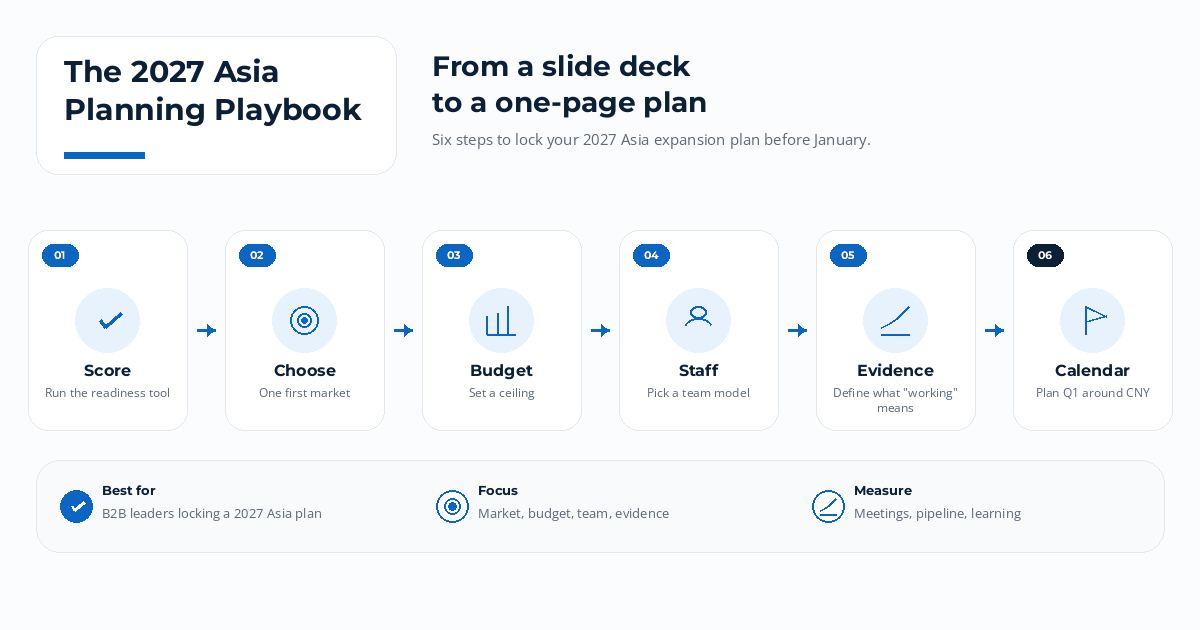
The 2027 Asia Expansion Planning Playbook
Step 1 — Score your readiness
Take the free Asia Expansion Readiness Assessment Tool. It scores commercial foundations across five pillars: Strategy, ICP and Market Evidence, People and Process, Infrastructure, and Leadership and Investment. You rate 14 statements on a 1 / 3 / 5 scale: not in place, partially in place, or strong and repeatable.4
Do this before you lock budget or headcount. A low score on evidence should shrink the plan, not just add a consultant.
For a walkthrough, see Asia Expansion Readiness Assessment: How to Score Your Team.
Step 2 — Choose one first market
Write one country (and, if useful, one city or segment) on the page. If you cannot defend it in two sentences, you are not ready to fund it.
Step 3 — Set a budget ceiling
Split the envelope into categories you can track. Leave a reserve. In our experience, teams underfund discovery and overfund the office.
Step 4 — Pick a team model and an owner
Name the internal owner. Name the model for the first two quarters. Write the trigger that would change the model (for example, a set number of qualified opportunities before a local hire).
Step 5 — Define evidence gates
Pick a small set of leading indicators and a review date. If the gate is missed, you change the message, the segment, or the model — you do not automatically add headcount.
Step 6 — Build a Q1 calendar around Chinese New Year
Map January (conversations and first meetings), late January to mid-February (a planned pause in the markets that slow), and the restart after 13 February. Put the review date after the restart, not during the holiday.
Practical Rule (our take)
A good 2027 plan is short, dated, and owned.
If it cannot survive a budget meeting, it is not finished.
How This Plan Connects to Your Readiness Score
The tool’s five pillars are a useful check on the plan itself.
| Pillar | What the 2027 plan should show |
|---|---|
| Strategy | A first market and a reason, not “Asia” |
| ICP and Market Evidence | A target buyer and a way to test demand |
| People and Process | An owner and a team model, with a hiring trigger |
| Infrastructure | Tools, data, and a way to report pipeline |
| Leadership and Investment | A budget ceiling and a learning period the board will protect |
Score each pillar 1, 3, or 5 using the tool’s language: not in place, partially in place, strong and repeatable.4 In our view, do not fund a large local hire on a 1 in Market Evidence.
Practical Rule (our take)
Let the lowest pillar set the size of the first bet.
Need Help Building a 2027 Asia Expansion Plan?
Expand In Asia helps B2B companies turn a year-end intention into a plan they can run:
- first-market prioritization;
- readiness scoring across five pillars;
- ICP and target-list work;
- localized outreach and appointment setting;
- early pipeline reporting;
- a clearer picture before entity or hiring decisions.
Common Planning Mistakes
Mistake 1 — Treating a market list as a plan
A watchlist is useful. It is not a 2027 operating plan.
Mistake 2 — Budgeting only for headcount
Salaries matter. So do travel, data, events, and the time to learn. A headcount-only envelope underfunds the work that creates evidence.
Mistake 3 — Entering too many markets in January
One to three is our usual guidance. One first market is usually enough.
Mistake 4 — Hiring before demand is proven
This is still the expensive version of enthusiasm. See when to hire a local sales team.
Mistake 5 — Ignoring Chinese New Year
A Q1 plan that assumes a straight line from 4 January to 31 March will miss a pause you could have designed for.
Mistake 6 — Leaving ownership vague
If two leaders think the other owns Asia, no one does.
2027 Planning Scorecard
Score each area from 1 to 5. This is our own simplified framework, not an industry benchmark. For the fuller check, take the Asia Expansion Readiness Assessment Tool.
| Area | 1 — Weak | 3 — Developing | 5 — Strong |
|---|---|---|---|
| First market | “Asia” | A shortlist, no first pick | One named first market |
| Budget envelope | Revenue target only | A round number, no categories | A ceiling by category, with a reserve |
| Team model | “Hire in Q1” | A preference, no trigger | A model and a hiring trigger |
| Evidence standard | Revenue in 90 days | Some activity metrics | Leading indicators and a review date |
| Q1 calendar | “Start in January” | Holiday noted, no plan | January / pause / restart is dated |
| Owner | Unclear | Shared, informal | One named owner |
| Readiness score | Not taken | Taken, not used | Used to size the first bet |
| Link to mistakes to avoid | Repeating last year’s plan | Some adjustments | Explicitly avoids the five mistakes |
Score Interpretation (Our Guidance)
| Total Score | What It Means |
|---|---|
| 34–40 | Ready to run Q1 against the plan. |
| 27–33 | Good base. Lock the first market and the calendar. |
| 20–26 | Still a slide. Finish the five decisions before January. |
| Below 20 | Start with the readiness assessment and a validation plan. |
Need a Partner for the First Market?
Expand In Asia helps companies test demand and build early pipeline before they make fixed commitments.
Next Steps With Expand In Asia
Asia rewards companies that enter 2027 with focus, a budget, and a way to learn.
- Name one first market.
- Set a budget ceiling.
- Pick a team model and an owner.
- Write evidence gates and a Q1 calendar that includes Chinese New Year.
To go deeper:
Ready to Implement These Strategies?
Book a free 30-minute strategy session where we’ll audit your current growth approach and identify your highest-leverage opportunities in Asian markets.
Frequently Asked Questions
1. What should a 2027 Asia expansion plan include?
A 2027 Asia expansion plan is the set of decisions you lock before January: which market you will enter or deepen first, a budget envelope, a team model (remote, partner, or hire later), the evidence that will count as progress, and a Q1 calendar that accounts for Chinese New Year 2027 (6 February).
2. When should we finalize a 2027 Asia market-entry plan?
In our view, before January. Mid-November through mid-December is when many B2B teams lock next-year budgets and headcount. After mid-December, attention drops. Planning in January leaves little time before Chinese New Year slows parts of the region.
3. How is this different from choosing which Asian market to enter?
Market selection is one decision inside the plan. Our Top 5 Emerging B2B Markets guide is for the “which country” question. This playbook is for what you lock around that choice — budget, team model, evidence, and timing — so Q1 is a test, not a scramble.
4. Should we enter several Asian markets in January 2027?
Our recommendation is still one to three markets, and usually one first market to learn in. Entering five countries in January spreads evidence too thin. See our multi-country expansion strategy for how to sequence markets in waves.
5. How does Chinese New Year 2027 affect a Q1 plan?
Chinese New Year 2027 falls on Saturday 6 February. Mainland China’s official holiday runs 5–13 February 2027.3 In our experience, buying also slows in late January through mid-February in Singapore, Malaysia, and many regional headquarters. Finish important conversations in January, then plan a restart after mid-February.
6. How can Expand In Asia help with a 2027 Asia expansion plan?
Expand In Asia is a Singapore-based B2B outbound and market-entry partner. It helps companies prioritize a first market, test demand with real buyers, build early pipeline, and report evidence before larger commitments. Start with the free Asia Expansion Readiness Assessment Tool.
Are you locking a 2027 Asia plan in the next six weeks? Share your biggest open decision in the comments, or pass this playbook to the person who owns the budget.
About the author: Joel Berou is Asia Expansion & Revenue Growth Advisor at Expand In Asia, a Singapore-based B2B outbound and market-entry partner that helps companies build pipeline across Asian markets. Last updated: November 10, 2026.
Sources
-
International Monetary Fund. World Economic Outlook, October 2026: Resilience Under Strain, Urgent Choices (13 October 2026). World growth is projected at 3.1% in 2026 and 3.4% in 2027. https://www.imf.org/en/Publications/WEO/Issues/2026/10/13/world-economic-outlook-october-2026 ↩↩
-
International Monetary Fund. World Economic Outlook, October 2026, Statistical Appendix Table A and Table A4 (13 October 2026). Emerging and developing Asia: 5.1% (2026), 4.9% (2027); India: 7.0% and 7.0%; China: 4.5% and 4.0%. ASEAN-5 2026 forecast of 4.4% as stated in the October 2026 WEO / related IMF briefing. https://www.imf.org/-/media/files/publications/weo/2026/october/english/tablea.pdf ↩↩↩
-
State Council of the People’s Republic of China. Notice on the 2027 partial holiday arrangements (国办发明电〔2026〕10号), 5 November 2026. Spring Festival holiday 5–13 February 2027; makeup workdays 31 January and 14 February. https://www.gov.cn/zhengce/content/202611/content_7085101.htm ↩↩↩
-
Expand In Asia. Asia Expansion Readiness Assessment Tool (accessed 10 November 2026). Five pillars and 1 / 3 / 5 scale. https://tools.expandin.asia/ ↩↩