A practical budget guide for B2B leaders who need a first-year Asia market entry number they can defend
“How much will it cost to enter Asia?”
is the question finance will ask.
“A salesperson in Singapore”
is the answer many teams give.
That is not a first-year budget. It is one line.
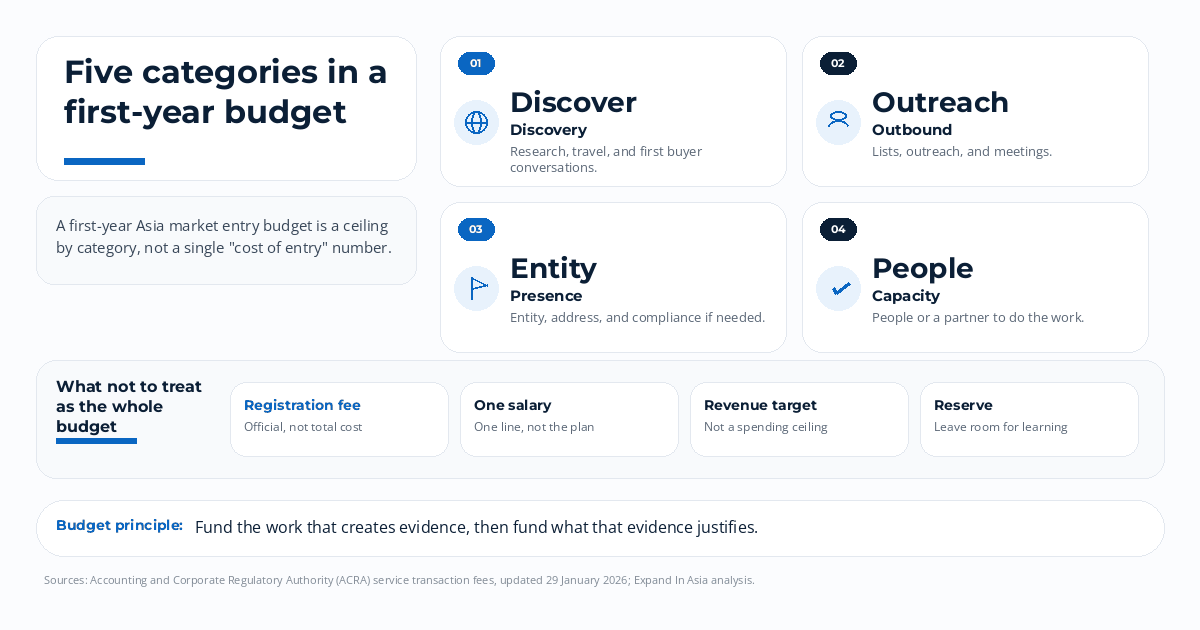
A serious Asia market entry budget is a spending ceiling for the first year in a named market. It covers discovery, outreach and meetings, tools and data, first capacity (people or a partner), and any local presence you actually need. It also leaves a reserve.
Official registration fees are part of that picture. They are a small part. As of 29 January 2026, Singapore’s Accounting and Corporate Regulatory Authority (ACRA) charges S$15 to reserve a company name and S$300 to register a company — S$315 in official fees — plus S$60 for an annual return.1 Those figures are real. They are not the cost of being present in Singapore, and they are not a first-year expansion budget.
This guide is the budget companion to How to Plan Your 2027 Asia Expansion. That playbook asks you to lock a first market, a team model, and a spending envelope before January. This one shows what belongs in the envelope, and what does not.
If you are comparing a local hire with outsourced or fractional capacity, see The Cost of Building a Sales Team in Singapore vs. Outsourcing, When Should You Hire a Local Sales Team in Asia?, and What Is a Fractional SDR?. If the entity question is in play, see Why Companies Use Singapore as a Regional Hub.
- TL;DR — Key Takeaways
- Budget by category, not by a single "cost of entry" number.
- Five lines to include: discovery, outbound and meetings, tools and data, first capacity, and local presence if you need it — plus a reserve (our view).
- Official fees are not the plan. ACRA’s official registration fees are S$315, plus S$60 for an annual return. Tax, accounting, and nominee costs are separate and vary.1
- Do not start with a full local sales hire. Fund evidence first, then fund what that evidence justifies (our view).
- A budget with no first market is a number looking for a use. Lock the market in your 2027 Asia expansion plan first.
If you only do one thing: write a one-page first-year budget with five categories, a ceiling, and a reserve, and take it to finance before January.
Who This Guide Is For—and Who It Is Not For
This Guide Is For
- founders, CFOs, and CROs building a first-year Asia budget;
- expansion leads asked to “put a number on Asia”;
- teams that have a country on a slide but no spending plan;
- companies comparing a Singapore hire with a lighter first-year model.
This guide is especially useful if your team is asking:
- What should a first-year Asia budget include?
- Is company registration the main cost?
- Should we budget a full local team in year one?
- How do we defend the number in a finance meeting?
This Guide Is Not For
- you need a tax opinion, payroll calculation, or entity-setup quote;
- you want a single “typical” first-year total (we will not invent one);
- you are writing a consumer-brand launch budget;
- you need country-by-country salary bands.
Practical fit check: if your Asia budget is still “one salesperson,” this guide is for you.
What a First-Year Asia Expansion Budget Means
A first-year Asia market entry budget is the money you will actually spend, in a named first market, to discover buyers, start conversations, book meetings, and learn whether demand is real — plus any local presence those activities require.
It is not a revenue target. It is not a registration receipt. It is not “the cost of a salesperson.”
A Number vs. a Budget
| Area | A number | A first-year budget |
|---|---|---|
| Scope | “Asia” | One first market |
| Shape | One salary or one fee | Categories, with a reserve |
| Official fees | Treated as the setup cost | Listed as official fees only |
| People | “Hire locally in Q1” | A capacity model and a hiring trigger |
| Success | Revenue in month three | Meetings and evidence, then revenue |
| Owner | Unclear | A named owner and a review date |
Practical Rule (our take)
If you cannot explain the budget in five categories, it is not ready for finance.
Why First-Year Costs Get Misread
Reason 1 — Official fees look like a complete answer
A published government fee is easy to cite. It is also easy to over-read. The official cost to register a company in Singapore is S$315, plus S$60 each year for an annual return.1 That is useful. It is not office rent, a nominee director, a tax agent, accounting, work passes, or the time to stay compliant. Those items vary by adviser and by what you set up. We will not invent a “typical” total for them.
Reason 2 — Headcount is treated as the whole plan
A local hire is visible. Discovery, data, travel, and meetings are easier to underfund. In our experience, teams then arrive in a market with a salary and no way to fill the calendar.
Reason 3 — Revenue is mistaken for a spending ceiling
“We will do $X in year one” does not tell finance what you will spend to get there, or when you will stop if evidence is weak.
Reason 4 — The first market is still undecided
A budget for “Asia” will be spent in too many places, or not spent at all. Name the market first, as in the 2027 planning playbook.
Practical Rule (our take)
Cite official fees as official fees.
Budget the work that creates evidence as the work that creates evidence.
The Five Cost Categories to Plan For
1. Discovery and travel
Buyer research, first trips, and first conversations. This is how you test whether the market is real. See How to Validate Product-Market Fit in a New Asian Market.
2. Outbound and meetings
Target lists, outreach, appointment setting, and the tools that support them. This is usually where a first-year budget should be most visible (our view).
3. Tools, data, and events
CRM, data, and any trade show or industry event you will actually use. Events are optional. If you include them, budget for meetings, not for booth size alone.
4. First capacity
The people — or the partner — who will do the work in the first two quarters. That can be a remote or hub-based team, a fractional SDR, staff augmentation, or a later local hire. Compare models in The Cost of Building a Sales Team in Singapore vs. Outsourcing and When Should You Hire a Local Sales Team in Asia?. We will not paste salary bands here; those change, and a band without a date and source is a guess.
5. Local presence (only if you need it)
Entity, registered address, banking, and ongoing compliance. If you are using Singapore as a hub, read Why Companies Use Singapore as a Regional Hub. If you do not need an entity in year one, do not invent one in the budget.
Add a reserve. In our experience, first-year learning produces trips, follow-up meetings, and tools you did not list in November. A reserve is not a slush fund. It is room to learn without reopening the whole envelope.
These five categories also stop a common debate: “is this a sales budget or a setup budget?” In the first year it is both, in proportions that should favor learning. If most of the ceiling sits in rent, entity, and a full local team, you have funded presence before conversations. If most of it sits in discovery, outreach, and meetings, you can change course without unwinding a structure you did not need yet (our view).
Official fees vs. real cost — the Singapore example
ACRA’s published company fees, updated 29 January 2026:1
| Item | Official fee |
|---|---|
| Reserve a company name | S$15 |
| Register a company | S$300 |
| Official registration total | S$315 |
| Annual return | S$60 |
These are government fees. They do not include professional services, nominee directors, tax filings, or accounting. Those costs are real. They are also variable. Treat any “all-in first-year entity cost” that does not name its source as unverified.
Practical Rule (our take)
Fund discovery and meetings first.
Fund an entity or a full local team when the plan, not the calendar, requires it.
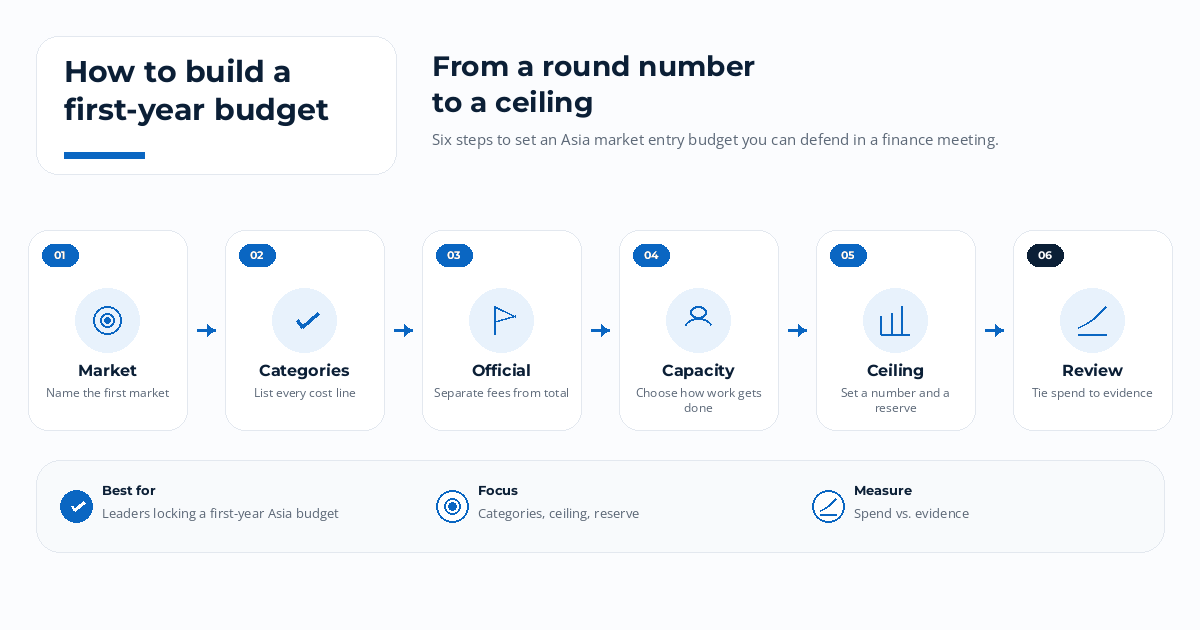
How to Build a First-Year Asia Budget
Step 1 — Name the first market
A budget without a market is a placeholder. Lock the market in your 2027 Asia expansion plan.
Step 2 — List every cost line under the five categories
If a line has no owner, it will be forgotten or doubled.
Step 3 — Separate official fees from professional and operating costs
Write “ACRA S$315” as an official fee. Do not let it stand in for “setup.”
Step 4 — Choose a capacity model
Remote, partner, fractional, or hire later. Write the trigger that would change the model.
Step 5 — Set a ceiling and a reserve
The ceiling is the number finance will protect. The reserve sits inside it.
Step 6 — Tie spend to evidence and a review date
Decide what meetings, stakeholders, and opportunities must appear before you release the next block of spend. See Leading Indicators That Prove Your Asia Expansion Is Working.
Practical Rule (our take)
A good first-year budget is a ceiling you can explain, not a guess you hope is low enough.
How This Budget Connects to Your 2027 Plan
The budget is one of the five decisions in the year-end plan: first market, budget envelope, team model, evidence standard, and Q1 calendar.
Use the free Asia Expansion Readiness Assessment Tool before you lock the number. The tool scores five pillars — Strategy, ICP and Market Evidence, People and Process, Infrastructure, and Leadership and Investment — on a 1 / 3 / 5 scale.2 In our view, a 1 on Market Evidence should shrink the first-year envelope, not enlarge the hiring line.
Practical Rule (our take)
Let the weakest readiness pillar set the size of the first bet.
Need Help Building a First-Year Asia Budget?
Expand In Asia helps B2B companies spend the first year on evidence, not on an empty office:
- first-market prioritization;
- readiness scoring across five pillars;
- ICP and target-list work;
- localized outreach and appointment setting;
- early pipeline reporting;
- a clearer picture before entity or hiring decisions.
Common Budgeting Mistakes
Mistake 1 — Treating official fees as the setup budget
S$315 is a real official fee. It is not a presence budget.
Mistake 2 — Budgeting only for a local hire
A salary without discovery, lists, and meetings is a cost without a motion.
Mistake 3 — Using a revenue target as a budget
Finance needs a spending ceiling, not only a sales goal.
Mistake 4 — Funding five countries in year one
One first market is usually enough. See the 2027 planning playbook.
Mistake 5 — Leaving no reserve
First-year learning is not a straight line.
Mistake 6 — Releasing the whole envelope in January
Hold a portion for the review after you have evidence — and, in 2027, after Chinese New Year.
First-Year Budget Scorecard
Score each area from 1 to 5. This is our own simplified framework, not an industry benchmark.
| Area | 1 — Weak | 3 — Developing | 5 — Strong |
|---|---|---|---|
| First market | “Asia” | A shortlist | One named market |
| Categories | One salary or one fee | Some lines, gaps | Five categories, complete |
| Official vs. real cost | Fees treated as setup | Fees listed, other costs guessed | Fees and variable costs are separate |
| Capacity model | “Hire in Q1” | A preference | A model and a trigger |
| Ceiling and reserve | No ceiling | A round number | A ceiling with a reserve |
| Evidence link | Spend, then hope | Some activity metrics | Spend released against leading indicators |
| Owner and review | Unclear | Informal | Named owner and a date |
| Readiness input | Not used | Score taken, ignored | Score used to size the bet |
Score Interpretation (Our Guidance)
| Total Score | What It Means |
|---|---|
| 34–40 | Ready for a finance review. |
| 27–33 | Good base. Finish categories and the reserve. |
| 20–26 | Still a number, not a budget. |
| Below 20 | Start with the 2027 plan and the readiness tool. |
Need Flexible Capacity Instead of a Full Hire?
Expand In Asia can add outbound capacity while you test a first market.
Next Steps With Expand In Asia
A first-year Asia budget should fund learning, not just presence.
- Name one first market.
- List the five cost categories and a reserve.
- Separate official fees from variable costs.
- Tie the ceiling to evidence and a review date.
To go deeper:
Ready to Implement These Strategies?
Book a free 30-minute strategy session where we’ll audit your current growth approach and identify your highest-leverage opportunities in Asian markets.
Frequently Asked Questions
1. What should a first-year Asia market entry budget include?
Five cost categories: discovery and travel, outbound and meetings, tools and data, first capacity (people or a partner), and any local presence (entity, address, compliance) if you need it. Add a reserve. Official registration fees are only one line, not the plan.
2. How much does it cost to enter an Asian market?
There is no single number that fits every company, product, or first market. Treat any “average first-year cost” you see without a source as a guess. Build an envelope by category, then set a ceiling your finance team will protect.
3. Is the official company registration fee the cost of setting up in Singapore?
No. As of 29 January 2026, ACRA charges S$15 to reserve a name and S$300 to register a company (S$315 in official fees), plus S$60 for an annual return.1 Tax agents, nominee directors, accounting, and ongoing compliance are separate and vary. The official fee is not a first-year entity budget.
4. Should we budget first for a local sales hire?
In our view, no. Budget first for discovery, outreach, and meetings that create evidence. A local hire is a later line, triggered by that evidence. See when to hire a local sales team and fractional SDRs.
5. How does this budget connect to a 2027 Asia expansion plan?
The budget is the spending ceiling in that plan. Lock the first market, the team model, and the evidence standard first, then fund them. A budget with no first market is a number looking for a use. See How to Plan Your 2027 Asia Expansion.
6. How can Expand In Asia help with a first-year Asia budget?
Expand In Asia is a Singapore-based B2B outbound and market-entry partner. It helps companies test demand and build early pipeline so the first-year budget is spent on evidence, not on an office that sits empty. Start with the free Asia Expansion Readiness Assessment Tool.
Are you locking a first-year Asia budget this month? Share the category you are most unsure about in the comments, or pass this guide to the person who owns the envelope.
About the author: Joel Berou is Asia Expansion & Revenue Growth Advisor at Expand In Asia, a Singapore-based B2B outbound and market-entry partner that helps companies build pipeline across Asian markets. Last updated: November 10, 2026.
Sources
-
Accounting and Corporate Regulatory Authority (ACRA). Service and Transaction Fees (updated 29 January 2026). Reserve a name S$15; incorporate / register a company S$300; annual return S$60. https://www.acra.gov.sg/manage/companies/service-transaction-fees/ ↩↩↩↩↩
-
Expand In Asia. Asia Expansion Readiness Assessment Tool (accessed 10 November 2026). Five pillars and 1 / 3 / 5 scale. https://tools.expandin.asia/ ↩