A practical guide for B2B teams who have a better product—and keep losing to the incumbent
You have the better product.
The demo went well.
The buyer agreed it was impressive.
Then they renewed with the supplier they have used for years.
In our experience, this is how many foreign B2B companies first learn what relationship selling in Asia really means. Trust built over time, across several people in the account, often decides the deal before the product comparison does.
Relationship selling in Asia usually involves:
- meeting more people in each target account;
- building trust at several levels, not just with one champion;
- showing you are in the market for the long run;
- understanding the buyer’s business before pitching;
- measuring progress, not just activity.
Most sales leaders at headquarters ask:
“Why is our Asia team still ‘building relationships’ instead of closing?”
But for B2B teams selling across Asia, the better question is:
“Are these relationships helping us make progress inside the account?”
Because relationships are not a soft excuse.
They are a pipeline asset—if they move.
A buyer in Seoul may need several meetings before sharing a real priority.
A buyer in Ho Chi Minh City may test whether you will still be around next year.
This guide expands on Mistake 3 from our masterclass, Breaking Into Asia: 5 Critical Asia Expansion Mistakes.
- TL;DR — Key Takeaways (our view)
- Trust often beats features. In our experience, a weaker product with stronger relationships can win.
- Relationships matter everywhere. The difference in many Asian markets is how much weight they carry and how long they take.
- Build at several levels. One champion is rarely enough in hierarchical organizations.
- Do not rush the close. Pushing too fast can burn opportunities.
- Patience needs progress. Track four signals: priorities, introductions, decision process, next steps.
- Judge the account, not the country. Headquarters should ask whether relationships are producing movement.
If you only do one thing: for every open account in Asia, write down which of the four progress signals you have seen in the last 30 days.
Who This Guide Is For—and Who It Is Not For
This Guide Is For
- sales leaders managing reps or partners in Asia from abroad;
- founders whose Asia deals take longer than at home;
- regional managers who need to explain “slow” pipeline to headquarters;
- B2B companies selling complex or high-value solutions;
- account executives entering accounts with a strong incumbent supplier;
- teams that rely on one contact per account.
This guide is especially useful if your team is asking:
- Why did we lose to a weaker competitor?
- How long should we wait before pushing for a decision?
- How do we know a relationship is real?
- How do we report relationship progress to leadership?
This Guide Is Not For
- you sell low-cost, self-serve products;
- you need negotiation and closing tactics only (read Cultural Nuances in Closing Deals Across Asia);
- you expect trust to be built in one meeting;
- you want a reason to stop measuring pipeline.
Practical fit check: if your forecast in Asia keeps slipping and your rep says “the relationship is good,” this guide is for you.
What Relationship Selling in Asia Means
Relationship selling in Asia is a B2B sales approach where trust built over time, across several people in the buyer’s organization, drives the deal more than product features or a single demo. In our experience, it means more meetings, more stakeholders, and more patience, measured by clear signs of progress.
It is not the same as “being friendly.”
Transactional Selling vs. Relationship Selling (Our Comparison)
| Area | Transactional Selling | Relationship Selling in Asia |
|---|---|---|
| Main driver | Product, price, demo | Trust, reliability, long-term commitment |
| Contacts per account | One champion | Several people at several levels |
| Pace | Push for the close | Let the close become the natural next step |
| Proof | Features and ROI | Local presence, consistency, understanding |
| How progress is measured | Stage changes in the CRM | Signals of deepening trust plus next steps |
| Main risk | Losing on price | Losing time without progress |
Practical Rule (our take)
Features get you the meeting.
Trust gets you the contract.
Why Relationship Selling Matters More in Asia
Building relationships to do business is universal. Nobody in the US or Europe would argue otherwise.
So why is this a mistake companies keep making?
In our view, because it is subtle. Teams agree relationships matter, then still plan the sales process as if one strong demo will do the job.
The Better-Product Trap
Nicolas Levitte, Founder & CEO of Expand In Asia, shared his own experience from 2011, when he arrived in Singapore to set up the regional subsidiary of a US media-technology company.
He met the right people at the right companies. He was confident a simple demo would win the business.
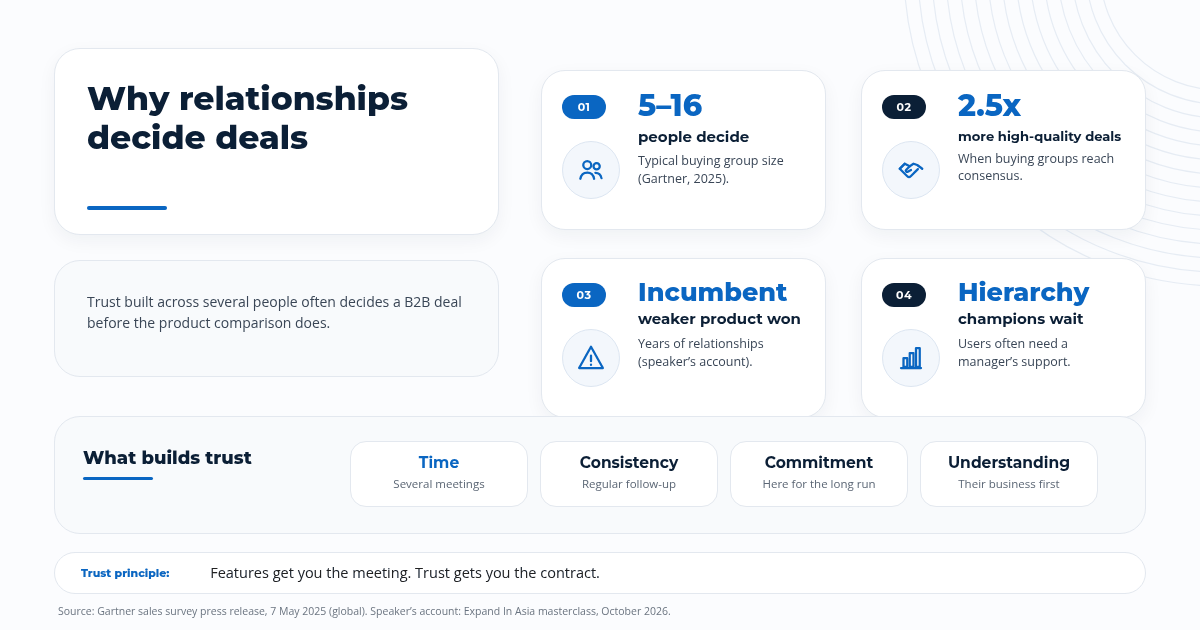
In his account, it did not go that way. He tried to close too fast and burned several opportunities. A competitor with a weaker product had owned those client relationships for years. It convinced clients it would catch up, and that the newcomer’s product was built for the US market.
The business did grow in the region. But looking back, he says more patience, meeting many more people in each account, and taking more time to build trust would have had a bigger impact.
Many People Decide
Large B2B purchases involve groups, not individuals. Gartner’s May 2025 global survey of 632 B2B buyers found buying groups of five to 16 people across up to four functions, and found that groups that reach consensus are 2.5 times more likely to report a high-quality deal.1
In our experience, relationships at several levels help that consensus form, especially in hierarchical organizations.
Trust Reduces Risk
In our experience, choosing an unfamiliar foreign supplier feels risky for many Asian buyers. A long-standing relationship lowers that risk. Your job is to lower it too, through time, consistency, and visible commitment.
Practical Rule (our take)
The incumbent is not selling a product.
They are selling a relationship the buyer does not want to risk.
How to Build Trust in an Asian B2B Account
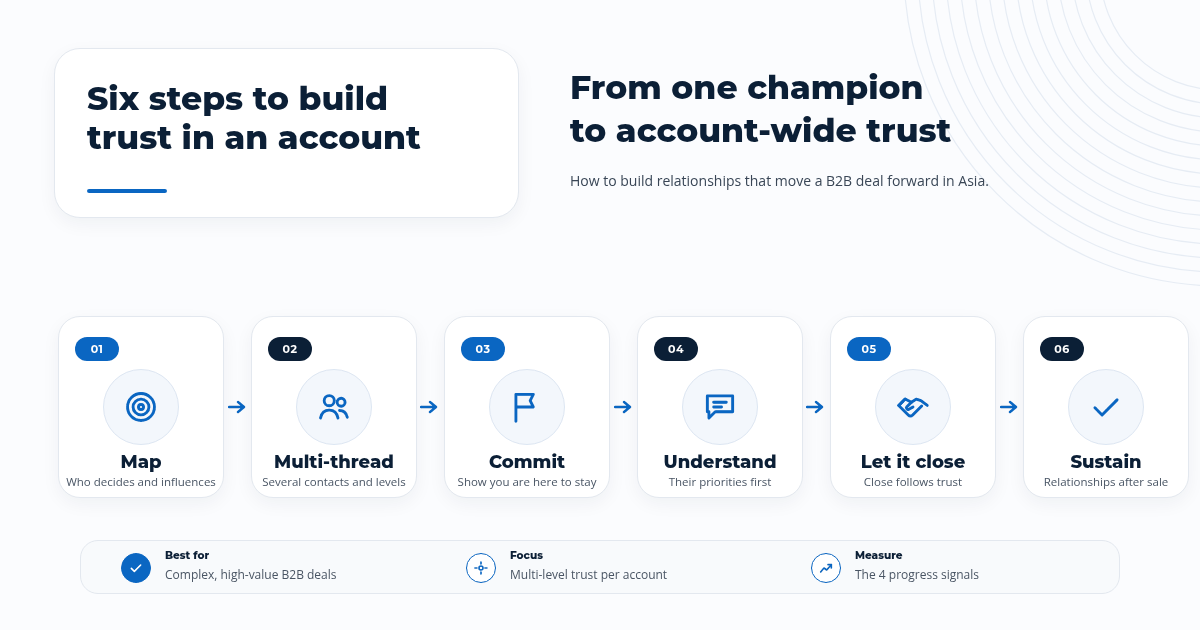
Step 1 — Map the Account Before You Pitch
What to Do
List the decision-makers, influencers, and future users in the account. Note who your competitor already knows.
Why It Matters
In our experience, if you only know one person, you only see one view of the deal.
For a structured approach, see our Account-Based Selling (ABS) guide for Asia.
Step 2 — Multi-Thread From Day One
What It Means
Multi-threading means building relationships with several people in the same company instead of relying on one contact.
How to Implement
- engage a senior sponsor early;
- build relationships with users in parallel;
- ask each contact who else should be involved;
- keep notes on each person’s priorities.
Some of those people will not be on LinkedIn. Our guide on how to reach B2B decision-makers in Asia who aren’t on LinkedIn covers the other ways in.
Step 3 — Show You Are Here for the Long Run
What to Show
Local presence or a local partner, a regional roadmap, local references, and consistent follow-up.
Relatable Example
If your team flies in once a quarter and disappears in between, the buyer notices. A local partner who follows up every week tells a different story.
Step 4 — Understand Their Business Before Selling Yours
What to Do
Ask about priorities, constraints, and how success is judged inside their organization. Talk less about features.
Why It Works (Our Experience)
Buyers trust suppliers who understand their business and how to help them. A feature list does not prove that. Good questions do.
Step 5 — Let the Close Follow Trust
What to Avoid
Pushing for a decision before trust is in place.
Our View
When trust is already there, you do not have to push for the close. The close becomes the natural next step.
Step 6 — Keep Relationships Going After the Sale
Why It Matters
In our experience, a satisfied client who trusts you is often your best source of introductions in a relationship-driven market.
Read From Client to Advocate: How to Build B2B Referral Programs in Asia.
The 4 Progress Signals: Patience With Progress
Here is the hard part for leaders at headquarters.
“We are building relationships” can be true.
It can also be an excuse for weak execution.
Nicolas’s recommendation at our masterclass: do not judge by the country. Judge whether the relationship is helping you make progress inside the account. We call this framework Patience With Progress.
Signal 1 — They Share More About Their Priorities
What It Looks Like
The contact tells you about budgets, internal projects, or problems they did not mention in the first meeting.
Signal 2 — They Introduce You to Other Stakeholders
What It Looks Like
You are invited to meet a manager, a technical team, or another department.
Signal 3 — They Explain How Decisions Are Made
What It Looks Like
The contact walks you through who approves, what procurement needs, and when budgets are set.
Signal 4 — They Agree to a Concrete Next Step
What It Looks Like
A date, a meeting, a pilot discussion, or a document request, even if the purchase is still some time away.
Progress Signal Check (Our Framework)
| Signal | Seen in the Last 30 Days? | If No, Try This |
|---|---|---|
| Priorities shared | Yes / No | Ask about their current projects and goals |
| Stakeholders introduced | Yes / No | Ask who else should be involved |
| Decision process explained | Yes / No | Ask how a similar purchase was approved |
| Next step agreed | Yes / No | Propose one small, specific next step |
Practical Rule (our take)
Patience matters, but it should come with progress.
Give the relationship time—and still agree on next steps.
For the metrics side, read How to Shorten Your B2B Sales Cycle in Singapore and SEA.
How to Report Relationship Progress to Headquarters
Many Asia teams lose leadership support not because deals are dead, but because progress is invisible.
A CRM (customer relationship management system, where your team tracks contacts and deals) usually shows stages like “meeting held” or “proposal sent.” In a relationship-driven market, an account can stay in one stage for weeks while real progress happens underneath.
A Simple Weekly Account Update (Our Template)
| Account | Contacts Engaged | New Signal This Week | Next Step and Date |
|---|---|---|---|
| Example: regional logistics firm | Operations manager, IT lead | Introduced to the finance director | Meeting with finance director, next Tuesday |
| Example: manufacturing group | Plant manager | Explained the approval process | Send pilot outline by Friday |
Relatable Example
“Still building the relationship” tells a CEO nothing.
“The IT lead introduced us to the finance director, and we meet Tuesday” tells them the deal is moving.
Practical Rule (our take)
If you cannot name the latest signal and the next step, the account is not progressing—whatever the relationship feels like.
Mini Case Study: Losing to the Incumbent
These details come from Nicolas Levitte’s first-hand account at our masterclass.
Situation
A US media-technology company opened a subsidiary in Singapore in 2011 to sell to radio broadcasters across the region.
Trigger
The team had a stronger product and early traction in Singapore and Malaysia.
Barrier
A competitor with a weaker product had years of relationships with the same clients.
What Went Wrong
The team tried to close too fast, and some opportunities were lost.
Results (Speaker’s Account)
The business did develop in the region with some success. In hindsight, he says more patience and more contacts per account would have paid off.
Our Take
A better product does not cancel out an existing relationship. Plan the sales process around trust from the first meeting.
Need Help Building Relationships in Target Accounts?
Expand In Asia helps B2B companies open and develop conversations in Asian markets through:
- market prioritization;
- account mapping and stakeholder research;
- ICP definition (ICP: your ideal customer profile);
- localized buyer messaging;
- LinkedIn, email, and phone outreach;
- SDR execution (the people who run first outreach and book meetings);
- appointment setting with several stakeholders per account;
- pipeline tracking with progress signals.
Common Relationship-Selling Mistakes
Mistake 1 — One Contact per Account
In our experience, when that person leaves or goes quiet, the deal disappears.
Mistake 2 — Closing Too Fast
Pushing for a decision before trust exists can burn the opportunity.
Mistake 3 — Confusing Friendliness With Progress
Pleasant lunches are not progress unless one of the four signals appears.
Mistake 4 — Flying In, Flying Out
Occasional visits without consistent follow-up suggest you are not committed. Lasting presence usually means local people, and When Should You Hire a Local Sales Team in Asia? Signs You’ve Validated the Market covers when that hire makes sense.
Mistake 5 — No Way to Report Progress
If headquarters only sees CRM stages, “relationship building” looks like nothing is happening. Report the signals too.
Mistake 6 — Ignoring the Home-Market Playbook Issue
Sometimes the relationship is fine and the pitch is the problem. See our guide on how to localize your sales playbook for Asia.
Relationship Selling Scorecard
Score each area from 1 to 5. This is our own simplified framework, not an industry benchmark. For a broader view of your team’s readiness to sell in Asia, take the free Asia Expansion Readiness Assessment Tool.
| Area | 1 — Weak | 3 — Developing | 5 — Strong |
|---|---|---|---|
| Account mapping | None | Key names known | Full map of decision-makers and users |
| Contacts per account | One | Two or three | Several, at several levels |
| Senior engagement | None | Occasional | Planned and regular |
| Local commitment | Occasional visits only | Partner or periodic presence | Consistent local presence or partner |
| Business understanding | Feature-led | Some discovery | Priorities documented per account |
| Progress signals tracked | Not tracked | Informal | Reviewed weekly per account |
| Next steps agreed | Rarely | Sometimes | After every meeting |
| Post-sale relationships | None | Ad hoc | Planned referrals and reviews |
Score Interpretation (Our Guidance)
| Total Score | What It Means |
|---|---|
| 34–40 | Strong relationship engine. Focus on scaling. |
| 27–33 | Good base. Tighten progress tracking. |
| 20–26 | Relationships exist but may not move deals. Start multi-threading. |
| Below 20 | High risk of losing to incumbents. Rebuild account coverage first. |
Need Help Managing Relationship-Driven Pipeline?
Expand In Asia helps you track and move accounts through the pipeline across Asian markets.
Next Steps With Expand In Asia
- Map each account: who decides, who influences, who uses.
- Multi-thread: several contacts at several levels.
- Show commitment: consistent local follow-up.
- Track the four signals: priorities, introductions, decision process, next steps.
To go deeper:
Ready to Implement These Strategies?
Book a free 30-minute strategy session where we’ll audit your current growth approach and identify your highest-leverage opportunities in Asian markets.
Frequently Asked Questions
1. What is relationship selling in Asia?
Relationship selling in Asia is a B2B sales approach where trust built over time, across several people in the buyer’s organization, drives the deal more than product features or a single demo. In our experience, it means more meetings, more stakeholders, and more patience, measured by clear signs of progress.
2. Why are relationships so important in B2B sales in Asia?
Relationships matter in B2B sales everywhere. In our experience, many Asian buyers give them more weight because trust reduces the risk of choosing an unfamiliar supplier. Nicolas Levitte, Founder & CEO of Expand In Asia, describes losing deals to a competitor with a weaker product but long-standing client relationships.
3. How long does it take to build trust with Asian buyers?
There is no reliable public benchmark, and it varies by country, industry, and deal size. In our experience, it usually takes longer than in the US or Europe. Instead of a timeline, track progress signals: shared priorities, introductions, explanations of the decision process, and agreed next steps.
4. How do you tell real relationship progress from a stalled deal?
Our recommendation is to check four signals: the contact shares more about their priorities, introduces you to other stakeholders, explains how decisions are made, and agrees to a concrete next step. If none of these is happening, the relationship is probably not moving the deal forward.
5. Is 'we are building relationships' a valid excuse for slow pipeline?
Only if progress is visible. In our view, patience is right, but it should come with progress. Headquarters should judge the account, not the country: are relationships producing new information, new contacts, and next steps? If not, the issue may be sales execution.
6. What does multi-threading mean in Asian B2B sales?
Multi-threading means building relationships with several people in the same target company instead of relying on one contact. In our experience, it matters in hierarchical organizations, where a user may need a manager’s support before recommending you.
7. How can Expand In Asia help us build relationships in a new market?
Expand In Asia is a Singapore-based B2B outbound and market-entry partner. It opens conversations with decision-makers and stakeholders in target accounts across Asian markets and tracks the progress signals in each account, so your team can focus on deepening the relationships that move.
Have you ever lost a deal to a weaker product with stronger relationships? Share what you learned in the comments or pass this guide to the person who reviews your Asia forecast.
About the author: Joel Berou is Asia Expansion & Revenue Growth Advisor at Expand In Asia, a Singapore-based B2B outbound and market-entry partner that helps companies build pipeline across Asian markets. This article draws on the October 2026 masterclass presented by Nicolas Levitte, Founder & CEO of Expand In Asia. Last updated: October 16, 2026.
Sources
-
Gartner, Inc. “Gartner Sales Survey Finds 74% of B2B Buyer Teams Demonstrate ‘Unhealthy Conflict’ During the Decision Process” (press release, 7 May 2025; survey of 632 B2B buyers, August–September 2024). https://www.gartner.com/en/newsroom/press-releases/2025-05-07-gartner-sales-survey-finds-74-percent-of-b2b-buyer-teams-demonstrate-unhealthy-conflict-during-the-decision-process ↩