
How to Shorten Your B2B Sales Cycle in Singapore and SEA
A practical guide to moving qualified buyers from first conversation to closed deal faster—without rushing the relationship
Long B2B sales cycles are expensive.
They delay revenue, increase customer acquisition cost, weaken forecast accuracy, drain sales capacity, and give competitors more time to influence your buyer.
In Singapore and Southeast Asia, long sales cycles are often not caused by lack of interest. They are usually caused by friction:
- unclear buyer needs;
- too many stakeholders involved too late;
- weak internal business case;
- insufficient local proof;
- unclear procurement steps;
- slow follow-up;
- generic messaging;
- poor qualification;
- no agreed next step after meetings.
This matters because modern B2B buying is already complicated. Gartner describes the B2B buying journey as nonlinear, with buyers moving through tasks such as problem identification, solution exploration, requirements building, and supplier selection while often revisiting earlier steps. Forrester’s 2026 business buying research also reported that a typical buying decision includes 13 internal stakeholders and nine external influencers, with even more participants in complex or strategic purchases.
So the solution is not to pressure buyers harder.
The solution is to make the buying process easier, clearer, and more relevant from the beginning.
- TL;DR — Key Takeaways
- Shortening the sales cycle does not mean rushing buyers. It means removing confusion, delays, poor fit, and unnecessary friction.
- Engage the buying committee earlier. Late stakeholder discovery is one of the most common reasons deals slow down.
- Local proof matters in Singapore and SEA. Buyers often need regional relevance, practical business case, and confidence that the solution fits their market.
- Qualification must happen early. Poor-fit meetings create a bigger pipeline but a slower sales cycle.
- Every meeting needs a clear next step. Momentum disappears when follow-up is vague.
- Buyer enablement speeds decisions. Help buyers build the internal case with simple materials, ROI logic, objection answers, and implementation clarity.
- Multichannel follow-up matters. McKinsey’s B2B research continues to show that buyers use many interaction channels across the buying journey, making coordinated sales and marketing touchpoints important.
If you only do one thing: map the stakeholders, decision criteria, and approval process in the first serious sales conversation—not after the proposal.
Who This Comparison Is For (and Not For)
This Guide Is For
- B2B companies selling into Singapore, ASEAN, or wider Southeast Asia.
- Founders and sales leaders trying to improve deal velocity.
- CROs and revenue teams looking to reduce stalled opportunities.
- SDR and BDR teams improving qualification before handing leads to sales.
- Country managers building pipeline in Singapore, Malaysia, Indonesia, Thailand, Vietnam, or the Philippines.
- SaaS, cybersecurity, cloud, fintech, HR tech, healthtech, managed services, data, AI, and professional-services companies.
- Teams that already generate meetings but struggle to convert them into opportunities or closed deals.
This guide is especially useful if your team faces issues such as:
- too many “interested but not urgent” prospects;
- proposals sitting with no update;
- multiple meetings but no decision;
- late-stage objections from finance, IT, procurement, or regional leadership;
- weak follow-up after discovery calls;
- deals that depend too heavily on one champion;
- slow internal approvals from the buyer’s side.
This Guide Is Not For
This guide may be less useful if:
- your sales process is purely transactional and closes in one call;
- your product has no clear ICP yet;
- your team cannot support timely follow-up;
- your offer requires no stakeholder alignment;
- you only want aggressive closing tactics;
- your pipeline issue is lack of demand rather than slow conversion;
- your team is unwilling to adjust messaging, discovery, qualification, or proposal process.
Practical fit check: This guide is for teams that want to shorten the cycle by making buying easier—not by pressuring buyers into faster decisions.
Why B2B Sales Cycles Are Longer in Singapore and SEA
A long sales cycle is not always a sign of weak interest.
In Singapore and Southeast Asia, it can be a sign of complexity.
Many deals involve:
- local users;
- regional leaders;
- finance;
- procurement;
- IT or security teams;
- legal;
- external consultants;
- headquarters approval;
- implementation partners;
- multiple countries or business units.
The buyer may like the solution, but still need to answer:
- Why now?
- Why this vendor?
- Why not solve it internally?
- Who owns the budget?
- What happens if we delay?
- Is this proven in our market?
- Will this work across our regional structure?
- What risk does this create for our team?
- Who needs to approve the purchase?
Forrester’s 2024 business buying research found that 86% of B2B purchases stall during the buying process, which reinforces how common delay and friction are in modern B2B buying.
The sales team’s job is not just to sell.
It is to help the buyer move through the decision process with confidence.
The Real Cost of a Slow Sales Cycle
Long sales cycles create obvious revenue delays.
But the hidden costs are often bigger.
Hidden Costs of a Slow Sales Cycle
| Cost | What It Means |
|---|---|
| Forecast uncertainty | Deals remain open but unreliable |
| Higher CAC | More sales effort is required per opportunity |
| Lower rep capacity | Sellers spend time chasing stalled deals |
| Competitor risk | More time for competitors to influence the account |
| Champion fatigue | Internal buyer loses energy or political capital |
| Discounting pressure | Longer cycles often create price negotiation pressure |
| Pipeline distortion | CRM appears healthy, but many deals are inactive |
A bloated pipeline can look impressive.
But if deals are not moving, it becomes a false signal.
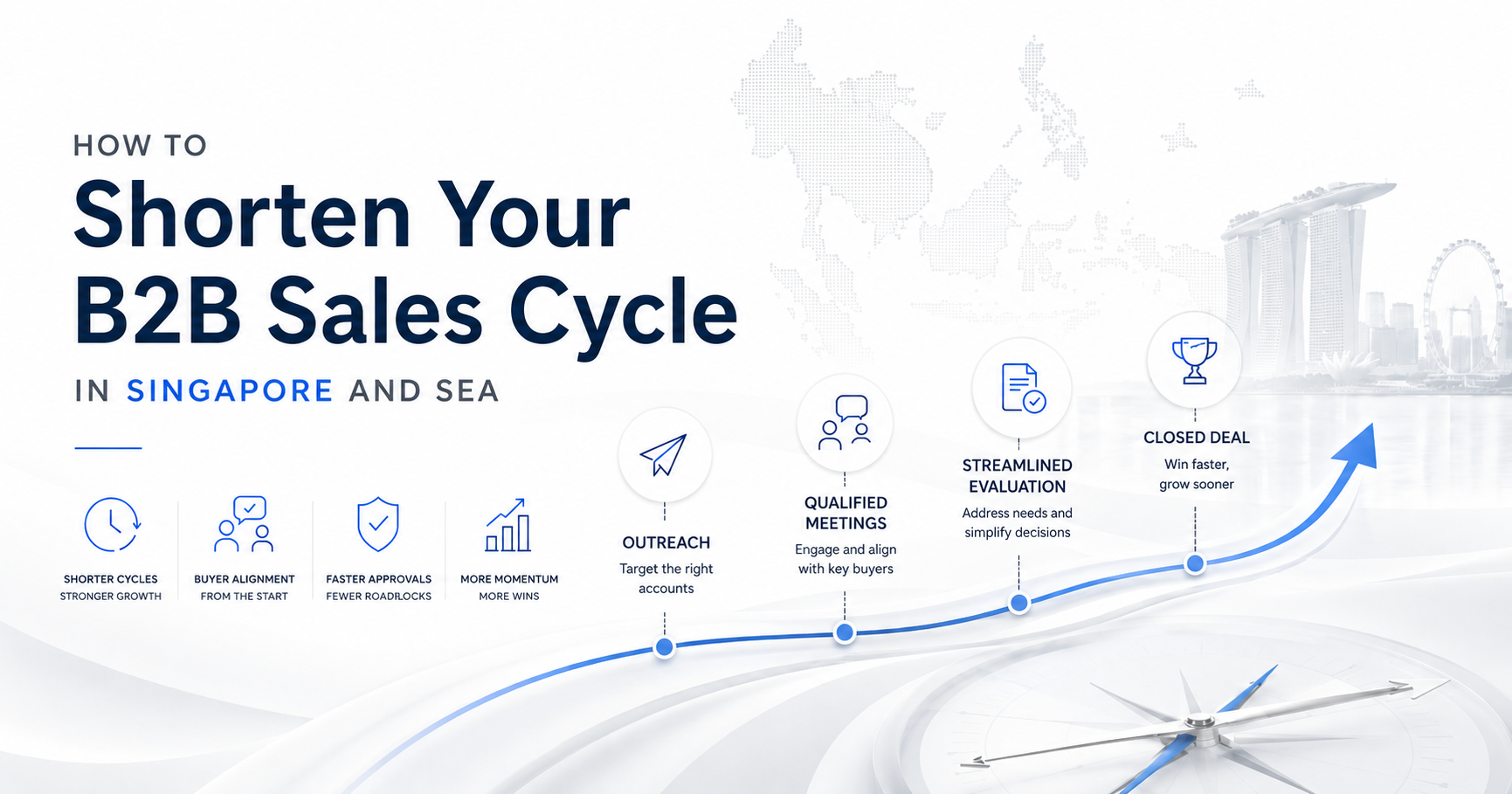
Step 1 — Qualify Harder Before the First Meeting
Shorter sales cycles begin before the first meeting.
A common mistake is treating every meeting as progress.
It is not.
A meeting with the wrong company, wrong persona, or no real pain will slow the sales cycle because your team will spend time trying to manufacture urgency.
Qualification Questions to Ask Early
| Qualification Area | Question |
|---|---|
| Account fit | Does this company match our ICP? |
| Persona fit | Is this person a decision-maker, influencer, or useful referrer? |
| Problem fit | Is there a real business problem we can solve? |
| Timing | Is this active, near-term, or future consideration? |
| Budget fit | Can the account realistically support the investment? |
| Authority | Who else needs to be involved? |
| Process | What steps happen before a decision? |
Strong Qualification Standard
A qualified meeting should include:
- relevant company;
- relevant buyer or influencer;
- clear business context;
- known reason for interest;
- realistic next step;
- no obvious disqualifier.
Do not confuse booked meetings with qualified pipeline.
Step 2 — Identify Stakeholders Early
Many deals slow down because the seller discovers the real buying committee too late.
The first person who agrees to a meeting may not be the person who approves the purchase.
In Singapore and SEA, stakeholder complexity can involve:
- regional headquarters;
- local country teams;
- group finance;
- procurement;
- IT;
- legal;
- implementation owners;
- senior executives;
- external advisers.
Forrester’s 2026 research shows how broad buying groups have become, with a typical purchase involving 13 internal stakeholders and nine external influencers.
Stakeholder Mapping Questions
Ask early:
- Who is most affected by this problem?
- Who owns the budget?
- Who would need to approve this?
- Who would evaluate the technical side?
- Who has pushed similar initiatives before?
- Who could block this later?
- Is this decision local, regional, or headquarters-led?
Stakeholder Map
| Stakeholder | Role in the Deal |
|---|---|
| Economic buyer | Controls budget or final approval |
| Business owner | Feels the pain directly |
| Technical evaluator | Reviews integration, IT, security, or implementation |
| Procurement | Manages vendor process and commercial terms |
| Legal | Reviews contract and risk |
| Champion | Supports the initiative internally |
| Executive sponsor | Gives political support |
| External adviser | Influences recommendation or de-risking |
Sales-Cycle Impact
The earlier you identify stakeholders, the faster you can:
- align the message;
- prepare the business case;
- avoid late objections;
- involve the right people;
- prevent restarts.
Step 3 — Clarify Buyer Needs and Success Metrics
A vague problem creates a slow deal.
If the buyer says:
“We are exploring options.”
That is not enough.
Your team needs to clarify:
- what is not working today;
- why it matters;
- what happens if nothing changes;
- how success will be measured;
- who cares about the result;
- what timeline matters.
Better Discovery Questions
Business Impact
- What is the current cost of this problem?
- What happens if this remains unresolved for another quarter?
- Which team is most affected?
Success Metrics
- What would make this project successful?
- Is the goal cost reduction, speed, revenue, compliance, visibility, or risk reduction?
- How will leadership evaluate the outcome?
Decision Context
- Why is this being reviewed now?
- Has the team tried solving this before?
- What would stop this from moving forward?
Why This Shortens the Cycle
Clear needs create a clearer proposal.
Clear success metrics create a stronger business case.
A stronger business case makes internal approval easier.
Step 4 — Prove Local and Regional Relevance
Many sellers underestimate how much local relevance matters.
A global case study may be impressive, but buyers in Singapore and SEA may still ask:
- Have you worked in this market?
- Do you understand regional business norms?
- Can this work with our local team?
- Do you understand our budget environment?
- Can this support multi-country operations?
- Do you have examples from similar markets?
Types of Proof That Help
| Proof Type | Example |
|---|---|
| Local customer | Similar company in Singapore or SEA |
| Regional use case | Comparable APAC expansion or GTM project |
| Industry proof | Similar vertical or buyer problem |
| Process proof | Clear implementation or delivery method |
| Risk proof | How onboarding, compliance, or quality is managed |
| Commercial proof | ROI, efficiency, pipeline, or cost impact |
If You Do Not Have Local Proof
Use:
- comparable market examples;
- industry-specific examples;
- pilot structures;
- proof-of-concept;
- relevant frameworks;
- partner credibility;
- references from similar buyer types.
The point is to reduce perceived risk.
The more risk the buyer feels, the longer the sales cycle becomes.
Step 5 — Simplify the Business Case
A buyer may like your solution but still struggle to justify it internally.
Your job is to help them explain:
- why the problem matters;
- why now;
- why this approach;
- what value is expected;
- what risk is reduced;
- what happens if they do nothing.
Business Case Elements
| Element | Purpose |
|---|---|
| Current problem | Explains why action is needed |
| Cost of inaction | Shows why delay matters |
| Expected outcome | Defines measurable value |
| Investment | Clarifies required budget |
| Timeline | Sets realistic expectations |
| Risk mitigation | Reduces internal concern |
| Stakeholders | Shows who is involved |
| Next steps | Makes approval easier |
Example
Instead of saying:
“Our solution improves sales productivity.”
Say:
“If your team needs 20 qualified conversations per quarter to support regional growth, the business case is whether outsourced pipeline support can create those conversations faster and at lower risk than hiring a full internal team before market demand is validated.”
This gives the buyer language they can use internally.
Step 6 — Reduce Procurement and Approval Friction
Many deals slow down after verbal interest.
The buyer says:
“This looks good. Let me check internally.”
Then nothing happens.
The reason is often approval friction.
Common Approval Blockers
- unclear budget owner;
- procurement process not understood;
- legal review takes longer than expected;
- IT or security review introduced late;
- no internal business case;
- no executive sponsor;
- unclear implementation plan;
- competing priorities;
- no timeline pressure.
Questions to Ask Before Proposal
- What happens after we send the proposal?
- Who needs to review it?
- Is procurement involved?
- Is legal involved?
- Are there security or data requirements?
- Is there a preferred vendor process?
- Is budget already allocated?
- What timeline are you working toward?
- What could delay this internally?
Why This Matters
A proposal does not accelerate a deal if the approval path is unknown.
Know the process before sending the proposal.
Step 7 — Keep Momentum With Clear Next Steps
Every meeting should end with a specific next step.
Not:
“Let’s stay in touch.”
Better:
“We’ll send the summary by Wednesday, you’ll review internally with finance, and we’ll reconnect next Tuesday to decide whether a pilot makes sense.”
Strong Next Steps Include
- owner;
- action;
- date;
- purpose;
- expected outcome.
Examples
| Weak Next Step | Stronger Next Step |
|---|---|
| “I’ll send info.” | “I’ll send a one-page business case by Thursday.” |
| “Let us know what you think.” | “Can we reconnect next Tuesday after you share this with your COO?” |
| “We’ll follow up soon.” | “We’ll send the proposal tomorrow and review questions on Friday.” |
| “We can discuss internally.” | “Who will be part of the internal review, and what do they need to see?” |
Momentum is not created by enthusiasm.
It is created by agreed action.
Step 8 — Use Multichannel Follow-Up Intelligently
Follow-up should not mean sending the same reminder five times.
Use multiple channels with purpose:
- email for summaries and documents;
- LinkedIn for visibility and light engagement;
- phone for clarification;
- webinars for education;
- events for relationship-building;
- referrals for credibility;
- CRM reminders for discipline.
McKinsey’s B2B research highlights ongoing commitment to omnichannel sales among B2B growth leaders.
Follow-Up Cadence Example
| Timing | Action |
|---|---|
| Same day | Send meeting recap and agreed next steps |
| 2–3 days later | Share supporting proof or business case |
| 5–7 days later | Ask whether internal review happened |
| 10–14 days later | Address likely blocker or stakeholder concern |
| After no response | Offer a graceful close or future timing check |
Follow-Up Principle
Every follow-up should add clarity, value, or momentum.
If it only says “checking in,” rewrite it.
Step 10 — Track the Right Sales-Cycle Metrics
You cannot shorten what you do not measure.
Metrics to Track
| Metric | Why It Matters |
|---|---|
| Sales cycle length | Measures total time from qualified opportunity to closed deal |
| Stage duration | Shows where deals stall |
| Meeting-to-opportunity rate | Measures quality of first conversations |
| Proposal-to-close rate | Shows whether proposals are well qualified |
| No-decision rate | Identifies weak urgency or poor business case |
| Stakeholder count | Shows complexity of buying group |
| Time to next step | Measures momentum |
| Follow-up response time | Shows sales execution discipline |
| Win rate by segment | Reveals which markets or buyers convert faster |
Track by Segment
Measure sales-cycle performance by:
- country;
- industry;
- buyer persona;
- deal size;
- lead source;
- channel;
- solution type;
- stakeholder complexity.
A long cycle may not be a company-wide problem.
It may be concentrated in one segment.
Singapore and SEA Sales-Cycle Acceleration Framework
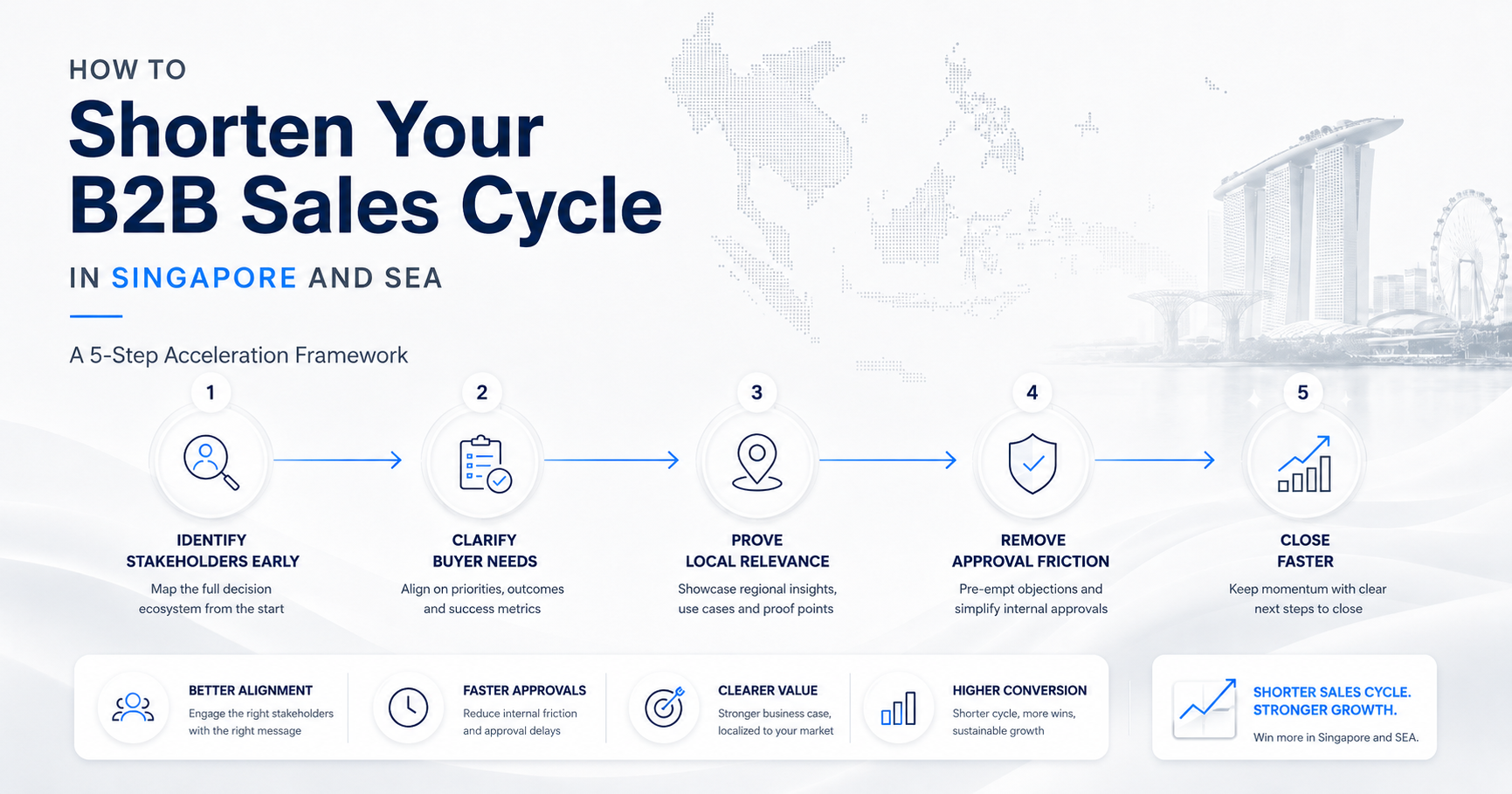
Use this five-step framework.
Step 1 — Identify Stakeholders Early
Map the decision ecosystem before proposal.
Step 2 — Clarify Buyer Needs
Define the problem, impact, priority, and success metrics.
Step 3 — Prove Local Relevance
Use market-specific proof, regional examples, or comparable use cases.
Step 4 — Remove Approval Friction
Understand procurement, legal, security, budget, and decision timelines.
Step 5 — Close Faster
Keep momentum through clear next steps, buyer enablement, and timely follow-up.
Framework Summary
| Step | Sales-Cycle Benefit |
|---|---|
| Stakeholder mapping | Avoids late-stage surprises |
| Needs clarification | Creates a stronger proposal |
| Local proof | Reduces perceived risk |
| Approval planning | Prevents internal delays |
| Clear next steps | Maintains momentum |
Common Mistakes That Slow Deals Down
Mistake 1 — Talking to Only One Person
Your champion may not control the decision.
Mistake 2 — Sending Proposals Too Early
A proposal sent before pain, process, and stakeholders are clear often stalls.
Mistake 3 — No Local Proof
Buyers may hesitate if all examples are from unrelated markets.
Mistake 4 — Weak Discovery
If you do not understand the real business issue, the proposal becomes generic.
Mistake 5 — No Clear Next Step
Every vague next step increases the chance of delay.
Mistake 6 — Ignoring Procurement
Procurement friction often appears late because sales did not ask early.
Mistake 7 — Over-Relying on Discounts
Discounts rarely fix unclear value or weak urgency.
Mistake 8 — Poor Handoff From SDR to AE
If the AE lacks context, discovery restarts and the buyer loses confidence.
Mistake 9 — No Internal Business Case
Your champion may want to move forward but lack the materials to persuade others.
Mistake 10 — Treating SEA as One Market
A process that works in Singapore may need adaptation in Malaysia, Indonesia, Vietnam, Thailand, or the Philippines.
Sales-Cycle Acceleration Scorecard
Score each area from 1 to 5.
| Area | 1 — Weak | 3 — Developing | 5 — Strong |
|---|---|---|---|
| Qualification | Meetings booked without clear fit | Basic fit checks | Written qualification criteria |
| Stakeholder mapping | One contact only | Some roles identified | Full buying committee mapped |
| Discovery | Surface-level pain | Business issue explored | Problem, impact, metrics, timing clarified |
| Local proof | Generic global examples | Some regional relevance | Strong market or comparable proof |
| Business case | Seller-focused proposal | Value included | Clear ROI, urgency, and internal justification |
| Approval process | Unknown | Partially understood | Procurement, legal, budget, and timeline mapped |
| Follow-up | Ad hoc reminders | Basic cadence | Value-led, multichannel, owner-based follow-up |
| CRM visibility | Stages unclear | Basic tracking | Stage duration, blockers, and next steps tracked |
| Buyer enablement | None | Some collateral | Assets built for champion and buying group |
| Momentum | Vague next steps | Occasional dates | Every meeting ends with owner, action, and date |
Score Interpretation
| Total Score | Recommendation |
|---|---|
| 42–50 | Strong sales-cycle discipline; optimise by segment |
| 34–41 | Good foundation; fix the weakest friction points |
| 25–33 | Deals may progress, but cycle risk is high |
| Below 25 | Rebuild qualification, discovery, and follow-up process |
Need to Shorten Your B2B Sales Cycle in Singapore and SEA?
Expand In Asia helps B2B companies improve pipeline quality and deal velocity through:
- ICP refinement;
- lead qualification;
- stakeholder mapping;
- appointment setting;
- LinkedIn and email outreach;
- buyer-focused messaging;
- CRM reporting;
- Asia-focused GTM execution.
Talk to Expand In Asia about accelerating your sales pipeline →
15. Next Steps With Expand In Asia
Shortening your sales cycle is not about rushing buyers.
It is about helping them make a confident decision faster.
The strongest B2B teams in Singapore and SEA usually do five things well:
- qualify fit before investing heavy sales time;
- identify the buying committee early;
- clarify business impact and success metrics;
- prove local or regional relevance;
- maintain momentum with clear next steps and buyer enablement.
For broader market-entry planning, read:
Go-to-Market (GTM) Strategies for Asia
For more pipeline-building tactics, read:
10 Best B2B Qualified Lead Generation Strategies for 2026
Schedule a consultation with Expand In Asia →
Ready to Implement These Strategies?
Book a free 30-minute strategy session where we’ll audit your current growth approach and identify your highest-leverage opportunities in Asian markets.
Frequently Asked Questions
1. How do you shorten a B2B sales cycle?
Shorten the cycle by improving qualification, identifying stakeholders early, clarifying the buyer’s problem and success metrics, proving relevant value, understanding the approval process, and keeping every meeting tied to a clear next step.
2.Why are B2B sales cycles long in Singapore and Southeast Asia?
Sales cycles can be longer because buying decisions often involve local teams, regional stakeholders, finance, procurement, IT, legal, and sometimes headquarters approval. Buyers may also need local proof, internal business case support, and risk reduction before moving forward.
3. What is the biggest cause of delayed B2B deals?
One of the biggest causes is late stakeholder discovery. If the seller only learns about finance, procurement, IT, or executive approval after the proposal, the deal often restarts or stalls.
4.Does discounting shorten the sales cycle?
Sometimes, but it is rarely the best first solution.
If the buyer does not understand the value, urgency, or internal business case, a discount may not solve the real problem. It can also weaken perceived value.
5. What should be included in a buyer enablement pack?
A strong buyer enablement pack may include a one-page business case, ROI logic, implementation plan, stakeholder FAQ, case study, risk mitigation notes, pricing explanation, and internal approval checklist.
6. How should sales teams measure sales-cycle improvement?
Track sales cycle length, stage duration, proposal-to-close rate, meeting-to-opportunity conversion, no-decision rate, stakeholder count, time to next step, follow-up response time, and win rate by segment.
7. What role does outbound lead generation play in shortening the sales cycle?
Good outbound lead generation helps shorten the cycle by targeting better-fit accounts, reaching the right stakeholders earlier, creating relevant conversations, and improving qualification before opportunities enter the pipeline.
8. Can this framework work outside Singapore?
Yes. The framework can be adapted across Southeast Asia, but messaging, proof, buying committee structure, language, and follow-up approach should be localised for each market.