A practical guide for B2B leaders deciding whether—and why—to base Asia operations in Singapore
Singapore is often the first answer.
“Where should our Asia office be?”
“Singapore.”
It is efficient. It is international. It is easy to explain to a board.
And for many companies, it is the right call.
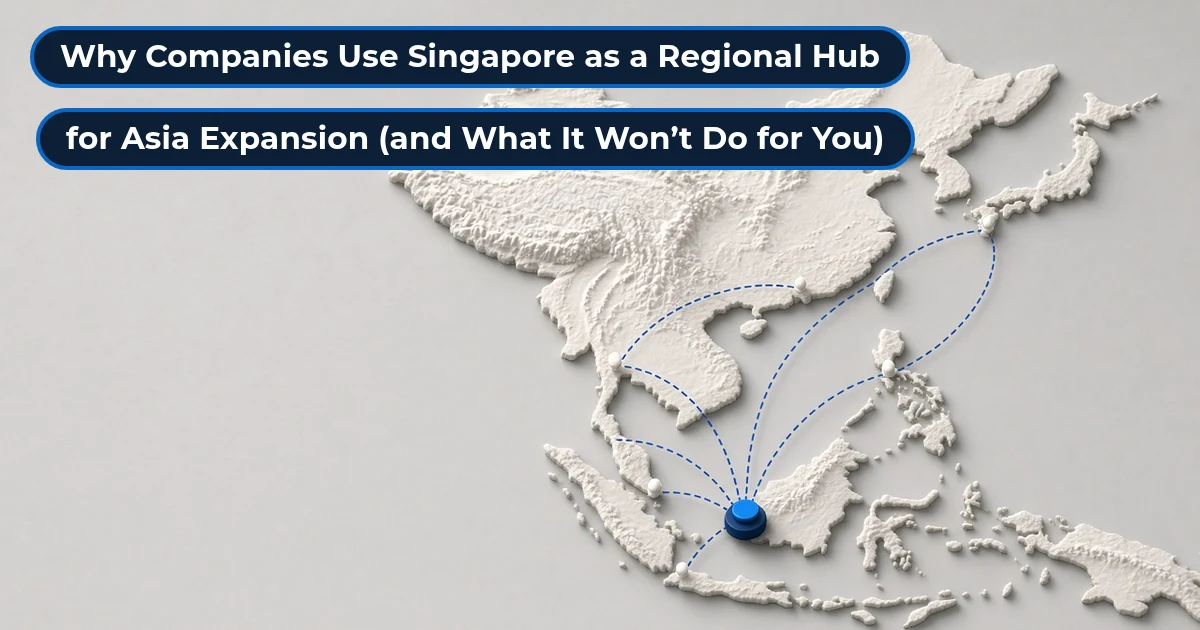
But a Singapore regional hub for Asia expansion solves some problems and leaves others untouched. It can make contracting, tax, hiring, and regional management easier. It will not, on its own, win you customers in Jakarta, Ho Chi Minh City, or Tokyo.
A Singapore hub can help with:
- setting up a legal entity quickly;
- contracting and invoicing across the region;
- hiring regional talent;
- access to Singapore’s trade agreements;
- running regional management and reporting.
Most leadership teams ask:
“Should we set up in Singapore?”
But for B2B companies expanding into Asia, the better question is:
“What exactly do we need our Singapore hub to do—and what must still happen in each market?”
Because a hub is infrastructure, not demand.
A Singapore entity can sign a contract with a buyer in Manila.
It cannot make that buyer trust you.
At our October 2026 masterclass, Nicolas Levitte, Founder & CEO of Expand In Asia, described Singapore as a country trying to create an environment that makes business quite easy—while stressing that Asia should not be treated as a single market. This guide explores both sides. It builds on our pillar, Breaking Into Asia: 5 Critical Asia Expansion Mistakes.
- TL;DR — Key Takeaways
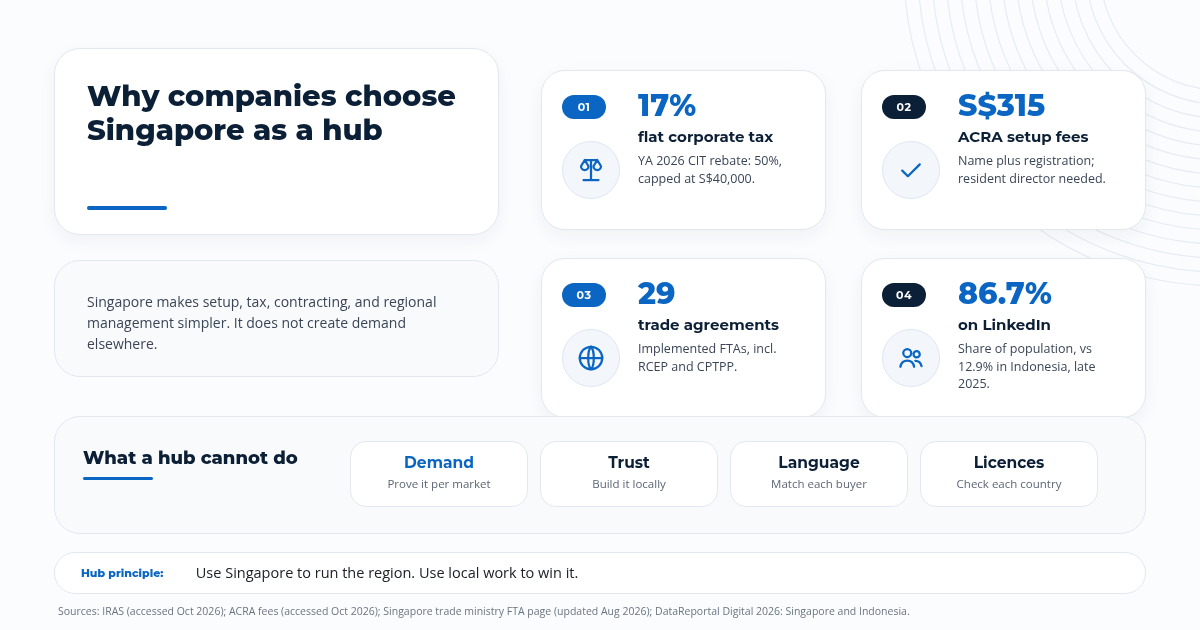
- Singapore makes setup simple. S$315 in ACRA fees, at least one locally resident director, online registration.
- Tax is competitive. A flat 17% corporate rate, with a 50% CIT Rebate for YA 2026, capped at S$40,000 (IRAS).
- Trade access is broad. 29 implemented free trade agreements (Singapore government, 2026).
- It is not a proxy for the region. 86.7% of Singapore’s population are LinkedIn members vs. 12.9% in Indonesia (DataReportal 2026).
- A hub does not create demand. Local language, proof, and relationships still matter in each market (our view).
- Decide the hub’s purpose first (our recommendation).
This article is general information, not legal or tax advice.
Who This Guide Is For—and Who It Is Not For
This Guide Is For
- founders and CEOs choosing a base for Asia;
- CFOs comparing Singapore with other regional locations;
- expansion leads planning a multi-country Asia rollout;
- B2B SaaS, technology, and services companies;
- companies already in Singapore wondering why the rest of Asia is slow;
- boards reviewing an Asia office proposal.
This guide is especially useful if your team is asking:
- Why do so many companies choose Singapore?
- Does a Singapore entity help us sell elsewhere in Asia?
- What does setup actually involve?
- Should we set up before or after testing demand?
This Guide Is Not For
- you need step-by-step legal, tax, or immigration advice;
- you only sell in one Asian country outside Singapore;
- you need a detailed cost comparison of sales teams (read The Cost of Building a Sales Team in Singapore vs. Outsourcing);
- you have already decided on a hub and need only sales tactics.
Practical fit check: if your Asia plan starts with “open a Singapore office” and ends there, this guide is for you.
What a Singapore Regional Hub for Asia Expansion Means
A Singapore regional hub for Asia expansion is a Singapore-based company or office that supports a business across several Asian markets, typically handling contracting, invoicing, regional management, hiring, and sometimes sales coverage. It provides a stable legal and operating base. It does not replace market-by-market sales and relationship work.
What a Hub Usually Does vs. What It Does Not
| A Singapore Hub Can… | A Singapore Hub Cannot… |
|---|---|
| Hold contracts and invoice regional clients | Create demand in other countries |
| Employ regional managers and specialists | Replace local language and relationships |
| Simplify regional reporting and finance | Guarantee licensing in other markets |
| Use Singapore’s trade agreement network | Prove product-market fit elsewhere |
| Signal long-term commitment to Asia | Substitute for local references |
Practical Rule (our take)
Singapore is a launchpad.
It is not the destination.
Why Companies Choose Singapore as a Regional Hub
Reason 1 — Simple, Fast Company Setup
According to ACRA, Singapore’s company registrar, government fees are S$15 to reserve a company name and S$300 to register a company, S$315 in total.1 Registration is online through Bizfile. Companies need at least one locally resident director, a registered office address in Singapore, and a company secretary appointed within six months, and foreign founders register through a registered filing agent.12
Reason 2 — Foreign Ownership
According to Chambers and Partners’ Doing Business In 2026: Singapore guide, foreign investors can typically own a Singapore company fully without a local equity partner, outside specific regulated sectors.3
Reason 3 — Competitive, Simple Tax
IRAS states that companies are taxed at a flat 17% of chargeable income. For Year of Assessment 2026, IRAS lists an enhanced Corporate Income Tax Rebate of 50% of tax payable, with total benefits capped at S$40,000, and qualifying new companies can use a start-up tax exemption in their first three years of assessment.4 Eligibility rules apply. This is not tax advice.
Reason 4 — Trade Agreement Network
Singapore’s trade ministry lists 29 implemented free trade agreements (page updated August 2026), including RCEP, CPTPP, and the EU-Singapore FTA.5
Reason 5 — An International, English-Speaking Business Base
DataReportal’s Digital 2026 Singapore report shows 5.10 million LinkedIn members in late 2025, equal to 86.7% of the population.6 In plain terms: Singapore’s business community is highly international and easy to reach online.
Reason 6 — Access to Regional Talent
Singapore lets companies hire regional specialists, with rules. For example, the Ministry of Manpower’s minimum qualifying salary for an Employment Pass is S$5,600 a month today, rising to S$6,000 for new applications from 1 January 2027 (higher in financial services and for older candidates).7
Practical Rule (our take)
Singapore reduces friction.
It does not reduce the need for market-by-market work.
What a Singapore Hub Won’t Do for You
Limit 1 — It Is Not a Proxy for the Region
Singapore had about 5.88 million people in October 2025, according to UN data cited by DataReportal.6 Indonesia had about 283.5 million in 2024, according to the UN.8 LinkedIn membership equals 86.7% of Singapore’s population but 12.9% of Indonesia’s.69 What works in Singapore may not work next door.
Limit 2 — It Does Not Create Local Trust
As Nicolas said at our masterclass, relationships and trust matter a lot in the region, and having someone on the ground helps show you are serious. A Singapore office is “on the ground” in Singapore—not necessarily in Indonesia or Vietnam.
Limit 3 — It Does Not Replace Local Language
Buyers in Vietnam, Indonesia, Thailand, or Japan often expect their own language. Read how to localize your sales playbook for Asia.
Limit 4 — It Does Not Cover Every Legal Requirement
Some markets and sectors require local entities, licences, or partners. Get local legal advice for each country you sell into.
Limit 5 — It Does Not Validate Demand
An office proves commitment, not demand. See When Should You Hire a Local Sales Team in Asia?.
Limit 6 — It Does Not Make One Privacy Policy Enough
Singapore’s Personal Data Protection Act governs data handled in Singapore. Prospects in Vietnam, Indonesia, Malaysia, Thailand, the Philippines, Japan, and India fall under their own data protection laws, several of which changed in 2025 and 2026. A Singapore hub running regional outreach needs to check each market’s rules, not just Singapore’s. This is not legal advice.
Practical Rule (our take)
Use Singapore to run the region.
Use local work to win it.
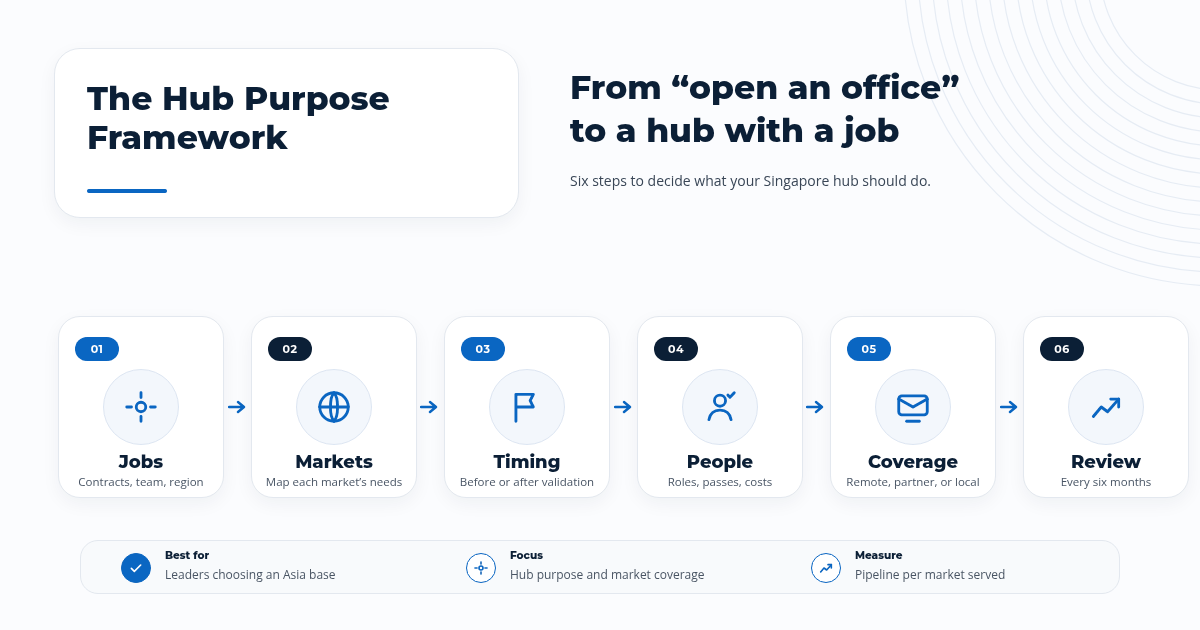
The Hub Purpose Framework
Our framework, the Hub Purpose Framework, helps you decide what your Singapore hub should do before you set it up.
Step 1 — Define the Hub’s Jobs
Questions to Answer
Will it hold contracts? Employ people? Sell in Singapore? Manage the region? Hold intellectual property? Each job has different requirements.
Step 2 — Map the Markets It Will Serve
What to Do
List each market the hub supports and what each one needs: local entity, partner, language, presence.
Step 3 — Decide Timing: Before or After Validation
Our View
If you have no buyer evidence yet, consider validating demand first. A hub can follow pipeline, not lead it.
Step 4 — Plan People and Roles
What to Decide
Regional manager, local sales, partners, or a mix. Check employment pass rules and costs before you plan headcount.
Step 5 — Plan Coverage for Each Market
Options
Remote outreach from Singapore, local partners, local hires, or local entities—market by market.
For multi-country sequencing, read our guide to a multi-country expansion strategy for Asia.
Step 6 — Review Every Six Months
What to Check
Is the hub doing the jobs you defined? Are other markets getting what they need? If one market now has strong pipeline, does it need its own local presence or entity?
What Setting Up a Singapore Hub Usually Involves (Overview)
This is a simplified overview based on ACRA and GoBusiness guidance, not a legal checklist.1210 Requirements can change and depend on your structure and sector.
| Stage | What It Typically Involves |
|---|---|
| Choose a structure | Local company, branch, or representative office, depending on your needs |
| Reserve a name | Through Bizfile, S$15 (ACRA) |
| Prepare officers | At least one locally resident director; a company secretary within six months |
| Register the company | Through Bizfile, S$300 (ACRA); foreign founders use a registered filing agent |
| Set up a registered office | A Singapore address for official correspondence |
| Plan tax and hiring | Corporate tax registration and employment pass planning |
Relatable Example
Setting up the entity is often the easy part. Deciding who will sit in it, what they will do, and which markets they will cover takes longer.
Questions to Ask Before You Incorporate
Use these with your leadership team and advisers before signing anything. They are our recommended questions, not legal requirements, and they work for any regional hub location.
- Which contracts will the Singapore entity sign, and with which countries’ buyers?
- Who will be the locally resident director?
- Which roles will be based in Singapore, and which in other markets?
- Do any of our target markets require a local entity or licence for our product?
- What buyer evidence do we have outside Singapore?
- How will we measure whether the hub is helping the region, not just Singapore?
Our View
If you cannot answer the last two questions, validate demand before investing in a large hub.
Hub Models Compared
| Model | How It Works | Fits When (Our View) |
|---|---|---|
| Singapore hub, remote coverage | Singapore entity; outreach to other markets from Singapore | Early stage, validating several markets |
| Singapore hub plus local partners | Hub contracts; partners handle local relationships | Markets need language and relationships |
| Singapore hub plus local entities | Hub manages; local entities sell and deliver | Proven demand, licensing needs |
| No hub, direct market entry | Entity in one priority market | One market dominates your plan |
Mini Example: The Hub That Waited for Demand (Illustrative)
This is an illustrative example, not a client case.
Situation
A European software company plans a Singapore office to serve Southeast Asia.
Decision
Before incorporating, it runs remote outreach in Singapore, Vietnam, and the Philippines for one quarter with a local partner.
What It Learns
Singapore buyers respond fastest; Vietnamese buyers need Vietnamese-language outreach; the Philippines shows the most active pipeline.
Outcome
It sets up in Singapore for contracting and management, with a partner covering Vietnam and a first local hire planned for the Philippines.
Our Take
The hub was the right choice. The order of steps made it work.
Need Help Building Pipeline From Your Singapore Hub?
Expand In Asia helps B2B companies based in or entering Singapore grow across Asia through:
- market prioritization;
- ICP definition (ICP: your ideal customer profile);
- localized buyer messaging for each market;
- LinkedIn, email, and phone outreach;
- SDR execution (the people who run first outreach and book meetings);
- appointment setting with decision-makers;
- lead qualification;
- market feedback by country.
Common Singapore Hub Mistakes
Mistake 1 — Treating Singapore Results as Regional Results
Singapore buyers are not regional buyers.
Mistake 2 — Incorporating Before Defining the Hub’s Jobs
Set the purpose first.
Mistake 3 — Running Every Market From Singapore in English
Many buyers expect local language.
Mistake 4 — Assuming the Entity Covers Other Countries’ Rules
Check each market.
Mistake 5 — Hiring a Regional Team Before Demand
Validate first. See our guide to validate product-market fit in Asia.
Mistake 6 — Forgetting the Cost of People
Plan salary floors and pass rules early.
For selling inside Singapore, read LinkedIn Lead Generation in Singapore: Tactics That Work in 2026 and How to Shorten Your B2B Sales Cycle in Singapore and SEA.
Singapore Hub Readiness Scorecard
Score each area from 1 to 5. This is our own simplified framework, not an industry benchmark. For a broader check, take the free Asia Expansion Readiness Assessment Tool.
| Area | 1 — Weak | 3 — Developing | 5 — Strong |
|---|---|---|---|
| Hub purpose | “Be in Asia” | Some jobs defined | Clear, written jobs |
| Markets served | “Asia” | Some named | Each market’s needs mapped |
| Demand evidence | None | Singapore only | Several markets |
| Legal and tax advice | None | General | Specific, per market |
| People plan | Unclear | Roles named | Roles, passes, and costs planned |
| Market coverage | Singapore only | Remote outreach | Partners or local presence where needed |
| Localization | English only | Some markets | Each priority market |
| Review cadence | None | Annual | Every six months |
Score Interpretation (Our Guidance)
| Total Score | What It Means |
|---|---|
| 34–40 | Hub well planned. Focus on market execution. |
| 27–33 | Good base. Fill market coverage gaps. |
| 20–26 | Hub planned, region not. Map market needs. |
| Below 20 | Define the hub’s purpose before incorporating. |
Need Coverage Beyond Singapore?
Expand In Asia helps you build pipeline in the markets your hub serves.
Next Steps With Expand In Asia
- Define the hub’s jobs.
- Map each market’s needs.
- Validate demand before scaling people.
- Get specific legal and tax advice.
To go deeper:
- read the pillar guide, Breaking Into Asia: 5 Critical Asia Expansion Mistakes;
- read The Cost of Building a Sales Team in Singapore vs. Outsourcing;
- read our B2B GTM strategy for Vietnam;
- read our B2B GTM strategy for Malaysia.
Ready to Implement These Strategies?
Book a free 30-minute strategy session where we’ll audit your current growth approach and identify your highest-leverage opportunities in Asian markets.
Frequently Asked Questions
1. Why do companies set up in Singapore to expand into Asia?
Common reasons include a flat 17% corporate income tax rate, a fast online company registration process, foreign ownership generally allowed outside regulated sectors, an English-speaking business environment, and a network of 29 implemented free trade agreements, according to Singapore government sources as of 2026.
2. Does a Singapore entity help you sell in Indonesia or Vietnam?
It can help with contracting, invoicing, and regional management. It does not create demand, relationships, or local-language capability in those markets. In our experience, buyers in Indonesia or Vietnam still expect local proof, local language, and sometimes local presence or partners.
3. What does it cost to register a company in Singapore?
According to ACRA, government fees are S$15 to reserve a company name and S$300 to register the company, or S$315 in total. You also need at least one locally resident director, a registered office address in Singapore, and a company secretary within six months.
4. What is Singapore's corporate tax rate in 2026?
IRAS states that companies are taxed at a flat 17% of chargeable income. For Year of Assessment 2026, IRAS lists an enhanced Corporate Income Tax Rebate of 50% of tax payable, with total benefits capped at S$40,000. Check eligibility with a tax adviser. This is not tax advice.
5. Is Singapore a good test market for Asia?
It is a good starting point but a weak proxy. Singapore is small, international, and English-speaking. In our view, success there does not prove demand in Indonesia, Vietnam, or Japan. Validate each market separately.
6. Do I need a Singapore entity before selling in Asia?
Not always. Many companies validate demand first through remote outreach and partners. In our view, set up a hub when you need it for contracts, people, or regional management, not as proof that you are serious.
7. How can Expand In Asia help companies using Singapore as a hub?
Expand In Asia is a Singapore-based B2B outbound and market-entry partner. It helps companies based in or entering Singapore build pipeline across Asian markets with localized outreach, appointment setting, and market feedback, before larger hiring and office commitments.
Why did your company choose (or not choose) Singapore as its Asia base? Share it in the comments or pass this guide to your CFO.
About the author: Joel Berou is Asia Expansion & Revenue Growth Advisor at Expand In Asia, a Singapore-based B2B outbound and market-entry partner that helps companies build pipeline across Asian markets. This article is general information and not legal, tax, or immigration advice. Last updated: October 16, 2026.
Sources
-
Accounting and Corporate Regulatory Authority (ACRA). Service & transaction fees: Companies (accessed 16 October 2026). https://www.acra.gov.sg/manage/companies/service-transaction-fees/ ↩↩↩
-
ACRA. Step 1: Understanding requirements & eligibility (accessed 16 October 2026). https://www.acra.gov.sg/register/business/requirements-eligibility/ ↩↩
-
Chambers and Partners. Doing Business In 2026: Singapore. https://practiceguides.chambers.com/practice-guides/doing-business-in-2026/singapore ↩
-
Inland Revenue Authority of Singapore (IRAS). Corporate Income Tax Rate, Rebates & Tax Exemption Schemes (accessed 16 October 2026). https://www.iras.gov.sg/taxes/corporate-income-tax/basics-of-corporate-income-tax/corporate-income-tax-rate-rebates-and-tax-exemption-schemes ↩
-
Singapore Ministry of Trade and Industry website (page title: Ministry of Energy, Trade and Industry). Free Trade Agreements (FTAs) (last updated 21 August 2026). https://www.mti.gov.sg/trade-international-economic-relations/agreements/free-trade-agreements-fta/ ↩
-
DataReportal (Kepios, Meltwater, We Are Social). Digital 2026: Singapore (data as of October 2025). https://datareportal.com/reports/digital-2026-singapore ↩↩↩
-
Ministry of Manpower Singapore. Employment Pass: Eligibility (accessed 16 October 2026). https://www.mom.gov.sg/passes-and-permits/employment-pass/eligibility ↩
-
United Nations, Department of Economic and Social Affairs, Population Division. World Population Prospects 2024. https://population.un.org/wpp/ ↩
-
DataReportal. Digital 2026: Indonesia (data as of October 2025). https://datareportal.com/reports/digital-2026-indonesia ↩
-
GoBusiness Singapore. Step 4: Register your business (accessed 16 October 2026). https://www.gobusiness.gov.sg/resources/start-up-guide/register-your-business ↩