A practical playbook for foreign B2B companies that want to build pipeline in Vietnam
Vietnam keeps showing up in board decks.
Fast growth. A young, digital workforce. Manufacturing and investment flowing in.
So the plan says: “Enter Vietnam next year.”
But a market is not a plan.
A B2B GTM strategy for Vietnam turns interest into a sequence of decisions: who to sell to, where, in which language, through which channels, and how to know it is working. GTM (go-to-market) simply means your plan for reaching and winning customers in a market.
A Vietnam GTM plan usually covers:
- the segments and cities you will target first;
- how you will localize your message into Vietnamese;
- which outreach channels you will use;
- how you will price and contract;
- which local rules apply to your outreach and data;
- how you will measure early progress.
Most expansion teams ask:
“Is Vietnam a big enough opportunity?”
But for B2B companies entering Vietnam, the better question is:
“Which Vietnamese buyers will buy from us first—and how will we reach them?”
Because growth at the country level does not create demand for your product automatically.
A manufacturer in Binh Duong may need your solution tomorrow.
A bank in Hanoi may need two years of relationship-building first.
This playbook extends our series of country GTM guides, including GTM Strategy for B2B SaaS Entering the Philippine Market and How to Build a GTM Playbook for Entering the Indonesian B2B Market. It builds on our pillar, Breaking Into Asia: 5 Critical Asia Expansion Mistakes.
- TL;DR — Key Takeaways
- Vietnam is growing fast. GDP grew an estimated 8.02% in 2025, to about US$514 billion (Vietnam statistics office).
- Start with one segment and one city. Ho Chi Minh City and Hanoi often behave like different markets (our view).
- Localize into Vietnamese. English works with some buyers, not most local mid-sized firms (our experience).
- LinkedIn is not enough. About 9.8% of the population were members in late 2025.
- Check the new data law. Vietnam’s Personal Data Protection Law took effect on 1 January 2026.
- Validate before you build. Pipeline first; entity and hires later (our view).
If you only do one thing: pick one segment in one city and book ten discovery meetings before writing the rest of your Vietnam plan.
Who This Guide Is For—and Who It Is Not For
This Guide Is For
- foreign B2B SaaS, technology, and services companies considering Vietnam;
- companies already in Singapore or elsewhere in Southeast Asia adding Vietnam;
- sales leaders asked to build Vietnam pipeline from abroad;
- suppliers to manufacturing, logistics, and export-driven industries;
- founders comparing Vietnam with Indonesia, Thailand, or the Philippines;
- regional teams building a multi-country plan.
This guide is especially useful if your team is asking:
- Where should we start in Vietnam?
- Do we need Vietnamese-language outreach?
- Which channels reach Vietnamese decision-makers?
- What do we need to know about compliance?
This Guide Is Not For
- you need step-by-step legal guidance on licensing or company setup;
- you sell only to consumers;
- you want a ranking of Asian markets (see our multi-country expansion strategy for Asia);
- you plan to copy your Singapore approach unchanged.
Practical fit check: if your Vietnam plan is one slide in a regional deck, this guide is for you.
What a B2B GTM Strategy for Vietnam Means
A B2B GTM strategy for Vietnam is a plan for how a foreign company will find, reach, and win business customers in Vietnam: which segments and cities to target, what to say in Vietnamese, which channels to use, how to price, how to comply with local rules, and how to measure early progress.
Regional Plan vs. Vietnam-Specific GTM
| Area | Generic Regional Plan | Vietnam-Specific GTM |
|---|---|---|
| Target | “SEA mid-market” | One segment in one city |
| Language | English | Vietnamese for most local buyers |
| Channels | LinkedIn and email | Phone, email, LinkedIn, introductions, events |
| Proof | Global or Singapore logos | Vietnamese or similar-market references |
| Compliance | One regional policy | Vietnam’s PDP Law and decree checked |
| Success metric | Revenue in year one | Meetings, pipeline, and learning first |
Practical Rule (our take)
Vietnam is not a smaller Singapore.
Plan it as its own market.
Why Vietnam Deserves Its Own GTM Plan
Reason 1 — Fast Growth and a Large Economy
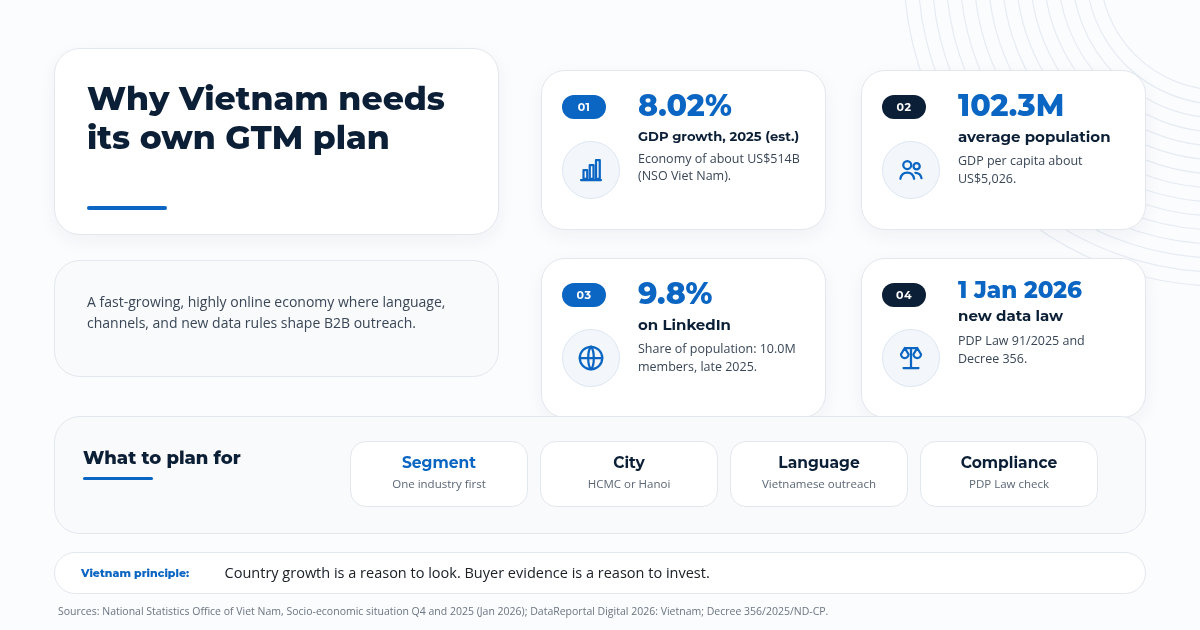
According to the National Statistics Office of Viet Nam, GDP grew an estimated 8.02% in 2025, reaching about US$514 billion. GDP per capita reached about US$5,026, and the average population was about 102.3 million.1
Reason 2 — Investment and New Businesses
The same release estimates disbursed foreign direct investment at US$27.62 billion in 2025, up 9.0%, and reports nearly 297,500 newly established and resumed enterprises.1 In plain terms: more companies, more projects, and more potential B2B buyers.
Reason 3 — A Highly Online Population, but Thin LinkedIn Coverage
DataReportal’s Digital 2026 Vietnam report counts 85.6 million internet users in late 2025, or 84.2% of the population. But LinkedIn had 10.0 million members, about 9.8% of the population, while Facebook’s ad reach equaled 77.6%.2 Members and ad reach are not the same as active business users, so treat these as signals, not targets.
Reason 4 — Language Matters
Vietnam scored 500 in the EF English Proficiency Index 2025.3 In our experience, English works well with multinationals and tech firms, but Vietnamese-language outreach usually performs better with local mid-sized companies.
Reason 5 — New Data Protection Rules
Vietnam’s Law on Personal Data Protection (Law No. 91/2025/QH15) and its guiding Decree 356/2025/ND-CP took effect on 1 January 2026, replacing Decree 13/2023.5 Any prospect list and outreach plan should be checked against them. This is not legal advice.
Practical Rule (our take)
Country growth is a reason to look.
Buyer evidence is a reason to invest.
Choosing Your First Segment and City
Segment
In our experience, foreign B2B companies often find early traction in segments that are already international or fast-growing, such as:
- manufacturing and export suppliers;
- logistics and supply chain;
- technology and software companies;
- financial services and fintech;
- professional services serving foreign investors.
These are examples, not a ranking. Validate your own segment.
City
| City | Often Fits (Our Experience) | Keep in Mind |
|---|---|---|
| Ho Chi Minh City | Commercial hub; many private companies and startups | Fast-moving; competitive |
| Hanoi | Capital; government-linked and large enterprises | Relationships and formality matter more |
| Industrial provinces around both cities | Manufacturing and export buyers | Decision-makers may be harder to reach online |
Practical Rule (our take)
Start where your best-fit buyers are concentrated, not where the office would be most convenient.
The Vietnam B2B Entry Playbook
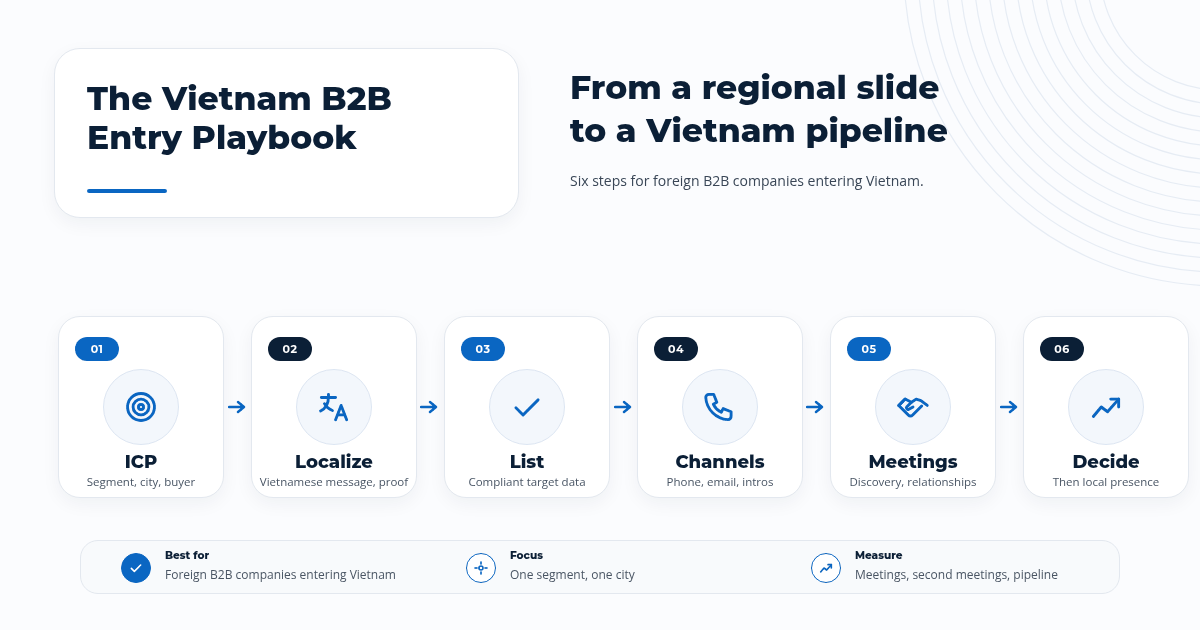
Our framework, the Vietnam B2B Entry Playbook, follows six steps. It mirrors the structure we use in our Philippines and Indonesia guides, adapted for Vietnam.
Step 1 — Define Your ICP for Vietnam
What to Do
Define your ICP (ideal customer profile: the type of company most likely to buy) for Vietnam specifically: industry, size, city, ownership type, and buyer role.
Why It Matters
In our experience, a foreign-owned factory and a family-owned local manufacturer in the same industry buy very differently.
Step 2 — Localize Message and Proof
What to Change
- outreach and materials in Vietnamese where buyers need it;
- examples that reflect Vietnamese business realities;
- references from Vietnam or similar Southeast Asian markets.
Example First Message (Translated Into English Here)
“Dear Mr. Minh, I am contacting you from [Company], which helps freight forwarders in Ho Chi Minh City reduce manual shipment tracking. Two forwarders in the region are already using our system. Would you be open to a 20-minute conversation next week to see whether it is relevant for your team?”
Why It Works (Our View)
It is short, specific to the buyer’s industry and city, uses regional proof, and asks for a small next step. In practice, send it in Vietnamese and adjust the formality to the recipient’s seniority.
For country-level content differences, read Country-Specific Content Localization: Singapore vs. Indonesia vs. Vietnam. For the sales side, see how to localize your sales playbook for Asia.
Step 3 — Build a Compliant Target List
What to Do
Build a list of target companies and decision-makers from reliable sources. Check how Vietnam’s new data protection rules affect how you collect, store, and use contact data.
Step 4 — Choose a Channel Mix
Channels to Combine (Our Experience)
- phone outreach, ideally in Vietnamese;
- email with short, clear messages;
- LinkedIn for tech, multinationals, and senior professionals;
- introductions through partners, chambers, and existing clients;
- industry events and trade shows.
Practical Rule (our take)
Pick channels by buyer type, not by what worked at home.
Step 5 — Run Discovery Meetings and Build Relationships
What to Do
Book discovery meetings with target buyers. Follow up consistently. Multi-thread: build relationships with several people in each account.
Why It Matters
In our experience, trust still drives many B2B decisions in Vietnam. Read relationship selling in Asia for how to measure progress.
Step 6 — Measure, Then Decide on Local Presence
What to Measure
Meetings held, second meetings, stakeholders engaged, objections, and early opportunities.
When to Add Local Presence (Our View)
Once real opportunities exist and trust needs a local face. See When Should You Hire a Local Sales Team in Asia?.
How Vietnam Compares With Indonesia and the Philippines
If Vietnam is one option in a wider Southeast Asia plan, these published figures help frame the differences. They describe whole populations, not B2B buyers.
| Indicator | Vietnam | Indonesia | Philippines |
|---|---|---|---|
| LinkedIn members as % of population (late 2025) | 9.8% | 12.9% | 18.8% |
| EF English Proficiency Index 2025 score | 500 | 471 | 569 |
| Population | ~102.3M (2025 average, NSO) | ~283.5M (2024, UN) | ~115.8M (2024, UN) |
Sources: DataReportal Digital 2026 country reports;2 EF EPI 2025;3 National Statistics Office of Viet Nam;1 UN World Population Prospects 2024.4
What This Means in Practice (Our View)
Compared with the Philippines, Vietnam usually needs more local-language outreach and less reliance on LinkedIn. Compared with Indonesia, it is smaller but often more concentrated in two commercial centers.
What to Expect From Vietnamese B2B Buyers (Our Experience)
- Speed varies by sector. Private and tech companies can move quickly; government-linked and large enterprises usually take longer.
- Relationships matter. Consistent follow-up and in-person meetings build trust.
- Seniority counts. Owners and general directors often make or approve decisions in mid-sized firms.
- Practical value wins. Buyers often ask for clear cost savings or revenue impact.
- Local support is expected. Who will help them, in Vietnamese, after the sale?
Relatable Example
A general director of a family-owned manufacturer may agree to a meeting quickly but want to meet in person, with a Vietnamese speaker, before discussing budgets.
Working With Local Partners in Vietnam
In our experience, a local partner can shorten the learning curve by:
- building accurate target lists;
- running Vietnamese-language calls and emails;
- arranging meetings and introductions;
- explaining local buying practices.
What to Check (Our Recommendation)
Ask any partner for examples in your segment, how they handle prospect data under Vietnam’s new rules, and how they will report what buyers say.
Pricing and Commercial Terms in Vietnam
What to Consider (Our Experience)
- local price expectations may differ from Singapore or your home market;
- buyers may ask for pricing in Vietnamese dong;
- contracts and invoices may need Vietnamese-language versions;
- larger buyers may have formal procurement steps.
Our View
Keep your pricing logic consistent across markets. Adjust levels and terms where Vietnamese buyers require it. Get local tax and legal advice before finalizing contracts, and agree payment terms in writing before work starts.
Mini Example: Testing Vietnam From Singapore (Illustrative)
This is an illustrative example, not a client case.
Situation
A Singapore-based logistics software company wants to test Vietnam.
Approach
It targets mid-sized freight forwarders in Ho Chi Minh City, translates its one-page overview into Vietnamese, and runs phone and email outreach with a local partner.
What It Learns
Buyers respond to cost and visibility problems, ask for local references, and want Vietnamese-language support.
Next Decision
It adds one Vietnamese reference customer before expanding to Hanoi.
Our Take
The first wave of meetings is not about revenue. It is about learning what Vietnamese buyers actually need.
If you are running Vietnam from a Singapore base, our guide to Singapore as a regional hub for Asia expansion explains what that base can and cannot do.
Need Help Building a Vietnam GTM Strategy?
Expand In Asia helps foreign B2B companies enter Vietnam through:
- market and segment prioritization;
- ICP definition for Vietnam;
- target account and contact research;
- Vietnamese-language buyer messaging;
- phone, email, and LinkedIn outreach;
- SDR execution (the people who run first outreach and book meetings);
- appointment setting with decision-makers;
- market feedback reports.
Common Vietnam GTM Mistakes
Mistake 1 — Treating Vietnam as One Market
Ho Chi Minh City, Hanoi, and industrial provinces can differ.
Mistake 2 — English-Only Outreach
You may reach multinationals and miss local buyers.
Mistake 3 — Relying on LinkedIn
Coverage is limited. Mix channels.
Mistake 4 — Setting Up Before Testing
An entity and office before pipeline is an expensive bet.
Mistake 5 — Ignoring the New Data Law
Check how Vietnam’s 2026 rules apply to your data and outreach.
Mistake 6 — Using Global References Only
Local proof matters. Win one Vietnamese reference early.
Vietnam GTM Readiness Scorecard
Score each area from 1 to 5. This is our own simplified framework, not an industry benchmark. For a broader check, take the free Asia Expansion Readiness Assessment Tool.
| Area | 1 — Weak | 3 — Developing | 5 — Strong |
|---|---|---|---|
| Segment and city | “Vietnam” | One segment, several cities | One segment, one city |
| ICP for Vietnam | Copied from home market | Partly adapted | Defined with local evidence |
| Vietnamese localization | None | Some materials | Outreach and materials localized |
| Target list | None | Partial | Accurate and compliance-checked |
| Channel mix | LinkedIn only | Two channels | Mixed by buyer type |
| Local proof | None | Regional | Vietnamese references |
| Compliance review | None | Informal | Checked with an adviser |
| Progress metrics | Revenue only | Some activity metrics | Meetings, stakeholders, opportunities |
Score Interpretation (Our Guidance)
| Total Score | What It Means |
|---|---|
| 34–40 | Ready to scale outreach in Vietnam. |
| 27–33 | Good base. Fix localization and proof. |
| 20–26 | Still a regional plan. Focus on segment and city. |
| Below 20 | Start with validation. See How to Validate Product-Market Fit in Asia. |
Need Pipeline in Vietnam?
Expand In Asia runs localized B2B outreach and appointment setting in Vietnam.
Next Steps With Expand In Asia
- Pick one segment and one city.
- Localize into Vietnamese.
- Mix channels by buyer.
- Check compliance, then test.
To go deeper:
Ready to Implement These Strategies?
Book a free 30-minute strategy session where we’ll audit your current growth approach and identify your highest-leverage opportunities in Asian markets.
Frequently Asked Questions
1. What is a B2B GTM strategy for Vietnam?
A B2B GTM strategy for Vietnam is a plan for how a foreign company will find, reach, and win business customers in Vietnam: which segments and cities to target, what to say in Vietnamese, which channels to use, how to price, how to comply with local rules, and how to measure early progress.
2. How do foreign B2B companies enter Vietnam?
In our experience, most start by validating demand remotely or with a local partner: choosing one segment, running Vietnamese-language outreach, and holding discovery meetings in Ho Chi Minh City or Hanoi. Legal entity, hiring, and office decisions usually come after early pipeline exists.
3. How big is Vietnam's economy in 2025?
According to Vietnam’s statistics office, GDP grew an estimated 8.02% in 2025, reaching about US$514 billion, with GDP per capita of about US$5,026. The average population was about 102.3 million.
4. Which channels work for B2B outreach in Vietnam?
In our experience, a mix of phone, email, LinkedIn, introductions, and events works best, in Vietnamese where possible. DataReportal’s Digital 2026 Vietnam report shows 10.0 million LinkedIn members in late 2025, about 9.8% of the population, so LinkedIn alone will miss many buyers.
5. Is English enough to sell B2B in Vietnam?
Sometimes, especially with multinationals and tech companies. Vietnam scored 500 in the EF English Proficiency Index 2025. In our experience, Vietnamese-language outreach and materials improve response from local mid-sized companies and traditional sectors.
6. What data privacy rules affect B2B outreach in Vietnam?
Vietnam’s Law on Personal Data Protection (Law No. 91/2025/QH15) and its guiding Decree 356/2025/ND-CP took effect on 1 January 2026, replacing Decree 13/2023. Check how they apply to your prospect data and outreach with a qualified adviser. This is not legal advice.
7. How can Expand In Asia help with a Vietnam GTM strategy?
Expand In Asia is a Singapore-based B2B outbound and market-entry partner. It helps foreign companies prioritize Vietnamese segments, build target lists, run localized outreach, book meetings with decision-makers, and report market feedback before larger commitments.
Are you planning to enter Vietnam in the next year? Share your biggest question in the comments or pass this playbook to your expansion team.
About the author: Joel Berou is Asia Expansion & Revenue Growth Advisor at Expand In Asia, a Singapore-based B2B outbound and market-entry partner that helps companies build pipeline across Asian markets. Last updated: October 16, 2026.
Sources
-
National Statistics Office of Viet Nam. Socio-economic situation in the fourth quarter and 2025 (January 2026). https://www.nso.gov.vn/en/data-and-statistics/2026/01/socio-economic-situation-in-the-fourth-quarter-and-2025/ ↩↩↩
-
DataReportal (Kepios, Meltwater, We Are Social). Digital 2026: Vietnam (data as of October 2025). https://datareportal.com/reports/digital-2026-vietnam ↩↩
-
EF Education First. EF English Proficiency Index 2025. https://www.ef.com/wwen/epi/ ↩↩
-
United Nations, Department of Economic and Social Affairs, Population Division. World Population Prospects 2024. https://population.un.org/wpp/ ↩
-
Government of Viet Nam. Decree No. 356/2025/ND-CP detailing the Law on Personal Data Protection (issued 31 December 2025, effective 1 January 2026). https://congbaocdn.chinhphu.vn/180507251028987904/2026/1/17/356signed-1768638052103952849513.pdf — summary in English: DLA Piper, Data Protection Laws of the World: Vietnam. https://www.dlapiperdataprotection.com/?c=VN&t=law ↩