A practical guide for B2B teams whose ideal buyers simply are not online
You have the perfect target account.
You open LinkedIn.
The decision-maker is not there.
Neither is their deputy.
The company website lists one phone number and a general email address.
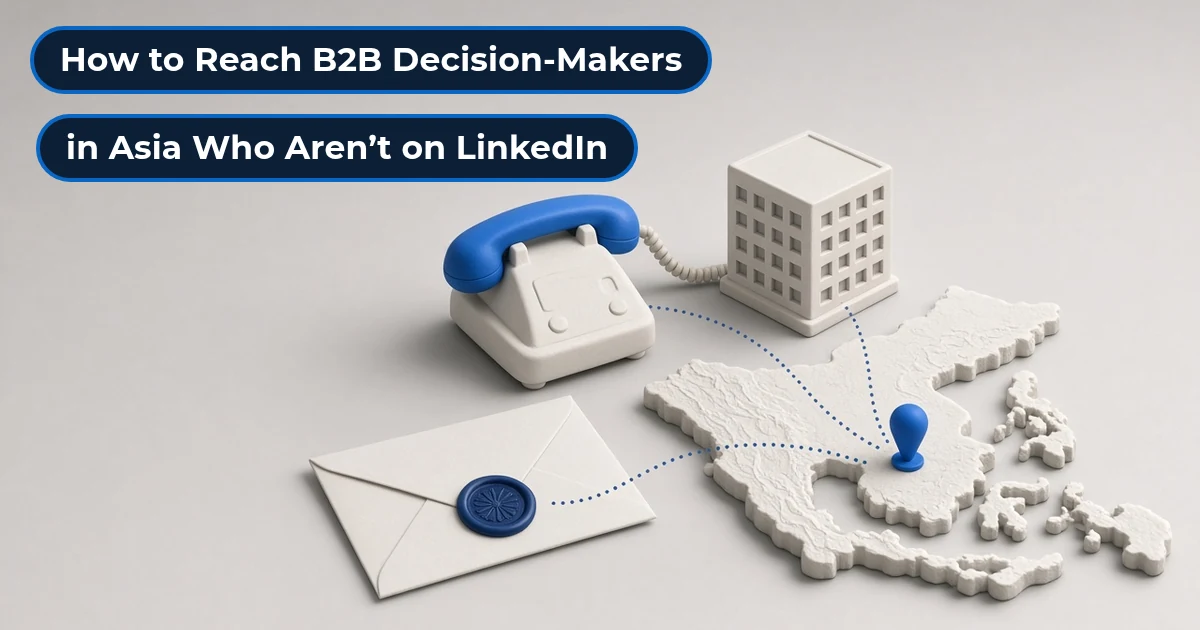
If you sell to mining, oil and gas, shipbuilding, government agencies, or family-owned groups in Asia, this will feel familiar. This guide shows how to reach B2B decision-makers not on LinkedIn: how to choose channels by buyer, when to send a formal letter, and how to work with gatekeepers instead of fighting them.
For these buyers, getting a first answer can depend on:
- picking up the phone;
- sending a formal letter asking permission to talk;
- treating the gatekeeper as a partner;
- using a local language and a formal tone;
- moving to digital channels only once the buyer agrees.
Most sales teams ask:
“Which channel converts best in Asia?”
But for B2B teams selling to traditional industries and the public sector, the better question is:
“How does this specific buyer expect to be approached for the first time?”
Because channel popularity is not the same as buyer preference.
A SaaS founder in Singapore may answer a LinkedIn message in an hour.
A plant director in East Kalimantan may only respond to a letter on company letterhead.
This guide expands on Mistake 4 from our masterclass, Breaking Into Asia: 5 Critical Asia Expansion Mistakes.
- TL;DR — Key Takeaways (our view)
- Choose channels by buyer, not by popularity. The right channel depends on the country, industry, and seniority.
- LinkedIn coverage varies a lot. Digital 2026 data puts LinkedIn members at 18.8% of the Philippine population but 4.4% in Japan.
- Cold calling is not dead. In our experience, it opens a large share of conversations in Asia.
- A formal letter can open locked doors. Ask permission to talk; do not pitch.
- Work with the gatekeeper. They often decide whether your request reaches the decision-maker.
- Check local rules. For example, Singapore’s Do Not Call provisions.
If you only do one thing: for each target segment, write down how its decision-makers actually prefer to be contacted before choosing your outreach channels.
Who This Guide Is For—and Who It Is Not For
This Guide Is For
- companies selling to heavy industries such as mining, energy, or shipbuilding;
- teams targeting government agencies or state-linked companies;
- sales leaders whose LinkedIn and email outreach gets no replies;
- SDR managers (SDR: sales development representative, the person who runs first outreach and books meetings) building channel plans for several Asian markets;
- founders selling to family-owned groups or traditional conglomerates;
- teams entering Indonesia, the Philippines, Japan, or other markets where online coverage of senior buyers is thin.
This guide is especially useful if your team is asking:
- What do we do when the buyer is not on LinkedIn?
- Is cold calling still worth it in Asia?
- How do we get past the executive assistant?
- Is a letter really worth sending in 2026?
This Guide Is Not For
- you sell mainly to tech startups that live on LinkedIn;
- you want a channel-by-channel conversion comparison (read Cold Email vs. LinkedIn Outreach: Which Converts Better in Asia?);
- you plan mass, untargeted outreach;
- you are not willing to adapt tone and formality.
Practical fit check: if you cannot find your buyer’s name online, this guide is for you.
What It Means to Reach B2B Decision-Makers Beyond LinkedIn
Reaching B2B decision-makers beyond LinkedIn means opening first conversations with senior buyers through the channels they and their organizations actually use, such as phone calls, formal letters, introductions, and gatekeepers. In our experience, it matters most for traditional industries, government agencies, and hierarchical companies in Asia.
Channel-by-Buyer Matrix (Our Experience)
| Buyer Type | Often Works First | Often Struggles First |
|---|---|---|
| Tech and SaaS companies | LinkedIn, email | Formal letters |
| Mid-sized local businesses | Phone, introductions | Long cold emails |
| Heavy industry (mining, oil and gas, shipbuilding) | Phone to main office, formal letter | |
| Government agencies | Formal letter, official channels, gatekeeper | Informal social messages |
| Large multinationals in Asia | LinkedIn, email, phone | Generic sequences |
| Family-owned groups | Introductions, phone, formal approach | Automated outreach |
Practical Rule (our take)
Do not pick a channel because it is popular in Asia.
Pick it because it matches how your specific buyer buys in that specific market.
Why LinkedIn Is Not Enough in Many Asian Markets
Nicolas Levitte, Founder & CEO of Expand In Asia, worked at LinkedIn on the team that launched Sales Navigator in Asia in 2014. In his own words at our masterclass, he was convinced cold calling was dead—and Sales Navigator worked well for him.
Then he founded Expand In Asia. After working with businesses in many industries, he concluded LinkedIn was not enough. Cold calling had to be part of the service.
The numbers help explain why. DataReportal’s Digital 2026 reports, which use LinkedIn’s own advertising data from late 2025, show very different coverage by country:123
| Country | LinkedIn Members (Late 2025) | Share of Total Population |
|---|---|---|
| Philippines | 22.0 million | 18.8% |
| Indonesia | 37.0 million | 12.9% |
| Japan | 5.40 million | 4.4% |
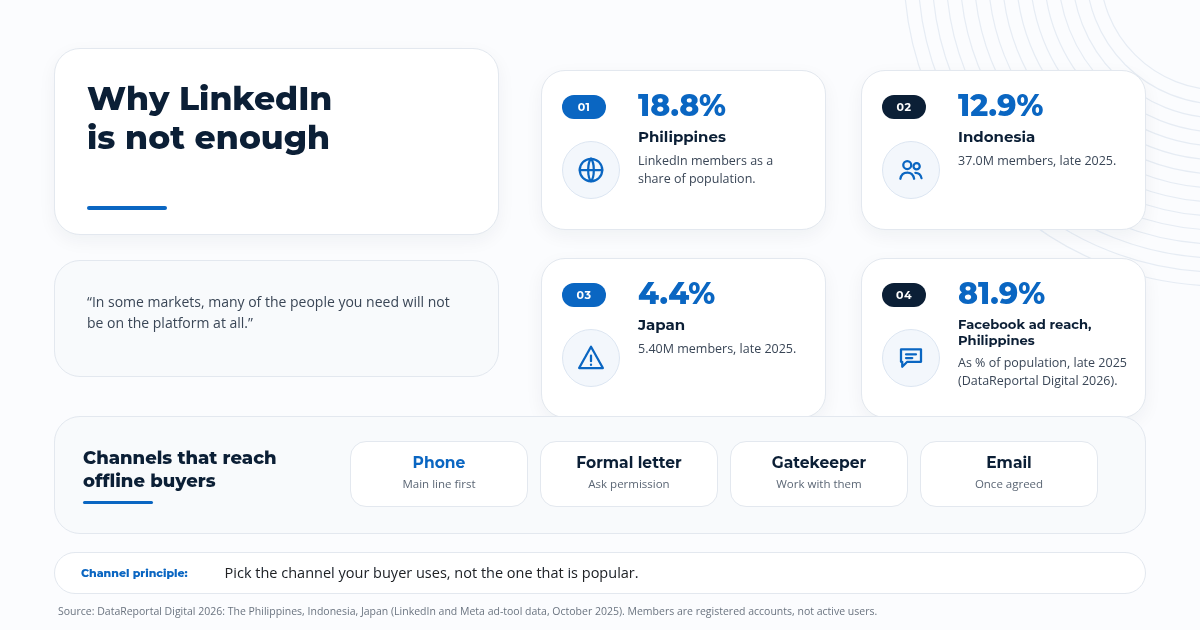
Two cautions. These are registered members, not active users. And they cover the whole population, not just business buyers. But the gap is clear: in some markets, many of the people you need will not be on the platform at all.
Other platforms can be big in one country and irrelevant in another. In the Philippines, for example, Facebook’s ad reach was equal to 81.9% of the population in late 2025, according to the same Digital 2026 report.1 Ad reach is not the same as active business use, though.
Practical Rule (our take)
LinkedIn is a channel, not a market map.
If your buyer is not there, no message will reach them.
Cold Calling in Asia: Still Working, Used Well
In Expand In Asia’s experience, cold calls create a large share of the conversations it opens for clients across Asia—more in some markets than others, India being one example Nicolas gave. You will get rejection. You will also build traction.
How to Make Cold Calls Work (Our Recommendations)
- call the main line and ask politely who handles the topic;
- introduce yourself and your company in one sentence;
- explain why you are calling this specific organization;
- ask for permission or the right process, not for a sale;
- use the local language where it helps;
- follow up in writing with what you discussed.
Check the Rules First
Rules differ by country. In Singapore, for example, PDPC guidelines state that the Do Not Call provisions do not apply to business-to-business marketing messages sent to organizations, though other Personal Data Protection Act obligations may still apply.4 This is general information, not legal advice.
For call structure, read The Anatomy of a High-Converting Appointment Setting Script and Why Cold Calling Is Your Secret Weapon.
The Permission-First Outreach Method
Our framework for buyers who cannot be reached online is the Permission-First Outreach Method. It is built from the client cases Nicolas shared at our masterclass.
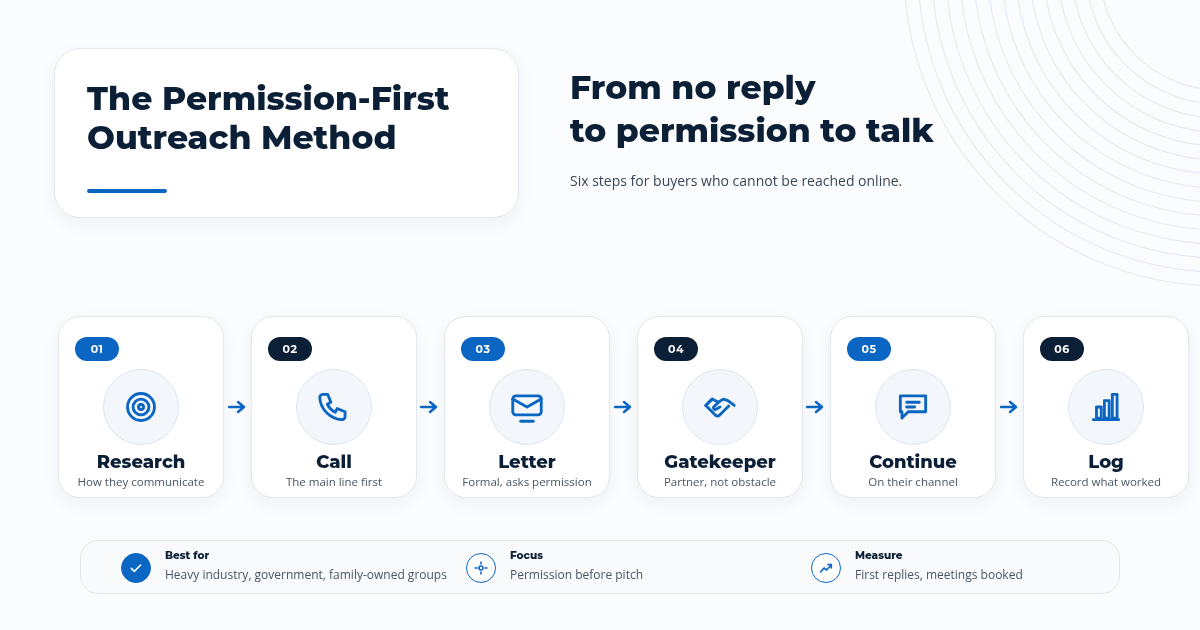
Step 1 — Research How the Organization Communicates
What to Check
Official contact channels, the organization chart if public, procurement pages, and how partners or suppliers are announced.
Why It Matters
In our experience, the organization often tells you how it wants to be approached, if you look.
Step 2 — Call the Main Line
What to Do
Ask who is responsible for the area you serve and how requests are usually received.
What You Learn
Names, titles, and the right process—information that is not online.
Step 3 — Send a Formal Letter Asking Permission
What It Is
A short, formal letter, on company letterhead, addressed to the right person or office.
What to Include
- who you are and who you represent;
- why you are writing to this organization;
- a clear request for permission to start a conversation;
- how they can reply.
What to Avoid
A sales pitch, attachments, or pricing.
Relatable Example
Think of it like asking for an appointment with a senior official, not sending an advertisement.
Step 4 — Work With the Gatekeeper
Who They Are
Executive assistants, secretaries, and department coordinators who manage access to the decision-maker.
Our View
Accept that you have to deal with the gatekeeper instead of trying to avoid them. Be clear, patient, and respectful. They are often the fastest route to a yes.
Step 5 — Continue on the Buyer’s Preferred Channel
What to Do
Once you have permission to talk, ask how the buyer would like to continue—email, phone, video calls—and follow their lead on timing.
Why It Matters
Permission to speak once is not permission to chase.
Step 6 — Log What Worked
What to Record
For each segment: which channel got the first reply, who the gatekeeper was, how the organization prefers to be contacted, and how long it took.
Why It Matters
In our experience, this log turns one lucky breakthrough into a repeatable process for the next account in the same sector.
Practical Rule (our take)
For hard-to-reach buyers, the first goal is not a meeting.
It is permission to have one.
Sample Permission Letter (Template)
Here is a simple structure we recommend. Adapt the tone, language, and titles to the country and organization. In many markets, a translated version signed by a senior person carries more weight.
[Company letterhead]
[Date]
To: [Name and title, or Head of the relevant department]
[Organization name and address]Subject: Request to Arrange an Introductory Conversation
Dear [Title and family name],
I am writing on behalf of [Your company], a [one-line description] that works with [type of organizations] in [countries].
We would welcome the opportunity to introduce our work to [Organization] and to understand whether it may be relevant to your priorities in [area].
May we request a short introductory conversation with you or a member of your team at a time convenient to you? If another colleague or process is more appropriate, we would be grateful for your guidance.
You may reply to [email] or call [phone].
Yours sincerely,
[Name, title, signature]
Why This Works (Our Experience)
It is short, respectful, and asks for permission and guidance—not a purchase. It also gives the gatekeeper an easy way to route it.
Build a Channel Plan per Market and Segment
Do not write one outreach plan for “Asia.”
How to Build It
- list your priority segments in each country;
- for each, note where decision-makers are reachable today;
- choose a first-contact channel and two follow-up channels;
- define when to switch to a formal approach;
- review replies every two weeks and adjust.
Relatable Example
Your Singapore software buyers may get a LinkedIn message, an email, then a call. Your Indonesian mining buyers may get a call to the head office, then a formal letter, then a follow-up call to the assistant.
Two Client Cases (Clients Unnamed)
These details come from Nicolas Levitte’s account at our masterclass. Both clients asked not to be named.
Case 1 — Heavy-Industry Buyers in Indonesia
Situation
A French multinational software company serving heavy industries—mining, oil and gas, shipbuilding—asked Expand In Asia to open conversations in Indonesia.
Barrier
The target decision-makers were not on LinkedIn.
Solution
The team returned to a traditional approach: a formal letter asking permission to start a conversation. That helped identify the right person and led the team to work with the gatekeeper instead of around them.
Results (Speaker’s Account)
In his words, it “opened the doors we needed.” Once permission was given, the conversations moved to digital channels.
Case 2 — Government Agencies in the Philippines
Situation
A German client needed to engage government agencies in the Philippines.
Barrier
The usual mix of email, LinkedIn, and cold calling did not produce answers. The team even explored Facebook.
Solution
The team used the same permission-first process from the Indonesia case.
Results (Speaker’s Account)
It worked, and the conversation continued by email.
Our Take
A letter is rare in 2026. That is exactly why it can stand out with the right buyer.
Need Help Reaching Buyers Who Are Not Online?
Expand In Asia helps B2B companies open conversations with hard-to-reach decision-makers across Asia through:
- market and segment prioritization;
- account and stakeholder research;
- ICP definition (ICP: your ideal customer profile);
- channel planning by buyer type;
- cold calling in local languages;
- formal, permission-first outreach;
- email and LinkedIn where buyers use them;
- appointment setting with decision-makers.
Talk to Expand In Asia about reaching hard-to-reach buyers →
Common Mistakes When Buyers Are Hard to Reach
Mistake 1 — Assuming Everyone Is on LinkedIn
Coverage varies widely by country and industry.
Mistake 2 — Treating the Gatekeeper as an Obstacle
In our experience, gatekeepers remember how you treated them.
Mistake 3 — Pitching in the First Contact
For formal organizations, ask permission first.
Mistake 4 — Using Informal Channels Too Early
A channel being widely used does not mean buyers want sales messages there.
Mistake 5 — Ignoring Local Rules
Check telemarketing and data-protection rules in each country.
Mistake 6 — Giving Up After One Channel
In our experience, hard-to-reach buyers often answer the second or third approach, through a different channel.
Hard-to-Reach Buyer Outreach Scorecard
Score each area from 1 to 5. This is our own simplified framework, not an industry benchmark. For a broader check of your outbound capability, take the free Asia Expansion Readiness Assessment Tool.
| Area | 1 — Weak | 3 — Developing | 5 — Strong |
|---|---|---|---|
| Buyer research | None | Basic | Contact preferences known per segment |
| Channel mix | LinkedIn only | Two channels | Chosen by buyer type |
| Cold calling | Not used | Occasional | Structured, local-language calls |
| Formal approach | Never used | Ad hoc | Template and process ready |
| Gatekeeper handling | Avoided | Tolerated | Treated as a partner |
| Local language | English only | Partly | Where buyers need it |
| Compliance check | None | Informal | Checked per country |
| Follow-up discipline | One attempt | Two attempts | Planned multi-channel sequence |
Score Interpretation (Our Guidance)
| Total Score | What It Means |
|---|---|
| 34–40 | Strong outreach engine for hard-to-reach buyers. |
| 27–33 | Good base. Add formal and gatekeeper steps. |
| 20–26 | Too dependent on digital channels. Add phone and permission-first outreach. |
| Below 20 | High risk of missing your best buyers. Rebuild the channel plan first. |
Need Help With Heavy-Industry Buyers?
Expand In Asia works with companies selling into mining, energy, manufacturing, and other heavy industries across Asia.
Next Steps With Expand In Asia
- Research the buyer: how do they prefer to be approached?
- Pick channels by buyer type, not popularity.
- Ask permission first for formal organizations.
- Work with gatekeepers, not around them.
To go deeper:
- read the pillar guide, Breaking Into Asia: 5 Critical Asia Expansion Mistakes;
- read how to build a multi-country expansion strategy for Asia;
- read about relationship selling in Asia;
- see our B2B Prospecting services.
Ready to Implement These Strategies?
Book a free 30-minute strategy session where we’ll audit your current growth approach and identify your highest-leverage opportunities in Asian markets.
Frequently Asked Questions
1. How do you contact B2B decision-makers who aren't on LinkedIn?
In our experience, start by finding out how that buyer and their organization prefer to be approached. For traditional industries and government agencies, that can mean phone calls to the main office, a formal letter asking permission to start a conversation, and working with the gatekeeper rather than around them.
2. How do you get past gatekeepers in Asia?
Our view: do not try to get past them; work with them. Gatekeepers such as executive assistants or department secretaries often decide whether your request reaches the decision-maker. Be clear, polite, and formal, explain why you are reaching out, and ask how their organization prefers to receive such requests.
3. Does cold calling still work in Asia?
In Expand In Asia’s experience, yes. Cold calls create a large share of the conversations it opens for clients, and in some markets more than others. Expect rejection, keep calls short and respectful, and check local rules first, such as Singapore’s Do Not Call provisions.
4. When should you send a formal letter in B2B outreach?
In our experience, consider a formal letter when buyers are not active online, when the organization is hierarchical or public-sector, and when email, LinkedIn, and calls have not produced an answer. Use the letter to ask permission to start a conversation, not to pitch.
5. How many decision-makers in Asia are actually on LinkedIn?
It varies widely by country. DataReportal’s Digital 2026 reports, using LinkedIn’s own late-2025 figures, put LinkedIn members at about 18.8% of the Philippine population, 12.9% in Indonesia, and 4.4% in Japan. Members are registered accounts, not active users.
6. Do Singapore's Do Not Call rules apply to B2B cold calls?
According to Singapore’s PDPC guidelines, the Do Not Call provisions do not apply to business-to-business marketing messages sent to organizations. Other Personal Data Protection Act obligations may still apply. Check the PDPC guidance or get legal advice before running outreach.
7. How can Expand In Asia help us reach hard-to-reach buyers?
Expand In Asia is a Singapore-based B2B outbound and market-entry partner. It runs multi-channel outreach across Asian markets, including cold calling, email, LinkedIn, and formal approaches for traditional industries and public-sector buyers, and books meetings with decision-makers.
What is the most unusual channel that has opened a door for you in Asia? Share it in the comments or pass this guide to your SDR team.
About the author: Joel Berou is Asia Expansion & Revenue Growth Advisor at Expand In Asia, a Singapore-based B2B outbound and market-entry partner that helps companies build pipeline across Asian markets. This article draws on the October 2026 masterclass presented by Nicolas Levitte, Founder & CEO of Expand In Asia. Last updated: October 16, 2026.
Sources
-
DataReportal (Kepios, Meltwater, We Are Social). Digital 2026: The Philippines (data as of October 2025). https://datareportal.com/reports/digital-2026-philippines ↩↩
-
DataReportal. Digital 2026: Indonesia (data as of October 2025). https://datareportal.com/reports/digital-2026-indonesia ↩
-
DataReportal. Digital 2026: Japan (data as of October 2025). https://datareportal.com/reports/digital-2026-japan ↩
-
Personal Data Protection Commission Singapore. Advisory Guidelines on the Do Not Call Provisions (revised 1 February 2021). https://www.pdpc.gov.sg/-/media/Files/PDPC/PDF-Files/Advisory-Guidelines/Advisory-Guidelines-on-the-DNC-Provisions-1-Feb-2021.pdf ↩