The Anatomy of a High-Converting Appointment Setting Script
A practical framework for turning first conversations into better qualified meetings
A good appointment setting script is not a robotic word-for-word pitch.
It is a conversation structure.
The goal is not to force a prospect into a meeting. The goal is to create enough relevance, curiosity, and trust for the right prospect to agree that a next conversation is worth their time.
That distinction matters.
Most poor scripts fail because they are built around the seller:
- “Here is who we are.”
- “Here is what we do.”
- “Here are our services.”
- “Can we book a meeting?”
A stronger appointment setting script is built around the buyer:
- “Why are we reaching out to you?”
- “What situation might be relevant?”
- “What problem may be worth discussing?”
- “Is this worth exploring further?”
- “Who should be involved in the next step?”
In B2B sales, especially across competitive markets such as Singapore, ASEAN, and wider Asia, prospects are busy, cautious, and often exposed to a high volume of generic outreach. A high-converting script must therefore be clear, respectful, relevant, and easy to respond to.
This guide breaks down the anatomy of a strong appointment setting script and provides practical examples your team can adapt.
- TL;DR — Key Takeaways
- A script should guide the conversation, not trap the caller. The best appointment setters sound prepared, not scripted.
- The opening must earn attention quickly. Long company introductions usually lose the buyer before relevance is established.
- Relevance comes before the pitch. Explain why the outreach makes sense for that prospect, role, account, or market.
- Pain discovery matters more than feature explanation. Great appointment setting scripts ask questions that reveal fit.
- The CTA should be low-friction. The next step should feel easy, specific, and commercially reasonable.
- Objection handling should acknowledge the concern, not fight it. The purpose is to keep the conversation open.
- Conversation quality matters more than call volume. A booked meeting is only useful if the buyer fits the ICP and understands why the meeting exists
If you only do one thing: replace long product pitches with a short relevance statement and one strong qualifying question.
Who This Comparison Is For (and Not For)
This Guide Is For
- B2B companies using outbound calls, LinkedIn, email, or multichannel campaigns to book meetings.
- SDRs, BDRs, appointment setters, and sales development teams that need clearer conversation structure.
- Sales leaders improving call quality, meeting conversion, and handoff standards.
- Founders booking their own early sales meetings.
- Agencies and outsourced sales teams that need a repeatable but human framework.
- MSPs, SaaS companies, cybersecurity firms, professional-services firms, fintech companies, HR tech companies, and enterprise solution providers.
This guide is especially useful if your team struggles with:
- prospects ending calls quickly;
- conversations sounding too scripted;
- meetings being booked with poor-fit prospects;
- SDRs over-explaining the product;
- weak discovery questions;
- unclear next steps;
- inconsistent objection handling.
This Guide Is Not For
This guide may be less useful if:
- your team sells a purely transactional consumer offer;
- your campaign depends only on mass call volume;
- your product has no clear ICP;
- your team is not allowed to adapt the script naturally;
- you expect one script to work for every industry, persona, and country;
- you measure success only by meetings booked rather than meetings accepted by sales.
Practical fit check: This guide is for teams that want better conversations and qualified meetings—not just more calendar invites.
1. What an Appointment Setting Script Should Actually Do
An appointment setting script has one job:
Help the right prospect agree to the right next conversation.
It should not try to:
- close the full deal;
- explain every feature;
- handle every possible objection;
- pressure the buyer;
- sound clever at the expense of clarity;
- book meetings with anyone who is willing to talk.
A good script should help the appointment setter:
- open the conversation professionally;
- explain why the outreach is relevant;
- ask a useful question;
- identify fit or disqualification;
- handle basic concerns;
- propose a clear next step;
- set expectations for the meeting.
The best scripts are flexible frameworks. They give reps structure while still allowing them to listen and adapt.
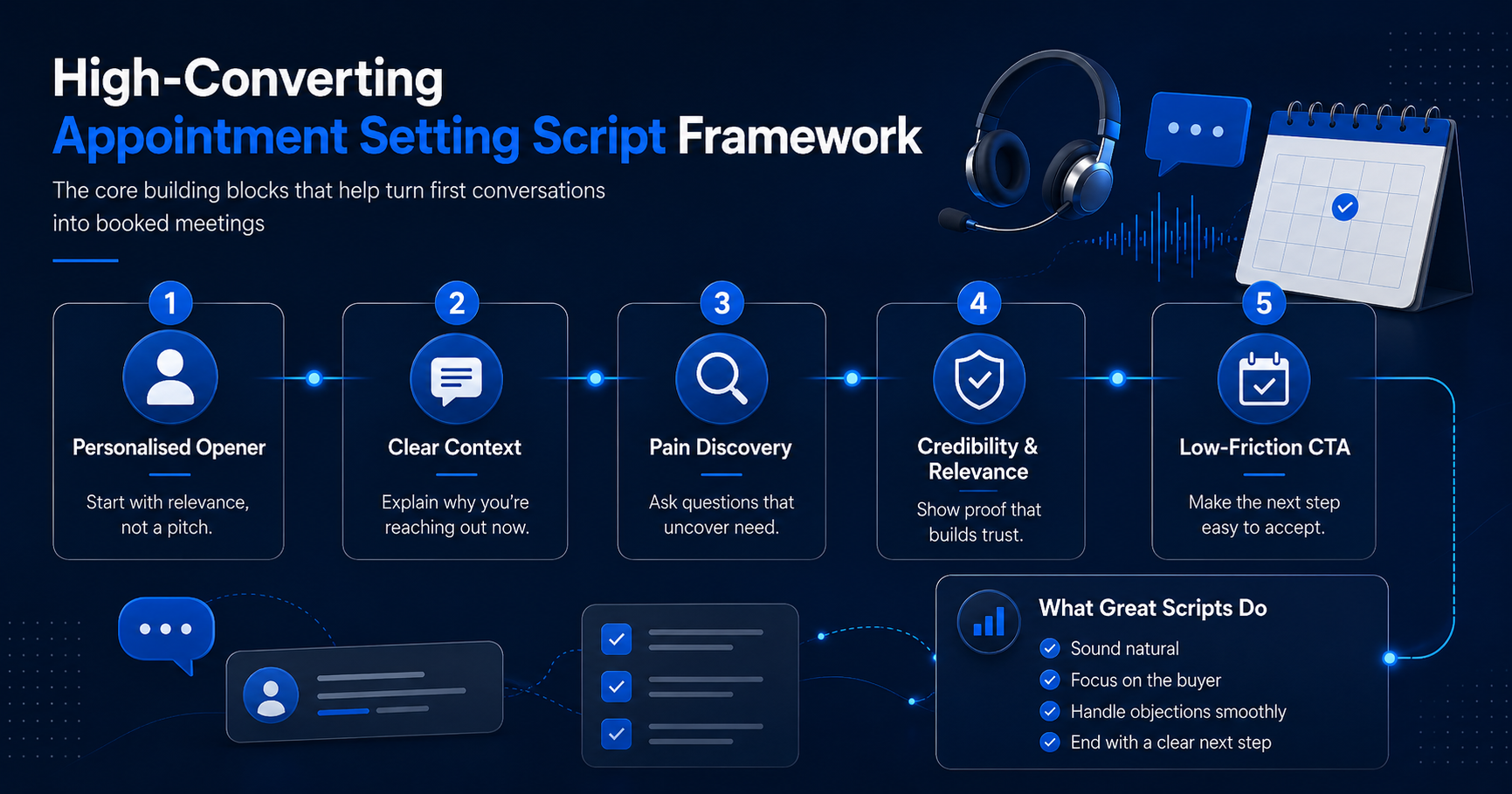
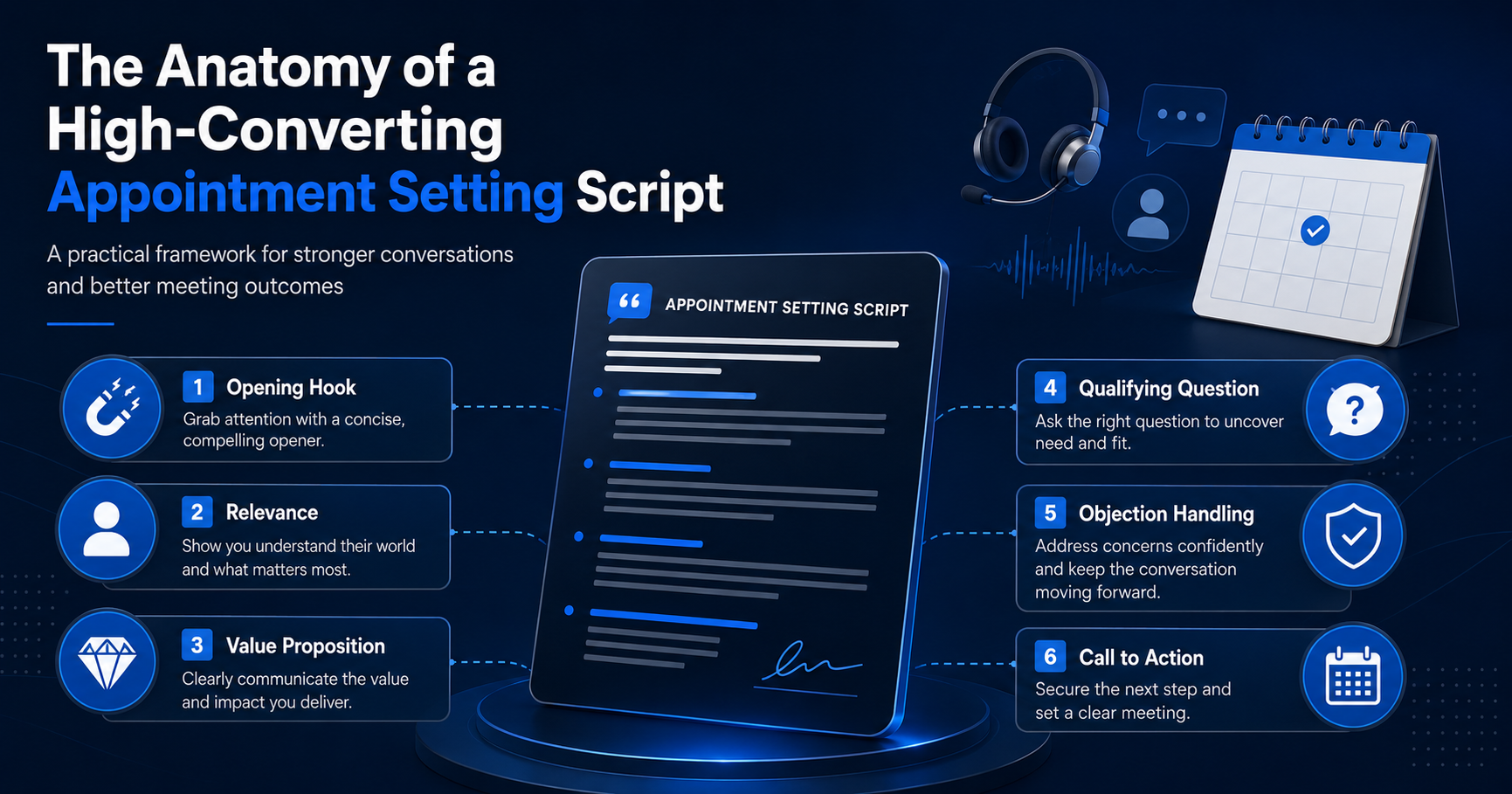
2. The Six-Part Anatomy of a High-Converting Script
A strong appointment setting script usually includes six parts:
| Script Part | Purpose |
| 1. Opening Hook | Earn attention quickly |
| 2. Relevance Bridge | Explain why the outreach makes sense |
| 3. Value Proposition | Communicate the business outcome clearly |
| 4. Qualifying Question | Discover need, fit, or priority |
| 5. Objection Handling | Address concern without pressure |
| 6. Low-Friction CTA | Secure a clear and reasonable next step |
Each part should be short.
The more complex the script sounds, the harder it becomes for the prospect to engage.
3. Part 1 — The Opening Hook
The opening hook determines whether the prospect stays in the conversation.
A weak opener sounds like:
“Hi, my name is John from ABC Company. We are a leading provider of innovative solutions helping businesses optimise operations and drive growth.”
The problem is that the prospect still does not know why the call matters.
A Strong Opener Should Be
- short;
- calm;
- specific;
- relevant;
- easy to process.
Better Opening Examples
Phone
Hi Sarah, this is John from ABC. I know I’m catching you without notice, so I’ll be brief. We work with Singapore-based B2B teams that are trying to create more qualified sales meetings without hiring a full internal SDR team.
Hi Sarah, noticed you lead growth for a Singapore-based B2B team. We work with companies trying to build qualified pipeline across Asia, so I thought it made sense to connect.
Hi Sarah, reaching out because many Singapore-based B2B teams we speak with are trying to create more qualified meetings without adding local headcount too early.
Why This Works
The opener:
- respects the prospect’s time;
- explains context quickly;
- avoids exaggerated claims;
- introduces relevance before pitching.
4. Part 2 — The Relevance Bridge
The relevance bridge answers the prospect’s silent question:
“Why are you reaching out to me?”
Without this, the message feels random.
Relevance Can Come From
- role;
- industry;
- company size;
- market expansion;
- hiring signal;
- funding event;
- recent announcement;
- common problem;
- regional context;
- mutual connection;
- event attendance.
Weak Relevance
“I saw your profile and was impressed.”
This is too vague.
Stronger Relevance
“I noticed your team is expanding across Southeast Asia and hiring for commercial roles. We often see that stage create pressure to build pipeline before the local sales structure is fully in place.”
Relevance Bridge Formula
Use:
Trigger → Business implication → Why it may matter
Example:
“Saw your team is expanding into Singapore. At that stage, many companies are trying to validate pipeline before committing to local hires. That is the area we usually support.”
This gives the outreach a reason to exist.
5. Part 3 — The Value Proposition
The value proposition should not be a full company pitch.
It should explain the outcome in one clear sentence.
Weak Value Proposition
“We offer end-to-end lead generation solutions using innovative processes and technology.”
This sounds generic.
Stronger Value Proposition
“We help B2B companies create qualified sales conversations in Asia by handling account research, outreach, follow-up, and meeting qualification.”
Value Proposition Formula
Use:
We help [buyer type] achieve [business outcome] by [method].
Examples:
For Sales Leaders
We help sales teams create qualified meetings with hard-to-reach B2B buyers by combining account research, LinkedIn outreach, email, and follow-up.
For Founders
We help founders test demand in new Asian markets before they commit to hiring a full local sales team.
For MSPs
We help MSPs book qualified conversations with companies that fit their service model, budget, and decision-maker profile.
Keep It Outcome-Led
Buyers care less about your process at first.
They care about whether the conversation is relevant to a business issue.
6. Part 4 — The Qualifying Question
This is where many scripts fail.
Poor scripts move straight from pitch to meeting request:
“Would you be available for a 30-minute call next week?”
But the prospect may not yet see why the meeting is worth taking.
A qualifying question creates dialogue.
Good Qualifying Questions
Pipeline Question
Is creating qualified outbound pipeline currently a priority for your team?
Market Expansion Question
Are you currently trying to validate demand in Singapore or wider Asia?
Team Structure Question
Is outbound handled internally today, or are you considering external support?
Pain Question
Where does your team usually struggle more—finding the right accounts, getting replies, or converting interest into meetings?
Timing Question
Is this something you are actively reviewing now, or more of a future consideration?
What Makes a Good Question
A strong question is:
- easy to answer;
- relevant to the buyer;
- tied to the business problem;
- not too invasive;
- useful for qualification.
The goal is to learn whether the prospect should move forward—not to interrogate them.
7. Part 5 — Objection Handling
Objections are not always rejection.
Sometimes they mean:
- the prospect is busy;
- timing is wrong;
- they do not understand the relevance;
- they already have a provider;
- they are not the right person;
- they need more trust before agreeing.
A good script handles objections by acknowledging and redirecting.
Common Objections and Responses
“We already have a team.”
That makes sense. Many of the companies we speak with already have internal sales coverage. The question is usually whether they have enough qualified outbound conversations in the target market. Is pipeline generation fully covered today, or is there still a gap?
“Not interested.”
Understood. Just so I do not follow up unnecessarily, is that because outbound is not a priority right now, or because you already have it covered?
“Send me information.”
Happy to. To make sure I send something relevant, are you more interested in how appointment setting works, pricing models, or examples of target-market validation?
“No budget.”
That is fair. Is this something completely off the table, or more a question of timing and business case?
“We tried this before and it did not work.”
I hear that quite often. Usually the issue is either targeting, message quality, lead qualification, or handoff. Do you remember where it broke down for your team?
“I’m not the right person.”
Thanks for clarifying. Who would usually own pipeline generation or sales development on your side?
Objection Handling Principle
Do not argue.
Acknowledge, clarify, and decide whether to continue or disqualify.
8. Part 6 — The Low-Friction CTA
A strong CTA should feel like a logical next step.
A weak CTA sounds like:
“Can I book 30 minutes with you for a demo?”
That may be too much too soon.
Better CTAs
Exploratory CTA
Would it be useful to compare how your team is currently approaching outbound with what we are seeing across similar B2B teams?
Diagnostic CTA
Would a short conversation to identify where pipeline generation is breaking down be useful?
Market Validation CTA
Would it make sense to discuss whether Singapore is worth testing before committing to a local sales hire?
Referral CTA
If this is not your area, who would be the best person to ask about pipeline generation?
Permission-Based CTA
Open to a short conversation next week to see if this is relevant, and if not, we can leave it there?
Why Low-Friction CTAs Work
They reduce pressure.
They make it clear that:
- the call is exploratory;
- the prospect is not committing to buy;
- the meeting has a clear purpose;
- the seller is willing to qualify fit.
9. Full Appointment Setting Script Template (Example)
Use this as a flexible structure.
Phone Script
Hi [Name], this is [Your Name] from [Company]. I know I’m catching you without notice, so I’ll be brief.
We work with [buyer type] that are trying to [business outcome], especially when [relevant situation or trigger].
The reason I reached out is [specific relevance].
Usually, teams at this stage are dealing with [pain point 1], [pain point 2], or [pain point 3].
Curious—how are you currently handling [problem area]?
If Interested
That makes sense. Based on what you shared, it may be worth a short conversation to compare where things are today and whether there is a practical way to support.
Would [day/time] or [day/time] work for a quick 20-minute discussion?
If Unsure
Completely fair. Would it help if I sent a short overview first, and then you can decide if a conversation makes sense?
If Not the Right Person
Thanks for clarifying. Who would typically own this on your side?
10. Script Examples by Channel
Cold Email Script
Subject: Singapore pipeline question
Hi [Name],
Reaching out because [Company] looks like the type of B2B team that may be building pipeline across Singapore or wider Asia.
We help companies create qualified sales conversations by handling account research, outreach, follow-up, and meeting qualification.
Curious—are you currently building outbound pipeline internally, or is this something you are considering external support for?
Best,
[Name]
LinkedIn Message Script
Hi [Name], thanks for connecting.
We work with B2B teams building qualified pipeline across Asia, often before they commit to hiring a full local SDR function.
Curious if outbound pipeline generation is something your team is actively reviewing, or already fully covered internally?
Call Follow-Up Script
Hi [Name],
Thanks again for the quick conversation earlier.
Based on what you shared, the main question seems to be whether your team can create enough qualified conversations in [market] without adding more internal headcount right away.
I’ll send over a short overview, and we can use the call to compare fit rather than run through a generic pitch.
11. Script Examples by Persona
Founder / CEO
We usually speak with founders when they are trying to validate a new market before hiring locally. Is Singapore or wider Asia expansion currently something you are testing?
Sales Leader
We often work with sales leaders who have a strong product and market direction but need more qualified first conversations. Is outbound pipeline generation fully covered by your current team?
Marketing Leader
We usually support teams where marketing is creating awareness, but sales still needs more qualified conversations with target accounts. Is that gap relevant on your side?
Country Manager
We often speak with country managers who are responsible for growth but do not yet have a full local SDR function. Is pipeline creation something your team is handling directly?
MSP Owner
We work with MSPs that want qualified conversations with companies matching their service model, budget, and technical needs. Are you currently trying to increase sales meetings with better-fit accounts?
12. Common Mistakes to Avoid
Mistake 1 — Over-Scripting Every Word
A script should guide the conversation, not remove natural speech.
Mistake 2 — Starting With the Company Pitch
The prospect does not care who you are until they understand why the conversation matters.
Mistake 3 — Asking for a Meeting Too Early
If the buyer does not understand the relevance, the CTA feels like pressure.
Mistake 4 — Asking Weak Questions
Questions such as “Do you need more leads?” are too broad.
Mistake 5 — Treating Every Objection as Resistance
Sometimes objections are useful signals that help qualify fit.
Mistake 6 — Booking Poor-Fit Meetings
A full calendar is not useful if the sales team rejects the meetings.
Mistake 7 — No Handoff Notes
The closer should understand why the meeting was booked and what the prospect cares about.
Mistake 8 — No Testing
Scripts should evolve based on call outcomes, objections, and meeting quality.
13. Appointment Setting Script Scorecard
Score each area from 1 to 5.
| Script Area | 1 — Weak | 3 — Developing | 5 — Strong |
| Opening | Generic company intro | Basic relevance | Short, specific, buyer-focused opener |
| Relevance | No clear reason | Some context | Clear trigger or role-based reason |
| Value Proposition | Feature-heavy | Outcome mentioned | Clear business outcome and method |
| Discovery | Yes/no question | Basic qualification | Useful question that reveals need and fit |
| Objection Handling | Defensive | Prepared responses | Calm, clarifying, non-pushy handling |
| CTA | Hard demo ask | Basic meeting ask | Low-friction next step with clear purpose |
| Qualification | Anyone who agrees | Some filters | Written fit and disqualification criteria |
| Handoff | Minimal notes | Basic summary | Clear context, pain, role, and next step |
Score Interpretation
| Total Score | Meaning |
| 33–40 | Strong script; focus on coaching and optimisation |
| 25–32 | Solid foundation; improve weak sections |
| 17–24 | Script may create activity but inconsistent meeting quality |
| Below 17 | Rebuild the script before scaling outreach |
14. How to Train Your Team on the Script
A strong script still fails without training.
Step 1 — Teach the Structure
Make sure the team understands each part:
- opener;
- relevance;
- value;
- question;
- objection handling;
- CTA.
Step 2 — Roleplay by Persona
Practice with:
- founder;
- sales leader;
- marketing leader;
- country manager;
- technical buyer;
- gatekeeper.
Step 3 — Review Real Calls
Listen for:
- rushed openings;
- too much seller talk;
- weak questions;
- missed objections;
- unclear next steps.
Step 4 — Track Objections
Build a shared objection library.
Include:
- objection;
- likely meaning;
- recommended response;
- when to disqualify.
Step 5 — Update the Script Monthly
Improve based on:
- reply quality;
- call outcomes;
- meetings held;
- sales acceptance;
- common objections;
- disqualification reasons.
Need Better Appointment Setting Conversations?
Expand In Asia helps B2B companies improve outbound execution through:
- ICP definition;
- lead research;
- appointment setting;
- script development;
- LinkedIn and email outreach;
- qualification;
- CRM handoff;
- campaign reporting.
Talk to Expand In Asia about improving your appointment setting process →
15. Next Steps With Expand In Asia
A high-converting appointment setting script is not about sounding perfect.
It is about helping the right buyer understand why a conversation may be worth their time.
The strongest scripts are:
- clear;
- buyer-focused;
- relevant;
- flexible;
- qualification-driven;
- easy to adapt by market and persona.
For more appointment setting strategy, read:
The Complete Guide to MSP Appointment Setting in 2026
For broader lead-generation tactics, read:
10 Best B2B Qualified Lead Generation Strategies for 2026
Schedule a consultation with Expand In Asia →
Ready to Implement These Strategies?
Book a free 30-minute strategy session where we’ll audit your current growth approach and identify your highest-leverage opportunities in Asian markets.
Frequently Asked Questions
1.What is an appointment setting script?
An appointment setting script is a structured conversation guide used to open outreach, explain relevance, qualify interest, handle objections, and book a next meeting with the right prospect.
It should guide the conversation, not force the rep to read word-for-word.
2. What makes an appointment setting script high-converting?
A high-converting script is relevant, concise, buyer-focused, and qualification-driven.
It includes a strong opener, clear relevance, simple value proposition, useful discovery question, calm objection handling, and low-friction CTA.
3. Should appointment setters read from a script?
They should use a script as a framework, not as a rigid script.
The best appointment setters sound prepared and natural. They know the structure but adapt based on the buyer’s response.
4. How long should an appointment setting script be?
The opening should be short—usually a few sentences.
The full script can include different paths for objections, personas, and follow-ups, but the live conversation should feel concise.
5. What is the best opening line?
A strong opening line quickly explains who you help and why the outreach is relevant.
Example:
“Hi [Name], I know I’m catching you without notice, so I’ll be brief. We work with B2B teams trying to create more qualified sales meetings in Singapore and wider Asia.”
6. How do you handle “send me information”?
Acknowledge it, then qualify what information would be useful.
Example:
“Happy to. To make sure I send something relevant, are you more interested in how the process works, pricing models, or examples of the types of meetings we help generate?”
7. Should the CTA always be a meeting?
Not always.
Sometimes the right next step is:
- sending a relevant resource;
- confirming the correct contact;
- asking one more qualifying question;
- inviting the prospect to a webinar;
- booking a short exploratory call.
8. How should appointment setting scripts differ by market?
The core structure can stay the same, but the wording, level of directness, proof points, examples, and CTA may need to change by country, industry, and buyer seniority.