A practical guide to the five mistakes B2B companies make when entering Asian markets, drawn from Expand In Asia’s live masterclass and 15 years of on-the-ground experience
Asia is one of the biggest growth opportunities for B2B companies.
In our experience, it is also where well-run companies lose time, budget, and momentum.
Not because the opportunity is not real. Because they enter with the wrong assumptions.
In our experience, the most common Asia expansion mistakes are not about product or funding. They are about how companies read the region, sell, reach buyers, and commit headcount. They show up as:
- one regional plan for very different countries;
- a home-market pitch that opens doors but does not close;
- closing attempts before trust exists;
- channels chosen because they are popular, not because buyers use them;
- local hires made before there are live deals in progress (a “pipeline”) for them to own.
Most leadership teams ask:
“How fast can we get into Asia?”
But for B2B teams expanding across Asia, the better question is:
“How ready are we to sell in each specific Asian market we are targeting?”
Because Asia is not one market.
A message that works in Singapore may not work in Indonesia.
A sales motion that works in Europe may stall in Japan.
This guide is based on the Expand In Asia masterclass Breaking Into Asia: 5 Critical Mistakes Companies Make (And How to Avoid Them), hosted on 7 October 2026 by Nicolas Levitte, Founder & CEO of Expand In Asia, and moderated by Joel Berou. The five topics were chosen from a pre-webinar survey of executives, sales and operations leaders, and go-to-market (GTM) professionals: the people who plan how a company finds, reaches, and sells to customers.
The goal is not to make Asia sound harder than it is. The goal is fewer expensive surprises.
- TL;DR — Key Takeaways (our view, from the masterclass and our client work)
- Asia is a region, not a market. Prioritize one to three countries and adapt your approach to each.
- Your home-market playbook is a starting point, not a template. Localize the buying experience before rebuilding the proposition.
- In our experience, trust closes deals in most of Asia. A competitor with a weaker product but stronger relationships can still win.
- Choose channels by buyer, not by trend. Phone, introductions, events, and even formal letters can matter as much as email and LinkedIn.
- Validate before you scale. Build conversations and early pipeline before hiring a full local team.
- Measure your readiness before you spend. Score your outbound capability (how well your team proactively reaches new buyers) across five pillars, from strategy to leadership.
If you only do one thing: score your team with the Asia Expansion Readiness Assessment Tool before you commit budget or headcount to a new Asian market.
Who This Guide Is For—and Who It Is Not For
This Guide Is For
- founders and CEOs planning their first move into Asia;
- revenue and sales leaders responsible for an Asia target;
- business development teams opening new Asian markets;
- SaaS, technology, industrial, and professional services companies entering Singapore, Southeast Asia, Japan, or India;
- leadership teams deciding when to hire locally.
This guide is especially useful if your team is asking:
- Which Asian markets should we enter first?
- Why is our pipeline in Asia moving slower than at home?
- Which outreach channels actually work in each country?
This Guide Is Not For
- you want a ranking of the “best” country to enter (see our APAC market watchlist instead);
- you need legal, tax, or incorporation advice for a specific country;
- your company has no product that is ready to sell outside its home market;
- you expect one tactic to work identically across every Asian country.
Practical fit check: if your Asia plan fits on one slide for the whole region, this guide is for you.
What “Asia Expansion Mistakes” Means
Asia expansion mistakes are avoidable strategic and commercial decisions that slow down or derail a company’s entry into Asian markets. They usually come from applying home-market assumptions to markets that buy differently: treating the region as one market, reusing the same pitch, rushing trust, picking the wrong outreach channels, or hiring before demand is proven.
They are rarely dramatic. They look like reasonable decisions at the time.
Common Assumption vs. Asia Reality
| Common Assumption | What We Often See in Asia (Our Experience) |
|---|---|
| “Asia is one big opportunity.” | Each country has its own languages, regulations, buyer behavior, and decision-making norms. |
| “Our playbook worked in three markets, so it will work here.” | Messaging, proof, and sales motion often need to change, even when the product does not. |
| “A better product wins.” | Buyers often choose the vendor they trust to stay and support them. |
| “LinkedIn and email will reach everyone.” | Some buyers respond to phone calls, introductions, events, or formal requests first. |
Why These Mistakes Matter Now
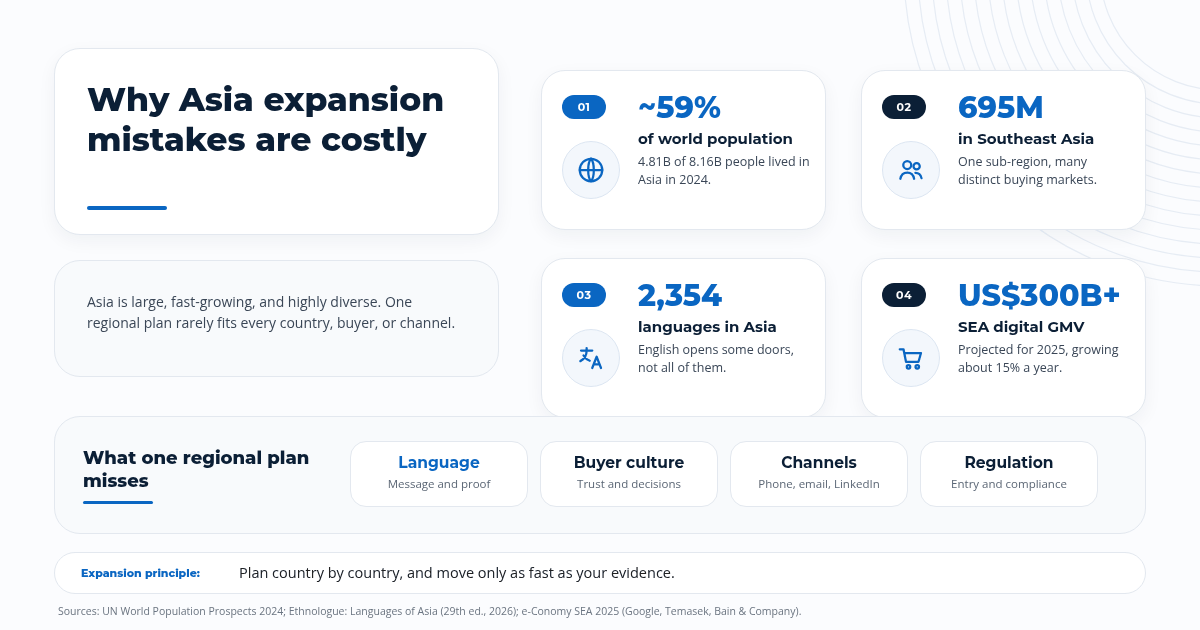
According to the United Nations’ World Population Prospects 2024, the latest edition, Asia had an estimated 4.81 billion people in 2024, close to 59% of the world’s 8.16 billion.1 Southeast Asia alone accounts for about 695 million of them. Indonesia has about 283 million people; Singapore has about 5.8 million.
The same region is extremely diverse. The 2026 (29th) edition of Ethnologue: Languages of Asia catalogs 2,354 languages across the continent.2 In our experience, English opens many doors in Singapore. It does not open all of them in Japan, Indonesia, or Vietnam.
Digital adoption is accelerating. The e-Conomy SEA 2025 report by Google, Temasek, and Bain & Company, the most recent edition (November 2025), projects that Southeast Asia’s digital economy will surpass US$300 billion in gross merchandise value (GMV, the total value of goods and services sold online) in 2025, with GMV and revenue each growing about 15% year on year.3
Some governments also make entry easier. Singapore, where Expand In Asia is based, taxes companies at a flat 17% corporate income tax rate according to IRAS (the rate in effect in 2026).4 According to Chambers and Partners’ Doing Business In 2026: Singapore guide, foreign investors can typically own a Singapore company fully without a local equity partner, outside specific regulated sectors.5 Companies still need at least one locally resident director, according to GoBusiness Singapore’s current registration guide.6
But Singapore is not a proxy for the region.
That is where the first mistake begins.
The 5 Critical Asia Expansion Mistakes
Each mistake comes from the masterclass. Some were observed with Expand In Asia clients; others, Nicolas Levitte says, he made himself after moving to Asia in 2011 to set up a US media-technology company’s regional subsidiary.
Mistake 1 — Treating Asia Like It Is One Market
What It Looks Like
A company sees the size of the region and builds one “Asia” strategy: one deck, one price list, one outreach sequence, across several countries. In our experience, who decides, who influences, and which channels buyers respond to change from one country to the next.
From the Field
In his own account, from his first Asia role, Nicolas found early traction in Singapore and Malaysia, then had to work differently elsewhere:
- in Japan, he needed a translator and an advisor experienced in Japanese business, because decisions were consensus-driven and meetings included many stakeholders who were not fluent in English;
- in Indonesia, polite interest often meant learning, not buying, and contacts were reluctant to say no;
- in India and China, regulation of the media sector limited the opportunity from the start.
What We Recommend Instead
- Prioritize one to three markets by ICP concentration (how many companies match your ideal customer profile, or ICP: the type of company and buyer most likely to buy), market size, competition, ease of entry, and strategic importance.
- Meet prospects early to test messaging, interest, channels, and objections.
- Adapt the GTM by country: keep the core value proposition (the main reason customers buy from you); localize messaging, channels, proof, and sometimes pricing. Our multi-country expansion strategy for Asia shows how to plan this market by market.
“What works in Singapore will not necessarily work elsewhere in Asia.” — Nicolas Levitte, Founder & CEO, Expand In Asia
Practical Rule (our take)
For an initial test, prioritize evidence of reachable demand and speed of learning over headline market size.
If you are still choosing countries, read Top 5 Emerging B2B Markets in Asia Pacific to Watch in 2026–2027.
Mistake 2 — Assuming Your Home-Market GTM Playbook Will Work in Asia
What It Looks Like
A company that has already expanded internationally reuses the pitch, case studies, and sales motion that worked in Europe, North America, or another Asian country. In the pre-webinar survey, this topic resonated most.
From the Field
As Nicolas tells it: in 2014, he joined LinkedIn on the team launching Sales Navigator in Asia, after successful launches in the US and Australia. The new Singapore team relied on US messaging: be an early adopter and gain a competitive advantage through social selling (using LinkedIn networks and content to find and approach buyers).
Doors opened. Closing was slower than expected. For many prospects, being first was a risk, not an advantage: if no one local used it, maybe it only worked in the US. The team shifted to a fear-of-missing-out approach: win smaller companies first, then return to larger accounts with local success stories.
A Second Gap: Bottom-Up Selling
Champion-led selling (relying on one internal fan of your product to sell it to their bosses) is common in the US and Europe. In our experience, it is harder in hierarchical organizations, where a power user may hesitate to recommend a new solution without their manager’s support.
What We Recommend Instead
- lead with proof from the same or a similar market, starting with smaller reference accounts;
- engage senior decision-makers earlier while building support among users;
- rebuild the proposition only if buyers reject the value itself, not just the way it is presented.
In our experience, this kind of message lands better than “be the first”:
“Two of your competitors in this region are already evaluating this, and one is already using it.”
Practical Rule (our take)
Localize the buying experience first.
Rebuild the core proposition only when the market evidence says the proposition itself is wrong.
For the wider framework, read Go-to-Market (GTM) Strategies for Asia and Why Localization Fails: Common Mistakes B2B Companies Make in Asia. For what to change first, see our guide on how to localize your sales playbook for Asia.
Mistake 3 — Underestimating Relationships and Overestimating the Product
What It Looks Like
The team believes a superior product will sell itself if it reaches the right people, so it books demos and pushes for the close. Relationships matter everywhere, but in Asia they often operate at a different level.
From the Field
Nicolas entered the region with what he considered a far superior product: a solution that helped radio broadcasters turn audio streaming from a cost into revenue. He met the right people, then burned several opportunities by trying to close too fast.
A competitor with a weaker product had owned those relationships for years and persuaded clients to wait for it to catch up. The business did grow, but more patience would have produced a bigger impact.
What We Recommend Instead
- over-invest time in genuine relationships before pushing for a decision;
- show that you are in the market for the long run and meet more stakeholders per account;
- track whether relationships produce progress: shared priorities, introductions to other stakeholders, insight into how decisions are made, and agreed next steps.
Practical Rule (our take)
A better product wins only when the buyer also believes choosing you is a safe and supportable business decision.
Patience matters, but it should come with progress.
For a step-by-step approach to building that trust, read Relationship Selling in Asia: How to Build Trust That Actually Moves B2B Deals Forward. For closing-stage nuances by country, read Cultural Nuances in Closing Deals Across Asia.
Mistake 4 — Choosing the Wrong Route to Market: Incorrect Channel Mix
What It Looks Like
The company prospects as it does at home, LinkedIn plus email at scale, and concludes the market is not ready when responses disappoint. Often, the route to the buyer is what is wrong.
From the Field
At LinkedIn, Nicolas was convinced that social selling had replaced cold calling. After founding Expand In Asia, his experience changed his mind: LinkedIn alone was not enough, and phone outreach proved necessary in many Asian markets, India in particular. In our experience at Expand In Asia, cold calls still open a large share of the conversations we create for clients.
Two client examples showed how different the route can be:
- A French multinational software company serving heavy industries (mining, oil and gas, shipbuilding) needed to reach Indonesian prospects who were not on LinkedIn. The team sent a formal letter requesting permission to talk, worked with the gatekeeper (the assistant or office that controls access to the decision-maker) instead of avoiding them, and identified the right decision-makers from there.
- A German company targeting Philippine government agencies got no traction through email, LinkedIn, phone, or Facebook. The same formal-letter approach opened the door.
What We Recommend Instead
- map how each buyer prefers to be approached, by country and industry, and combine email, LinkedIn, phone, introductions, and events;
- plan for gatekeepers and formal, permission-based first contact in traditional industries and the public sector;
- review channel performance by country, not as one regional average.
Practical Rule (our take)
Do not pick a channel because it is popular in Asia.
Pick it because it matches how your specific buyer buys in that specific market.
For channel comparisons, read Cold Email vs. LinkedIn Outreach: Which Converts Better in Asia? and Why Cold Calling Is Your Secret Weapon. If your buyers are not on LinkedIn at all, see how to reach B2B decision-makers in Asia who aren’t on LinkedIn.
Mistake 5 — Scaling the Local Team Before Validating the Market
What It Looks Like
A company attends an event in Asia, meets interested people, and hires locally. A press release goes out. A country manager starts with targets but no pipeline. It looks like progress, but it is an expensive way to learn.
From the Field
Trajaan, a 10-person, Paris-based search-intelligence startup, wanted to build a global brand without constant travel to Asia. According to the Trajaan case study on our website, it worked with Expand In Asia’s local experts to test the market and build pipeline remotely while the founder stayed focused on product. In the words of co-founder and CEO Matthieu Danielou: “We closed 12 deals without flying even once to Asia.”7 He also credits that international traction with helping the company’s acquisition by Cision.
In Nicolas’s own account, his company did the same in 2011: a local consultant opened the first doors, so he arrived with early pipeline and key relationships.
What We Recommend Instead
- start conversations and build relationships remotely or with a local partner;
- test market assumptions with real buyers, not only market-size reports;
- build early pipeline before the first permanent hire;
- hire when there are real accounts and opportunities for that person to develop.
One caveat: at some point you do need people on the ground, because local presence builds trust. The point is not to wait for perfect conditions. It is to do enough groundwork first.
Practical Rule (our take)
Send the right person.
But send them prepared.
For the cost side of this decision, read The Cost of Building a Sales Team in Singapore vs. Outsourcing. For the timing, and the signs that tell you the market is ready, see When Should You Hire a Local Sales Team in Asia? Signs You’ve Validated the Market.
The Asia Entry Sequence: How to Avoid All Five Mistakes
Our view: the five mistakes share one root cause, which is moving faster than your evidence. Our framework, the Asia Entry Sequence, puts the fixes in order.
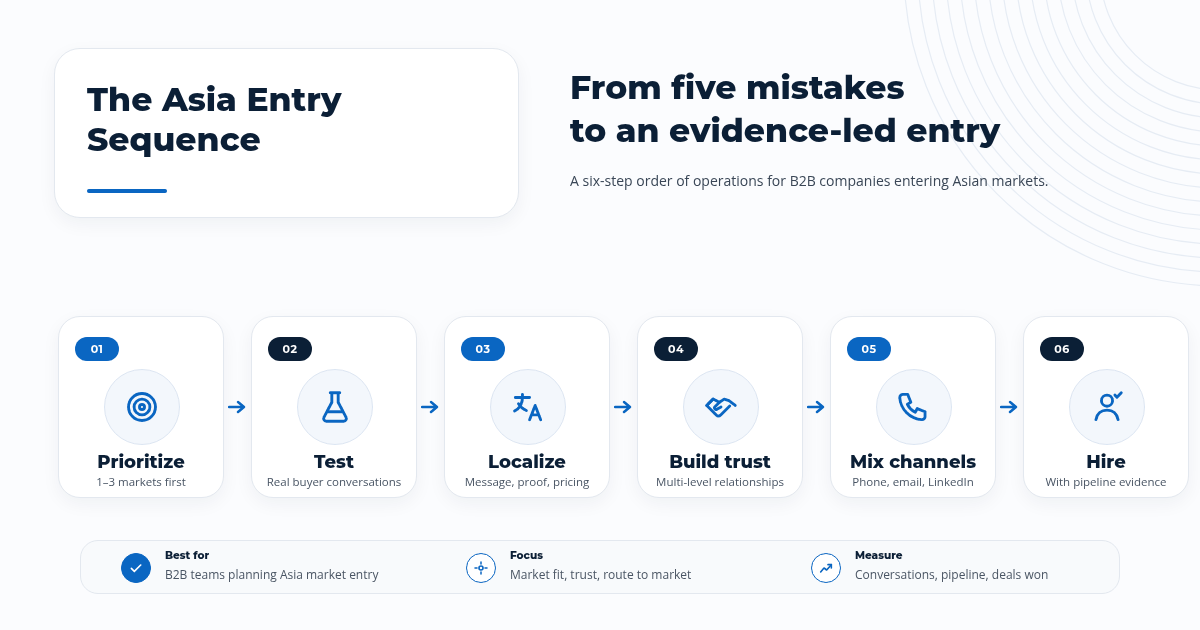
Step 1 — Prioritize. Choose one to three markets based on ICP concentration, reachable demand, and ease of entry.
Step 2 — Test. Talk to real target buyers about messaging, interest, channels, and objections.
Step 3 — Localize. Keep the core value proposition; adapt messaging, proof, sales motion, and sometimes pricing per country.
Step 4 — Build trust. Engage several levels of each account and track progress, not just activity.
Step 5 — Mix channels. Use the channels each buyer actually responds to.
Step 6 — Hire with evidence. Hire locally when there are deals and relationships for that person to own.
Need Help Avoiding These Asia Expansion Mistakes?
Expand In Asia helps B2B companies enter and grow in Asian markets through:
- market prioritization;
- ICP and account research;
- localized buyer messaging;
- LinkedIn and email outreach;
- cold calling and appointment setting;
- SDR/BDR execution (the people who run first outreach and book meetings);
- product-market fit validation (testing whether real buyers want your product);
- pipeline reporting and market feedback loops.
Talk to Expand In Asia about de‑risking your Asia market entry →
The Asia Expansion Readiness Assessment Tool: Check Your Outbound Engine First
Across all five mistakes, one question keeps coming back: how ready are you, really?
Not in terms of product or funding. In terms of the engine that creates growth in a new market: your outbound capability, your sales development function (the team that finds prospects and books first meetings), and the people and processes that open the right doors with the right people in the right way.
The Asia Expansion Readiness Assessment Tool is a free self-rating exercise that Expand In Asia built from the conversations it kept having with companies at the start of their Asia journey. It is not a sales tool. It shows where you stand before you spend money in the wrong places.
You rate 14 short statements from 1 to 5. A 1 means “not in place.” A 3 means “partially in place.” A 5 means “strong and repeatable.” You get an overall readiness score and a score for each pillar.
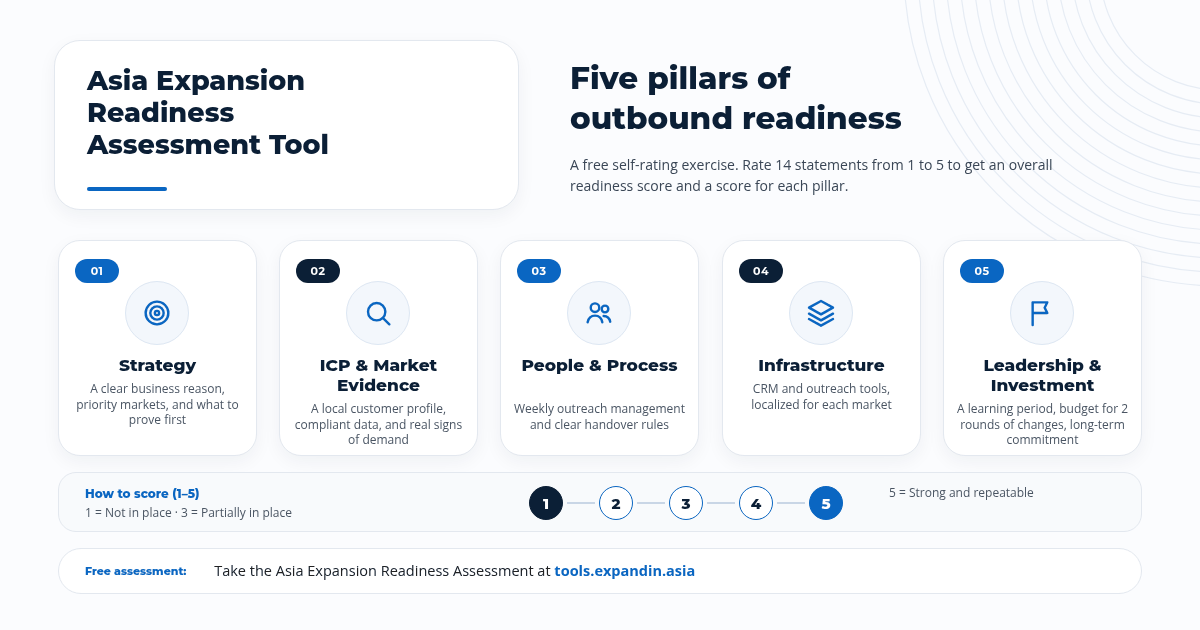
The Five Pillars
| Pillar | What It Checks |
|---|---|
| Strategy | A clear business reason for Asia, specific priority markets, and a short list of what you need to prove first |
| ICP and Market Evidence | A local ideal customer profile, accurate and compliant prospect data, and real evidence of demand such as buyer conversations or opportunities |
| People and Process | Someone who manages outreach performance every week, clear rules for handing meetings to closers, and a sales process built for longer cycles |
| Infrastructure | A CRM plus sequencing, calling, and reporting tools that track Asia activity, and the ability to localize messaging, email domains, time zones, and compliance by market |
| Leadership and Investment | Leaders aligned on a learning period, budget for at least two rounds of changes, and willingness to invest locally for the long term |
Asia Expansion Readiness Scorecard
Want a quick version before you take the full tool? Score each area from 1 to 5, using the same scale as the tool. This scorecard is our own simplified framework based on the five mistakes, not the tool itself and not an industry benchmark.
| Area | 1 — Not in Place | 3 — Partially in Place | 5 — Strong and Repeatable |
|---|---|---|---|
| Market focus | “Asia” as one target | Shortlist, no clear criteria | 1–3 markets chosen on clear criteria |
| Country-level GTM | One plan for all markets | Some local adjustments | GTM adapted per country |
| ICP and data | Home-market ICP reused | ICP partly adapted | Local ICP with verified local data |
| Messaging and proof | Home-market pitch and case studies | Some regional proof | Local or similar-market proof per country |
| Relationship progress | Activity only | Occasional next steps | Introductions, shared priorities, next steps tracked |
| Channel mix | One or two default channels | Several channels, not country-specific | Channels matched to buyers per country |
| Leadership and investment | Expects quick results | Supportive, short horizon | Aligned on a learning period, with budget for at least two rounds of changes |
| Hiring trigger | Hire first, learn later | Hire after events or interest | Hire when pipeline and accounts exist |
Score Interpretation (Our Guidance)
| Total Score | What It Means |
|---|---|
| 34–40 | Ready to scale in your priority markets. Focus on execution and local hiring. |
| 27–33 | Good foundation. Close the gaps in your lowest-scoring areas before adding markets. |
| 20–26 | Early stage. Validate demand and adapt your approach before committing headcount. |
| Below 20 | High risk of repeating the five mistakes. Start with market prioritization and buyer conversations. |
Need Help Closing Your Readiness Gaps?
Expand In Asia helps B2B companies validate markets and build pipeline across Asia.
Next Steps With Expand In Asia
Asia rewards companies that enter with focus, patience, and evidence.
- Treat Asia as a region and adapt to each market.
- Localize how you sell with local proof.
- Invest in trust and track real progress.
- Reach buyers where they are.
- Hire with evidence, not enthusiasm.
To go deeper:
- read Building a B2B Sales Pipeline from Zero in a New Asian Market;
- explore B2B Prospecting services;
- missed the live session? Visit Events & Webinars.
Ready to Implement These Strategies?
Book a free 30-minute strategy session where we’ll audit your current growth approach and identify your highest-leverage opportunities in Asian markets.
Frequently Asked Questions
1. What are the most common Asia expansion mistakes?
Based on our masterclass and client work, the five most common Asia expansion mistakes are treating Asia as one market, reusing your home-market go-to-market playbook, overestimating the product while underestimating relationships, choosing the wrong outreach channels, and hiring a local team before demand is proven.
2. Why do companies fail when expanding into Asia?
In our experience, companies struggle because they apply home-market assumptions to many different countries: one message, one channel mix, one sales approach, one hiring plan. The product is rarely the only problem. Fit with local buying behavior, trust, and how you reach buyers usually decide the outcome.
3. How many Asian markets should a company enter first?
Our recommendation is one to three markets. Prioritize them by how many target customers they have, market size, competition, ease of entry, and strategic importance. Favor markets where you can reach real buyers and learn quickly over markets that only look large on paper.
4. Is relationship-building really more important in Asia than in the West?
Relationships matter in every market. In our experience, they carry more weight in many Asian markets because buyers need to believe that choosing you is a safe, supportable decision. That is why a competitor with a weaker product and stronger relationships can still win.
5. Does cold calling still work for B2B sales in Asia?
In our experience, yes. Phone outreach remains an important channel in many Asian markets alongside email, LinkedIn, introductions, and events. The right mix depends on the country, industry, and buyer; some decision-makers in traditional industries and the public sector are hard to reach on LinkedIn at all.
6. When should a company hire a local sales team in Asia?
Our view: hire locally once you have evidence of demand, not just enthusiasm. That means active conversations, relationships in target accounts, and real opportunities a local person can take over. Many companies build that evidence first through remote prospecting or a local partner.
7. What is the Asia Expansion Readiness Assessment Tool?
The Asia Expansion Readiness Assessment Tool is a free self-rating exercise from Expand In Asia. It scores your outbound capability, meaning how well your team proactively reaches new buyers, across five pillars: Strategy, ICP and Market Evidence, People and Process, Infrastructure, and Leadership and Investment. You rate 14 statements from 1 (not in place) to 5 (strong and repeatable).
Which of these five Asia expansion mistakes has cost your team the most time? Share your experience in the comments or pass this guide to the colleague leading your Asia plan.
About the author: Joel Berou is Asia Expansion & Revenue Growth Advisor at Expand In Asia, a Singapore-based B2B outbound and market-entry partner that helps companies build pipeline across Asian markets. This article draws on the October 2026 masterclass presented by Nicolas Levitte, Founder & CEO of Expand In Asia. Last updated: October 16, 2026.
Sources
-
United Nations, Department of Economic and Social Affairs, Population Division. World Population Prospects 2024. Asia: 4,806,898,007; world: 8,161,972,572; South-Eastern Asia: 695,149,428 (2024 estimates). https://population.un.org/wpp/ — regional table: https://unstats.un.org/unsd/demographic-social/products/vitstats/seratab1.pdf ↩
-
Eberhard, D. M., Simons, G. F., & Robinson, A. J. (Eds.). (2026). Ethnologue: Languages of Asia (29th ed.). SIL Global. https://www.sil.org/resources/publications/entry/111053 ↩
-
Google, Temasek, and Bain & Company. e-Conomy SEA 2025 (11 November 2025). Google summary: https://blog.google/company-news/inside-google/around-the-globe/google-asia/sea-economy-2025/ — Temasek press release: https://www.temasek.com.sg/en/news-and-resources/news-room/news/2025/e-conomy-sea-2025-report-aseans-digital-economy-poised-to-surpass-300-billion ↩
-
Inland Revenue Authority of Singapore (IRAS). Corporate Income Tax Rates (current page, accessed 16 October 2026). https://www.iras.gov.sg/quick-links/tax-rates/corporate-income-tax-rates ↩
-
Chambers and Partners. Doing Business In 2026: Singapore (foreign investment section). https://practiceguides.chambers.com/practice-guides/doing-business-in-2026/singapore — see also ACRA, Ways to set up foreign businesses in Singapore: https://www.acra.gov.sg/register/foreign-business/ways-to-set-up/ ↩
-
GoBusiness Singapore. Step 4: Register your business (current page, accessed 16 October 2026). https://www.gobusiness.gov.sg/resources/start-up-guide/register-your-business ↩
-
Expand In Asia. Case Studies: Trajaan (client testimonial by Matthieu Danielou, Co-Founder & CEO). https://expandin.asia/case-studies/ — also shared on Expand In Asia’s LinkedIn page, 4 September 2026: https://www.linkedin.com/posts/expand-in-asia_asiaexpansion-gotomarket-b2bsales-activity-7501567431212011521-helz ↩