A practical guide for B2B teams who want proof of demand in Asia—not another market report
The market report says the opportunity is huge.
The pitch deck says Asia is your next growth engine.
Your team is excited.
But nobody has spoken to ten real buyers in the country yet.
That is the gap this guide closes. Before you hire, open an office, or sign long contracts, you can validate product-market fit in Asia with real buyer conversations, small outreach tests, and early commitments. In plain terms: you find out whether buyers there actually want what you sell, enough to act.
Validation in a new Asian market usually involves:
- talking to real target buyers in one country;
- testing which segments respond to outreach;
- logging every objection and question;
- checking pricing and buying process early;
- asking the most interested buyers for a commitment.
Most leadership teams ask:
“How big is the market?”
But for B2B companies entering Asia, the better question is:
“What evidence do we have that buyers in this country will buy from us?”
Because market size is not demand.
A big market can still have no buyers for your product.
A small segment can be ready to buy next month.
This guide builds on our pillar, Breaking Into Asia: 5 Critical Asia Expansion Mistakes, and on our guide to when to hire a local sales team in Asia.
- TL;DR — Key Takeaways (our view)
- Reports are not buyers. Only real conversations show real demand.
- Validate one market and one segment at a time.
- Climb the Evidence Ladder. Conversations, responses, repeat objections, second meetings, pricing, commitments.
- Set pass/fail rules before you start. Otherwise every result looks promising.
- Commitment beats interest. A paid pilot or letter of intent says more than ten “sounds interesting.”
- You can start remotely, with a local partner opening doors.
If you only do one thing: write down, before any outreach, what result would make you stop, continue, or invest.
Who This Guide Is For—and Who It Is Not For
This Guide Is For
- founders testing demand in a first Asian market;
- product and growth leaders adapting an offer for Asian buyers;
- CROs asked to “prove Asia” before budget is approved;
- B2B SaaS, technology, and services companies;
- companies with traction at home but no Asian customers yet;
- teams that tried Asia once and are not sure why it did not work.
This guide is especially useful if your team is asking:
- How do we know buyers in this market want our product?
- What counts as proof?
- How do we test without hiring?
- When do we stop testing and invest?
This Guide Is Not For
- you already have repeatable customers in the market;
- you need a market ranking (see our multi-country expansion strategy for Asia);
- you are looking for consumer product testing;
- you want a single number that guarantees success.
Practical fit check: if your Asia business case cites market size but no buyer quotes, this guide is for you.
What It Means to Validate Product-Market Fit in Asia
To validate product-market fit in Asia means testing, with real buyers in a specific Asian country, whether enough target companies have the problem you solve, value your solution, and will commit time or money to it. It replaces assumptions from reports with evidence from conversations, pilots, and early deals.
Product-market fit itself simply means: the right buyers want your product enough to buy it, use it, and recommend it.
Assumption-Based vs. Evidence-Based Entry
| Area | Assumption-Based Entry | Evidence-Based Entry |
|---|---|---|
| Main input | Market reports, home-market success | Conversations with local buyers |
| Target segment | “Mid-sized companies in Asia” | One segment in one country |
| Pricing | Converted from home currency | Tested in conversations |
| Proof of demand | Event interest, inbound curiosity | Second meetings, pilots, commitments |
| Decision to invest | Based on potential | Based on evidence |
| Cost of being wrong | High | Low |
Practical Rule (our take)
A market report tells you where demand could be.
Buyers tell you where it is.
Why Validation Matters Before You Commit Budget
Reason 1 — Home-Market Fit Does Not Travel Automatically
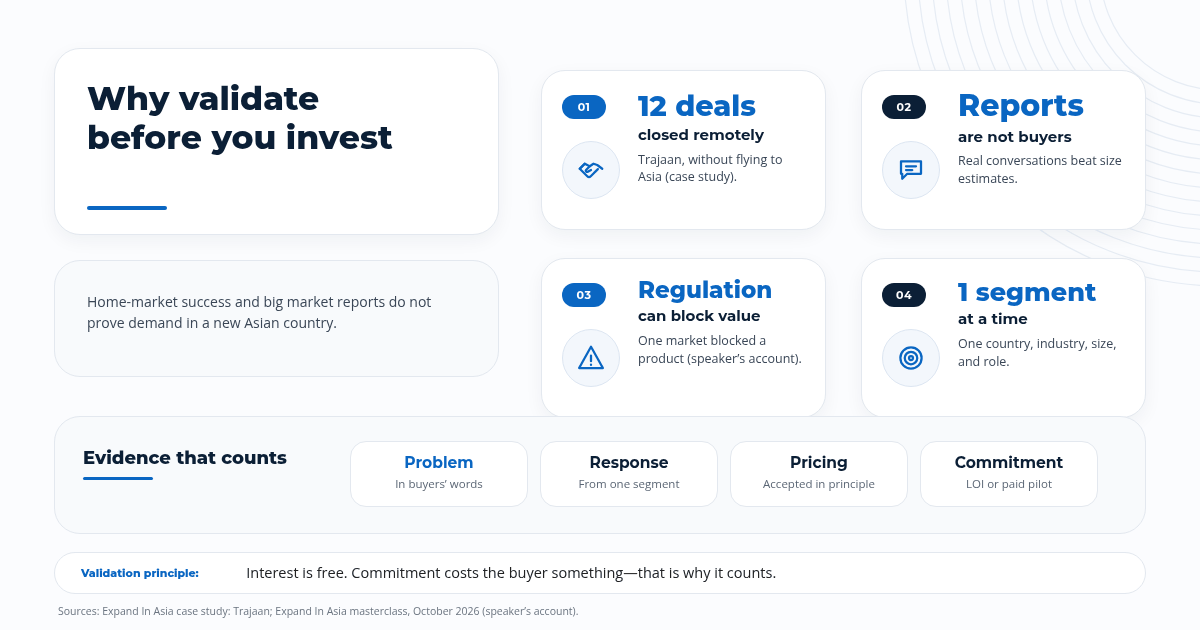
Nicolas Levitte, Founder & CEO of Expand In Asia, shared at our masterclass how the same product found traction in some Asian markets and struggled in others. In one market, by his account, regulation at the time limited how his media-technology solution could create value at all.
Reason 2 — Real Conversations Beat Estimates
Before he moved to Asia in 2011, his company worked with a local consultant who opened first doors. In his words, those remote conversations gave a sense of the real opportunities—not just estimates of total market size, theoretical data, or a consulting report.
Reason 3 — Validation Can Start Remotely
Reason 4 — It Makes the Next Decision Easier
In our experience, clear evidence turns the hiring, pricing, and market-sequencing decisions from debates into simple calls.
Practical Rule (our take)
Do not ask your team to sell in a market you have not tested.
Test first. Then sell.
The Evidence Ladder: Six Steps to Validate Product-Market Fit
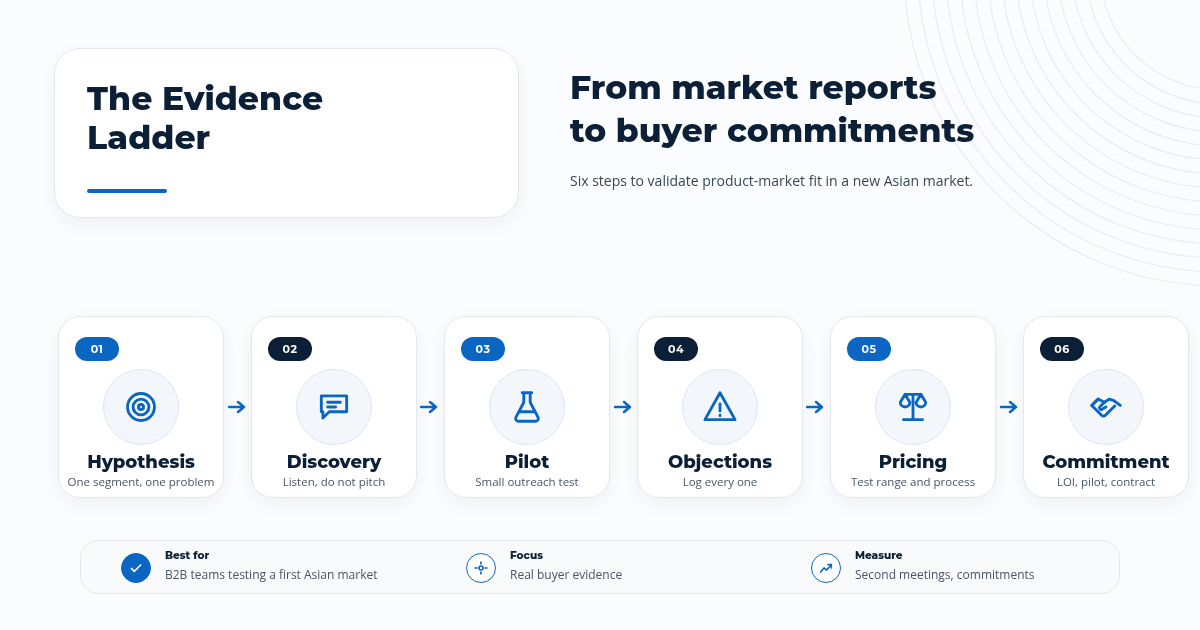
Our framework, the Evidence Ladder, orders validation methods from cheapest to strongest. Each step produces stronger evidence than the one before.
Step 1 — Define One Segment and Your Hypothesis
What to Do
Pick one country, one industry, one company size, and one buyer role. Write down the problem you believe they have.
Example Hypothesis
“Logistics companies in Vietnam with 200–1,000 employees struggle with manual shipment tracking, and operations directors will pay to fix it.”
Why It Matters
In our experience, “Asia” is too broad to validate. So is “mid-sized companies.”
Step 2 — Run Discovery Conversations
What They Are
Short, structured conversations with target buyers about their problems—not a sales pitch.
Questions to Ask
- How do you handle this today?
- What does it cost you, in time or money?
- Who else is involved when you change how this works?
- What have you tried before?
What to Look For
The same problems described in buyers’ own words, across several companies.
Step 3 — Launch a Small Pilot Outreach Campaign
What It Is
A limited outreach test—email, LinkedIn, phone—to a few hundred target contacts in one segment, with two or three message variations.
What You Learn
Which segments respond, which messages land, which channels work.
Asia-Specific Reminder
In our experience, response rates and channel preferences vary a lot by country. Test locally; do not borrow home-market benchmarks.
Step 4 — Keep an Objection Log
What It Is
A simple shared sheet where every objection, question, and concern is recorded with the company, role, and date.
Why It Works (Our Experience)
Patterns appear fast. If five buyers raise the same concern, it is not an objection anymore. It is a product or positioning issue.
| Objection | How Often | What It Usually Means (Our View) |
|---|---|---|
| “Who else here uses it?” | Often | You need local proof |
| “It’s too expensive.” | Often | Pricing or value not adapted |
| “We already have a supplier.” | Often | Switching cost or relationship barrier |
| “We don’t have this problem.” | Repeated | Segment or proposition mismatch |
Step 5 — Test Pricing and Buying Process
What to Do
Share pricing ranges in later conversations. Ask how purchases like yours are approved.
What You Learn
Whether your price is in range, and how long buying takes.
Step 6 — Ask for a Commitment
Options, From Weaker to Stronger
- a second meeting with more stakeholders;
- a letter of intent (LOI): a short, usually non-binding statement of intent to buy;
- a paid pilot;
- a first contract.
Practical Rule (our take)
Interest is free.
Commitment costs the buyer something—that is why it counts.
A Simple Discovery Conversation Guide (Template)
Use this structure for 20–30 minute discovery calls. It is our recommended format, not a script to read word for word.
1. Context (2–3 minutes)
Explain who you are and why you are talking to companies like theirs. Make it clear you are learning, not selling.
2. Current Situation (8–10 minutes)
- How do you handle [the problem] today?
- Who is involved?
- What tools or suppliers do you use?
3. Pain and Priority (8–10 minutes)
- What is hardest about it?
- What does it cost you, in time, money, or risk?
- Where does it rank among this year’s priorities?
4. Buying Process (5 minutes)
- If you changed how you do this, who would decide?
- How was a similar purchase approved last time?
5. Next Step (2 minutes)
Ask whether they would be open to seeing an approach in a second meeting, and who else should join.
Relatable Example
If the buyer spends 15 minutes describing the problem and asks what you would suggest, you have learned something. If they politely wait for your pitch, you have learned something too.
How Validation Differs by Market (Examples)
The method stays the same. How you run it changes. These examples come from our experience and the masterclass.
| Market | What Often Changes in Validation |
|---|---|
| Singapore | English usually works; buyers are international, so global proof may carry more weight |
| Japan | Meetings may include several stakeholders; a translator or Japan-experienced advisor can help (speaker’s account) |
| Indonesia | Local language and relationships matter more; plan for more meetings before honest feedback |
| Vietnam | Fast-moving buyers in some sectors; confirm who holds budget early |
| Philippines | English is widely used in business; senior buyers may still prefer introductions |
Practical Rule (our take)
Run the same Evidence Ladder in every market.
Adjust the language, pace, and introductions to fit each one.
Pass, Continue, or Stop: Setting Your Rules
Decide your rules before outreach starts. These are examples of the types of criteria we recommend, not universal thresholds. Set your own numbers based on your deal size and sales cycle.
| Signal | Stop | Continue | Pass |
|---|---|---|---|
| Problem confirmed in conversations | Rarely | Sometimes | Consistently, in buyers’ words |
| Pilot outreach responses | Almost none | Some, from mixed segments | Concentrated in one segment |
| Second meetings | None | A few | Several, with more stakeholders |
| Pricing reaction | Far out of range | Negotiable | Acceptable in principle |
| Commitments | None | Verbal interest | LOI, paid pilot, or contract |
Relatable Example
If six of ten logistics companies describe the same tracking problem, three agree to a second meeting, and one signs a paid pilot, that is a pass for this segment—and a reason to invest in the next step.
Why Validation Is Cheaper Than Learning Through a Hire
Compare the cost of being wrong.
If you skip validation and hire a foreign salesperson in Singapore on an Employment Pass, the Ministry of Manpower’s minimum qualifying salary alone is S$5,600 a month today, rising to S$6,000 for new applications from 1 January 2027 (higher in financial services and for older candidates).2 That is a floor, before benefits, office, travel, and management time.
A focused validation sprint, by contrast, tests the same question—will buyers here buy?—with a fraction of that fixed commitment.
Our View
Spend small to learn. Spend big once you know.
Remote Validation With a Local Partner
You do not need an office to start.
In our experience, a local partner can:
- build accurate target lists for your segment;
- run outreach in the local language and business style;
- book discovery meetings with decision-makers;
- report back what buyers actually say.
This is how the 2011 groundwork Nicolas described worked, and how Trajaan’s remote market testing worked according to its case study.
What Remote Validation Cannot Do (Our View)
It cannot replace being on the ground forever. Once evidence is strong, local presence helps deepen trust. Read When Should You Hire a Local Sales Team in Asia? for that decision.
Need Help Validating Product-Market Fit in Asia?
Expand In Asia helps B2B companies test Asian markets before they commit budget through:
- market and segment prioritization;
- ICP definition (ICP: your ideal customer profile);
- target account and contact research;
- localized buyer messaging;
- pilot outreach by email, LinkedIn, and phone;
- discovery meeting booking;
- objection and feedback reporting;
- evidence summaries for leadership decisions.
Talk to Expand In Asia about validating product-market fit →
Common Validation Mistakes
Mistake 1 — Validating “Asia”
Validate one country and one segment.
Mistake 2 — Pitching Instead of Listening
Discovery conversations are for learning. A pitch gets polite answers, not honest ones.
Mistake 3 — Counting Interest as Demand
“Sounds interesting” is not evidence.
Mistake 4 — No Rules Before You Start
Without pass/fail rules, every result looks promising.
Mistake 5 — Ignoring Objections
Repeated objections are data. Log them.
Mistake 6 — Stopping Too Early
In our experience, trust takes time in many Asian markets. One silent month does not mean no demand.
For a step-by-step pipeline approach once you pass, read Building a B2B Sales Pipeline from Zero in a New Asian Market. For broader lessons, see Scaling Beyond Borders: Key Lessons for SMEs Expanding Internationally.
Product-Market Fit Validation Scorecard
Score each area from 1 to 5. This is our own simplified framework, not an industry benchmark. For a wider check of your commercial readiness, take the free Asia Expansion Readiness Assessment Tool.
| Area | 1 — Weak | 3 — Developing | 5 — Strong |
|---|---|---|---|
| Segment focus | “Asia” | One country, broad segment | One country, one segment, one role |
| Hypothesis | None | Vague | Written and testable |
| Discovery conversations | None | A few | Enough for patterns to repeat |
| Pilot outreach | None | One message | Several messages and channels tested |
| Objection log | None | Informal notes | Shared and reviewed |
| Pricing evidence | Untested | Some reactions | Accepted in principle |
| Commitments | None | Verbal | LOI, paid pilot, or contract |
| Decision rules | None | Informal | Written before outreach |
Score Interpretation (Our Guidance)
| Total Score | What It Means |
|---|---|
| 34–40 | Strong evidence. Plan the next investment step. |
| 27–33 | Promising. Push for commitments. |
| 20–26 | Early. Run more conversations and tighten the segment. |
| Below 20 | Not validated yet. Start with Steps 1–2. |
Need Evidence Fast?
Expand In Asia runs product-market fit validation with real buyers across Asian markets.
Next Steps With Expand In Asia
- Pick one segment in one country.
- Write your hypothesis and rules.
- Climb the Evidence Ladder.
- Decide on evidence.
To go deeper:
- read the pillar guide, Breaking Into Asia: 5 Critical Asia Expansion Mistakes;
- take the Asia Expansion Readiness Assessment Tool;
- read Building a B2B Sales Pipeline from Zero in a New Asian Market.
Ready to Implement These Strategies?
Book a free 30-minute strategy session where we’ll audit your current growth approach and identify your highest-leverage opportunities in Asian markets.
Frequently Asked Questions
1. What does it mean to validate product-market fit in Asia?
To validate product-market fit in Asia means testing, with real buyers in a specific Asian country, whether enough target companies have the problem you solve, value your solution, and will commit time or money to it. It replaces assumptions from reports with evidence from conversations, pilots, and early deals.
2. How do you test demand in an Asian market before entering?
In our experience, start remotely: run discovery conversations with target buyers, then a small pilot outreach campaign to see who responds, log every objection, and ask the most interested prospects for a paid pilot or a letter of intent. A local partner can make first contacts in the local language.
3. What signals show product-market fit in a new country?
Our view: strong signals include buyers describing the problem in their own words, agreeing to second meetings, introducing colleagues, accepting pricing in principle, and committing to a pilot or purchase. Polite interest without next steps is not a signal.
4. How many discovery conversations do you need?
There is no universal number. In our experience, keep going until the same problems, objections, and buying criteria repeat across companies in your target segment. If every conversation sounds different, your segment may be too broad.
5. What is a letter of intent in B2B validation?
A letter of intent, or LOI, is a short, usually non-binding document in which a prospect states it intends to buy or pilot your product under certain conditions. In our view, it is stronger evidence than verbal interest, but weaker than a paid pilot or a signed contract.
6. Can you validate product-market fit in Asia remotely?
Yes, at least the first stages. Expand In Asia’s client Trajaan says, in its published case study, that it closed 12 deals without flying to Asia. In our view, remote validation works best with local partners who can open doors and run conversations in each market.
7. How can Expand In Asia help validate product-market fit?
Expand In Asia offers product-market fit validation for B2B companies entering Asian markets. It defines the target segment, runs outreach to real buyers, books discovery meetings, and reports what buyers say, so you can decide on evidence whether to invest further.
What evidence convinced you that an Asian market was worth entering? Share it in the comments or pass this guide to whoever is writing your Asia business case.
About the author: Joel Berou is Asia Expansion & Revenue Growth Advisor at Expand In Asia, a Singapore-based B2B outbound and market-entry partner that helps companies build pipeline across Asian markets. This article draws on the October 2026 masterclass presented by Nicolas Levitte, Founder & CEO of Expand In Asia. Last updated: October 16, 2026.
Sources
-
Expand In Asia. Case Studies: Trajaan (client testimonial by Matthieu Danielou, Co-Founder & CEO). https://expandin.asia/case-studies/ ↩
-
Ministry of Manpower Singapore. Employment Pass: Eligibility (accessed 16 October 2026). https://www.mom.gov.sg/passes-and-permits/employment-pass/eligibility ↩