A practical guide for B2B teams who need to understand enterprise buying in Asia before they forecast a close date
A good first meeting in Tokyo, Singapore, or Bangkok can feel like a deal.
It is usually the start of a file.
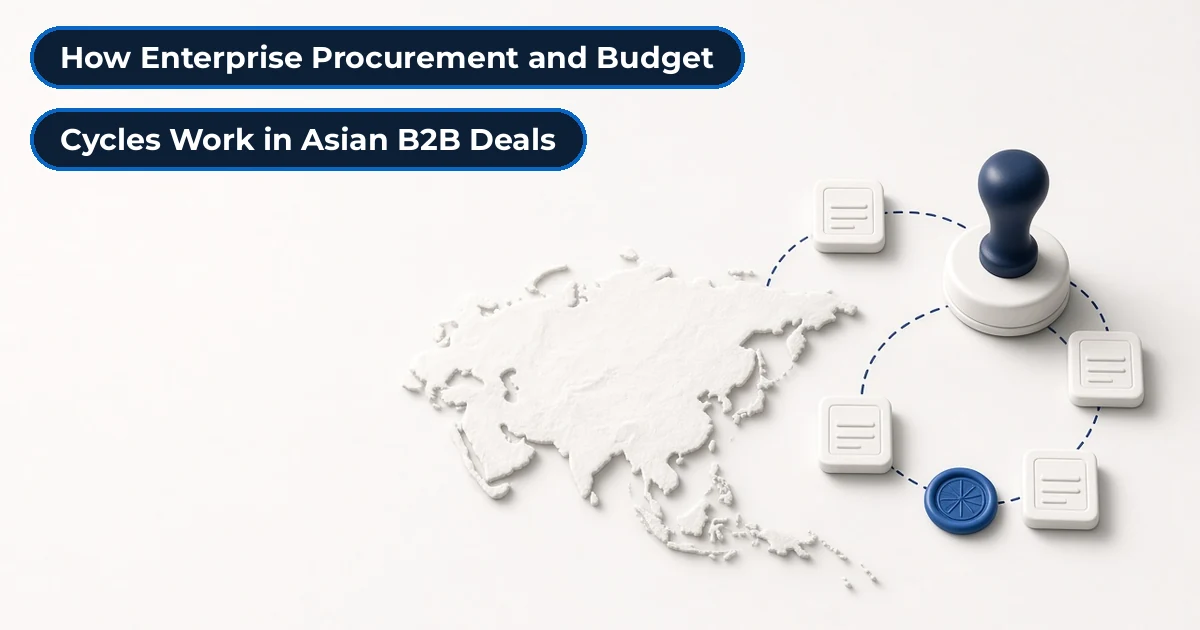
An enterprise procurement cycle in Asia is the path from interest to a purchase order inside a company or government-linked buyer: the budget year the spend must land in, the committee that has to agree, the vendor-registration or compliance file, and the formal path (a quote, an RFP, or both).
There is no single “Asian” cycle. Markets differ. So do industries, and so do companies in the same city. What does not change is this: if you treat a first meeting as a late-stage opportunity, your forecast will be early, and your first-year budget will look late.
This guide sits beside How to Plan Your 2027 Asia Expansion and What a First-Year Asia Expansion Budget Actually Includes. The plan names the market. The budget names the ceiling. This playbook explains why enterprise revenue often arrives later than a Western forecast expects — and what to do about it.
For the relationship side of the same work, see Relationship-Based Selling in Asia. For what to track before a PO appears, see Leading Indicators That Prove Your Asia Expansion Is Working and How to Shorten Your B2B Sales Cycle in Asia. For culture and etiquette, see Cultural Nuances in B2B Sales Across Asian Markets.
We will not invent an “average enterprise sales cycle in Asia.” Those figures are rarely sourced, and they hide the difference between a mid-market software deal and a government-linked tender. What we can map is the structure.
- TL;DR — Key Takeaways
- A first meeting is not a purchase order. In enterprise deals, it is often a relationship and discovery step (our view).
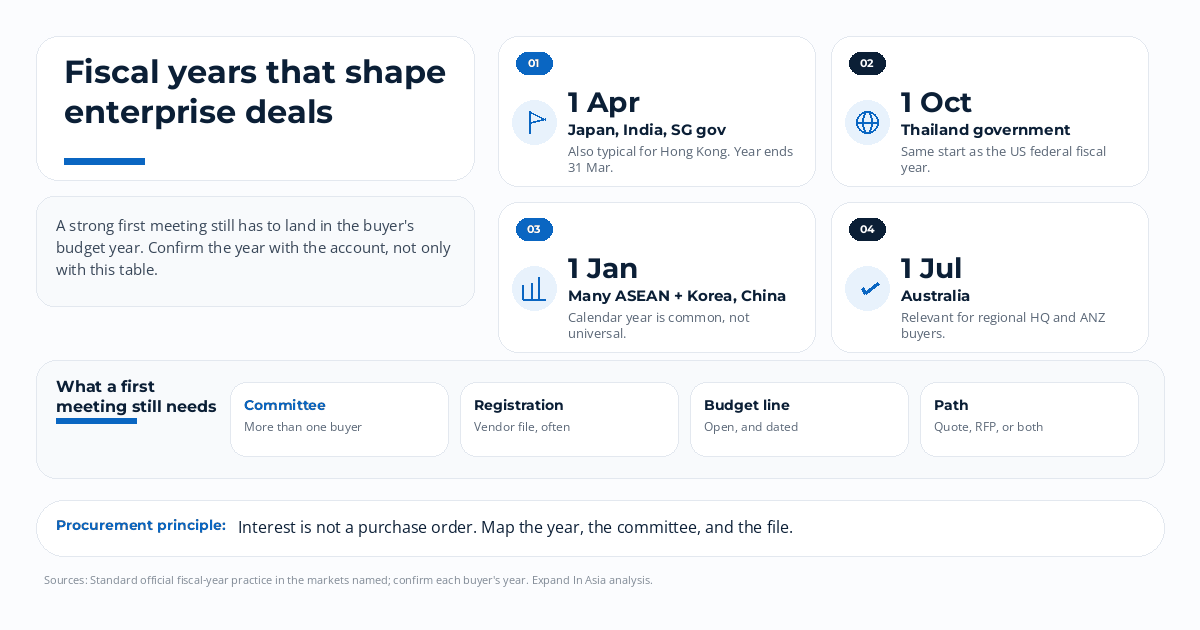
- Map the buyer’s fiscal year. Japan, India, and the Singapore government typically use 1 April–31 March. The Thai government year starts 1 October. Many ASEAN markets, Korea, and China typically use the calendar year.
- Expect a committee and, often, a vendor file. Registration can start before a PO can be issued.
- Do not put a cycle-length number in your plan if you cannot source it. Track stakeholders, next steps, and budget timing instead.
- Build procurement time into your 2027 plan and your first-year budget.
If you only do one thing: for every serious enterprise account, write down the fiscal year, the committee, and whether vendor registration has started.
Who This Guide Is For—and Who It Is Not For
This Guide Is For
- founders and CROs selling to enterprises, conglomerates, or government-linked buyers in Asia;
- sales leaders whose “hot” first meetings go quiet;
- teams building a 2027 forecast that needs a realistic path to revenue;
- expansion leads who have a budget but no picture of how buying actually works.
This guide is especially useful if your team is asking:
- When do fiscal years start in the markets we sell to?
- Why did a good meeting not become a proposal?
- Do we need to register as a vendor first?
- How should this change our Q1 plan?
This Guide Is Not For
- you sell only to small private companies with a one-person buying process;
- you need a legal guide to public tenders or a bid-writing manual;
- you want a single “average months to close” statistic (we will not invent one);
- you need consumer checkout or e-commerce advice.
Practical fit check: if your forecast assumes a first meeting becomes a deal in the same quarter, this guide is for you.
What Enterprise Procurement Means in Asian B2B Deals
Enterprise procurement is the formal path a larger buyer uses to approve a vendor and release spend: budget, stakeholders, compliance or vendor registration, and a purchase process.
A budget cycle is the year in which that spend must be approved and used. Miss the window, and a “yes” can wait for the next year.
In our experience, foreign B2B teams often see three moments and misread all three:
- a warm introduction as a short cycle;
- a request for information as a late stage;
- silence as a lost deal, when the file is still moving inside the buyer’s process.
Interest vs. a Buying Path
| Area | Interest | A buying path |
|---|---|---|
| Meeting | One champion | A mapped committee |
| Budget | “We have budget” | A named year and a line |
| Vendor status | A conversation | A registration or compliance file |
| Next step | “Send a deck” | A dated request, quote, or RFP |
| Forecast | Close this quarter | A close date tied to the year |
Practical Rule (our take)
If you cannot name the fiscal year and the next internal step, the opportunity is earlier than it looks.
Why Fiscal Years Matter More Than a First Meeting
A strong conversation still has to land in an open budget.
These are the typical official or statutory fiscal years in markets we meet often. They are a starting map, not a substitute for asking the buyer which year their company uses. Private companies sometimes choose a different year from the government.
| Market | Typical fiscal year | Starts |
|---|---|---|
| Japan | 1 April – 31 March | 1 April |
| India | 1 April – 31 March | 1 April |
| Singapore (government) | 1 April – 31 March | 1 April |
| Hong Kong (government) | 1 April – 31 March | 1 April |
| Thailand (government) | 1 October – 30 September | 1 October |
| United States (federal) | 1 October – 30 September | 1 October |
| Malaysia | Calendar year | 1 January |
| Indonesia | Calendar year | 1 January |
| Vietnam | Calendar year | 1 January |
| Philippines | Calendar year | 1 January |
| South Korea | Calendar year | 1 January |
| China | Calendar year | 1 January |
| Australia | 1 July – 30 June | 1 July |
Why this matters in practice (our view):
- A January meeting with a Japanese enterprise may sit late in their fiscal year, or too late for this year’s budget.
- A mid-year meeting with a Thai government-linked buyer may be early or late depending on their October year, not yours.
- A calendar-year buyer in Jakarta or Ho Chi Minh City may close planning in the fourth quarter — which is when your team is also trying to close the year.
We are not saying every deal follows the government calendar. We are saying you should ask, then plan backwards from the year you are told.
Practical Rule (our take)
Write the buyer’s fiscal year on the opportunity the same day you write the champion’s name.
Buying Committees, Vendor Registration, and the Path to a PO
The committee is usually larger than the first room
In our experience, the first meeting is often with a sponsor or a user, not with every person who can stop or approve the purchase. Finance, procurement, IT or security, and a senior operator may all enter later. This is consistent with what we have written about relationship-based selling and cultural nuances: trust and hierarchy shape who must be included, and in what order.
Ask, early, who else will need to see this. Then ask how those people prefer to be introduced. Do not skip a stakeholder because the first meeting went well.
Vendor registration is often a gate, not a formality
Many large companies and government-linked buyers will not issue a purchase order to a vendor that is not in their system. The file can ask for legal documents, bank details, tax information, policies, or proof of local presence. Requirements differ by buyer and by country. Start the file when interest is real, not after you “win.”
We will not list a standard set of documents for “Asia.” There is no standard set. Ask the procurement contact for the checklist.
The path may be a quote, an RFP, or both
Some buyers can purchase from a proposal and a vendor file. Others must run a request for proposal, even when they already know you. In our experience, a request for a detailed proposal is not the same as a verbal yes. Treat it as a stage with a date, an owner, and a document list.
Silence is not always a "no"
Internal routing can take time, especially around fiscal year-end, public holidays, and Chinese New Year. Follow up with a useful next step, not with pressure that ignores the process.
Practical Rule (our take)
The deal is only as mature as the file, the committee, and the budget year — not the warmth of the first meeting.
A Practical Playbook for Enterprise Deals
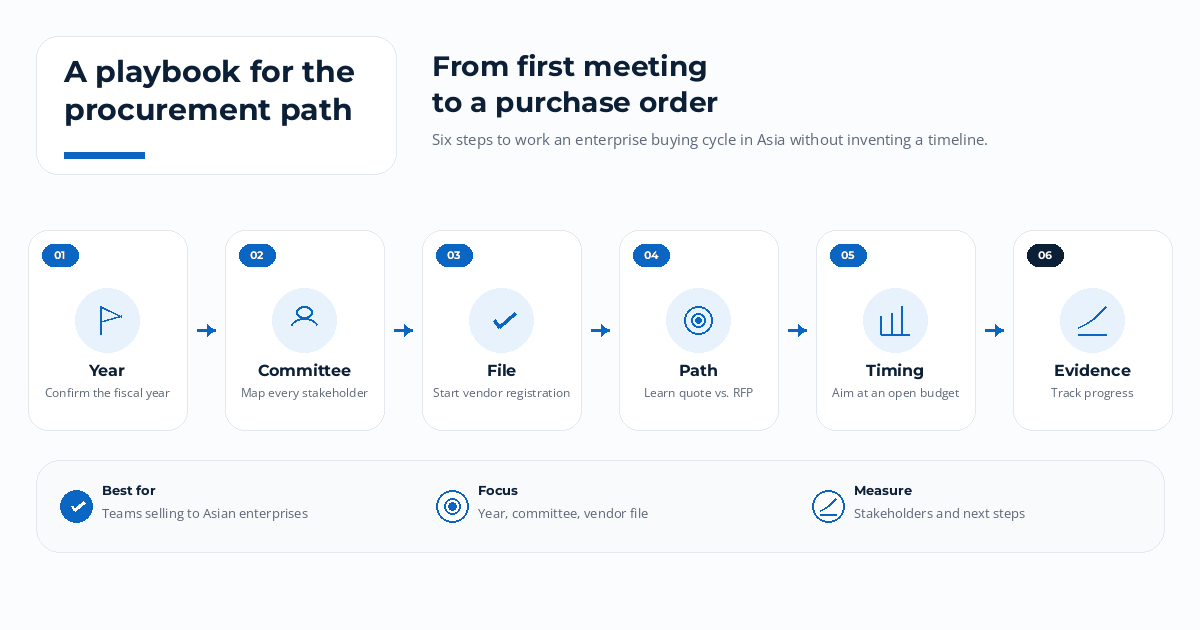
Step 1 — Confirm the fiscal year
Ask which year the company uses, when budget is locked, and whether this category is still open.
Step 2 — Map the committee
Name every stakeholder you know, and the ones you have been told exist but have not met. Track introductions, not just emails sent.
Step 3 — Start vendor registration when interest is real
Get the checklist. Assign an owner on your side. Do not let a missing document become the delay you discover in the last week.
Step 4 — Learn the path: quote, RFP, or both
Agree what “next” means in their process, and date it.
Step 5 — Aim your work at an open budget window
If the window is closing, ask what can be approved now and what must wait. If the window is late, use the time to complete the file and the committee, not to discount early (our view).
Step 6 — Track evidence, not hope
Use leading indicators: meetings with new stakeholders, a started vendor file, a dated request, a confirmed budget line. See leading indicators and how to shorten the sales cycle without pretending you can skip procurement.
Practical Rule (our take)
A clean process will not always make the cycle short.
It will make the cycle visible.
How This Connects to Your Plan, Budget, and Pipeline
Build procurement into the 2027 Asia expansion plan so Q1 is not forecast as a straight line to revenue. Build document work and longer stakeholder time into the first-year budget. And keep the pipeline honest: a first meeting belongs in an early stage until the committee, the year, and the file are known.
The free Asia Expansion Readiness Assessment Tool is useful here too. It scores Strategy, ICP and Market Evidence, People and Process, Infrastructure, and Leadership and Investment on a 1 / 3 / 5 scale.1 A weak score on People and Process often shows up later as a pipeline that cannot explain why deals stall.
Practical Rule (our take)
If your plan needs revenue in a quarter the buyer’s year cannot support, change the plan, not the close date.
Need Help Managing Longer Enterprise Cycles in Asia?
Expand In Asia helps B2B companies keep enterprise deals visible and moving:
- stakeholder and account mapping;
- localized outreach and appointment setting;
- a pipeline view that tracks next steps, not just meetings;
- reporting that finance can use in a longer cycle;
- a clearer picture before you add local headcount.
Common Procurement Mistakes
Mistake 1 — Forecasting from the first meeting
Warmth is not a stage.
Mistake 2 — Ignoring the fiscal year
Your calendar is not the buyer’s calendar.
Mistake 3 — Meeting one champion and stopping
Enterprise deals usually need a committee.
Mistake 4 — Starting vendor registration too late
The file is part of the cycle, not admin after the win.
Mistake 5 — Inventing a cycle-length target
A number without a source will train the team to pressure the wrong step.
Mistake 6 — Going quiet around year-end and holidays
In our experience, this is when files stall unless you have already agreed the next dated action.
Enterprise Cycle Scorecard
Score each area from 1 to 5. This is our own simplified framework, not an industry benchmark.
| Area | 1 — Weak | 3 — Developing | 5 — Strong |
|---|---|---|---|
| Fiscal year | Not asked | Known for some accounts | Known and used in the forecast |
| Committee | One contact | A partial list | Mapped, with introductions planned |
| Vendor file | Not started | Started late | Started when interest is real |
| Buying path | “They liked us” | Quote or RFP, unclear | Path and date agreed |
| Budget window | Assumed open | Mentioned | Confirmed open or deferred on purpose |
| Stage hygiene | First meeting = late stage | Mixed | Stage matches the file |
| Leading indicators | Only revenue | Some activity | Stakeholders, file, next step |
| Plan and budget link | Cycle ignored | Noted, not funded | Built into the 2027 plan and budget |
Score Interpretation (Our Guidance)
| Total Score | What It Means |
|---|---|
| 34–40 | Enterprise deals are visible enough to forecast with care. |
| 27–33 | Good base. Finish fiscal-year and vendor-file discipline. |
| 20–26 | Interest is being mistaken for a path. |
| Below 20 | Start with relationship selling and leading indicators. |
Need Help Keeping the Pipeline Honest?
Expand In Asia can help you run multi-stakeholder outreach and keep next steps visible.
Next Steps With Expand In Asia
Enterprise revenue in Asia follows a year, a committee, and a file.
- Confirm the fiscal year on every serious account.
- Map the committee and start vendor registration when interest is real.
- Track leading indicators, not only close dates.
- Build this into your 2027 plan and first-year budget.
To go deeper:
Ready to Implement These Strategies?
Book a free 30-minute strategy session where we’ll audit your current growth approach and identify your highest-leverage opportunities in Asian markets.
Frequently Asked Questions
1. How does the enterprise procurement cycle work in Asia?
There is no single Asian cycle. In many enterprise deals, a first meeting is followed by more stakeholders, vendor registration or compliance checks, and a formal purchase path (quote, RFP, or both) that has to land in the buyer’s fiscal year. The sequence is common. The length is not a number we will invent.
2. When do fiscal years start in major Asian markets?
Japan, India, and the Singapore government (and Hong Kong) typically use 1 April–31 March. The Thai government fiscal year runs 1 October–30 September, as does the US federal year. Malaysia, Indonesia, Vietnam, the Philippines, South Korea, and China typically use the calendar year. Australia uses 1 July–30 June. Always confirm the buyer’s own year.
3. Why do enterprise deals in Asia stall after a good first meeting?
In our experience, the first meeting is often a relationship and discovery step, not a buying step. The deal then needs a wider committee, a registered-vendor file, and a budget line that is still open. See Relationship-Based Selling in Asia.
4. Do we need to be a registered vendor before we can sell?
Often, for larger enterprises and government-linked buyers, yes — or you will need to start registration before a purchase order can be issued. Requirements differ by company and country. Treat “we had a great meeting” as incomplete until you know the registration path.
5. How should this change our 2027 plan and first-year budget?
Build time for procurement into the plan, and do not forecast revenue as if a January meeting becomes a January booking. Budget for longer stakeholder work and for the documents a vendor file will ask for. See the 2027 Asia expansion plan and the first-year budget guides.
6. How can Expand In Asia help with enterprise deals in Asia?
Expand In Asia is a Singapore-based B2B outbound and market-entry partner. It helps companies reach the right stakeholders, keep pipeline visible through a longer buying path, and avoid treating a first meeting as a closed deal. Start with the free Asia Expansion Readiness Assessment Tool.
Are you working a serious enterprise account in Asia this quarter? Share the step that usually stalls — fiscal year, committee, or vendor file — in the comments.
About the author: Joel Berou is Asia Expansion & Revenue Growth Advisor at Expand In Asia, a Singapore-based B2B outbound and market-entry partner that helps companies build pipeline across Asian markets. Last updated: November 10, 2026.
Sources
-
Expand In Asia. Asia Expansion Readiness Assessment Tool (accessed 10 November 2026). Five pillars and 1 / 3 / 5 scale. https://tools.expandin.asia/ ↩
Fiscal-year dates in the table are stated as typical official or statutory practice in the markets named. Confirm each buyer’s year, especially for private companies that may use a different period.