

Customer Churn in B2B SaaS: Preventing Revenue Leakage in Asian Markets
A practical guide for identifying churn risk, protecting recurring revenue, and improving customer retention across Asia
Customer churn is not always loud.
Sometimes it looks like a cancellation request.
But often, it starts much earlier.
A champion stops replying.
Users stop logging in.
The customer skips a business review.
Support tickets increase.
A local team never fully adopts the platform.
A regional buyer likes the strategy, but country teams do not see the value.
The renewal date approaches, and the customer suddenly asks, “Can we reduce seats?”
That is revenue leakage.
For B2B SaaS companies expanding across Asian markets, churn is not only a customer success problem.
It is a go-to-market problem.
Why?
Because churn often begins when the promise made during sales does not translate into value after purchase.
This is especially true in Asia, where SaaS customers may operate across different countries, languages, business cultures, budget expectations, stakeholder groups, and support needs.
A SaaS company may close a customer in Singapore, but the daily users may sit in the Philippines, Vietnam, Indonesia, Malaysia, Thailand, India, Japan, or Korea.
If onboarding, enablement, support, and value communication do not match that reality, churn risk increases.
Recent SaaS benchmark discussions consistently show that churn varies by segment and business model. Some 2025 B2B SaaS benchmark summaries put average B2B SaaS monthly churn around the mid-single digits, while noting that enterprise SaaS often needs much lower churn to protect unit economics.
The exact benchmark matters less than the business lesson:
Churn prevention must start before the customer becomes a renewal risk.
This guide explains how B2B SaaS teams can prevent revenue leakage in Asian markets by improving onboarding, adoption, localization, support, customer health tracking, and renewal readiness.
- TL;DR — Key Takeaways
- Churn is not only cancellation. Revenue leakage can appear as downgrades, seat reductions, poor adoption, delayed expansion, weak referrals, or silent non-renewal risk.
- Asian markets add complexity. B2B SaaS customers may involve regional buyers, local users, different language needs, local support expectations, and multi-country rollout challenges.
- Onboarding is a churn prevention tool. Slow time-to-value is one of the earliest signs of future churn.
- Adoption must be tracked by role and market. A happy executive buyer does not guarantee user adoption.
- Localization affects retention. Local-language training, market-aware support, and country-specific value stories can reduce friction.
- Customer health should combine multiple signals. Usage, support tickets, stakeholder engagement, NPS, renewal stage, and business outcomes should be viewed together.
- Churn prevention needs a closed-loop system. Detect risk, prioritize accounts, act quickly, prove value, and update the GTM motion.
If you only do one thing: stop treating churn as a renewal event. Treat churn as a pattern that starts during onboarding, adoption, and customer value realization.
Who This Guide Is For—and Who It Is Not For
This Guide Is For
- B2B SaaS companies selling into Asian markets.
- SaaS founders trying to protect recurring revenue after market entry.
- Customer success leaders building regional retention systems.
- CROs and revenue leaders managing churn, renewals, and expansion.
- RevOps teams building customer health dashboards.
- Sales leaders who want better handoff and customer expectations.
- Account managers managing multi-country customers.
- Companies selling SaaS into Singapore, Indonesia, Vietnam, the Philippines, Malaysia, Thailand, India, Japan, Korea, and wider APAC.
This guide is especially useful if your team is asking:
- Why do customers churn after a promising sales process?
- How do we identify churn risk earlier?
- What churn signals matter across Asian markets?
- How do we reduce downgrades and seat reductions?
- How do we improve SaaS adoption in Southeast Asia?
- How do we localize customer success?
- What should we track before renewal?
This Guide Is Not For
This guide may be less useful if:
- your product is fully transactional;
- customers do not renew or expand;
- you do not track product usage or customer health;
- your team does not have post-sale ownership;
- you only want a churn benchmark and not an operating plan;
- your company is unwilling to adjust onboarding, support, or enablement by market.
Practical fit check: If recurring revenue matters to your business, churn prevention should be treated as part of your growth strategy.
What Customer Churn Means in B2B SaaS
Customer churn usually means customers stop paying.
But in B2B SaaS, churn is more than cancellation.
Types of Churn
| Type | What It Means |
|---|---|
| Logo churn | The customer cancels completely |
| Revenue churn | The customer reduces contract value |
| Seat churn | The customer keeps the account but reduces users |
| Product churn | The customer removes modules or add-ons |
| Usage churn | The customer pays but usage drops |
| Champion churn | The internal supporter leaves or loses influence |
| Expansion churn | The expected growth opportunity never happens |
| Advocacy churn | The customer remains but stops referring or supporting the vendor internally |
Why Revenue Leakage Matters
A customer does not need to cancel for revenue to leak.
Revenue leakage can happen when:
- the account renews at a lower value;
- users do not adopt;
- expansion stalls;
- the customer reduces seats;
- support costs rise;
- the customer stops advocating internally;
- the renewal requires discounting;
- the customer keeps one team but blocks wider rollout.
That is why SaaS teams should monitor churn risk earlier than the renewal window.

Why Churn Becomes Harder to Manage in Asian Markets
Asia is not one market.
Customer expectations can vary significantly across countries.
Common Market Differences
| Market Factor | Why It Matters |
|---|---|
| Language | Training and support may need localization |
| Business culture | Feedback may be direct in some markets and indirect in others |
| Decision structure | Regional buyers and local users may not align |
| Support expectations | Some customers expect fast human support |
| Implementation maturity | Some teams need more hands-on rollout |
| Budget pressure | ROI must be clear before renewal |
| Partner involvement | Local partners may influence adoption and trust |
| Procurement norms | Renewal and payment cycles may differ |
Example
A SaaS company may close a regional deal through a Singapore HQ.
But adoption may depend on:
- users in the Philippines;
- implementation leads in Vietnam;
- finance in Malaysia;
- local operations in Indonesia;
- regional leadership in Singapore.
If the onboarding process only serves the original buyer, churn risk can build quietly across the actual user base.
For broader market-entry planning, see Go-to-Market (GTM) Strategies for Asia.
The Hidden Types of Revenue Leakage
Many teams only track churn after cancellation.
That is too late.
Revenue Leakage Examples
| Revenue Leak | What It Looks Like |
|---|---|
| Seat reduction | “We only need 20 seats now, not 50.” |
| Module downgrade | “We are removing the advanced package.” |
| Delayed rollout | “We will expand to other countries later.” |
| Discounted renewal | “We will renew only if pricing changes.” |
| Low adoption | “Only one team is using it.” |
| Support burden | “This customer is expensive to maintain.” |
| Lost expansion | “The second market rollout never happened.” |
| Referral loss | “They are not willing to recommend us.” |
Practical Rule
If an account is not growing in value, usage, trust, or advocacy, there may already be leakage.
Why SaaS Customers Churn in Asia
Churn usually has multiple causes.
Common Churn Drivers
| Driver | What Happens |
|---|---|
| Poor onboarding | Customer never reaches value |
| Weak local enablement | Users do not understand how to apply the product |
| Low adoption | Product is not embedded in daily work |
| Champion loss | Internal advocate leaves or loses influence |
| Poor stakeholder alignment | Buyer, users, IT, finance, and leadership are not aligned |
| Support frustration | Issues are slow or unclear |
| Pricing pressure | Value is not strong enough to justify spend |
| Product-market mismatch | The use case does not fit the local operating reality |
| Competitor pressure | Another vendor offers local support or better perceived value |
| No value story | Renewal lacks clear business impact |
Customer success management research frames customer success as a proactive approach focused on improving the value customers realize from a product or solution, with retention as a core goal.
That is the key difference between support and customer success.
Support fixes issues.
Customer success prevents value failure.
Churn Signal 1 — Weak Onboarding and Slow Time-to-Value
Onboarding is where churn risk often begins.
Warning Signs
- kickoff is delayed;
- sales context is missing;
- the wrong people attend onboarding;
- success criteria are unclear;
- users do not complete training;
- the first value milestone is not defined;
- implementation tasks stall;
- local teams do not understand the use case.
What to Do
Create a structured onboarding plan that includes:
- sales-to-CS handoff;
- kickoff agenda;
- first value milestone;
- stakeholder map;
- role-based training;
- local support needs;
- 30-60-90 day success plan;
- early adoption check.
For a related onboarding framework, see Building a B2B Customer Onboarding Program for the Southeast Asian Market.
Churn Signal 2 — Low Adoption and Usage Decay
Usage decay is one of the clearest early churn signals.
Watch For
- fewer active users;
- fewer logins;
- less feature usage;
- no admin activity;
- no new teams added;
- declining workflow activity;
- only one champion using the product;
- usage concentrated in one market but not others.
BillingPlatform’s churn guidance highlights the importance of monitoring usage analytics and subscriber behavior to identify at-risk customers and proactively engage them.
What to Do
Segment usage by:
- country;
- team;
- role;
- product feature;
- account tier;
- onboarding stage;
- renewal date.
Then ask:
- who is using the product?
- who is not?
- where did usage drop?
- did usage drop after a support issue?
- did a champion leave?
- does the customer still understand the value?
Churn Signal 3 — Champion Risk and Stakeholder Gaps
A champion can help you win the deal.
But one champion is not enough to protect the renewal.
Champion Risk Appears When:
- the champion leaves;
- the champion changes roles;
- the champion loses budget authority;
- the champion is not close to daily users;
- the champion cannot prove value internally;
- the champion is supportive but isolated.
What to Do
Map the account beyond the champion.
| Stakeholder | Retention Role |
|---|---|
| Executive sponsor | Protects strategic priority |
| Champion | Drives internal support |
| End users | Prove daily adoption |
| Admin | Keeps system operational |
| IT / security | Supports access and integrations |
| Finance | Evaluates ROI |
| Procurement | Handles renewal process |
| Regional leader | Supports multi-country rollout |
| Local manager | Drives team adoption |
A strong renewal process starts with multi-stakeholder confidence.
For sales-cycle and stakeholder enablement ideas, read How to Shorten Your B2B Sales Cycle in Singapore and SEA.
Churn Signal 4 — Support Friction and Localization Gaps
Support frustration can damage trust quickly.
In Asian markets, support expectations may differ by country, segment, and customer type.
Common Support Gaps
- unclear escalation process;
- slow response time;
- documentation not localized;
- support not aligned with local working hours;
- unclear implementation ownership;
- too much reliance on the champion;
- regional buyer receives updates but local users do not;
- training materials do not match local workflows.
What to Do
Create a support model that clarifies:
- response expectations;
- escalation paths;
- account owner;
- local-language needs;
- training resources;
- recurring check-ins;
- issue resolution tracking;
- customer communication rhythm.
Localization Reminder
Localization is not only a marketing activity.
For churn prevention, localization may include:
- onboarding materials;
- admin guides;
- support FAQs;
- renewal business cases;
- user training;
- internal rollout templates;
- account review decks.
For related guidance, see Positioning a Global Brand for Local Buyers.
Churn Signal 5 — Weak Renewal Value Story
Renewal should not be a pricing conversation only.
It should be a value conversation.
Weak Renewal Story
“Your contract is up. Do you want to renew?”
Strong Renewal Story
“Here is what your team achieved, where adoption improved, which teams are active, what risks we resolved, and where we can create more value next.”
Value Story Components
| Component | Example |
|---|---|
| Original goal | Why the customer bought |
| Adoption progress | Who is using the product |
| Business outcome | What improved |
| Support record | What issues were resolved |
| Stakeholder engagement | Who is involved |
| Risk plan | What still needs attention |
| Next phase | What expansion or improvement makes sense |
Practical Rule
Do not build the renewal story 30 days before renewal.
Build it from onboarding.
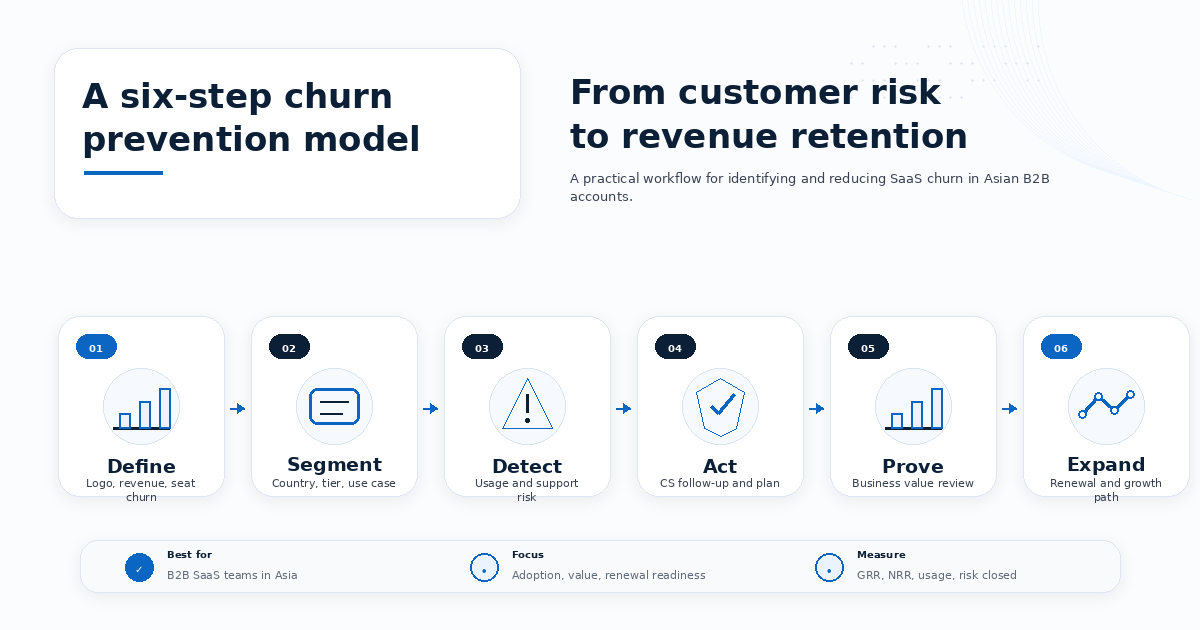
How to Build a Churn Prevention Operating Model
Use this six-step model.
Step 1 — Define
Clarify what churn means for your business:
- logo churn;
- revenue churn;
- seat churn;
- module churn;
- expansion delay;
- customer health decline.
Step 2 — Segment
Segment accounts by:
- country;
- account tier;
- industry;
- use case;
- renewal date;
- onboarding stage;
- adoption level;
- revenue value.
Step 3 — Detect
Track early warning signals:
- usage decline;
- unresolved tickets;
- missed meetings;
- delayed onboarding;
- champion silence;
- negative feedback;
- renewal hesitation.
Step 4 — Act
Create intervention plays:
- executive check-in;
- user training;
- local-language materials;
- support escalation;
- success plan review;
- product education;
- adoption campaign.
Step 5 — Prove
Show value through:
- business reviews;
- usage reports;
- adoption milestones;
- ROI summaries;
- stakeholder updates;
- success stories.
Step 6 — Expand
Turn retained customers into:
- expanded accounts;
- reference customers;
- referrals;
- case studies;
- multi-country rollout opportunities.
Metrics to Track for Churn Prevention
Core Retention Metrics
| Metric | What It Shows |
|---|---|
| Logo churn | Customer cancellations |
| Gross revenue retention | Revenue retained before expansion |
| Net revenue retention | Revenue retained including expansion |
| Seat retention | User count stability |
| Product usage | Adoption behavior |
| Feature adoption | Depth of product value |
| Time-to-value | Onboarding effectiveness |
| Support ticket volume | Friction level |
| NPS / CSAT | Sentiment and satisfaction |
| Renewal forecast | Commercial risk |
| Expansion pipeline | Growth opportunity |
Practical Rule
Do not rely on one metric.
Churn prevention works best when commercial, product, support, and relationship signals are combined.
Customer Health Scorecard for Asian Markets
A customer health score should be more than a color-coded field.
It should explain what action is needed.
| Health Signal | Green | Yellow | Red |
|---|---|---|---|
| Product usage | Active and expanding | Stable but limited | Declining or inactive |
| Stakeholder engagement | Multiple stakeholders engaged | Champion only | Champion silent or gone |
| Support experience | Issues resolved quickly | Some friction | Escalations or repeated complaints |
| Time-to-value | First value reached | Delayed but moving | No clear first value |
| Localization fit | Materials fit users | Some gaps | Users do not understand or adopt |
| Renewal readiness | Value story clear | Some proof missing | Renewal risk unclear or negative |
| Expansion potential | New teams interested | Possible but not active | No expansion path |
How to Use It
For each yellow or red account:
- identify root cause;
- assign owner;
- define next action;
- set deadline;
- track outcome;
- update health status.
Common Churn Prevention Mistakes
Mistake 1 — Waiting Until Renewal
By renewal time, the customer may already have decided.
Mistake 2 — Treating All Markets the Same
Singapore, Indonesia, Vietnam, Japan, Korea, India, Thailand, Malaysia, and the Philippines may require different support and enablement.
Mistake 3 — Tracking Only Logo Churn
Revenue leakage can happen without full cancellation.
Mistake 4 — Ignoring Usage Data
Low usage is often an early churn signal.
Mistake 5 — No Localized Enablement
Global help docs may not be enough for local teams.
Mistake 6 — No Stakeholder Expansion
One champion cannot protect the account forever.
Mistake 7 — No Closed-Loop Feedback
If churn reasons do not improve onboarding, product, support, and sales messaging, the same issues repeat.
Churn Prevention Scorecard
Score each area from 1 to 5.
| Area | 1 — Weak | 3 — Developing | 5 — Strong |
|---|---|---|---|
| Churn definition | Only cancellations tracked | Basic logo and revenue churn tracked | Logo, revenue, seat, module, and expansion leakage tracked |
| Segmentation | Overall churn only | Churn by account tier | Churn by country, tier, use case, industry, and lifecycle stage |
| Onboarding | Generic setup checklist | Basic kickoff and training | First-value milestone, stakeholder map, and 30-60-90 plan |
| Adoption tracking | No usage view | Basic login or activity tracking | Role, team, feature, and country-level adoption tracking |
| Customer health | Manual opinion | Basic red/yellow/green status | Health score based on usage, support, engagement, value, and renewal risk |
| Localization | Global materials only | Some local support | Market-aware onboarding, training, support, and renewal assets |
| Stakeholder coverage | Champion only | Some stakeholder mapping | Champion, sponsor, users, IT, finance, procurement, and local teams mapped |
| Support response | Reactive | Basic ticket handling | Proactive escalation, ownership, and risk follow-up |
| Renewal readiness | Renewal discussed late | Some business review | Value story built throughout the customer lifecycle |
| Feedback loop | Churn reasons not captured | Basic churn notes | Churn insights improve sales, onboarding, product, and support |
Score Interpretation
| Total Score | Recommendation |
|---|---|
| 42–50 | Strong churn prevention system; optimize by market and account segment |
| 34–41 | Good foundation; improve localization, health scoring, or renewal readiness |
| 25–33 | Churn is being tracked, but prevention may be inconsistent |
| Below 25 | Rebuild churn prevention before scaling customer acquisition |
Need Help Building Market-Ready Revenue Systems in Asia?
Expand In Asia helps B2B companies build growth systems across Asian markets through:
- ICP and account research;
- localized buyer messaging;
- sales prospecting;
- appointment setting;
- market validation;
- pipeline reporting;
- market feedback loops.
Talk to Expand In Asia about building healthier pipeline and customer growth systems across Asia →
Next Steps With Expand In Asia
Customer churn in B2B SaaS is not only a retention issue.
It is a growth issue.
If your company is expanding across Asia, you need to understand not only how to win new customers, but also how to help them adopt, prove value, renew, and expand.
The strongest SaaS teams do not wait until renewal to care about churn.
They manage churn risk from the first sales conversation, through onboarding, adoption, support, business review, and expansion planning.
For broader market-entry planning, read Go-to-Market (GTM) Strategies for Asia.
For early-market pipeline development, read Building a B2B Sales Pipeline from Zero in a New Asian Market.
For buyer enablement and sales-cycle improvement, read How to Shorten Your B2B Sales Cycle in Singapore and SEA.
Schedule a consultation with Expand In Asia →
Ready to Implement These Strategies?
Book a free 30-minute strategy session where we’ll audit your current growth approach and identify your highest-leverage opportunities in Asian markets.
Frequently Asked Questions
1. What is customer churn in B2B SaaS?
Customer churn in B2B SaaS usually refers to customers canceling or not renewing. But churn can also include revenue reduction, seat reduction, product downgrade, usage decline, or lost expansion potential.
2. Why does churn matter so much in SaaS?
SaaS depends on recurring revenue. When customers churn, the company must replace lost revenue before it can grow. Churn also reduces lifetime value, weakens expansion, and increases pressure on acquisition.
3. What is revenue leakage?
Revenue leakage happens when revenue quietly declines or fails to expand. In SaaS, this may include downgrades, fewer seats, stalled rollout, discounted renewals, poor adoption, or lost expansion.
4. Why is churn prevention different in Asian markets?
Asian markets can involve different languages, support expectations, buyer roles, cultural feedback patterns, and local adoption needs. A regional buyer may sign the contract, but local teams must still adopt the solution.
5. What are early churn signals?
Common early churn signals include slow onboarding, low usage, declining logins, support frustration, champion silence, delayed business reviews, no first value milestone, and unclear renewal value.
6. How can B2B SaaS companies reduce churn?
B2B SaaS companies can reduce churn by improving onboarding, tracking adoption, localizing enablement, mapping stakeholders, monitoring customer health, resolving support friction, and building renewal value stories early.
8. What metrics should SaaS teams track?
Track logo churn, gross revenue retention, net revenue retention, seat retention, product usage, feature adoption, time-to-value, support tickets, NPS, CSAT, renewal forecast, and expansion pipeline.