

Business success in Asia is not determined solely by the quality of your product or the competitiveness of your pricing. The ability to close deals across Asian markets hinges on understanding and navigating complex cultural nuances that shape every aspect of the negotiation process.
-
TL;DR — Key Takeaways
- Relationship building precedes transactions : Asian markets prioritize trust and personal connections over contractual formalities, with relationship-building phases averaging 6-10 weeks before substantive negotiations begin.
- Hierarchy shapes every interaction : Understanding and respecting organizational hierarchies, seniority protocols, and decision-making chains is non-negotiable for successful deal closure across China, Japan, South Korea, and Southeast Asia.
- Saving face drives communication styles : Indirect communication, consensus-building, and face-saving mechanisms determine how objections are raised, feedback is delivered, and agreements are reached.
- Patience yields exponentially better outcomes : Asian negotiations average 20 weeks compared to 8 weeks in Western markets, but rushing this process destroys trust and derails deals.
- Cultural intelligence is your competitive advantage : Companies that invest in understanding market-specific nuances like Chinese guanxi, Japanese nemawashi, and Thai face-saving protocols achieve 40% higher conversion rates.
Who this playbook is for (and not for)
This guide is essential for:
B2B companies entering Asian markets for the first time who need practical frameworks to navigate cultural complexities without costly trial-and-error learning curves.
Business development professionals tasked with establishing partnerships, negotiating contracts, or closing deals with Chinese, Japanese, Korean, or Southeast Asian counterparts.
Sales leaders building teams across Asia who need to train their personnel on culturally-appropriate negotiation tactics that respect local business protocols.
Consultants and advisors supporting clients’ Asian expansion who must provide culturally-intelligent guidance beyond standard business development practices.
This guide is not for:
Companies seeking quick transactional deals without commitment to relationship-building or long-term market presence.
Organizations unwilling to adapt their negotiation timelines, communication styles, or decision-making processes to accommodate Asian business cultures.
Businesses that view cultural adaptation as unnecessary overhead rather than strategic investment in sustainable market success.
The Real Cost of Cultural Missteps in Asian Markets
When a UK software company entered the Japanese market with a proven product and competitive pricing, they secured initial meetings with major enterprises but failed to close a single deal in nine months. The culprit was not their technology or pricing but their failure to understand nemawashi, Japan’s consensus-building process that requires 60-70% of project timelines be dedicated to informal stakeholder alignment before formal decisions.
Research on failed cross-cultural negotiations reveals that 85% of deal failures stem from skipping relationship-building phases, while 82% involve causing loss of face through direct confrontation or public criticism. A particularly instructive case involved Australian and Chinese business delegations whose negotiation collapsed despite shared objectives because the Australians pushed for immediate business discussions while the Chinese needed extended relationship development through dinners and informal interactions.
The financial implications extend beyond individual failed deals. Companies that ignore cultural nuances experience longer sales cycles, lower conversion rates, damaged reputations in tight-knit business communities, and lost referral opportunities that flow through relationship networks. Conversely, organizations that master cultural intelligence report 40% higher conversion rates and significantly faster market establishment than competitors who neglect these dimensions.
The Six Cultural Pillars That Determine Deal Success
Pillar 1: Relationship Over Transaction
Asian business cultures fundamentally prioritize relationships (guanxi in China, quan hệ in Vietnam) over transactional efficiency. This means the contract represents the beginning of the relationship rather than its conclusion. In China, business partners expect reciprocal exchanges of favors extending far beyond the initial agreement, viewing each transaction as building blocks in multi-decade partnerships.
Vietnamese business culture exemplifies this principle through its emphasis on cultivating genuine relationships before pushing for contracts or closing deals. Foreigners with experience in Vietnam consistently advise newcomers to dedicate substantial time to relationship cultivation, understanding that business is seen as an extension of personal relationships where trust must precede transactions.
Pillar 2: Hierarchical Decision-Making
Decision-making authority concentrates at senior levels across Asian markets, creating longer approval chains than Western counterparts typically encounter. In South Korea, hierarchical structures rooted in Confucian principles mean that employees seldom contradict superiors openly, and critical decisions flow top-down with subordinates respecting these determinations without dissent.
The practical implication is that your negotiating counterparts may lack authority to commit, requiring patience as proposals move through organizational hierarchies. In Singapore, Malaysia, and the Philippines, final decisions typically rest with company directors or owners, even for seemingly routine commitments.
Pillar 3: Indirect Communication and Face-Saving
High-context communication cultures across Asia rely heavily on indirect signals, non-verbal cues, and implicit messaging that low-context Western negotiators frequently miss. In China and Japan, business partners will say “no” without direct refusal to allow face-saving – phrases like “that seems fairly all right” or “let’s take a look” may actually signal rejection.
Thailand’s business culture places exceptional emphasis on face-saving, where losing your temper in public demonstrates poor upbringing and lack of self-control. Public criticism or embarrassment can permanently damage relationships, making private, tactful feedback essential for maintaining harmony while addressing concerns.
Pillar 4: Consensus-Building Before Formal Decisions
Japanese nemawashi represents the most formalized consensus-building process, involving informal discussions with every significant stakeholder before formal proposals. This bidirectional negotiation allows coordinators to actively incorporate feedback, adjusting timelines, budgets, or scope to address concerns until all major stakeholders signal tacit approval.
Singapore demonstrates similar consensus-oriented approaches where groups continue discussing and negotiating until finding solutions acceptable to everyone. While this extends negotiation timelines, it dramatically reduces implementation resistance and post-agreement disputes because potential resisters were converted into allies during the consensus phase.
Pillar 5: Long-Term Orientation
Asian negotiators bring distinctive long-term perspectives where initial contact sometimes extends over multiple days or weeks before substantive discussions begin. This contrasts sharply with Western short-term focus and transaction-oriented approaches that prioritize efficiency and quick decision-making.
In Vietnam, negotiations progress slowly as partners build understanding and trust, with emphasis not only on closing deals but on establishing strong relationships that enable future collaboration. Suppliers often offer better terms, increased flexibility, and priority production slots to buyers they view as long-term partners rather than one-time customers.
Pillar 6: Respect for Authority and Seniority
Age and positional seniority carry significant weight in determining who speaks, who decides, and how respect is demonstrated throughout negotiations. Korean business culture exemplifies this through “age hierarchy” where older individuals or those in higher positions receive more authority and decision-making power, with team leaders making key decisions while junior members defer to their guidance.
Seating arrangements for negotiations are not left to chance in Southeast Asia, with high-ranking participants and decision-makers sitting with their backs to walls facing doors, while negotiating partners of equal rank sit directly facing one another. Understanding and respecting these protocols signals cultural competence and facilitates smoother negotiations.
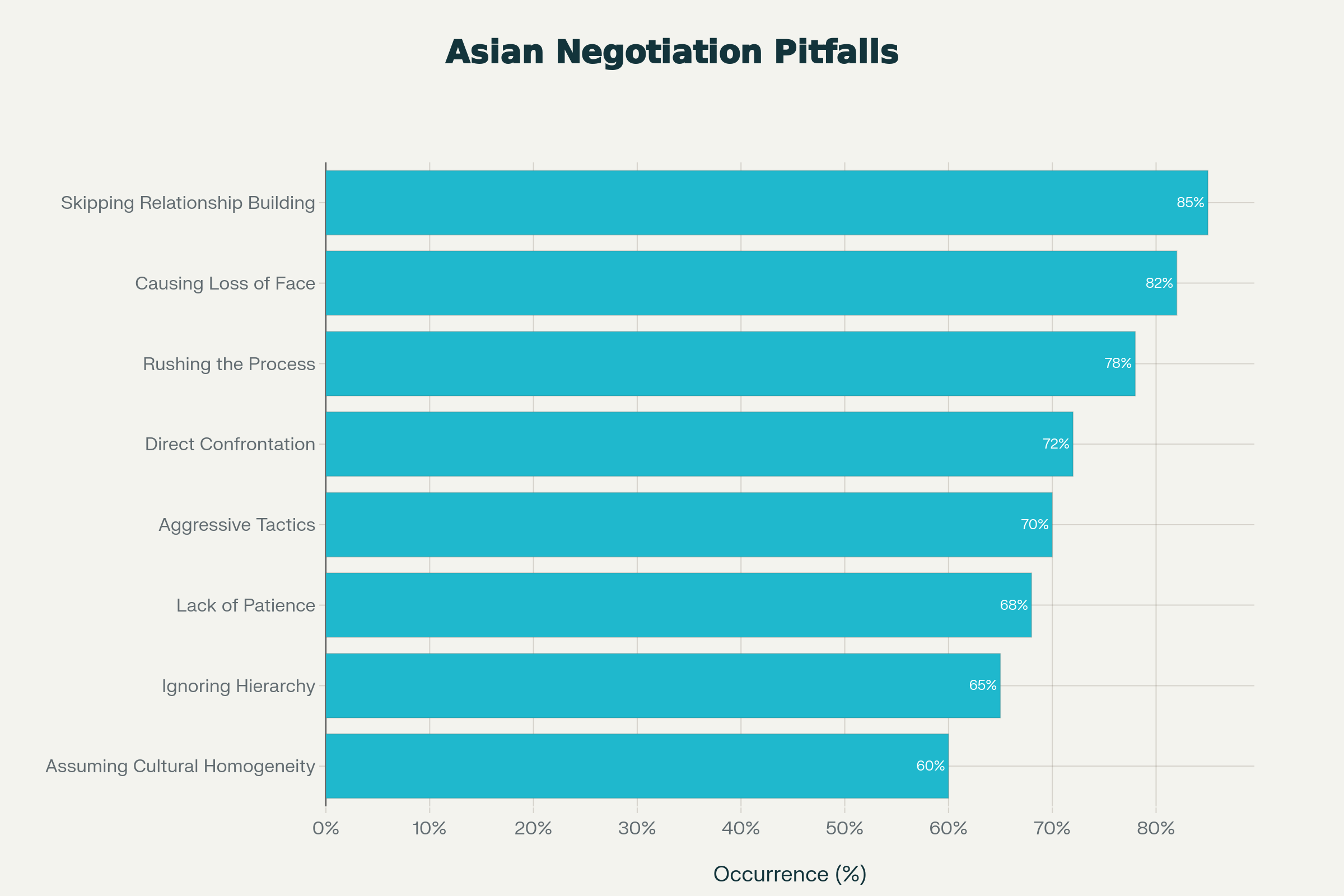
Eight common mistakes that derail business negotiations in Asian markets, with “Skipping Relationship Building” being the most frequent pitfall.
EXAMPLES | Market-by-Market Negotiation Nuances
China: Mastering Guanxi and Maintaining Face
Chinese business negotiations revolve around guanxi – networks of mutually beneficial relationships that facilitate business dealings. Building guanxi requires attending business dinners before negotiations begin, engaging in reciprocal favor exchanges, and demonstrating commitment to long-term mutual benefits rather than one-off transactions.
Face (miàn zi) represents dignity, honor, and social standing that must never be threatened. Never act in ways causing loss of face for yourself or others, discuss difficult topics privately rather than in group settings, and maintain diplomatic restraint even when frustrated. Negotiations can take place over extended periods because the goal extends beyond closing immediate deals to establishing foundations for future collaboration.
Key protocols: Use light handshakes with family name and title, present business cards with both hands, expect verbal agreements to carry less weight than relationship strength, and prepare for circular negotiation patterns where topics are raised, dropped, and revisited.
Japan: Navigating Nemawashi and Consensus
Japanese business culture emphasizes harmony (wa) and consensus-building through nemawashi, requiring 60-70% of project timelines dedicated to informal stakeholder alignment before formal meetings. The process involves at least three separate conversations with each key stakeholder to plant ideas, incorporate refinements, and harvest commitments.
Decision-making follows bottom-up consensus processes even within hierarchical corporations, with multiple working groups studying problems in detail to enable decisions based on perfect information. Patience is crucial as decisions are made collectively, and rushing the process appears disrespectful.
Key protocols: Exchange business cards with both hands and slight bow, use polite suffix -san with names, prepare for longer meetings with senior executives leading while junior members speak less, and understand that silence often communicates volumes.
South Korea: Respecting Hierarchy and Building Injeong
South Korean business hierarchy, strongly influenced by Confucian principles, emphasizes respect for elders and superiors in shaping all interactions and decision-making. The hierarchical structure dictates top-down decision-making with higher-ups making critical decisions and subordinates respecting them without much dissent.
Injeong – building and maintaining harmonious relationships within the hierarchy – is essential, as personal relationships often influence business decisions and partnerships. Employees seldom contradict superiors openly, valuing harmony and respectfulness above individual opinions.
Key protocols: Greet the most senior person first, address colleagues by official titles or surnames unless specified otherwise, expect final decisions to come from senior leadership even after junior staff provide input, and demonstrate patience as consensus builds across organizational levels.
Singapore: Balancing Efficiency with Relationship Building
Singapore blends Western business practices with Eastern cultural values, creating unique negotiation dynamics emphasizing long-term relationships over short-term gains. While punctuality is non-negotiable and meetings follow agendas, discussions can be circular with previously closed items returning to discussion as the group seeks consensus.
Decision-making requires approval from higher management, potentially taking longer than Western contexts, with written agreements highly valued to formalize verbal commitments. Singaporeans may not give outright “no” even when disagreeing, using phrases like “we’ll consider it” or “let’s discuss it further” to indicate hesitation.
Key protocols: Arrive punctually, exchange business cards using both hands, build relationships before serious business discussions, read between lines for indirect communication, and follow up meetings with written email summaries.
Vietnam: Cultivating Quan Hệ Through Patience
Vietnamese business culture emphasizes quan hệ – relationships and trust before transactions. Foreigners must dedicate time to cultivating genuine relationships before pushing for contracts, understanding that business represents an extension of personal relationships where rapport is essential.
Negotiations progress slowly with multiple layers of consultation and bureaucracy, requiring patience and persistence. When mutual connections or trusted referrals are involved, doors open more quickly and negotiations proceed more smoothly. Vietnamese negotiators view early transactions as investments in relationships, expecting that mutual trust will lead to more favorable arrangements over time.
Key protocols: Engage in small talk to create personal connections before business discussions, address names with Vietnamese structure, avoid aggressive tactics, extend negotiations as far as possible, and don’t expect decisions before dinner and drinks.
Thailand: Preserving Face and Maintaining Harmony
Thai business culture centers on face-saving where losing your temper in public shows poor upbringing and little self-control. Embarrassing someone publicly makes them lose face and can permanently damage business relationships.
Business interactions require keeping voices quiet and words sweet even when meaning differs, as emotional restraint is a sign of strength while emotional outbursts result in both parties losing face. Negotiations emphasize finding solutions in non-confrontational manners rather than pointing out problems bluntly.
Key protocols: Maintain calm and patient demeanor, address concerns privately with tact and kindness, use indirect language like “perhaps we could try another way” instead of direct criticism, demonstrate humility and non-boastfulness, and let people exit gracefully from difficult situations.
Malaysia: Respecting Diversity and Building Consensus
Malaysian business culture, shaped by Malay, Chinese, and Indian influences, follows hierarchical structures where seniority and titles are taken seriously with decisions often made by top-level management. While junior staff may be involved in early stages, final negotiations usually involve company directors or owners.
Relationship-building precedes business discussions, with time invested in asking about background, company history, or family fostering essential trust. Negotiations approach problems cooperatively rather than confrontationally, with aggressive tactics potentially backfiring and stalling progress.
Key protocols: Exchange business cards with both hands, begin meetings with personal rapport building, avoid pressuring for quick decisions, be mindful of prayer times for Muslim suppliers, position proposals as win-win opportunities, and clarify everything in writing post-meeting.
Philippines: Navigating Pakikisama and Hierarchy
Filipino business culture emphasizes pakikisama (harmony) and utang na loob (debt of gratitude), with employees valuing harmonious relationships while viewing loyalty to management as essential. The hierarchical nature means decision-making power concentrates at the top with senior managers playing significant roles.
Employees may hesitate to challenge decisions from higher authority as respect for hierarchy is ingrained culturally. Business practices thrive on strong relationships, polite communication, and values of trust and respect, with employees typically not addressing bosses by first names.
Key protocols: Use formal titles like “Sir” or “Ma’am” with last names, respect the top-down decision flow, invest time in building genuine personal connections, demonstrate patience as proposals move through hierarchies, and understand that decisions typically require senior executive approval.
Building Trust Before Talking Business
The most critical phase in Asian business negotiations occurs before any substantive business discussions begin. This relationship-building phase, which Western negotiators often underestimate or skip entirely, determines whether deals progress or stall indefinitely.
The Front-Loading Investment That Pays Exponential Returns
Research on Asian business relationships reveals that dedicating 6-10 weeks to relationship cultivation before substantive negotiations dramatically increases conversion rates and deal velocity once discussions begin. This investment involves multiple dinners, informal meetings, and social interactions where personal connections are established separate from transactional objectives.
In China, business dinners remain a central ritual with multiple courses and toasts that strengthen bonds, where guests wait until the host begins eating and declining toasts is seen as impolite. Japan emphasizes subtle courtesy with drinks poured for others never for oneself, and seating arrangements reflecting rank. These meals serve as safe spaces where honne (private feelings) can emerge away from the formal tatemae (public facade) that characterizes group settings.
Moving from Credibility to Trust to Partnership
A great product, star engineering team, and Western track record establish initial credibility, but converting credibility into trust and then trust into lasting relationships requires helping your Asian counterpart boost their reputation internally. This concept of “giving face” means positioning your partnership in ways that elevate your counterpart’s standing within their organization.
For semiconductor IP companies entering Asian markets, the pattern is consistent: early relationship-building goes smoothly based on technical credibility, but converting interest into closed deals requires sustained relationship investment that builds trust beyond technical capabilities. Companies that understand this invest in local presence, hire local talent, and build networks with government and business entities rather than attempting to manage relationships remotely.
The Role of Intermediaries and Local Partners
Intermediaries and consultants with extensive relationship networks prove pivotal for foreign businesses entering Asian markets. They act as bridges between businesses and local entities, helping navigate cultural intricacies and establishing necessary connections to facilitate business processes and negotiations.
In Singapore, where relationships are not yet established, using third-party liaisons helps intermediaries properly introduce both parties, creating foundations for slowly building better relationships. This approach provides warm introductions and guided communication strategies, with bilingual teams ensuring nuances of relationship-building aren’t lost in translation.
Navigating Hierarchy and Decision-Making Structures
Understanding organizational hierarchies and decision-making chains represents a non-negotiable competency for successfully closing deals across Asian markets. Misreading these structures leads to wasted time, damaged relationships, and stalled negotiations.
Identifying True Decision-Makers
Your primary negotiating counterparts frequently lack authority to make final commitments, serving instead as information gatherers and internal advocates who must build support through organizational hierarchies. In Japan, even senior executives rarely have power to make decisions single-handedly, with consensus decision-making requiring multiple working groups to study problems before determinations are made.
The practical implication is that sales cycles extend significantly beyond Western norms as proposals move up decision chains. In Malaysian business culture, while you may communicate with junior staff during early stages, final negotiations usually involve company directors or owners who hold ultimate approval authority.
Respecting Seniority Protocols
Meeting protocols reflect and reinforce hierarchical structures throughout Asian business cultures. In South Korea, it is customary to greet the most senior person first, with this respect for seniority extending to seating arrangements and dining etiquette. Interactions including discussions and greetings hinge on understanding one’s position within established hierarchies.
Southeast Asian negotiations feature careful seating arrangements where high-ranking participants sit with backs to walls facing doors, while negotiating partners of equal rank sit directly facing one another. These arrangements are not arbitrary but communicate respect for position and facilitate appropriate interaction patterns.
Building Consensus Across Organizational Layers
Reaching agreements in Asian markets typically results from group decisions involving experts alongside actual decision-makers who may lack specialized knowledge. Recommendations are discussed in groups within companies before being passed through hierarchical levels until the highest-ranking responsible person makes final decisions that employees accept without question.
This consensus-building process, while time-consuming, yields significant implementation benefits. When everyone involved has genuinely signed off through the nemawashi process, grounds for dispute disappear and implementation becomes swift and unified. Japanese companies report remarkably low rates of corporate litigation and high stakeholder loyalty precisely because consensus-building converts potential resisters into allies.
The Art of Face-Saving in Negotiations
The concept of “face” – maintaining dignity, respect, and reputation – fundamentally shapes communication patterns, feedback mechanisms, and negotiation tactics across Asian business cultures.
Reading Indirect Communication
High-context Asian cultures rely heavily on indirect signals, non-verbal cues, and implicit messaging that low-context Western negotiators frequently miss or misinterpret. In China and Japan, direct refusals are rare as business partners will say “no” without explicit rejection to allow face-saving for both parties.
A Chinese negotiator might use phrases like “that seems fairly all right” or “we’ll take a look” when they actually mean “no,” while Japanese counterparts might suggest “we’ll need to study this further” as polite rejection. Singaporeans may not give outright “no” even when disagreeing, instead using phrases like “we’ll consider it” or “let’s discuss it further” to indicate hesitation or disinterest.
Managing Disagreements Without Causing Loss of Face
Public disagreements or criticisms cause loss of face that can permanently damage relationships and derail negotiations. In Thai business culture, the worst action is losing your temper in public, as this shows poor upbringing and lack of self-control. Embarrassing someone publicly through teasing too sharply, pointing out mistakes, or voicing things they’ve done wrong makes them lose face.
The solution is addressing concerns privately with tact and kindness, using indirect language that highlights solutions rather than problems. Instead of “you did this wrong,” effective communicators say “perhaps we could try another way” or “let me suggest an alternative approach”. This maintains harmony while still allowing issues to be addressed and resolved.
Giving Face to Build Stronger Partnerships
“Giving face” represents the positive counterpart to avoiding loss of face, involving actions that elevate your counterpart’s dignity, status, and reputation. In Asian business contexts, this means positioning partnerships in ways that boost your counterpart’s standing within their organization, celebrating their contributions publicly, and acknowledging their expertise and guidance.
Small gestures carry significant weight: expressing appreciation during holidays and festivals, sending well-timed greetings for Lunar New Year or Hari Raya, and maintaining relationships through periodic check-ins beyond transactional touchpoints. These actions demonstrate that you value the relationship beyond immediate business benefits, reinforcing long-term partnership foundations.
Timing and Patience: The Hidden Success Factor
The temporal dimension of Asian business negotiations – how long processes take and why patience yields exponentially better outcomes – represents one of the most challenging adjustments for Western business professionals accustomed to shorter sales cycles.
Why Asian Negotiations Take 2.5x Longer
Asian business negotiations average 20 weeks from initial contact to closed deal compared to 8 weeks in Western markets. This extended timeline reflects fundamental cultural priorities: relationship-building precedes substantive discussions, consensus must be built across organizational hierarchies, and face-saving communication patterns require multiple interactions to surface genuine concerns.
Japan represents the longest commitment at approximately 30 weeks due to extensive nemawashi consensus-building processes. Vietnam follows at 24 weeks reflecting the importance of quan hệ relationship cultivation, while South Korea averages 20 weeks balancing hierarchical decision-making with somewhat faster modern business practices.
The Relationship Building Phase (6-10 Weeks)
The front-end investment in relationship cultivation before substantive business discussions begin typically spans 6-10 weeks across Asian markets. This phase involves multiple dinners, informal meetings, and social interactions where personal connections are established separate from transactional objectives.
Rushing this phase or attempting to skip it entirely is consistently identified as the most common and damaging pitfall in Asian business negotiations. Research shows 85% of deal failures stem from inadequate relationship-building, as Asian business partners will not proceed to substantive negotiations without established trust foundations.
The Negotiation and Consensus Phase (6-12 Weeks)
Once relationship foundations are established, substantive negotiations begin but follow patterns quite different from Western linear progressions. Negotiations take circular courses with topics raised, dropped, and picked up again at later stages, particularly for important and difficult subjects that could quickly lead to disagreement and disrupt harmony.
In Japan, the nemawashi process requires 60-70% of project timelines dedicated to informal stakeholder alignment before formal decisions. This involves multiple rounds of feedback incorporation and proposal refinement until all major stakeholders signal approval. While this extends timelines, it dramatically reduces implementation resistance and post-agreement disputes.
The Decision-Making Phase (4-8 Weeks)
Final decision-making requires proposals to move through organizational hierarchies to ultimate decision-makers who hold approval authority. In many Asian businesses, these decision processes involve extensive internal consultation where recommendations are passed through levels of hierarchy until senior leaders make determinations.
Strategic timing considerations can accelerate this phase. In Japan, starting technical discussions before summer breaks and reserving Q4 for building executive relationships can make substantial differences, with deals initiated in May receiving approvals 53% faster than those starting in November. Understanding these patterns allows better planning and expectation management.
Common Pitfalls That Kill Deals
Understanding what not to do proves as critical as mastering effective approaches. Research on failed cross-cultural negotiations reveals consistent patterns of mistakes that derail otherwise promising opportunities.
Pitfall 1: Rushing the Process
Pushing for quick closes in relationship-focused cultures represents the single most frequent tactical error. Asian negotiators often critique Western counterparts for hastiness, viewing rushed timelines as disrespectful and signaling lack of genuine commitment to long-term partnerships.
In Southeast Asian business cultures, negotiators know that Westerners often have tight schedules and use this knowledge to their advantage, sometimes not expressing actual concerns and demands until shortly before Westerners must depart. The counterpart feels pressure and becomes more likely to agree to compromises favoring the Asian partner.
Pitfall 2: Causing Loss of Face
Public criticism, direct confrontation, or actions causing embarrassment create permanent relationship damage that cannot be easily repaired. In Thai business culture, causing someone to lose face through public embarrassment ranks among the worst cultural violations, fundamentally undermining trust and harmony.
The failure cascade from face-loss extends beyond the immediate interaction. Tight-knit Asian business communities mean that reputations for cultural insensitivity spread rapidly through relationship networks, closing doors to future opportunities before conversations even begin.
Pitfall 3: Skipping Relationship Building
Attempting to dive directly into business discussions without adequate relationship cultivation represents the most common and lethal pitfall. The case study of Australian and Chinese business delegations illustrates this perfectly: despite shared objectives and genuine desire for collaboration, negotiations collapsed because Australians pushed for immediate business discussions while Chinese partners needed extended relationship development.
A UK software company’s nine-month failure to close any Japanese deals despite proven technology and competitive pricing demonstrates the consequences of inadequate relationship investment. Technical excellence and market competitiveness prove insufficient without the trust and rapport that can only be built through dedicated relationship cultivation.
Pitfall 4: Ignoring Hierarchy
Failing to identify true decision-makers, bypassing proper approval chains, or showing disrespect to seniority protocols wastes time and damages credibility. In South Korean business settings, employees seldom contradict superiors openly, meaning that attempting to negotiate directly with junior staff who lack authority proves futile.
The practical challenge is that your negotiating counterparts may be gracious and engaged without having authority to commit to anything substantive. Understanding this dynamic allows better strategizing about how to gain access to actual decision-makers through proper channels rather than attempting end-runs that offend hierarchical sensibilities.
Pitfall 5: Direct Confrontation
Aggressive negotiation tactics, ultimatums, or confrontational approaches backfire spectacularly in Asian business contexts valuing harmony and consensus. Malaysian negotiation culture views confrontation as counterproductive, preferring cooperative problem-solving where proposals are positioned as win-win opportunities.
In Vietnam, while negotiators are often flexible and open to creative solutions, aggressive tactics damage the relationship foundations that enable this flexibility. Suppliers who feel respected and valued go above and beyond to accommodate special requests, while buyers approaching negotiations with inflexibility or ultimatums find suppliers becoming equally rigid.
Pitfall 6: Assuming Cultural Homogeneity
Treating all Asian markets as identical represents a fundamental error given the vast differences in negotiation protocols, communication styles, and business practices across the region. Chinese guanxi-based relationships differ substantially from Japanese nemawashi consensus-building, which in turn differs from Vietnamese quan hệ trust cultivation and Thai face-saving protocols.
Singapore and Hong Kong blend Western and Eastern practices in unique ways that differ from practices in China, Japan, or Southeast Asia. The Philippines’ Spanish colonial influence and strong Catholic traditions create different cultural dynamics than Buddhist Thailand or Muslim-majority Malaysia. Effective negotiators invest time learning market-specific nuances rather than applying one-size-fits-all Asian approaches.
Pitfall 7: Lack of Patience
Expressing frustration with extended timelines, pressing for rapid decisions, or showing impatience signals disrespect and lack of genuine commitment. In Malaysian business culture, pressuring suppliers for rapid answers is viewed as rude or inconsiderate, as Malaysians prefer consensus-building where discussions go through multiple internal layers before decisions are made.
Vietnamese business culture emphasizes that patience demonstrates respect, with relationships developing through consistent orders, timely payments, and respectful communication over extended periods. Initial orders might not offer the best prices or terms as suppliers view early transactions as relationship investments expecting mutual trust to lead to more favorable arrangements over time.
Pitfall 8: Neglecting Follow-Through
Viewing signed contracts as endpoints rather than beginnings of ongoing relationships undermines the trust built during negotiations. The negotiation process doesn’t end when deals are signed; maintaining relationships through periodic check-ins, shared updates, and expressions of appreciation reinforces long-term trust.
Malaysian business culture values relationship maintenance through well-timed cultural gestures like sending holiday greetings during Hari Raya or Chinese New Year. These follow-ups ensure cultural gestures are appropriate and well-timed, demonstrating that you value the partnership beyond immediate transactional benefits.
Ready to Implement These Strategies?
Book a free 30-minute strategy session where we’ll audit your current growth approach and identify your highest-leverage opportunities in Asian markets.
Translating cultural understanding into practical action requires systematic frameworks that can be implemented by teams navigating Asian markets for the first time or seeking to improve their conversion rates.
Phase 1: Pre-Engagement Cultural Intelligence (Weeks 1-2)
Conduct market-specific cultural research identifying the key cultural dimensions, negotiation protocols, and business practices for your target market. This includes understanding whether you’re entering high-context or low-context communication cultures, individualist or collectivist societies, and high or low power distance organizational structures.
Engage local experts and advisors who can provide market intelligence, make warm introductions, and guide your approach to respect local norms. Intermediaries with extensive relationship networks act as bridges between your business and local entities, helping navigate cultural intricacies you cannot perceive from outside.
Develop culturally-adapted materials including business cards with local language, presentation decks that respect local communication preferences, and proposals structured to address local decision-making processes. Ensure your team understands proper business card exchange protocols, appropriate titles and forms of address, and seating arrangement significance.
Phase 2: Relationship Cultivation (Weeks 3-10)
Initiate contact through proper channels using introductions from mutual connections, respected intermediaries, or established relationship networks rather than cold outreach. In Asian markets, who introduces you carries significant weight in determining how your overture is received.
Invest in multiple informal interactions including business dinners, social meetings, and casual conversations where personal connections are established separate from transactional discussions. These interactions serve as safe spaces where genuine concerns and interests can emerge away from formal meeting constraints.
Demonstrate long-term commitment through actions that signal you’re investing in relationships rather than seeking quick transactional wins. This includes discussing your company’s long-term market vision, explaining how partnerships align with sustained presence rather than one-off deals, and showing genuine interest in your counterparts’ businesses and challenges.
Phase 3: Consensus-Building Negotiation (Weeks 11-20)
Structure discussions for consensus rather than persuasion recognizing that Asian negotiations aim to find common ground through iterative discussions rather than winning arguments. Present proposals as starting points for refinement rather than take-it-or-leave-it final offers.
Navigate hierarchy respectfully by ensuring senior members of your team engage with senior counterparts, using proper titles and forms of address, and avoiding attempts to bypass approval chains. Understand that your negotiating counterparts may need to build internal consensus before responding to proposals.
Practice active face-saving by addressing concerns privately, using indirect language that preserves dignity, and positioning feedback as collaborative refinement rather than criticism. Create opportunities for your counterparts to “give face” to you while you reciprocate, building mutual respect and trust.
Exercise strategic patience by accepting that negotiations take circular rather than linear paths, with topics being raised, dropped, and revisited as understanding deepens. Recognize that apparent delays often represent critical consensus-building activities happening within your counterpart’s organization.
Phase 4: Decision Facilitation (Weeks 21-25)
Support internal advocacy by providing your negotiating counterparts with materials, data, and messaging that help them build support within their organizations. Recognize that your counterparts are allies who must advocate for your partnership internally rather than adversaries to be overcome.
Confirm in writing all verbal agreements and understandings, providing clear documentation that supports accountability without suggesting mistrust. Malaysian business culture particularly values written confirmation for future reference.
Allow appropriate decision timelines without pressuring for premature commitments that could cause counterparts to lose face if they cannot deliver. Understand that decision processes involve multiple organizational layers and that patience at this stage prevents implementation problems later.
Phase 5: Post-Agreement Relationship Maintenance (Ongoing)
Treat signed agreements as relationship beginnings rather than endpoints, maintaining regular contact, sharing updates, and demonstrating ongoing investment in partnership success. In Asian business culture, contracts represent frameworks for ongoing collaboration rather than comprehensive specifications of all obligations.
Maintain cultural gestures including holiday greetings, periodic check-ins unrelated to immediate transactional needs, and celebrations of milestones in your partnership. These small but consistent actions reinforce that you value the relationship beyond business transactions.
Continue building depth in relationships through face-to-face visits when possible, involvement in local business communities, and genuine interest in your partners’ evolving needs and challenges. Companies that maintain relationship investments over time receive better terms, increased flexibility, and priority treatment as trusted partners.
Ready to Close Deals the Right Way
Success in Asian markets requires more than understanding cultural nuances intellectually – it demands systematic implementation of relationship-focused, culturally-intelligent approaches throughout every phase of the deal lifecycle.
The path forward involves three critical commitments:
Investing in cultural intelligence before entering markets, recognizing that front-loaded learning prevents costly mistakes and accelerates results once you begin negotiations.
Dedicating adequate time to relationship-building phases, accepting that 20-week timelines yield stronger partnerships and better terms than rushed 8-week attempts that sacrifice trust for speed.
Partnering with experts who understand local markets deeply, provide warm introductions, and guide your team through cultural complexities you cannot perceive from outside.
For companies serious about Asian expansion, the question is not whether to adapt to local business cultures but how quickly you can build the cultural competencies that separate successful market entrants from those who struggle indefinitely despite superior products and competitive pricing.
Frequently Asked Questions
1.How long should I expect the relationship-building phase to take before substantive negotiations begin?
The relationship-building phase typically requires 6-10 weeks of multiple dinners, informal meetings, and social interactions before substantive business discussions can productively begin. In Japan, this phase extends even longer with nemawashi consensus-building requiring 60-70% of total project timelines. Attempting to skip or rush this phase causes 85% of deal failures in Asian markets.
2. What are the most critical cultural differences between negotiating in China versus Japan versus Southeast Asia?
China emphasizes guanxi relationship networks and reciprocal favor exchanges with negotiations focused on long-term mutual benefits. Japan prioritizes nemawashi consensus-building requiring extensive informal stakeholder alignment before formal decisions, with bottom-up processes even in hierarchical corporations. Southeast Asian markets like Thailand and Vietnam blend relationship focus with strong face-saving protocols and hierarchical decision structures. Each market requires specific cultural adaptation rather than generic “Asian” approaches.
3. How can I tell if my Asian counterpart is actually saying "no" when they seem to be agreeing?
High-context Asian cultures use indirect communication where “no” is rarely stated explicitly. In China and Japan, phrases like “that seems fairly all right,” “let’s take a look,” or “we’ll need to study this further” often signal rejection while allowing face-saving. Singaporeans might say “we’ll consider it” or “let’s discuss it further” to indicate disinterest. Pay attention to non-verbal cues, body language, and the enthusiasm level in responses rather than taking polite phrases at face value.
4. What should I do if I accidentally cause someone to lose face during negotiations?
Immediately apologize softly and sincerely if you’ve caused discomfort, even if unintentionally. Address the situation privately rather than drawing additional public attention to the incident. Offer a face-saving explanation or graceful exit from the difficult situation without pressing further. Follow up with gestures that “give face” back to the person, such as public acknowledgment of their expertise or contributions. Understand that rebuilding trust after face-loss takes time and consistent demonstration of respect
5. How do I balance respecting hierarchies while still accessing true decision-makers?
Work through proper channels and intermediaries who can facilitate introductions to senior decision-makers while respecting organizational hierarchies. Ensure your team includes senior members who can appropriately engage with counterpart senior leaders, as peer-level interactions are expected in hierarchical cultures. Be patient as junior staff gather information and build internal support for your partnership before senior leaders engage in final decision-making. Never attempt to bypass established approval chains or go over your counterpart’s head, as this causes loss of face and damages relationships
6. Why do Asian negotiations seem to follow circular rather than linear patterns?
Negotiations in Asian markets take circular courses with topics raised, dropped, and picked up again at later stages because this approach allows face-saving discussion of difficult subjects that could quickly lead to disagreement. The circular pattern enables relationship deepening while consensus builds, with stakeholders learning more about counterparts and recognizing new aspects that could be expanded. This contrasts with Western linear progressions from point A to B to C, but proves highly effective for building sustainable partnerships where all parties genuinely commit rather than grudgingly acquiesce
Top Sources Utilized To Enriched The Article:
-
Harvard Program on Negotiation, How to Deal with Cultural Differences in Negotiation
-
ESSEC Knowledge, 5 Tips for Negotiating a Business Deal in Asia
-
CrossCulture Academy, Negotiating with Southeast Asian Business Partners
-
Globally Cool, Doing Business in Asia: 2025 Etiquette and Culture Guide
-
Eos Global Expansion, Understanding Cultural Nuances in Business Negotiations Across APAC
-
Sterlinx Global, The Power of Guanxi: A Strategic Guide to Scaling Your Business in China
-
GLOBIS, How Nemawashi Shapes Every Decision in Japan
-
The Nest Asia, Business Culture in Vietnam: Relationships and Trust
-
Silk Legal, Doing Business with Thais? Stop Offending Everyone!
-
TechUK, Success Through Relationships in Asia