
The economic gravity of the world is shifting East, but the graveyard of failed expansions is crowded. For every success story like Uniqlo or Grab, there are dozens of Western and mature-APAC companies that retreated after failing to crack the code of Emerging Asia.
The problem isn’t a lack of capital; it is a lack of context. Too many firms attempt to “copy-paste” strategies that worked in Singapore, London, or New York directly into Jakarta or Ho Chi Minh City. They overlook the hyper-local nuance of fragmented supply chains, informal trade networks, and distinct digital behaviors.
This article provides a validated, step-by-step market entry framework. We will move beyond high-level theory and give you the operational spine needed to build a strategy that survives first contact with the market.
KEY TAKEAWAYS
Don’t treat “Asia” as a monolith: Consumer behaviors in Jakarta are fundamentally different from those in Manila or Bangkok.
Localization > Translation: True localization means adapting your billing, pricing (PPP), and support channels, not just translating your landing page.
Partner, don’t just hire: In markets with high regulatory friction (like Indonesia), a local Joint Venture (JV) or strategic partner is often faster and safer than a Wholly Foreign-Owned Enterprise (WFOE).
If you only do one thing: Validate your “Value Proposition” locally before you invest in physical infrastructure. What is a “nice-to-have” in the West must be a “need-to-have” here to survive price sensitivity.
This is for you if:
-
You are a B2B or B2C company with established revenue in your home market.
-
You are targeting high-growth economies: Vietnam, Indonesia, Philippines, Thailand, or India.
-
You are willing to adapt product features or pricing models to fit local purchasing power.
This is NOT for you if:
-
You are an early-stage startup without product-market fit in your home country.
-
You are looking for a “remote-only” strategy (Emerging Asia relies heavily on high-touch relationships).
Before signing a lease or hiring a Country Manager, you must validate the macroeconomic tailwinds against your specific industry constraints.
What to measure:
Do not rely on general GDP data alone. You must look at the addressable growth relative to your sector.
The Economic Case:
According to the IMF’s October 2024 World Economic Outlook, Emerging and Developing Asia is projected to grow at roughly 5.0% in 2025, significantly outpacing advanced economies like the US (2.2%) and the Euro Area (1.2%).
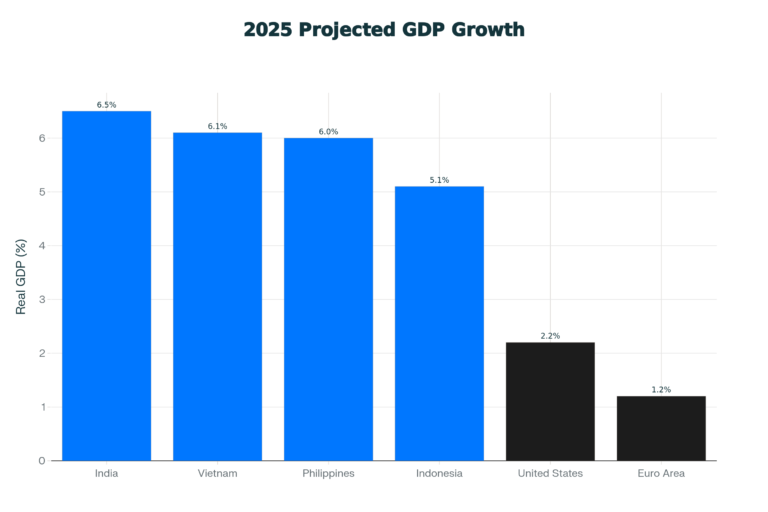
Real GDP Growth Projections (2025): Emerging Asia vs. Advanced Economies. Source: IMF World Economic Outlook (October 2024)
The Diagnosis Checklist:
| Metric | What to check | Red Flag |
|---|---|---|
| Regulatory Friction | Foreign Ownership Lists (Negative Investment Lists) | Your sector is closed to 100% foreign ownership (common in logistics/telecom). |
| Price Sensitivity | Local Purchasing Power Parity (PPP) | Your operational costs require a price point 3x above local competitors. |
| Digital Readiness | Digital Payment Adoption (e.g., QRIS in Indonesia, GCash in Philippines) | Your tech stack only accepts credit cards (low penetration in these markets). |
The Framework:
Product Localization:
Action: Adapt specifically for “mobile-first” environments. According to the e-Conomy SEA 2024 report (Google, Temasek, Bain), Southeast Asia is a mobile-centric economy. Desktop-heavy B2B interfaces often fail here.
Micro-SOP: Audit your UX bandwidth usage. In markets like the Philippines or Vietnam, data costs and internet speeds vary outside tier-1 cities. Ensure your app creates a “Lite” version if necessary.
Pricing & Payments:
Action: Move beyond USD billing immediately.
Why it works: Volatility in local currency exchange rates makes USD billing unpredictable for local SMEs.
Micro-SOP: Integrate local payment gateways (Midtrans in Indonesia, VNPAY in Vietnam) to build trust.
Execution in Emerging Asia is rarely a solo endeavor. The complex archipelago geography of Indonesia and the relational business culture of Vietnam necessitate partners.
The “Distributor vs. Direct” Decision Matrix:
Option A: Distributor / Agency Model
Pros: Fast market entry, low fixed costs, utilizes existing regulatory licenses.
Cons: Lower margin, loss of direct customer data, brand dilution risk.
Best for: CPG products, hardware, and initial market testing.
Option B: Joint Venture (JV)
Pros: Shared risk, immediate access to local government networks, compliant with “Negative Investment Lists.”
Cons: Complex governance, potential for culture clash, slower decision-making.
Best for: Infrastructure, heavy industry, and regulated fintech.
Option C: Wholly Foreign-Owned Enterprise (WFOE)
Pros: Full control, maximum margin retention, IP protection.
Cons: High capital requirement, slow setup (6–12 months), high compliance burden.
Best for: SaaS companies and consulting firms in open sectors.
Practitioner Insight: “In Vietnam, relationships (Guanxi in China, Quan he in Vietnam) are currency. A local partner doesn’t just sell for you; they navigate the unwritten bureaucratic gray zones that a foreign WFOE cannot touch.”
Scenario: A B2B HR-Tech SaaS (US-based) entering Indonesia.
Trigger: The company noticed 15% of their inbound traffic coming from Jakarta but had a 0% conversion rate to paid accounts.
Barrier: The product required credit card payment (subscription) and the UI was only in English. Most Indonesian SMEs prefer bank transfer or e-wallet payments and struggled with the English-only onboarding.
Solution:
Partnered with a local payroll consultant to act as a reseller (Distributor model).
Integrated a “Pay via Bank Transfer” feature.
Translated the “Employee Onboarding” module into Bahasa Indonesia.
Results (Year 1):
Conversion Rate: Increased from 0% to 3.2%.
Retention: Churn dropped by 40% due to local language support.
Time-to-Value: Reduced customer onboarding time from 3 weeks to 4 days.
Visualizing the Opportunity: The Digital Surge
Understanding the velocity of the market is crucial. The digital economy in Southeast Asia isn’t just growing; it is becoming the primary engine of commerce.
Insight: The e-Conomy SEA report highlights that e-commerce and digital financial services are the primary drivers. Your entry strategy must have a digital component, even if you sell physical goods.
Frequently Asked Questions
How long does it take to set up a legal entity in Vietnam or Indonesia?
It varies by structure, but generally, expect 3 to 6 months for a fully operational Wholly Foreign-Owned Enterprise (WFOE). A Representative Office (RO) is faster (6–8 weeks) but cannot generate revenue directly.
Should we hire a local Country Manager or send an Expat?
The most successful model is often a “Two-in-the-Box” approach: A local Country Manager (for sales, government relations, and culture) paired with a HQ liaison (for product knowledge and company culture). Relying 100% on an expat often leads to market blindness.
What is the biggest hidden cost in entering these markets?
Compliance and Logistics. In archipelago nations like the Philippines and Indonesia, last-mile delivery costs can be significantly higher than in Western markets. Additionally, tax compliance is complex and often requires retaining a local accounting firm.
Is it safe to invest in emerging Asian economies right now?
While currency fluctuation is a risk, the macroeconomic fundamentals are strong. With young demographics and rising middle-class consumption, the long-term ROI often outweighs short-term volatility—provided you hedge your currency exposure.