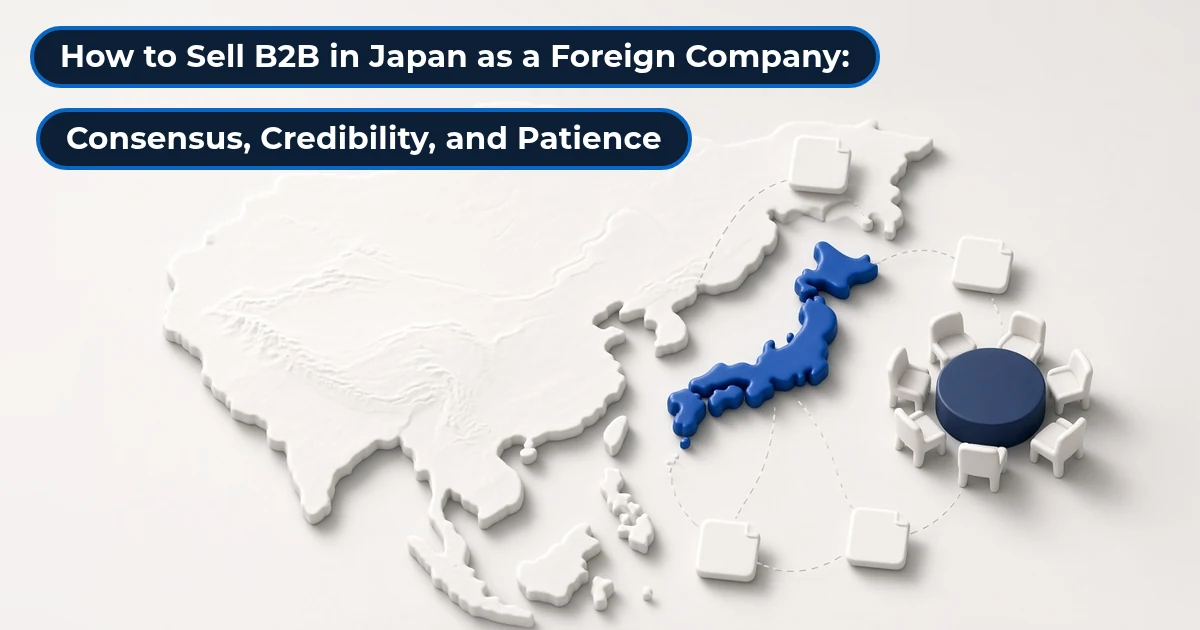
A practical guide for foreign B2B teams who want to win in Japan without rushing it
Your first meeting in Tokyo went well.
Everyone was polite. Everyone took notes.
There were eight people in the room.
You expected a decision.
You got a request for more documents—and another meeting.
If that sounds familiar, you have met the reality of B2B sales in Japan for foreign companies. Japan is one of the most sophisticated B2B markets in Asia. It rewards credibility, preparation, and patience. It punishes rushing.
Selling B2B in Japan usually means:
- more stakeholders in every decision;
- agreement built before the formal approval;
- detailed questions and documentation;
- Japanese-language support, even when your contact speaks English;
- long-term trust over quick wins.
Most foreign sales teams ask:
“How do we speed up the Japanese sales cycle?”
But for B2B companies entering Japan, the better question is:
“How do we help our buyer build internal agreement around us?”
Because in many Japanese companies, nobody decides alone.
A buyer in Singapore may sign after two meetings.
A buyer in Osaka may need every affected department on board first.
This guide builds on our pillar, Breaking Into Asia: 5 Critical Asia Expansion Mistakes, and our guide to relationship selling in Asia.
- TL;DR — Key Takeaways (our view)
- Japan decides by consensus. Nemawashi builds agreement; a ringi document makes it formal.
- Plan for more people and more time. Do not push for a decision in the meeting.
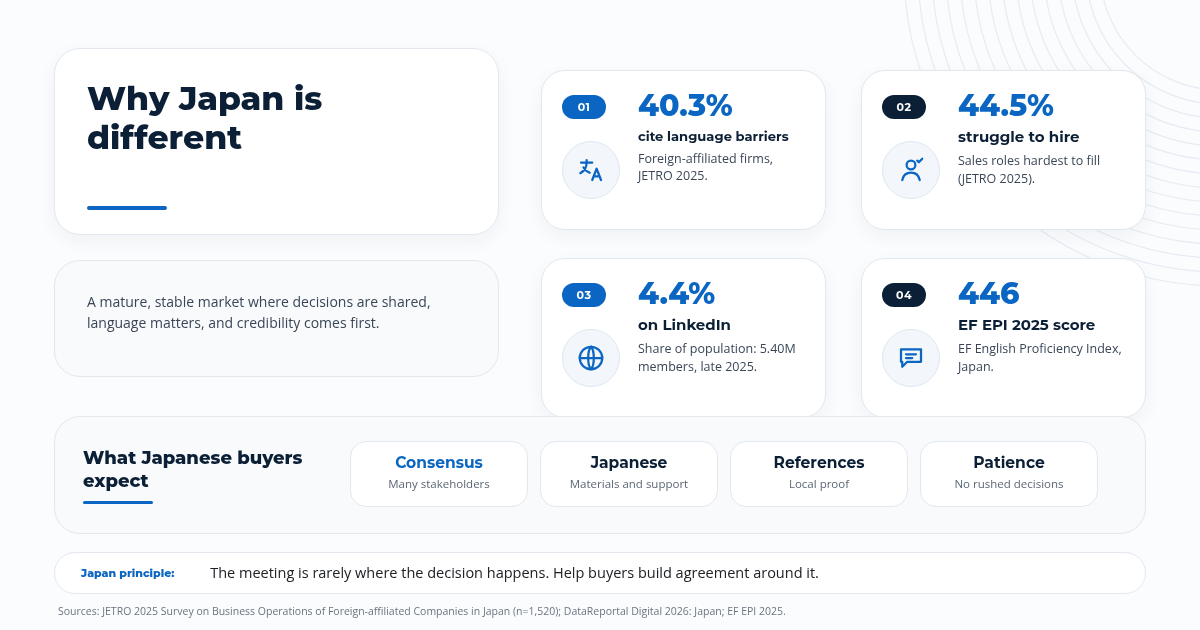
- Language support matters. Japan scored 446 in EF EPI 2025; 40.3% of foreign-affiliated firms in JETRO’s 2025 survey cite language barriers.
- Credibility comes first. Local references, Japanese documents, and support commitments.
- LinkedIn reach is limited. 4.4% of Japan’s population were members in late 2025.
- Hiring sales talent is hard. JETRO found sales roles the hardest to fill.
If you only do one thing: prepare a complete Japanese-language information pack before your first meeting.
Who This Guide Is For—and Who It Is Not For
This Guide Is For
- foreign B2B companies planning to enter Japan;
- sales leaders whose Japan pipeline moves slower than expected;
- regional managers in Singapore or Hong Kong covering Japan;
- B2B SaaS, technology, industrial, and services companies;
- founders deciding whether they need a Japanese partner;
- teams preparing for their first meetings with Japanese enterprises.
This guide is especially useful if your team is asking:
- Why are there so many people in our meetings?
- Why does nobody make a decision?
- Do we need to translate everything?
- Should we hire in Japan or work with a partner first?
This Guide Is Not For
- you need legal guidance on setting up a Japanese entity;
- you sell only to consumers;
- you want negotiation tactics only (see Cultural Nuances in Closing Deals Across Asia);
- you expect Japan to work like Singapore.
Practical fit check: if your Japan forecast assumes the same sales cycle as your home market, this guide is for you.
What B2B Sales in Japan Means for Foreign Companies
B2B sales in Japan for foreign companies means selling to Japanese businesses whose buying decisions are often consensus-based, documentation-heavy, and relationship-driven. In our experience, success depends less on a strong pitch and more on credibility, Japanese-language support, patient multi-level engagement, and helping buyers build internal agreement.
Two terms to know, as explained by the EU-Japan Centre for Industrial Cooperation:4
- Nemawashi: literally “digging around the roots”; informal, one-to-one conversations that build agreement before a formal decision;
- Ringi: a formal written proposal that circulates through departments for approval.
Selling in Japan vs. Selling in Many Western Markets (Our Comparison)
| Area | Many Western Markets | Japan (Often) |
|---|---|---|
| Who decides | A senior buyer or small group | Consensus across departments |
| Meeting purpose | Pitch and decide | Share information, gather questions |
| Speed | Weeks | Often longer, with more steps |
| Language | English usually fine | Japanese support usually needed |
| Proof expected | Case studies, ROI | Local references, detail, reliability |
| Risk of rushing | Lost momentum | Lost trust |
Practical Rule (our take)
In Japan, the meeting is rarely where the decision happens.
It happens in the conversations around it.
Why Japan Is Different for Foreign B2B Sellers
Reason 1 — Consensus-Driven Decisions
Nicolas Levitte, Founder & CEO of Expand In Asia, shared his own Japan experience at our masterclass. Working with a very large Japanese media company, his main contact spoke English. But decisions were consensus-driven, meetings included many people, and most participants were not fluent in English. He worked with a translator and with someone who had many years of experience doing business in Japan.
Reason 2 — Language and Communication
Reason 3 — Different Digital Channels
DataReportal’s Digital 2026 Japan report shows 5.40 million LinkedIn members in late 2025, equal to 4.4% of the population. LINE, a messaging app, had 99.0 million monthly active users, or 80.5%.2 In plain terms: the platform many foreign teams prospect on reaches a small share of Japan. Popularity of a messaging app is not permission to cold-message buyers there, though.
Reason 4 — Sales Talent Is Hard to Hire
JETRO’s 2025 survey found 44.5% of foreign-affiliated companies faced difficulties securing human resources, and sales-related positions were the hardest to fill, at over 60% of companies recruiting for them.1 That makes “just hire a Japanese sales rep” harder than it sounds.
Reason 5 — A Stable, Mature Market
The same survey found “social and economic stability/geopolitical stability” was the top attraction of Japan’s business environment for foreign-affiliated companies.1 Japan is worth the patience. It simply works differently.
Practical Rule (our take)
Japan is not slow.
It is thorough. Plan for that.
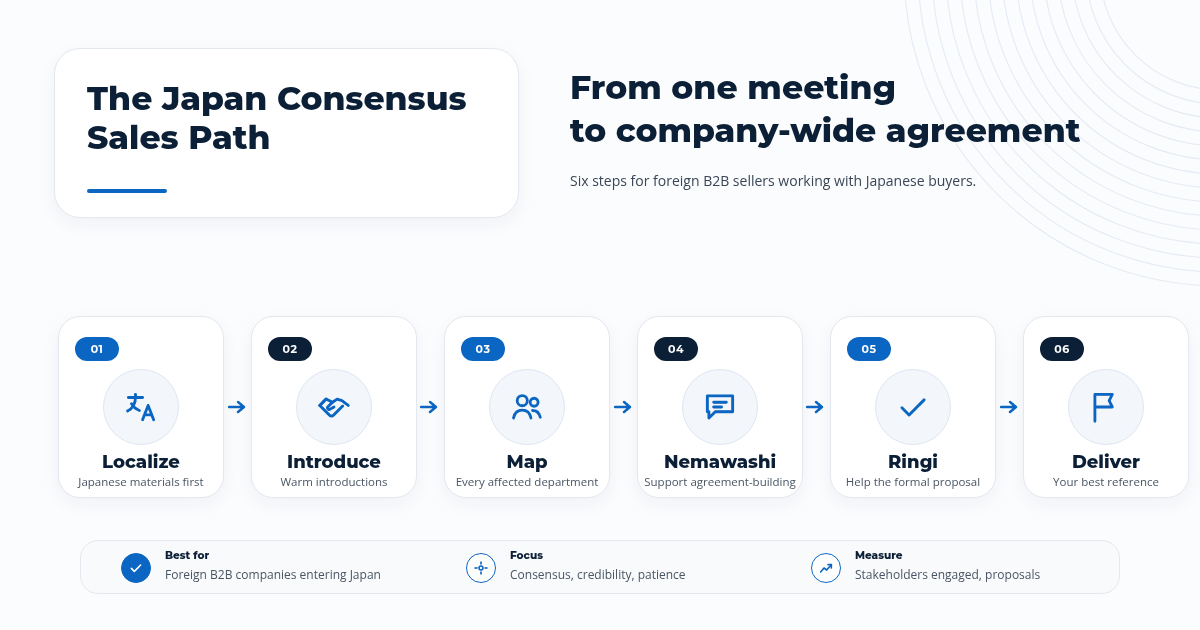
The Japan Consensus Sales Path
Our framework, the Japan Consensus Sales Path, organizes the work around how many Japanese buyers decide.
Step 1 — Localize Before You Approach
What to Prepare
- a Japanese-language company and product overview;
- Japanese case studies or references, if you have them;
- clear support, security, and service commitments in writing.
Why It Matters
In our experience, Japanese buyers often share your materials internally. If they are only in English, they may not travel far.
For the difference between translating and localizing, read Content Localization vs. Translation.
Step 2 — Get Introduced
What to Do
Use partners, existing clients, chambers of commerce, events, or local advisors to secure warm introductions.
Our View
A trusted introduction often opens doors faster than cold outreach in Japan.
Step 3 — Map the Stakeholders
What to Do
Identify every department affected by your product—users, IT, procurement, finance, management.
Relatable Example
If your software touches operations and IT, expect both teams in the room. Prepare for both sets of questions.
Step 4 — Support Nemawashi
What to Do
Make it easy for your contact to build agreement internally: short summaries in Japanese, answers to every department’s concerns, and patience between meetings.
What to Avoid
Pressing for a decision in a meeting. In our experience, it can make your contact look bad internally.
Step 5 — Help With the Formal Proposal
What to Do
Offer the information your contact needs for the formal approval document: costs, benefits, risks, implementation plan, references.
Why It Works (Our Experience)
You are helping your champion succeed inside their company. That builds trust.
Step 6 — Deliver and Stay Close
What to Do
After the deal, deliver exactly what you promised, keep regular contact, and ask for introductions once results are visible.
Practical Rule (our take)
In Japan, your first client is your most important reference.
Treat it that way.
Japanese Business Etiquette in Sales: The Practical Basics
These are common practices, described from our experience. Japanese companies vary, so follow your contact’s lead.
- Business cards: bring plenty; offer and receive them with both hands and read them before putting them away;
- Punctuality: arrive early;
- Seniority: match seniority where possible; if your contact brings a senior manager, bring yours;
- Documents: bring printed copies in Japanese;
- Follow-up: send a written summary of what was agreed;
- Silence: do not rush to fill pauses; people may be thinking.
- Names: use family names with “-san” unless your contact suggests otherwise;
- Email tone: formal and polite, with a clear subject and a short summary at the top;
- Decisions: never ask someone to commit on the spot in front of colleagues.
Practical Rule (our take)
When in doubt in Japan, be more formal, not less.
How Japanese Buyers Often Evaluate Foreign Suppliers
In our experience, Japanese B2B buyers look past the product demo. They want to know whether choosing a foreign supplier is a safe decision they can defend internally.
| What Buyers Often Check | What It Means for You (Our View) |
|---|---|
| Reliability | Clear delivery plans, realistic promises, no surprises |
| Support in Japan | Who answers questions, in Japanese, in Japan’s time zone |
| Track record | References in Japan or similar markets; how long you have operated |
| Data and security | Written answers on where data is stored and how it is protected |
| Long-term commitment | Signs you will still be in the market in five years |
| Price | Important, but rarely the first question |
Relatable Example
A Japanese operations manager who recommends you is putting their reputation on the line. Give them every document they need to defend that choice to colleagues.
Practical Rule (our take)
Sell certainty, not just capability.
A Realistic Japan Sales Process (Illustrative Stages)
Every company is different. These are the stages we often see in enterprise deals, not fixed timelines.
| Stage | What Happens | What You Do |
|---|---|---|
| First meeting | Information exchange, several attendees | Listen, take questions, share Japanese materials |
| Follow-up questions | Detailed written questions arrive | Answer fully and quickly, in Japanese |
| Department reviews | Other teams review internally | Offer separate sessions for IT, finance, users |
| Proposal preparation | Your contact drafts the internal proposal | Provide costs, risks, plan, and references |
| Formal approval | The proposal circulates for sign-off | Stay available; do not push |
| Pilot or first order | A small start to reduce risk | Deliver perfectly; agree on review points |
Our View
Many foreign teams see stages two to five as “delays.” They are the buying process.
Where to Find First Conversations in Japan
In our experience, these routes work better for first contact in Japan than cold LinkedIn messages:
- Introductions from existing clients, investors, or partners;
- Industry events and trade shows where buyers expect to meet new suppliers;
- Foreign chambers of commerce in Japan, which run networking and business events;
- JETRO’s support services, including the Invest Japan Business Support Center for foreign companies setting up in Japan;5
- Japanese-language outreach by phone and email, done respectfully and formally.
For channel planning beyond LinkedIn, read How to Reach B2B Decision-Makers in Asia Who Aren’t on LinkedIn.
Local Partner, Local Hire, or Remote? Choosing a Model for Japan
| Model | When It Can Fit (Our View) | Watch Out For |
|---|---|---|
| Remote outreach with Japanese-language support | Testing demand, first conversations | Limited trust without local presence |
| Local partner or distributor | Industries driven by introductions | Less control over the customer relationship |
| Japan-experienced advisor | Complex enterprise deals | Cost; finding the right person |
| Local sales hire | Proven demand, active pipeline | JETRO found sales roles hardest to fill |
Our View
Start by validating demand with Japanese-language support. Add local presence once buyers are engaged. See When Should You Hire a Local Sales Team in Asia?.
Mini Case Study: Selling to a Large Japanese Enterprise
These details come from Nicolas Levitte’s first-hand account at our masterclass. The company is not named.
Situation
As the regional head of a US media-technology company, he was selling to a very large Japanese media company.
Trigger
His main point of contact spoke English, so it looked like English would be enough.
Barrier
Inside that division, decisions were consensus-driven. Meetings included a fairly large number of people, and most of them were not fluent in English.
Solution
He worked with a translator and with a person who had many years of experience doing business in Japan.
Results (Speaker’s Account)
Meetings could include everyone who needed to be part of the decision, in their own language, with someone who understood how the organization worked.
Our Take
One English-speaking contact does not make an English-speaking buyer. Plan for the whole room.
Need Help Entering the Japanese Market?
Expand In Asia helps foreign B2B companies prepare for and test Japan through:
- market and segment prioritization;
- ICP definition (ICP: your ideal customer profile);
- localized buyer messaging;
- stakeholder mapping in target accounts;
- outreach and appointment setting;
- SDR execution (the people who run first outreach and book meetings);
- meeting preparation and follow-up support;
- market feedback before larger investments.
Common Mistakes Foreign Companies Make in Japan
Mistake 1 — English-Only Materials
Your contact may understand. Their colleagues may not.
Mistake 2 — Pushing for a Decision
It can break the consensus process—and the relationship.
Mistake 3 — Talking Only to One Person
Several departments usually need to agree.
Mistake 4 — Thin Proof
Global logos may not be enough. Local references carry weight.
Mistake 5 — Relying on LinkedIn
Coverage is limited. Use introductions and Japanese-language outreach.
Mistake 6 — Expecting Your Home-Market Cycle
Plan your forecast and budget for longer timelines.
Japan B2B Sales Readiness Scorecard
Score each area from 1 to 5. This is our own simplified framework, not an industry benchmark. For a broader check, take the free Asia Expansion Readiness Assessment Tool.
| Area | 1 — Weak | 3 — Developing | 5 — Strong |
|---|---|---|---|
| Japanese materials | None | Partly translated | Full localized pack |
| Language support | None | Ad hoc | Translator or Japanese-speaking team |
| Introductions | Cold only | Some | Partners and references |
| Stakeholder mapping | One contact | Some departments | All affected departments |
| Local references | None | Regional | Japanese clients |
| Proposal support | None | Basic | Ready-to-use approval content |
| Forecast realism | Home-market cycle | Adjusted | Japan-specific timelines |
| Post-sale delivery | Unclear | Basic | Clear commitments and contact |
Score Interpretation (Our Guidance)
| Total Score | What It Means |
|---|---|
| 34–40 | Well prepared for Japan. |
| 27–33 | Good base. Strengthen language and references. |
| 20–26 | Gaps likely to slow deals. Localize before outreach. |
| Below 20 | Not ready. Start with materials and language support. |
Need Help Planning Japan Alongside Other Markets?
Japan is often one market in a wider plan. Read our guide to a multi-country expansion strategy for Asia.
Next Steps With Expand In Asia
- Localize your materials into Japanese.
- Get introduced where you can.
- Map every stakeholder.
- Support consensus, do not rush it.
To go deeper:
- read the pillar guide, Breaking Into Asia: 5 Critical Asia Expansion Mistakes;
- read Cultural Nuances in Closing Deals Across Asia;
- read Content Localization vs. Translation.
Ready to Implement These Strategies?
Book a free 30-minute strategy session where we’ll audit your current growth approach and identify your highest-leverage opportunities in Asian markets.
Frequently Asked Questions
1. How do Japanese companies make B2B buying decisions?
Many larger Japanese companies decide by consensus. Informal one-to-one consultations, often called nemawashi, build agreement before a formal proposal, often called a ringi document, circulates for approval. In practice, this means more stakeholders, more meetings, and longer timelines than many foreign sellers expect.
2. Do you need a local partner to sell B2B in Japan?
Not always, but in our experience most foreign companies benefit from Japanese-language support and someone experienced in Japanese business. Nicolas Levitte, Founder & CEO of Expand In Asia, says he worked with a translator and a Japan-experienced advisor even when his main contact spoke English.
3. Is English enough for B2B sales in Japan?
Often not. Japan scored 446 in the EF English Proficiency Index 2025, and JETRO’s 2025 survey of foreign-affiliated companies lists language and communication barriers among the main challenges of doing business in Japan, cited by 40.3% of respondents.
4. Why do B2B sales cycles take longer in Japan?
In our experience, because consensus takes time. Several departments may need to agree, written proposals circulate for approval, and buyers expect detailed answers and proof. Pushing for a fast decision can damage trust.
5. Is LinkedIn effective for B2B prospecting in Japan?
It is limited. DataReportal’s Digital 2026 Japan report shows 5.40 million LinkedIn members in late 2025, equal to 4.4% of the population. In our experience, introductions, events, partners, and Japanese-language outreach often matter more.
6. What do Japanese B2B buyers expect from foreign suppliers?
In our experience: reliability, detailed documentation in Japanese, local references, clear support commitments, and patience. Japan is a mature, sophisticated market that often requires deeper localization and more credibility than other markets in the region.
7. How can Expand In Asia help with B2B sales in Japan?
Expand In Asia is a Singapore-based B2B outbound and market-entry partner. It helps foreign companies prioritize segments, prepare localized messaging, open first conversations with decision-makers, and gather market feedback before larger investments.
What surprised you most about selling in Japan? Share it in the comments or pass this guide to your Japan team.
About the author: Joel Berou is Asia Expansion & Revenue Growth Advisor at Expand In Asia, a Singapore-based B2B outbound and market-entry partner that helps companies build pipeline across Asian markets. This article draws on the October 2026 masterclass presented by Nicolas Levitte, Founder & CEO of Expand In Asia. Last updated: October 16, 2026.
Sources
-
JETRO (Japan External Trade Organization). 2025 Survey on Business Operations of Foreign-affiliated Companies in Japan (survey period 25 September–31 October 2025; 1,520 valid responses; published 2026). https://www.jetro.go.jp/ext_images/_News/releases/2026/f40d8720121d8e2a/survey_en_v3.pdf ↩↩↩
-
DataReportal (Kepios, Meltwater, We Are Social). Digital 2026: Japan (data as of October 2025). https://datareportal.com/reports/digital-2026-japan ↩
-
EF Education First. EF English Proficiency Index 2025. https://www.ef.com/wwen/epi/ ↩
-
EU-Japan Centre for Industrial Cooperation. From Understanding to Navigating Japanese Business Culture (2018). https://www.eu-japan.eu/sites/default/files/report_from_understanding_to_navigating_japanese_business_culture.pdf ↩
-
JETRO. Investing in Japan: JETRO’s Support (accessed 16 October 2026). https://www.jetro.go.jp/en/invest/ ↩