A practical guide for using AI to improve research, messaging, qualification, and outbound execution without sounding like everyone else
Generative AI has changed B2B prospecting fast.
Not slowly.
Fast.
A few years ago, building a good outbound campaign required hours of manual research, copywriting, list building, message testing, and CRM updating.
Today, sales teams can use AI to:
- summarize company websites;
- research target accounts;
- draft LinkedIn messages;
- personalize cold emails;
- analyze prospect signals;
- score leads;
- prepare discovery questions;
- generate follow-up ideas;
- support SDR coaching;
- clean CRM notes;
- identify buying committee gaps.
That is powerful.
But it also creates a new problem.
When every sales team uses the same AI tools, prospects start receiving messages that sound the same.
This is especially important in Singapore and Southeast Asia, where buyers already receive high volumes of outreach from vendors entering the region. AI can help teams move faster, but speed without relevance can damage trust.
McKinsey’s 2025 State of AI research describes wider AI use and growing interest in agentic AI, but also notes that many companies still struggle to move from pilots to scaled business impact. For sales teams, that means AI is no longer a novelty. The real question is whether it improves the quality of prospecting, not just the quantity.
In Singapore, AI is also becoming a national and enterprise priority. Reuters reported that Singapore will invest over S$1 billion in public AI research through 2030, including responsible and resource-efficient AI, talent development, and industry adoption. ASEAN has also published an expanded guide on AI governance and ethics for generative AI, highlighting both the opportunities and risks of GenAI adoption across the region.
For B2B teams prospecting into Singapore and Southeast Asia, the message is clear:
Generative AI can improve prospecting, but only if it is used with strategy, local context, and human judgment.
This guide explains how generative AI is changing B2B prospecting in Singapore and SEA, where it helps most, where it can hurt, and how sales teams should use it without becoming generic.
- TL;DR — Key Takeaways
- Speed is not the same as relevance. AI-generated outreach can quickly become generic if teams do not add market context, buyer insight, and human judgment.
- Singapore and SEA require localization. Messages that work in the US, UK, or Europe may not work in Singapore, Indonesia, Vietnam, Malaysia, Thailand, or the Philippines.
- AI is strongest as a research and workflow assistant. It helps with account summaries, persona mapping, segmentation, objection prep, and follow-up ideas.
- AI is weakest when used as a full replacement for sales thinking. If AI writes every message with no human editing, outreach will sound templated.
- The best teams use AI to improve quality, not just volume.
- Governance matters. B2B teams should avoid sensitive-data misuse, hallucinated claims, fake personalization, and over-automation.
If you only do one thing: use AI to prepare better human conversations, not to send more generic messages faster.
Who This Guide Is For—and Who It Is Not For
This Guide Is For
- B2B companies prospecting into Singapore and Southeast Asia.
- SaaS, cybersecurity, cloud, fintech, HR tech, healthtech, AI, data, managed services, and professional-services companies.
- Founders and CEOs entering Asian markets.
- CROs and sales leaders improving outbound performance.
- SDR and BDR teams using AI tools for research, personalization, and follow-up.
- RevOps teams building AI-assisted workflows.
- Marketing teams supporting sales with account intelligence.
- GTM teams trying to avoid generic AI outreach.
This guide is especially useful if your team is asking:
- How should we use generative AI for prospecting?
- Can AI improve outbound sales in Singapore?
- How do we personalize at scale without sounding fake?
- What parts of prospecting should AI handle?
- What parts should humans still own?
- How do we avoid AI-generated spam?
- How do we use AI responsibly across Southeast Asian markets?
This Guide Is Not For
This guide may be less useful if:
- your company wants fully automated spam campaigns;
- your team has no clear ICP;
- you do not review AI-generated output;
- your sales team is not trained to validate AI research;
- your market-entry strategy is still undefined;
- you want AI to replace relationship-building.
Practical fit check: AI works best when your prospecting strategy is already clear. It will not fix weak targeting, weak positioning, or poor follow-up.
What Generative AI Means for B2B Prospecting
Generative AI refers to AI systems that can create new text, summaries, drafts, ideas, analysis, and recommendations based on prompts and data.
In B2B prospecting, generative AI can support tasks such as:
- writing email drafts;
- creating LinkedIn message variations;
- summarizing company websites;
- extracting possible buyer pains;
- building account briefs;
- identifying possible triggers;
- drafting call scripts;
- preparing discovery questions;
- creating follow-up notes;
- generating campaign angles.
Traditional Prospecting vs. AI-Assisted Prospecting
| Area | Traditional Prospecting | AI-Assisted Prospecting |
|---|---|---|
| Account research | Manual website and LinkedIn review | AI-generated account summaries |
| Message drafting | Written from scratch | Drafted faster with human editing |
| Segmentation | Manual tagging | AI-assisted clustering |
| Lead qualification | Rep judgment only | Rep judgment plus AI scoring inputs |
| Follow-up | Based on memory or notes | AI-generated follow-up suggestions |
| CRM updates | Manual and often incomplete | Summaries and structured notes |
| Coaching | Manager review only | AI-assisted pattern review |
AI does not remove the need for sales skill.
It changes where sales skill is applied.

Why AI Matters for Singapore and SEA Prospecting
Singapore and Southeast Asia are attractive markets for B2B companies because of regional business activity, digital adoption, and cross-border expansion opportunities.
But prospecting across the region is complex.
Why Prospecting Is Hard in SEA
B2B teams must deal with:
- different languages;
- different buyer maturity levels;
- different business cultures;
- different procurement expectations;
- different local proof requirements;
- different levels of category awareness;
- different levels of trust in foreign vendors;
- regional HQ and local decision-maker differences.
A message that works in Singapore may not work in Indonesia.
A message that works in the Philippines may not work in Vietnam.
A message that works in Australia may sound too casual in Japan or Korea.
AI can help organize these differences.
But it cannot fully understand local nuance unless humans train, guide, and review the process.
For broader market-entry planning, read Go-to-Market (GTM) Strategies for Asia.
Where AI Helps Most in B2B Prospecting
Generative AI helps most when it supports specific, repeatable prospecting tasks.
Best AI Prospecting Use Cases
| Use Case | AI Value | Human Role |
|---|---|---|
| Account research | Summarizes companies quickly | Validate and interpret |
| Persona mapping | Suggests likely stakeholders | Confirm decision roles |
| Message drafting | Creates first drafts | Rewrite for tone and relevance |
| Lead scoring | Highlights possible fit signals | Apply commercial judgment |
| Follow-up | Suggests next angles | Choose the right timing |
| Objection prep | Lists possible objections | Adapt to actual buyer context |
| CRM summaries | Reduces admin time | Check accuracy |
| Campaign testing | Creates variations | Measure and refine |
Practical Rule
Use AI for preparation.
Use humans for judgment.
Use Case 1 — Account Research and Segmentation
One of the strongest AI use cases is account research.
Instead of manually reading every website, sales teams can use AI to summarize:
- what the company does;
- who they sell to;
- where they operate;
- possible growth signals;
- relevant buyer personas;
- likely pain points;
- possible market-entry triggers;
- potential reasons to care.
Example Prompt
Summarize this company’s business model, likely target customers, recent growth signals, and possible reasons they may need help building B2B pipeline in Southeast Asia.
How This Helps
AI can help sales teams move from:
“Who is this company?”
to:
“Why might this company care about our offer?”
What Humans Must Check
AI can be wrong.
Sales teams should verify:
- company facts;
- funding or expansion claims;
- leadership names;
- geography;
- customer segments;
- recent announcements;
- ICP fit.
Asia-Specific Application
AI can help segment accounts by:
- Singapore regional HQ;
- companies expanding into ASEAN;
- companies hiring APAC sales roles;
- SaaS companies targeting enterprise buyers;
- firms entering Indonesia, Vietnam, or the Philippines;
- companies with regional partner strategies.
For early-market pipeline planning, read Building a B2B Sales Pipeline from Zero in a New Asian Market.
Use Case 2 — Persona and Buying Committee Mapping
B2B prospecting often fails because teams contact only one person.
AI can help identify possible buying committee roles.
Possible Buying Committee Roles
| Role | Why They Matter |
|---|---|
| CEO / founder | Strategic expansion decision |
| CRO / VP Sales | Pipeline and revenue ownership |
| CMO / demand leader | Demand generation and messaging |
| Head of APAC | Regional market-entry ownership |
| SDR / BDR leader | Outbound execution |
| RevOps | CRM, workflows, data, reporting |
| Partnerships leader | Local channel strategy |
| Finance | Budget and ROI review |
| Country manager | Local market execution |
AI Can Help With
- role prioritization;
- persona-specific pain points;
- likely objections;
- different message angles;
- discovery questions by role;
- stakeholder mapping.
Human Judgment Still Matters
AI may suggest roles that do not apply.
A sales leader must still ask:
- who owns the problem?
- who controls budget?
- who feels the pain?
- who can block the deal?
- who needs to be educated?
- who should be contacted first?
For account-based selling ideas, the blog Account-Based Selling (ABS) for B2B Companies in Asia is a suitable follow-on internal read.
Use Case 3 — Outreach Message Drafting
This is where many teams start using AI.
It is also where many teams make the biggest mistake.
AI can write a first draft quickly.
But AI-written messages often sound:
- polished but generic;
- confident but vague;
- personalized but fake;
- relevant on the surface but not insightful;
- similar to every other AI-generated message.
Weak AI Outreach
Hi [Name], I noticed your company is growing and thought our solution could help you improve sales efficiency. Would you be open to a quick call?
This sounds like thousands of other messages.
Stronger AI-Assisted Outreach
Hi [Name], noticed [Company] is building more regional visibility across Southeast Asia. A common challenge we see at this stage is separating “market interest” from qualified pipeline before committing to local sales hires.
Curious if your team is already validating ASEAN pipeline, or if that is still on the roadmap?
This is better because it includes:
- context;
- a realistic business problem;
- a market-specific angle;
- a low-pressure question.
Practical Rule
Let AI draft.
Let humans sharpen.
Use Case 4 — Lead Qualification and Prioritization
AI can help identify which prospects deserve attention.
This does not mean AI should replace qualification.
It means AI can support it.
AI-Assisted Qualification Signals
| Signal | Example |
|---|---|
| Company fit | Industry, size, business model |
| Geography | Singapore, SEA, APAC presence |
| Trigger | Funding, hiring, expansion, event, new product |
| Persona fit | Sales, marketing, GTM, expansion ownership |
| Problem fit | Need for pipeline, localization, market validation |
| Timing | Recent announcement or strategic initiative |
| Engagement | Reply, click, webinar attendance, content view |
Why This Matters
A sales team should not spend equal effort on every lead.
AI can help rank accounts based on visible signals.
But the sales team must still validate whether the account has:
- real pain;
- budget;
- timing;
- decision authority;
- internal urgency;
- market relevance.
For a deeper related topic, read How AI is Transforming Lead Qualification in B2B Sales Pipelines.
Use Case 5 — Follow-Up and Objection Handling
Most prospecting does not convert on the first touch.
Follow-up matters.
AI can help create follow-up ideas based on:
- the prospect’s role;
- the original message;
- the buyer’s likely objection;
- the account’s market;
- previous engagement;
- recent trigger events.
Follow-Up Examples
If the Prospect Accepted a LinkedIn Request
Thanks for connecting, [Name]. I’m interested in how teams like yours are thinking about Southeast Asia pipeline before adding local headcount. No pitch here — just curious if ASEAN expansion is already active for your team or still early-stage.
If the Prospect Did Not Reply
Quick follow-up, [Name]. The reason I asked is that many B2B teams entering SEA underestimate the gap between market interest and sales-qualified meetings. Usually worth validating before hiring locally.
If the Prospect Says “Not Now”
Makes sense. If timing is early, the useful question may be less “do you need sales support now?” and more “what signal would tell you the market is ready?” Happy to share a simple validation framework if useful.
AI can draft these.
Humans should decide which one feels appropriate.
Use Case 6 — CRM Notes, Summaries, and Sales Productivity
Generative AI can reduce sales admin.
This is valuable because SDRs and AEs often lose time to:
- manual CRM updates;
- call summaries;
- meeting notes;
- follow-up writing;
- account research;
- handoff documentation.
AI Can Help Create
- call summaries;
- next-step notes;
- opportunity summaries;
- CRM field suggestions;
- follow-up emails;
- account briefs;
- sales handoff notes;
- objection summaries.
McKinsey’s research on the economic potential of generative AI estimated that generative AI could increase sales productivity by approximately 3% to 5% of current global sales expenditures, depending on implementation and use case.
Practical Rule
Use AI to reduce admin.
Do not use AI to reduce accountability.
A rep still owns the quality of the note, the next step, and the customer context.
What AI Should Not Replace
AI should not replace:
- real buyer research;
- market understanding;
- sales judgment;
- human conversation;
- local nuance;
- ethical decision-making;
- relationship-building;
- proof validation;
- commercial qualification;
- strategic prioritization.
Why This Matters in Asia
In many Asian markets, trust is built through:
- relevance;
- patience;
- credibility;
- referrals;
- market understanding;
- respectful communication;
- proof of commitment.
AI can help prepare for that.
It cannot fully replace that.
Common AI Prospecting Mistakes
Renewal readiness measures whether the customer has enough value, adoption, support, and stakeholder alignment to renew confidently.
Renewal Readiness Inputs
- product usage;
- value achieved;
- stakeholder coverage;
- support experience;
- unresolved risks;
- procurement timeline;
- budget status;
- champion strength;
- executive sponsor engagement;
- customer health score.
Practical Rule
Renewal readiness should be reviewed long before the renewal date.
Suggested cadence:
Mistake 1 — Sending AI Drafts Without Editing
This creates generic outreach.
Mistake 2 — Fake Personalization
Mentioning a random company fact is not real relevance.
Mistake 3 — Over-Automating LinkedIn
Too many automated messages can damage brand reputation.
Mistake 4 — Using One Prompt for Every Market
Singapore, Indonesia, Vietnam, Malaysia, Thailand, and the Philippines should not all receive the same angle.
Mistake 5 — Trusting AI Research Without Verification
AI can hallucinate.
Always verify important facts.
Mistake 6 — Measuring Only Volume
More messages do not mean better pipeline.
Mistake 7 — No Governance
Teams need rules on what data can be used, what claims can be made, and what humans must review.
ASEAN’s generative AI governance guide highlights the need for risk-aware use of GenAI and recommends that ASEAN member states apply governance recommendations on a voluntary basis.
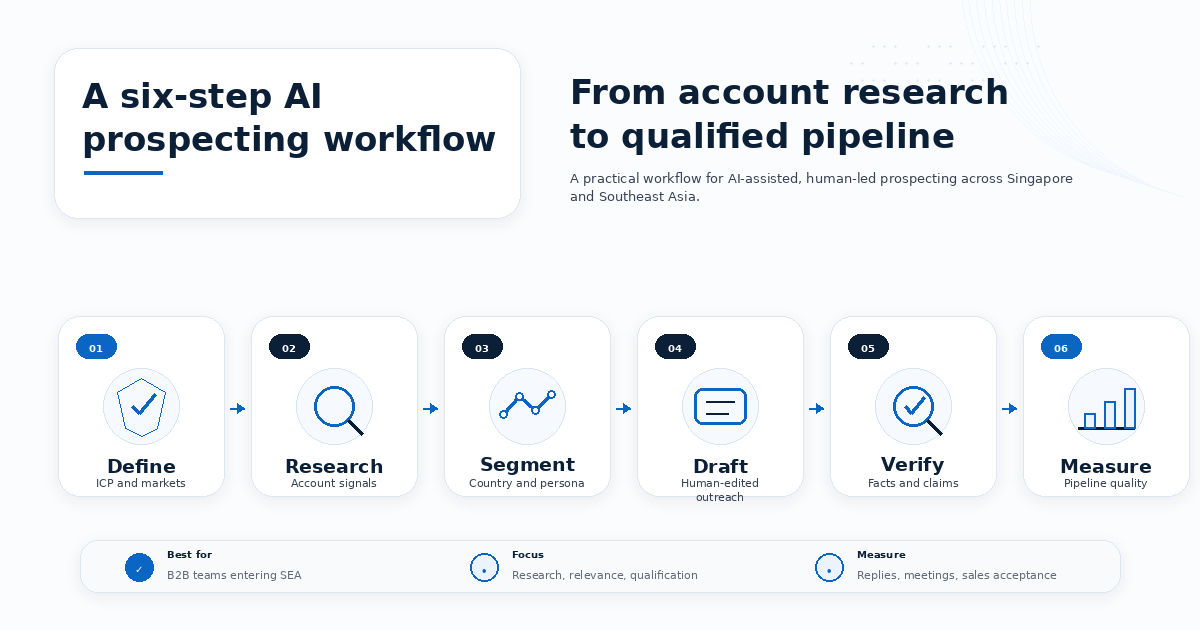
AI Prospecting Workflow for Singapore and SEA
Use this six-step workflow.
Step 1 — Define ICP
Clarify:
- target markets;
- target industries;
- company size;
- buyer roles;
- pain points;
- triggers;
- disqualification criteria.
Step 2 — Research Accounts
Use AI to summarize and organize account information.
Validate important facts manually.
Step 3 — Segment by Market
Separate accounts by:
- Singapore regional HQ;
- Indonesia local market;
- Vietnam growth market;
- Philippines delivery or support hub;
- Malaysia or Thailand expansion;
- wider ASEAN relevance.
Step 4 — Draft Messaging
Use AI to create first drafts by persona and market.
Then edit for:
- tone;
- specificity;
- local relevance;
- commercial clarity;
- human feel.
Step 5 — Qualify and Prioritize
Use AI to support lead scoring.
Use human judgment to confirm fit, urgency, and next step.
Step 6 — Learn and Improve
Track:
- positive replies;
- meetings held;
- sales acceptance;
- objections;
- market feedback;
- conversion by country;
- AI-assisted vs. human-edited message performance.
AI Prospecting Scorecard
Score each area from 1 to 5.
| Area | 1 — Weak | 3 — Developing | 5 — Strong |
|---|---|---|---|
| ICP clarity | Broad target market | Basic ICP by segment | Clear ICP by country, role, trigger, and disqualification criteria |
| Account research | Manual and inconsistent | AI summaries used | AI-assisted research validated by humans |
| Market segmentation | One SEA message | Basic country split | Country-specific messaging and prioritization |
| Persona mapping | One buyer persona | Some persona variations | Buying committee mapped by role and influence |
| Message quality | AI draft sent as-is | Human edits applied | Market-specific, human-sounding, insight-led outreach |
| Lead qualification | Every reply treated equally | Basic scoring | Fit, timing, urgency, role, and market signal reviewed |
| Follow-up quality | Generic follow-ups | Some personalization | Contextual follow-up based on role, market, and engagement |
| CRM workflow | Manual notes | Some AI summaries | Structured AI-assisted notes with human validation |
| Governance | No AI rules | Informal review | Clear rules on data, claims, approvals, and human review |
| Measurement | Volume tracked only | Replies and meetings tracked | Pipeline quality, sales acceptance, and market learning tracked |
Score Interpretation
| Total Score | Recommendation |
|---|---|
| 42–50 | Strong AI-assisted prospecting system; optimize by market and persona |
| 34–41 | Good foundation; improve governance, segmentation, or message quality |
| 25–33 | AI is helping activity, but may not yet improve pipeline quality |
| Below 25 | Rebuild targeting, messaging, and AI review process before scaling |
Need Help Building AI-Assisted Prospecting That Still Feels Human?
Expand In Asia helps B2B companies build market-ready prospecting systems across Asia through:
- ICP and account research;
- localized buyer messaging;
- LinkedIn and email outreach;
- SDR/BDR execution;
- appointment setting;
- lead qualification;
- market feedback loops;
- pipeline reporting.
Talk to Expand In Asia about building AI-supported, human-led prospecting systems in Singapore and Southeast Asia →
Next Steps With Expand In Asia
Generative AI is changing B2B prospecting in Singapore and SEA.
But the best teams are not simply using AI to send more messages.
They are using AI to:
- research better;
- segment smarter;
- personalize more carefully;
- qualify faster;
- follow up with better context;
- reduce sales admin;
- learn from market feedback.
The teams that win will not be the ones that automate the most.
They will be the ones that combine AI speed with human relevance.
For broader market-entry planning, read Go-to-Market (GTM) Strategies for Asia.
For AI and qualification specifically, read How AI is Transforming Lead Qualification in B2B Sales Pipelines.
For building early pipeline in a new market, read Building a B2B Sales Pipeline from Zero in a New Asian Market.
For improving deal progression after prospects engage, read How to Shorten Your B2B Sales Cycle in Singapore and SEA.
Schedule a consultation with Expand In Asia →
Ready to Implement These Strategies?
Book a free 30-minute strategy session where we’ll audit your current growth approach and identify your highest-leverage opportunities in Asian markets.
Frequently Asked Questions
1. How is generative AI used in B2B prospecting?
Generative AI can help with account research, company summaries, persona mapping, message drafting, follow-up ideas, lead scoring, objection preparation, CRM notes, and sales call summaries.
2. Can AI replace SDRs or BDRs?
Not fully. AI can support research, drafting, prioritization, and admin tasks, but SDRs and BDRs still need to validate information, interpret buyer context, build trust, qualify opportunities, and handle conversations.
3. Why does AI prospecting often sound generic?
AI often uses common patterns, safe phrasing, and generic business language unless the user provides strong context, clear ICP, market-specific prompts, and human editing.
4. Is AI useful for prospecting in Singapore?
Yes. AI can help research accounts, identify regional expansion signals, draft relevant messaging, and prepare better outreach. But Singapore buyers often expect clarity, commercial relevance, and proof, so messages still need human editing.
5. How should B2B teams use AI across Southeast Asia?
Use AI to support country-specific research, segmentation, messaging, and follow-up. Avoid using one generic SEA campaign across every market.
6. What are the risks of AI prospecting?
Risks include hallucinated facts, fake personalization, privacy issues, over-automation, generic messaging, inaccurate lead scoring, and damaged brand trust.
7. What should sales leaders measure?
Measure positive replies, meetings held, sales acceptance, opportunity creation, pipeline quality, market feedback, objection patterns, and performance by country and persona.