A practical guide for turning customer trust into warm introductions, better sales conversations, and qualified pipeline
Referrals are one of the most powerful growth channels in B2B.
But in Asia, they are not something you can force.
They must be earned.
A happy customer may like your product.
A satisfied client may renew.
A strong champion may speak well of you internally.
But that does not automatically mean they will introduce you to another company.
Referral programs fail when they treat advocacy like a transaction.
They work better when they are built around trust, timing, relevance, and respect.
This matters even more in Asian markets, where business relationships, reputation, personal trust, and warm introductions can strongly influence whether a new conversation starts at all.
Referrals are widely recognized as a high-quality source of B2B pipeline. Referral Rock’s B2B referral statistics summary cites data showing that 82% of sales leaders believe referrals are vital to sales success, 71% of B2B professionals report higher conversion rates from referrals, and 69% say referred leads close faster than other leads.
At the same time, advocacy cannot be left to chance. Forrester has described customer advocacy technology as moving B2B advocacy from “random acts of references” into more strategic engagement with advocate storytellers.
That is the key point.
A referral program should not be a random favor asked at the end of a good meeting.
It should be a structured, respectful system for identifying happy clients, making the right ask, qualifying introductions, recognizing advocates, and tracking pipeline impact.
- TL;DR — Key Takeaways
- Referrals are earned before they are requested. A customer needs to experience real value before being asked to introduce you.
- Asian B2B referrals depend heavily on trust and reputation. A client may hesitate to refer unless they are confident you will protect their relationship.
- A referral program should be structured, not random. Define advocate criteria, ideal referral profiles, ask timing, follow-up process, and measurement.
- The ask must be specific. “Do you know anyone?” is too vague. Ask for a type of company, role, region, or business situation.
- Referral quality matters more than volume. A small number of relevant introductions can outperform large numbers of cold leads.
- Recognition should be respectful. Not every advocate wants public attention or financial rewards.
- Measure referred pipeline. Track introductions, meetings held, sales acceptance, opportunity creation, deal speed, win rate, and revenue.
If you only do one thing: stop asking customers for “referrals” broadly. Ask for a specific introduction when value, trust, and relevance are already clear.
Who This Guide Is For—and Who It Is Not For
This Guide Is For
- B2B companies expanding into Asian markets.
- SaaS, cybersecurity, cloud, fintech, HR tech, healthtech, AI, data, managed services, professional-services, and enterprise solution providers.
- Founders and CEOs who rely heavily on personal networks.
- CROs and sales leaders trying to turn customer trust into repeatable pipeline.
- Customer success leaders identifying promoters and advocates.
- Account managers handling expansion, referrals, and references.
- Partner managers building ecosystem-led introductions.
- GTM teams looking for warmer routes into Singapore, Indonesia, Vietnam, the Philippines, Malaysia, Thailand, India, Japan, Korea, and wider APAC.
This guide is especially useful if your team is asking:
- How do we turn satisfied customers into advocates?
- When should we ask for referrals?
- How do we ask without sounding transactional?
- What kind of referral incentives work in B2B?
- How do we qualify referred leads?
- How do we build a referral program across Asian markets?
- How do we measure referral-generated pipeline?
This Guide Is Not For
This guide may be less useful if:
- your customers are not yet getting measurable value;
- your product or service has weak retention;
- your team asks for referrals before solving customer issues;
- you want aggressive referral tactics that pressure customers;
- your sales team cannot follow up quickly;
- you do not have a clear ICP;
- your company cannot protect the advocate’s reputation after an introduction.
Practical fit check: A referral program should amplify trust. It should not borrow trust before your company has earned it.
Why B2B Referral Programs Matter in Asia
In many Asian markets, a warm introduction can make the difference between a conversation and silence.
That does not mean cold outreach does not work.
It means referral-led trust can reduce friction.
Asian B2B sales often involves:
- reputation;
- relationship context;
- internal consensus;
- hierarchy;
- local proof;
- risk reduction;
- personal credibility;
- partner influence;
- longer trust-building periods.
A referral can help because it gives the buyer a reason to listen.
What Referrals Can Do
| Referral Benefit | Why It Matters |
|---|---|
| Warmer access | A prospect is more likely to respond |
| Faster trust | The introducer lends credibility |
| Better context | The referral can explain why the conversation matters |
| Higher meeting quality | Referred prospects often have clearer relevance |
| Shorter discovery path | Some trust is already established |
| Better local proof | A customer in-region can validate credibility |
| Stronger reputation | Happy customers become market signals |
For broader market-entry planning, see Go-to-Market (GTM) Strategies for Asia. Expand In Asia’s live GTM guide focuses on building market-entry frameworks for B2B companies expanding into Asia.

What Makes Referrals Different From Outbound Leads
A referral is not just another lead source.
It carries relationship capital.
When a customer introduces you, they are putting part of their credibility behind the introduction.
That should be treated carefully.
Referral vs. Outbound Lead
| Area | Outbound Lead | Referral Lead |
|---|---|---|
| Access | Earned through targeting and outreach | Opened through relationship trust |
| Trust level | Low to moderate | Often higher at first contact |
| Context | Created by seller | Often created by introducer |
| Risk | Prospect ignores or declines | Advocate’s reputation is involved |
| Follow-up | Seller-led | Seller must protect the relationship |
| Measurement | Reply, meeting, conversion | Intro quality, meeting quality, advocate experience |
Practical Rule
Treat referred leads with more care than cold leads.
A bad follow-up does not only lose the prospect.
It can weaken the advocate relationship.
Why Referral Programs Fail
Referral programs usually fail for one of five reasons.
Reason 1 — The Ask Comes Too Early
The customer has not experienced enough value yet.
Reason 2 — The Ask Is Too Vague
“Do you know anyone?” makes the customer do too much work.
Reason 3 — The Follow-Up Is Poor
The referred prospect is contacted slowly or generically.
Reason 4 — The Incentive Feels Awkward
Some B2B buyers do not want financial rewards or public recognition.
Reason 5 — The Program Is Not Tracked
Referrals happen, but nobody knows which introductions became meetings, opportunities, or revenue.
For companies still building early-market pipeline, referrals should complement—not replace—a repeatable pipeline system. See Building a B2B Sales Pipeline from Zero in a New Asian Market.
Why SaaS Customers Churn in Asia
Churn usually has multiple causes.
Common Churn Drivers
| Driver | What Happens |
|---|---|
| Poor onboarding | Customer never reaches value |
| Weak local enablement | Users do not understand how to apply the product |
| Low adoption | Product is not embedded in daily work |
| Champion loss | Internal advocate leaves or loses influence |
| Poor stakeholder alignment | Buyer, users, IT, finance, and leadership are not aligned |
| Support frustration | Issues are slow or unclear |
| Pricing pressure | Value is not strong enough to justify spend |
| Product-market mismatch | The use case does not fit the local operating reality |
| Competitor pressure | Another vendor offers local support or better perceived value |
| No value story | Renewal lacks clear business impact |
Customer success management research frames customer success as a proactive approach focused on improving the value customers realize from a product or solution, with retention as a core goal.
That is the key difference between support and customer success.
Support fixes issues.
Customer success prevents value failure.
Churn Signal 1 — Weak Onboarding and Slow Time-to-Value
Onboarding is where churn risk often begins.
Warning Signs
- kickoff is delayed;
- sales context is missing;
- the wrong people attend onboarding;
- success criteria are unclear;
- users do not complete training;
- the first value milestone is not defined;
- implementation tasks stall;
- local teams do not understand the use case.
What to Do
Create a structured onboarding plan that includes:
- sales-to-CS handoff;
- kickoff agenda;
- first value milestone;
- stakeholder map;
- role-based training;
- local support needs;
- 30-60-90 day success plan;
- early adoption check.
For a related onboarding framework, see Building a B2B Customer Onboarding Program for the Southeast Asian Market.
Step 1 — Deliver Value Before Asking
The best time to ask for a referral is after a clear value moment.
Not after contract signature.
Not randomly at renewal.
Not during an unresolved support issue.
Good Referral Timing
Ask after:
- a successful implementation;
- a strong business review;
- a measurable outcome;
- a positive NPS response;
- a customer thanks your team;
- a renewal is confirmed;
- an expansion is completed;
- a stakeholder shares positive feedback;
- a client agrees to a case study or testimonial.
Bad Referral Timing
Avoid asking when:
- onboarding is delayed;
- support issues are unresolved;
- adoption is weak;
- the champion is under pressure;
- renewal is at risk;
- the customer has not seen value;
- the relationship is too new.
Practical Rule
Earn advocacy before requesting it.
A referral program should begin with customer success.
Churn Signal 3 — Champion Risk and Stakeholder Gaps
A champion can help you win the deal.
But one champion is not enough to protect the renewal.
Champion Risk Appears When:
- the champion leaves;
- the champion changes roles;
- the champion loses budget authority;
- the champion is not close to daily users;
- the champion cannot prove value internally;
- the champion is supportive but isolated.
What to Do
Map the account beyond the champion.
| Stakeholder | Retention Role |
|---|---|
| Executive sponsor | Protects strategic priority |
| Champion | Drives internal support |
| End users | Prove daily adoption |
| Admin | Keeps system operational |
| IT / security | Supports access and integrations |
| Finance | Evaluates ROI |
| Procurement | Handles renewal process |
| Regional leader | Supports multi-country rollout |
| Local manager | Drives team adoption |
A strong renewal process starts with multi-stakeholder confidence.
For sales-cycle and stakeholder enablement ideas, read How to Shorten Your B2B Sales Cycle in Singapore and SEA.
Step 2 — Identify the Right Advocates
Not every customer is a referral candidate.
Look for customers who have both value and trust.
Advocate Signals
| Signal | What It Means |
|---|---|
| Positive NPS or CSAT | Customer satisfaction is visible |
| Strong usage | The product or service is being adopted |
| Renewal or expansion | Commercial trust exists |
| Public testimonial | Customer is comfortable endorsing |
| Champion engagement | The relationship is active |
| Business outcome achieved | Value has been proven |
| Relevant network | Customer knows your target market |
| Low support friction | Relationship is not strained |
Advocate Types
| Advocate Type | Best Referral Role |
|---|---|
| Executive sponsor | Senior introductions |
| Champion | Role-specific introductions |
| Power user | Peer-level credibility |
| Partner | Ecosystem introductions |
| Investor / advisor | Founder or board-level introductions |
| Customer success contact | Internal expansion referrals |
Practical Rule
The best advocate is not always the happiest user.
It is the person with trust, credibility, and relevant network access.
Step 3 — Define Your Ideal Referral Profile
Do not ask customers for “anyone who might be interested.”
That is too broad.
Give them a clear picture.
Ideal Referral Profile
Define:
- target country;
- industry;
- company size;
- buyer role;
- business trigger;
- problem you solve;
- who should not be referred;
- what kind of introduction is useful.
Example
Instead of:
“Do you know anyone who needs sales support?”
Ask:
“Do you know any Singapore-based SaaS founders or CROs who are trying to validate pipeline in Southeast Asia before hiring their first local SDR team?”
That is easier to answer.
Referral Fit Criteria
| Criteria | Example |
|---|---|
| Market | Singapore, Indonesia, Vietnam, Philippines, India |
| Industry | SaaS, cybersecurity, fintech, cloud, HR tech |
| Role | Founder, CEO, CRO, VP Sales, Head of APAC |
| Situation | Entering Asia, low pipeline, hiring delay, event follow-up |
| Pain | Need qualified meetings before scaling headcount |
| Exclusion | Too small, no B2B sales motion, no budget, no Asia priority |
Clear criteria creates better referrals.
Step 4 — Make a Respectful and Specific Ask
Referral asks should feel easy and respectful.
Weak Ask
“Can you refer us to anyone?”
Better Ask
“You mentioned a few SaaS founders in Singapore are also trying to validate ASEAN pipeline. If anyone comes to mind who is exploring market entry this year, would you be open to making a soft intro?”
Even Better Ask
“Would you be comfortable introducing us to one or two B2B SaaS leaders who are trying to build qualified pipeline in Singapore or Indonesia before hiring locally? A simple email intro is enough, and we’ll keep it low-pressure.”
Why This Works
It is:
- specific;
- low-pressure;
- respectful;
- easy to act on;
- clear about the prospect type;
- protective of the customer’s relationship.
Referral Ask Template
Hi [Name],
Really appreciate the trust your team has placed in us. Given the progress we’ve made around [specific outcome], I wanted to ask something small.
Are there one or two [target role/company type] in [market] who might be facing a similar [problem]?
A soft intro would be more than enough. We’ll keep it respectful and only explore if the timing makes sense for them.
Step 5 — Qualify Referred Leads Properly
A referral is warm.
It is not automatically qualified.
Qualify For
- company fit;
- buyer role;
- business problem;
- market priority;
- urgency;
- budget potential;
- decision path;
- timing;
- next step.
Why Qualification Still Matters
Some referrals are friendly but not commercial.
Examples:
- a friend who is curious;
- a company too small to buy;
- a market that is not a priority;
- a role with no decision influence;
- a prospect with no active problem.
Referral Qualification Questions
Ask internally:
- Why was this person referred?
- What problem might they have?
- How does the referrer know them?
- Is the company in our ICP?
- What should the first conversation focus on?
- Should we ask for context before contacting them?
For account-based targeting ideas, see Account-Based Selling (ABS) for B2B Companies in Asia, which discusses using account focus and buying-committee context for Asian B2B sales.
Step 6 — Recognize Advocates Without Making It Awkward
Referral incentives are tricky in B2B.
Some customers appreciate rewards.
Others may feel uncomfortable.
Some companies have policies against accepting incentives.
Some senior executives may prefer private appreciation, not public recognition.
Recognition Options
| Recognition Type | Best Use |
|---|---|
| Private thank-you | Most B2B referrals |
| Donation to charity | When financial reward feels awkward |
| Customer spotlight | If customer wants visibility |
| Event invite | For executive relationships |
| Access to exclusive insight | For strategic customers |
| Service credit | If commercially appropriate |
| Co-marketing | If customer wants exposure |
| Referral fee | Where policy allows |
Practical Rule
Ask what is appropriate.
Do not assume every advocate wants a gift card, commission, or public shout-out.
In Asia, preserving reputation and relationship comfort can matter as much as the reward itself.
Step 7 — Track Referred Pipeline and Revenue Impact
Referral programs should be measured.
Not just celebrated informally.
Metrics to Track
| Metric | What It Shows |
|---|---|
| Referral asks made | Program activity |
| Referrals received | Advocate participation |
| Referral-to-meeting rate | Introduction quality |
| Meeting held rate | Buyer commitment |
| Sales acceptance | Commercial fit |
| Opportunity creation | Pipeline value |
| Win rate | Referral effectiveness |
| Sales-cycle length | Deal speed |
| Average deal size | Revenue quality |
| Advocate participation | Program health |
| Advocate experience | Relationship quality |
Referral Rock’s B2B statistics summary notes that 69% of companies with referral programs say referrals take less time to close than other leads, and 59% of B2B sales and marketing professionals believe referrals have higher lifetime value.
Practical Rule
If referrals are not tracked in CRM, they will stay random.
Create fields for:
- referral source;
- advocate name;
- relationship type;
- referred account;
- referral date;
- meeting status;
- opportunity stage;
- revenue outcome;
- thank-you status.
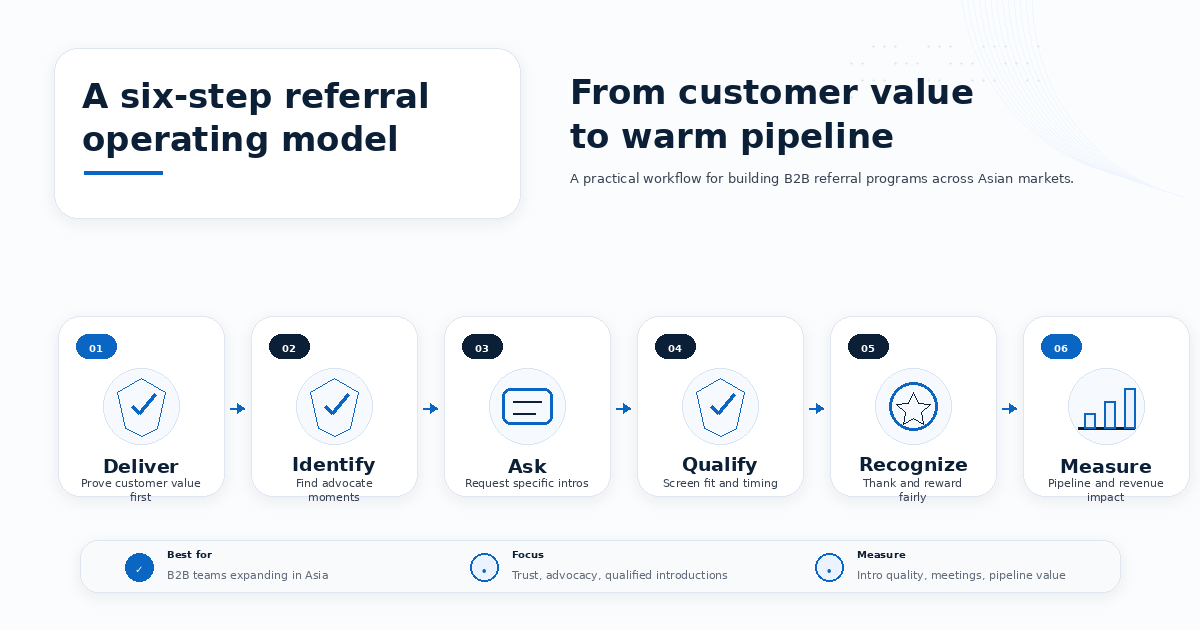
Referral Program Operating Model for Asia
Use this six-step model.
Step 1 — Deliver
Create real customer value before asking for introductions.
Step 2 — Identify
Find promoters, champions, executive sponsors, partners, and power users who may be willing to advocate.
Step 3 — Ask
Make a specific, respectful, low-pressure referral request.
Step 4 — Qualify
Screen referred leads for fit, timing, problem relevance, and decision path.
Step 5 — Recognize
Thank advocates in a way that fits their culture, role, company policy, and comfort level.
Step 6 — Measure
Track referral quality, meetings, opportunities, revenue, sales-cycle speed, and advocate experience.
Need Help Building Market-Ready Revenue Systems in Asia?
Expand In Asia helps B2B companies build growth systems across Asian markets through:
- ICP and account research;
- localized buyer messaging;
- sales prospecting;
- appointment setting;
- market validation;
- pipeline reporting;
- market feedback loops.
Talk to Expand In Asia about building healthier pipeline and customer growth systems across Asia →
Common Referral Program Mistakes to Avoid
Mistake 1 — Asking Too Early
The customer has not yet experienced enough value.
Mistake 2 — Asking Too Broadly
“Do you know anyone?” creates work for the customer.
Mistake 3 — Treating Referrals Like Cold Leads
A referred lead carries the advocate’s reputation.
Mistake 4 — No CRM Tracking
If the referral is not tracked, the program cannot improve.
Mistake 5 — Ignoring Cultural Comfort
Some advocates prefer private recognition over public praise or financial rewards.
Mistake 6 — No Follow-Up Discipline
Slow or generic follow-up can damage both the referral and the customer relationship.
Mistake 7 — No Ideal Referral Profile
Customers cannot help you well if they do not know who you want to meet.
Mistake 8 — Depending Only on Referrals
Referrals are powerful, but they should complement outbound, partnerships, content, events, and account-based selling.
B2B Referral Program Scorecard
Score each area from 1 to 5.
| Area | 1 — Weak | 3 — Developing | 5 — Strong |
|---|---|---|---|
| Customer value | Referrals requested before value is clear | Some success signals exist | Clear customer outcomes before referral ask |
| Advocate identification | Ad hoc list | Some promoters identified | Promoters, champions, sponsors, partners, and users mapped |
| Referral profile | “Anyone interested” | Basic ICP guidance | Clear market, role, trigger, problem, and disqualification criteria |
| Referral ask | Vague or awkward | Some structured messaging | Specific, respectful, low-friction ask |
| Qualification | Every referral goes to sales | Basic fit check | Fit, timing, urgency, role, and decision path confirmed |
| Follow-up | Slow or generic | Basic response process | Contextual follow-up that protects the advocate relationship |
| Recognition | No thank-you process | Occasional appreciation | Appropriate, policy-safe, culturally respectful recognition |
| CRM tracking | Not tracked | Basic source field | Full referral source, status, stage, revenue, and thank-you tracking |
| Measurement | Referrals counted manually | Meetings and opportunities tracked | Conversion, velocity, revenue, LTV, and advocate participation tracked |
| Program rhythm | Random asks | Quarterly activity | Ongoing advocate program tied to CS, sales, and GTM motions |
Score Interpretation
| Total Score | Recommendation |
|---|---|
| 42–50 | Strong referral program; optimize by market and advocate segment |
| 34–41 | Good foundation; improve tracking, recognition, or referral specificity |
| 25–33 | Referrals happen, but the program may be inconsistent |
| Below 25 | Build the advocacy foundation before scaling referral asks |
Need Help Turning Customer Trust Into Qualified Pipeline?
Expand In Asia helps B2B companies build growth systems across Asian markets through:
- ICP and account research;
- localized buyer messaging;
- sales prospecting;
- appointment setting;
- market validation;
- pipeline reporting;
- referral and market-feedback loops.
Talk to Expand In Asia about building referral-ready pipeline systems across Asia →
Next Steps With Expand In Asia
A B2B referral program in Asia should never feel like a pressure tactic.
It should feel like a natural extension of trust.
When a customer has received value, understands your ideal buyer, and feels confident that you will handle the introduction respectfully, referrals become easier.
The best referral programs do three things well:
- they earn advocacy through delivery;
- they make the referral ask specific and respectful;
- they track referred pipeline like any other serious revenue channel.
For broader market-entry planning, read Go-to-Market (GTM) Strategies for Asia.
For building early pipeline before referrals are available, read Building a B2B Sales Pipeline from Zero in a New Asian Market.
For positioning that makes referrals easier to explain, read Positioning a Global Brand for Local Buyers.
Schedule a consultation with Expand In Asia →
Ready to Implement These Strategies?
Book a free 30-minute strategy session where we’ll audit your current growth approach and identify your highest-leverage opportunities in Asian markets.
Frequently Asked Questions
1. What is a B2B referral program?
A B2B referral program is a structured system for encouraging satisfied customers, partners, and advocates to introduce your company to relevant potential buyers.
2. Why are referrals important in Asian B2B markets?
Referrals can reduce trust friction, create warmer access, improve meeting quality, and help unfamiliar vendors enter relationship-driven markets with more credibility.
3. When should we ask a customer for a referral?
Ask after a clear value moment, such as successful implementation, measurable outcome, renewal, positive NPS, expansion, or strong business review.
4. How should we ask for referrals without sounding pushy?
Be specific and low-pressure. Ask for a particular type of company, buyer role, market, or business situation. Make it clear that a soft introduction is enough and that you will handle the conversation respectfully.
5. Are referred leads automatically qualified?
No. Referred leads should still be qualified by company fit, buyer role, problem relevance, urgency, budget potential, and decision path.
6. What should referral programs measure?
Measure referral asks, referrals received, referral-to-meeting rate, meeting held rate, sales acceptance, opportunity creation, win rate, sales-cycle length, average deal size, revenue, and advocate participation.