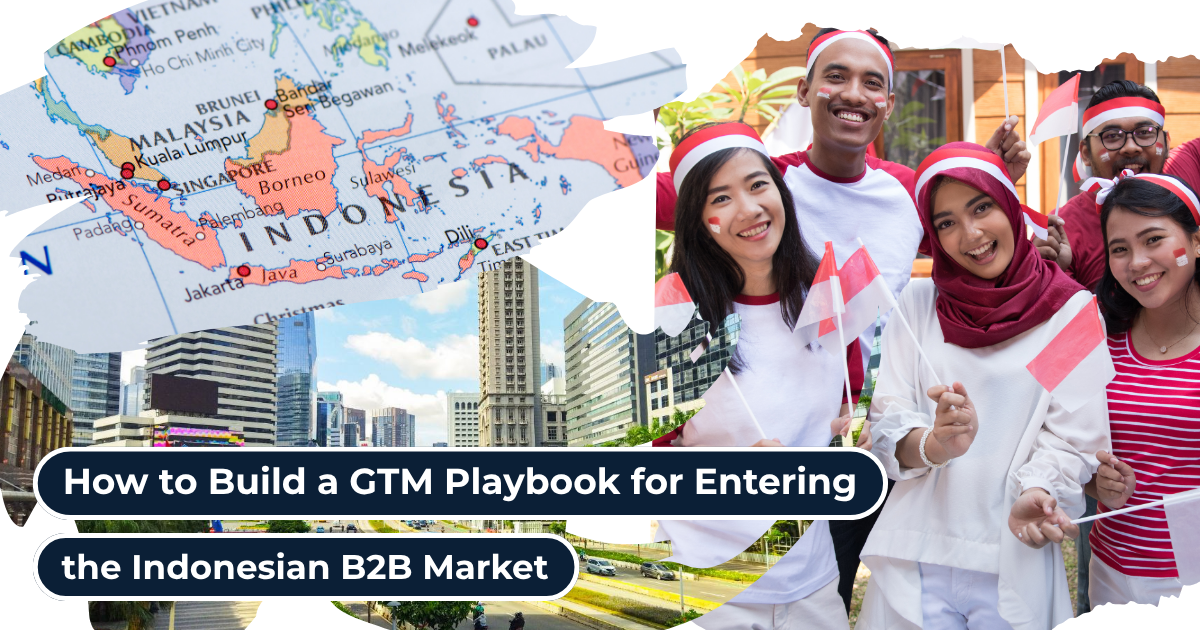
How to Build a GTM Playbook for Entering the Indonesian B2B Market
A practical guide for turning Indonesia’s market potential into focused pipeline, trusted relationships, and scalable execution
Indonesia is one of the most attractive B2B markets in Southeast Asia.
It is the region’s largest economy, the world’s fourth most populous country, and an archipelago of more than 17,000 islands with more than 300 ethnic groups. Its digital economy is also expanding quickly: Google’s Indonesia e-Conomy SEA 2025 coverage reported that Indonesia’s digital economy was projected to approach US$100 billion in GMV in 2025, driven by areas such as video commerce, digital financial services, digital media, and AI adoption.
But Indonesia is not a market where B2B companies should enter with a generic Southeast Asia campaign.
The opportunity is large, but the execution is nuanced.
A company entering Indonesia needs to understand:
- which segment to prioritise;
- whether the buyer problem is urgent enough;
- who influences the buying process;
- how much Bahasa Indonesia support is needed;
- what trust signals matter;
- whether partnerships are necessary;
- which channels create real conversations;
- how to validate demand before scaling investment.
That is why companies need a GTM playbook, not just a campaign plan.
A GTM playbook gives your team a practical operating system for entering the market: who to target, how to message them, which channels to use, how to qualify demand, how to handle objections, and when to scale.
- TL;DR — Key Takeaways
- Indonesia is large, but your first GTM motion should be narrow. Start with one segment, one buyer problem, and one priority account list.
- Trust-building matters. Many B2B conversations benefit from local relevance, partner credibility, relationship development, and patient follow-up.
- Bahasa Indonesia support can improve access and credibility. Indonesian language use is especially important for broader local teams, official contexts, and internal circulation. Indonesia’s Cabinet Secretariat notes that Indonesian language must be used in official state documents, including agreements and court decisions.
- Do not assume a Singapore playbook will work unchanged in Indonesia. Indonesia requires different localization, buyer education, channel sequencing, and relationship-building.
- Use a pilot before scaling. Run a controlled GTM test to validate ICP fit, messaging, channels, meeting quality, and sales acceptance.
- Measure market learning, not just activity. Track objections, stakeholder patterns, language needs, partner signals, qualified meetings, and opportunity creation.
- Build for repeatability. A strong playbook should be specific enough to execute and flexible enough to adapt by segment, city, industry, and buyer role.
If you only do one thing: build the Indonesia GTM playbook around trust, localization, and focused market validation—not broad-volume outreach.
Who This Comparison Is For (and Not For)
This Guide Is For
- B2B companies entering Indonesia for the first time.
- SaaS, cybersecurity, cloud, fintech, HR tech, healthtech, logistics tech, data, AI, managed services, and professional-services companies.
- Founders and CEOs validating whether Indonesia should become a priority market.
- CROs and sales leaders building early pipeline before hiring locally.
- Marketing leaders adapting global or regional content for Indonesian buyers.
- SDR and BDR teams running outbound campaigns into Indonesia.
- Country managers responsible for creating early traction.
- GTM teams deciding whether to build internally, outsource, partner, or use a hybrid approach.
This guide is especially useful if your team is asking:
- Which Indonesian segment should we target first?
- Should we localize into Bahasa Indonesia?
- Should we use direct sales, partners, or both?
- Which channels work for B2B prospecting in Indonesia?
- How do we validate demand before hiring locally?
- What should our first 90-day GTM test look like?
This Guide Is Not For
This guide may be less useful if:
- your product is purely consumer-focused;
- your offer has no defined ICP;
- your company wants to launch across all of Indonesia at once;
- your team is unwilling to localize content or follow-up;
- you expect quick enterprise conversion without trust-building;
- you do not have internal capacity to handle qualified meetings;
- you want one generic Southeast Asia message for every country.
Practical fit check: This guide is for B2B teams that want qualified conversations and market learning—not just a list of Indonesian companies.
Why Indonesia Needs Its Own GTM Playbook
Indonesia is not a single, simple market.
It is large, diverse, relationship-driven, and regionally complex. A buyer in Jakarta may behave differently from a buyer in Surabaya, Bandung, Medan, or Bali. A large enterprise may require a different sales motion from a fast-growing tech company or mid-market services firm.
A generic “Asia” or “Southeast Asia” campaign often fails because it does not account for:
- language;
- trust;
- hierarchy;
- procurement process;
- regional differences;
- partner influence;
- local proof requirements;
- buyer education needs;
- slower relationship development.
A strong GTM playbook gives your team a shared operating model.
It answers:
- who are we targeting first?
- why does this segment matter?
- what problem are we solving?
- what proof do we have?
- what channels will we use?
- how will we qualify interest?
- what will sales do after the meeting?
- how will we know whether the market is working?
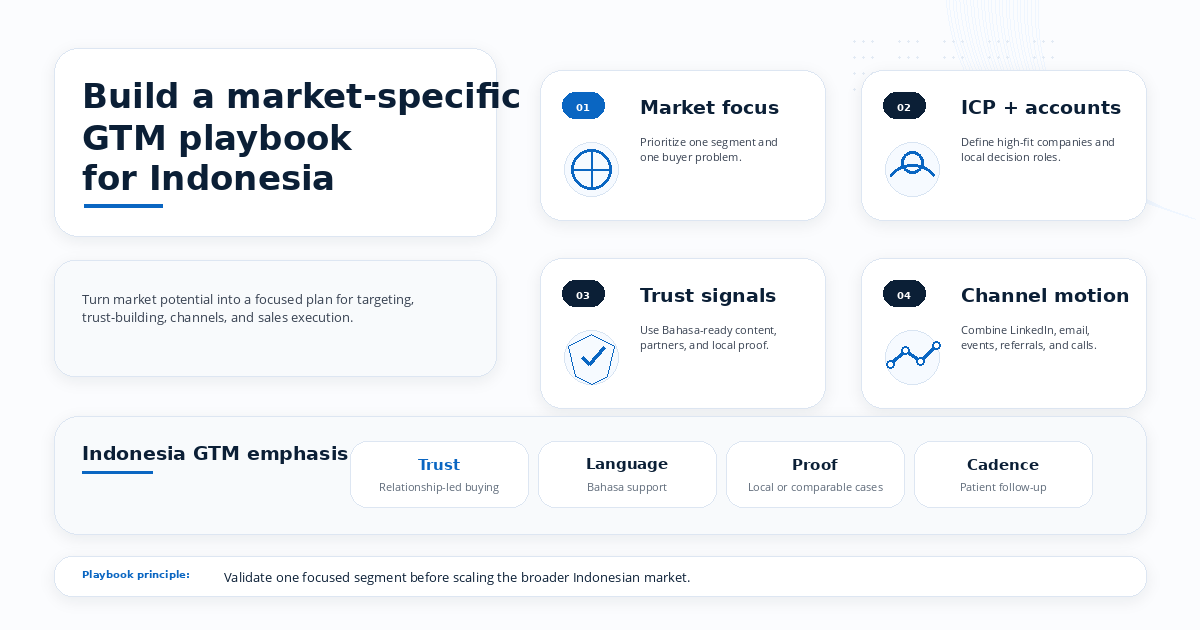
Step 1 — Choose Your First Indonesian Market Segment
The first mistake is targeting “Indonesia” as one broad market.
That is too wide.
Start with a specific segment.
Segmentation Options
| Segment Type | Examples |
|---|---|
| Industry | fintech, logistics, manufacturing, SaaS, retail, healthcare, education |
| Company size | startups, mid-market, enterprise, conglomerates |
| Geography | Jakarta-first, Java-focused, national coverage, priority cities |
| Buyer problem | pipeline growth, compliance, digital transformation, cost control, automation |
| Business model | B2B SaaS, professional services, enterprise software, channel-led |
| Market maturity | digitally mature firms, traditional enterprises, growth-stage companies |
Recommended Starting Point
For many B2B companies, start with one of these:
- Jakarta-based companies in a specific vertical;
- regional or national companies with a clear operational pain;
- technology-forward companies more likely to consider external vendors;
- companies with public expansion, hiring, funding, or digital transformation signals;
accounts where you have relevant regional proof.
Why Narrowing Works
A focused segment helps you:
- write sharper messages;
- identify the right buyer roles;
- test the right channels;
- understand objections faster;
- avoid wasting outreach on poor-fit accounts;
- build a repeatable motion before expanding.
Step 2 — Define Your Indonesia-Specific ICP
Your global ICP may not be enough.
An Indonesia-specific ICP should include local fit, buyer access, and operational practicality.
ICP Criteria
| ICP Area | Questions to Answer |
|---|---|
| Industry fit | Which sectors have the strongest need and budget? |
| Company size | Which accounts can afford the offer and support the sales cycle? |
| Location | Jakarta only, Java-first, or national coverage? |
| Buyer role | Who owns the problem locally? |
| Decision path | Is the decision local, regional, or headquarters-led? |
| Language need | Is Bahasa Indonesia required for outreach, meetings, or internal buy-in? |
| Trust requirement | Does the buyer need local proof, partner credibility, or referrals? |
| Trigger | What creates urgency now? |
| Disqualifier | Which accounts should be excluded? |
Example Indonesia ICP
Jakarta-based mid-market fintech and logistics companies with 100–1,000 employees, active digital transformation initiatives, and senior operations, technology, or commercial leaders responsible for improving efficiency, compliance, or revenue growth.
Disqualification Criteria
Exclude accounts that are:
- too small to afford the solution;
- outside the priority segment;
- not active in the relevant market;
- unreachable through practical channels;
- not aligned with the offer’s use case;
- already owned by a partner or competitor conflict;
- lacking a clear decision role.
Step 3 — Map the Buying Committee and Influence Path
In Indonesia, the person who responds may not be the person who decides.
B2B deals may involve:
- local business leaders;
- department heads;
- finance;
- procurement;
- IT;
- legal;
- owners or family business leadership;
- regional or group leadership;
- external consultants;
- implementation partners.
Buying Committee Map
| Role | What They Influence |
|---|---|
| Economic buyer | Budget and final approval |
| Business owner | Problem urgency and operational need |
| Technical evaluator | Implementation, integration, security |
| Finance | ROI and payment terms |
| Procurement | Vendor process and commercial terms |
| Legal | Contract risk |
| Champion | Internal momentum |
| Local partner | Credibility and access |
| Executive sponsor | Political support and prioritisation |
Questions to Ask Early
- Who owns this issue internally?
- Who needs to approve the budget?
- Is procurement involved?
- Is the decision local or group-level?
- Is Bahasa Indonesia needed for internal materials?
- Would a local partner or reference help?
- What would make this easier to discuss internally?
Why This Matters
If you map the buying committee late, the deal slows down.
If you map it early, your team can prepare the right proof, content, and follow-up.
Step 4 — Localize Positioning and Content
Localization is not just translation.
For Indonesia, localization should adapt:
- language;
- tone;
- proof;
- examples;
- CTA;
- content format;
- follow-up style;
- stakeholder materials.
Localization Priorities
Language
English may work for some senior, regional, or technology buyers.
But Bahasa Indonesia support can improve accessibility and trust with broader local teams.
Tone
Use respectful, commercially clear, relationship-aware language.
Avoid overly aggressive or overly casual outreach.
Proof
Use:
- Indonesia case studies where available;
- Southeast Asia examples;
- similar market examples;
- partner validation;
- pilot structure;
- implementation clarity.
CTA
A hard “book a demo” CTA may not always be the best first step.
Better CTAs may include:
- “Explore whether this is relevant for your team”
- “Discuss Indonesia market fit”
- “Review a practical framework”
- “Join a short market briefing”
- “Compare your current approach”
Assets to Localize First
| Asset | Why It Matters |
|---|---|
| Landing page | Establishes local relevance |
| Sales deck | Supports first serious conversations |
| One-page overview | Easy to forward internally |
| Email and LinkedIn copy | Improves first-touch relevance |
| Webinar topic | Creates education and trust |
| Case study | Reduces perceived risk |
| FAQ | Helps answer internal objections |
Step 5 — Build Trust Signals Before Pushing Conversion
Indonesia often rewards patience and credibility.
A prospect may need to see that your company is serious about the market before agreeing to a commercial conversation.
Trust Signals That Help
- local or regional case studies;
- Bahasa Indonesia content;
- credible local partners;
- referrals;
- event participation;
- founder or senior leader involvement;
- practical market insights;
- clear implementation process;
- strong professional presence on LinkedIn;
- consistent follow-up.
Trust-Building Touchpoints
| Touchpoint | Purpose |
|---|---|
| LinkedIn content | Builds familiarity |
| Partner webinar | Adds credibility |
| Localised guide | Shows market understanding |
| Referral request | Creates warmer access |
| Follow-up note | Maintains relationship momentum |
| Case study | Reduces risk |
| Executive message | Signals commitment |
Practical Rule
Do not push conversion before trust exists.
Create a reason for the buyer to believe the conversation is worth their time.
Step 6 — Choose the Right GTM Channels
No single channel will carry the entire Indonesia GTM motion.
Use a coordinated mix.
Core Channels
Useful for:
- finding executives;
- mapping accounts;
- engaging technology, commercial, and regional buyers;
- building professional visibility;
- supporting outbound.
Cold Email
Useful for:
- structured outreach;
- multi-contact account coverage;
- follow-up;
- sharing assets;
- testing message angles.
Phone
Useful for:
- qualification;
- follow-up;
- clarifying roles;
- reaching operational buyers.
Webinars
Useful for:
- education;
- trust-building;
- partner co-marketing;
- multi-stakeholder engagement.
Events
Useful for:
- relationship-building;
- enterprise trust;
- local market presence;
- partner development.
Referrals and Partners
Useful for:
- credibility;
- access;
- relationship-led introductions;
- local context.
Recommended First GTM Motion
For many B2B companies:
- build a focused account list;
- map decision-makers;
- engage on LinkedIn;
- send localized email;
- invite prospects to a practical webinar or discussion;
- follow up by phone or LinkedIn;
- qualify meetings;
- capture objections and market feedback.
Step 7 — Build a Pilot Campaign Before Scaling
Do not scale Indonesia before validating the motion.
Run a pilot.
90-Day Pilot Structure
Days 1–30 — Foundation
- define ICP;
- build account list;
- map buyer roles;
- localize messaging;
- prepare proof assets;
- set CRM fields;
- define qualification criteria.
Days 31–60 — Activation
- run LinkedIn and email outreach;
- test webinar or content angle;
- make follow-up calls;
- track replies;
- document objections;
- book qualified meetings.
Days 61–90 — Learning and Decision
- review meetings held;
- assess sales acceptance;
- compare segments;
- analyze objections;
- identify language gaps;
- decide whether to scale, adjust, or pause.
Pilot Metrics
| Metric | What It Shows |
|---|---|
| Positive reply rate | Message relevance |
| Meeting held rate | Buyer commitment |
| Sales acceptance | Lead quality |
| Objection themes | Market readiness |
| Language requests | Localization need |
| Partner referrals | Trust pathway |
| Opportunity creation | Commercial potential |
Step 8 — Design the Sales Handoff and Qualification Process
Step 8 — Design the Sales Handoff and Qualification Process
A GTM playbook fails if qualified interest is not handled properly.
Handoff Notes Should Include
- company context;
- buyer role;
- trigger;
- source;
- language preference;
- pain discussed;
- objections raised;
- stakeholders mentioned;
- next step;
- recommended discovery questions.
Qualification Criteria
A qualified Indonesia meeting should include:
- account fit;
- relevant buyer or influencer;
- clear problem context;
- practical next step;
- no obvious disqualifier;
- sales-ready notes.
Why This Matters
If the AE enters the call without context, the buyer has to repeat everything.
That slows momentum and weakens trust.
Step 9 — Track Market Feedback and Pipeline Quality
A GTM playbook should capture learning, not just activity.
What to Track
- which industries respond;
- which job titles engage;
- whether Bahasa Indonesia is requested;
- which objections appear;
- whether local proof is required;
- which channels create quality conversations;
- whether referrals improve response;
- what stalls meetings;
- which accounts become opportunities.
Reporting Dashboard
| Category | Metrics |
|---|---|
| Activity | accounts researched, contacts mapped, outreach sent |
| Engagement | replies, positive replies, LinkedIn responses, webinar attendance |
| Quality | meetings held, sales acceptance, disqualification reasons |
| Pipeline | opportunities created, pipeline value, stage progression |
| Market learning | objections, language needs, proof gaps, partner signals |
The goal is to decide what to do next with evidence.
Step 10 — Decide When to Scale, Partner, or Hire Locally
After the pilot, choose the next move.
Scale If:
- ICP fit is clear;
- buyers respond;
- meetings are held;
- sales accepts the meetings;
- opportunities are forming;
- objections are manageable;
- the channel mix is repeatable.
Partner If:
- trust barriers are high;
- local credibility is needed;
- implementation requires local support;
- referrals matter;
- enterprise access is difficult.
Hire Locally If:
- Indonesia is strategic;
- pipeline is validated;
- sales cycles require local presence;
- buyers need Bahasa support;
- leadership wants long-term market ownership.
Pause or Adjust If:
- the ICP is unclear;
- meetings do not convert;
- buyers show weak urgency;
- language or proof gaps are too large;
- the market needs education before sales.
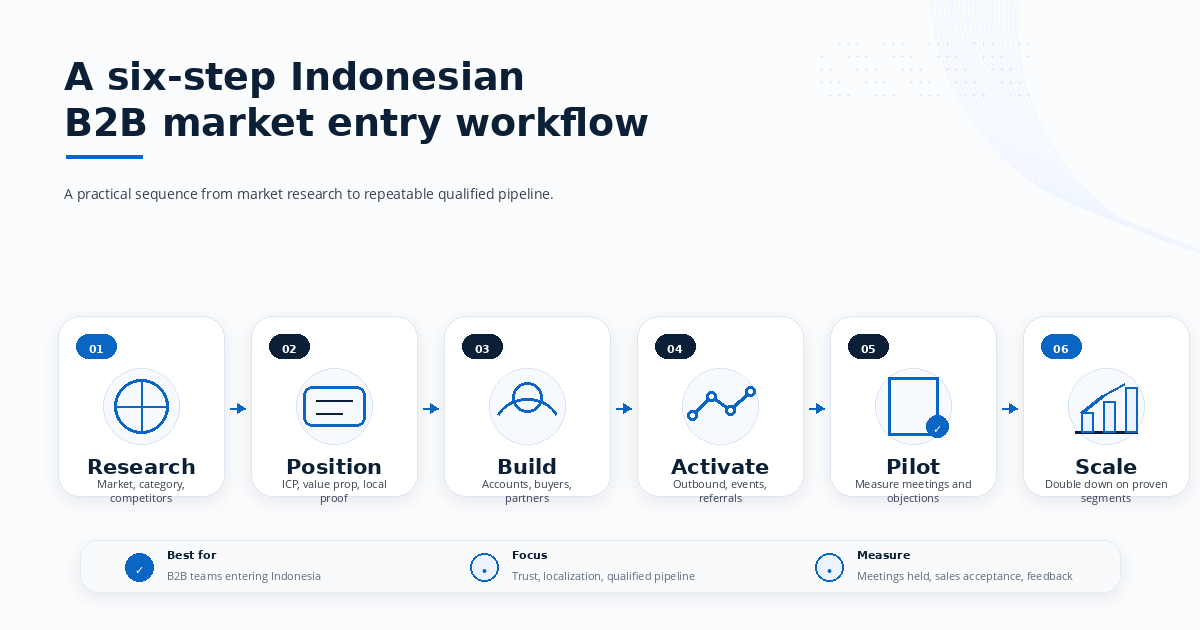
Indonesia GTM Playbook Framework
Use this six-step playbook.
Step 1 — Research
Understand the market, category maturity, competitors, language needs, and buyer behaviour.
Step 2 — Position
Adapt the ICP, value proposition, proof, tone, and CTA for Indonesian buyers.
Step 3 — Build
Create target-account lists, buyer maps, localised assets, and partner lists.
Step 4 — Activate
Launch outreach, LinkedIn engagement, webinars, events, referral campaigns, and partner-led plays.
Step 5 — Pilot
Measure reply quality, meetings held, objections, language needs, and sales acceptance.
Step 6 — Scale
Expand only when a segment, message, and channel mix show evidence of working.
Common Mistakes to Avoid
Mistake 1 — Treating Indonesia as One Homogeneous Market
Start with a specific segment before expanding.
Mistake 2 — Copying the Singapore Playbook
Singapore and Indonesia often require different trust-building, localization, and channel sequencing.
Mistake 3 — Ignoring Bahasa Indonesia
English may work for some buyers, but Bahasa support can improve trust and internal sharing.
Mistake 4 — Pushing Too Hard Too Early
Indonesia may require more relationship-building before direct conversion.
Mistake 5 — Skipping Partner Strategy
Local partners can provide credibility, market context, and access.
Mistake 6 — Measuring Only Meetings Booked
Track meetings held, sales acceptance, objections, and opportunity creation.
Mistake 7 — Hiring Before Validation
Validate the market before committing to fixed local cost.
Mistake 8 — No Sales Feedback Loop
Sales feedback should improve ICP, messaging, proof, and channel strategy.
Indonesia GTM Scorecard
Score each area from 1 to 5.
| Area | 1 — Weak | 3 — Developing | 5 — Strong |
|---|---|---|---|
| Market focus | Broad Indonesia target | Basic segment focus | Clear priority segment and city/industry logic |
| ICP | Generic B2B audience | Some buyer definition | Indonesia-specific ICP and disqualifiers |
| Localization | English-only copy | Some local references | Bahasa-ready, market-aware content |
| Trust signals | None | Some regional proof | Local proof, partners, or strong comparable cases |
| Channels | One channel | Two-channel test | LinkedIn, email, calls, webinars, partners, and referrals |
| Partner strategy | No partner view | Some possible partners | Clear partner/referral path |
| Pilot design | Ad hoc outreach | Campaign test | 90-day pilot with metrics and learning goals |
| Qualification | Any meeting counts | Basic filters | Written qualified meeting criteria |
| CRM | Scattered notes | Basic tracking | Market, language, source, and objection tracking |
| Scaling decision | Based on optimism | Based on activity | Based on sales acceptance and pipeline evidence |
Score Interpretation
| Total Score | Recommendation |
|---|---|
| 42–50 | Strong Indonesia GTM foundation; prepare for controlled scaling |
| 34–41 | Good foundation; improve weaker trust, localization, or channel areas |
| 25–33 | Continue validation before scaling investment |
| Below 25 | Rebuild GTM strategy before expanding into Indonesia |
Need Help Entering the Indonesian B2B Market?
Expand In Asia helps B2B companies enter Indonesia through:
- ICP definition;
- account research;
- localized messaging;
- LinkedIn and email outreach;
- appointment setting;
- lead qualification;
- CRM reporting;
- market feedback.
Talk to Expand In Asia about building your Indonesia GTM playbook →
Next Steps With Expand In Asia
Indonesia can be a strong B2B growth market, but it rewards companies that enter with focus, patience, and local relevance.
A strong Indonesia GTM playbook should help your team:
- select the right first segment;
- define the right ICP;
- map the buying committee;
- localize messaging and proof;
- build trust before conversion;
- test the right channels;
- qualify meetings properly;
- decide when to scale.
For broader market-entry planning, read:
Go-to-Market (GTM) Strategies for Asia
For pipeline tactics, read:
10 Best B2B Qualified Lead Generation Strategies for 2026
Schedule a consultation with Expand In Asia →
Ready to Implement These Strategies?
Book a free 30-minute strategy session where we’ll audit your current growth approach and identify your highest-leverage opportunities in Asian markets.
Frequently Asked Questions
1. What is a GTM playbook?
A GTM playbook is a practical operating guide that defines how a company enters and sells into a market. It usually includes ICP, positioning, target accounts, messaging, channels, qualification criteria, sales handoff, reporting, and scaling rules.
2. Why does Indonesia need a separate GTM playbook?
Indonesia has its own language, trust dynamics, business culture, geography, partner ecosystem, and buying behaviour. A generic Southeast Asia playbook may miss these factors.
3. Should B2B companies use Bahasa Indonesia?
Often, yes. English may work for some executive, regional, and technology audiences, but Bahasa Indonesia support can improve accessibility, trust, and internal circulation, especially with broader local teams.
4. Is Indonesia a good B2B market?
Indonesia can be attractive for B2B companies because of its economic size, population, digital growth, and expanding business sectors. However, success depends on segment focus, local relevance, trust-building, and execution quality.
5. Should companies hire locally before entering Indonesia?
Not always. Many companies should first validate the market through outsourced prospecting, founder-led outreach, partners, or a 90-day pilot before committing to permanent local headcount.
6. Which channels work for Indonesia B2B GTM?
Common channels include LinkedIn, email, phone, webinars, events, referrals, and partner-led introductions. The right mix depends on the target buyer, industry, deal size, language needs, and level of trust required.
7. How long should an Indonesia GTM pilot run?
A 90-day pilot is often enough to test account fit, buyer response, messaging, channels, meeting quality, objections, and early opportunity creation
8. What should be measured?
Measure positive replies, meetings held, sales acceptance, opportunity creation, objections, language needs, partner signals, channel performance, and pipeline quality.