A practical guide for using automation to improve outbound efficiency without losing buyer relevance, local context, or trust
AI sales automation is changing outbound sales.
Not in theory.
In daily sales workflows.
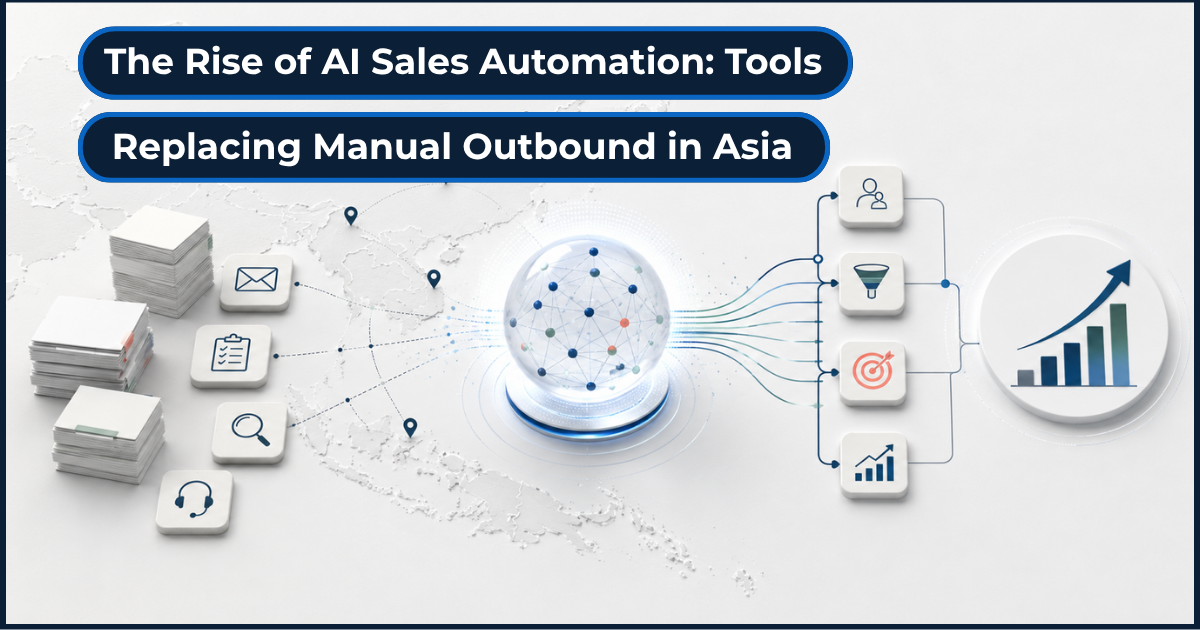
Tasks that used to take SDRs and BDRs hours can now be assisted, accelerated, or partially automated.
AI can help teams:
- build prospect lists;
- enrich contact data;
- summarize accounts;
- identify buying signals;
- draft outbound messages;
- personalize follow-ups;
- score leads;
- update CRM records;
- summarize calls;
- suggest next steps;
- route leads;
- analyze campaign performance.
That is why many sales leaders are asking:
“Which parts of outbound can we automate?”
But for B2B teams expanding across Asia, the better question is:
“Which parts should we automate—and which parts still require human judgment?”
Because Asia is not one outbound market.
A message that works in Singapore may not work in Indonesia.
A sequence that performs in the Philippines may not work in Japan.
A fully automated email workflow may move fast, but still fail if it misses local context, buyer hierarchy, proof expectations, or relationship-building norms.
Salesforce’s 2026 State of Sales report says nine in ten sales teams use AI agents today or expect to within two years, and describes agents as being used across sales processes from planning to quoting. McKinsey’s 2025 State of AI research also shows wider AI use and increasing interest in agentic AI, while noting that many organizations still struggle to move from pilots to scaled business impact.
So the direction is clear.
AI sales automation is rising.
But success will not come from replacing every manual outbound task with automation.
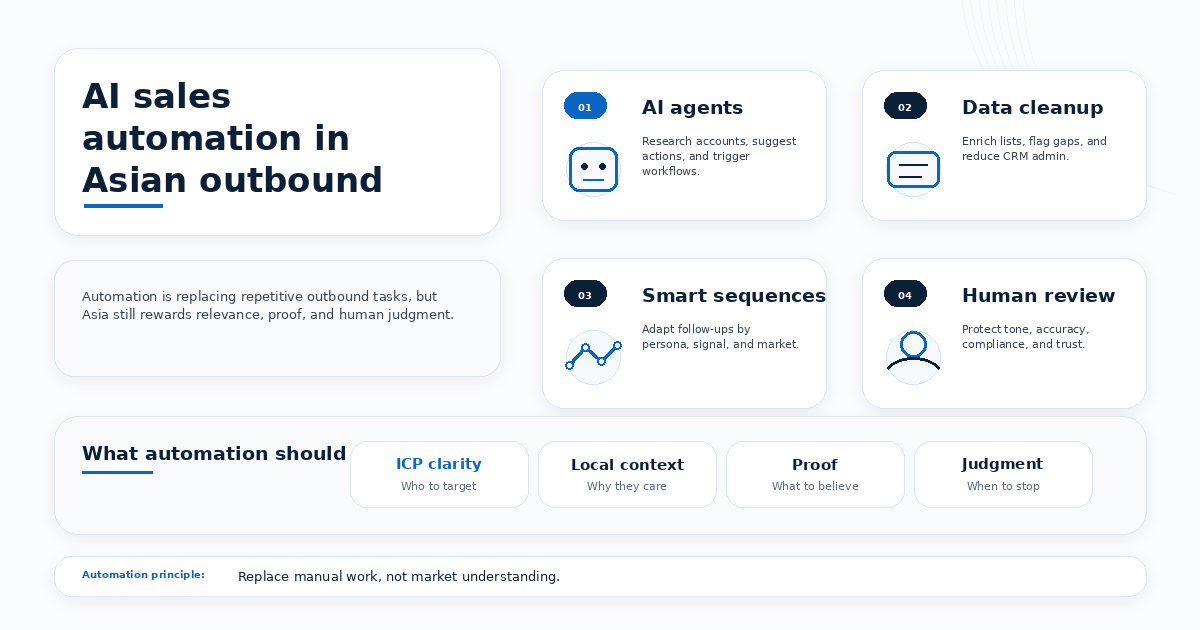
Success will come from automating repetitive work while keeping human judgment where it matters most.
- TL;DR — Key Takeaways
- AI sales automation is replacing repetitive outbound tasks. List enrichment, account research, message drafting, sequencing, CRM updates, and lead scoring are increasingly AI-assisted.
- Automation does not fix weak strategy. Bad ICP, weak messaging, poor proof, and unclear market positioning still produce poor results.
- Asia requires market-aware automation. Singapore, Indonesia, Vietnam, the Philippines, Malaysia, Japan, Korea, and India may require different tones, proof, timing, and localization.
- The best use case is not “send more.” It is “prepare better, prioritize better, and follow up more intelligently.”
- Human review is still essential. Sales teams must validate facts, adjust tone, avoid fake personalization, and protect brand trust.
- AI agents will increasingly support sales workflows. But governance, CRM quality, and clear workflow design will determine whether the tools create pipeline or noise.
- Measure pipeline quality, not automation volume. The right metrics are positive replies, meetings held, sales acceptance, opportunity creation, and market feedback.
If you only do one thing: automate the repetitive work, but keep humans responsible for relevance, accuracy, and judgment.
Who This Guide Is For—and Who It Is Not For
This Guide Is For
- B2B companies prospecting into Asian markets.
- SaaS, cybersecurity, cloud, fintech, HR tech, AI, data, managed services, and professional-services companies.
- CEOs and founders trying to scale outbound without over-hiring.
- CROs and sales leaders evaluating AI SDR or sales automation tools.
- SDR and BDR managers improving prospecting workflows.
- RevOps teams building automated sales systems.
- GTM teams expanding into Singapore, Southeast Asia, India, Japan, Korea, and wider APAC.
- Companies that want efficiency without damaging market trust.
This guide is especially useful if your team is asking:
- Which outbound tasks can AI automate?
- Are AI SDR tools replacing manual prospecting?
- How should we use AI sales automation in Asia?
- What should humans still review?
- How do we avoid generic AI outreach?
- How do we measure AI outbound performance?
- What sales automation stack should we build?
This Guide Is Not For
This guide may be less useful if:
- you want to run fully automated spam campaigns;
- your company has no defined ICP;
- your sales team does not validate AI-generated output;
- your CRM data is unreliable;
- you cannot personalize by market or persona;
- your team measures only email volume;
- you want automation to replace strategy.
Practical fit check: AI sales automation works best when your sales process is already clear. It accelerates good systems and exposes weak ones.
What AI Sales Automation Means
AI sales automation means using AI-powered tools to automate, assist, or accelerate parts of the sales prospecting process.
It can include:
- data enrichment;
- account research;
- lead scoring;
- intent signal detection;
- email and LinkedIn message drafting;
- sequence personalization;
- CRM note generation;
- call summaries;
- next-step recommendations;
- workflow routing;
- sales coaching insights.
Traditional Outbound vs. AI-Assisted Outbound
| Area | Traditional Manual Outbound | AI-Assisted Sales Automation |
|---|---|---|
| List building | Manual research and spreadsheet work | Enrichment, filtering, and account scoring |
| Account research | Rep reads websites and LinkedIn profiles | AI summarizes accounts and triggers |
| Messaging | Written manually from scratch | AI drafts options by persona and market |
| Follow-up | Rep remembers or manually plans | AI suggests follow-up angles |
| CRM admin | Manual updates | AI-generated notes and field suggestions |
| Prioritization | Rep judgment only | Rep judgment plus AI signals |
| Coaching | Manager review only | AI-assisted call and message analysis |
The goal is not to remove the seller.
The goal is to remove unnecessary manual work so sellers can spend more time on judgment, relevance, and conversations.
Why AI Sales Automation Is Rising in Asia
B2B teams expanding across Asia face a volume and complexity problem.
They need to reach enough target accounts, but they also need market relevance.
That is difficult manually.
Why Asia Makes Outbound Hard
Asian outbound often requires:
- country-specific targeting;
- buyer-role variation;
- localized messaging;
- different levels of category awareness;
- different proof expectations;
- varied language requirements;
- complex stakeholder mapping;
- longer trust-building;
- partner or referral paths;
- different follow-up norms.
AI tools can reduce the manual workload.
But they cannot remove the need for market understanding.
ASEAN’s expanded guide on AI governance and ethics for generative AI highlights both opportunities and risks of GenAI adoption and recommends voluntary governance practices for the region.
That matters because AI outbound at scale can create reputational risk if teams misuse data, hallucinate claims, or automate low-quality messages.
For the broader context of AI in prospecting, read How Generative AI is Changing B2B Prospecting in Singapore and SEA.
What Outbound Tasks AI Is Replacing
AI is replacing or reducing manual work in several outbound tasks.
Manual Tasks Being Automated
| Outbound Task | How AI Helps |
|---|---|
| Building lead lists | Filters accounts, enriches data, identifies missing fields |
| Account research | Summarizes websites, news, hiring, funding, and signals |
| Persona mapping | Suggests buyer roles and likely stakeholders |
| Message drafting | Creates first drafts and variations |
| Follow-up planning | Suggests next message based on prior activity |
| Lead scoring | Prioritizes accounts based on fit and signals |
| CRM updates | Summarizes calls and suggests fields |
| Campaign analysis | Identifies reply patterns and objections |
Practical Rule
AI should handle repeatable preparation.
Humans should handle commercial interpretation.
Task 1 — Prospect List Building and Enrichment
Manual list building is slow.
AI and automation can help teams:
- find target accounts;
- enrich company data;
- identify contacts;
- detect missing fields;
- tag accounts by market;
- flag likely ICP fit;
- remove duplicates;
- segment records;
- prepare CRM imports.
What This Replaces
- manual spreadsheet cleanup;
- copy-pasting company data;
- basic website review;
- contact-field normalization;
- industry tagging.
What Humans Still Need to Do
Humans still need to define:
- ICP criteria;
- disqualification rules;
- target markets;
- acceptable data sources;
- contact relevance;
- priority segments.
Bad data at scale creates bad outreach at scale.
Asia-Specific Reminder
For Asia, enrichment should account for:
- regional HQ vs. local office;
- market of operation;
- business language;
- country-specific job titles;
- local subsidiaries;
- partner ecosystem;
- regional buying committees.
Task 2 — Account Research and Buyer Signal Detection
AI can summarize signals that used to take reps hours to find.
Useful Signals
- funding;
- hiring;
- expansion;
- new office;
- product launch;
- event participation;
- leadership changes;
- partnerships;
- regulatory pressure;
- digital transformation projects;
- new regional strategy.
Example
An AI-assisted workflow can identify:
“This Singapore-based SaaS company is hiring APAC sales roles, targeting enterprise customers, and publishing content about Southeast Asia expansion.”
That becomes a better outreach angle than:
“I saw your company is growing.”
Human Validation
Do not trust AI blindly.
Validate:
- dates;
- executive names;
- expansion claims;
- funding details;
- market relevance;
- source credibility.
For early-market pipeline planning, read Building a B2B Sales Pipeline from Zero in a New Asian Market.
Task 3 — Message Drafting and Sequence Creation
AI can draft messages quickly.
But fast writing is not the same as good messaging.
What AI Can Draft
- LinkedIn connection notes;
- first-touch emails;
- follow-up emails;
- event follow-up;
- webinar follow-up;
- reactivation messages;
- persona-specific snippets;
- call openers;
- objection responses.
Where AI Often Fails
AI messages can sound:
- generic;
- too polished;
- overly friendly;
- fake-personalized;
- repetitive;
- too long;
- lacking commercial insight.
Better Workflow
- AI drafts the first version.
- SDR edits for tone.
- Sales leader checks positioning.
- Market owner checks local relevance.
- Campaign launches in controlled volume.
- Replies and objections are reviewed.
- Messaging improves weekly.
For script structure, see The Anatomy of a High-Converting Appointment Setting Script.
Task 4 — Lead Scoring and Prioritization
AI can help teams prioritize the right accounts.
AI-Assisted Scoring Inputs
| Signal | Why It Matters |
|---|---|
| Industry fit | Shows ICP relevance |
| Company size | Indicates budget and sales motion |
| Geography | Matches market priority |
| Hiring signals | Shows expansion or growth |
| Funding signals | Suggests investment capacity |
| Tech stack | Indicates compatibility |
| Website language | Suggests localization needs |
| Engagement | Shows intent or awareness |
| Persona match | Helps choose first contact |
Why This Matters
Sales teams should not spend equal effort on every account.
A well-designed scoring model helps SDRs focus on accounts more likely to become qualified opportunities.
For a related guide, read How AI is Transforming Lead Qualification in B2B Sales Pipelines.
Task 5 — CRM Updates and Sales Admin
AI automation can reduce the admin burden on sales teams.
AI Can Help With
- call summaries;
- meeting notes;
- CRM field suggestions;
- follow-up reminders;
- task creation;
- opportunity summaries;
- next-step recommendations;
- account briefing;
- sales handoff notes.
McKinsey’s research on generative AI’s economic potential estimated that GenAI could increase sales productivity by approximately 3% to 5% of current global sales expenditures depending on implementation and use case.
Practical Rule
Automate admin, not accountability.
The seller still owns the quality of the CRM record.
Task 6 — Follow-Up, Call Prep, and Objection Handling
AI can help reps prepare better follow-ups.
AI Can Suggest
- why the account might care;
- what objection may appear;
- what case study to mention;
- which stakeholder to contact next;
- how to summarize the last interaction;
- what question to ask;
- what not to say.
Example Follow-Up Prompt
Based on this prospect’s role, company, market, and previous reply, suggest three follow-up angles that are concise, respectful, and relevant to B2B expansion in Southeast Asia.
Human Review
The rep should still decide:
- whether the follow-up is appropriate;
- whether the timing is right;
- whether the message sounds natural;
- whether the prospect needs more education;
- whether to stop outreach.
What AI Should Not Replace
AI should not replace:
- ICP strategy;
- market prioritization;
- buyer empathy;
- proof selection;
- sales judgment;
- ethical review;
- local nuance;
- relationship-building;
- qualification discipline;
- human conversation.
Asia-Specific Reality
In Asian markets, buyers often evaluate not only the solution, but also:
- vendor seriousness;
- local commitment;
- responsiveness;
- trustworthiness;
- proof from similar markets;
- ability to support implementation;
- relationship fit.
Automation can help prepare the conversation.
It cannot fully replace the relationship.
Risks of Over-Automating Outbound in Asia
Risk 1 — Generic AI Outreach
When everyone uses similar tools, prospects receive similar messages.
Risk 2 — Fake Personalization
Mentioning a random fact is not the same as relevant insight.
Risk 3 — Hallucinated Claims
AI may generate inaccurate company facts or unsupported claims.
Risk 4 — Compliance and Data Issues
Teams must understand consent, data handling, and platform rules.
Risk 5 — Brand Damage
Over-automation can make a premium company sound careless.
Risk 6 — Poor Market Fit
Automation may scale a message that should never have been sent.
HubSpot’s 2026 marketing report emphasizes the tension between AI-driven scale and the need to preserve human distinctiveness, trust, and relevance as AI floods markets with content.
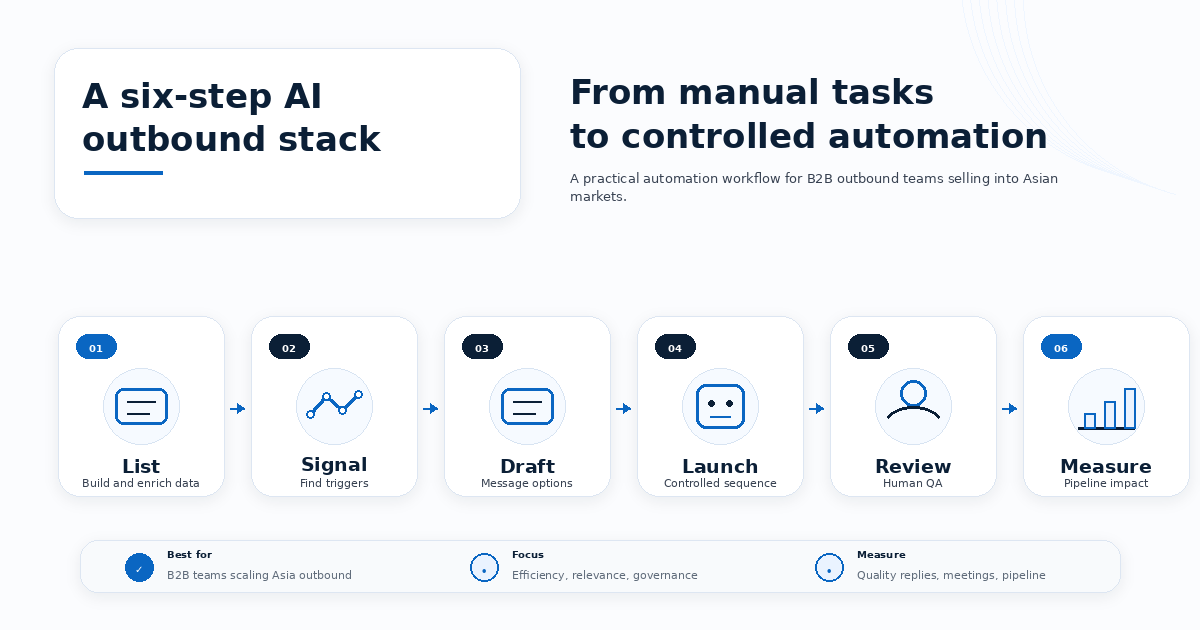
AI Outbound Operating Model for Asian Markets
Use this six-step operating model.
Step 1 — Build the List
Use AI and automation to build and enrich target accounts.
Step 2 — Detect Signals
Identify triggers such as hiring, funding, expansion, product launches, events, and leadership changes.
Step 3 — Draft Messaging
Create persona-specific and country-specific outbound drafts.
Step 4 — Launch Controlled Sequences
Start with small batches to test relevance.
Step 5 — Review Human Quality
Review facts, tone, cultural fit, claims, and response quality.
Step 6 — Measure Pipeline Impact
Track quality replies, meetings held, sales acceptance, opportunities, and market feedback.
Need Help Choosing the Right APAC Market?
Expand In Asia helps B2B companies validate and build pipeline across Asian markets through:
- ICP and account research;
- market prioritization;
- localized buyer messaging;
- LinkedIn and email outreach;
- appointment setting;
- sales qualification;
- pipeline reporting;
- market feedback loops.
Talk to Expand In Asia about identifying your best-fit APAC market before scaling →
Sales Automation Tool Categories to Consider
The specific tools will change.
The categories matter more.
Useful Tool Categories
| Tool Category | Purpose |
|---|---|
| Data enrichment | Improve company and contact records |
| Prospecting database | Find accounts and contacts |
| Sales engagement | Run email and LinkedIn sequences |
| AI writing assistant | Draft and adapt messages |
| Intent data | Identify buyer signals |
| Conversation intelligence | Analyze calls and meetings |
| CRM automation | Reduce manual updates |
| Lead scoring | Prioritize accounts |
| Workflow automation | Trigger tasks and routing |
| Analytics | Measure performance and pipeline quality |
Practical Rule
Do not buy tools before defining workflow.
The best automation stack supports a clear sales motion.
AI Sales Automation Scorecard
Score each area from 1 to 5.
| Area | 1 — Weak | 3 — Developing | 5 — Strong |
|---|---|---|---|
| ICP clarity | Broad or unclear target | Basic ICP by segment | Clear ICP by market, persona, trigger, and disqualification rule |
| Data quality | Messy lists | Basic enrichment | Clean, enriched, deduplicated, and market-tagged records |
| Signal detection | No trigger tracking | Some manual signals | Automated signal capture with human validation |
| Message quality | Generic AI copy | Some human editing | Market-specific, proof-led, human-reviewed messaging |
| Sequencing | One generic sequence | Basic persona split | Persona, country, intent, and lifecycle-based sequences |
| Human review | No QA process | Informal review | Clear review rules for claims, tone, relevance, and compliance |
| CRM workflow | Manual admin | Some automation | AI-assisted notes, routing, tasks, and handoff fields |
| Lead scoring | Every lead equal | Basic fit scoring | Fit, intent, timing, persona, and market readiness scored |
| Governance | No AI rules | Basic tool usage policy | Clear data, privacy, compliance, and approval standards |
| Measurement | Volume only | Replies and meetings tracked | Sales acceptance, opportunity creation, pipeline value, and market learning tracked |
Score Interpretation
| Total Score | Recommendation |
|---|---|
| 42–50 | Strong AI automation system; optimize by market and persona |
| 34–41 | Good foundation; improve governance, data quality, or sequence relevance |
| 25–33 | Automation exists, but may be scaling weak outbound habits |
| Below 25 | Rebuild ICP, data, messaging, and human review before scaling automation |
Need Help Building AI-Supported Outbound That Still Feels Human?
Expand In Asia helps B2B companies build market-ready outbound systems across Asia through:
- ICP and account research;
- localized buyer messaging;
- LinkedIn and email outreach;
- SDR/BDR execution;
- appointment setting;
- lead qualification;
- market feedback loops;
- pipeline reporting.
Talk to Expand In Asia about building AI-supported, human-led outbound systems across Asia →
Next Steps With Expand In Asia
AI sales automation is rising because it solves a real problem.
Manual outbound is slow.
But fully automated outbound can be careless.
The winning approach is not human-only or AI-only.
It is a controlled system where AI handles repetitive work and humans protect buyer relevance.
For B2B teams expanding in Asia, that means using automation to:
- research faster;
- prioritize better;
- write first drafts;
- reduce admin;
- detect risk and intent;
- learn from campaign feedback.
But humans should still own:
- ICP clarity;
- market nuance;
- proof;
- positioning;
- qualification;
- timing;
- relationship-building.
For deeper AI prospecting context, read How Generative AI is Changing B2B Prospecting in Singapore and SEA.
For lead scoring and qualification, read How AI is Transforming Lead Qualification in B2B Sales Pipelines.
For broader expansion strategy, read Go-to-Market (GTM) Strategies for Asia.
Schedule a consultation with Expand In Asia →
Ready to Implement These Strategies?
Book a free 30-minute strategy session where we’ll audit your current growth approach and identify your highest-leverage opportunities in Asian markets.
Frequently Asked Questions
1. What is AI sales automation?
AI sales automation uses AI tools to automate or assist sales tasks such as list building, account research, message drafting, lead scoring, follow-up planning, CRM updates, and workflow routing.
2. Is AI replacing manual outbound?
AI is replacing parts of manual outbound, especially repetitive research, admin, enrichment, sequencing, and first-draft writing. It is not replacing the need for human strategy, judgment, local context, and relationship-building.
3. What outbound tasks should B2B teams automate first?
Start with low-risk tasks such as data cleanup, account summaries, CRM notes, follow-up reminders, and first-draft messaging. Keep human review for final messaging, claims, tone, and qualification.
4. Why is AI outbound risky in Asia?
Asian markets often require local context, proof, respectful communication, and relationship-building. Over-automated outreach can sound generic, inaccurate, or culturally tone-deaf.
5. What should sales leaders measure?
Measure quality replies, meetings held, sales acceptance, opportunities created, pipeline value, reply sentiment, objection patterns, and performance by country and persona.
6. Can AI SDR tools replace human SDRs?
They can replace some manual tasks, but not the full SDR function. Human SDRs are still needed for judgment, live conversations, account interpretation, qualification, and trust-building.