
Country-Specific Content Localization: Singapore vs. Indonesia vs. Vietnam
A practical B2B guide to adapting your message, proof, tone, and content strategy across three very different Southeast Asian markets
Many companies misunderstand localization.
They treat it as translation.
They take an English landing page, translate it into another language, change the country name, and assume the message is ready for market.
That approach may be enough for basic comprehension.
It is rarely enough for B2B conversion.
In Southeast Asia, content localization is not only about language. It is about helping the buyer feel that your company understands their market, business environment, decision process, risk concerns, and local context.
That matters because buyers respond differently across Singapore, Indonesia, and Vietnam.
A Singapore-based regional director may expect concise business logic, ROI clarity, regional proof, and executive-ready messaging. An Indonesian enterprise buyer may place more weight on trust, relationships, Bahasa Indonesia support, local credibility, and patient engagement. A Vietnamese B2B buyer may need practical education, clear implementation guidance, category explanation, and proof that the solution can work in their operating environment.
CSA Research’s “Can’t Read, Won’t Buy” research found that 76% of surveyed consumers prefer products with information in their own language, and 40% will not buy from websites in other languages. The same research also found that respondents in several Asia-Pacific markets showed especially strong preference for local-language product information.
For B2B companies, the takeaway is simple:
Translation helps people understand your words. Localization helps buyers trust your message.
This guide compares content localization across Singapore, Indonesia, and Vietnam and provides a practical framework for adapting your B2B content by country.
- TL;DR — Key Takeaways
- Localization is not the same as translation. Translation changes the language. Localization adapts the message, proof, tone, examples, channel, and buying context.
- Singapore often requires clarity, credibility, and regional business logic. English works widely in business settings, but generic global messaging still underperforms.
- Indonesia requires stronger localization depth. Bahasa Indonesia, local trust signals, relationship-building, and market-specific proof are often more important.
- Vietnam often rewards practical education and implementation clarity. Buyers may need content that explains the problem, the solution category, the business case, and the operational path forward.
- The same content asset should not be copied across all three markets. A white paper, LinkedIn post, webinar, sales deck, or landing page may need different positioning by country.
- Local proof matters. If you do not have local case studies, use comparable regional examples, pilot offers, partner credibility, or market-specific frameworks.
- Measure content by pipeline influence, not only traffic. Track engagement from target accounts, meetings influenced, qualified leads, sales acceptance, and objections reduced.
If you only do one thing: stop asking, “Should we translate this?” Start asking, “What does this buyer need to believe before they will take the next step?”
Who This Comparison Is For (and Not For)
This Guide Is For
- B2B companies expanding into Singapore, Indonesia, or Vietnam.
- SaaS, cybersecurity, fintech, cloud, HR tech, healthtech, professional-services, data, AI, and enterprise-software companies.
- Marketing teams adapting global content for Southeast Asian buyers.
- Sales teams that need localised messaging, decks, one-pagers, and follow-up materials.
- Founders and country managers building early demand in a new market.
- Demand generation teams running campaigns across several Southeast Asian countries.
- GTM leaders deciding what content should be translated, rewritten, or fully localised.
This guide is especially useful if your team is asking:
- Can we use the same content in Singapore, Indonesia, and Vietnam?
- When is English enough?
- When do we need Bahasa Indonesia or Vietnamese?
- How should case studies be adapted?
- What proof points matter by country?
- How should tone change by market?
- Which assets should be localised first?
This Guide Is Not For
This guide may be less useful if:
- you only need literal document translation;
- your business is consumer-focused rather than B2B;
- your product has no defined ICP;
- your team is unwilling to adapt messaging by country;
- your content strategy is based only on SEO traffic, not pipeline;
- your company wants one generic “Asia” campaign for every market;
- your team cannot support localised follow-up after campaigns.
Practical fit check: This guide is for companies that want market-relevant B2B content—not just translated copy.
What Country-Specific Content Localization Means
Country-specific content localization means adapting content for the buyer’s local market.
It goes beyond word-for-word translation.
A properly localized B2B asset adapts:
- language;
- tone;
- examples;
- market references;
- buyer pain points;
- proof points;
- case studies;
- regulatory context;
- decision-making process;
- pricing sensitivity;
- industry maturity;
- preferred channels;
- calls to action.
Translation vs. Localization
| Area | Translation | Localization |
|---|---|---|
| Main focus | Language accuracy | Market relevance |
| Output | Same message in another language | Adapted message for local buyers |
| Buyer context | Often unchanged | Reworked by country, role, and market maturity |
| Proof | Global proof copied over | Local, regional, or comparable proof |
| CTA | Same next step | Adapted to buyer readiness |
| Best use | Basic comprehension | Demand generation, sales enablement, conversion |
Example
A global English message might say:
“Scale revenue faster with automated pipeline generation.”
A Singapore-localized version may say:
“Build more predictable regional pipeline without adding full local SDR headcount too early.”
An Indonesia-localized version may say:
“Support local market development with trusted outreach, Bahasa Indonesia-ready communication, and relationship-led follow-up.”
A Vietnam-localized version may say:
“Create practical market education, qualified conversations, and clear implementation confidence before scaling sales investment.”
The product may be the same.
The buying context is not.

Why Localization Matters in B2B Market Entry
B2B buyers are not only evaluating your product.
They are evaluating risk.
They are asking:
- Does this vendor understand our market?
- Can they support our local team?
- Have they worked with companies like ours?
- Is this relevant to our business environment?
- Will this be easy to explain internally?
- Will this create implementation risk?
- Can we trust them?
Content helps answer those questions before and after a sales conversation.
Localization Supports the Full Funnel
| Funnel Stage | Localized Content Role |
|---|---|
| Awareness | Makes the problem feel relevant locally |
| Interest | Shows that the vendor understands the buyer’s market |
| Consideration | Provides local or comparable proof |
| Evaluation | Helps stakeholders compare options |
| Internal approval | Gives champions business-case materials |
| Post-meeting follow-up | Answers objections and reduces uncertainty |
Why It Matters Across Singapore, Indonesia, and Vietnam
Singapore, Indonesia, and Vietnam are all Southeast Asian markets, but they are not interchangeable.
Singapore has four official languages—Malay, Mandarin, Tamil, and English—while English is widely used in business and government communication. Indonesia has Bahasa Indonesia as the official language, and Indonesian-language use is required in many official documents and government contexts. Vietnam’s Constitution states that the national language is Vietnamese.
Those language realities affect how buyers interpret content, credibility, and trust.
Singapore Localization: Clarity, Credibility, and Regional Business Logic
Singapore is often the easiest of the three markets for English-language B2B content.
But that does not mean global content can be copied without adaptation.
Singapore buyers are often sophisticated, time-conscious, commercially direct, and used to comparing vendors. Many B2B buyers in Singapore may also hold regional responsibilities across Southeast Asia or APAC.
What Singapore Buyers Often Need
- clear business value;
- concise messaging;
- ROI logic;
- executive-ready proof;
- regional relevance;
- credible case studies;
- implementation clarity;
- strong website and LinkedIn presence;
- professional tone;
- low-friction next steps.
Localization Priorities for Singapore
1. Use clear English, not heavy jargon
Singapore B2B content should be concise and commercially sharp.
Avoid:
- vague claims;
- overdone buzzwords;
- long abstract paragraphs;
- overly casual messaging;
- generic “Asia expansion” language.
2. Show regional relevance
Singapore is often a regional hub.
Content should clarify whether your offer supports:
- Singapore-only operations;
- ASEAN growth;
- APAC expansion;
- regional headquarters;
- multi-country sales;
- local market validation.
3. Use business-case content
Singapore buyers often respond well to:
- comparison guides;
- ROI calculators;
- executive summaries;
- short decision frameworks;
- market-entry checklists;
- vendor evaluation scorecards;
- cost-benefit analysis.
4. Make the next step specific
Instead of:
“Book a demo.”
Use:
“Discuss whether your Singapore-based team has enough qualified pipeline to support regional growth.”
Recommended Singapore Content Assets
| Asset | Why It Works |
|---|---|
| Executive one-pager | Easy to forward internally |
| ROI framework | Helps justify investment |
| Comparison article | Supports vendor evaluation |
| LinkedIn thought leadership | Builds senior visibility |
| Market-entry guide | Supports regional decision-makers |
| Webinar with practical insights | Creates qualified conversations |
| Case study or proof deck | Reduces perceived risk |
Singapore Localization Principle
Be clear, credible, concise, and commercially useful.
Indonesia Localization: Trust, Bahasa Indonesia, and Relationship Depth
Indonesia is Southeast Asia’s largest economy and the world’s fourth most populous country, according to the World Bank. It is also made up of more than 17,000 islands and more than 300 ethnic groups.
That complexity matters for B2B content.
Indonesia localization often requires more than translating English into Bahasa Indonesia. It may require stronger relationship-building, deeper trust signals, local partner credibility, and content that respects the buyer’s operating environment.
What Indonesia Buyers Often Need
- Bahasa Indonesia support;
- local relevance;
- relationship-building;
- trusted introductions;
- partner credibility;
- implementation reassurance;
- practical business case;
- patience in follow-up;
- less aggressive sales tone.
Localization Priorities for Indonesia
1. Use Bahasa Indonesia where buyer trust requires it
English may work with some regional, tech, or executive audiences. But Bahasa Indonesia can be important for broader market access, local business teams, public-sector-adjacent conversations, and operational stakeholders.
CSA Research’s localization findings are particularly relevant here: its report notes that Indonesian respondents showed strong preference for local-language product information.
2. Build trust before pushing conversion
Indonesia content should often include:
- local examples;
- partner credibility;
- relationship-led messaging;
- event-based engagement;
- market education;
- proof of long-term commitment.
3. Avoid overly aggressive CTAs
A hard-sell CTA may underperform.
Better options include:
- “Discuss market fit”
- “Explore whether this applies to your team”
- “Join a practical session”
- “Review a regional framework”
- “Speak with a local market specialist”
4. Adapt examples to local business reality
Use examples connected to:
- local operating models;
- regional growth;
- digital adoption;
- branch or island complexity;
- multi-stakeholder decision-making;
- implementation and support needs.
Recommended Indonesia Content Assets
| Asset | Why It Works |
|---|---|
| Bahasa Indonesia landing page | Builds accessibility and trust |
| Localized webinar | Educates and creates engagement |
| Partner co-branded content | Adds credibility |
| Practical guide | Reduces buyer uncertainty |
| Case study with comparable market | Supports internal confidence |
| WhatsApp-friendly follow-up content | Useful for conversational engagement |
| Executive summary in Bahasa Indonesia | Helps internal circulation |
Indonesia Localization Principle
Local language and trust signals matter as much as the message itself.
Vietnam Localization: Education, Practicality, and Implementation Confidence
Vietnam is a fast-growing business environment with strong interest in digital adoption, technology, manufacturing, services, and international business.
For B2B content, the key is often practical clarity.
Vietnamese buyers may need content that explains:
- what the solution does;
- why the problem matters;
- how implementation works;
- what resources are required;
- what the expected outcomes are;
- how risk will be managed.
Vietnam’s Constitution states that Vietnamese is the national language, while ethnic groups have the right to use their own spoken and written languages. For most B2B market-entry campaigns, Vietnamese-language localization should be considered when targeting local decision-makers, operational teams, and broader market education.
What Vietnam Buyers Often Need
- practical explanations;
- clear category education;
- localized Vietnamese content;
- implementation confidence;
- step-by-step materials;
- business-case logic;
- relevant proof;
- responsive follow-up;
- simple, direct messaging.
Localization Priorities for Vietnam
1. Make the category easy to understand
If your product category is still developing in Vietnam, content should explain the problem before selling the solution.
Good content formats include:
- “What is…” articles;
- practical guides;
- implementation checklists;
- explainer videos;
- comparison guides;
- customer-readiness checklists.
2. Show practical outcomes
Vietnam content should avoid sounding abstract.
Instead of:
“Transform your go-to-market engine.”
Use:
“Identify target accounts, reach decision-makers, and book qualified meetings before hiring a full local team.”
3. Build implementation confidence
Buyers may need to know:
- how long onboarding takes;
- who needs to be involved;
- what data is required;
- what support is available;
- how success will be measured.
4. Localize follow-up materials
Vietnamese-language follow-up assets can help internal sharing, especially when buyers need to explain the solution to colleagues who were not part of the first conversation.
Recommended Vietnam Content Assets
| Asset | Why It Works |
|---|---|
| Vietnamese explainer article | Builds category understanding |
| Step-by-step implementation guide | Reduces uncertainty |
| Practical checklist | Makes action easier |
| Sales deck with localized examples | Supports internal discussion |
| Webinar with educational format | Builds trust and market familiarity |
| FAQ document | Handles common concerns |
| ROI and readiness worksheet | Helps buyers evaluate fit |
Vietnam Localization Principle
Make the value practical, clear, and easy to explain internally.
Singapore vs. Indonesia vs. Vietnam: Side-by-Side Comparison
| Area | Singapore | Indonesia | Vietnam |
|---|---|---|---|
| Primary content challenge | Standing out in a sophisticated market | Building trust and local credibility | Educating buyers and reducing uncertainty |
| Language approach | English often works for B2B, but local nuance matters | Bahasa Indonesia can be important for trust and reach | Vietnamese localization often important for local buyers |
| Tone | Clear, professional, direct | Respectful, relationship-led, patient | Practical, educational, clear |
| Proof needed | ROI, regional case studies, executive logic | Local partner proof, relationship credibility, relevant examples | Implementation proof, practical outcomes, comparable cases |
| Best content formats | Executive guides, comparison pages, ROI tools | Localized webinars, Bahasa content, partner assets | Explainers, checklists, step-by-step guides |
| CTA style | Specific and business-oriented | Lower-pressure, trust-building | Educational and next-step focused |
| Sales alignment | Strong handoff and regional context | Relationship nurturing and patient follow-up | Practical follow-up and implementation clarity |
| Common mistake | Assuming English content needs no localization | Translating words without building trust | Using abstract global messaging |
What Content to Localize First
Not every asset needs to be localized immediately.
Start with the assets that directly affect conversion.
Priority 1 — Landing Pages
Localize:
- headline;
- value proposition;
- proof;
- CTA;
- market examples;
- FAQs.
Priority 2 — Sales Decks
Localize:
- problem framing;
- market examples;
- proof points;
- implementation timeline;
- buyer objections;
- next steps.
Priority 3 — Email and LinkedIn Messaging
Localize:
- opening context;
- pain point;
- tone;
- CTA;
- follow-up rhythm.
Priority 4 — Case Studies
Localize:
- industry relevance;
- market similarity;
- business outcome;
- implementation lessons;
- buyer role.
Priority 5 — Webinars and Event Content
Localize:
- topic;
- speaker framing;
- examples;
- language support;
- follow-up assets.
Priority 6 — Buyer Enablement Materials
Localize:
- ROI logic;
- internal approval checklist;
- FAQ;
- comparison framework;
- one-page business case.
8. How to Adapt Tone by Country
Tone is one of the easiest localization details to overlook.
Singapore Tone
Use:
- concise language;
- business logic;
- clear outcomes;
- practical evidence;
- direct but respectful CTAs.
Avoid:
- over-explaining;
- vague marketing claims;
- unnecessary emotional language;
- generic regional statements.
Indonesia Tone
Use:
- respectful language;
- relational framing;
- softer CTAs;
- trust-building context;
- local or partner credibility.
Avoid:
- overly aggressive sales language;
- too much pressure;
- assuming quick decision-making;
- using English-only content for broad local teams.
Vietnam Tone
Use:
- practical explanations;
- educational framing;
- clear steps;
- simple business outcomes;
- implementation reassurance.
Avoid:
- abstract strategy language;
- heavy jargon;
- vague transformation claims;
- unclear next steps.
How to Localize Proof and Case Studies
Proof is one of the most important parts of localization.
A global case study may be impressive, but it may not answer the local buyer’s real concern.
Local Proof Hierarchy
| Proof Type | Strength |
|---|---|
| Same country, same industry | Strongest |
| Same country, adjacent industry | Strong |
| Same region, same industry | Strong |
| Similar market maturity | Useful |
| Global case study only | Useful but may need adaptation |
| No proof, only claims | Weak |
How to Adapt Case Studies
Instead of presenting a case study exactly as written, adapt the framing.
For Singapore
Emphasize:
- regional scale;
- ROI;
- speed;
- executive decision-making;
- business efficiency.
For Indonesia
Emphasize:
- trust-building;
- partner involvement;
- local operating context;
- adoption support;
- relationship continuity.
For Vietnam
Emphasize:
- practical implementation;
- operational results;
- clarity;
- education;
- team readiness.
How to Localize CTAs and Conversion Paths
The same CTA may not work equally in all three markets.
CTA Examples by Country
| Country | Strong CTA Examples |
|---|---|
| Singapore | “Compare your regional pipeline assumptions”; “Assess market-fit and pipeline readiness”; “Book a Singapore GTM review” |
| Indonesia | “Explore whether this applies to your local market”; “Join a practical discussion”; “Speak with a regional specialist” |
| Vietnam | “Download the implementation checklist”; “Join a practical explainer session”; “Assess your readiness for outbound pipeline” |
CTA Principle
A CTA should match buyer readiness.
If the market is highly aware and problem-ready, a consultation CTA may work.
If the market needs education, a guide, checklist, webinar, or diagnostic may work better.
How Sales Teams Should Use Localized Content
Localized content is not only a marketing asset.
It should support the sales process.
Sales Use Cases
| Sales Situation | Localized Asset |
|---|---|
| First outreach | Country-specific message angle |
| After connection | Local market insight |
| After discovery | Buyer-specific summary |
| Objection handling | FAQ or proof asset |
| Internal stakeholder sharing | One-page business case |
| Proposal stage | Localized deck or implementation plan |
| Post-event follow-up | Country-specific recap |
| Nurture | Relevant educational content |
Sales Enablement Rule
If sellers are still explaining local relevance manually in every call, the content is not doing enough work.
Common Localization Mistakes
Mistake 1 — Translating Without Repositioning
The words change, but the message remains globally generic.
Mistake 2 — Treating Southeast Asia as One Market
Singapore, Indonesia, and Vietnam require different assumptions.
Mistake 3 — Over-Relying on English
English may work for some B2B audiences, but not all stakeholders.
Mistake 4 — Ignoring Buyer Maturity
Some markets may need category education before conversion.
Mistake 5 — Using Irrelevant Case Studies
A global enterprise case study may not build confidence for a local mid-market buyer.
Mistake 6 — Keeping the Same CTA Everywhere
Buyers in different markets may need different next steps.
Mistake 7 — No Sales Feedback Loop
Sales teams hear objections first. That feedback should improve localized content.
Mistake 8 — No Measurement
Localization should be measured by lead quality, meeting quality, pipeline influence, and objections reduced.
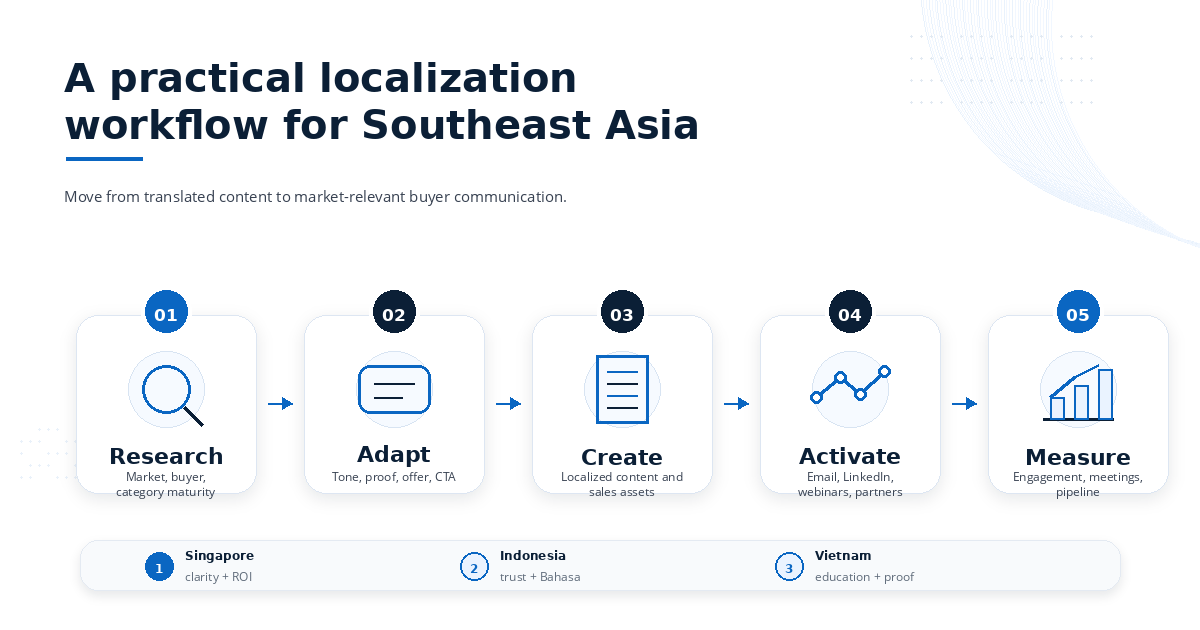
Country-Specific Localization Framework
Use this five-step process.
Step 1 — Research
Understand:
- buyer role;
- market maturity;
- language needs;
- business culture;
- common objections;
- local proof gaps;
- preferred channels.
Step 2 — Adapt
Adjust:
- positioning;
- tone;
- proof;
- CTA;
- examples;
- stakeholder messaging.
Step 3 — Create
Build:
- landing pages;
- sales decks;
- one-pagers;
- case studies;
- LinkedIn posts;
- email templates;
- webinars;
- buyer enablement assets.
Step 4 — Activate
Use content across:
- outbound;
- LinkedIn;
- webinars;
- partner campaigns;
- events;
- sales follow-up;
- nurture.
Step 5 — Measure
Track:
- engagement by country;
- reply quality;
- meetings booked;
- meetings held;
- sales acceptance;
- pipeline created;
- objections reduced;
- content-assisted opportunities.
Localization Scorecard
Score each area from 1 to 5.
| Area | 1 — Weak | 3 — Developing | 5 — Strong |
|---|---|---|---|
| Language fit | Same English copy everywhere | Some translated assets | Country-specific language strategy |
| Market relevance | Generic Asia message | Some local references | Clear country-specific positioning |
| Buyer insight | Broad persona assumptions | Basic persona mapping | Role, maturity, and stakeholder-specific messaging |
| Proof | Global case studies only | Regional examples | Local, regional, or highly comparable proof |
| Tone | Same tone everywhere | Some tone adaptation | Market-appropriate voice and CTA |
| Sales alignment | Marketing-only content | Sales uses some assets | Localized assets embedded in sales process |
| Channels | Same campaign everywhere | Some channel changes | Country-specific channel activation |
| Buyer enablement | None | Basic one-pagers | Localized business case, FAQ, and decision support |
| Measurement | Traffic only | Leads and engagement | Pipeline influence and objection reduction |
| Feedback loop | No review | Occasional updates | Sales feedback improves localization continuously |
Score Interpretation
| Total Score | Recommendation |
|---|---|
| 42–50 | Strong localization foundation; optimize by segment |
| 34–41 | Good foundation; improve proof, sales alignment, or measurement |
| 25–33 | Localization exists but may not support conversion strongly |
| Below 25 | Rebuild localization strategy before scaling campaigns |
Need Country-Specific Content for Southeast Asia?
Expand In Asia helps B2B companies localize go-to-market content for Asian markets through:
- ICP and buyer research;
- country-specific messaging;
- LinkedIn and email outreach;
- sales enablement assets;
- appointment setting;
- campaign feedback;
- localized GTM execution.
Talk to Expand In Asia about localizing your content for Singapore, Indonesia, and Vietnam →
Next Steps With Expand In Asia
Country-specific localization is not a cosmetic exercise.
It affects whether buyers understand you, trust you, and believe your solution fits their market.
For Singapore, prioritize clarity, ROI, and regional business logic.
For Indonesia, prioritize Bahasa Indonesia support, trust, relationships, and local credibility.
For Vietnam, prioritize practical education, Vietnamese-language accessibility, implementation clarity, and step-by-step proof.
For more on this topic, read:
Content Localization vs. Translation
For broader market-entry planning, read:
Go-to-Market (GTM) Strategies for Asia
Schedule a consultation with Expand In Asia →
Ready to Implement These Strategies?
Book a free 30-minute strategy session where we’ll audit your current growth approach and identify your highest-leverage opportunities in Asian markets.
Frequently Asked Questions
1. What is content localization?
Content localization is the process of adapting content to fit a specific market’s language, culture, buyer expectations, proof requirements, tone, channels, and decision-making context.
2. How is localization different from translation?
Translation changes words from one language to another.
Localization adapts the message for the market. It may change examples, proof points, CTA, tone, visuals, content format, and sales follow-up.
3. Is English enough for Singapore B2B content?
English is widely used in Singapore business communication, but that does not mean global English content is automatically effective. Singapore content should still be localized for regional relevance, business clarity, and buyer expectations.
4. Do B2B companies need Bahasa Indonesia content?
Often, yes—especially when targeting local business teams, operational stakeholders, broader enterprise audiences, government-adjacent sectors, or relationship-led campaigns. Bahasa Indonesia can support trust, accessibility, and internal sharing.
5. Should companies localize content into Vietnamese?
If targeting local Vietnamese buyers, operational stakeholders, or broader market education, Vietnamese localization can be important. It can help explain the problem, solution, implementation path, and business case more clearly.
6. Which content assets should be localized first?
Start with assets closest to conversion:
- landing pages;
- sales decks;
- email and LinkedIn messaging;
- case studies;
- webinar content;
- buyer enablement materials;
- proposal templates.
7. Can one Southeast Asia campaign work across Singapore, Indonesia, and Vietnam?
A single strategic theme can work, but the execution should change by country. The message, proof, tone, CTA, language, and channel mix should be adapted.
8. How do you measure localization success?
Measure:
- engagement by country;
- reply quality;
- meetings booked;
- meetings held;
- sales acceptance;
- pipeline value;
- conversion by market;
- objections reduced;
- content-assisted opportunities.