How AI is Transforming Lead Qualification in B2B Sales Pipelines
From manual scoring to smarter, faster, and more consistent sales-ready lead prioritisation
Lead qualification used to rely heavily on human judgement.
Sales and marketing teams would review form submissions, job titles, company names, email domains, website behaviour, CRM notes, and maybe a few firmographic filters before deciding whether a lead was worth sending to sales.
That process worked when lead volume was manageable.
But modern B2B pipelines are more complex.
Leads can come from:
- LinkedIn outreach;
- cold email;
- webinars;
- paid campaigns;
- website forms;
- product trials;
- events;
- referrals;
- partner campaigns;
- content downloads;
- chatbots;
- CRM reactivation;
- intent data platforms.
The problem is no longer simply generating more leads.
The harder problem is knowing which leads deserve attention first.
AI is changing that.
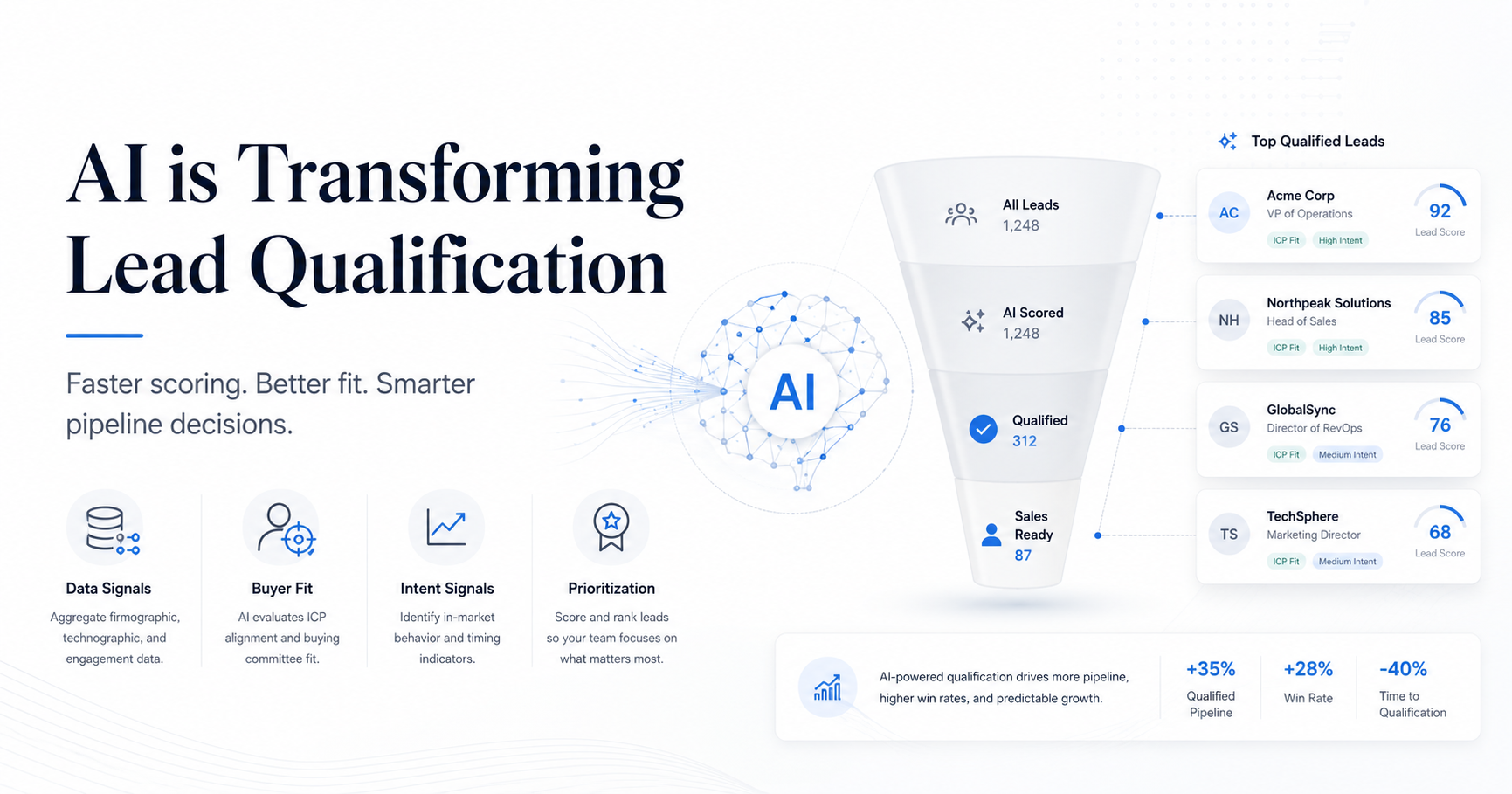
Used properly, AI can help B2B teams identify stronger-fit accounts, detect intent signals, prioritise sales-ready prospects, summarise buyer context, route leads faster, and reduce the amount of manual work required to qualify opportunities.
Salesforce’s 2024 State of Sales coverage reported that 83% of sales teams using AI saw revenue growth, compared with 66% of teams without AI. McKinsey also describes AI-powered opportunity identification and personalisation as important ways B2B sales leaders can improve performance.
But AI does not replace qualification strategy.
It improves the qualification system when the company already knows what a good lead looks like.
- TL;DR — Key Takeaways
- AI helps sales teams prioritise better. It can score leads using firmographic, behavioural, intent, engagement, and CRM signals.
- AI improves speed. Leads can be enriched, scored, routed, and summarised faster than manual review alone.
- AI does not fix a weak ICP. If your qualification criteria are unclear, AI will simply automate confusion.
- AI is most useful when paired with human judgement. Sales teams still need to validate context, urgency, buying influence, and fit.
- Lead scoring is becoming more dynamic. Instead of static points for job title or company size, AI can update scores as new signals appear.
- Pipeline quality matters more than lead volume. AI should improve sales-accepted opportunities, meeting quality, and conversion—not just create more “qualified” labels.
- Data quality is still the foundation. Bad CRM data, duplicate records, outdated titles, and unclear source tracking will reduce AI accuracy.
If you only do one thing: define your sales-qualified lead criteria before implementing AI scoring or automation.
Who This Comparison Is For (and Not For)
This Guide Is For
- B2B companies receiving leads from multiple channels.
- Sales and marketing teams struggling to prioritise which leads sales should contact first.
- SDR and BDR teams qualifying inbound, outbound, webinar, event, and product-led leads.
- RevOps teams improving CRM scoring, routing, enrichment, and reporting.
- SaaS, MSP, cybersecurity, fintech, HR tech, cloud, data, AI, and professional-services companies.
- Founders and sales leaders trying to reduce wasted time on poor-fit leads.
- Teams expanding into Asia that need better lead quality before scaling outreach.
This guide is especially useful if your team faces problems such as:
- too many leads and not enough sales capacity;
- inconsistent qualification between marketing and sales;
- slow lead follow-up;
- poor CRM data hygiene;
- weak meeting-to-opportunity conversion;
- high no-show rates;
- SDRs spending too much time researching accounts manually;
- sales teams rejecting “qualified” leads from marketing.
This Guide Is Not For
This guide may be less useful if:
- your company has no defined ICP;
- your CRM data is too messy to support reliable scoring;
- your team wants AI to replace human sales judgement entirely;
- you have very low lead volume and can manually review every account;
- your product is purely transactional and does not require meaningful qualification;
- your team is not prepared to update process, routing, and feedback loops.
Practical fit check: AI works best when it improves an existing qualification framework. It should not be used as a shortcut for unclear targeting, weak segmentation, or poor sales process.
1. What Lead Qualification Means in B2B Sales
Lead qualification is the process of deciding whether a lead is worth sales attention.
A lead may look promising because someone:
- downloaded a guide;
- attended a webinar;
- accepted a LinkedIn request;
- replied to an email;
- visited a pricing page;
- started a free trial;
- asked for information;
- spoke with an SDR.
But activity does not always mean fit.
A properly qualified B2B lead should usually match several conditions:
| Qualification Area | What It Means |
|---|---|
| Account fit | The company matches your target industry, size, geography, maturity, and use case |
| Persona fit | The contact is a decision-maker, influencer, evaluator, or credible internal referrer |
| Problem fit | The account has a relevant business pain, initiative, or trigger |
| Timing | There is a current or foreseeable reason to engage |
| Authority or influence | The person can influence the buying process or introduce the right stakeholder |
| Commercial viability | The account can realistically support your price point and sales effort |
| Engagement quality | The interaction shows meaningful interest, not just casual activity |
AI can help evaluate these factors more consistently, but the company must define them first.
2. Why Traditional Lead Qualification Breaks Down
Traditional qualification often depends on static rules.
For example:
- +10 points if the contact is a director;
- +10 points if the company has more than 200 employees;
- +5 points if they open an email;
- +20 points if they visit the pricing page;
- +30 points if they request a demo.
This can be useful, but it has limitations.
Problem 1 — Static Scores Miss Context
A junior manager at a perfect-fit account may be more valuable than a senior executive at a poor-fit account.
Static scoring often struggles with that nuance.
Problem 2 — Engagement Is Not Always Intent
Someone may download a guide for research, education, competitor analysis, or personal learning.
That does not mean they are sales-ready.
Problem 3 — Manual Research Slows Follow-Up
Sales teams often need to check:
- company size;
- industry;
- role;
- funding;
- hiring;
- recent news;
- technology stack;
- LinkedIn profile;
- CRM history.
That slows down response time.
Problem 4 — Sales and Marketing Disagree
Marketing may mark a lead as qualified because it hit a score threshold.
Sales may reject it because the account has no budget, no urgency, or no decision authority.
Problem 5 — Lead Volume Is Fragmented
Modern B2B leads come from many channels.
Without automation, teams struggle to compare a webinar attendee, a LinkedIn reply, a product signup, and a cold email response consistently.
3. How AI Changes Lead Qualification
AI changes lead qualification by making the process more dynamic, data-driven, and context-aware.
Instead of relying only on fixed rules, AI can analyse patterns across multiple signals.
AI Can Help With
- lead scoring;
- account prioritisation;
- contact enrichment;
- intent detection;
- CRM summarisation;
- duplicate detection;
- routing;
- next-best action recommendations;
- buyer behaviour analysis;
- sales call summaries;
- pipeline risk detection.
HubSpot’s 2025 sales trends coverage notes that sales teams are using AI for prospecting, lead qualification, and research, freeing up time that was previously spent reviewing lists manually.
The Shift
| Traditional Qualification | AI-Enhanced Qualification |
|---|---|
| Static scoring | Dynamic scoring |
| Manual research | Automated enrichment |
| One-dimensional engagement | Multi-signal analysis |
| Generic lead routing | Fit-based and priority-based routing |
| Slow handoff | Faster sales-ready context |
| Limited feedback loop | Continuous model improvement |
| Activity-based scoring | Conversion-likelihood scoring |
AI does not eliminate human review. It helps sales teams spend more time on the leads that are most likely to matter.
4. Use Case 1 — AI Lead Scoring
AI lead scoring uses data to estimate which leads are most likely to convert.
It can consider many factors at once:
- company size;
- industry;
- geography;
- job title;
- seniority;
- department;
- website behaviour;
- content engagement;
- email replies;
- CRM history;
- intent signals;
- product usage;
- event attendance;
- past conversion patterns.
Salesforce describes AI-powered lead scoring as a way to identify leads most likely to convert into customers.
Example AI Score
| Signal | Example |
|---|---|
| Firmographic fit | Mid-market SaaS company in Singapore |
| Persona fit | VP Sales or Founder |
| Engagement | Attended webinar and replied to follow-up |
| Intent | Viewed pricing or market-entry page |
| CRM history | No open opportunity but past engagement |
| Score | 87 / 100 |
| Recommended action | SDR follow-up within 24 hours |
Why It Helps
AI scoring can help sales teams:
- reduce time spent on weak-fit leads;
- prioritise accounts with stronger buying signals;
- identify hidden high-fit leads;
- route better leads faster;
- align marketing and sales around quality.
Important Warning
AI scores are only as good as the data and assumptions behind them.
A high score should trigger action, not blind trust.
5. Use Case 2 — Data Enrichment and Account Research
Lead qualification often fails because the original lead data is incomplete.
A form submission may only include:
- name;
- email;
- company;
- job title.
That is not enough to qualify properly.
AI and enrichment tools can add context such as:
- industry;
- employee count;
- headquarters;
- office locations;
- funding stage;
- recent hiring;
- technology stack;
- website category;
- LinkedIn profile;
- company growth signals;
- relevant news;
- potential competitors;
- regional presence.
Before Enrichment
| Field | Value |
|---|---|
| Name | Sarah Lim |
| sarah@company.com | |
| Company | Company X |
| Title | Director |
After Enrichment
| Field | Value |
|---|---|
| Company size | 250 employees |
| Industry | B2B SaaS |
| Location | Singapore |
| Regional relevance | APAC HQ |
| Buyer role | Revenue leader |
| Trigger | Hiring SDRs across ASEAN |
| ICP fit | Strong |
| Suggested message | Pipeline scaling and regional outbound support |
This makes the handoff more useful.
6. Use Case 3 — Intent and Engagement Signal Detection
AI can help identify which leads are showing meaningful interest.
Signals may include:
- repeat website visits;
- pricing page views;
- multiple content downloads;
- webinar attendance;
- high-intent search behaviour;
- product trial usage;
- LinkedIn engagement;
- email reply sentiment;
- event participation;
- competitor comparison page visits.
Not All Signals Are Equal
A buyer who opens one newsletter is not the same as a buyer who:
- attends a product webinar;
- visits a pricing page;
- views a case study;
- invites colleagues to a trial;
- replies with a business question.
AI can help weigh these differences.
Intent Signal Categories
| Signal Type | Example | Qualification Value |
|---|---|---|
| Low intent | Blog view | Awareness |
| Moderate intent | Guide download | Education / research |
| High intent | Demo request | Active interest |
| Very high intent | Pricing + sales reply + stakeholder involvement | Sales-ready |
The goal is to separate curiosity from commercial momentum.
7. Use Case 4 — Lead Prioritisation and Routing
AI can help decide which lead should go where.
For example:
| Lead Type | Recommended Route |
|---|---|
| High-fit enterprise account | Senior AE |
| Mid-market fit with clear interest | SDR qualification |
| Low-fit but engaged | Nurture |
| Existing customer expansion signal | Account manager |
| Product signup from target account | Sales-assisted motion |
| Student / vendor / competitor | Disqualify |
Why Routing Matters
Slow or incorrect routing creates pipeline leakage.
A high-fit lead may wait too long.
A low-fit lead may waste AE time.
An existing customer may be treated like a new prospect.
AI can reduce this friction by recommending routes based on fit, intent, account ownership, and CRM history.
Human Check Still Matters
AI can recommend routing.
Sales operations should still define ownership rules and exceptions.
8. Use Case 5 — Conversation Intelligence and Qualification Notes
AI can support qualification after the first conversation.
Conversation intelligence tools can:
- record calls;
- transcribe conversations;
- summarise key points;
- identify objections;
- capture next steps;
- detect competitor mentions;
- highlight budget or timing references;
- update CRM notes.
This helps sales teams avoid losing important context.
Example AI-Generated Qualification Summary
| Area | Summary |
|---|---|
| Pain | Team struggles to convert webinar leads into qualified meetings |
| Current process | Manual follow-up by marketing coordinator |
| Timing | Reviewing vendors this quarter |
| Decision-maker | Head of Growth and CEO involved |
| Objection | Concerned about outsourced quality |
| Next step | Send case study and schedule discovery call |
| Qualification | Strong fit |
Why It Helps
It improves:
- handoff quality;
- coaching;
- CRM completeness;
- follow-up accuracy;
- sales-manager visibility;
- pipeline forecasting.
9. Use Case 6 — Predictive Pipeline Quality
AI can also help evaluate pipeline health.
Beyond scoring leads, AI can help identify:
- which opportunities are likely to progress;
- which leads are at risk of going cold;
- which accounts resemble past customers;
- which segments produce better conversion;
- which channels create higher-quality pipeline;
- which SDR behaviours correlate with accepted opportunities.
McKinsey’s B2B sales AI guidance includes AI-powered opportunity identification as one way sales leaders can improve commercial performance.
Example Predictive Insights
- Webinar leads from Singapore SaaS companies convert better than generic guide downloads.
- LinkedIn replies from founders produce fewer meetings but higher opportunity value.
- Product trial signups from companies above 200 employees deserve faster SDR follow-up.
- Leads with both intent signals and firmographic fit outperform leads with only engagement.
These insights help teams improve resource allocation.
10. What AI Should Not Decide Alone
AI can support qualification, but some decisions still need human judgement.
AI Should Not Fully Own
| Decision | Why Human Review Matters |
|---|---|
| Strategic account prioritisation | Some accounts matter for brand, partnerships, or market entry beyond score |
| Complex buying influence | Job titles do not always reveal real influence |
| Cultural context | Market nuance and relationship expectations may not be captured in data |
| Disqualification | A low score may miss a hidden opportunity |
| Enterprise qualification | Large deals often require human interpretation |
| Sensitive follow-up | Tone, timing, and relationship history matter |
Gartner’s 2026 B2B buyer research reported that 67% of surveyed B2B buyers preferred a rep-free experience, showing that buyers increasingly want control over the buying journey. But that does not remove the need for sales judgement. It means human sales involvement must be more relevant, better timed, and better informed.
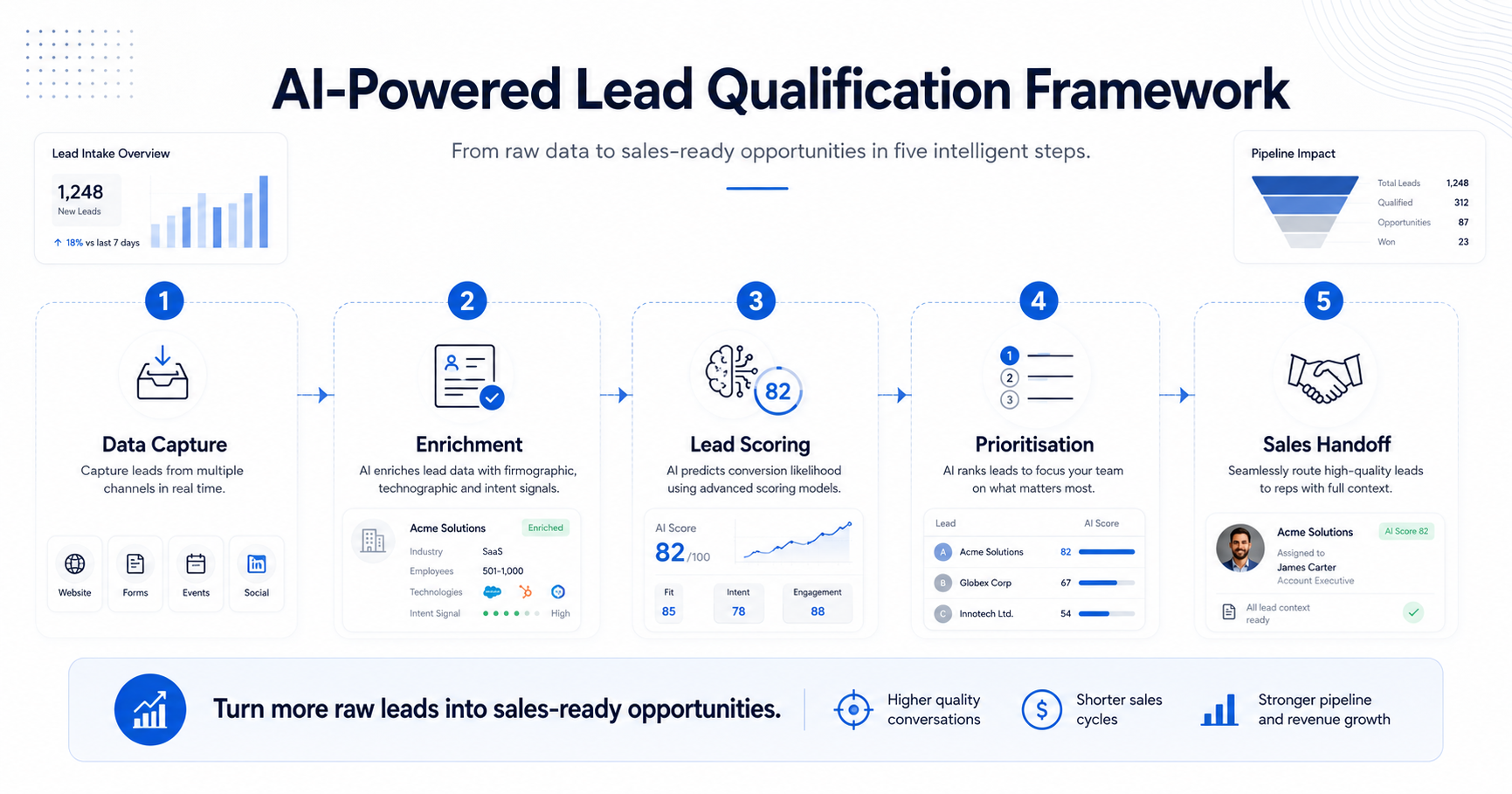
11. AI-Powered Lead Qualification Framework
A practical AI-enhanced qualification process has five stages.
Step 1 — Data Capture
Collect leads from:
- website forms;
- LinkedIn;
- cold email;
- webinars;
- events;
- product trials;
- referrals;
- partner campaigns;
- chat.
Step 2 — Enrichment
Add:
- company size;
- industry;
- role;
- seniority;
- location;
- technology stack;
- growth signals;
- CRM history;
- account ownership.
Step 3 — Lead Scoring
Score based on:
- ICP fit;
- persona fit;
- intent;
- engagement;
- timing;
- historical conversion patterns.
Step 4 — Prioritisation
Rank leads into:
- sales-ready;
- SDR qualification;
- nurture;
- disqualified;
- account manager follow-up.
Step 5 — Sales Handoff
Send sales a complete context package:
- why the lead scored highly;
- what the buyer did;
- what problem may be relevant;
- what message to use;
- recommended next step.
What Good Looks Like
| Stage | Output |
|---|---|
| Data Capture | Complete lead record |
| Enrichment | Better account and contact context |
| Scoring | Prioritised fit and intent ranking |
| Routing | Correct owner and next action |
| Handoff | Sales-ready context |
12. Implementation Checklist
Before implementing AI lead qualification, prepare the foundation.
Strategy
- Define ICP.
- Define MQL, SQL, SAL, and opportunity criteria.
- Agree on disqualification rules.
- Clarify lead ownership.
- Set follow-up SLAs.
Data
- Clean CRM records.
- Remove duplicates.
- Standardise fields.
- Review source tracking.
- Validate email and company data.
- Fix missing account ownership.
Scoring
- Identify historical conversion patterns.
- Decide which signals matter.
- Separate fit signals from intent signals.
- Weight account quality more than vanity engagement.
- Review scoring thresholds regularly.
Process
- Define routing rules.
- Create feedback loops.
- Require sales rejection reasons.
- Monitor lead-to-opportunity conversion.
- Audit AI recommendations.
Governance
- Limit data access.
- Review vendor data practices.
- Document how scores are used.
- Avoid unnecessary personal data.
- Align with applicable data protection requirements.
14. Metrics to Track
AI lead qualification should improve commercial outcomes.
Input Metrics
- lead volume by source;
- data completeness;
- enrichment success rate;
- duplicate rate;
- invalid email rate.
Scoring Metrics
- percentage of leads scored;
- score distribution;
- high-score lead volume;
- scoring accuracy over time.
Sales Metrics
- speed to lead;
- SDR acceptance rate;
- sales acceptance rate;
- meeting booked rate;
- meeting held rate;
- disqualification rate.
Pipeline Metrics
- lead-to-opportunity conversion;
- opportunity value;
- win rate;
- sales-cycle length;
- pipeline generated by source.
Quality Metrics
- sales rejection reasons;
- false positives;
- false negatives;
- lead source quality;
- segment-level conversion.
What Success Looks Like
A successful AI qualification system should help your team:
- respond faster;
- waste less time on poor-fit leads;
- improve sales acceptance;
- identify better accounts;
- increase qualified pipeline;
- improve reporting clarity.
Need Better Lead Qualification Before Scaling Outreach?
Expand In Asia helps B2B companies improve lead generation and qualification through:
- ICP definition;
- lead-list building;
- appointment setting;
- LinkedIn and email outreach;
- lead scoring frameworks;
- sales-ready handoff;
- CRM reporting;
- Asia-focused GTM execution.
Talk to Expand In Asia about improving your lead qualification process →
15. Next Steps With Expand In Asia
AI is transforming lead qualification, but the fundamentals still matter.
You still need:
- clear ICP criteria;
- accurate data;
- relevant lead sources;
- qualified conversations;
- sales feedback;
- CRM discipline;
- human judgement.
AI makes the system faster and smarter.
It does not remove the need for strategy.
For broader qualification tactics, read:
10 Best B2B Qualified Lead Generation Strategies for 2026
For appointment setting and handoff strategy, read:
The Complete Guide to MSP Appointment Setting in 2026
Schedule a consultation with Expand In Asia →
Ready to Implement These Strategies?
Book a free 30-minute strategy session where we’ll audit your current growth approach and identify your highest-leverage opportunities in Asian markets.
Frequently Asked Questions
1. What is AI lead qualification?
AI lead qualification uses artificial intelligence to evaluate, score, prioritise, and route leads based on data such as company fit, buyer role, engagement, intent, CRM history, and historical conversion patterns.
2. How is AI lead qualification different from traditional lead scoring?
Traditional scoring often uses fixed rules, such as assigning points for job title or website visits.
AI-enhanced scoring can analyse more signals, update dynamically, and identify patterns that may not be obvious through manual rules.
3. Can AI replace SDRs?
Not completely.
AI can reduce manual research, prioritise leads, summarise context, and recommend next steps. SDRs are still needed for judgement, conversations, qualification, objection handling, and relationship-building.
4. What data does AI need for lead qualification?
Useful data includes:
- company size;
- industry;
- location;
- job title;
- seniority;
- website behaviour;
- content engagement;
- CRM history;
- product usage;
- event attendance;
- email replies;
- intent signals.
5. What is the biggest risk of AI lead scoring?
The biggest risk is trusting the score without understanding the inputs.
If CRM data is poor or qualification criteria are unclear, AI can prioritise the wrong leads.
6. How should sales and marketing use AI lead scores?
Use scores as prioritisation signals, not final decisions.
Sales and marketing should review conversion data, rejected leads, and opportunity outcomes to keep improving the scoring model.
What does a sales-ready AI-qualified lead look like?
A sales-ready lead should have:
- strong account fit;
- relevant buyer role;
- clear engagement or intent;
- commercial context;
- clean contact data;
- ownership assigned;
- recommended next step;
- enough notes for sales to follow up properly.
7. Is AI lead qualification useful for Asia-focused B2B sales?
Yes, especially when companies are managing multiple markets, buyer roles, lead sources, and regional qualification criteria.
However, AI should be combined with local market knowledge because buyer behaviour, role titles, decision-making structures, and trust signals can vary significantly across Asian markets.