Top B2B Lead Generation Channels for SaaS Companies Entering Southeast Asia
A practical channel strategy for building qualified SaaS pipeline across Singapore, Malaysia, Indonesia, Vietnam, Thailand, and the Philippines
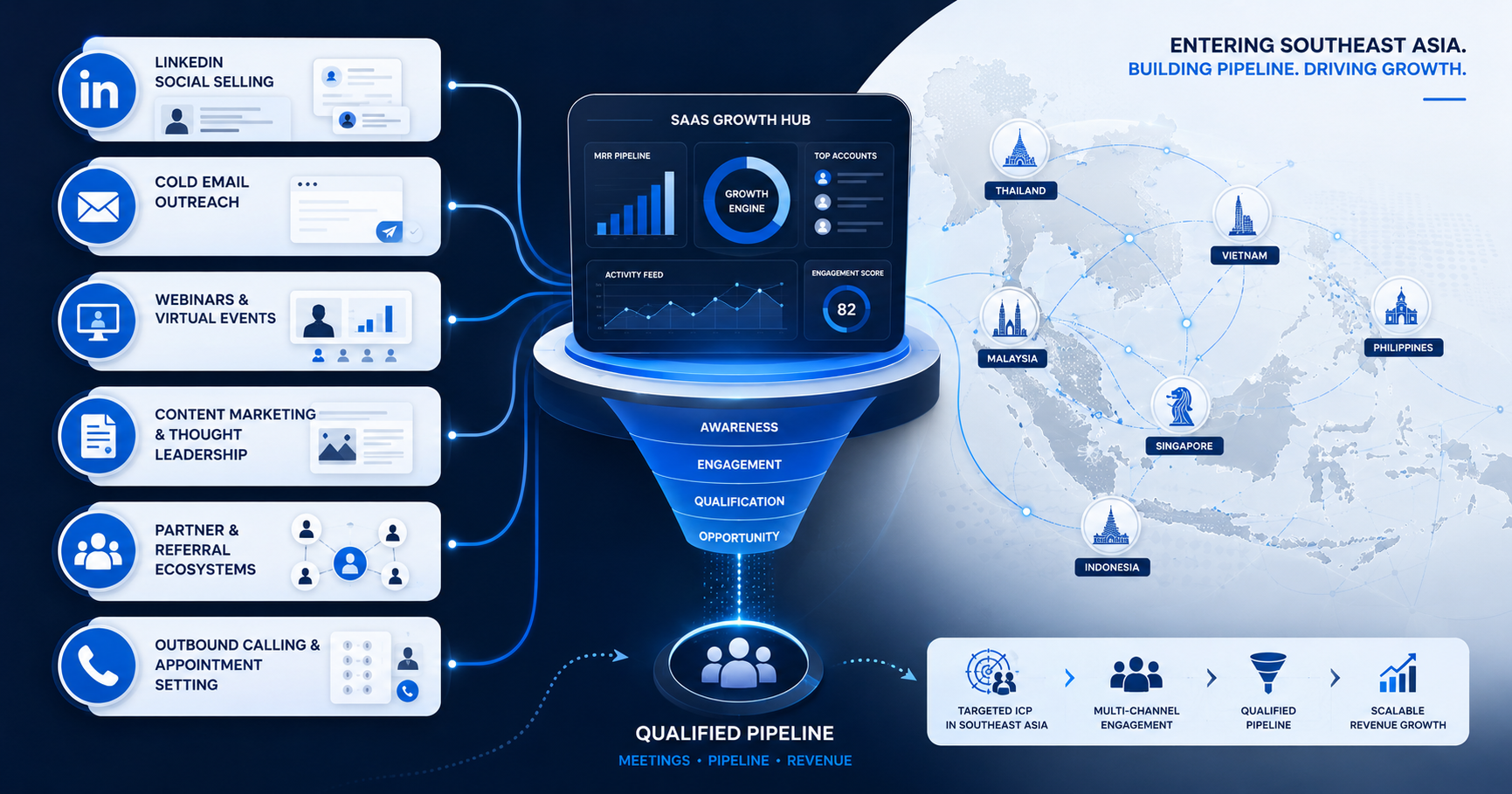
Southeast Asia is attractive for SaaS companies because the region is large, digital adoption is rising, and many businesses are modernising how they buy, manage, and scale technology.
The opportunity is real.
The e-Conomy SEA 2025 report by Google, Temasek, and Bain states that Southeast Asia’s digital economy is on track to surpass US$300 billion in GMV, with both GMV and revenue growing around 15% year over year.
But entering Southeast Asia is not as simple as launching one campaign across the whole region.
A SaaS company selling into Singapore may need a different lead generation motion from one targeting Indonesia, Vietnam, Thailand, Malaysia, or the Philippines. Buyer maturity, language, trust signals, decision-making hierarchy, procurement expectations, and preferred channels can vary significantly.
That is why channel selection matters.
The best SaaS companies do not ask:
“Which lead generation channel is best?”
They ask:
“Which channel should we use for this market, this buyer, this sales motion, and this stage of market entry?”
This guide breaks down the top B2B lead generation channels for SaaS companies entering Southeast Asia and explains how to prioritise them.
- TL;DR — Key Takeaways
- There is no single best SaaS lead generation channel for Southeast Asia. Channel performance depends on country, buyer maturity, deal size, language, and trust requirements.
- LinkedIn works well for visibility, social selling, founder-led outreach, and senior buyer engagement.
- Cold email works well for scale, account coverage, and structured testing.
- Webinars and virtual events are useful for educating the market and creating multi-stakeholder engagement.
- Content and thought leadership help build credibility before buyers are ready to speak with sales.
- Partner and referral ecosystems matter in relationship-led markets.
- Appointment setting and outbound calling help convert interest into qualified conversations.
- Product-led growth can support SaaS expansion, but it should be connected to sales when deal size, onboarding complexity, or enterprise requirements increase.
- The strongest Southeast Asia strategy is usually multichannel.
If you only do one thing: start with your ICP and target market, then choose channels based on trust, speed, scalability, and buyer accessibility.
Who This Comparison Is For (and Not For)
This Guide Is For
- SaaS companies entering Southeast Asia for the first time.
- B2B SaaS founders validating demand in Singapore, Malaysia, Indonesia, Vietnam, Thailand, or the Philippines.
- CROs and sales leaders deciding where to invest outbound and demand generation resources.
- Marketing teams building awareness and demand in new Asian markets.
- SDR and BDR teams creating outbound pipeline across Southeast Asia.
- Product-led SaaS companies deciding when to add sales-assisted lead generation.
- Enterprise SaaS companies that need to reach decision-makers and buying committees.
This guide is especially relevant if your SaaS company sells:
- cybersecurity;
- cloud infrastructure;
- HR technology;
- fintech software;
- sales and marketing technology;
- collaboration tools;
- data and AI platforms;
- compliance software;
- vertical SaaS;
- enterprise workflow platforms.
This Guide Is Not For
This guide may be less useful if:
- you are selling a purely consumer app;
- your SaaS product has no clear ICP yet;
- your pricing is too low to support outbound or sales-assisted channels;
- your team wants one generic campaign for all Southeast Asian markets;
- you only want paid ads without outbound, partnerships, or sales follow-up;
- you cannot support demos, onboarding, or localised discovery conversations.
Practical fit check: This guide is for SaaS companies that want qualified B2B pipeline in Southeast Asia—not just website traffic, signups, or unqualified leads.
1. Why Southeast Asia Needs a Channel Strategy
Southeast Asia is not one market.
A SaaS company entering the region may need to navigate:
- Singapore as a regional headquarters and validation market;
- Malaysia as a digitally mature adjacent market;
- Indonesia as a large, relationship-driven growth market;
- Vietnam as a fast-growing business and technology market;
- Thailand as a market with strong local business dynamics;
- the Philippines as a highly English-proficient services and technology market.
Each market can differ in:
- buyer accessibility;
- language;
- procurement complexity;
- trust requirements;
- SaaS maturity;
- channel preference;
- price sensitivity;
- sales-cycle length;
- partner importance.
That means a lead generation channel that works in one country may not perform the same way in another.
For example:
- LinkedIn may work strongly for Singapore-based regional leaders.
- Cold email may help test multiple segments across Malaysia and the Philippines.
- Partner-led introductions may matter more in relationship-heavy enterprise markets.
- Webinars may help educate buyers in markets where the category is still emerging.
- Product-led growth may work for lower-friction SaaS products but may not be enough for complex enterprise sales.
A proper channel strategy helps your team avoid spreading budget too thin across every possible tactic.
2. How to Choose the Right Lead Generation Channels
Before selecting channels, define five things.
1. Target Market
Which country or countries are in scope?
Do not begin with “Southeast Asia” as one broad territory.
2. ICP
Which companies are most likely to buy?
Define:
- industry;
- company size;
- maturity stage;
- technology adoption level;
- budget fit;
- use case;
- buying trigger.
3. Buyer Persona
Who owns the problem?
Examples:
- CEO;
- founder;
- COO;
- CIO;
- CTO;
- CISO;
- HR director;
- finance director;
- head of sales;
- head of operations.
4. Sales Motion
Is the product:
- self-serve;
- sales-assisted;
- product-led;
- enterprise sales-led;
- channel-led;
- partner-led?
5. Trust Requirement
How much trust is needed before a buyer engages?
Higher-trust sales motions often require:
- founder visibility;
- referrals;
- events;
- content;
- local proof;
- strategic discovery.
Lower-friction SaaS products may rely more on:
- trials;
- paid acquisition;
- self-serve onboarding;
- product-led signals.
3. Channel 1 — LinkedIn Social Selling
LinkedIn is one of the most useful B2B lead generation channels for SaaS companies entering Southeast Asia, especially when targeting founders, executives, regional leaders, commercial teams, HR leaders, technology buyers, and professional-services firms.
Best For
- Singapore-based regional buyers;
- SaaS founders and operators;
- technology decision-makers;
- senior commercial leaders;
- relationship-building before outreach;
- social proof and thought leadership;
- founder-led sales.
Why It Works
LinkedIn gives buyers context.
They can see:
- your profile;
- company credibility;
- mutual connections;
- content;
- comments;
- events;
- professional background.
That matters when your SaaS brand is not yet well known in the region.
How SaaS Companies Should Use LinkedIn
Use LinkedIn to:
- map target accounts;
- identify decision-makers and influencers;
- engage before direct outreach;
- publish market-relevant content;
- connect with priority buyers;
- follow up after webinars or events;
- create soft entry points into accounts.
What to Post
Effective SaaS content includes:
- market observations;
- buyer pain points;
- product-use cases;
- implementation lessons;
- benchmark insights;
- customer stories;
- decision frameworks;
- expansion lessons;
- practical checklists.
Key Metrics
- profile views from target buyers;
- connection acceptance rate;
- reply rate;
- positive replies;
- conversations started;
- meetings booked;
- sales-accepted opportunities.
Common Mistake
Treating LinkedIn like a pitch inbox.
The first message should start a conversation, not force a demo.
4. Channel 2 — Cold Email Outreach
Cold email remains a strong SaaS lead generation channel because it is structured, measurable, and scalable.
Best For
- testing new markets;
- reaching multiple stakeholders;
- account-based outbound;
- follow-up after LinkedIn engagement;
- structured messaging tests;
- targeting operational and functional buyers.
Why It Works
Cold email allows you to:
- test different ICP segments;
- reach several contacts per account;
- measure replies and conversions;
- run controlled sequences;
- share resources and case studies;
- coordinate follow-up in CRM.
What Makes Cold Email Work in Southeast Asia
Cold email works best when:
- the list is accurate;
- the buyer role is specific;
- the message is short;
- the pain point is relevant;
- the CTA is low-friction;
- the sender is credible;
- follow-up is timely.
Sample SaaS Cold Email Structure
Subject: Quick question on [business problem]
Hi [Name],
Noticed [Company] is [relevant trigger or context].
We work with SaaS teams and B2B companies that are trying to [business outcome] without [common constraint].
Curious if [problem area] is something your team is actively looking at this quarter?
Best,
[Name]
Key Metrics
- delivery rate;
- bounce rate;
- reply rate;
- positive reply rate;
- meetings booked;
- meetings held;
- opportunity creation.
Common Mistake
Sending the same email across all Southeast Asian markets.
A Singapore regional leader and a local Indonesian enterprise buyer may need very different messaging.
5. Channel 3 — Webinars and Virtual Events
Webinars work well for SaaS companies because many buyers need education before they agree to a product conversation.
Best For
- educating new markets;
- category creation;
- multi-stakeholder engagement;
- regional campaigns;
- lead nurturing;
- partner co-marketing;
- product demonstrations;
- market-entry credibility.
Why It Works
A webinar gives buyers a reason to engage without committing to a sales call.
It also helps your team:
- identify interested accounts;
- capture attendee data;
- engage multiple stakeholders;
- test market topics;
- repurpose content;
- support sales follow-up.
Strong Webinar Topics for SaaS
Examples:
- “How Singapore-Based SaaS Teams Are Scaling Across ASEAN”
- “Cybersecurity Priorities for Southeast Asian Mid-Market Companies”
- “What HR Leaders in Southeast Asia Need to Know About AI Adoption”
- “How to Build a Regional Pipeline Before Hiring Local Sales Teams”
- “The SaaS Buyer’s Guide to [Problem] in 2026”
Follow-Up Sequence
After a webinar:
- thank attendees;
- send recording and slides;
- segment based on attendance and engagement;
- follow up with a relevant question;
- invite high-fit accounts to a diagnostic call;
- route qualified leads to sales.
Key Metrics
- registrations;
- attendance rate;
- target-account attendance;
- engagement;
- questions asked;
- meetings booked;
- opportunities created.
Common Mistake
Treating all registrants as sales-ready.
Attendance signals interest, but qualification still matters.
6. Channel 4 — Content Marketing and Thought Leadership
Content helps SaaS companies build trust before buyers are ready to speak with sales.
This is especially important in Southeast Asia, where buyers may need to understand:
- what the category does;
- why the problem matters;
- how the product fits their market;
- whether the vendor understands local realities;
- how the solution compares with internal alternatives.
LinkedIn and Edelman’s 2025 B2B Thought Leadership Impact Report found that thought leadership plays an important role in building trust, driving alignment, and opening doors with visible and hidden decision-makers.
Best For
- building awareness;
- educating buyers;
- influencing hidden stakeholders;
- supporting outbound;
- improving sales conversations;
- creating retargeting audiences;
- establishing regional credibility.
Content Formats That Work
- market guides;
- benchmark reports;
- comparison articles;
- buyer checklists;
- implementation guides;
- ROI calculators;
- customer stories;
- founder POV posts;
- webinar clips;
- short LinkedIn posts.
Strong SaaS Content Angles
- “How to Choose [Software Category] in Southeast Asia”
- “Singapore vs. Regional Rollout: What SaaS Buyers Should Consider”
- “The Cost of Manual [Workflow] for Mid-Market Companies”
- “What APAC Teams Get Wrong About [Category] Adoption”
- “How to Build a Business Case for [Software Category]”
Key Metrics
- target-account traffic;
- content engagement;
- downloads;
- demo assists;
- influenced pipeline;
- newsletter subscribers;
- sales conversations sourced by content.
Common Mistake
Publishing global content with no Southeast Asia relevance.
Local context increases credibility.
7. Channel 5 — Partner and Referral Ecosystems
Partnerships are often underestimated by SaaS companies entering Southeast Asia.
In many Asian markets, trust networks matter.
Best For
- markets where relationships matter;
- enterprise SaaS;
- complex implementation;
- regulated industries;
- channel-led sales;
- category education;
- local trust-building.
Potential Partners
- consulting firms;
- systems integrators;
- MSPs;
- cloud providers;
- industry associations;
- local agencies;
- regional resellers;
- venture capital firms;
- startup communities;
- event organisers;
- complementary SaaS vendors.
Why It Works
Partners can provide:
- credibility;
- introductions;
- local context;
- implementation support;
- co-marketing;
- procurement guidance;
- market feedback.
Partner-Led Lead Generation Tactics
- joint webinars;
- co-authored guides;
- referral agreements;
- marketplace listings;
- ecosystem roundtables;
- partner newsletters;
- reseller enablement;
- event sponsorships.
Key Metrics
- partner-sourced leads;
- partner-referred meetings;
- conversion rate;
- pipeline value;
- co-marketing registrations;
- partner-influenced opportunities.
Common Mistake
Expecting partners to produce leads without enablement.
Partners need messaging, training, proof, and a clear reason to refer.
8. Channel 6 — Outbound Calling and Appointment Setting
Calling is not dead.
It is simply more effective when combined with accurate data, relevant messaging, and prior digital touchpoints.
Best For
- converting interest into meetings;
- qualifying inbound or event leads;
- following up after email or LinkedIn engagement;
- reaching operational buyers;
- clarifying buying responsibility;
- appointment setting for complex SaaS.
Why It Works
A call can quickly clarify:
- whether the person is relevant;
- whether the problem exists;
- who owns the decision;
- whether timing is active;
- whether the account is worth pursuing.
Strong Calling Use Cases
- webinar follow-up;
- target-account follow-up;
- event attendee follow-up;
- post-email outreach;
- partner referral follow-up;
- trial-user qualification;
- account mapping.
What the Call Should Do
The call should not over-pitch.
It should:
- confirm relevance;
- ask one or two useful questions;
- identify fit;
- offer a clear next step;
- document the conversation.
Key Metrics
- connect rate;
- meaningful conversations;
- qualified meetings;
- no-show rate;
- sales acceptance;
- opportunity creation.
Common Mistake
Calling a weak list with a generic script.
A bad list makes calling look worse than it is.
9. Channel 7 — Product-Led Growth and Free Trials
For SaaS companies, product-led growth can be a powerful channel when the product is easy to try, understand, and adopt.
ProductLed’s 2025 PLG benchmark research surveyed more than 600 SaaS businesses and examined adoption of PLG models, free-model conversion, product-qualified leads, ownership, and PLG investment trends.
Best For
- low-friction SaaS products;
- clear user value;
- self-serve onboarding;
- product-qualified leads;
- bottom-up adoption;
- freemium or free trial offers.
Why It Works
PLG allows buyers to experience value before speaking with sales.
This can help in Southeast Asia when:
- buyers want proof before commitment;
- budgets are cautious;
- internal champions need evidence;
- decision-makers want usage data.
When PLG Needs Sales Support
PLG alone may not be enough when:
- deal size is high;
- implementation is complex;
- procurement is formal;
- security review is required;
- multiple stakeholders are involved;
- regional rollout is needed.
Product-Led Signals to Track
- signups by country;
- activated accounts;
- product usage;
- feature engagement;
- invited team members;
- repeat usage;
- trial-to-paid conversion;
- expansion signals;
- high-fit company domains.
Common Mistake
Treating every signup as equal.
A signup from a target enterprise account should not be handled the same way as a student, vendor, freelancer, or low-fit user.
10. Channel 8 — Paid LinkedIn and Retargeting
Paid channels can accelerate market entry when the audience is well defined.
Best For
- targeting regional decision-makers;
- promoting thought leadership;
- webinar registrations;
- report downloads;
- retargeting engaged accounts;
- building awareness in a new market.
Useful LinkedIn Ad Formats
- Sponsored Content;
- Thought Leader Ads;
- Document Ads;
- Lead Gen Forms;
- Event Ads;
- Conversation Ads.
LinkedIn says Lead Gen Forms use pre-filled professional profile data and can help marketers track cost per lead, lead form fill rate, and lead sources by audience segment.
How to Use Paid LinkedIn Properly
Do not start with a demo ad to a cold audience.
A better sequence:
- promote a market insight;
- retarget engaged buyers with a practical guide;
- invite them to a webinar;
- use a Lead Gen Form;
- qualify high-fit leads;
- route to sales.
Key Metrics
- cost per target engagement;
- lead form completion rate;
- cost per qualified lead;
- target-account engagement;
- webinar registrations;
- sales-accepted leads;
- pipeline influenced.
Common Mistake
Optimising for cheap leads instead of qualified SaaS buyers.
11. Channel 9 — Events, Roundtables, and Field Marketing
Even in digital-first SaaS, events still matter.
This is especially true when selling to senior buyers, enterprise accounts, regulated industries, or relationship-led markets.
Best For
- trust-building;
- executive engagement;
- enterprise SaaS;
- partner ecosystems;
- high-value accounts;
- regional credibility;
- market education.
Event Formats
- small executive roundtables;
- industry breakfasts;
- partner-hosted panels;
- customer workshops;
- SaaS implementation clinics;
- conference side meetings;
- private dinners;
- community meetups.
Why Events Work in Southeast Asia
Events create:
- face-to-face credibility;
- local presence;
- referral opportunities;
- deeper conversations;
- content for follow-up;
- stronger partner relationships.
How to Generate Leads From Events
Before the event:
- define target accounts;
- identify attendees;
- book meetings early;
- prepare relevant content.
During the event:
- focus on conversations, not badge scanning;
- qualify interest;
- document notes quickly.
After the event:
- follow up within 24–48 hours;
- reference the conversation;
- route qualified leads to sales;
- nurture non-ready contacts.
Common Mistake
Treating events as brand awareness only.
Events should feed pipeline, partner development, and content.
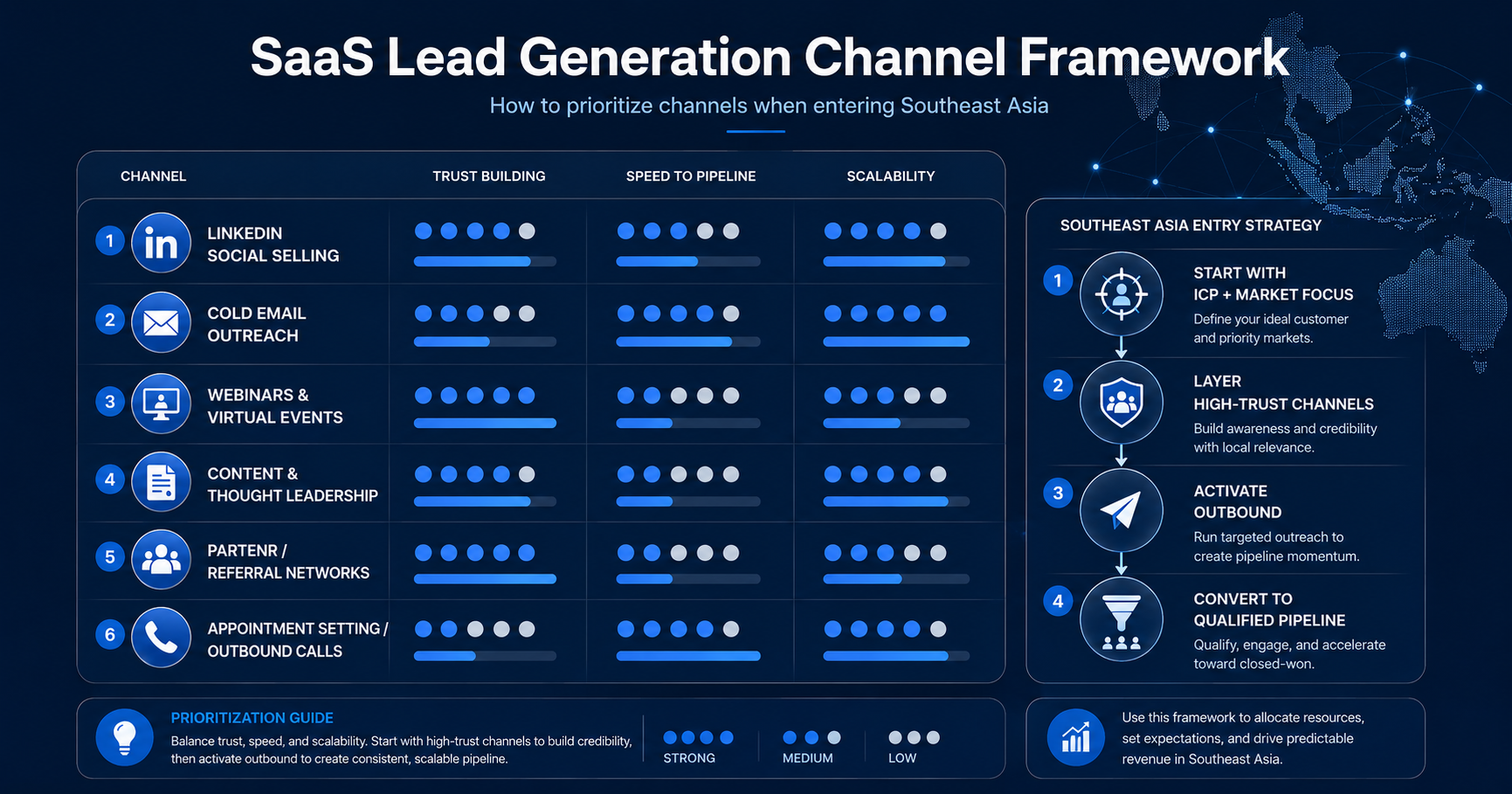
Channel Comparison Framework
| Channel | Trust Building | Speed to Pipeline | Scalability | Best Use Case |
| LinkedIn Social Selling | High | Medium | Medium | Senior buyers and relationship-building |
| Cold Email Outreach | Medium | High | High | Account coverage and outbound testing |
| Webinars / Virtual Events | High | Medium | Medium | Education and multi-stakeholder engagement |
| Content / Thought Leadership | High | Slow-Medium | High | Credibility and demand creation |
| Partner / Referral Ecosystems | Very High | Slow-Medium | Medium | Enterprise and relationship-led markets |
| Outbound Calling / Appointment Setting | Medium | High | Medium | Qualification and meeting conversion |
| Product-Led Growth | Medium | Medium | High | Low-friction SaaS and PQL generation |
| Paid LinkedIn / Retargeting | Medium-High | Medium | High | Awareness, retargeting, and content distribution |
| Events / Roundtables | Very High | Medium | Low-Medium | Senior relationships and enterprise trust |
How to Read This
- Choose cold email and calling when speed and testing matter.
- Choose LinkedIn and content when credibility and senior-buyer access matter.
- Choose partners and events when trust and local relationships matter.
- Choose PLG when your product can deliver value before sales involvement.
- Combine channels when the sale is complex.
Recommended Channel Mix by SaaS Stage
Early Market Validation
Best channels:
- LinkedIn social selling;
- cold email;
- founder-led outreach;
- small webinars;
- account research;
- appointment setting.
Goal:
Identify whether the ICP, message, and offer resonate in the target market.
First Pipeline Build
Best channels:
- cold email;
- LinkedIn outreach;
- webinar follow-up;
- calling;
- content;
- CRM-based nurture.
Goal:
Create repeatable qualified meetings and learn which segments respond.
Scaling Growth
Best channels:
- partner ecosystem;
- paid LinkedIn;
- thought leadership;
- events;
- PLG;
- account-based outbound;
- localised content.
Goal:
Expand from early traction into repeatable regional pipeline.
Enterprise Expansion
Best channels:
- executive LinkedIn outreach;
- referrals;
- field events;
- partner-led introductions;
- roundtables;
- account-based content;
- outbound calling.
Goal:
Build trust with complex buying committees.
Recommended Channel Mix by Southeast Asian Market Type
Singapore
Recommended mix:
- LinkedIn;
- cold email;
- content;
- webinars;
- paid LinkedIn;
- executive outreach.
Why:
Singapore has a high concentration of regional decision-makers and digitally active B2B buyers.
Malaysia
Recommended mix:
- cold email;
- LinkedIn;
- partner outreach;
- webinars;
- calling.
Why:
Strong fit for structured regional campaigns with a mix of digital and relationship-building channels.
Indonesia
Recommended mix:
- partnerships;
- referrals;
- LinkedIn;
- events;
- localised outbound;
- account-based selling.
Why:
Large market with strong relationship dynamics and a need for local credibility.
Vietnam
Recommended mix:
- educational content;
- webinars;
- partner channels;
- LinkedIn;
- targeted email;
- community engagement.
Why:
Education and market relevance can help build trust and category understanding.
Philippines
Recommended mix:
- cold email;
- LinkedIn;
- calling;
- webinars;
- appointment setting.
Why:
English-language outreach and call-based follow-up can support pipeline creation.
Thailand
Recommended mix:
- partners;
- localised content;
- events;
- LinkedIn;
- email support.
Why:
Local relevance and relationship-building are important, especially for more complex B2B sales.
Common Mistakes to Avoid
Mistake 1 — Launching Every Channel at Once
This spreads attention and budget too thin.
Start with a small channel mix that matches your ICP.
Mistake 2 — Treating Southeast Asia as One Market
Each country needs its own targeting assumptions.
Mistake 3 — Over-Relying on Paid Ads
Paid campaigns can generate leads, but many SaaS buyers still need nurturing, education, and sales follow-up.
Mistake 4 — Ignoring Local Proof
Global case studies may not be enough.
Where possible, use regional customers, comparable markets, or local partner credibility.
Mistake 5 — Using the Same CTA Everywhere
A demo CTA may work for active buyers.
For colder markets, a guide, webinar, consultation, or market-readiness discussion may work better.
Mistake 6 — Measuring Leads Instead of Pipeline
A high number of low-fit leads can waste sales time.
Track qualified meetings, sales acceptance, opportunity creation, and pipeline value.
Mistake 7 — Not Following Up Quickly
Webinar attendees, event contacts, and product signups lose momentum when follow-up is slow.
Mistake 8 — Weak CRM Tracking
If channel data is not tracked properly, you will not know which channel actually creates pipeline.
SaaS Lead Generation Channel Scorecard
Score each channel from 1 to 5.
| Criteria | Question |
| ICP Reach | Can this channel reach the right accounts and personas? |
| Trust Building | Does it help build credibility in the market? |
| Speed | Can it generate early conversations quickly? |
| Scalability | Can it be expanded without losing quality? |
| Cost Control | Can spend be managed and measured clearly? |
| Localisation | Can it be adapted by market and language? |
| Qualification | Can it produce sales-accepted leads? |
| CRM Visibility | Can outcomes be tracked properly? |
Score Interpretation
| Score | Recommendation |
| 33–40 | Prioritise this channel |
| 25–32 | Use as a supporting channel |
| 17–24 | Test carefully before scaling |
| Below 17 | Deprioritise for now |
Need Help Choosing the Right SaaS Lead Generation Channels in Southeast Asia?
Expand In Asia helps B2B SaaS companies:
- prioritise markets;
- define ICPs;
- build account lists;
- run LinkedIn and email outreach;
- support appointment setting;
- localise messaging;
- qualify leads;
- create pipeline across Southeast Asia.
Talk to Expand In Asia about your SaaS expansion strategy →
Next Steps With Expand In Asia
SaaS lead generation in Southeast Asia works best when channel strategy is tied to market reality.
The strongest programmes usually combine:
- targeted outbound;
- LinkedIn visibility;
- content and thought leadership;
- webinars;
- partner ecosystems;
- calling and qualification;
- CRM reporting;
- staged market expansion.
For more lead-generation tactics, read:
10 Best B2B Qualified Lead Generation Strategies for 2026
For broader expansion planning, read:
Go-to-Market (GTM) Strategies for Asia
Schedule a consultation with Expand In Asia →
Ready to Implement These Strategies?
Book a free 30-minute strategy session where we’ll audit your current growth approach and identify your highest-leverage opportunities in Asian markets.
Frequently Asked Questions
1. What is the best B2B lead generation channel for SaaS companies entering Southeast Asia?
There is no universal best channel.
LinkedIn is strong for visibility and senior buyer access. Cold email is strong for account coverage and testing. Webinars and content are strong for education. Partnerships and events are strong for trust. The best approach is usually multichannel.
2. Should SaaS companies start with Singapore?
Singapore is often a strong first market because of its regional HQ concentration, digital maturity, and access to senior buyers.
However, the right first market depends on your ICP, pricing, product maturity, customer proof, and ability to support local or regional sales conversations.
3. Does cold email work for SaaS in Southeast Asia?
Yes, when the list is accurate, the message is relevant, and follow-up is disciplined.
Cold email is especially useful for testing segments and reaching multiple stakeholders within target accounts.
4. Does LinkedIn work for SaaS lead generation in Southeast Asia?
Yes, particularly for founders, regional leaders, technology buyers, and professional communities.
LinkedIn works best when combined with profile credibility, useful content, and personalised outreach.
5. Are webinars still useful for SaaS lead generation?
Yes.
Webinars can educate the market, create intent signals, and give sales teams a reason to follow up. They are particularly useful for complex SaaS products or emerging categories.
6. Should SaaS companies use product-led growth in Southeast Asia?
Product-led growth can work when the product is easy to understand, easy to try, and can show value quickly.
For enterprise SaaS or complex products, PLG often needs sales support to convert high-fit accounts into paid customers.
7. How should we measure channel performance?
Track:
- qualified leads;
- meetings held;
- sales acceptance;
- opportunity creation;
- pipeline value;
- conversion by market;
- conversion by persona;
- cost per qualified opportunity.
Avoid measuring only clicks, impressions, registrations, or raw lead count.
8. How many channels should we launch at once?
Start with two or three priority channels.
For example:
- LinkedIn + cold email + appointment setting;
- webinars + content + outbound follow-up;
- partners + events + account-based outreach.
Add more channels after you identify what is working.