
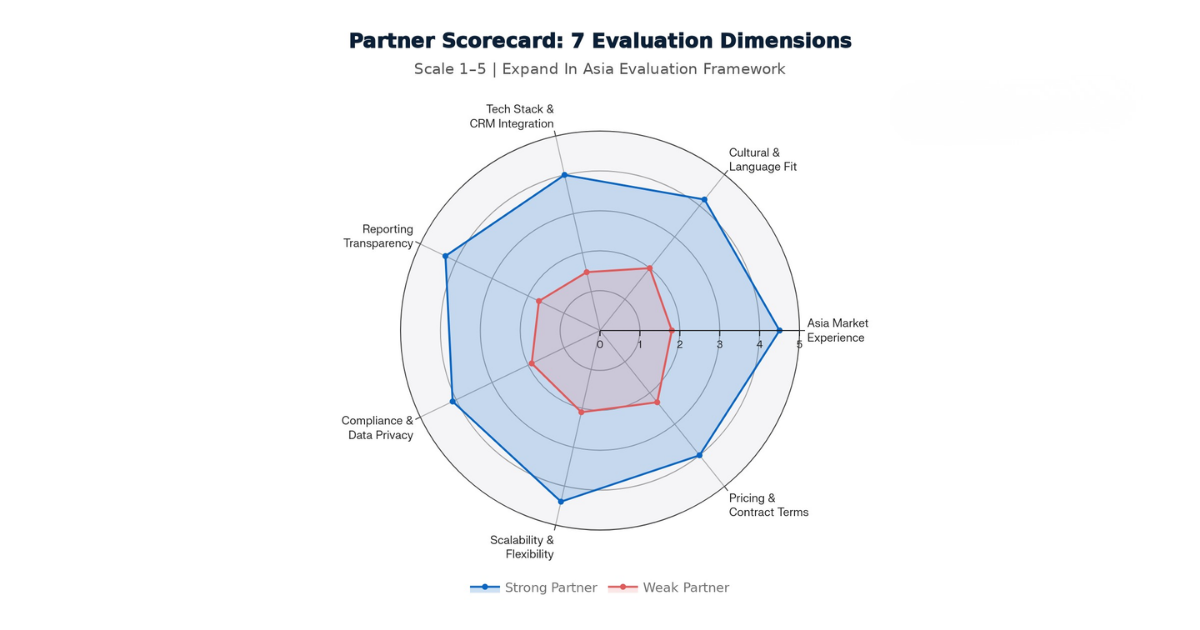
A Scorecard for Asian Markets
For B2B companies entering or scaling across Asia who need a structured, defensible way to select a sales outsourcing partner, without guesswork.
- TL;DR — Key Takeaways
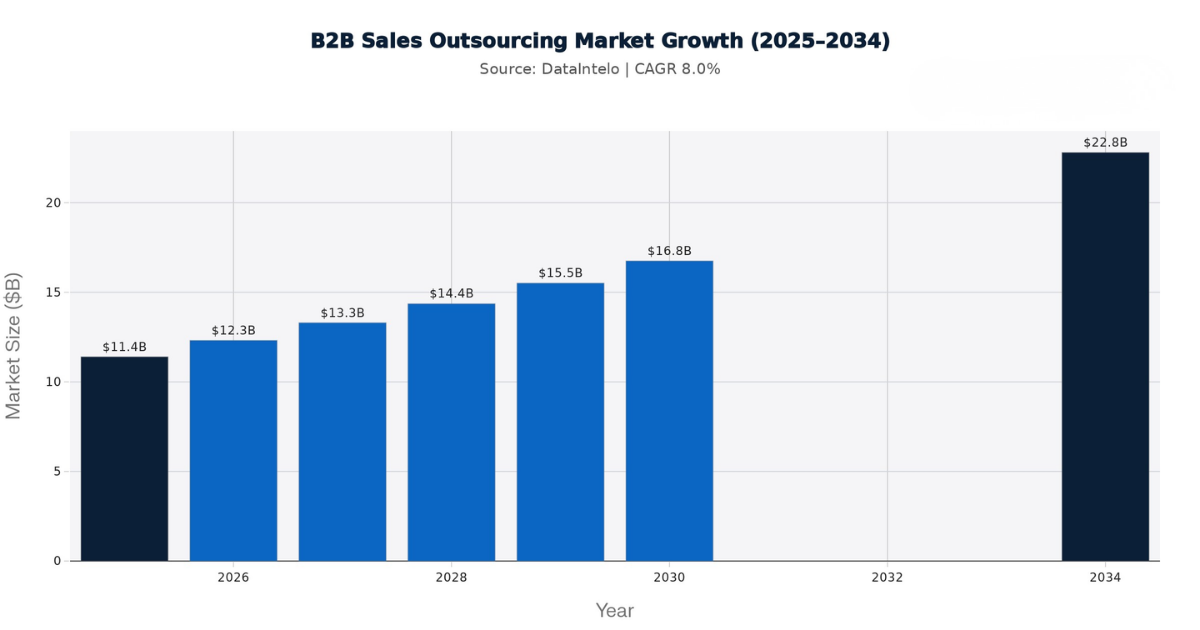
- The global B2B sales outsourcing market was valued at $11.4 billion in 2025 and is projected to reach $22.8 billion by 2034. Evaluating partners rigorously matters more than ever as the space crowds
- Companies using outsourced partners with industry-specific Asian experience report up to 23% higher conversion rates compared to those using generalist providers
- Deloitte's 2024 Global Outsourcing Survey found 80% of executives planned to maintain or increase investment in third-party partners, with 50% already using external teams for front-office work such as sales
- Effective evaluation covers 7 dimensions: market experience, cultural fit, tech stack, reporting transparency, compliance, scalability, and pricing
- A structured scorecard prevents you from being swayed by polished pitch decks and focuses decisions on verifiable evidence
If you only do one thing: Define your qualification criteria in writing before speaking to any vendor. Every conversation you have without this will waste your time.
Who this playbook is for (and not for)
This framework is designed for:
-
-
B2B companies planning to enter Singapore, Indonesia, Vietnam, the Philippines, Malaysia, or other ASEAN markets and need a local sales execution partner
-
Growth leaders who have identified outsourcing as the right model but need a defensible, structured process to choose among vendors
-
Revenue directors who have had a bad experience with a previous outsourced partner and want to avoid repeating it
-
Organizations evaluating 3–6 vendors simultaneously and need an apples-to-apples comparison method
-
This framework is NOT the right fit if:
- You have not yet defined your Ideal Customer Profile (ICP) for the Asian market — the scorecard cannot substitute for that strategic decisio
- You are only considering one vendor and treating this as a reference check — this is a comparative evaluation too.
- Your budget and timeline are not yet approved; vendor evaluation without internal alignment leads to wasted conversations on both sides
Why Vendor Selection Fails in Asian Markets
Most B2B companies entering Asia do not fail because they chose outsourcing — they fail because they chose the wrong partner using the wrong criteria.
The typical approach looks like this: a shortlist of vendors is assembled from a quick Google search or a referral, a few calls happen, a proposal lands, and a decision gets made based on who presented the most confidently. No structured scoring. No written definition of what “qualified lead” means. No verification of Asia-specific experience.
The result is predictable. According to Clutch, the top reasons B2B companies part ways with outsourced sales partners include misaligned expectations on lead quality, poor communication cadence, and cultural missteps with target buyers. All three of these are preventable with a proper upfront evaluation.
Asian markets compound this risk. Business norms in Singapore differ from those in Indonesia, Vietnam, or the Philippines. Relationship-building timelines are longer. Decision-making hierarchies are less transparent to outsiders. A generalist vendor with no Asia-Pacific track record is not equipped to navigate these dynamics — regardless of how impressive their pitch deck looks.
The market is also expanding fast. DataIntelo reports the B2B sales outsourcing services market at $11.4 billion in 2025, projected to more than double to $22.8 billion by 2034 at a CAGR of 8.0%. More vendors are entering the space, which raises the stakes for rigorous evaluation.
The 7-Dimension Evaluation Framework
Each dimension below is scored on a 1–5 scale. Scores are totaled for a maximum of 35 points. A vendor scoring below 21 (3.0 average) across all dimensions warrants serious caution before proceeding.
Dimension 1: Asia Market Experience
What to assess: Does the vendor have a verifiable track record — not just presence — in the specific Asian markets you are targeting?
There is a meaningful difference between a vendor who has operated in Singapore and one who has sold B2B solutions to enterprise buyers in Singapore’s specific regulatory and cultural environment. Ask for case studies that are market-specific, industry-specific, and show concrete pipeline and conversion outcomes, not just activity volume.
Questions to ask:
-
In which Asian markets have you actively run B2B sales campaigns in the past 24 months?
-
Can you share a case study with meeting-to-opportunity conversion rates for this market?
-
Who on your team has native knowledge of [target country’s] business culture?
Scoring guide:
| Score | Criteria |
|---|---|
| 5 | Proven track record in your exact target market with verifiable case studies and conversion data |
| 4 | Strong APAC experience with adjacently relevant market examples |
| 3 | General Asia exposure, limited market-specific proof |
| 2 | Claims Asia coverage without substantiated track record |
| 1 | No demonstrable Asia experience |
Dimension 2: Cultural & Language Fit
What to assess: Can the vendor’s team communicate credibly with your target buyers — in the buyer’s preferred language and communication style?
Gartner research indicates that 75% of B2B sales organizations are incorporating AI-guided selling, but localized human communication remains critical for relationship-building in Asia, particularly in markets such as Japan, South Korea, Indonesia, and Vietnam, where buyers expect culturally aligned interactions. A vendor who treats Southeast Asia as a single homogenous market is a significant risk.
Questions to ask:
-
What languages can your SDRs conduct outreach in for this market?
-
How do you adapt communication style between, say, Singaporean English-speaking buyers versus Bahasa Indonesia-speaking buyers?
-
Can I hear a sample call or read a sample sequence for this target segment?
Scoring guide:
| Score | Criteria |
|---|---|
| 5 | Native-language capability + culturally calibrated messaging frameworks per market |
| 4 | Strong bilingual capability with documented cultural adaptation process |
| 3 | English-only with general awareness of cultural norms |
| 2 | No language differentiation; one-size messaging |
| 1 | No evidence of cultural consideration in outreach approach |
Dimension 3: Tech Stack & CRM Integration
What to assess: Will the vendor’s tools integrate with your CRM, and do they use technology that supports transparent pipeline tracking?
According to SalesHive, by 2025 80% of B2B sales interactions are occurring through digital channels, making the technology layer of an outsourced partner a critical evaluation point. A vendor running outbound on disconnected spreadsheets with manual reporting is a bottleneck to your revenue operations from day one.
Questions to ask:
-
What CRM do you use natively, and how do you integrate with [your CRM]?
-
Do you provide shared dashboards with real-time pipeline visibility?
-
What tools do you use for sequence management, intent data, and call recording?
Scoring guide:
| Score | Criteria |
|---|---|
| 5 | Fully integrated with your CRM; shared real-time dashboards; documented tech stack |
| 4 | Strong tool suite with documented integration path |
| 3 | Uses established tools but limited native integration |
| 2 | Manual reporting with no real-time visibility |
| 1 | Unclear or undocumented technology process |
Dimension 4: Reporting Transparency
What to assess: Do they report on outcomes that map to pipeline — or just activity metrics that look busy but tell you little?
The distinction matters because activity metrics (dials, emails sent) can be inflated without driving revenue outcomes. What you need to track are pipeline-relevant KPIs: connect rate, meeting rate, show rate, opportunity rate, and meeting-to-opportunity conversion. Any vendor unwilling to commit to this level of reporting transparency should be treated as a yellow flag.
Questions to ask:
-
Can you show me an example of your reporting output from an existing client?
-
How do you define a “qualified meeting” — in writing?
-
What is your average show rate and meeting-to-opportunity conversion rate across your Asia accounts?
Scoring guide:
| Score | Criteria |
|---|---|
| 5 | Outcome-based reporting with shared dashboards, weekly cadence, and written SLA definitions |
| 4 | Regular structured reporting with KPIs aligned to pipeline |
| 3 | Monthly summaries focused primarily on activity |
| 2 | Ad-hoc reporting; no defined meeting qualification criteria |
| 1 | No structured reporting offered |
Dimension 5: Compliance & Data Privacy
What to assess: Is the vendor equipped to operate within the data privacy requirements of your target Asian markets — especially Singapore’s PDPA and the EU GDPR if applicable?
Singapore’s Personal Data Protection Act (PDPA) governs how personal data is collected, used, disclosed, and stored. A vendor handling prospect data on your behalf is a data intermediary under this framework, and non-compliance exposes your company to regulatory and reputational risk. Require documented data handling protocols as part of the contract.
Questions to ask:
-
Do you have a Data Processing Agreement (DPA) ready for execution?
-
How do you handle data retention, deletion, and access control at the end of an engagement?
-
Are your SDRs trained on PDPA compliance for Singapore-based outreach?
For a deeper overview of how data privacy laws in Asia affect B2B lead generation, see our post on Go-to-Market (GTM) Strategies for Asia.
Scoring guide:
| Score | Criteria |
|---|---|
| 5 | Documented PDPA/GDPR-aligned DPA, trained SDRs, clear data deletion protocol |
| 4 | Demonstrated compliance awareness and willingness to sign DPA |
| 3 | General GDPR familiarity; limited Asia-specific data knowledge |
| 2 | No DPA offered; compliance treated as client’s problem |
| 1 | Unclear data handling practices; no documentation available |
Dimension 6: Scalability & Flexibility
What to assess: Can the vendor scale capacity up or down in alignment with your business cycle — and will they lock you into rigid structures that don’t accommodate market realities?
Asian market entry often involves unpredictable ramp periods. A partner who can only operate at fixed monthly capacity without accommodating a strategic pivot is a liability in a dynamic market. Look for documented examples of how they have scaled engagements up or down in response to client needs.
Questions to ask:
-
What is your minimum engagement period, and what does the scale-up process look like if we want to add capacity?
-
How have you managed client requests to pivot target segments or geographies mid-engagement?
-
What is your SDR bench strength for [target market]?
Scoring guide:
| Score | Criteria |
|---|---|
| 5 | Proven scalability with documented examples; flexible engagement structures |
| 4 | Clear scale-up process with reasonable contract flexibility |
| 3 | Can scale but requires extended lead time or contract renegotiation |
| 2 | Rigid fixed-capacity model with limited flexibility |
| 1 | No flexibility or scalability plan |
Dimension 7: Pricing & Contract Terms
What to assess: Is the pricing model aligned with your outcomes — and are the contract terms fair and exit-friendly?
Pricing structures vary significantly across vendors: retainer-based, performance-based, or hybrid. There is no universally superior model, but the structure must align incentives correctly. A purely retainer-based model with no performance accountability creates misalignment. A purely performance-based model may incentivize volume over quality. Require transparency on assumptions around conversion rates and show rates when comparing vendor economics.
Questions to ask:
-
What is your pricing model, and how is performance defined in the contract?
-
What are the termination conditions and notice periods?
-
Are there additional fees for onboarding, tooling, or data procurement?
Scoring guide:
| Score | Criteria |
|---|---|
| 5 | Transparent, outcome-aligned pricing with clear definitions; fair exit terms |
| 4 | Clear pricing with reasonable performance components; manageable exit terms |
| 3 | Retainer-based with some performance accountability |
| 2 | Opaque pricing; difficult exit conditions |
| 1 | No pricing transparency; unfavorable lock-in terms |
The Printable Scorecard Table
Use this table when evaluating up to four vendors simultaneously. Score each vendor per dimension (1–5), total the scores, and compare.
| Evaluation Dimension | Weight | Vendor A | Vendor B | Vendor C |
|---|---|---|---|---|
| 1. Asia Market Experience | High | /5 | /5 | /5 |
| 2. Cultural & Language Fit | High | /5 | /5 | /5 |
| 3. Tech Stack & CRM Integration | Medium | /5 | /5 | /5 |
| 4. Reporting Transparency | High | /5 | /5 | /5 |
| 5. Compliance & Data Privacy | High | /5 | /5 | /5 |
| 6. Scalability & Flexibility | Medium | /5 | /5 | /5 |
| 7. Pricing & Contract Terms | Medium | /5 | /5 | /5 |
| TOTAL SCORE | /35 | /35 | /35 |
Interpretation:
-
29–35: Strong candidate — proceed to final due diligence and reference checks
-
21–28: Conditional — address specific dimension gaps before committing
-
Below 21: Significant risk — reassess or do not proceed without substantial evidence
Before finalizing your shortlist, review our curated resource: 25 Best B2B Sales Outsourcing Companies Worth Hiring in 2026
Real-World Application: How to Run the Evaluation
Situation: A SaaS company headquartered in Australia wants to enter the Singapore and Indonesian B2B markets. They have a defined ICP (mid-market fintech and logistics companies) and a 90-day timeline to generate their first qualified pipeline.
Trigger: Internal hiring of an Asia-based SDR team would take 6–9 months and cost significantly more per qualified opportunity than outsourcing.
Barrier: No structured way to compare the 5 vendors they have identified through referrals and Clutch reviews.
Solution applied: Running this scorecard across all five vendors in parallel. Each vendor is scored independently by two internal stakeholders; scores are averaged. Vendors scoring below 21 are removed from consideration before any proposals are requested.
Results flow:
-
Two vendors eliminated in round one due to scores of 14 and 17 (no PDPA documentation; no Asia-specific case studies)
-
One vendor scored 24 (conditional) — proceeded to a paid pilot after contract modifications
-
Top-scoring vendor (31/35) selected for full engagement; first pipeline reviewed at 60-day mark
Practitioner insight: “Evaluate an outbound sales agency on proof, call samples, SDR tenure, reporting examples, and case studies showing meeting-to-opportunity conversion — not just appointments booked.” — SalesHive Best Practices: Outsourcing B2B Sales Tasks in 2025
Red Flags to Watch For
Alongside the scorecard, these are specific signals that a vendor may not be the right partner — regardless of their pitch:
-
Cannot define “qualified meeting” in writing. If qualification criteria are not documented, your definition of success and theirs will diverge within 30 days.
-
Reports only on activity (dials, emails sent) with no conversion metrics. Activity without pipeline accountability is a leading indicator of misalignment.
-
No reference clients in Asia they will connect you with directly. Case studies are useful; speaking to an actual client is more useful.
-
Vague or evasive answers on data handling. In markets governed by PDPA, this is a compliance risk that lands on your company.
-
Proposes a “discovery period” of more than 30 days before any leading indicators are visible. Experienced vendors show connect rates and positive reply rates within the first 30 days.
-
No dedicated point of contact or account manager assigned. Shared resource pools with rotating contacts indicate you are not a priority account.
For a deeper look at warning signs, see our post: 7 Red Flags When Hiring a B2B Sales Outsourcing Company
Ready to Find a Partner Who Scores Well?
Expand In Asia works with B2B companies entering and scaling across Asian markets — providing outsourced sales execution, lead generation, and go-to-market support built specifically for the region’s commercial realities.
If you are actively evaluating partners or want to understand how we approach the seven dimensions in this scorecard, here are three practical next steps:
Talk to Our Team
Book a 30-minute consultation to walk through your market entry goals and how outsourced sales execution can accelerate your pipeline in Asia.
Schedule a Call with Expand In Asia →🗺️ Read Our GTM Framework
Understand the market entry context that shapes how sales outsourcing should be structured for your specific target markets.
Read: GTM Strategies for Asia →
Ready to Implement These Strategies?
Book a free 30-minute strategy session where we’ll audit your current growth approach and identify your highest-leverage opportunities in Asian markets.
Frequently Asked Questions
1. How long should a B2B sales outsourcing partner evaluation take?
A structured evaluation using a scorecard framework typically takes 2–4 weeks from initial vendor outreach to final selection. Most companies conducting this process properly allocate the first week to information gathering (RFI responses, case study reviews), the second week to vendor interviews and scoring, and the remaining time to reference checks and contract negotiation. Rushing this process is one of the most common contributors to poor partner selection outcomes.
2. Is a retainer or performance-based pricing model better for Asian markets?
Neither is universally superior — the right model depends on engagement scope and market maturity. Retainer models work well when the vendor is handling a defined scope of activities and the relationship is new enough that performance benchmarks have not yet been established. Performance-based components are appropriate once baseline conversion metrics are defined and agreed upon in writing. A hybrid model — retainer covering team costs with a performance bonus tied to qualified opportunities — is commonly used for more mature engagements.
3. What defines a "qualified meeting" in an outsourced sales context?
A qualified meeting should be defined in writing in your contract — not left to interpretation. At minimum, it should specify: target persona (title and seniority), company firmographics (industry, size, geography), a confirmed pain or trigger point, and the absence of disqualifiers (e.g., existing contract with a competitor). Vendors who resist this level of specificity in the contract are a risk indicator.
4. How should I measure the performance of an outsourced sales partner in the first 90 days?
A qualified meeting should be defined in writing in your contract — not left to interpretation. At minimum, it should specify: target persona (title and seniority), company firmographics (industry, size, geography), a confirmed pain or trigger point, and the absence of disqualifiers (e.g., existing contract with a competitor). Vendors who resist this level of specificity in the contract are a risk indicator.
5. Does Expand In Asia work with companies entering Asian markets for the first time?
Yes. Expand In Asia specializes in supporting B2B companies at the market entry stage, including those with no prior Asia-Pacific presence. Engagements typically begin with a GTM alignment session to validate ICP assumptions for the target market, followed by structured sales execution. You can learn more about this process at expandin.asia.
6. How does cultural fit affect sales outsourcing outcomes in Asia?
Cultural fit affects two distinct dimensions: how well the vendor’s team communicates with your target buyers (external cultural fit), and how well the vendor’s working style integrates with your internal team (internal cultural fit). Both matter. Vendors with native-language SDRs and culturally calibrated messaging for specific Asian markets — rather than generic “English-first” approaches — consistently demonstrate stronger engagement rates with Asia-based buyers
💬 Have a question or a specific evaluation challenge not covered above? Drop it in the comments below — or reach out to the Expand In Asia team directly. We read every question.
📤 Found this useful? Share it with a colleague navigating a similar vendor evaluation, or save the scorecard table for your next RFP process.