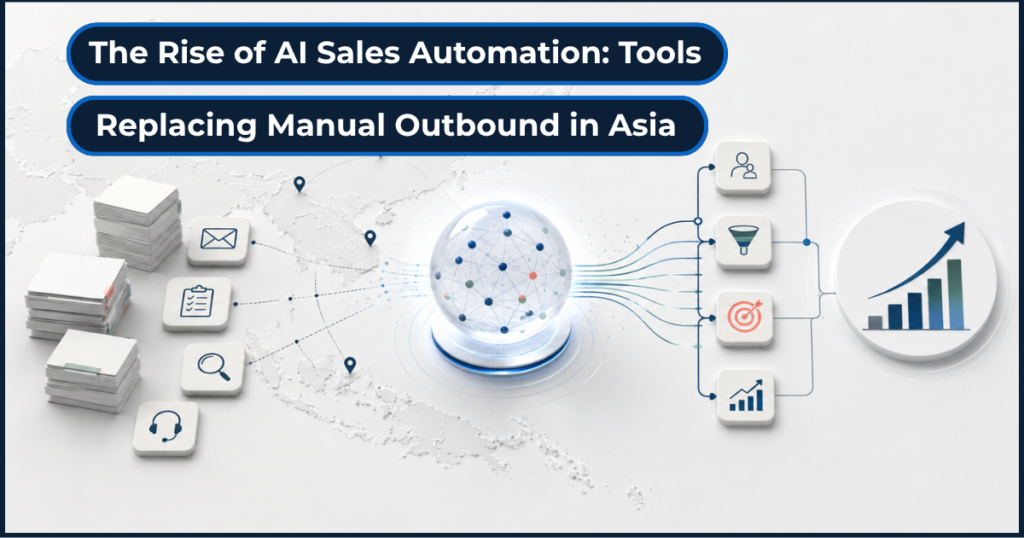

How Intelligent Technology Accelerates Asian Market Expansion with Measurable ROI
Market entry in Asia no longer requires years of manual research, expensive consultants, and guesswork-driven strategies. Artificial intelligence and automation are fundamentally transforming how B2B companies validate markets, identify prospects, and establish commercial presence across the Asia-Pacific region delivering market entry speeds 3x faster and cost reductions up to 60% compared to traditional approaches.
The data is clear: companies implementing AI-driven market entry strategies achieve revenue uplifts of 15% and sales ROI increases of 10-20%, while reducing sales cycles by an entire week and improving lead conversion rates by 40%. For businesses targeting Asia’s diverse, complex markets where cultural nuance, regulatory variation, and digital maturity differ dramatically across countries. AI provides the precision and speed that manual processes cannot match.
This comprehensive guide presents a structured framework for leveraging AI and automation in B2B market entry strategy, specifically designed for companies expanding into Asian markets through Expand In Asia’s proven methodologies.
-
TL;DR — Key Takeaways
- Speed multiplier effect: AI compresses market research from 6 months to 2 weeks and reduces overall market entry timelines by 3x, creating first-mover advantages
- Precision targeting at scale: AI-powered lead scoring achieves 70-85% accuracy in predicting conversion (versus 40-60% for traditional methods), enabling teams to focus resources on high-probability opportunities
- Cost-efficiency breakthrough: Automation reduces manual prospecting costs by 60% while maintaining personalization, with businesses reporting 25% operational cost savings
- Asia-specific advantage: Asia-Pacific leads global AI adoption at 45% GenAI implementation, with China at 70% and Singapore at 65%, making AI integration essential for competitive parity
- Measurable ROI validation: Companies implementing comprehensive AI market entry systems report 300% ROI on AI investments within six months, with 83% of initiatives generating positive returns
If you only do one thing:
Start with AI-powered market sizing and competitive intelligence to validate your target segments before committing resources—this single application reduces market entry risk by identifying viable opportunities in weeks rather than quarters.
Who this guide is for (and not for)
This guide is designed for high-growth B2B companies looking to expand beyond their home markets.
- Ideal for: VP of Sales or Founders at B2B SaaS/Tech companies with $10M+ ARR looking to enter Japan, SEA, or Greater China.
- Ideal for: Teams who have tried “remote selling” into Asia with little success.
- Ideal for: Companies with a high-ticket offering (ACV $20k+) where trust is a deal-breaker.
- NOT for: B2C e-commerce brands (the funnel dynamics are completely different).
- NOT for: Companies looking for “fast/cheap leads” without a budget for localization or relationship building.
1. Why AI-Powered Market Entry Matters for Asia
The Traditional Market Entry Challenge
Conventional B2B market entry into Asia follows a predictable, resource-intensive pattern: six months of desk research, expensive market visits, consultant engagements, and significant upfront capital investment—all before validating whether the market opportunity justifies the cost. This approach creates three critical problems:
Opportunity cost of delayed entry. In fast-moving Asian markets, six-month research cycles mean competitors establish relationships and market position while you’re still analyzing. The Asia-Pacific digital economy grew at 25% CAGR through 2025, with B2B e-commerce platforms like Alibaba and IndiaMart expanding rapidly. Delays translate directly to lost market share.
Resource allocation without validation. Traditional methods require substantial investment before confirming product-market fit. Companies commit to local hiring, office establishment, and partnership development based on incomplete information, increasing the risk of costly pivots or market exits.
Limited scalability across markets. Manual research doesn’t scale efficiently across Asia’s diverse markets. The approach that works for Singapore requires complete recalibration for Vietnam, Indonesia, or India—each iteration consuming similar time and resources.
The AI-Powered Alternative
AI and automation fundamentally restructure the market entry equation by delivering three transformative capabilities:
Accelerated intelligence gathering. AI-powered tools condense months of market analysis into weeks by processing government databases, social media trends, e-commerce data, and regulatory information simultaneously. Mid-market companies now achieve market validation in two weeks instead of six months, enabling faster go/no-go decisions and preserving capital for actual market execution.
Predictive market validation. Machine learning models analyze historical expansion patterns, customer behavior data, and competitive landscapes to predict market receptivity with 70-85% accuracy. This predictive capability allows companies to prioritize markets based on conversion probability rather than intuition, significantly improving resource allocation.
Scalable multi-market operations. Once AI systems are trained on one Asian market, they adapt to new markets with incremental effort rather than starting from scratch. Companies can simultaneously evaluate five markets with resources that previously analyzed one, enabling strategic portfolio approaches to market selection.

AI implementation delivers measurable improvements across seven critical B2B sales metrics, with productivity gains reaching 47% and conversion rates improving by 40%
Asia’s Unique Market Entry Requirements
Asia-Pacific markets present distinct challenges that make AI particularly valuable:
Cultural and linguistic diversity. Asia encompasses 48 countries with hundreds of languages and vastly different business cultures. AI-powered localization tools analyze cultural preferences, identify appropriate messaging frameworks, and adapt content to local contexts at scale—work that would require dedicated teams for each market.
Digital maturity variance. Singapore and Hong Kong operate at digital maturity levels comparable to Western markets, while emerging markets like Vietnam and the Philippines are mobile-first with different technology adoption patterns. AI tools assess digital infrastructure, platform preferences, and buyer behavior specific to each market’s maturity stage.
Regulatory complexity. Each Asian market maintains distinct regulatory frameworks for foreign market entry, data privacy, and B2B transactions. AI systems trained on regulatory data flag compliance requirements, identify potential risks, and recommend necessary product or process adjustments, reducing legal and operational risk.
2. The Asia-Pacific AI Advantage: Market Context
Leading Global AI Adoption
Asia-Pacific has emerged as the global leader in AI and digital transformation adoption, creating both opportunity and competitive necessity for companies entering these markets. Key data points establish the context:
Regional AI adoption rates. Asia-Pacific achieves 45% GenAI adoption at mid-to-high maturity levels, surpassing Europe’s 40% rate. Within the region, China leads at 70% adoption, followed by Singapore at 65%, South Korea at 58%, and Hong Kong at 62%. This high baseline adoption means B2B buyers in these markets increasingly expect AI-enabled engagement and digital-first interactions.
Investment momentum. China committed $912 billion to AI development, while Singapore allocated $1 billion strategically to AI programs. These government investments accelerate enterprise adoption, creating ecosystems where AI tools, talent, and infrastructure are readily available. For companies entering these markets, leveraging local AI capabilities becomes a competitive differentiator.
Digital transformation spending. China’s digital transformation market reached $218 billion in 2024, projected to hit $733 billion by 2028. Across APAC, digital economy revenue exceeded $6.74 trillion annually. This massive investment creates markets where buyers understand AI value propositions and actively seek technology-enabled solutions.
Market-Specific Digital Landscapes
Understanding each market’s digital maturity informs AI strategy:
Tier 1: High Digital Maturity (Singapore, Hong Kong, Japan, South Korea)
Sophisticated B2B buyers expect personalized, data-driven engagement
Strong digital infrastructure supports advanced AI applications
Regulatory frameworks for data privacy require careful compliance
Tier 2: Rapid Digital Growth (China, India, Thailand, Malaysia)
Mobile-first approaches dominate; WhatsApp, WeChat, LINE as primary business channels
E-commerce platforms serve as market entry vehicles (Alibaba, IndiaMart)
AI chatbots and conversational AI deliver high ROI given message-based commerce
Tier 3: Emerging Digital Markets (Vietnam, Philippines, Indonesia)
Relationship-driven business cultures value AI-enhanced rather than AI-replaced interactions
Lower digital infrastructure requires hybrid online-offline strategies
Cost-sensitive markets reward efficiency gains from automation
Platform and Channel Considerations
AI market entry strategies must align with Asia’s unique digital channel landscape:
Professional platforms. LinkedIn dominates in Singapore, Hong Kong, and India but is blocked in China. Japan favors BizReach for professional networking. AI-powered outreach must route through appropriate channels for each market, with tools adapting messaging to platform-specific norms.
Messaging apps as B2B channels. WeChat functions as China’s primary business communication tool, LINE dominates Thailand, WhatsApp serves South Asia and Southeast Asia, and KakaoTalk leads in South Korea. AI chatbots integrated into these platforms provide 24/7 engagement, with case studies showing 38% conversion rates and 47% reduction in support tickets.
Local e-commerce and marketplaces. B2B buyers increasingly source through platforms like Alibaba (China), IndiaMart (India), and TradeIndia (India). AI-powered product recommendations, dynamic pricing, and automated customer service drive platform success in these environments.
3. Seven AI Applications Transforming B2B Market Entry
AI delivers value across the entire market entry lifecycle. This section examines seven high-impact applications with specific use cases for Asian markets.
3.1 Intelligent Market Sizing and Opportunity Analysis
Application. AI processes economic data, industry reports, regulatory filings, and digital footprints to rapidly assess market size, growth trajectories, and addressable opportunity.
Asia-specific value. Traditional market sizing in fragmented Asian markets requires country-by-country manual research. AI tools aggregate data across government databases, trade associations, and digital sources to build comprehensive market models in days.
Implementation approach. Tools like Exploding Topics, Semrush Market Explorer, and AI-powered research platforms analyze search volumes, competitive densities, and growth signals. Companies input target industries and geographies; systems output TAM (Total Addressable Market), SAM (Serviceable Addressable Market), and SOM (Serviceable Obtainable Market) estimates with confidence intervals.
ROI data. Companies using AI market sizing reduce research time by 90% and achieve 40% accuracy improvements over manual methods.
3.2 Predictive Lead Scoring and Customer Profiling
Application. Machine learning models analyze demographic, firmographic, behavioral, and intent data to score leads by conversion probability, enabling sales teams to focus on high-value opportunities.
Asia-specific value. Asian markets present unique buyer signals—job titles mean different things across cultures, company size indicators vary by country, and buying committees differ in structure. AI models trained on regional data outperform Western templates by 25-30%.
Implementation approach. Platforms like 6sense, ZoomInfo, and Salesforce Einstein integrate with CRM systems to continuously score leads based on engagement patterns, intent signals, and behavioral data. Systems automatically flag high-priority accounts and recommend optimal outreach timing.
ROI data. AI lead scoring achieves 70-85% conversion prediction accuracy versus 40-60% for rule-based systems, driving 40% improvement in lead conversion rates and 30% higher deal closure rates.
3.3 Automated Competitive Intelligence and Monitoring
Application. AI systems continuously track competitor activities—website changes, product launches, pricing adjustments, social media positioning, and customer sentiment—providing real-time strategic intelligence.
Asia-specific value. Asian markets move rapidly; competitors emerge quickly and strategies shift based on local conditions. Real-time monitoring allows companies to adjust positioning and messaging as competitive landscapes evolve.
Implementation approach. Tools like Kompyte, Crayon, and Klue monitor competitor digital footprints, analyze messaging changes, and alert teams to significant shifts. AI-powered sentiment analysis tracks customer reactions to competitor offerings across regional social platforms and review sites.
ROI data. Companies using AI competitive intelligence reduce manual monitoring by 90%, enabling weekly rather than quarterly competitive reviews and enabling faster strategic responses.
3.4 AI-Driven Localization and Cultural Adaptation
Application. AI analyzes local language patterns, cultural references, visual preferences, and regulatory requirements to adapt messaging, content, and product positioning for specific markets.
Asia-specific value. Localization extends beyond translation—it requires cultural fluency across diverse markets. AI tools assess cultural values, identify taboo imagery or messaging, and recommend market-appropriate brand positioning.
Implementation approach. AI localization platforms analyze social media discourse, consumer reviews, and successful local competitors to surface cultural insights. Natural language processing adapts copy to match local honorific systems (critical in Korea and Japan), and computer vision tools assess visual cultural fit.
ROI data. AI localization reduces time-to-market by 60% and costs by up to 60% while improving cultural relevance scores by 45%.
3.5 Personalized Outreach at Scale
Application. AI generates customized messaging for thousands of prospects simultaneously, analyzing individual profiles, company contexts, and engagement histories to craft relevant communications.
Asia-specific value. Relationship-driven Asian business cultures require personalized engagement; generic templates fail. AI enables personalization at scale by researching each prospect’s business challenges, industry trends, and company growth trajectory to craft contextually relevant messages.
Implementation approach. Platforms like Apollo.io, Outreach.io, and LinkedIn Sales Navigator combine contact databases with AI message generation, creating sequences tailored to recipient profiles, company news, and behavioral signals. Systems test message variants and optimize based on response rates.
ROI data. AI-personalized outreach achieves 28% higher response rates, 30% faster time-to-conversion, and 25% improvement in qualified meeting rates compared to generic templates.
3.6 Intelligent Sales Forecasting and Pipeline Management
Application. Predictive analytics models analyze deal characteristics, engagement patterns, and historical win/loss data to forecast revenue with high precision and identify at-risk opportunities.
Asia-specific value. Asian buying cycles vary significantly by market—Singapore deals close faster than Japan, India requires longer relationship development than Hong Kong. AI models account for market-specific velocity patterns when forecasting.
Implementation approach. CRM-integrated AI (Salesforce Einstein, HubSpot AI, Gong) analyzes opportunity data in real-time, scoring deal health and recommending interventions for at-risk deals. Systems surface patterns across won deals to identify replicable success factors.
ROI data. AI-driven forecasting improves accuracy by 50%, reduces sales cycles by 25%, and increases win rates by 30%.
3.7 AI-Powered Product-Market Fit Validation
Application. AI analyzes customer feedback, conducts automated user interviews, and processes behavioral data to validate product-market fit before full-scale market entry.
Asia-specific value. Product positioning that works in Western markets often requires adjustment for Asia. AI-powered validation identifies necessary feature adaptations, pricing sensitivities, and positioning frameworks that resonate with local buyers.
Implementation approach. Platforms like Perspective AI conduct AI-powered customer interviews at scale, analyzing responses to assess product-market fit strength, willingness to pay, and feature priorities. Tools like Insight7 process customer interaction data to identify themes and sentiment patterns.
ROI data. AI validation reduces product-market fit assessment from months to weeks, enabling companies to validate concepts before committing to expensive local infrastructure.
4. Building Your AI-Enabled Market Entry Framework
A structured framework ensures AI investments deliver strategic value rather than creating disconnected tools.
Phase 1: Strategic Foundation
Define market entry objectives. Establish clear goals—market validation only, lead generation pilot, or full commercial launch. Each objective requires different AI tool combinations and success metrics.
Identify target markets and segments. Use AI market sizing tools to evaluate multiple Asian markets simultaneously, prioritizing based on market attractiveness, competitive intensity, and strategic fit. Focus initial efforts on 2-3 markets rather than attempting pan-Asian launches.
Build Ideal Customer Profile (ICP). Leverage AI customer profiling tools to analyze successful customers in home markets and identify analogous profiles in target Asian markets. Account for cultural and structural differences—procurement processes, budget authorities, and decision-making hierarchies vary significantly across Asian markets.
Phase 2: Data Infrastructure and Tool Selection
Establish data foundation. AI effectiveness depends on data quality. Integrate existing CRM data, website analytics, and customer interaction histories. For new markets, acquire validated contact databases through providers with strong Asian market coverage (ZoomInfo, Cognism, Apollo).
Select integrated tool stack. Prioritize platforms that integrate with existing systems rather than creating data silos. Core stack typically includes:
Market intelligence: Exploding Topics, Semrush, NewtonX for research
Lead data and scoring: ZoomInfo, 6sense, Clearbit for contacts and predictive scoring
Engagement automation: Outreach.io, Apollo.io, LinkedIn Sales Navigator for sequencing
Competitive intelligence: Kompyte, Klue for monitoring
Localization: AI translation and cultural adaptation tools
Configure for Asian markets. Ensure tools support Asian languages, integrate with regional platforms (WeChat API, LINE, WhatsApp Business), and comply with local data regulations (Singapore PDPA, Japan APPI, GDPR for Hong Kong).
Phase 3: AI Model Training and Customization
Train on regional data. Generic AI models underperform in Asian markets. Feed systems with Asia-specific training data—successful deal patterns from the region, local competitive intelligence, regional buyer personas.
Build market-specific ICPs. Develop separate ideal customer profiles for each target market. Singapore enterprise buyers differ from Indonesian SMB buyers; AI segmentation must reflect these distinctions.
Establish feedback loops. Configure systems to learn from outcomes—which leads converted, what messaging resonated, which channels performed best. Continuous learning improves model accuracy over time.
Phase 4: Process Design and Workflow Integration
Map customer journey. Document how prospects move from awareness to closed deal in target markets. Identify touchpoints where AI adds value—initial research, outreach, qualification, proposal, negotiation.
Design AI-human handoffs. Determine where AI operates autonomously versus where human judgment is required. In relationship-driven Asian markets, AI typically handles research and initial outreach; humans manage relationship development and closing.
Integrate with existing processes. Embed AI tools into daily workflows rather than creating parallel systems. Sales teams should access AI insights within their CRM, not in separate platforms.
5. Implementation Roadmap: From Planning to Execution
A phased rollout mitigates risk and demonstrates value before scaling.
Pilot Phase (Weeks 1-4): Single Market Validation
Select pilot market. Choose a market with sufficient opportunity but manageable risk—typically Singapore, Hong Kong, or mature Southeast Asian markets for B2B companies.
Deploy core AI stack. Implement market sizing, lead scoring, and automated outreach tools for the pilot market. Configure systems with baseline ICPs and engagement sequences.
Execute test campaigns. Launch limited outreach to 100-200 qualified prospects. Use AI personalization but maintain human oversight on all communications.
Measure and iterate. Track response rates, meeting conversion rates, and lead quality. Adjust ICPs, messaging, and outreach cadence based on results.
Expected outcomes. Pilot phase validates AI approach and generates initial qualified leads while building organizational familiarity with tools.
Expansion Phase (Weeks 5-12): Multi-Market Scaling
Replicate to 2-3 additional markets. Apply learnings from pilot to expand into additional target markets. Customize ICPs and messaging for each market’s cultural context.
Activate full AI suite. Layer in competitive intelligence, sales forecasting, and advanced lead scoring across all markets.
Build sales enablement. Develop playbooks for sales teams on interpreting AI insights, prioritizing AI-scored leads, and leveraging competitive intelligence.
Implement attribution tracking. Configure systems to track which AI applications drive outcomes—lead quality, conversion rates, deal velocity.
Expected outcomes. Expansion phase generates consistent pipeline across multiple markets while validating ROI metrics.
Optimization Phase (Weeks 13-24): Continuous Improvement
Refine AI models. Incorporate six months of regional outcome data to retrain scoring models, improving prediction accuracy.
Automate low-value tasks. Identify remaining manual processes suitable for automation—data entry, initial qualification, meeting scheduling.
Expand use cases. Add advanced applications like AI-powered proposal generation, dynamic pricing recommendations, and predictive churn analysis.
Develop regional expertise. Build internal capabilities to manage AI systems, train new team members on tools, and customize for new markets.
Expected outcomes. Optimization phase delivers full operational efficiency, with teams operating at 3x capacity of manual approaches.
6. Measuring Success: KPIs and ROI Validation
Rigorous measurement ensures AI investments deliver documented value.
Leading Indicators (Track Weekly)
Lead quality metrics
AI lead score accuracy: Percentage of high-scored leads that convert versus manual predictions
Target: 70-85% predictive accuracy
Engagement efficiency
Response rates: Percentage of outreach generating replies
Target: 28% lift over baseline with AI personalization
Operational efficiency
Time saved per rep per week: Hours automated by AI versus manual process
Target: 12+ hours saved weekly
Lagging Indicators (Track Monthly/Quarterly)
Conversion performance
Lead-to-opportunity conversion rate: Percentage of leads qualifying to opportunities
Target: 40% improvement over baseline
Revenue impact
Sales cycle length: Average days from initial contact to closed deal
Target: 25% reduction in cycle time
Win rate: Percentage of opportunities that close
Target: 30% improvement
Financial ROI
Cost per qualified lead: Total AI investment divided by qualified leads generated
Target: 50% reduction versus manual approaches
Revenue per sales rep: Total revenue divided by sales headcount
Target: 15% revenue uplift
Overall ROI: Net return on total AI investment
Target: 300% ROI within 6 months
Market Entry Speed Metrics
Time to first qualified meeting
Traditional approach: 12-16 weeks
AI-powered approach: 3-4 weeks
Time to validated market opportunity
Traditional approach: 24-26 weeks
AI-powered approach: 2-4 weeks
Cost to market validation
Traditional approach: $150,000-250,000
AI-powered approach: $60,000-100,000 (60% reduction)
7. Overcoming Common Challenges
Organizations encounter predictable obstacles when implementing AI for market entry. Proactive strategies address each.
Challenge 1: Data Quality and Availability
Issue. AI models require substantial training data; new market entry means limited historical data from target regions.
Solution. Begin with transfer learning—train models on home market data, then fine-tune with early target market results. Purchase validated contact databases from regional providers (ZoomInfo, Cognism) to supplement proprietary data. Partner with local market research firms to access regional behavioral data.
Asia-specific consideration. Data privacy regulations vary significantly across Asian markets. Ensure compliance with Singapore’s PDPA, Japan’s APPI, and emerging frameworks in Indonesia and Vietnam.
Challenge 2: Cultural Context and Localization
Issue. AI-generated messaging may miss cultural nuances, creating awkward or inappropriate outreach that damages brand perception.
Solution. Implement human oversight layer where local market experts review AI-generated content before deployment. Use AI cultural analysis tools to flag potential issues. Conduct A/B testing with small sample sizes before broad campaigns.
Asia-specific consideration. Honorific language systems (Japanese, Korean), indirect communication preferences (throughout Asia), and relationship-development timelines vary dramatically. AI handles research and initial drafting; humans ensure cultural appropriateness.
Challenge 3: Integration with Existing Systems
Issue. AI tools operating independently from CRM and sales workflows create data silos and reduce adoption.
Solution. Prioritize platforms with pre-built integrations to major CRM systems (Salesforce, HubSpot, Microsoft Dynamics). Invest in integration layer (Zapier, Make) if necessary. Design workflows so AI insights surface within existing tools rather than requiring separate logins.
Asia-specific consideration. Regional platforms like WeChat and LINE require API integration for AI chatbots and automated engagement. Budget for custom integration development.
Challenge 4: Team Adoption and Change Management
Issue. Sales teams resist AI tools if they perceive them as replacing human judgment or creating additional work.
Solution. Frame AI as augmentation rather than replacement. Demonstrate time savings through pilot programs. Provide training on interpreting AI insights and acting on recommendations. Create incentives aligned with AI-enabled metrics (prioritizing high-scored leads).
Asia-specific consideration. Some Asian markets have lower baseline familiarity with AI tools. Provide additional training and gradual rollout in these regions.
Challenge 5: ROI Measurement and Attribution
Issue. Attributing specific outcomes to AI versus other improvements is complex, making it difficult to justify continued investment.
Solution. Establish baseline metrics before AI implementation. Use control groups where possible (AI-enabled markets versus traditional approach markets). Track specific AI-attributable actions (AI-scored leads, AI-generated messaging, AI-recommended timing). Calculate ROI at multiple levels—efficiency gains, revenue impact, strategic advantages.
Asia-specific consideration. Longer sales cycles in some Asian markets (6-12 months) mean ROI validation takes time. Focus on leading indicators (response rates, meeting quality) in early months.
Future-Proofing Your Market Entry Strategy
The AI landscape evolves rapidly; forward-looking strategies anticipate upcoming capabilities.
Emerging AI Capabilities for Market Entry
Autonomous competitive response systems. Next-generation AI will automatically detect competitor actions and generate strategic responses based on predefined parameters and business objectives. Approximately 89% of businesses are integrating AI to automate routine competitive monitoring.
Agentic AI for complex analysis. Agentic AI systems—which reason, plan, and execute multi-step tasks with minimal human intervention—will compress complex market entry analyses from weeks to hours. IQVIA’s agentic market entry AI enables teams to ask questions like “Which countries should we prioritize for respiratory biologics launch and why?” and receive synthesized analysis drawing on sales data, pricing trends, forecasts, and market developments.
Multimodal AI for comprehensive intelligence. Advanced AI will process text, images, video, and audio simultaneously, analyzing competitor product demonstrations, customer testimonials, and market events to provide richer intelligence.
Voice and conversational AI at scale. AI-powered voice agents will conduct initial qualification calls, answer prospect questions, and schedule meetings autonomously, further expanding capacity. Southeast Asian markets already see high adoption of conversational AI on messaging platforms.
Building Adaptive Capabilities
Invest in AI literacy. Train teams to interpret AI insights, question AI recommendations, and combine AI analysis with human judgment. As AI becomes more sophisticated, the competitive advantage shifts to organizations that effectively combine AI capabilities with domain expertise.
Create feedback systems. Build processes to capture outcomes and feed them back to AI systems, enabling continuous learning. Companies with robust feedback loops see sustained improvement in AI accuracy and effectiveness.
Partner strategically. Evaluate whether to build AI capabilities internally or partner with specialized providers. For most mid-market companies expanding to Asia, partnering with regional experts who combine market knowledge with AI implementation expertise delivers faster results.
Monitor regulatory evolution. AI governance frameworks are emerging across Asia. Singapore leads with its Model AI Governance Framework, while China implements strict AI regulations. Ensure compliance strategies anticipate regulatory changes.
The Expand In Asia Advantage
Regional AI implementation expertise. Expand In Asia combines deep Asian market knowledge with AI implementation capabilities, enabling companies to leverage technology without navigating complex regional differences independently.
Proven AI-enabled methodologies. Our B2B prospecting, pipeline management, and product-market fit validation services integrate AI tools within established frameworks, delivering rapid results without experimental learning curves.
Local market validation. Our presence across Asian markets enables real-time validation of AI-generated insights, ensuring technology recommendations align with on-the-ground realities.
Ready to Implement These Strategies?
Book a free 30-minute strategy session where we’ll audit your current growth approach and identify your highest-leverage opportunities in Asian markets.
Frequently Asked Questions
1. How quickly can we see results from AI-powered market entry?
Companies typically achieve initial market validation within 2-4 weeks and generate first qualified meetings within 4-6 weeks of implementation. Full pipeline development and first closed deals occur within 12-16 weeks, compared to 24-40 weeks with traditional approaches.
2. Do we need internal AI expertise to implement this approach?
No. Expand In Asia provides the AI implementation expertise, tool management, and operational execution. Your team focuses on strategic decisions and relationship development while we handle AI system configuration, optimization, and ongoing management. We also provide training to build your team’s AI literacy over time.
3. How do you ensure AI-generated content is culturally appropriate for Asian markets?
We combine AI efficiency with human cultural expertise. AI handles research, drafting, and personalization at scale; our regional experts review content for cultural appropriateness before deployment. We also conduct market-specific A/B testing to validate messaging effectiveness.
4. Which Asian markets are best suited for AI-powered market entry?
All Asian markets benefit from AI acceleration, but implementation approaches vary by market maturity. High digital maturity markets (Singapore, Hong Kong, South Korea) adopt advanced AI applications immediately. Emerging markets (Vietnam, Indonesia, Philippines) benefit most from AI research and efficiency gains while maintaining relationship-driven engagement models.
5. Which Asian markets are best suited for AI-powered market entry?
All Asian markets benefit from AI acceleration, but implementation approaches vary by market maturity. High digital maturity markets (Singapore, Hong Kong, South Korea) adopt advanced AI applications immediately. Emerging markets (Vietnam, Indonesia, Philippines) benefit most from AI research and efficiency gains while maintaining relationship-driven engagement models.
6. What if AI doesn't work for our specific industry or product?
AI effectiveness varies by application, not industry. Begin with pilot programs to validate approach before scaling. If specific AI applications underperform, we adjust the mix. Some companies benefit most from market research automation, others from lead scoring or personalized outreach. The modular approach ensures ROI regardless of which specific applications deliver the greatest value.