The "Plug-and-Play" Trap
You have a winning sales playbook in the US or Europe. Your cold email sequences see a 5% reply rate, and your demos convert at 20%. So, you translate the landing pages into Japanese or Simplified Chinese, hire a local rep, and wait for the leads to roll in.
Six months later, your pipeline is empty.
The Problem: Western B2B funnels are transactional—optimized for speed and individual decision-making. Asian B2B markets are relational—optimized for consensus, trust, and risk mitigation. When you force a transactional funnel into a relational market, you don’t just lose speed; you lose “face,” and with it, the deal.
The Promise: This guide provides a proven, outcome-driven framework to re-engineer your sales funnel for the nuances of Asia. You will walk away with a specific strategy to shift from “pitching” to “partnering,” ensuring your pipeline is filled with the right conversations, not just noise.
- TL;DR — Key Takeaways
- Relationship > Speed: In Asia, "Trust" is a distinct funnel stage that must precede "Proposal." Do not skip it.
- Consensus is King: Decision-making involves 3-4x more stakeholders than in the West. Your content must arm your champion to sell internally.
- Channel Divergence: LinkedIn works in Singapore/India, but you will fail without WeChat in China or LINE in Japan.
- Pipeline velocity increases 2.3x when you localize for cultural and business nuances
- If you only do one thing: Localize your "Trust Signal." Replace generic case studies with local proof points or partner endorsements before asking for a meeting.
Who this playbook is for (and not for)
This guide is designed for high-growth B2B companies looking to expand beyond their home markets.
- Ideal for: VP of Sales or Founders at B2B SaaS/Tech companies with $10M+ ARR looking to enter Japan, SEA, or Greater China.
- Ideal for: Teams who have tried “remote selling” into Asia with little success.
- Ideal for: Companies with a high-ticket offering (ACV $20k+) where trust is a deal-breaker.
- NOT for: B2C e-commerce brands (the funnel dynamics are completely different).
- NOT for: Companies looking for “fast/cheap leads” without a budget for localization or relationship building.
Step 1 – Diagnose your current state
Before you build, you must identify where your “Western” funnel is leaking. In Asia, the friction points are different.
The Diagnosis Checklist:
| Funnel Stage | Western Metric | Asian Reality Check |
|---|---|---|
|
Awareness |
Traffic / MQLs |
Reputation: Do they know who introduced you? Cold traffic rarely converts without a “warm” bridge.
|
|
Consideration |
Demo booking rate |
Education: Have you provided enough detail for the group to review? Demos often happen after internal consensus starts. |
|
Decision |
Speed to Close |
Consensus: A “Yes” from a VP often requires a “stamp of approval” from 4-5 other departments.
|
Action: Audit your last 20 lost deals in Asia. Did they ghost you after the price presentation? That’s usually not a price objection—it’s a consensus failure. You moved too fast for their internal hierarchy.
Step 2 – Design the "Trust-First" approach
You must insert a “Trust Building” loop into your linear funnel.
The Framework:
Instead of Awareness → Interest → Decision, think Credibility → Connection → Consensus → Conversion.
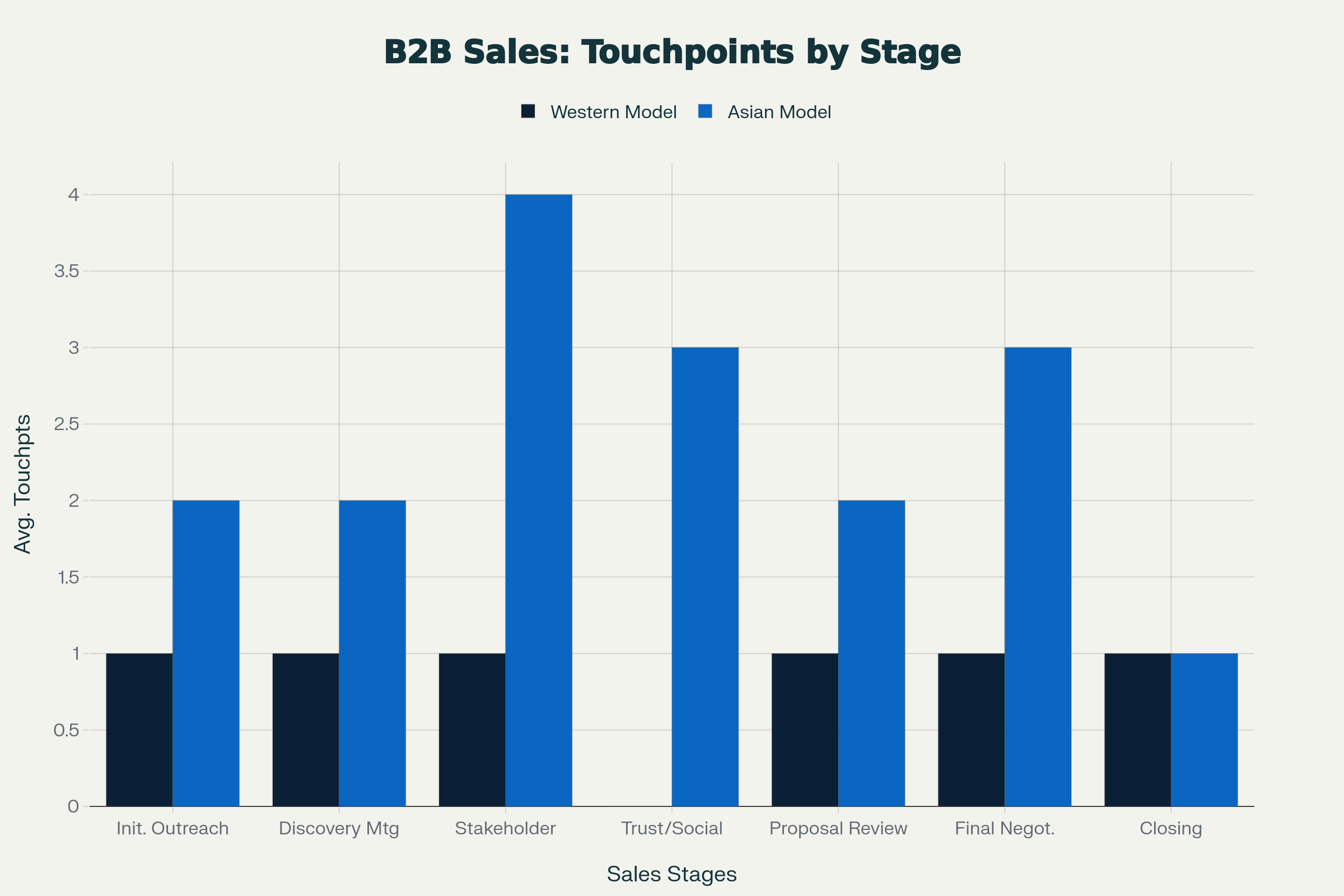
Comparison of B2B Sales Cycle Touchpoints: Western vs. Asian Markets
Why it works:
As shown in the chart above, the “Asian Model” requires significantly more touchpoints during the “Stakeholder Consensus” and “Trust Building” phases. While the Western model (Navy) is linear, the Asian model (Blue) spikes in the middle. You must budget time and resources for these extra 4-8 touchpoints.
How to implement (Micro-SOP):
- The “Face” Meeting: Don’t pitch in the first meeting. Use it to listen and show respect to the senior-most person in the room.
- The “Shadow” Content: Create a “Consensus Pack”—a detailed PDF (not a link) that your champion can print and physically hand to their boss. It should minimize risk, not just highlight features.
- The Local Validator: Feature a logo or testimonial from a local company early in the sequence. “Trusted by Google” is good; “Trusted by [Local Giant]” is better.
Step 3 – Execute the channel strategy
You cannot rely on email and LinkedIn alone. You must meet your buyers where they live.
The Channel Map:
- China: WeChat. It is an “everything app.” You need an official account for content and personal accounts for sales reps to chat with prospects. Email is often ignored.
- Japan: LINE & Facebook (Business). While email is used for formal “official” communication, quick coordination often happens on messaging apps. Cold calling is still effective but requires extreme etiquette training.
- Southeast Asia (Singapore, Thailand, Vietnam): LinkedIn & WhatsApp. Singapore is a LinkedIn stronghold. In Thailand and Vietnam, moving a conversation to LINE or Zalo signals you are “in”.
How to implement:
- Audit your tech stack: Does your CRM integrate with WeChat or WhatsApp Business API?
- Profile Cleanup: Ensure your sales reps have localized profiles. A LinkedIn profile in English is fine for Singapore, but for Japan, having a Japanese summary is a massive trust signal.
- The “Soft” Touch: Use messaging apps for “soft” follow-ups (e.g., sharing a relevant industry news article) rather than “hard” asks (e.g., “Did you sign the contract?”).
Pro Tip: Don’t outsource this blindly. “A pushy, fast-close approach may work in New York but can backfire in Tokyo.”
Real-world example: Manufacturing Success
Situation: A mid-sized industrial manufacturing firm was successful in Thailand but struggled to penetrate the broader APAC market (Singapore, Indonesia, India). They relied on trade shows and direct mail, which were becoming less effective.
Trigger: The “Western” style direct sales approach wasn’t working. They lacked visibility among decision-makers in new regions.
Solution:
- Step 1: They stopped generic “blast” marketing and built dedicated, localized landing pages for each target market (Singapore, Malaysia, India).
- Step 2: They shifted from “sales pitches” to “thought leadership,” publishing content that established them as reliable experts (Trust-First).
- Step 3: They used LinkedIn for targeted B2B distribution, bypassing the “gatekeepers” of traditional channels.
Results:
- 35% Increase in qualified B2B leads.
- Market Entry: Successfully broke into the Indian and Indonesian markets.
- Credibility: The content strategy positioned them as a “safe” choice for risk-averse buyers.
Proof in the Data
Localized strategies don’t just “feel” better; they perform better.
| KPI | Generic "Global" Approach | Localized "Asian" Approach |
|---|---|---|
|
Email Open Rates
|
12-15% |
25-40% (when subject lines are localized)
|
|
Response Time
|
3-5 Days
|
<2 Hours (via WeChat/WhatsApp/LINE)
|
|
Sales Cycle
|
Stalled / Ghosted
|
Progressive (Longer, but higher close rate)
|
Source: Aggregated performance data from successful APAC market entries.
“In Asia, trust, reputation, and introductions often carry more weight than the sharpest pitch deck.”
Ready to Implement These Strategies?
Book a free 30-minute strategy session where we’ll audit your current growth approach and identify your highest-leverage opportunities in Asian markets.
Frequently Asked Questions
1. Can we just use English for B2B sales in Asia?
In Singapore, Hong Kong, and the Philippines, yes. In Japan, China, Korea, and Thailand, no. Even if the decision-maker speaks English, their internal team (who they need consensus from) likely prefers local language. Forcing English adds friction and risk.
2. How long does it take to close a deal in Japan vs. the US?
Expect it to take 30-50% longer. You will need 4-5 meetings just to build the relationship before you even get to the “proposal” stage. Patience is your ROI driver here.
3. Is cold calling dead in Asia?
Not at all. In fact, in markets like Japan and Singapore, it can be effective if done with high cultural sensitivity and respect for hierarchy. However, “warm” introductions via partners always convert higher.
4. Do I need a local entity to sell in Asia?
Not necessarily. You can use Staff Augmentation or Employer of Record (EOR) services to hire local sales reps without setting up a full legal entity immediately. This allows you to validate Product-Market Fit before committing to heavy CAPEX.