
The "China+1" Reality Check
Global economic growth is projected to slow to 3.2% in 2025, yet Southeast Asia remains a rare bright spot. If you are still relying solely on traditional manufacturing hubs or saturated Western markets, you are missing the most significant diversification opportunity of the decade.
The problem isn’t a lack of opportunity—it’s speed and complexity. Traditional market entry (setting up a legal entity) takes 6–12 months. By the time you are operational, the 2025 window for early-mover advantage in markets like Vietnam or the Philippines may have narrowed.
This outlook is your blueprint. We analyzed data from the IMF, ADB, and global banking reports to give you a clear, data-backed path to entering the ASEAN market in 2025 without the administrative nightmare.
-
TL;DR — Key Takeaways
- Vietnam & Philippines Lead Growth: With projected GDP growth of 6.5% and 5.4% respectively, these are your top targets for manufacturing and labor arbitrage.
- Digital Economy Boom: The ASEAN digital economy will surpass $300 Billion GMV in 2025. If you sell digital services, this is your primary growth theater.
- China+1 is Now Standard: Foreign Direct Investment (FDI) into ASEAN manufacturing has overtaken China in transaction count. This is no longer a trend; it is the new baseline.
- Don't Incorporate Yet: Use a PEO/EOR model to deploy teams in weeks, not months.
If you only do one thing:
Audit your supply chain vulnerability and pilot a remote team in Vietnam or Indonesia using an EOR before committing to a full entity setup.
Who this guide is for (and not for)
This guide is built for:
Global Expansion Leaders seeking to diversify manufacturing or supply chains outside of China.
Tech & Service Companies looking to tap into Southeast Asia’s $300B digital economy.
Recruitment/HR Directors needing to hire specialized talent (developers, support) at competitive rates.
This is NOT for:
Companies looking for purely passive stock market investments.
Businesses unwilling to adapt to local compliance and cultural nuances.
Step 1 – Diagnose your current state
Before you choose a country, you must diagnose why you are expanding. In 2025, the ASEAN region offers two distinct “products” to investors: Growth (Emerging Markets) and Stability (Developed Markets).
Use this mini-checklist to determine your primary driver:
| If your goal is… | You need… | Your 2025 Target |
|---|---|---|
| Cost Reduction | Low-cost, high-skill labor & manufacturing | Vietnam, Philippines |
| Market Capture | Massive consumer base & middle class | Indonesia |
| Regional HQ | Financial stability, IP protection, low tax | Singapore |
Action: Pull your Q1 2025 forecasts. If your current growth projected in the EU/US is under 3%, you need exposure to markets growing at 5%+.
Action: Audit your last 20 lost deals in Asia. Did they ghost you after the price presentation? That’s usually not a price objection—it’s a consensus failure. You moved too fast for their internal hierarchy.
Step 2 – Design the new approach: Follow the Data
Don’t guess where to go. The data for 2025 is clear. While advanced economies slow down, key ASEAN nations are accelerating.
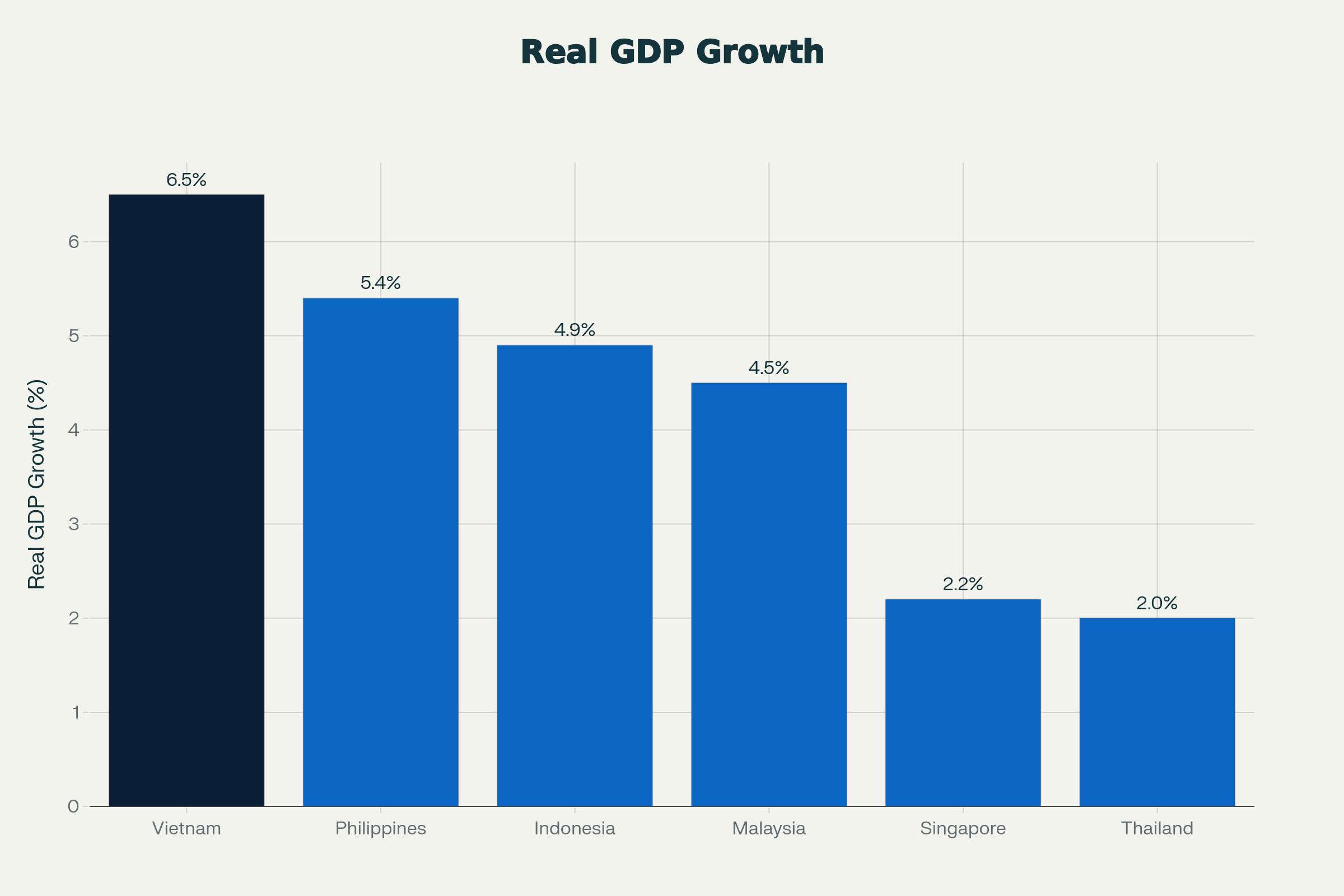
Projected 2025 Real GDP Growth for Key ASEAN Economies. Sources: IMF, ADB (2025 forecasts)
Analysis:
Vietnam (6.5%): The clear winner for manufacturing and export-oriented businesses. The government is aggressively upgrading infrastructure to support the influx of FDI.
Philippines (5.4%): A service economy powerhouse. English proficiency makes it the #1 choice for BPO and remote support teams.
Indonesia (4.9%): The giant of the region. With resilient domestic demand, this is a play for consumer goods and digital services.
Singapore (2.2%): While growth is lower, it remains the “control tower” for the region, offering the best legal framework for your holding company.
Step 3 – Execute the "Asset-Light" Play
The old way of entering these markets involved flying in, hiring lawyers, putting down $25k+ in capital, and waiting 6 months for a business license.
The 2025 Approach: Employer of Record (EOR)
You can bypass the entity setup entirely. Using an Employer of Record (EOR) allows you to hire staff legally in Vietnam, Indonesia, or Singapore without a local branch.
How to implement (Micro-SOP):
Select Talent: Source candidates (or use our recruitment service) in your target country.
Partner with an EOR: We (Expand In Asia) act as the legal employer.
Onboard: We handle the compliant employment contract, tax, and social security.
Deploy: Your team starts working in days, not months.
Why it works: It shifts your risk from “fixed” (Capital Expenditure) to “variable” (Operating Expenditure). If the market doesn’t work out in 12 months, you can exit without liquidation costs.
Real-world example: Tech Expansion in Vietnam
Situation: A US-based SaaS company needed to build a 24/7 developer team to support Asian clients.
Trigger: 2025 budget cuts required a 30% reduction in operational costs.
Barrier: They had zero legal presence in Vietnam and feared IP theft.
Solution: They used Expand In Asia’s PEO/EOR service. We hired 5 Senior Developers in Ho Chi Minh City on their behalf, ensuring strict IP clauses in local contracts.
Results:
Time-to-Value: Team operational in 14 days.
Cost Savings: 45% reduction in payroll costs vs. US equivalent.
Compliance: Zero risk of misclassification penalties.
Proof and Specificity
The shift is structural, not temporary. Look at the numbers driving the 2025 outlook:
| Metric | 2016 Value | 2025 Forecast | Growth Factor |
|---|---|---|---|
| Digital Economy GMV | ~$30B | $300B+ | 10x |
| E-Commerce GMV | ~$10B | $185B | 18x |
| FDI Source | West-Dominated | Diversified (China/Intra-ASEAN) | High |
Source: e-Conomy SEA 2025 Report (Google, Temasek, Bain)
Proof in the Data
Localized strategies don’t just “feel” better; they perform better.
| KPI | Generic "Global" Approach | Localized "Asian" Approach |
|---|---|---|
|
Email Open Rates
|
12-15% |
25-40% (when subject lines are localized)
|
|
Response Time
|
3-5 Days
|
<2 Hours (via WeChat/WhatsApp/LINE)
|
|
Sales Cycle
|
Stalled / Ghosted
|
Progressive (Longer, but higher close rate)
|
Source: Aggregated performance data from successful APAC market entries.
“In Asia, trust, reputation, and introductions often carry more weight than the sharpest pitch deck.”
Ready to Implement These Strategies?
Book a free 30-minute strategy session where we’ll audit your current growth approach and identify your highest-leverage opportunities in Asian markets.
Frequently Asked Questions
1. Is it safe to invest in ASEAN given the new 2025 tariffs?
Yes, but you must be strategic. While US tariffs impact some exports, ASEAN nations like Vietnam and Thailand are primary beneficiaries of supply chain relocation (“friend-shoring”). Intra-regional trade is also booming, reducing reliance on Western demand.
2. Which country has the best English proficiency for support teams?
The Philippines is the undisputed leader for English-speaking talent in 2025, followed closely by Malaysia and Singapore for higher-level technical roles.