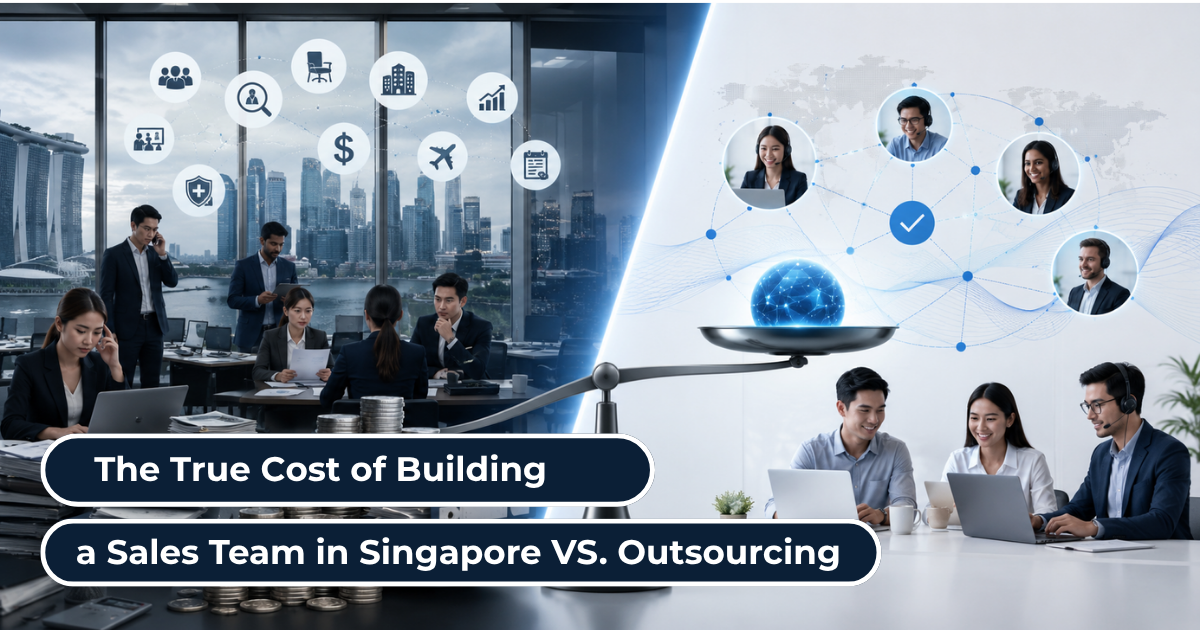
The Cost of Building a Sales Team in Singapore vs. Outsourcing
Most companies entering Singapore budget for salaries.
That is the first mistake.
A local sales team does not only cost base pay. It also requires employer CPF contributions, recruitment fees, onboarding, tools, management time, ramp-period inefficiency, and potentially office or workspace costs. Singapore is a strong regional commercial hub, but it is not a low-cost hiring market.
For B2B companies still validating their market entry strategy, the real question is not simply:
“Can we afford to hire?”
It is:
“Can we afford to spend 6–9 months building a team before we know if the market motion works?”
This guide breaks down the true cost of building a sales team in Singapore, compares it with outsourcing, and gives you a practical decision framework for choosing the right model.
- TL;DR — Key Takeaways
- A realistic Singapore sales team budget must include more than salaries. CPF, recruitment fees, tools, onboarding, workspace, and ramp time can materially change the business case.
- CPF employer contributions remain a major cost line. For employees aged 55 and below earning monthly wages above SGD 750, the employer CPF contribution rate is 17% in 2026.
- Recruitment fees can add a large upfront cost. Market references commonly cite permanent placement fees around 15–25% of first-year salary in Singapore.
- Outsourcing is usually most attractive during market validation. It reduces fixed hiring risk and can start pipeline activity faster, but it does not replace long-term institutional knowledge.
- Singapore wage benchmarks should be based on official or current market data. MOM’s Occupational Wages tables are designed for salary benchmarking and cover more than 500 occupations.
If you only do one thing: build a full Year 1 cost model before hiring. Salary-only comparisons make in-house teams look cheaper than they actually are.
Who This Comparison Is For (and Not For)
This guide is for B2B companies that are:
- entering Singapore for the first time;
- expanding from another APAC market into Singapore;
- deciding between hiring a local SDR / BDR team and using an outsourced partner;
- building a board-level business case for market entry;
- trying to avoid overcommitting before pipeline has been validated.
It is especially relevant if your company sells SaaS, professional services, cybersecurity, fintech, cloud solutions, HR tech, data services, or other B2B solutions that require outbound sales, meetings, and relationship-building.
This guide is not designed for companies that already have a mature Singapore office, a proven local sales motion, and internal sales leadership in place. At that stage, the economics may shift toward in-house expansion.
What “Building a Sales Team” Really Means in Singapore
A basic Singapore market-entry sales team usually includes:
| Role | Purpose |
|---|---|
| Sales Manager / Country Lead | Owns local strategy, manages pipeline, supports closing, coordinates with HQ |
| SDR / BDR 1 | Runs outbound prospecting, qualifies accounts, books meetings |
| SDR / BDR 2 | Expands coverage across segments, verticals, or accounts |
That sounds simple. But the cost base includes more than three salaries.
A realistic in-house model includes:
- base salaries;
- CPF employer contributions where applicable;
- recruitment agency or hiring costs;
- sales tools and data subscriptions;
- onboarding and training;
- management oversight;
- workspace or coworking costs;
- ramp-period inefficiency;
- replacement risk if one hire does not work out.
For a company still validating Singapore as a market, these costs create a fixed commitment before the GTM motion is proven.
Cost Comparison
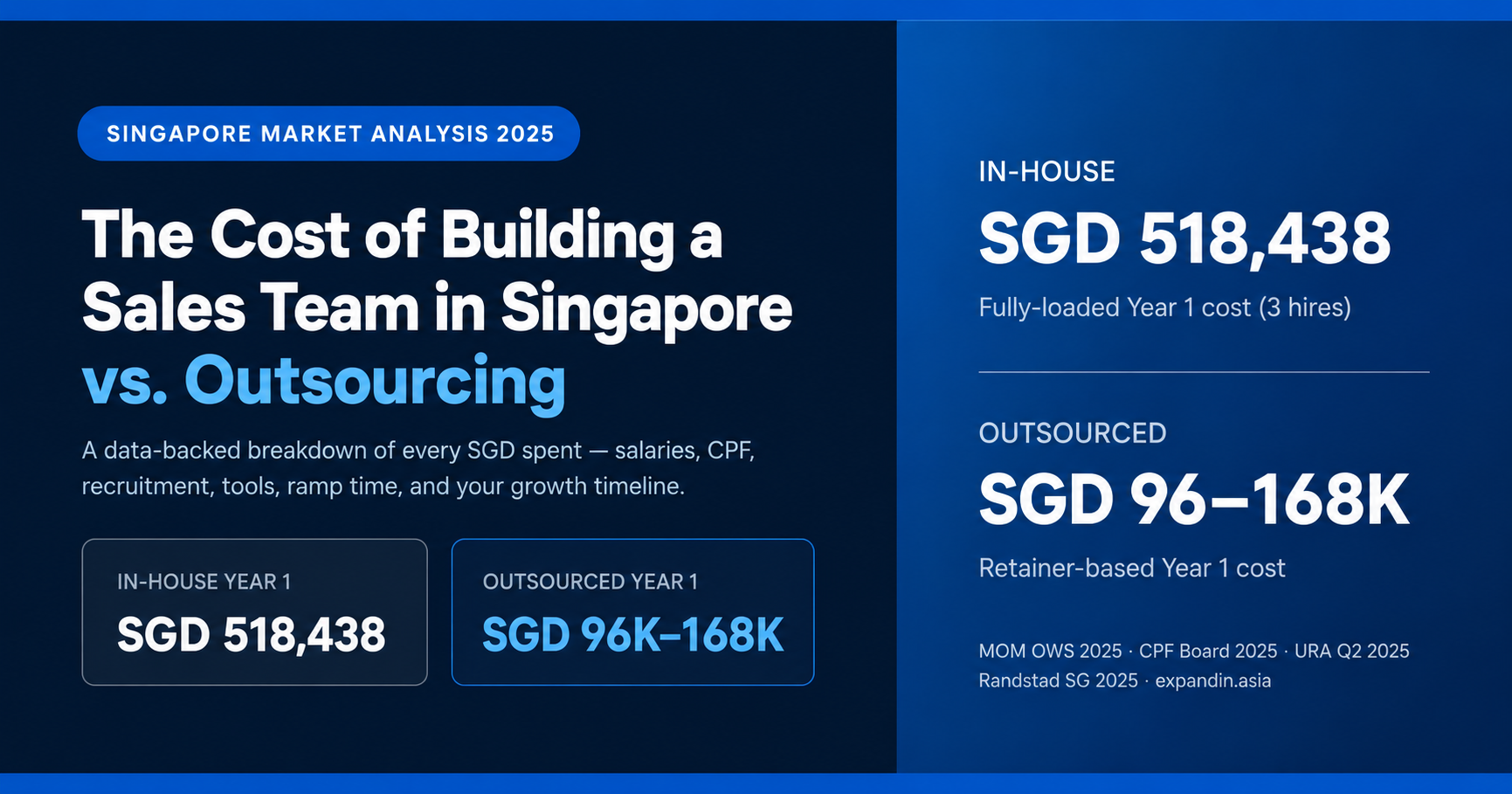
Year 1 Cost Components (Approximate)
Base Salaries
Salary is the most visible line item, but it is not the full cost.
MOM’s Occupational Wages tables are a strong starting point because they are published for salary benchmarking and cover full-time resident employees across hundreds of occupations. For private salary planning, companies often cross-check MOM data with recruiter salary guides and live market compensation expectations.
For a lean three-person B2B team, a reasonable planning model may look like this:
| Role | Estimated Annual Base Salary |
|---|---|
| Sales Manager / Country Lead | SGD 100,000–150,000 |
| SDR / BDR 1 | SGD 55,000–75,000 |
| SDR / BDR 2 | SGD 55,000–75,000 |
| Total Base Salary Range | SGD 210,000–300,000 |
This excludes commissions, bonuses, and equity.
CPF Employer Contributions
CPF is not optional when it applies.
For Singapore Citizens and Singapore Permanent Residents from the third year onward, the CPF Board’s current table shows that employees aged 55 and below earning monthly wages above SGD 750 have a 17% employer contribution rate and 20% employee contribution rate, for a total of 37%.
For planning purposes:
| Base Salary | Employer CPF at 17% |
|---|---|
| SGD 210,000 | SGD 35,700 |
| SGD 250,000 | SGD 42,500 |
| SGD 300,000 | SGD 51,000 |
CPF treatment can vary depending on citizenship, PR status, wage ceilings, and employee age. For final payroll modeling, companies should confirm with CPF Board guidance or a local payroll advisor.
Recruitment and Headhunting Fees
Recruitment costs are often ignored in early business cases.
For Singapore permanent placements, market references commonly cite agency fees in the range of 15–25% of first-year annual salary, with APSCo Asia survey references pointing to a median around 20%. Another Singapore recruitment reference cites permanent placement fees of 15–25% of annual salary, with executive search often higher.
For a three-person team, that creates a meaningful upfront cost:
| Base Salary Pool | Recruitment Fee at 15% | Recruitment Fee at 20% | Recruitment Fee at 25% |
|---|---|---|---|
| SGD 210,000 | SGD 31,500 | SGD 42,000 | SGD 52,500 |
| SGD 250,000 | SGD 37,500 | SGD 50,000 | SGD 62,500 |
| SGD 300,000 | SGD 45,000 | SGD 60,000 | SGD 75,000 |
Even if you hire directly, you still incur internal recruitment time, job ads, interview hours, and delayed productivity.
Sales Tools and Technology
A sales team needs infrastructure.
At minimum, budget for:
- CRM seats;
- sales engagement platform;
- LinkedIn Sales Navigator;
- data enrichment tools;
- email verification;
- calling / VoIP;
- meeting scheduling;
- reporting dashboards;
- AI note-taking or call intelligence tools.
A lean tool stack can easily cost SGD 1,000–3,000 per month depending on seats, data volume, and subscription choices.
| Tool Stack Scenario | Monthly Cost | Annual Cost |
|---|---|---|
| Lean stack | SGD 1,000 | SGD 12,000 |
| Standard B2B outbound stack | SGD 2,000 | SGD 24,000 |
| More advanced stack | SGD 3,000+ | SGD 36,000+ |
This is one area where outsourcing can reduce friction because many providers already include core tools, workflows, and reporting infrastructure in the engagement.
Onboarding, Training, and Management Time
Hiring does not equal productivity.
New sales hires need onboarding on:
- product positioning;
- ICP;
- buyer personas;
- objection handling;
- CRM process;
- local market messaging;
- compliance;
- reporting expectations;
- handoff process to account executives or founders.
Even strong hires need ramp time before output stabilizes. If the Sales Manager is also new, the company is onboarding both the team and the manager at the same time.
For a three-person team, companies should budget at least SGD 15,000–40,000 equivalent in training, internal time, documentation, and productivity drag.
Office, Workspace, and Admin Costs
A remote-first setup can reduce overhead, but many Singapore market-entry teams still require coworking, meeting rooms, or flexible office space.
Singapore office market data shows that office rents remained an active cost consideration in 2025. URA-related reports noted that Singapore’s central region office rental index declined 0.3% quarter-on-quarter in Q2 2025, while islandwide vacancy eased to 11.4%. Cushman & Wakefield also reported that Central Region office rents declined 0.3% quarter-on-quarter in Q2 2025, while CBD Grade A office rents still grew 0.6% quarter-on-quarter in its basket.
For a lean sales pod, workspace/admin costs might include:
| Cost Item | Estimated Annual Budget |
|---|---|
| Coworking seats / meeting rooms | SGD 12,000–30,000 |
| Laptops, devices, setup | SGD 6,000–12,000 |
| Payroll, HR, accounting support | SGD 6,000–18,000 |
| Total Admin / Workspace Range | SGD 24,000–60,000 |
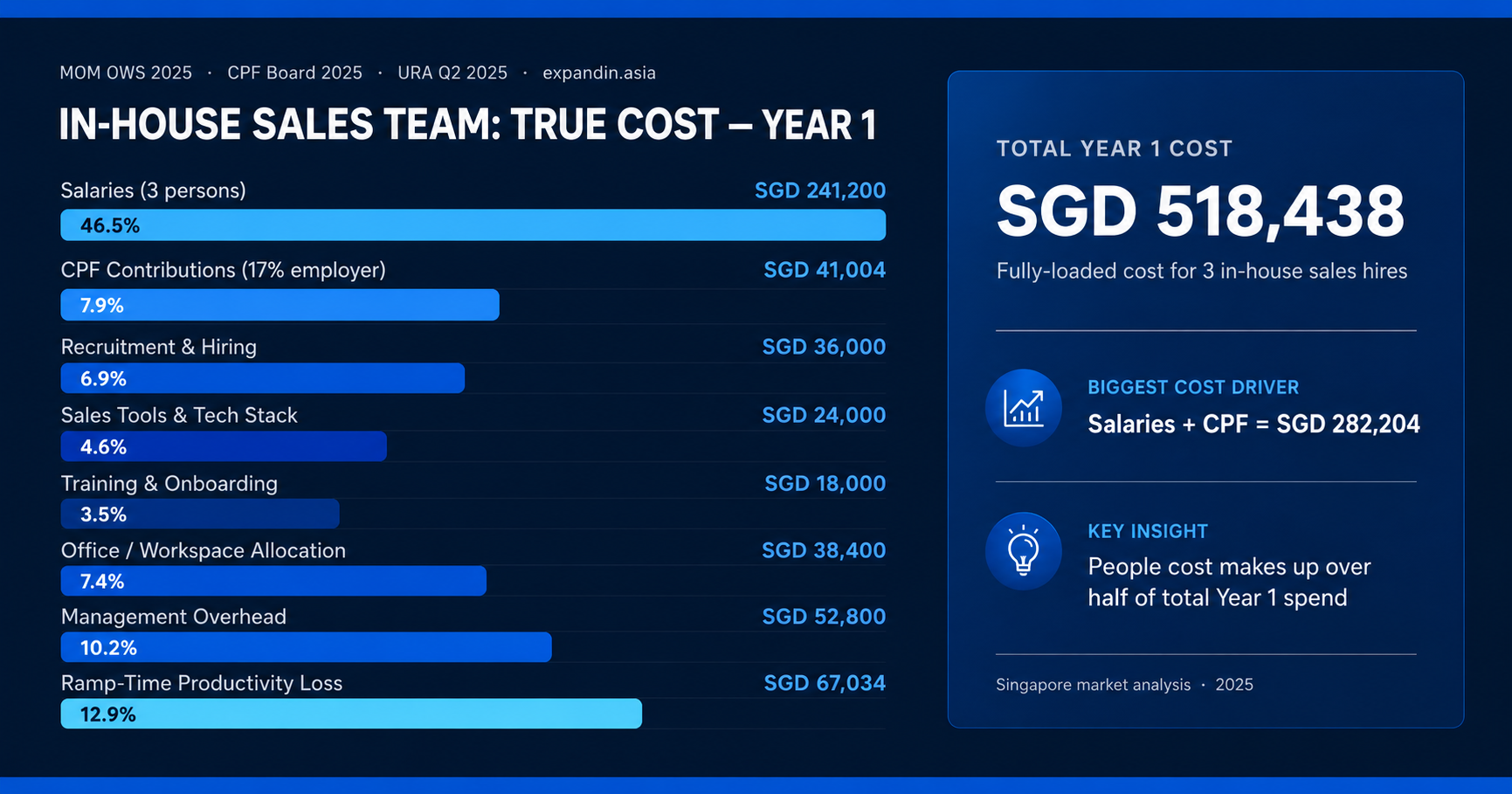
In-House Cost Model: 3-Person Singapore Sales Team
Below is a conservative planning model for Year 1.
Table 1 — Estimated Year 1 In-House Cost
| Cost Component | Low Estimate | High Estimate |
|---|---|---|
| Base salaries | SGD 210,000 | SGD 300,000 |
| Employer CPF / statutory costs | SGD 35,700 | SGD 51,000 |
| Recruitment fees | SGD 31,500 | SGD 75,000 |
| Sales tools and data | SGD 12,000 | SGD 36,000 |
| Onboarding and training | SGD 15,000 | SGD 40,000 |
| Workspace and admin | SGD 24,000 | SGD 60,000 |
| Ramp-period productivity drag | SGD 40,000 | SGD 90,000 |
| Estimated Year 1 Total | SGD 368,200 | SGD 652,000 |
Important note on the model
This is a planning estimate, not a fixed market price. The final number depends on seniority, compensation mix, whether hires are Singapore Citizens / PRs / Employment Pass holders, office requirements, tooling choices, and how quickly the team becomes productive.
For most foreign B2B companies entering Singapore, a practical planning range is:
SGD 400K–600K for Year 1 to build and operate a small in-house sales pod.
What Outsourced Sales Typically Costs in Singapore
Outsourced sales pricing varies by scope, seniority, market coverage, data requirements, and whether the partner provides SDRs only or a fuller GTM execution team.
Recent market references show broad outsourced sales development pricing ranges. A 2026 outsourced sales development benchmark cites USD 2,500–15,000+ per month for turnkey outsourced sales development, depending on model and scope. Martal’s 2026 guide cites managed SDR programs commonly running USD 5K–15K per month, with hybrid retainer-plus-performance structures becoming more common.
For Singapore planning, that translates roughly to:
| Outsourced Model | Monthly Range | Annual Range |
|---|---|---|
| Light outbound support | SGD 6,000–10,000 | SGD 72,000–120,000 |
| Managed SDR / appointment-setting pod | SGD 10,000–20,000 | SGD 120,000–240,000 |
| Multi-market GTM execution | SGD 20,000+ | SGD 240,000+ |
A realistic outsourced sales budget for a serious Singapore B2B market-entry motion is often:
SGD 120K–240K per year, depending on scope.
That is still meaningfully below the full Year 1 cost of hiring, especially when the company has not yet validated its Singapore pipeline assumptions.
Side-by-Side Comparison: In-House vs. Outsourced
Table 2 — Cost and Operating Comparison
| Criteria | In-House Sales Team | Outsourced Sales Partner |
|---|---|---|
| Estimated Year 1 Cost | SGD 400K–600K+ | SGD 120K–240K |
| Hiring Timeline | 2–4 months to hire, longer for senior roles | Often starts within weeks |
| Ramp Time | 3–6 months to stable productivity | Shorter if partner has existing process |
| Fixed Commitment | High | Lower |
| Market Learning | Internal knowledge compounds over time | Partner brings external market experience |
| Brand Control | Higher | Requires strong onboarding and QA |
| Scalability | Slower; depends on hiring | Faster; depends on partner capacity |
| Best Use Case | Proven market, long-term buildout | Market validation, pipeline testing, early expansion |
When In-House Makes Sense
Building an in-house sales team in Singapore makes sense when:
1. You already have validated pipeline
If you know your ICP, conversion rates, sales cycle, win rate, and average deal size in Singapore, hiring becomes easier to justify.
2. Your product requires deep technical selling
Complex enterprise products often need sellers who live inside the product, roadmap, and customer environment.
3. Singapore is a long-term strategic market
If the board has already committed to a 3–5 year Singapore strategy, in-house capability becomes more valuable.
4. Relationship continuity is critical
Some enterprise segments require consistent relationship owners. In-house teams are better suited for long-cycle account development.
When Outsourcing Makes Sense
Outsourcing is usually the stronger fit when:
1. You are still validating Singapore
If you do not yet know which buyer personas, verticals, or messages will work, outsourcing reduces the cost of learning.
2. You need pipeline quickly
An outsourced team can often begin outreach faster than a newly hired internal team.
3. You do not want to carry full employment risk
If the first ICP does not work, pivoting with an outsourced partner is usually easier than restructuring a local team.
4. You need local execution but not yet a full office
This is especially relevant for foreign companies using Singapore as their first Asian market.
5. You want to test before hiring
A well-run outsourced engagement can produce the conversion data needed to justify future in-house hiring.
The Hybrid Model: A Practical Middle Path
For many B2B companies, the best answer is not purely in-house or purely outsourced.
A hybrid model lets you keep strategic control while outsourcing the execution-heavy parts of early GTM.
Table 3 — Hybrid Ownership Model
| Function | Recommended Owner | Why |
|---|---|---|
| ICP definition | Internal team | Requires product and strategy knowledge |
| Market messaging | Internal + outsourced partner | Needs both product depth and local calibration |
| Data building | Outsourced partner | Execution-heavy and repeatable |
| LinkedIn / email outreach | Outsourced partner | Benefits from process and volume |
| First meetings | Outsourced partner + internal AE | Improves handoff and buyer confidence |
| Opportunity management | Internal team | Requires product depth and deal ownership |
| Market learnings | Shared | Should feed back into GTM strategy |
This is often the best model for companies entering Singapore for the first time: outsource pipeline creation first, then hire internally once the market is validated.
Decision Checklist
Choose in-house if:
- You already have proven Singapore pipeline.
- Your sales cycle requires deep product expertise.
- You have budget for 12–18 months of local team investment.
- You are committed to Singapore as a long-term strategic market.
- You have internal leadership capable of managing the team locally.
Choose outsourcing if:
- You are still validating the market.
- You need pipeline within 60–90 days.
- You want to reduce fixed hiring risk.
- You do not yet know which ICP will convert.
- You need local execution before building a full local office.
Choose hybrid if:
- You want speed without losing strategic control.
- Your internal team can close but needs help creating pipeline.
- You plan to hire later but need data first.
- You want to test Singapore before expanding into other Asian markets.
Real-World Scenario
Situation
A European B2B SaaS company wants to enter Singapore and target mid-market financial services and professional services companies.
Trigger
The company has received inbound interest from Singapore, but no repeatable outbound motion exists yet.
Barrier
Hiring a local Sales Manager and two SDRs would require a large Year 1 commitment before the company has validated messaging, buyer response, or opportunity conversion.
Solution
The company starts with an outsourced SDR partner to test:
- two ICP segments;
- three messaging angles;
- LinkedIn + email outreach;
- meeting qualification criteria;
- handoff process to the internal AE team.
Resulting Decision Path
| Month | Focus |
|---|---|
| Month 1 | ICP and messaging setup |
| Month 2 | First outreach and reply-rate analysis |
| Month 3 | Qualified meetings and early opportunity review |
| Month 4–6 | Double down on strongest vertical |
| Month 6+ | Decide whether to continue outsourcing, hire locally, or move hybrid |
The goal is not to avoid hiring forever. The goal is to hire with evidence.
Not sure whether to hire or outsource first?
Expand In Asia helps B2B companies validate and scale pipeline across Singapore and wider Asia through outsourced sales execution, lead generation, and GTM support.
Talk to Expand In Asia about your Singapore GTM plan →
Next Steps with Expand In Asia
Expand In Asia supports B2B companies entering and scaling across Asian markets through structured outsourced sales execution, outbound prospecting, and market-entry support.
Option 1 — Talk to Our Team
Book a consultation to discuss your Singapore target market, sales cycle, and whether in-house, outsourced, or hybrid execution makes the most sense.
Schedule a call with Expand In Asia →
Option 2 — Compare Providers
Review our related guide: 25 Best B2B Sales Outsourcing Companies Worth Hiring in 2026
Option 3 — Build Your GTM Foundation
Read: Go-to-Market (GTM) Strategies for Asia
Ready to Implement These Strategies?
Book a free 30-minute strategy session where we’ll audit your current growth approach and identify your highest-leverage opportunities in Asian markets.
Frequently Asked Questions
1. How much does it cost to build a sales team in Singapore?
For a small three-person B2B sales pod, a realistic Year 1 planning range is often SGD 400K–600K+ once salaries, CPF, recruitment, tools, onboarding, workspace, and ramp time are included. The final number depends on seniority, compensation structure, employee status, and how much infrastructure the company already has.
2. Is outsourcing sales cheaper than hiring in Singapore?
Usually, yes during the market validation stage. Outsourced sales can often be planned in the SGD 120K–240K annual range for a serious managed SDR or market-entry motion, depending on scope. That is typically lower than the full Year 1 cost of building an internal team.
3. Does outsourcing replace an in-house sales team?
Not always. In many cases, outsourcing is best used before or alongside hiring. It can help validate ICP, messaging, and pipeline economics before the company commits to permanent local headcount.
4. When should we hire in-house instead?
Hire in-house when Singapore is already validated, your sales cycle requires deep product knowledge, and you have enough pipeline volume to justify dedicated local headcount. In-house teams are stronger for long-term relationship ownership and institutional learning.
5.What is the biggest hidden cost of hiring a Singapore sales team?
Ramp time is often the biggest hidden cost. Even after hiring, the team may need several months before outreach, meetings, opportunity creation, and conversion stabilize.
6. Can Expand In Asia help us test Singapore before hiring?
Yes. Expand In Asia can support early-stage Singapore market entry through outsourced outbound execution, lead generation, and GTM support. This helps companies gather market evidence before committing to a full internal buildout.
💬 Which model are you currently evaluating — and what’s the biggest factor driving your decision? Drop your situation in the comments below. We read every response and often address recurring questions in follow-up content.
📤 Was this comparison useful? Share it with a colleague or partner navigating the same decision, or bookmark the decision matrix for your next strategy review.