

Building a B2B Customer Onboarding Program for the Southeast Asian Market
A practical guide for turning closed-won customers into retained, active, and expansion-ready accounts
Winning a B2B customer in Southeast Asia is not the finish line.
It is the start of the next commercial risk.
Many companies spend months building pipeline, running discovery calls, negotiating contracts, and closing a new customer.
Then onboarding begins.
And suddenly, the relationship becomes more fragile.
The champion who bought the solution may not be the person using it every day.
The regional buyer may expect rollout across several local teams.
The customer may need local-language enablement.
The legal team may care about data handling.
The finance team may question adoption if early usage is slow.
The local team may not fully understand the business case.
The vendor may assume the deal is “done,” while the customer is still asking, “Will this actually work for us?”
That is why B2B customer onboarding matters.
In Southeast Asia, onboarding is not only a product or customer success process.
It is part of your go-to-market strategy.
The customer onboarding process can influence:
- retention;
- time-to-value;
- product adoption;
- customer trust;
- renewal probability;
- expansion potential;
- referrals;
- local market reputation.
For companies entering Southeast Asia, onboarding is where market promises become customer reality.
Customer success platforms are now commonly used to track onboarding progress, customer health, product usage, support activity, surveys, and renewal risk; the broader customer success software category is also expected to grow significantly as companies focus more on retention, adoption, and revenue workflows.
The lesson is simple:
If your sales motion creates expectations, your onboarding program must prove them.
This guide explains how to build a B2B customer onboarding program for Southeast Asian markets, including sales handoff, kickoff planning, localization, stakeholder alignment, time-to-value, adoption, support, and renewal readiness.
- TL;DR — Key Takeaways
- Onboarding is part of retention, not administration. The first 30–90 days often shape whether a customer becomes active, confident, and renewal-ready.
- Southeast Asia requires market-aware onboarding. Customers across Singapore, Indonesia, Vietnam, Malaysia, Thailand, and the Philippines may need different enablement, stakeholder engagement, language support, and support expectations.
- The sales-to-CS handoff is critical. If discovery context, promises, stakeholders, risks, and success criteria are not transferred properly, onboarding starts weak.
- Time-to-value matters. The faster a customer reaches a clear first value milestone, the easier it is to build adoption momentum.
- Onboarding should include multiple stakeholders. Champions, users, managers, IT, finance, legal, procurement, and regional leaders may all influence long-term success.
- Localization is not only for marketing. Onboarding materials, training, support documentation, rollout plans, and success reviews may also need localization.
- Measure adoption, not only completion. A completed onboarding checklist does not mean the customer is getting value.
If you only do one thing: build your onboarding program around the customer’s first measurable business outcome—not your internal checklist.
Who This Comparison Is For (and Not For)
This Guide Is For
- B2B companies selling into Southeast Asian markets.
- SaaS, cybersecurity, cloud, fintech, HR tech, healthtech, AI, data, logistics tech, managed services, professional-services, and enterprise solution providers.
- Founders and CEOs entering Southeast Asia.
- Customer success leaders designing regional onboarding.
- Sales leaders trying to improve post-sale retention.
- RevOps teams connecting CRM, customer success, support, and renewal data.
- GTM leaders who want to reduce churn after new-market entry.
- Companies selling through a hybrid model of direct sales, partners, and regional account management.
This guide is especially useful if your team is asking:
- How do we onboard B2B customers across different Southeast Asian markets?
- What should be included in the sales-to-CS handoff?
- How do we reduce time-to-value?
- How do we localize onboarding without rebuilding everything from scratch?
- How do we keep champions engaged after the sale?
- What onboarding metrics should we track?
- How do we prepare customers for renewal and expansion from day one?
This Guide Is Not For
This guide may be less useful if:
- your product is fully self-serve and low-touch;
- your customers do not require implementation, training, or stakeholder alignment;
- your company only sells one-time projects with no renewal or expansion model;
- your team has no customer success ownership;
- your company cannot support local-market follow-up;
- your onboarding process is intentionally identical across all countries.
Practical fit check: If your customer needs training, adoption, implementation, or internal buy-in after signing, you need a real onboarding program.
Why Onboarding Matters in Southeast Asian B2B Markets
In Southeast Asia, B2B sales often requires trust-building before the contract is signed.
But trust does not stop at signature.
The customer still needs to see that your company can deliver.
This is especially important when:
- the vendor is new to the region;
- the customer has multiple local teams;
- the solution requires behaviour change;
- the product touches operations, data, sales, HR, finance, or customer service;
- the buying committee includes regional and local stakeholders;
- customer teams have different levels of digital maturity;
- local support expectations are high.
Onboarding Impacts the Full Customer Lifecycle
| Lifecycle Stage | Onboarding Impact |
|---|---|
| Post-sale confidence | Confirms that the customer made the right decision |
| Implementation | Aligns tasks, owners, and timelines |
| Adoption | Helps users understand how to use the solution |
| Time-to-value | Moves the customer toward measurable outcomes |
| Retention | Reduces early frustration and uncertainty |
| Expansion | Creates a foundation for additional teams or markets |
| Referrals | Builds trust that can lead to market advocacy |
A strong onboarding program makes the customer feel guided.
A weak onboarding program makes the customer feel sold to and left alone.

What a B2B Customer Onboarding Program Should Achieve
A good onboarding program should not only “train the customer.”
It should create confidence, clarity, adoption, and value.
Core Objectives
Your onboarding program should help the customer:
- understand the success plan;
- confirm roles and responsibilities;
- validate expectations from sales;
- reach first measurable value;
- onboard users or stakeholders;
- remove implementation blockers;
- understand support channels;
- track progress;
- prepare for long-term adoption.
What Good Onboarding Looks Like
| Area | Weak Onboarding | Strong Onboarding |
|---|---|---|
| Sales handoff | Minimal notes | Full context, promises, stakeholders, risks |
| Kickoff | Generic meeting | Goals, owners, timeline, success criteria |
| Training | One demo for everyone | Role-based enablement |
| Localization | Global content only | Market-aware materials and support |
| Value | Product setup only | First business outcome |
| Support | Reactive | Clear ownership and escalation path |
| Measurement | Checklist complete | Adoption, usage, health, value, risk |
| Renewal | Discussed late | Prepared from day one |
Step 1 — Build a Clean Sales-to-Customer-Success Handoff
The handoff is where many onboarding programs break.
Sales knows why the customer bought.
Customer success needs to know why the customer bought.
If that context is not transferred properly, the customer may need to repeat everything.
That creates friction.
Handoff Information to Capture
| Category | Details |
|---|---|
| Account context | Company, market, industry, size, location |
| Buyer problem | What triggered the purchase |
| Business goals | What success should look like |
| Stakeholders | Champion, economic buyer, users, IT, finance, legal |
| Promises made | Commitments, expectations, timelines |
| Risks | Budget concerns, adoption concerns, technical blockers |
| Use cases | Priority workflows or business problems |
| Timeline | Desired go-live or first-value date |
| Language needs | English, Bahasa Indonesia, Vietnamese, Thai, Tagalog, or others |
| Support needs | Training, documentation, escalation expectations |
Practical Handoff Template
Use this before kickoff:
- Why did the customer buy?
- Who was involved in the buying process?
- What outcome matters most?
- What objections came up during sales?
- What was promised?
- What is the first success milestone?
- Who must attend kickoff?
- What could put adoption at risk?
For a broader view of how GTM execution should connect across the buyer journey, see Go-to-Market (GTM) Strategies for Asia.
Step 2 — Define the Customer’s First Value Milestone
Onboarding should be designed around time-to-value.
Time-to-value means how quickly the customer reaches a meaningful outcome after signing.
That outcome depends on the product or service.
Examples of First Value Milestones
| Business Type | First Value Milestone |
|---|---|
| CRM software | Sales team logs first qualified pipeline report |
| HR tech | First employee workflow goes live |
| Cybersecurity | First risk assessment completed |
| Sales outsourcing | First qualified meeting accepted by sales |
| Marketing automation | First campaign launched and tracked |
| Data platform | First dashboard used by a business stakeholder |
| Cloud service | First workload migrated or optimized |
| Customer support tool | First support queue automated or measured |
Why This Matters
Customers do not renew because the onboarding checklist was completed.
They renew because they experienced value.
Practical Rule
Before kickoff, define:
- first value milestone;
- owner;
- deadline;
- required inputs;
- blockers;
- measurement method.
Step 3 — Run a Structured Kickoff Meeting
The kickoff meeting should create alignment.
It should not be a generic welcome call.
Kickoff Agenda
| Section | Purpose |
|---|---|
| Customer goals | Confirm the reason for buying |
| Success criteria | Define what good looks like |
| Stakeholder roles | Confirm decision-makers, users, approvers |
| Timeline | Agree on milestones |
| Responsibilities | Clarify who owns what |
| Risks | Identify blockers early |
| Support process | Explain channels and escalation |
| Next steps | Confirm actions and dates |
Questions to Ask
- What must happen for this to be considered successful?
- Who needs to be involved?
- Who will use this day to day?
- What internal dependencies could delay progress?
- What would make the rollout easier?
- Are there local language or training needs?
- How should we communicate updates?
Southeast Asia Consideration
In some markets, the kickoff may need to include both regional and local stakeholders.
For example:
- Singapore regional HQ buyer;
- Indonesia local operations lead;
- Vietnam implementation manager;
- Philippines support or admin team;
- finance or procurement stakeholder;
- local partner or reseller.
The more complex the rollout, the more important stakeholder alignment becomes.
Step 4 — Map Stakeholders and Adoption Roles
The buyer who signed may not be the user who adopts.
That is why onboarding must map roles.
Common Stakeholders
| Stakeholder | Onboarding Need |
|---|---|
| Executive sponsor | Business outcome and progress visibility |
| Champion | Internal support and proof of momentum |
| Admin user | Setup, access, configuration |
| End users | Practical training and daily workflow |
| IT / security | Access, data, integration, security |
| Finance | ROI and cost justification |
| Procurement | Vendor process and compliance |
| Regional leader | Cross-market rollout visibility |
| Local manager | Adoption within their team |
Adoption Risk
A customer can fail onboarding even if the champion is happy.
Why?
Because users may not adopt.
That is why role-based enablement matters.
Step 5 — Localize Onboarding Materials and Support
Localization does not stop after marketing.
Customers may need localized onboarding assets, especially when they have local teams across Southeast Asia.
What to Localize
- onboarding emails;
- training decks;
- user guides;
- implementation checklists;
- support FAQs;
- success plans;
- internal rollout templates;
- admin instructions;
- business-case summaries;
- renewal or QBR materials.
Localization by Market
| Market | Onboarding Consideration |
|---|---|
| Singapore | Executive clarity, regional reporting, ROI visibility |
| Indonesia | Bahasa Indonesia support, local trust, patient enablement |
| Vietnam | Practical instructions, implementation clarity, local-language support |
| Philippines | Clear business case, fast support, user-friendly guidance |
| Malaysia | Regional relevance, stakeholder clarity, practical training |
| Thailand | Local relationship management, partner support, clear handholding |
For more context on adapting GTM and customer communication locally, see The Role of Localization in Driving Cross-Border Success.
Step 6 — Build a 30-60-90 Day Onboarding Plan
A good onboarding program needs structure.
First 30 Days — Alignment and Setup
Focus on:
- handoff;
- kickoff;
- access;
- stakeholder alignment;
- requirements;
- success criteria;
- initial configuration;
- first training;
- first value milestone.
Days 31–60 — Adoption and Usage
Focus on:
- role-based training;
- user activation;
- workflow adoption;
- support issues;
- progress check-ins;
- usage reporting;
- early risk signals.
Days 61–90 — Value and Renewal Readiness
Focus on:
- measurable outcomes;
- adoption review;
- success plan update;
- customer health score;
- expansion signals;
- referral potential;
- next-phase plan.
30-60-90 View
| Period | Goal | Key Question |
|---|---|---|
| 0–30 days | Setup and first value | Are we aligned and moving? |
| 31–60 days | Adoption | Are users actually using it? |
| 61–90 days | Value validation | Can the customer see business impact? |
Step 7 — Create Role-Based Training and Enablement
Training should not be one-size-fits-all.
Different roles need different content.
Training by Role
| Role | Training Focus |
|---|---|
| Executive sponsor | Business outcomes, reporting, ROI |
| Champion | Rollout plan, adoption tracking, internal communication |
| Admin | Configuration, access, permissions, process setup |
| End user | Daily workflow and practical usage |
| IT | Integration, data, access, security |
| Manager | Team adoption and performance visibility |
Training Formats
Use a mix of:
- live sessions;
- recordings;
- short videos;
- one-page guides;
- admin checklists;
- FAQs;
- internal rollout templates;
- office hours.
Practical Rule
If users need to adopt the solution, training should be designed around their daily job—not your product menu.
Step 8 — Track Adoption, Health, and Risk Signals
Onboarding should be measured.
Not just completed.
Metrics to Track
| Metric | What It Shows |
|---|---|
| Kickoff completed | Alignment started |
| First value achieved | Early business outcome |
| User activation | Adoption progress |
| Feature usage | Product or service engagement |
| Training attendance | Enablement reach |
| Support tickets | Friction or confusion |
| Stakeholder engagement | Sponsorship health |
| Time-to-value | Speed of value realization |
| Customer health score | Retention risk |
| Expansion signals | Growth potential |
Customer health scores can combine product usage, support tickets, engagement levels, surveys, onboarding completion, and other signals to show whether an account is thriving, struggling, or at risk.
Risk Signals
Watch for:
- missed kickoff;
- delayed access;
- poor training attendance;
- low user activation;
- champion silence;
- repeated support issues;
- unclear ownership;
- no measurable business outcome;
- stakeholder turnover;
- no executive sponsor engagement.
Step 9 — Prepare for Renewal and Expansion Early
Renewal should not be discussed only near contract end.
The renewal story begins during onboarding.
What to Capture Early
- original business goals;
- success metrics;
- usage milestones;
- adoption progress;
- stakeholder feedback;
- support history;
- value moments;
- expansion interest;
- unresolved risks.
Expansion Signals
Expansion may be possible when:
- users adopt quickly;
- another team asks for access;
- a regional leader requests reporting;
- the champion shares results internally;
- the account wants a second use case;
- support requests become more advanced;
- the customer asks about additional markets.
For companies validating market demand before building large local teams, Building a B2B Sales Pipeline from Zero in a New Asian Market is a useful related guide.
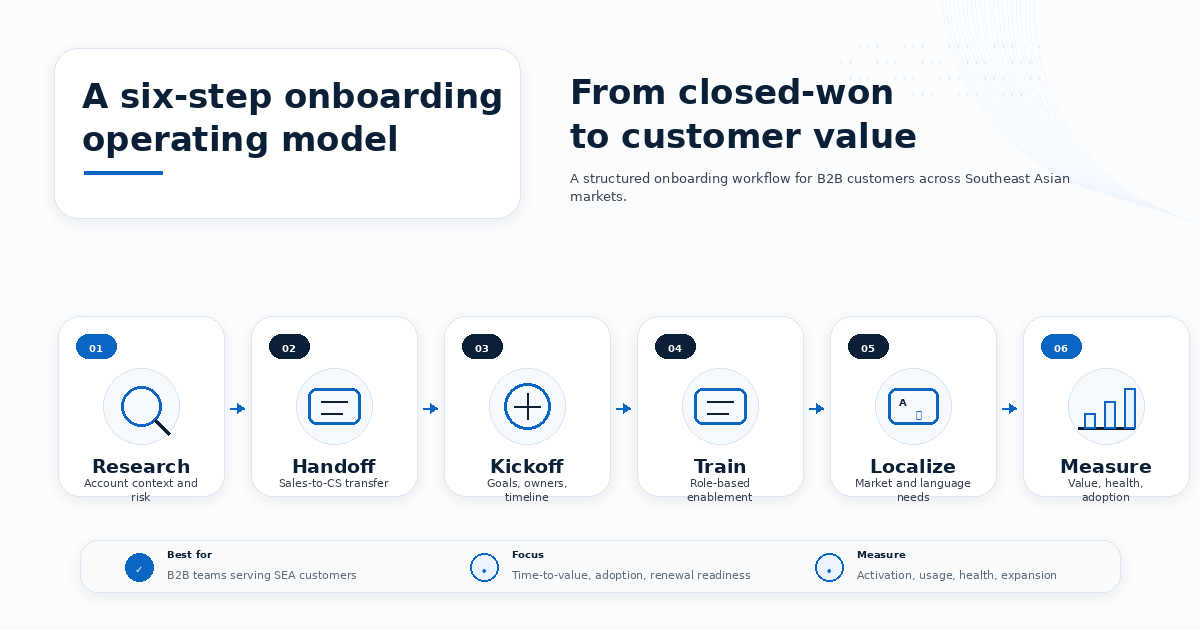
Customer Onboarding Operating Model for Southeast Asia
Use this six-step model.
Step 1 — Research
Understand the account, market, stakeholders, business goals, risks, language needs, and support expectations.
Step 2 — Handoff
Transfer sales context into customer success, implementation, support, and account management.
Step 3 — Kickoff
Confirm success criteria, stakeholders, timeline, responsibilities, and first value milestone.
Step 4 — Train
Deliver role-based enablement for champions, users, admins, managers, and approvers.
Step 5 — Localize
Adapt materials, support, communication, and rollout by market or local team.
Step 6 — Measure
Track time-to-value, adoption, usage, customer health, risk, and expansion readiness.
Common Onboarding Mistakes to Avoid
Mistake 1 — Treating Onboarding as Admin
Onboarding is not only setup.
It is the first proof that your company can deliver.
Mistake 2 — Weak Sales Handoff
If the CS team does not understand why the customer bought, onboarding starts from zero.
Mistake 3 — No First Value Milestone
Customers need to see progress early.
Mistake 4 — One Training for Everyone
Executives, admins, users, IT, and finance do not need the same training.
Mistake 5 — No Localization
Global onboarding materials may not work equally across Southeast Asian teams.
Mistake 6 — No Customer Health Tracking
By the time renewal risk is obvious, it may already be late.
Mistake 7 — Ignoring Internal Stakeholders
The champion may not be able to drive adoption alone.
Mistake 8 — Measuring Completion Instead of Value
A completed checklist is not the same as customer success.
B2B Onboarding Scorecard
Score each area from 1 to 5.
| Area | 1 — Weak | 3 — Developing | 5 — Strong |
|---|---|---|---|
| Sales handoff | Minimal notes | Basic context | Full goals, stakeholders, promises, risks |
| Kickoff | Generic welcome call | Basic kickoff agenda | Clear goals, owners, timeline, success criteria |
| First value | Undefined | Basic milestone | Specific measurable first-value outcome |
| Stakeholder mapping | Champion only | Some roles mapped | Champion, sponsor, users, IT, finance, local teams |
| Localization | Global content only | Some local context | Market-aware materials and support |
| Training | One demo | Basic training | Role-based enablement |
| Support | Reactive | Basic channels | Clear ownership, cadence, escalation |
| Adoption tracking | Checklist only | Some usage data | Activation, usage, health, risks |
| Renewal readiness | Late review | Basic QBR | Value story built from onboarding |
| Feedback loop | No review | Occasional review | Onboarding insights improve sales and GTM |
Score Interpretation
| Total Score | Recommendation |
|---|---|
| 42–50 | Strong onboarding system; optimize by market and customer segment |
| 34–41 | Good foundation; improve localization, health tracking, or role-based enablement |
| 25–33 | Onboarding exists but may not reliably support retention |
| Below 25 | Rebuild onboarding before scaling customer acquisition |
Need Help Building Customer-Ready Growth in Southeast Asia?
Expand In Asia supports B2B companies across the customer acquisition and market-entry journey, including:
- ICP and account research;
- localized buyer messaging;
- sales prospecting;
- appointment setting;
- market validation;
- pipeline reporting;
- GTM execution across Asia.
Talk to Expand In Asia about building a market-ready growth system for Southeast Asia →
15. Next Steps With Expand In Asia
A B2B customer onboarding program should not be an afterthought.
It should connect directly to your market-entry strategy.
If you are entering Southeast Asia, your onboarding program should help customers:
- understand what success looks like;
- get value quickly;
- align internal stakeholders;
- receive the right level of support;
- adopt the solution across teams;
- feel confident about renewal;
- become future expansion or referral opportunities.
For broader market-entry planning, read Go-to-Market (GTM) Strategies for Asia.
For sales-cycle and buyer enablement ideas, read How to Shorten Your B2B Sales Cycle in Singapore and SEA.
For pipeline validation before hiring locally, read The Cost of Building a Sales Team in Singapore vs. Outsourcing.
Schedule a consultation with Expand In Asia →
Ready to Implement These Strategies?
Book a free 30-minute strategy session where we’ll audit your current growth approach and identify your highest-leverage opportunities in Asian markets.
Frequently Asked Questions
1. What is B2B customer onboarding?
B2B customer onboarding is the process of guiding a new customer from contract signature to successful adoption, first value, and long-term usage. It usually includes handoff, kickoff, implementation, training, support, adoption tracking, and success planning.
2. Why is onboarding important in Southeast Asia?
Southeast Asian markets can involve multiple stakeholders, different language needs, local business practices, regional and local teams, and varied levels of digital maturity. Onboarding helps translate the sales promise into customer value.
3. How long should B2B onboarding take?
It depends on the product, service, customer size, implementation complexity, and stakeholder involvement. Many companies use a 30-60-90 day structure to manage setup, adoption, and value validation.
4. What should happen during the sales-to-CS handoff?
The handoff should include why the customer bought, success criteria, stakeholders, promises made, risks, use cases, timeline, language needs, and support expectations.
5. What is time-to-value?
Time-to-value is the time it takes for a customer to experience a meaningful first outcome after signing. A shorter time-to-value can improve confidence, adoption, and renewal readiness.
6. Should onboarding be localized?
Yes, when customers have local teams, language needs, market-specific processes, or different support expectations. Localization may include training materials, support FAQs, success plans, rollout templates, and internal enablement assets.
8. What onboarding metrics should B2B teams track?
Track kickoff completion, first value achieved, user activation, training attendance, support tickets, feature usage, stakeholder engagement, time-to-value, customer health, risk signals, and expansion opportunities.