
Why Localization Fails: Common Mistakes B2B Companies Make in Asia
Why translated content often underperforms—and what B2B teams should do instead
Many B2B companies know they need localization when expanding into Asia.
The problem is that they often define localization too narrowly.
They translate a landing page.
They change the country name.
They ask AI to rewrite the headline.
They use the same sales deck across Singapore, Indonesia, Vietnam, Japan, Korea, Thailand, and the Philippines.
Then they wonder why the campaign gets weak replies, poor meeting quality, or slow pipeline movement.
The issue is usually not that localization “doesn’t work.”
The issue is that the company translated the words but failed to localize the buyer journey.
Real localization should adapt:
- buyer pain points;
- proof;
- tone;
- content format;
- language;
- market maturity;
- sales follow-up;
- risk concerns;
- stakeholder materials;
- calls to action;
- channel strategy.
CSA Research’s “Can’t Read, Won’t Buy” research found that 76% of surveyed consumers prefer products with information in their own language, while 40% will not buy from websites in other languages. The same research reported especially strong preference for local-language product information in several Asia-Pacific markets.
For B2B teams, the point is not simply “translate everything.”
The point is:
Buyers are more likely to trust content when it feels relevant to their market, role, risk, and decision process.
This guide explains why localization fails for B2B companies in Asia and how to avoid the most common mistakes.
- TL;DR — Key Takeaways
- Localization fails when it is treated as translation only. Translation changes words. Localization changes market relevance.
- Asia is not one market. A message that works in Singapore may not work in Indonesia, Vietnam, Japan, Korea, Thailand, or the Philippines.
- B2B buyers need localized proof. Global case studies may not reduce local risk unless they are reframed properly.
- Tone matters. Some markets reward direct executive clarity; others require more trust-building, education, or relationship depth.
- Sales and marketing must align. Localized content fails when sales teams still use generic follow-up, global decks, and unclear qualification.
- Buyer enablement is often missing. Champions need localized materials to explain the decision internally.
- Measurement must go beyond traffic. Track reply quality, meetings held, sales acceptance, objections reduced, and pipeline created.
If you only do one thing: stop asking, “Did we translate the content?” Start asking, “Did we localize the decision process?”
Who This Comparison Is For (and Not For)
This Guide Is For
- B2B companies expanding across Asia.
- SaaS, cybersecurity, cloud, fintech, HR tech, healthtech, AI, data, logistics tech, and professional-services companies.
- Marketing teams adapting global content for Asian markets.
- Sales teams using localized content in outreach and follow-up.
- Founders and GTM leaders deciding where to invest in localization.
- Demand generation teams running campaigns across Southeast Asia, East Asia, or APAC.
- RevOps teams measuring conversion by market, channel, and content asset.
This guide is especially useful if your team struggles with:
- low engagement from translated campaigns;
- poor-quality meetings after localized landing pages;
- sales teams not using marketing assets;
- global case studies that do not persuade local buyers;
- confusing country-level performance;
- high interest but low conversion;
- content that sounds correct but does not feel locally relevant.
This Guide Is Not For
This guide may be less useful if:
- you only need legal or technical document translation;
- your company sells only to one highly standardized global buyer;
- your product requires no sales process or buyer education;
- your team is unwilling to adapt messaging by market;
- you want one generic “Asia” campaign for every country;
- you measure localization only by website visits or downloads.
Practical fit check: Localization should help buyers move forward—not just help them read your content.
What Localization Failure Really Means
Localization does not fail because a page was translated incorrectly.
That can happen, but it is only one type of failure.
B2B localization fails when content does not help buyers move closer to a decision.
That can show up as:
- low reply rates;
- high bounce from local landing pages;
- low webinar attendance;
- weak meeting quality;
- confused prospects;
- poor sales acceptance;
- longer sales cycles;
- repeated objections;
- low stakeholder engagement;
- deals stalling after initial interest.
Translation Accuracy vs. Buyer Relevance
| Area | Translation Accuracy | Buyer Relevance |
|---|---|---|
| Language | Are the words correct? | Does the message feel natural and credible? |
| Offer | Is the offer described? | Is the offer connected to a real local problem? |
| Proof | Is the case study translated? | Does the proof reduce local buyer risk? |
| CTA | Is the CTA readable? | Is the next step appropriate for buyer readiness? |
| Sales use | Can reps share the asset? | Does the asset help move the opportunity forward? |
A translated message can be accurate and still underperform.
That is the real localization problem.

Mistake 1 — Treating Localization as Translation Only
This is the most common mistake.
The company translates the words but keeps everything else the same.
Same headline.
Same examples.
Same CTA.
Same proof.
Same tone.
Same sales deck.
Same follow-up.
The result is content that is understandable but not persuasive.
Why It Fails
Translation alone does not answer:
- Why should this buyer care now?
- Is this relevant in their country?
- Have companies like them solved this problem?
- Is the vendor credible locally?
- What risk will this create internally?
- Who needs to approve this?
- What proof will satisfy finance, IT, legal, or procurement?
What to Do Instead
Localize at five levels:
- Language — make the content understandable.
- Market context — make the issue locally relevant.
- Buyer role — make the message persona-specific.
- Proof — make the evidence credible.
- Sales path — make the next step realistic.
Example
Weak localization:
“Improve your sales productivity with our platform.”
Stronger localization for a Singapore-based regional sales leader:
“Help your Singapore-based team create more predictable regional pipeline before adding full local headcount across ASEAN.”
Stronger localization for an Indonesian local-market buyer:
“Support local market development with relationship-led outreach, Bahasa-ready communication, and practical follow-up that builds buyer trust.”
Same category.
Different buyer logic.
Mistake 2 — Using One “Asia” Message Everywhere
Asia is too broad for one message.
A campaign that works in Singapore may not work in Japan.
A tone that works in the Philippines may not work in Korea.
A proof point that works in India may not work in Vietnam.
A CTA that works in Australia may not work in Indonesia.
Why It Fails
One “Asia” message usually ignores:
- language differences;
- business culture;
- buying hierarchy;
- category maturity;
- local proof expectations;
- economic context;
- procurement norms;
- channel preferences;
- speed of decision-making.
Gartner describes modern B2B buying as nonlinear, with buyers moving through tasks such as problem identification, solution exploration, requirements building, and supplier selection across digital and human interactions.
That means localized content should support the buying process—not only the first click.
What to Do Instead
Build country-level messaging layers.
| Layer | What to Localize |
|---|---|
| Regional theme | Overall business problem |
| Country angle | Local market context |
| Persona message | Buyer-specific pain |
| Proof | Local or comparable evidence |
| CTA | Next step based on readiness |
| Follow-up | Sales sequence and content path |
Practical Rule
Use regional themes, but execute by country.
Mistake 3 — Ignoring Market Maturity
Not every Asian market has the same category awareness.
In one market, buyers may already understand the solution.
In another market, they may need education before they can evaluate it.
Why It Fails
If buyers do not understand the category, a product demo CTA may be too early.
If buyers already understand the category, a basic explainer may feel too shallow.
Market Maturity Levels
| Maturity Level | Buyer Need | Useful Content |
|---|---|---|
| Low awareness | Understand the problem | Explainers, guides, checklists |
| Problem-aware | Understand options | Comparison articles, frameworks |
| Solution-aware | Evaluate vendors | Case studies, ROI tools, demos |
| Purchase-ready | Reduce risk | FAQs, implementation plans, procurement support |
What to Do Instead
Match content to buyer maturity.
For example:
- Vietnam may require more practical education for some B2B categories.
- Singapore may require more concise business-case and comparison content.
- Indonesia may require more trust-building and local-language credibility.
- Japan and Korea may require stronger local proof, partnership, and stakeholder alignment depending on the category.
Do not assume every market is at the same stage of readiness.
Mistake 4 — Using Proof That Does Not Travel
A global case study may look impressive to your team.
But to a local buyer, it may not answer the most important question:
“Will this work here?”
Why It Fails
Global proof may not reduce local risk if:
- the industry is different;
- the company size is different;
- the buyer maturity is different;
- the market context is different;
- implementation requirements are different;
- the buyer cannot relate to the example.
What to Do Instead
Use a proof hierarchy.
| Proof Type | Strength |
|---|---|
| Same country, same industry | Strongest |
| Same country, adjacent industry | Strong |
| Same region, same industry | Strong |
| Similar market maturity | Useful |
| Global enterprise case study | Useful, but needs reframing |
| Product claims only | Weak |
Reframing Example
Instead of saying:
“We helped a US enterprise increase pipeline by 40%.”
Say:
“While this example is from a US enterprise, the relevant lesson for Singapore-based regional teams is the operating model: clear ICP definition, dedicated outbound capacity, and consistent meeting qualification before hiring country-level sales reps.”
The same proof becomes more useful when it is framed around the buyer’s local decision.
Mistake 5 — Localizing Marketing but Not Sales Follow-Up
This mistake is extremely common.
Marketing creates localized landing pages, ads, or webinars.
Then sales follows up with a generic global deck.
The buyer notices the disconnect.
Why It Fails
The campaign creates interest, but the sales process does not continue the local relevance.
This can lead to:
- weaker meeting conversion;
- lower trust;
- repeated questions;
- poor handoff;
- confused prospects;
- stalled deals.
What to Do Instead
Localize the sales motion too.
Sales teams need:
- localized email follow-ups;
- country-specific discovery questions;
- localized sales decks;
- local or regional proof slides;
- localized objection handling;
- buyer enablement assets;
- CRM fields for country-level feedback.
Sales Follow-Up Checklist
Before launching a localized campaign, prepare:
- first-touch message;
- follow-up sequence;
- local sales deck;
- proof asset;
- FAQ;
- objection tracker;
- qualification criteria;
- handoff notes template;
- next-step CTA.
Localization is not complete until sales can continue the conversation properly.
Mistake 6 — Missing the Buying Committee
Many localization efforts focus on the visible lead.
But B2B purchases are often influenced by multiple stakeholders.
A local manager may care about usability.
Finance may care about ROI.
IT may care about security.
Legal may care about data handling.
Procurement may care about vendor process.
A regional leader may care about scalability.
Why It Fails
If content speaks only to one person, it may not help the buyer get internal support.
The lead may like the solution but fail to build consensus.
What to Do Instead
Create stakeholder-specific content.
| Stakeholder | Localized Content Need |
|---|---|
| CEO / founder | Strategic value and growth logic |
| CFO / finance | ROI, cost, budget justification |
| IT / security | Security, integration, data handling |
| Operations | Workflow impact and implementation |
| Sales / marketing | Pipeline, conversion, execution support |
| Procurement | Vendor process and commercial clarity |
| Champion | Internal business-case summary |
Practical Rule
Do not only localize for the person who fills out the form.
Localize for the people who influence the decision.
Mistake 7 — Keeping the Same CTA Everywhere
The same call to action does not work equally in every market.
“Book a demo” may work when buyers already understand the category.
It may fail when buyers need education, trust, or internal alignment first.
Why It Fails
A CTA can feel too early, too vague, too aggressive, or too low-value.
What to Do Instead
Match the CTA to market readiness.
| Buyer Readiness | Better CTA |
|---|---|
| Low awareness | Download a guide or attend a webinar |
| Problem-aware | Compare approaches or review a checklist |
| Solution-aware | Join a diagnostic or consultation |
| Purchase-ready | Book a demo or proposal discussion |
| Enterprise account | Schedule an account-specific strategy session |
CTA Examples
For Singapore:
“Compare your regional pipeline assumptions.”
For Indonesia:
“Explore whether this applies to your local market.”
For Vietnam:
“Download the implementation checklist.”
For the Philippines:
“Assess whether your team has repeatable demand before hiring locally.”
Each CTA reduces friction differently.
Mistake 8 — Overlooking Tone and Trust Signals
Tone is not cosmetic.
It affects trust.
A message can be grammatically correct and still feel wrong.
Why It Fails
Poor tone can make content feel:
- too aggressive;
- too casual;
- too vague;
- too global;
- too transactional;
- too unfamiliar;
- too vendor-centric.
What to Do Instead
Adapt tone by market, buyer seniority, and channel.
Tone Examples
| Market / Context | Better Tone |
|---|---|
| Singapore executive buyer | Clear, concise, commercial |
| Indonesia local buyer | Respectful, trust-building, patient |
| Vietnam education-led campaign | Practical, explanatory, implementation-focused |
| Japan enterprise buyer | Precise, credible, low-hype |
| Philippines mid-market buyer | Practical, warm, business-outcome focused |
| Australia / New Zealand buyer | Direct, evidence-based, straightforward |
Tone should support the buyer’s comfort level.
Mistake 9 — Measuring the Wrong Things
Localization teams often measure the wrong success signals.
They track traffic, downloads, or translation completion.
Those metrics are useful, but not enough.
Why It Fails
A localized page can get traffic but generate poor pipeline.
A webinar can get registrations but weak sales acceptance.
A translated deck can be used by sales but fail to reduce objections.
What to Do Instead
Measure business outcomes.
Better Localization Metrics
| Metric | Why It Matters |
|---|---|
| Country-level engagement | Shows market interest |
| Positive reply quality | Shows message relevance |
| Meetings held | Shows buyer commitment |
| Sales acceptance | Shows lead quality |
| Objection reduction | Shows content usefulness |
| Opportunity creation | Shows commercial potential |
| Pipeline influenced | Shows revenue relevance |
| Content-assisted deals | Shows sales enablement value |
DeepL’s 2024 localization report found that 96% of surveyed respondents reported positive ROI from localization, with 65% reporting 3x ROI or greater.
The lesson is not that localization automatically works. It is that localization needs to be connected to business outcomes.
Mistake 10 — Localizing Once and Never Updating
Markets change.
Buyer objections change.
Competitors change.
Regulations change.
Pricing expectations change.
New proof becomes available.
Sales teams learn better messages.
If localization is treated as a one-time project, it becomes stale.
What to Do Instead
Create a feedback loop.
Every month or quarter, review:
- which messages worked;
- which markets responded;
- which objections repeated;
- which content sales used;
- which assets influenced meetings;
- which buyer roles converted;
- which proof gaps remained.
Localization Feedback Loop
- Launch localized campaign.
- Track engagement and replies.
- Collect sales objections.
- Review meeting quality.
- Update content and follow-up.
- Test again.
- Scale only what works.
Localization should improve as your market learning improves.
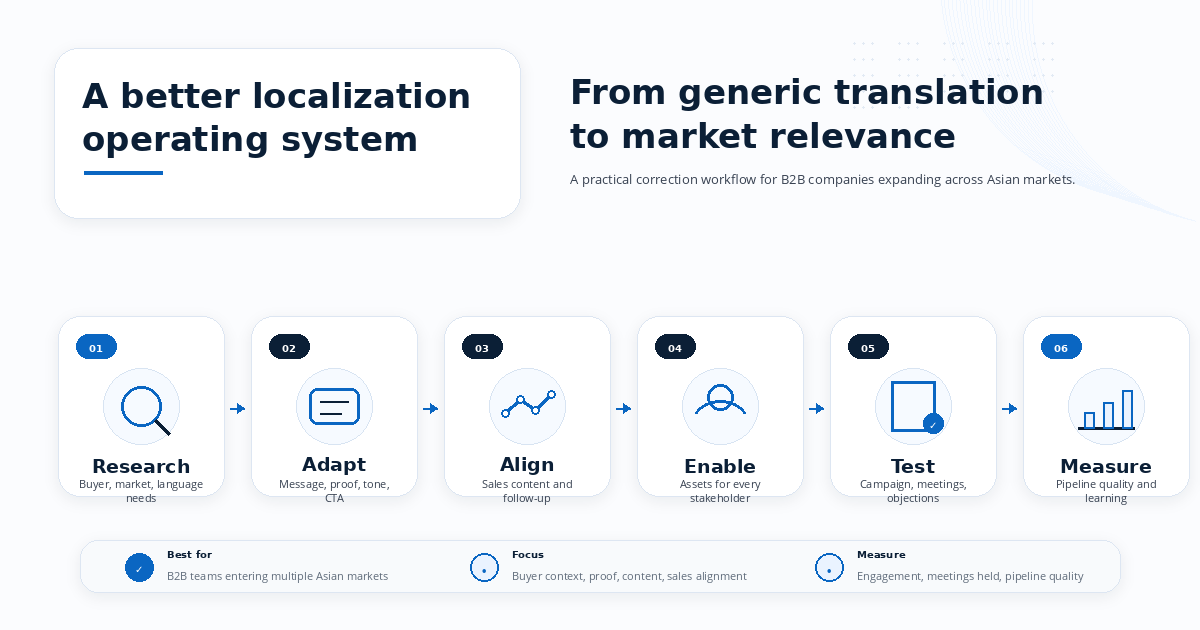
A Better Localization Operating System
Instead of treating localization as a content task, treat it as a GTM operating system.
Step 1 — Research
Understand:
- buyer roles;
- market maturity;
- language needs;
- local proof gaps;
- buying committee;
- competitive context;
- preferred channels.
Step 2 — Adapt
Adjust:
- message;
- tone;
- proof;
- CTA;
- content format;
- sales follow-up;
- stakeholder materials.
Step 3 — Align
Make sure sales and marketing are using the same localized logic.
Step 4 — Enable
Create assets for each stage:
- awareness;
- qualification;
- discovery;
- objection handling;
- internal approval;
- procurement.
Step 5 — Test
Run campaigns by country, segment, and persona.
Step 6 — Measure
Track:
- engagement;
- meetings held;
- sales acceptance;
- opportunity creation;
- objection reduction;
- pipeline influenced.
Step 7 — Improve
Update content based on real market feedback.
Localization Failure Scorecard
Score each area from 1 to 5.
| Area | 1 — Weak | 3 — Developing | 5 — Strong |
|---|---|---|---|
| Language fit | Global English only | Some translated assets | Country-specific language strategy |
| Market context | Generic Asia message | Some country references | Clear country-level positioning |
| Buyer insight | Broad persona assumptions | Basic role mapping | Stakeholder-specific messaging |
| Proof | Global proof only | Regional examples | Local, regional, or highly comparable proof |
| Tone | Same voice everywhere | Some tone changes | Market-appropriate tone and CTA |
| Sales alignment | Marketing-only localization | Sales uses some assets | Localized sales follow-up and handoff |
| Buyer enablement | Demo only | Basic one-pager | Role-specific assets for internal approval |
| Measurement | Traffic only | Leads and engagement | Sales acceptance, pipeline, objections reduced |
| Feedback loop | No update rhythm | Occasional updates | Continuous improvement from sales feedback |
| Channel fit | Same channel mix everywhere | Some channel testing | Country-specific channel strategy |
Score Interpretation
| Total Score | Recommendation |
|---|---|
| 42–50 | Strong localization system; optimize by market and segment |
| 34–41 | Good foundation; improve proof, sales alignment, or measurement |
| 25–33 | Localization exists but may not support conversion strongly |
| Below 25 | Rebuild localization strategy before scaling campaigns |
Need Help Fixing Localization Across Asian Markets?
Expand In Asia helps B2B companies adapt go-to-market content and sales execution for Asian markets through:
- ICP and buyer research;
- country-specific messaging;
- localized LinkedIn and email outreach;
- sales enablement assets;
- appointment setting;
- campaign feedback;
- market-level pipeline reporting.
Talk to Expand In Asia about improving your localization strategy for Asia →
Next Steps With Expand In Asia
Localization fails when it stops at language.
It works better when it supports the full buyer journey.
For B2B companies expanding across Asia, the goal is not to sound local for the sake of it.
The goal is to help buyers understand:
- why the problem matters in their market;
- why your solution is relevant;
- why your proof is credible;
- why the timing makes sense;
- why the next step is low-risk;
- why the internal business case is worth supporting.
For deeper context, read:
Content Localization vs. Translation
For broader market-entry planning, read:
Go-to-Market (GTM) Strategies for Asia
Schedule a consultation with Expand In Asia →
Ready to Implement These Strategies?
Book a free 30-minute strategy session where we’ll audit your current growth approach and identify your highest-leverage opportunities in Asian markets.
Frequently Asked Questions
1. Why does localization fail?
Localization usually fails when companies translate words but do not adapt market context, buyer pain, proof, tone, CTA, sales follow-up, or buyer enablement. The content may be readable but not persuasive.
2. Is localization the same as translation?
No. Translation changes language. Localization adapts the message, proof, examples, sales process, and buyer journey for a specific market.
3. Why is localization important for B2B companies in Asia?
Asia includes many different markets with different languages, business cultures, buying committees, trust expectations, and levels of category maturity. A generic message often underperforms.
4. What is the biggest B2B localization mistake?
The biggest mistake is treating localization as a marketing asset project instead of a go-to-market process. Sales follow-up, proof, buyer enablement, and measurement must be localized too.
5. Should all content be localized?
Not immediately. Start with content closest to conversion: landing pages, outreach sequences, sales decks, case studies, FAQs, ROI materials, and buyer enablement assets.
6. How do you measure localization success?
Track country-level engagement, positive reply quality, meetings held, sales acceptance, opportunity creation, pipeline influenced, objections reduced, and content-assisted deals.
7. How often should localized content be updated?
Review localized content at least quarterly, or more often during active market-entry campaigns. Sales feedback, objections, competitor changes, and new proof should guide updates.