Account-Based Selling (ABS) for B2B Companies in Asia: A Practical Guide
How to focus sales effort on the right accounts, right stakeholders, and right expansion opportunities
Many B2B companies entering Asia make the same mistake.
They treat the market like a large contact database.
They build big prospect lists, send broad outreach, book a few meetings, and hope that enough activity turns into pipeline.
Sometimes it works.
More often, it creates noise.
The harder truth is that many Asian B2B opportunities are not won by reaching one contact. They are won by understanding the account.
That means knowing:
- why the company is a strong fit;
- who influences the decision;
- which local or regional team owns the problem;
- what internal priorities matter;
- what risk the buyer is trying to reduce;
- which proof points will build confidence;
- how to stay relevant across the buying committee.
This is where account-based selling, or ABS, becomes useful.
ABS is a focused sales approach where your team prioritises high-value target accounts, maps the stakeholders inside those accounts, and creates coordinated sales engagement around the account’s specific business context.
For B2B companies selling into Singapore, ASEAN, India, Japan, Korea, Australia, or wider Asia-Pacific, ABS can be especially valuable because buying decisions are often relationship-driven, committee-based, and shaped by local context.
Gartner describes modern B2B buying as nonlinear, with buyers moving through buying tasks such as problem identification, solution exploration, requirements building, and supplier selection—often revisiting earlier stages as internal stakeholders get involved. That is exactly why selling to one contact is often not enough.
- TL;DR — Key Takeaways
- Account-based selling focuses on accounts, not isolated leads. The goal is to win the right companies by understanding their business context and buying group.
- ABS is especially useful in Asia when deals are strategic, complex, relationship-led, or multi-stakeholder.
- Start with account selection. Not every company deserves an account-based motion.
- Map the buying committee early. Hidden buyers, influencers, procurement, finance, technical evaluators, and regional leaders can shape the decision.
- Personalisation should be account-specific, not superficial. Mentioning a prospect’s job title is not enough.
- ABS works best when sales, marketing, SDR/BDR, and leadership are aligned around the same target accounts.
- Measure account engagement and pipeline quality, not just meetings booked.
- The strongest ABS model in Asia is usually multichannel. LinkedIn, email, phone, referrals, events, webinars, partners, and content can all support the account journey.
If you only do one thing: choose fewer accounts and engage them more intelligently.
Who This Comparison Is For (and Not For)
This Guide Is For
- B2B companies entering or expanding across Asia.
- SaaS, cybersecurity, cloud, fintech, HR tech, healthtech, managed services, data, AI, and professional-services companies.
- Sales teams pursuing mid-market, enterprise, or strategic accounts.
- Founders selling into high-value accounts where trust and relevance matter.
- CROs and sales directors building regional pipeline in Singapore, ASEAN, India, Japan, Korea, or wider APAC.
- SDR and BDR teams that need to move beyond generic lead generation.
- Marketing teams supporting strategic account engagement with content, webinars, events, or paid campaigns.
- RevOps teams improving CRM structure, account scoring, and sales-marketing alignment.
This guide is especially useful if your team struggles with:
- too many low-fit meetings;
- one contact per account;
- deals stalling after the first conversation;
- weak account research;
- generic messaging across different countries;
- no visibility into buying committees;
- difficulty expanding from one market into another.
This Guide Is Not For
This guide may be less useful if:
- your product is very low-ticket and transactional;
- your sales motion is fully self-serve;
- your market requires only high-volume lead capture;
- you have no defined ICP;
- your team cannot support personalised outreach;
- your CRM cannot track accounts and contacts properly;
- you expect one message to work across all Asian markets;
- your team is not prepared to coordinate sales and marketing.
Practical fit check: ABS is best when the account is valuable enough to justify deeper research, multithreaded engagement, and tailored follow-up.
What Account-Based Selling Means
Account-based selling is a sales strategy where your team focuses on a defined set of target accounts rather than trying to pursue every possible lead.
Instead of asking:
“Who replied to our campaign?”
ABS asks:
“Which accounts are worth winning, who matters inside them, and what is the best way to create a relevant buying conversation?”
In Practice, ABS Means
- selecting priority accounts;
- researching business context;
- identifying decision-makers and influencers;
- engaging multiple stakeholders;
- tailoring messaging to account priorities;
- coordinating sales and marketing touchpoints;
- tracking account-level engagement;
- expanding from first meeting to opportunity.
ABS is not just personalisation.
It is account strategy.
ABS vs. ABM vs. Traditional Lead Generation
ABS is often discussed alongside ABM, or account-based marketing.
They are related, but not identical.
| Approach | Primary Focus | Typical Owner | Main Output |
|---|---|---|---|
| Traditional lead generation | Individual leads | Marketing / SDR | Contacts, MQLs, meetings |
| ABM | Target-account awareness and engagement | Marketing + sales | Account engagement and demand |
| ABS | Strategic sales engagement into target accounts | Sales + SDR/BDR + leadership | Qualified opportunities and revenue |
| Account-based GTM | Full-funnel account growth | Sales, marketing, CS, leadership | Pipeline, revenue, expansion |
Demandbase’s 2025 State of ABM report positions ABM around account focus, AI, hyper-personalisation, and cross-functional alignment for revenue outcomes. ITSMA also describes itself as having formalised and promoted ABM in 2003, and continues to focus on account-based marketing excellence, benchmarks, and training.
Simple Difference
- ABM warms and influences the account.
- ABS sells into the account.
- Account-based GTM connects both.
For companies entering Asia, ABS and ABM often work best together.
Why ABS Matters in Asian Market Expansion
Asia is not one sales market.
A target account in Singapore may be a regional headquarters.
A buyer in Indonesia may require local trust and relationship-building.
A Japanese enterprise account may involve a longer consensus-building process.
A Vietnamese or Philippine opportunity may require education and stakeholder alignment.
A multinational account may have local users but regional or global approval.
ABS helps because it forces your team to study the account before trying to sell into it.
ABS Is Useful When
- the deal size is meaningful;
- multiple stakeholders are involved;
- local proof matters;
- trust must be built before the sale;
- the buyer has regional complexity;
- outbound response rates are low;
- a single contact cannot move the deal alone.
LinkedIn and Edelman’s 2025 research highlights the importance of “hidden buyers,” noting that hidden buyers can influence B2B purchases even when they are not the obvious target contact. The report says 56% of target buyers and 55% of hidden buyers use thought leadership during vendor evaluation.
That supports a core ABS principle:
You are not selling to one person. You are influencing the account.
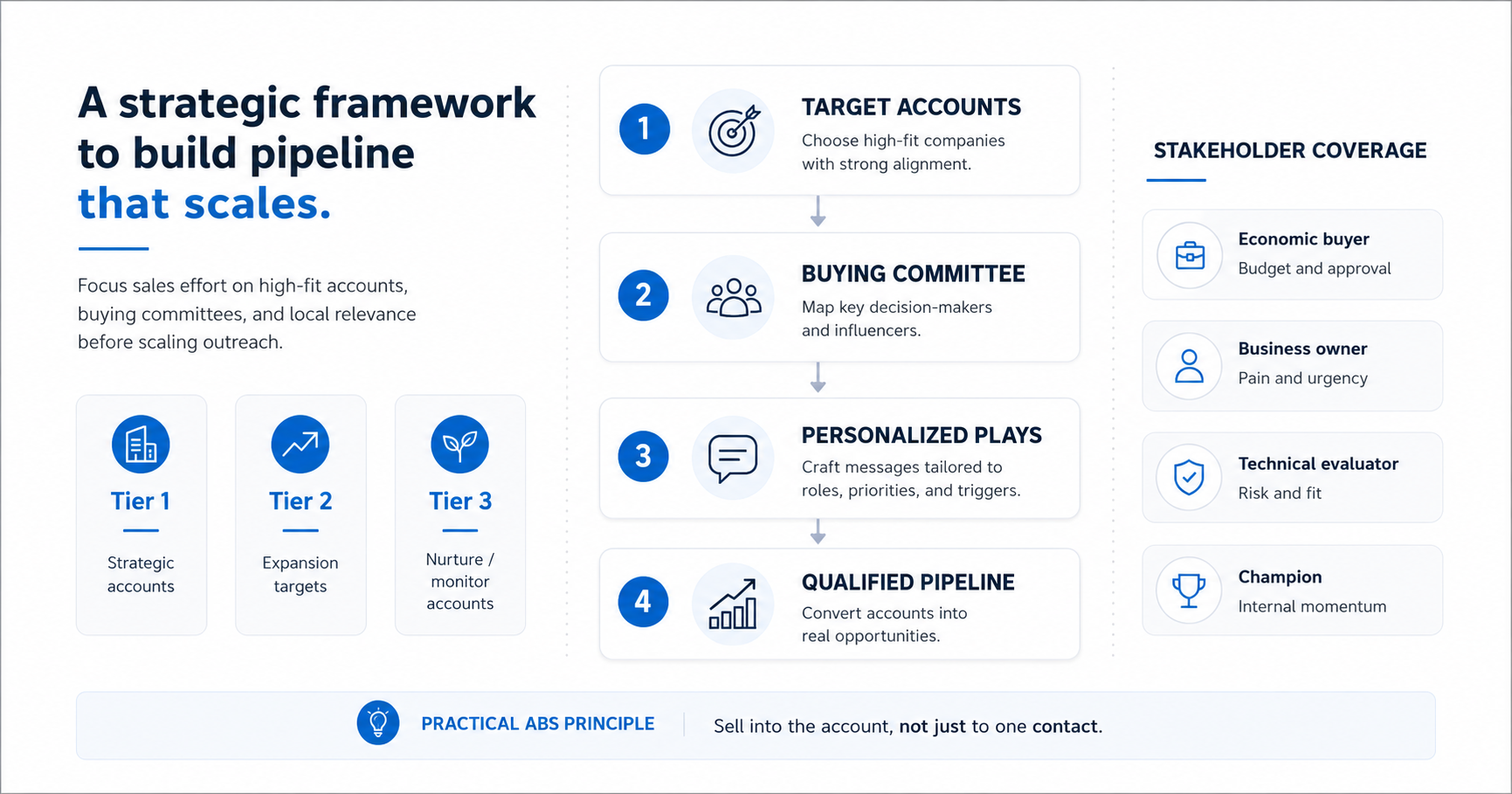
Step 1 — Select the Right Target Accounts
ABS starts with account selection.
Do not apply account-based selling to every company in your database.
It requires more research, more coordination, and more personalisation. Use it where the potential value justifies the effort.
Account Selection Criteria
| Criterion | Questions to Ask |
|---|---|
| ICP fit | Does the company match your ideal customer profile? |
| Market relevance | Is the company in a priority Asian market? |
| Commercial value | Is the account valuable enough for deeper engagement? |
| Problem fit | Does the company likely have the pain you solve? |
| Buyer accessibility | Can stakeholders be identified and reached? |
| Trigger event | Is there a reason to engage now? |
| Regional complexity | Does the account have multi-country relevance? |
| Proof fit | Do you have examples or use cases that will resonate? |
| Expansion potential | Could this account grow over time? |
Strong ABS Account Example
Singapore-based regional SaaS company with 300 employees, expanding into ASEAN, hiring sales roles, and likely needing scalable outbound pipeline support.
Weak ABS Account Example
Small, low-budget company with no clear trigger, no strategic value, and no identifiable decision-maker.
The first account may justify personalised research.
The second probably belongs in a lighter nurture or broad outbound motion.
Step 2 — Tier Your Accounts by Strategic Value
Not every target account should receive the same level of effort.
Use tiers.
Account Tiering Model
| Tier | Description | Recommended Approach |
|---|---|---|
| Tier 1 | Highest-value strategic accounts | Deep research, multithreaded outreach, leadership involvement |
| Tier 2 | Strong-fit accounts with good potential | Persona-specific outreach and moderate personalisation |
| Tier 3 | Broad-fit accounts | Scaled outreach, light personalisation, nurture |
Tier 1 Accounts
Use for:
- enterprise targets;
- high-value SaaS buyers;
- regional headquarters;
- strategic partners;
- named accounts;
- companies with strong trigger events.
Tier 2 Accounts
Use for:
- mid-market accounts;
- strong ICP fits;
- accounts with some trigger signals;
- accounts worth personalised outreach but not full account plans.
Tier 3 Accounts
Use for:
- lighter campaigns;
- content nurture;
- event invitations;
- early market testing;
- future pipeline.
Tiering helps your team avoid over-investing in weak accounts and under-investing in important ones.
Step 3 — Map the Buying Committee
One of the biggest ABS mistakes is focusing on only one contact.
Complex B2B buying often involves multiple people.
Buying Committee Roles
| Role | What They Care About |
|---|---|
| Economic buyer | Budget, ROI, strategic fit |
| Business owner | Problem, results, operational impact |
| Technical evaluator | Implementation, security, integration |
| Procurement | Vendor process, price, terms |
| Legal / compliance | Risk, contracts, data handling |
| Champion | Internal momentum and advocacy |
| Executive sponsor | Priority and political support |
| Hidden buyer | Internal influence, risk perception, consensus |
Gartner’s buying journey guidance notes that multiple stakeholder concerns add complexity to the buyer journey and that CSOs and CMOs need to simplify the buying experience.
What to Map
For each priority account, identify:
- who owns the business problem;
- who controls budget;
- who evaluates risk;
- who may block the deal;
- who could become a champion;
- who has regional influence;
- who needs education before sales involvement.
Practical Rule
For Tier 1 accounts, do not stop at one contact.
Aim to map at least:
- one senior decision-maker;
- one business owner;
- one technical or operational evaluator;
- one possible champion;
- one referral path.
Step 4 — Build Account Intelligence
Good ABS depends on account intelligence.
This means gathering useful context before outreach.
Account Intelligence Sources
- company website;
- LinkedIn company page;
- executive profiles;
- job postings;
- funding announcements;
- press releases;
- event participation;
- annual reports;
- partner pages;
- technology stack;
- local market news;
- competitor activity;
- CRM history;
- referral network.
What to Capture
| Field | Why It Matters |
|---|---|
| Company priorities | Helps shape business relevance |
| Market presence | Clarifies local vs regional scope |
| Recent triggers | Creates a reason to engage |
| Buying roles | Helps multithreading |
| Current initiatives | Shows potential timing |
| Local proof need | Identifies credibility gaps |
| Potential pain | Guides messaging |
| Existing relationships | Finds referral paths |
| Competitor presence | Shapes positioning |
| Expansion potential | Supports account value |
Example Account Insight
The company opened a Singapore office, is hiring regional sales roles, and recently announced Southeast Asia expansion. Likely needs pipeline generation, partner development, and local market validation before scaling headcount.
That insight is far stronger than:
“They are a tech company in Singapore.”
Step 5 — Create Account-Specific Messaging
Personalisation is often misunderstood.
Weak personalisation says:
“I saw your LinkedIn profile and was impressed by your experience.”
Strong account-specific messaging says:
“Noticed your team is building regional sales coverage from Singapore. At that stage, many B2B companies need to validate which ASEAN markets produce qualified pipeline before hiring country-level sales teams.”
ABS Messaging Formula
Use:
Account context → likely business issue → relevant perspective → low-friction next step
Example
Hi Sarah, noticed your team is hiring regional commercial roles from Singapore.
We often see B2B companies at that stage generate early referrals in Asia but struggle to turn that into repeatable pipeline by country.
We help teams validate priority accounts, run localised outreach, and qualify meetings before they commit to full local headcount.
Would comparing your current Asia pipeline assumptions with what we are seeing across similar companies be useful?
What Makes It Work
The message:
- references account context;
- does not over-assume;
- provides a market perspective;
- connects to a business issue;
- uses a low-friction CTA.
Step 6 — Run Multithreaded Engagement
ABS is not one message to one person.
It is coordinated engagement across multiple stakeholders.
Multithreaded Engagement Channels
| Channel | Role |
|---|---|
| Visibility, research, warm-up, executive access | |
| Structured communication and follow-up | |
| Phone | Qualification and clarification |
| Webinars | Education and multi-person engagement |
| Events | Trust-building and relationship development |
| Referrals | Credibility and access |
| Partner outreach | Local context and introductions |
| Thought leadership | Influence visible and hidden buyers |
Example Multithreaded Play
For a Tier 1 account:
- research the account;
- map five stakeholders;
- engage with two people on LinkedIn;
- send tailored email to the business owner;
- connect with a possible champion;
- invite relevant stakeholders to a webinar;
- use a regional insight post to build familiarity;
- call or email the most relevant contact;
- ask for the correct decision path;
- capture all engagement in CRM.
Why Multithreading Works
It reduces dependence on one champion.
It also helps you learn:
- who cares about the issue;
- who has authority;
- who influences risk;
- who needs proof;
- who can move the account forward.
Step 7 — Use Content and Thought Leadership to Influence Hidden Buyers
In Asia, some of the most important buying influence may happen outside the sales conversation.
A finance leader may question the business case.
A technical evaluator may worry about implementation.
A regional leader may ask whether the solution works across countries.
A hidden influencer may compare vendors without ever replying to outreach.
Thought leadership helps shape that internal conversation.
LinkedIn and Edelman’s research found that hidden buyers are less likely to take sales meetings or follow brands than target buyers, which makes broader thought leadership and awareness important for influencing buying groups.
Useful Content for ABS
- industry-specific guides;
- regional market insights;
- buyer checklists;
- ROI frameworks;
- implementation playbooks;
- comparison articles;
- event recaps;
- case studies;
- stakeholder FAQs;
- executive summaries.
Content by Stakeholder
| Stakeholder | Useful Content |
|---|---|
| CEO / founder | Strategic value and market opportunity |
| CFO | ROI, cost of inaction, budget logic |
| COO | Process impact and operational efficiency |
| CIO / CTO | Security, integration, implementation |
| Country manager | Local execution and market fit |
| Procurement | Vendor process, proof, risk mitigation |
| Champion | Internal business case materials |
ABS works better when every stakeholder has content that speaks to their concern.
Step 8 — Qualify Account-Level Opportunity
Traditional qualification often focuses on one person.
ABS qualification focuses on the account.
Account-Level Qualification Areas
| Area | Question |
|---|---|
| Account fit | Is this company worth pursuing? |
| Buying group | Have we identified the right stakeholders? |
| Problem fit | Is there a meaningful business issue? |
| Urgency | Is there a reason to act now or soon? |
| Commercial fit | Can the account support the investment? |
| Decision path | Do we understand the process? |
| Proof required | What evidence is needed to reduce risk? |
| Expansion potential | Can the account grow over time? |
Account Qualification Signal
A strong ABS opportunity is not simply:
“One person replied.”
It is:
“A high-fit account has a relevant problem, identifiable stakeholders, credible urgency, and a realistic next step.”
Step 9 — Coordinate Sales, Marketing, and Leadership
ABS fails when teams work separately.
Sales targets one account.
Marketing promotes a generic campaign.
Leadership has no visibility.
SDRs are measured only on meetings.
AEs reject poor-fit handoffs.
CRM data is incomplete.
That is not ABS.
Team Responsibilities
| Function | Role in ABS |
|---|---|
| Sales leadership | Account selection, strategy, commercial ownership |
| Marketing | Content, awareness, ads, webinars, stakeholder education |
| SDR / BDR | Research, outreach, engagement, meeting qualification |
| AE / Founder | Discovery, business case, proposal, closing |
| RevOps | CRM, account scoring, reporting, attribution |
| Customer success | Expansion signals, references, retention insights |
Weekly ABS Review
Review:
- account engagement;
- stakeholder coverage;
- meetings held;
- objections;
- content engagement;
- next steps;
- opportunity stage;
- risk;
- expansion potential.
Demandbase’s ABM materials emphasise cross-functional alignment and breaking through departmental silos as important parts of modern account-based execution.
Step 10 — Measure Account-Based Selling Performance
ABS should be measured differently from volume-based outreach.
Activity Metrics
- accounts researched;
- stakeholders mapped;
- contacts engaged;
- content sent;
- messages delivered;
- calls completed.
Engagement Metrics
- account engagement score;
- stakeholder response;
- target-account website visits;
- content engagement;
- event attendance;
- webinar attendance;
- LinkedIn engagement.
Sales Metrics
- qualified meetings;
- sales-accepted opportunities;
- opportunity value;
- stage progression;
- pipeline generated;
- win rate;
- deal cycle length;
- expansion pipeline.
Coverage Metrics
- number of stakeholders per account;
- decision roles identified;
- champion identified;
- executive sponsor identified;
- procurement process understood.
Quality Metrics
- account fit rate;
- meeting acceptance rate;
- opportunity conversion;
- disqualification reasons;
- no-decision rate.
A good ABS programme may generate fewer meetings than broad outreach, but those meetings should be more strategic and better aligned.
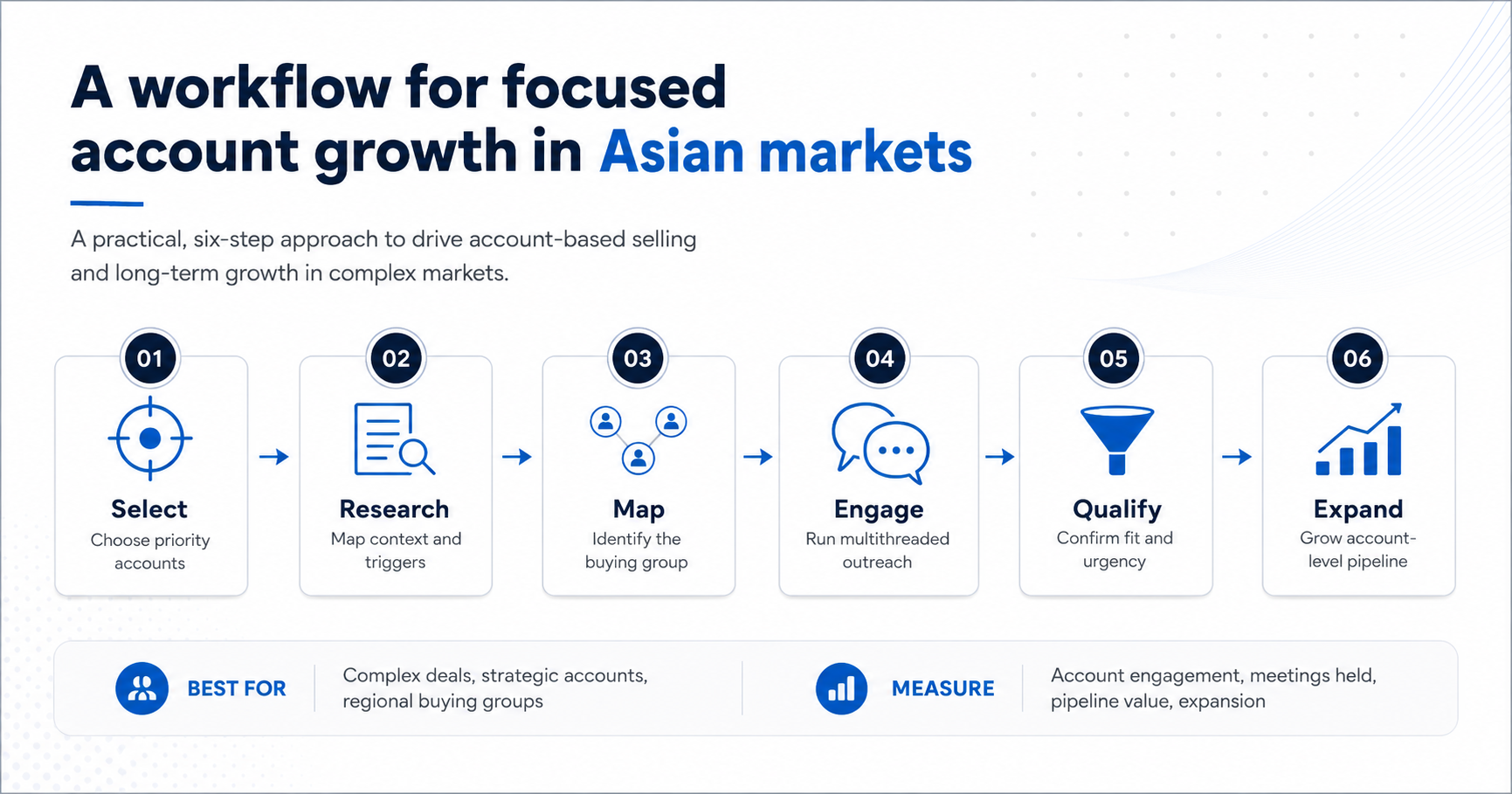
ABS Framework for B2B Companies in Asia
Use this six-step process.
Step 1 — Select
Choose the right high-fit accounts.
Step 2 — Research
Understand market context, triggers, business priorities, and account structure.
Step 3 — Map
Identify decision-makers, influencers, hidden buyers, and possible champions.
Step 4 — Engage
Use coordinated LinkedIn, email, phone, content, events, referrals, and partner channels.
Step 5 — Qualify
Confirm account fit, problem fit, urgency, decision process, and business case.
Step 6 — Expand
Grow from first opportunity to wider account penetration, referrals, and regional expansion.
Framework Summary
| Stage | Output |
|---|---|
| Select | Target-account list |
| Research | Account intelligence |
| Map | Buying committee view |
| Engage | Multichannel account activity |
| Qualify | Sales-accepted account opportunity |
| Expand | Account growth and regional pipeline |
Common Mistakes to Avoid
Mistake 1 — Calling It ABS but Still Chasing Any Reply
ABS starts with account selection, not inbox response.
Mistake 2 — Personalising Only at the Contact Level
ABS requires account-level relevance.
Mistake 3 — One Contact Per Account
This creates risk if the contact goes silent, lacks authority, or cannot influence internally.
Mistake 4 — Treating Asia as One Market
Singapore, Indonesia, Japan, Vietnam, India, Korea, and the Philippines may require different proof, messaging, and relationship-building.
Mistake 5 — No Marketing Support
Sales alone cannot always influence hidden buyers.
Mistake 6 — No Tiering
Not every account deserves deep personalisation.
Mistake 7 — Measuring Only Meetings
Track account engagement, stakeholder coverage, opportunity value, and conversion.
Mistake 8 — Weak CRM Structure
ABS requires account-level visibility, not just contact-level notes.
Mistake 9 — No Executive Involvement
Some strategic accounts require founder, CRO, or senior leader participation.
Mistake 10 — No Expansion Plan
ABS should not stop at first deal. Strategic accounts may create multi-country, multi-department, or referral opportunities.
Account-Based Selling Scorecard
Score each area from 1 to 5.
| Area | 1 — Weak | 3 — Developing | 5 — Strong |
|---|---|---|---|
| Account selection | Broad list | Basic ICP fit | High-fit, high-value target accounts |
| Tiering | No tiers | Basic priority list | Clear Tier 1, 2, and 3 treatment |
| Account research | Minimal | Some company context | Deep business, market, and trigger intelligence |
| Buying committee | One contact | Some role mapping | Multi-stakeholder map with hidden buyers |
| Messaging | Generic | Persona-based | Account-specific and market-relevant |
| Channels | One channel | Two channels | Coordinated multichannel engagement |
| Sales-marketing alignment | Separate campaigns | Shared target list | Shared account plays and content |
| CRM visibility | Contact-level only | Some account notes | Full account engagement and pipeline tracking |
| Qualification | Reply equals lead | Basic meeting fit | Account-level qualification criteria |
| Expansion | No expansion motion | Ad hoc upsell | Regional and multi-stakeholder growth plan |
Score Interpretation
| Total Score | Recommendation |
|---|---|
| 42–50 | Strong ABS foundation; ready to scale carefully |
| 34–41 | Good foundation; improve weak account coverage or alignment areas |
| 25–33 | ABS activity exists, but account strategy needs strengthening |
| Below 25 | Rebuild targeting, research, messaging, and CRM before scaling |
Need Help Building an Account-Based Selling Motion in Asia?
Expand In Asia helps B2B companies build qualified pipeline in Asia through:
- ICP definition;
- target-account selection;
- buying committee mapping;
- account research;
- LinkedIn and email outreach;
- appointment setting;
- lead qualification;
- CRM reporting;
- market feedback.
Talk to Expand In Asia about building your ABS motion in Asia →
15. Next Steps With Expand In Asia
Account-based selling is not about sending a more personalised email.
It is about building a more focused sales motion around the accounts that matter most.
For B2B companies expanding across Asia, ABS can help your team:
- focus on the right accounts;
- understand complex buying committees;
- localise messaging;
- build trust across stakeholders;
- qualify opportunities better;
- reduce wasted sales effort;
- create higher-quality pipeline.
For broader pipeline tactics, read:
10 Best B2B Qualified Lead Generation Strategies for 2026
For market-entry planning, read:
Go-to-Market (GTM) Strategies for Asia
Schedule a consultation with Expand In Asia →
Ready to Implement These Strategies?
Book a free 30-minute strategy session where we’ll audit your current growth approach and identify your highest-leverage opportunities in Asian markets.
Frequently Asked Questions
1. What is account-based selling?
Account-based selling is a sales strategy focused on winning specific high-value target accounts. Instead of pursuing every lead, the sales team selects priority accounts, researches them deeply, maps stakeholders, and creates coordinated engagement around the account’s business context.
2. Is ABS the same as ABM?
No.
ABM, or account-based marketing, is usually marketing-led and focuses on account awareness, engagement, and influence. ABS is sales-led and focuses on creating and progressing account-level opportunities. The best approach often combines both.
3. Why is ABS useful in Asia?
ABS is useful in Asia because many B2B deals involve multiple stakeholders, regional complexity, local proof, trust-building, and relationship dynamics. A one-contact sales approach often misses the real buying group.
4. Which companies should use ABS?
It depends on team capacity and deal value.
A small team may start with 25–50 Tier 1 accounts and a larger Tier 2 list. The point is to avoid selecting more accounts than the team can research, engage, and manage properly.
5. What roles should be mapped in an account?
Map the economic buyer, business owner, technical evaluator, procurement, legal or compliance, champion, executive sponsor, and hidden influencers.
6. How should ABS be measured?
Track account engagement, stakeholder coverage, meetings held, sales-accepted opportunities, pipeline value, stage progression, win rate, deal size, sales-cycle length, and expansion potential.
7. Can ABS work with outbound sales outsourcing?
Yes.
An outsourced team can support research, account mapping, LinkedIn and email outreach, appointment setting, and qualification. The internal team should still own positioning, commercial strategy, discovery, proposal, and closing.